Category Archives: Nature

Coorg Butterflies Make their Annual Tour to Silent Valley

Aralam Wild Life Sanctuary, one of the most precious evergreen forests in the state, is witnessing the breath-taking annual migration of butterflies from the Coorg hills. The wintering butterflies, mostly of Albatross species, breeze by the rivulets in the forests like gentle patch of yellow clouds, making their way to Nilambur forests and to Silent Valley, apparently guided by an unknown collective memory passed on to generations.

The amazing migration of the butterflies is better seen in the morning and when the sun gets hot by noon, they stop moving. As many as 40,000 Common Albatross butterflies can be seen in a single flock in the morning, says V C Balakrishnan of Malabar Natural History Society (MNHS) and a regular visitor at Aralam during this season. The Great Orange Tip, Lesser Gull and Plain Pussin butterflies can also be seen following the Albatross migration, he said. Many varieties of butterflies of Daniane sub species were seen congregating in the Aralam Sanctuary in the season. Lakhs of butterflies roosting on trees in the forests is a sight of a lifetime, Balakrishnan said.

Experts say that the butterfly migration through this stretch of Western Ghats is known to start from the evergreen forests in Coorg where these butterflies generally lay eggs on a particular tree locally known as Choota Maram or Asthi Maram (Drypetes Venusta). The butterflies fly through Aralam to Nilambur and to Silent Valley forests. “However, not much is known about when these butterflies would return to Coorg,” Balakrishnan said.

A group of nature lovers and butterfly enthusiasts would annually visit the sanctuary to witness the wonderful natural phenomenon every January. The Kerala Forests and Wildlife Department conducts joint explorations with MNHS during the season to survey butterflies. Many new species have been identified during these explorations. “We have been regularly conducting butterfly surveys during the season for the past eight years,” said Harikrishnan Nair, Wildlife Warden, Aralam Wildlife Sanctuary.

A total of 242 species of butterflies were spotted at Aralam, the highest among the forests in the state. This makes a big share of the total of 320 butterfly species found in the entire state. “The thick evergreen forests and the rich diverse flora at Aralam make perfect home for the butterflies. However, the maximum number of butterfly species is recorded here because we conduct regular surveys and scientifically categorise it,” the Wildlife Warden explains.

source: http://www.newindianexpress.com / The New Indian Express / Home> States> Kerala / by Express News Service – Kannur / January 13th, 2014
Lit Buffs Throng Honey Stalls, But Shun Booze

Writers and literature lovers visiting this hilly town are clamouring for honey, and staying away from its liquor stores and bars.

Bee-rearing is popular in and around Madikeri, and stalls selling honey are doing brisk business during the 80th all-India Kannada Sahitya Sammelana. The three-day gala ends on Thursday.

About 20 shops in the vicinity of the literary carnival trade in honey. On a normal day, they sell 30 to 50 kilos. Over the past two days, sales have doubled.

Ashok, Secretary of the Coorg Progressive Beekeepers Co-operative Society, said, “Each shop has asked for 500 boxes. Each box holds 12 one-kg bottles.”

Despite the demand, vendors have not hiked their prices. “A kilo of pure honey in a sealed bottle costs `220. The price is `180 otherwise,” Ashok said.

Honey production peaks between March and June. “This is actually off season. We are struggling to meet the demand,” he said.

There are 1,100 bee-keepers in and around Madikeri, and 6,000 in Kodagu district.

Chandappa, head master of a government school in Bijapur district and a conference delegate, said, “We don’t get honey in our districts. That’s why we are taking home some.”

The visiting writers and literature buffs aren’t giving good business to liquor shops, though.

Thimmappa of National Wines on the Madikeri main road feels the guests are not the drinking type.

“On normal days, we sell seven to eight boxes of whiskey, with each box containing 12 bottles. Since Monday, the number has come down to four or five,” he said.

Traffic diversions for the literary carnival have also had a negative impact on the liquor business, he said.

Madappa, another liquor shop owner, said visitors from North Karnataka don’t drink.

“A small number come for wine and ask about the percentage of alcohol in it,” he said.

The weather is not helping the liquor business either. “It has become warm over the past week, and that is one of the reasons our customers have just one or two pegs of whiskey,” said Madappa.

The temperature in Madikeri on Wednesday afternoon (4pm) was 26 degree Celsius, not warm at all by the standards of northern Karnataka districts, where temperatures touch 40 degrees. Madikeri has about 30 liquor stores and bars.

Pure for sure?

Rajashree, owner of a honey shop in Madikeri, offered tips on how to test the purity of honey. “Take a cup of water and put a drop of honey in it. If the honey is pure, it goes to the bottom, but if it is adulterated, it spreads,” she said. The second trick is to use paper. “Dip a piece of paper in the bottle. If the honey is pure, the paper will not get wet,” she said.

source: http://www.newindianexpress.com / The New Indian Express / Home> States> Karnataka / by Rashmi Belur and Ashwini M. Sripad – Madikeri / January 09th, 2014

Farmers to get 50 per cent subsidy for solar fencing

The government will provide 50 per cent subsidy to farmers to put up solar fences on their farms, said Minister for Forests B. Ramanath Rai on Thursday, as an obstacle against entry of wild animals and to reduce man-animal conflict

During his visit to the Karnataka Pradesh Congress Committee (KPCC) office here, the Minister told presspersons that the department had put up elephant-proof trenches and installed solar-powered fences around some stretches of the reserve forests and national parks. “This is part of the Karnataka Sustainable Forest Management and Bio-diversity Conservation Programme. However, if farmers want to get solar fences installed by private companies, we will grant them 50 per cent subsidy,” he said.

The Minister said his department was not against development. However, only such projects that will directly benefit people will be permitted. People who submit applications for land in deemed and reserve forests should keep in mind the various rules governing forests in the State.

The Minister said the process of resolving the confusion over the C and D categories of land (degraded forest land) had commenced. “According to the law, there is no provision to regularise encroachments on forest land after April 27, 1978. However, we have received over one lakh applications seeking regularisation of land. A Cabinet subcommittee has been formed to study the issue and take a decision,” he said.

Posts to be filled

He said 700 posts in the department would be filled shortly. “The department is also encouraging farmers to grow sandalwood. We are giving away saplings at Re. 1 and Rs. 2 each to farmers. These farmers will also get an incentive of Rs. 10, Rs. 15 and Rs. 20 for each sapling annually, in the first, second and third year respectively, to ensure its growth,” the Minister said.

source: http://www.thehindu.com / The Hindu / Home> News> National> Karnataka / by Special Correspondent / Bangalore – January 03rd, 2014

Bangaloreans head to forest, hill stations for new year’s eve

CoorgKF31dec2013
Bangalore:
With New Year round the corner, many Bangaloreans have finalised plans to head for nearby hill stations and jungle resorts, to be away from the city’s din and bustle, to usher in 2014. Madikeri, Coorg, Kodaikanal, Nagarhole and Bandipur are the hottest picks.

Bored with the same old ways to welcome new year, Bopanna K J, a city based HR professional, is all set to travel to Coorg this New Year’s Eve with few of his friends. He said “New Year Eve for me used to be either Goa or any of the pubs in Bangalore all these years.

But this year I just want to get out of this commercial buzz and corporate things and want to check out for something different. We have already made the bookings at a resort and are leaving on December 31 afternoon.”

Since Coorg is relatively closer to Bangalore, we need not take many days leave. It would be all green and we will have more time to spend amidst the nature, peace and tranquility, he further added.
Yet another city resident Shiv Shankar is driving to Coorg on December 31 morning, where he will be joined by 35 of his family members and relatives.

“The weather at Coorg is pleasant this time of the year and since it is not very from Bangalore, we chose that place to celebrate the New Year eve. Once we reach there we will also have ample time for the midnight preparation. We are just waiting for the day to enjoy the greenery and have a break.”

Meanwhile, a group of four young IT professionals are heading to Bandipur Tiger Reserve. Navin, one among them, said, “As per our plans we will be leaving Bangalore on December 31 afternoon for a day-long stay at the jungle lodge, which we have booked about months ago. Then we will head towards Cauvery Wildlife Sanctuary and return to city on January 1, 2014 night.”

Many city residents are also heading towards Kodaikanal. Neelesh Bothra is all excited to celebrate the New Year’s Eve with his family at Kodaikanal.

source: http://www.deccanchronicle.com / Deccan Chronicle / Home> News> Current Affairs / DC / by Luna Dewan / December 26th, 2013

‘Good potential for litchi cultivation in Kodagu’

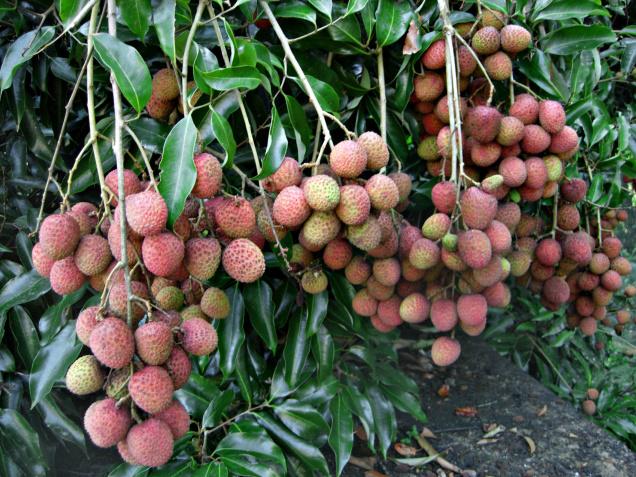
Litchi grown in Kodagu during the off-season can be marketed across the country, says an expert.

Growers in Kodagu, faced with pest attacks on coffee and diseases in cardamom, orange, and banana crops, had something to look forward to during the Litchi Field Day organised by the Central Horticultural Experiment Station (CHES) at Chettalli in the district recently.

About 50 progressive growers attended the event. A field visit to litchi orchards of the CHES in Chettalli gave the growers exposure to cultivation methods. CHES scientists apprised the growers about the soil requirements, fruiting, flowering pattern, and yield of litchi.

P.C. Tripathi, head of the CHES, made a presentation on the prospects of litchi cultivation in Kodagu. He said litchi matures in the off-season, during November-December period, in Kodagu, unlike in traditional cultivation areas in north India where it matures during May and June. As this was the off-season, the fruits were in demand in the market. He told The Hindu that litchi grown in Kodagu during the off-season could be marketed across the country.

The current price of litchi is around Rs. 150 a kg. Litchi cultivation had picked up in Kodagu in the last four years, he said. A grower had planted 900 plants in Chettalli area, he said.

Income from litchi cultivation could augment the annual income of growers who were left to fend for themselves due to the volatility of coffee and pepper prices, Dr. Tripathi said. A small litchi tree could yield between 30 to 50 kg of fruits while bigger ones could yield more than 2 quintals, he said. India is ranked second in the world in litchi production, after China. In India, litchi is grown on nearly 75,000 hectares with a yield of 4.83 lakh tonnes. Bihar, West Bengal, Uttar Pradesh, Jharkhand and Uttarakhand are the major litchi growing States in the country. At the programme, growers raised queries on profitability and feasibility of litchi cultivation.

Planters including N. Bose Mandanna, Col. Kumar (retd.), B.D. Manjunath, Vijay Devaiah and Shambhu Chengappa participated in the programme. Scientists of the CHES, Indian Institute of Spices Research, Appangala, near Madikeri; Coffee Board, Chettalli; and Krishi Vijnana Kendra, Gonicoppa, as well as government officials were present.

source: http://www.thehindu.com / The Hindu / Home> News> National> Karnataka / by K. Jeevan Chinnappa / Madikeri – December 26th, 2013

‘Huthari’, harvest festival observed across Kodagu

Celebration began at Igguthappa temple

‘Huthari’ festival was observed with grandeur and traditional fervour in Kodagu district on Sunday.

The Huthari celebrations began at the Igguthappa temple and ‘prasadam’ was distributed. Sheaves of paddy were taken from the temple to mark the beginning of the festival in the district.

Later, people in the district visited paddy fields in a procession in their traditional attire and harvested the crop after offering prayer. Before harvesting, they shouted slogans ‘Poli Polio deva’ and fired three times in the air and burst crackers.

Kolata

Members of Pandeera family, Kodava Samaja and Sri Omkareshwara temple organised ‘Huthari’ kolata as a part of Huthari festival at Old Fort premises in Madikeri on Monday.
Bettageri Pandeera family members presented Kolata and ‘Bolakat,’ on the occasion.

Speaking on the occasion, Pandeera family member Monnappa said that kolata has been performed from the time immemorial. There is a need to continue the tradition. Huthari festival brings all the family member together for celebrations. New year

Lt General (retd) B C Nanda said that Huthari festival is new year for the Kodavas.

Festivals play a vital role in conserving the culture and traditions of the region. Kodava Samaja president Moovera Subbaiah, Vice President Mandepanda Rathan Kuttaiah and others were present.

source: http://www.deccanherald.com / Deccan Herald / Home> District / Napoklu-Madikeri, DHNS , December 16th, 2013

‘Kodagu climate suitable for growing vegetables’

Scientist from Indian Horticulture Research Institute Dr A T Sadashiva has said that the climate in Kodagu is conducive for growing vegetables.

Speaking at a session held at agriculture technology week organised by Krishi Vigyan Kendra, Gonikpppa on Wednesday, he said that after the harvest of paddy, about 35,000 hectare of land will be left as it is. Vegetables can be cultivated in the paddy field after the harvest.

He further said that Indian Horticulture Research Institute has brought out sachets of improvised seeds of different varieties of vegetables.

Steps will be taken to make these seeds available at all places, he said and added that these vegetables could be grown in kitchen garden and also on earthen pots, he said.
Senior scientist T S Aghora said that 96 varieties have been developed in 23 vegetables. Best varieties are available in tomato, chilly, cucumber, pumpkin and beans.

A beans variety called ‘Arka Sharat’ is considered as the best variety. Vegetables like cabbage, red chilly and red carrots which are grown in Ooty can also be grown in Kodagu.

District Horticulture department Deputy Director S N Sudhindra said that the department will bear 50 per cent of the expenditure of the farmers for growing vegetables. A subsidy of Rs 13,000 per acre is available under Krishi Vikas Yojana, he said.

He further said that a subsidy of Rs 1,500 per bee hive wil be provided for the apiculturists.

A honey park will be developed at Bhagamandala to encourage apiculture.
Scientists Dr S S Hebbar, Dr Shrinivas Rao, Progressive farmer C P Sathish from Somwarpet, Gonikoppa Krishi Vigyan Kendra Director Dr P C Tripathi and others were present.

An exhibition on food products and agriculture equipment was held on the occasion.

source: http://www.deccanherald.com / Deccan Herald / Home> District / Gonikoppa – DHNS, December 11th, 2013

Apiculture park to come up in Kodagu

An apiculture park will be set up at Bhagamandala in Kodagu district to revive apiculture in Karnataka, Horticulture Minister Shamanur Shivashankarappa said on Thursday.

He told reporters here that the park would come up on six acres at Bhagamandala. The department would distribute 20,000 boxes to Jenu Kurubas, a tribe that has expertise in honey cultivation and extraction.

According to him, Rs. 60 lakh had been earmarked in the current fiscal to promote apiculture. “At present, the honey production is around 800 metric tonnes but it is possible to increase it to 8,000 metric tonnes per annum. Besides awareness, training would be imparted to the local tribe to promote apiculture. There is a lot of scope for promoting apiculture in Uttara Kannada, Dakshina Kannada and other Malnad districts,” he said.

Neera Policy

The minister said the department has submitted a proposal to the Finance Department to announce a policy on neera.

“An amendment to the State Excise Act is necessary to allow the tapping and selling of neera in the state. Already, steps have been taken to promote value-added products from the neera like palm syrup, palm jaggery and palm sugar. Now it is up to the Finance Department to table a bill in the State Legislature to pass the Neera Policy,” he said.

Proposal Submitted

He said the state government has submitted a proposal to the Union government seeking release of Rs. 100 crore to revive coconut plantations in several districts.

“Thirty per cent of the coconut plants have perished due to pests and failure of monsoon. The department is educating the farmers of rain-fed areas to go for alternative crops,” he said. According to him, the department has given Rs. 12,000 per acre to farmers for loss of coconut plants.

Auction Centres

Shamanur said two flower auction centres set up in Tumkur and Davangere would be inaugurated soon. The Department of Horticulture has provided the infrastructure but it would be managed by the Karnataka Agricultural Marketing Department.

“Floriculture is no longer a profitable venture following competitions from the African countries. In recent years, Kenya and Ethiopia have emerged as leading flower export countries after the European countries. Despite this, many flowers are being exported from Karnataka thanks to the department’s support. Fifty per cent subsidy is being given to entrepreneurs under the National Horticulture Mission to promote floriculture,” he said.

Census

He said the census of horticulture crops’ areas under cultivation and production were in progress in Bagalkot, Belgaum, Bellary, Chitradurga, Davangere, Gulbarga, Hassan, Kolar, Mysore, Shimoga and Tumkur districts. According to him, Rs. 5 crore had been earmarked for the purpose. “Nearly 50 per cent of the work has been completed,” he said.

source: http://www.newindianexpress.com / The New Indian Express / Home> States> Karnataka / by Express News Service – Bangalore / November 22nd, 2013

Govindappa Jayaram elected Karnataka Planters’ Association chairman

Bangalore :

Govindappa Jayaram from Kodagu district has been elected as Chairman and K Kurian from Chikmagalur district as Vice Chairman of Karnataka Planters’ Association.

Jayaram and Kurian got elected at the 55th Annual General Meeting of the Karnataka Planters’ Association.

The following have been elected to executive committee of KPA: Chikmagalur District – H.T. Pramod, Shirish Vijayendra, Mahesh Shashidhar.

Kodagu District – A.A. Ponappa, N. Bose Mandanna, M.A. Sampath (Corporate Seat).

Hassan District – V. Murali (Corporate Seat) and Baba P.S. Bedi.

Small Growers seat – Kodagu District – Dr M.M.Chengappa.

source: http://www.thehindubusinessline.com / Business Line / Home> Industry> Agri-Biz / by Anil Urs anil.u@thehindu.co.in / Bangalore – November 17th, 2013

Indian Woman Spins Fresh Honey Into Sweet Success

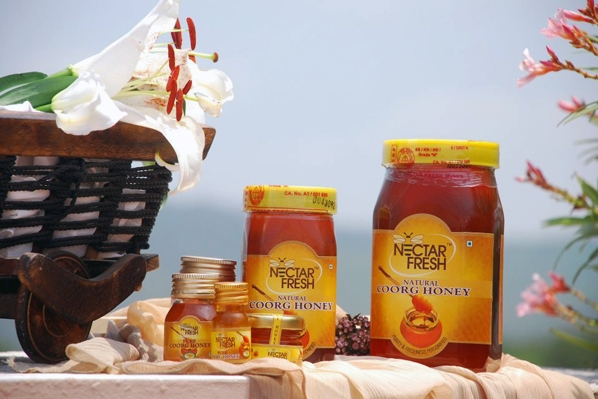
Nectar Fresh honey. Credit: Chayaa Nanjappa

Coorg (Kodagu) is a picturesque hill district along the verdant western Ghats Mountains in the state of Karnataka, South India, which is well known for its aromatic coffee, luscious oranges and fragrant spices. This landscape with steep hills, valleys and ravines with countless streams is home to forests of rosewood, teakwood, sandalwood and silver oak. In this setting, one entrepreneur is turning the region’s traditions of beekeeping and honey collecting into a global operation called Nectar Fresh honey.

Honey is an important part of the culture in Coorg, where bees are kept and honey is cultivated throughout the dense forests and on the many coffee plantations. At “A Cookery Year in Coorg,” Shalini Nanda Nagappa writes “at a Coorg child’s naming ceremony, a gold coin is dipped in honey, and touched to the infant’s lips, a symbolic wish and blessing for the child to live a life of sweetness and prosperity.”

Humble beginnings with a dream
In 2007, Chayaa Nanjappa, a young woman from Coorg, decided to leave her job in the hospitality industry to follow her dream of starting her own honey business. Her initial plan was to supply the purest quality honey from her hometown to the local markets in Bangalore.

To learn the ropes of the new business, she trained at the central Bee Research and Training Institute in Pune, Maharashtra. With a small loan from her mother and with the support of Khadi and Village Industries. she started her business Nectar Fresh honey in Bangalore.

Honey is collected directly from the source and filtered. It later undergoes moisture reduction and then again more filtration. It is then cooled and sent to settling tanks. Processed honey is meticulously tested for quality at the in-house laboratory. Initially the honey was processed and packaged for the pharmaceutical, ayurveda, and hospitality sectors. After serving solely as a supplier to other brands, Nectar Fresh began marketing honey and related products under its own label across India in 2007.

Three years later, Nanjappa relocated the flourishing business to Mysore. Kuppanda Rajappa, a well-known businessman of Coorg origin, with considerable experience in management of plantations and retail sector joined the company as partner. Nectar Fresh was initially sourcing honey only from Coorg. Today the company selectively sources raw honey from various honey-rich regions of India. The honey is collected from forests, certified apiaries, tribal societies and small farmers.

Growing Nectar Fresh honey’s export operation
Pure unadulterated Coorg honey is unique in flavor, aroma and color. These qualities vary depending on the nectar source, age and storage conditions of the honey. Honey extracted during different seasons and from various parts of Coorg carries the flavor of seasonal and regional flowers. Color ranges from dark to light amber: Pale honeys have a mild flavor, while the darker ones have more robust flavor.

Honey made primarily from the nectar of one type of flower is called mono-floral. They have high value in the market due to distinctive flavor. Darker honeys are used for large-scale commercial purposes while lighter honeys are marketed for direct consumption and demand a premium price over the darker counterparts. Most of Nectar Fresh honey is organic and the company also specializes in mono-floral honeys, including Coorg honey, eucalyptus honey, acacia honey, clover honey, mustard honey, sunflower honey, jamun honey, lychee honey and forest honey, which is sourced from dense forests where herbal plants known for their medicinal properties grow.

From the new processing plants in Mysore the company started marketing single-portion packs and 30-gram bottles under Nectar Fresh brand for sale in the hospitality industry. Soon Nectar fresh launched retail-portion package of jams and sauces. Nectar Fresh is one of the largest suppliers of bulk honey from south India, and today its products are exported through middlemen to United Arab Emirates, Malaysia and European Union markets. Recently Nectar Fresh met the stringent standards necessary for approval to export honey to Germany.

The company is awaiting the completion of a new processing plant with a much larger capacity, which would enable Nectar Fresh to produce even more honey. Another plant for processing fruit jams and tomato sauces and purées is expected to be operational by June. The company is in the process of introducing Nectar Fresh Coorg coffee. Plans are also in the works for marketing Coorg-grown pepper, cardamom and kokum.

Nanjappa is a member of the National Bee Board of India. From humble beginning of supplying quality honey to the local market, the company has evolved into one of the top five suppliers and exporter of bulk, raw honey as well as processed honey and the only one manufacturing different varieties of mono-floral honey.

source: http://www.zesterdaily.com / Zester Daily / Home> World / contributor Ammini Ramachandran, Texas based contributor / June 06th, 2013