Category Archives: Nature

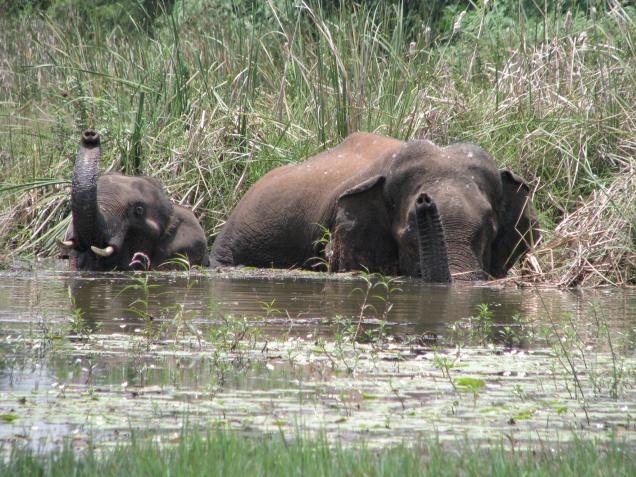
State prepares for biggest elephant capture operation since 1971 ‘khedda’

OUT OF PLACE?: In Alur taluk, a herd of 25–30 elephants inhabit a tiny 5-sq. km forest patch circumscribed by agricultural fields that they routinely raid, according to M.D. Madhusudan, a member of the Karnataka Elephant Task Force./  File photo / The Hindu
OUT OF PLACE?: In Alur taluk, a herd of 25–30 elephants inhabit a tiny 5-sq. km forest patch circumscribed by agricultural fields that they routinely raid, according to M.D. Madhusudan, a member of the Karnataka Elephant Task Force./ File photo / The Hindu

At least 25 wild elephants are set to be caught in Alur taluk of Hassan district

With a green signal from the Karnataka High Court on Tuesday, the Department of Forests now sets about planning its biggest ever operation to capture wild elephants since the State’s last ‘khedda’ in 1971, when 47 animals were captured.

At the very least, this would mean the capture and taming of around 25 elephants in Hassan’s Alur taluk, the epicentre of human-elephant conflict in the State. The Karnataka Elephant Task Force in its report to the High Court in September 2012, identified two regions — Alur and Tumkur district’s Savandurga — as “elephant removal zones” for the “unacceptable levels” of conflict they encountered.

The department, however, places “the outer limit” for the number of elephants to be captured at 150 and hope to extend the ‘removal zone’ to parts of Kodagu where human-elephant conflict is intense. “The actual number we capture will be much less, but we’ll have to take a call on areas such as Kodagu based on an assessment of conflict levels and perceptions of people here,” said Principal Chief Conservator of Forests (Wildlife) G.S. Prabhu.

‘Extreme measure’

Members of the task force don’t quite agree. Removing wild elephants from a natural landscape is “an extreme measure” and one that should be done with the “greatest judiciousness”, said M.D. Madhusudan, scientist with the Nature Conservation Foundation and task force member. Only two areas have been identified by the task force as potential “removal zones” and Kodagu is not one of them, he said.

Alur was an anomaly of sorts and justifies the approach, he explained. The conflict in Alur was intense, and the elephant population was ecologically unviable. “Here, a herd of 25–30 elephants inhabit a tiny 5-sq. km forest patch circumscribed by agricultural fields that they routinely raid.” Between 1986 and 2011, elephants killed 46 people and injured over 240, according to the task force report, creating a “fear psychosis among people that hampers their ability to work and live normal lives.”

The situation in Kodagu was not adequately studied yet, said Raman Sukumar, chairman of the Centre for Ecological Sciences, Indian Institute of Science. “We first need to assess the conflict situation in Kodagu, understand the dynamic of elephants here (are they transitory, for instance) before we decide on a course of action.”

Meanwhile, the Department of Forests has set aside Rs. 4 crore to create kraals to restrain elephants captured, which typically take a year to tame, and new elephant camps. “The project can only begin in January, after the rain,” Mr. Prabhu said, and added that the department would be using a combination of methods that incorporate elements from traditional ‘khedda’ (stockade traps) and also modern-day chemical tranquilising.

BACK TO THE WILD

Even as it prepares for a large-scale capture of elephants, the department, ironically, admits that its 10 camps, which together have 91 elephants, are too crowded.

“We are looking at the possibility of returning around 30 of these back to the wild,” Mr. Prabhu said.

source: http://www.thehindu.com / The Hindu / Home> News> National> Karnataka / by Divya Gandhi / Bangalore – October 13th, 2013
Problem elephants might be captured, tamed

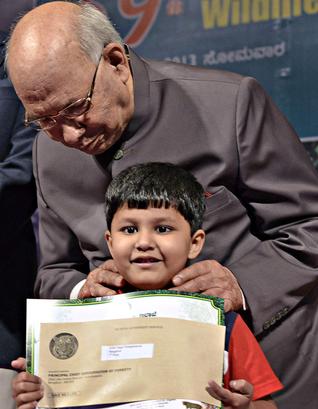
Governor H.R. Bhardwaj with Ashit Sagar Puttannanavar, one of the prize winners, at the valedictory function of the 59th Wildlife Week in Bangalore on Monday. / Photo: Bhagya Prakash K. / The Hindu

Wild elephants that have for years posed a major problem to the lives and livelihoods of residents in Hassan’s Alur taluk and in Kodagu’s Virajpet could soon be captured and tamed, Principal Chief Conservator of Forests (Wildlife) G.S. Prabhu said on Monday.

The Department of Forests had, earlier this year, proposed the capture of several problem elephants that routinely raided crops and came in conflict with people.

Mr. Prabhu was speaking at the valedictory function of the 59th Wildlife Week organised by the department, where schoolchildren were given prizes for essay and painting competitions on the theme ‘The importance of environmental protection’.

A sum of Rs. 21 crore had been earmarked to mitigate the human-animal conflict in the State, Minister for Forests, Environment and Ecology, B. Ramanath Rai, said.

Governor H.R. Bhardwaj said several species across the world were endangered because of human greed. He added that the budget allocation for wildlife conservation should be increased.

source: http://www.thehindu.com / The Hindu / Home> News> National> Karnataka / by Special Correspondent / Bangalore – October 08th, 2013

‘Doctor’ Brijita Lobo celebrates 101st birthday

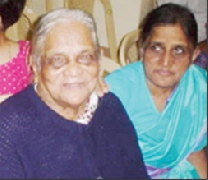
Centenarian Brijita Lobo with her daughter Philomena Lobo.

Rotary Club of Mysore Royal

by Rtn. Pius Saldanha

This doctor neither has a medical degree nor has she gone to any school but she was an expert in herbal medicine. Meet Brijita Lobo, who celebrated her 101st birthday recently.

Born on Sept. 30, 1913 in Betolli village of Virajpet taluk, and settled down in Beppunad (Kedamullur village) after marrying M.P. Lobo (late), who was a Shirastedar in Virajpet court, she celebrated her 101st birthday on Sept. 30 at Bangalore. Many joined the celebrations which included a Thanksgiving Mass and prayed for her good health.

Like a Kannada saying goes, ‘Aadu muttada soppilla,’ there is no ailment that she did not handle and was an expert as Gynaec. The nearest town, Virajpet being six kilometres away, she was often disturbed for midnight emergency. Any difficult delivery, she handled with confidence. She was fondly called as ‘Badavara Bandhu’ (Messiah of the Poor) by the villagers.

I was her neighbour and in the summer of 1977 came down on holidays from Haryana. Following day, I was relaxing under a tree, talking to my neighbours. I saw her coming down from a hillock, situated a kilometer away. On seeing me, she came and enquired fondly, ‘how are you my son!’ (kosuasaiputa?). I said, ‘Moushe, (O Aunt) I can’t lift my right hand, a dozen boils under my arm due to the heat of summer. On examining me, she went back to the hillock, and returned after 45 minutes and treated me with her herbs. Next day, I could lift my hand with ease and on the following day, I was cured totally.

My cousin Trecilla, a teacher delivered a baby girl in a hospital, and was suffering with acute stomach ache. After a week, this ‘doctor’ treated Trecilla with her herbal medicine, the dead twin baby was flushed out. Trecilla is enjoying her retired life with good health now. Her first twin girl is a mother of two now.

The grand-mother, Brijita Lobo is living with her children in Bangalore. Last year, well-wishers and friends wished her for her 100th birthday. She can be contact on Mob: 9482220399.

source: http://www.starofmysore.com / Star of Mysore / Home> Feature Articles / by Rtn. Pius Saldhana / October 04th, 2013

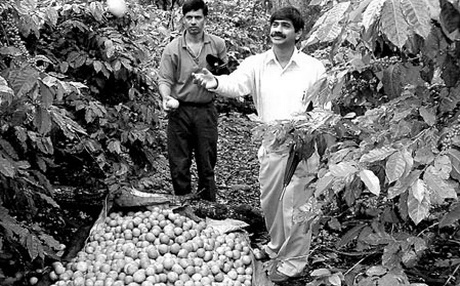
Kodagu orange may see revival

Horticulture department

You may get to savour the famous ‘Kodagina Kittale’ (Kodagu orange) again. The State Horticulture Department has decided to revive the now-extinct variety.

“Our department is tying up with the Indian Institute of Horticultural Sciences (IIHS), Chettalli in Kodagu, to revive ‘Kodagina Kittale’. We are ready to pump in whatever funds required for the purpose,” said Horticulture Department Principal Secretary M K Shankarlinge Gowda.

A couple of decades ago, Kodagu was famous for its variety of orange known for its taste. Coffee planters used to grow the plants in the coffee estates. Over the years, it became extinct because of frequent pest attacks. Gowda said his department will take assistance from the IIHS to revive the citric fruit.

Chettalli farm has around 160 acres of land on which orange saplings will be raised. Once they are ready for transplantation, they will be distributed to farmers and estate owners. Scientists at IIHS will be requested to make those plants pest-resistant so that they will not vanish again. In fact, there is a group of agriculture graduates in Kodagu which is interested in the revival of the variety. “We will rope in their services to create awareness among the people to go for orange cultivation again,” Gowda said.

He said, during hey days orange was planted on more than 2,000 hectares in Kodagu district as the climate is well suited for growing this citric fruit. But now it vanished from coffee estates.

Although Kodagina Kittale cannot compete with the orange of Nagpur, still it has its own place.

No Dearthof Funds

Gowda said plenty of funds are available under Rashtriya Krishi Vikas Yojna and Competitive Horticulture Programme for promotion of horticulture crops in the state. Around `240 crore is now available with the department and it can spend this money at its discretion.

“My aim is to revive all rare fruits, flowers and vegetables for which Karnataka is known, at least for the future generation,” he said.

A Nanaiah, a resident of Kodagu, said loads of oranges were harvested and sent to neighbouring states but the pests pushed this rare variety of orange to extinct. “As children, we used to eat this orange but now we miss it,” he laments.

source: http://www.newindianexpress.com / The New Indian Express / Home> Cities> Bangalore / by Shyam Sundar Vattan / October 07th, 2013

Permission to sell Kodagu’s Jamma lands could lead to ecological disaster

The tiny hill district of Kodagu (Coorg) in Karnataka is facing an ecological disaster with the President of India giving his assent to a controversial legislation which allows the disposal and sale of Jamma lands in Kodagu located in the fragile Western Ghats. It is feared that the resultant denudation of the forests in the region could trigger an environmental damage with unpredictable consequences.

The repercussions of the legislation — The Karnataka Land Revenue (Third Amendment), Act, 2011, which received Presidential assent early this year after the bill was referred to the President by the Karnataka governor last year, will not only be severe on the Western Ghats region, considered as one of world’s bio-diversity hotspots, but will also take its toll on the customary laws, traditions and culture of the indigenous communities.

Jamma land tenure is unique to Kodagu district and it is estimated that the extent of ‘Jamma Baane’ land in Kodagu is around 2.55 lakh acres in possession of the local people — Kodavas, Amma-Kodavas, Heggades, Airis, Koyavas, Moplas and Gaudas. Jamma lands consist of wetland for growing paddy and the accompanying Baane land, initially used for cattle grazing and held free of assessment, now converted into coffee estates.

According to Sir J B Lyall, a British expert on tenures in Coorg who traced the origin of Jamma, it was originally a military tenure held on payment of half the assessment in consideration of military service. Jamma was granted under ‘sanads’ largely by the Coorg Rajas (1600 AD to 1834 AD) and to a smaller extent by the British till 1895 to the local inhabitants.

Hitherto, there was a ban on the sale of Jamma lands as the cultivator was only a ‘deemed owner’. The new legislation will confer the title of ‘occupant owner’ and allows the sale of land. The legislation, it is feared, will legitimise large scale denudation of trees and the formation of human settlements on Jamma Bane lands as there will be heavy influx of population from the neighbouring states. The presence of increased human habitation will have its impact on the adjoining forest land, its flora and fauna.

For generations, the life of the local communities, centered around the cultivation of the Jamma lands, the principal tenure in Kodagu. The Jamma lands could not be alienated as there was no provision for transferring the title of the property. The ownership was jointly held by the clan and it was managed by the head of the clan (Pattedara).

The issue went before the Karnataka high court and a full bench of the court held in its judgement delivered in October, 1993 that Jamma Baane landholders had limited privileges for cattle grazing, supply of firewood and timber for the domestic and agriculture purposes, but had no right to exploit the trees for commercial purposes, unless the holder had paid full timber value to the government. The court also held that the land-owner had no right to the sub-soil.

Customs and traditions

Once the ban on the sale of Jamma lands is lifted, the indigenous communities will be removed from their traditional Jamma holdings which formed the basis of their customs and traditions. The ‘ain-mane’ or the ancestral houses of the clans, was the focal point of all festivities and religious usages. It is feared that once the Jamma lands are sold to outsiders, the new land owners could lay claim to the ‘ain-manes,’ considered sacred to the local communities. This could lead to social tensions and law and order problem.

The biggest threat will come from the real estate mafia who were eyeing the Jamma lands all these years. With tourism boom in Kodagu, the local communities will be under pressure to sell their lands as the state will not have any control over them. It is learnt that already Jamma lands are being sold in anticipation of the new law taking effect.

The amendment to the Jamma tenure was effected during the previous BJP regime. The amendment was politically motivated and passed in haste without much debate in the Legislative Assembly, reportedly at the instance of the then Speaker K G Bopaiah who wanted to take political advantage. One of the reasons for Bopaiah’s re-election from the Virajpet constituency was on account of the political mileage he gained by getting the amendment passed.

The new amendment will create more problems than it hopes to solve. Those who drafted the amendment bill have failed to recognise the fact that apart from Jamma Baane lands, there are other types of Baanes — ‘Hithlu’ and ‘Sagu Baane’ lands.
Advocate K Sarojini Muthanna, who is knowledgeable on Jamma tenure matters, has suggested that the government should carry out further amendments to the Karnataka Land Revenue Act, 1964, devoting a separate chapter for the Jamma lands of Kodagu. The main support for the amendment has come from Akhila Kodava Samaja, representing a small section of the Kodavas. The president of the Samaja, Mathanda C Monnappa, opined that the amendment removed ‘irritants’ by way of government circulars which gave the impression that the land belonged to the government.

A large section of people, however, feel that in the interest of preserving the culture of Kodagu, and maintaining the ecological balance in the Western Ghats, the Siddaramaiah government should not give effect to the amendment to the Jamma land tenure.

source: http://www.deccanherald.com / Deccan Herald / Home> Panorama / by P.T.Bopanna / July 24th, 2013

Ajith song shoot in Madikeri

The two songs of the upcoming Kannada movie Ajith, which has Chiranjeevi Sarja and Nikki Galrani in the lead roles, will be shot in Madikeri and surrounding areas. Harsha will do the choreography for the songs.
SongKF15sept2013
The film, which is directed by Mahesh Babu, is the remake of Tamil film Paiyya. The movie will mark the debut of Nikki Galrani in Sandalwood and Yuva Shankar Raja — the music composer for Paiyya — as he will be scoring the music for the Kannada version too. The film also has Arpitha, Rockline Sudhakar and Shivamanju in important roles. Ajith has already been shot in Mysore and other locations of the state, and Sundaranath Suvarna is the cinematographer of the movie.

Meanwhile Chiranjeevi Sarja will soon start working for the movie Ayya-2, which will be a sequel to Ayya movie. The film will be directed by Om Prakash Rao. Chiranjeevi Sarja also has another remake film Chandralekha in the pipeline, which is a remake of the Telugu film Prema Katha Charitham.

source: http://www.articles.timesofindia.indiatimes.com / The Times of India / Home> Entertainment> Regional> Kannada> Film / by Vinay Lokesh, TNN / September 13th, 2013

Birds, frogs and civet coffee in Madikeri

What comes to mind when you think of Kodagu or Madikeri? Coffee, homestays, waterfalls, elephant camps, Tibetan settlements, meaty-pork stews? How many of us know that Kodagu, unlike the other districts of Karnataka, is home to a range of wildlife species? And in particular, birds and reptiles?
KodaguKF06sept2013
I found the answers in a plantation located in Galibeedu village, Madikeri. I visited a 25-acre plantation, in which coffee, pepper, cardamom and vanilla are cultivated for a two-day stay. It is run by a North Indian couple who quit their jobs 20 years ago to develop this piece of land into an eco initiative that can be enjoyed by all.

The plantation is dense with coffee and other spices grown under the inter-cropping method. Guests are accommodated in tents and a handful of cottages. Locally grown organic food is served to them. The entire plantation is run on solar power, bringing it as close to the nature as possible.

The plantation also serves Civet Coffee, which is made out of beans that are defecated by the civet, a wild cat, that feasts on ripe coffee berries. The beans are washed, sundried and roasted to yield maximum aroma. Due to the enzymatic activity and the touch of amino acids in the Civet’s gut, these beans acquire unique flavours—making it less bitter, more aromatic and hence one of the most expensive and exclusive kinds of coffee in the world.

The night called for a few pleasant surprises—the deafening sounds of the crickets followed by a soothing array of fireflies. Though their charm might be ephemeral, they have a magical effect on you. I tried so hard not to blink, fearing the loss of a few glints. The minimally-lit tents with below 10-watt bulbs paved a perfect setting for this magical moment.

The plantation is an ornithologist’s delight. I spotted the Malabar Whistling Thrush, Woodpeckers, Racket Tailed Drongos, Fly Catchers and Kingfishers among several tiny birds. The plantation is also home to stick insects, hibernating butterflies, tree frogs and leaf frogs. Some belonged to the Lateralus family and are endemic to the Western Ghats region. The frogs were a sight to behold; they changed colours, had shiny-green skin, big, bulgy eyes and had perched themselves on twigs as if waiting for us to visit them.

My two-day stay passed away in a blur and I decided to walk down to the much talked-about stream surrounded by birds about five kilometres away before departing. As I trekked down, the clouds got thicker and darker. I spotted a flock of birds, all different in colour and kind, perched on a tree. It suddenly began to drizzle and the birds in search of shelter, flew from one tree to the other at once. The swarming birds flew low, making it one of my most colourful memories—tints of hidden orange and blue, reds and greys exposed—a flying rainbow indeed.

Ignoring the rain and time, I soaked and hiked at my own pace. When I got back, I was the only one for breakfast and I had missed out on my last dig at the sumptuous avocados too! Oh well!! What more can one ask for when you had the experience of a flying rainbow?

source: http://www.deccanherald.com / Deccan Herald / Home> Supplements> Spectrum / by Aishwarya Madineni, DHNS / September 03rd, 2013

Forest officials drive back elephants into Kodagu forests

The two-day operation to drive wild elephants back into forests by the forest department in South Kodagu in progress | Express photos

The two-day initiative of the Forest Department to drive wild elephants back into the forests came to an end on Saturday.

On Friday, the operation commenced in the presence of chief conservator of forests, Kodagu circle, Brijesh Kumar Dixith, Deputy Conservator of Forests (DCF), Virajpet division, Malathi Priya, Deputy Conservator of Forests, Nagarahole wildlife division, Gokul, assistant conservator of forests and range forest officials and staff from all the forest department divisions of Kodagu district.

14 Jumbos Driven Back to Forests

The teams were able to chase away 14 elephants from Devarapura and Nokya Gram Panchayat limits, ACF Belliappa told Express.

On Saturday, the teams were unable to spot even one elephant.

He said the teams will continue to ensure the elephants do not return.

“The operation will be continued next week in Pollibetta areas. Movement of vehicles and people will be restricted through publicity arrangements,” he said.

Belliappa added that most elephants entered South Kodagu either from Mauvkal or Nagarahole forests.

Need for Public Help

The operation involved tamed elephants, special task force staff, wildlife staff from Nagarahole, Virajpet division forest officers and staff along with watchers. General public and police also extended required assistance to the department.

Chief conservator of forests, Kodagu circle, Dixith told reporters here on Saturday that as per the elephant census taken last year, as many as 6,000 elephants were located in the state. In Kodagu region, covering Gonikoppa, Thithimathi and Maldaare areas, as many as 100 wild elephants are troubling people, he said.

“Another 32 elephants are permanent residents of BBTC coffee estates in Siddapura. These should be captured and shifted,” he said. However, before their capture, a few technical and legal aspects need to be addressed, he said.

In Bramhagiri wildlife sanctuary, 30 elephants on the Kodagu-Kerala border have been identified that need to be captured and sent back into forest cover, he said. All these issues have been brought to the notice of Forest Minister Ramanath Rai, Dixith added.

source: http://www.newindianexpress.com / The New Indian Express / Home> States> Karnataka / by Express News Service – Madikeri / July 29th, 2013

Harangi garden to open on August 15

Harangi Reservoir, one of the most important water bodies in the Cauvery basin, will soon get a garden modelled after the Brindavan Gardens of Krishna Raja Sagar Dam, thereby fulfilling a dream that has been pending for decades.

The idea of a park came about when R Gundu Rao was the chief minister. However, once he stepped down, the project was sidelined and came to a standstill.

Later, when M P Appachu Ranjan became MLA and then District Minister, he put in all his efforts to make the dream a reality. He was supported by then minister for Major Irrigation Basavaraj Bommai who gave his nod for the project.

Bommai also came down to Harangi Dam and laid the foundation stone for the about `4 crore project.

MLA M P Appachu Ranjan told Express that the project was one of his major achievements as a minister in the BJP government.

Executive engineer of Harangi Reservoir Phalanethraiah and manager Nagaraj told Express that the park would be inaugurated on August 15.

source: http://www.newindianexpress.com / The New Indian Express / Home> States> Karnataka / by B C Dinesh / ENS – Madikeri / June 21st, 2013

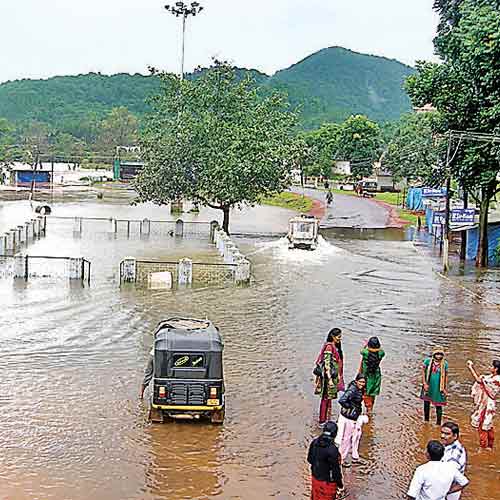
Rain brings festive atmosphere to Coorg

Kodagu is inundated after recent downpours. - DNA
Kodagu is inundated after recent downpours. – DNA

The copious amount of rain that areas near Bhagamandala in Kodagu received in the recent past has pronounced good news for the people of Bangalore and Mysore. The rainwater has started filling up the Krishnaraja Sagar reservoir in Srirangapatna taluk in Mandya district, which is the main source of water for Bangalore and Mysore.

As a result of the heavy rain on the hills of Madikeri, the Bhagamandala-Talacauvery area, which resembled a drought stricken place a few days back, filled people with joy, despite the road from Bhagamandala-Napoklu being inundated, throwing life out of gear.

People did not mind their children missing classes and ignored the absence of the workers in their fields and plantations, and chose to just sit back and enjoy the rain. Men settled down with their bottle of rum while ladies were in a holiday mood and many of them cooked their signature dish ‘Pandi Curry’(pork chops) and ‘Pundi’ (rice dumplings) for their family.

“This is the time to be happy. Kodagu is looked upon by the people in the Cauvery basin as the provider of life. We were sad when there was less water in Cauvery. But, for the past few weeks, the elders were worried about the drought like situation in Bhagamandala and the entire river course of Cauvery and the dry situation at the KRS,” said Prasad Nanjappa, a resident of Madikeri town.

Confirming copious inflow of water into the reservoir, executive engineer of the KRS facility told dna that the inflow improved tremendously to reach 4,300 cusecs per day, which subsequently increased the water level from 65 feet in the past week to 80.16 feet.

“With the rains in Kodagu district intensifying, we expect more water to flow into the KRS reservoir in the next few days,” he added.

Meanwhile, the Kodagu district administration has declared holidays for schools and colleges for the next two days.

source:http://www.dnaindia.com / DNA / Home> Bangalore> Report / by M Raghuram / Place:Mysore, Agency:DNA / Wednesday – June 26th, 2013