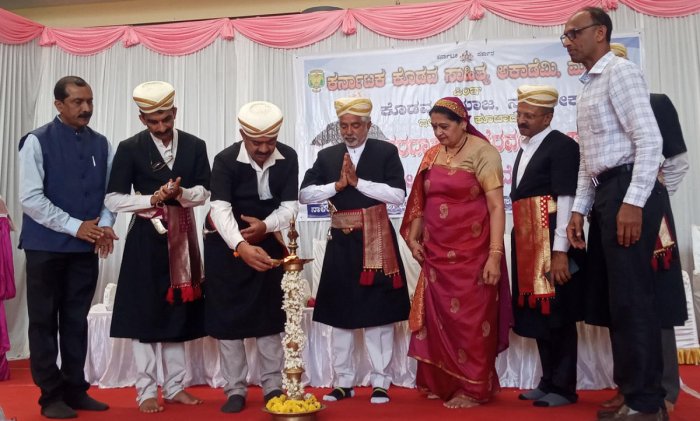
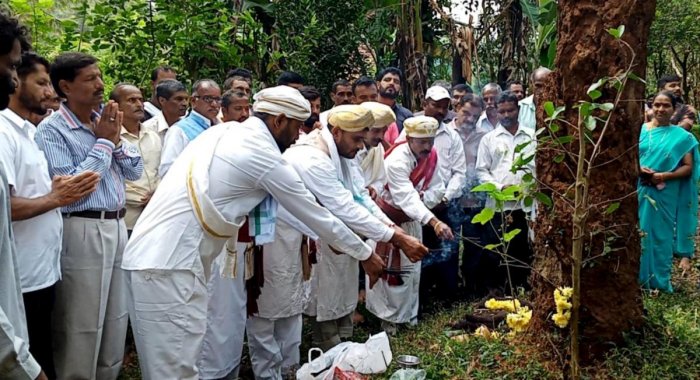
Kodava Samaja, Napoklu, president Appachettolanda Manu Muttappa inaugurates the 153rd birth anniversary celebrations of Appacha Kavi, organised at Appacha Kavi auditorium in Kodava Samaja, Napoklu.
The Ainmane, traditional house of Haradasa Appacha Kavi, the first poet of Kodagu, should be developed into a memorial, said Appachettolanda Manu Muttappa, president of Napoklu Kodava Samaja.
He was speaking during the 153rd birth anniversary celebrations of Appacha Kavi, organised by Karnataka Kodava Sahitya Academy and Napoklu Kodava Samaja, at Appacha Kavi auditorium, on Tuesday.
Manu Muttappa said that along with the residences of great poets and writers, their native places should also be developed.
“There is a need to introduce Appacha Kavi’s works to the present generation. Appacha Kavi had great knowledge of Kannada and Sanskrit. An education officer called Raghunatha Raya inspired Appacha Kavi to create literary works in the Kodava language, he said.
Speaking on Appacha Kavi, Rangayana, Mysuru, director Addanda Cariappa said that Appacha Kavi should be awarded the ‘Karnataka Ratna’ award.
Karnataka Kodava Sahitya Academy chairperson Dr Ammatanda Parvathi Appaiah, Academy registrar Ajjikuttira Girish, Appaneravanda Ainmane Development Committee president Appaneravanda Chummi Devaiah, Appaneravanda Ramu and Dr Manoj were present.
‘Ummattat’ and other cultural programmes were held on the occasion.
Folklore scholar Bottolanda Kashi Achaiah sang songs composed by Appacha Kavi.
source: http://www.deccanherald.com / Deccan Herald / Home> State> Mangaluru / by DHNS, Napoklu / September 21st, 2022
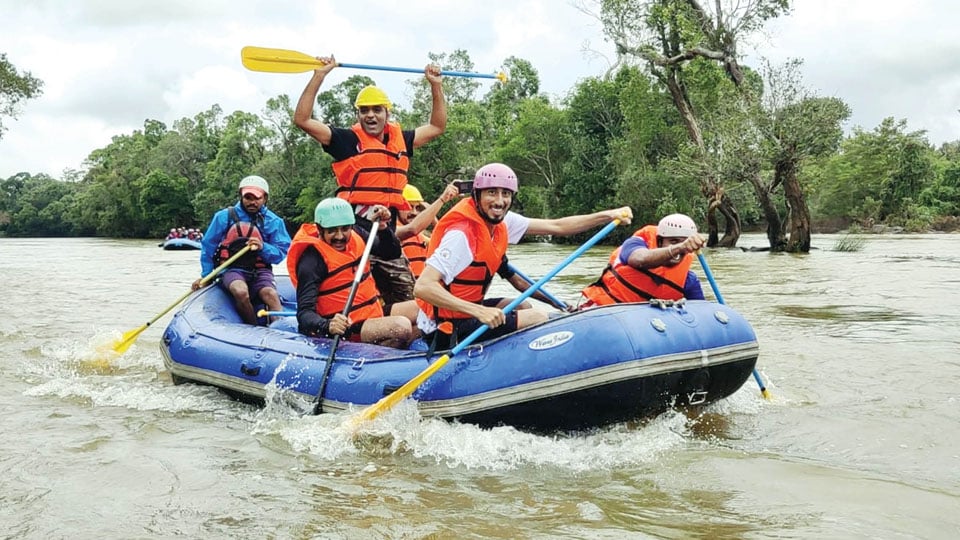
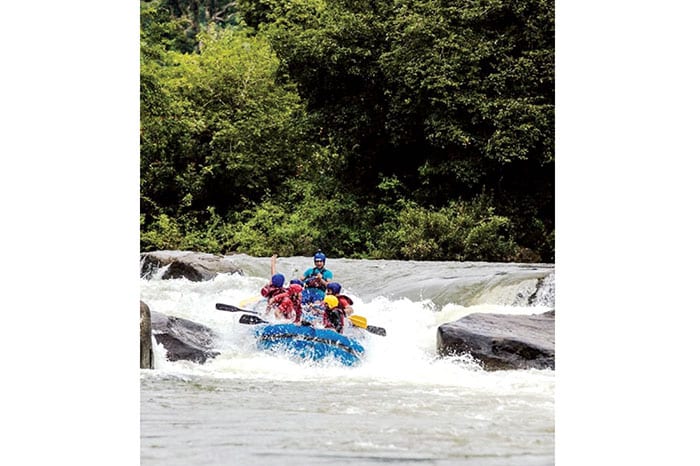
Adventure lovers who have been pining to get some adrenaline rush are heading towards Dubare and Barapole in Kodagu district for whitewater river rafting and rappelling in the rapids. Rafting in the Cauvery and at Barapole is an exhilarating experience. Rafting usually starts once the inflow into the Cauvery and Barapole increases and the level rises. A raft is a rubberised, inflatable boat with different carrying capacities.
A 7-kilometre journey at Dubare will take about one-and-a-half hours while it is shorter but adventurous at Barapole’s 4.5-km rafting. The tranquil water may be a deceitful thing along the course of the Cauvery and Barapole as one hits the rapids (a section of the river where the water moves very fast particularly over or bisecting the rocks).
If one is tired of their mundane schedule and wants to try something adventurous with friends then river rafting is one of the perfect and thrilling options that one can opt for. The thrill, however, is not without a certain amount of risk. However, the risks are what enhance the river rafting experience for many adrenaline junkies.
Rapid adventure
At Dubare, rafters will get to experience two rapids and swimming is allowed at two places. Barapole has more than nine Class 2 Class 4 rapids and is set on the banks of the Kithu Kakathu River (KKR). The river is a turbulent one all along its route as it flows through the Brahmagiri hills to the Arabian Sea via Kerala.
While June to the end of September is the ‘whitewater’ season, October to December or January is a ‘stillwater’ season. After which, the water level depletes. Whitewater is formed in a rapid when a river’s gradient changes enough to generate so much turbulence that air is trapped within the water. This forms an unstable current that froths, making the water appear opaque and white. Stillwater is part of a stream where no water current is visible.
The response for rafting is pretty good with over 2,000 rafters during weekends and over 250 rafters daily. At Dubare, there are 70 rafts and 70 guides while Barapole has 9 rafts and 9 guides. Soon, 10 more rafts will be added to the existing fleet at Dubare as there is a huge demand.
Safety is of paramount importance here and all the guides are well trained. Life jackets are worn by all the rafters and the guide and at Dubare, each life jacket can withstand a weight of 180 kgs and there is little chance of drowning. Rafting at Dubare costs Rs. 600 per person and Rs. 1,200 at Barapole. Each raft can carry six rafters and one guide.
Speaking to Star of Mysore, Pavan of Coorg Water Rafting Sports and Adventures, Barapole, said that the response is good. “Only those who are passionate about rafting and adventure come here and we have many regulars. It is quite challenging and tests the adventure spirit,” he said.
Barapole
Need changing room for ladies
C.L. Vishwa, raft owner and former President of Dubare Rafters Association, said that they desperately need a changing room at Dubare for ladies and girls and also there is a need to establish a drinking water facility.
“If the District Administration wants to attract more tourists to Dubare, then a hanging bridge is a must for tourists to reach the Elephant Camp from one side of the Cauvery river. Unfortunately, the tourist-friendly project has been shelved by officers without a vision,” he added.
Rules and regulations
The Kodagu District Administration has came out with a 23-point formula to ensure safety. The operators must secure permission from the Departments of Police, Forests, Fire Force and Tourism, and employ trained guards to accompany the rafters. Every one of them should have ID cards issued by Tourism Department and should be trained in first-aid methods. Smoking and drinking is prohibited during rafting. Rafters should also obtain permission from the Karnataka Inland Water Transport Department.
source: http://www.starofmysore.com / Star of Mysore / Home> News> Top Stories / July 24th, 2022
Many take part in programme despite intermittent drizzle
Providing a reprieve from the stress and strain of a vigorous monsoon which tends to wreak havoc in Kodagu, was the slush field sports conducted by the district administration, on Saturday.
The monsoon in Kodagu tends to conjure up images of flood and landslips. But with the rains abating, the people put their worries behind to take time off and participate in the 30 th State-level slush field sports organised at Kaggodlu village in Madikeri taluk.
It was conducted by the Kodagu district administration, Zilla Panchayat and Department of Youth Empowerment and Sports and inaugurated by Appachu Ranjan, MLA. He recalled that in earlier days, every farmer or landlord in Kodagu used to take part in slush sports after sowing and it helped bring the community together and strengthened bond.
The competition drew people from different parts of the district who braved the intermittent drizzle and encouraged the participants who were drenched in muddy water and slush and gave a display of their prowess in different games. The festival was open to boys and girls as also men and women and included 50 metrerace, 200 metre race, 400 metre race , throwball, volleyball, tug-of-war etc.
source: http://www.thehindu.com / The Hindu / Home> News> India> Karnataka / by Special Correspondent / July 23rd, 2022
After Ganga, Brahmaputra Galleries, first such Gallery in South India
Gallery timings: 10 am – 6 pm
Entry ticket: Adults – Rs. 20, children – Rs. 10
Mysore/Mysuru:
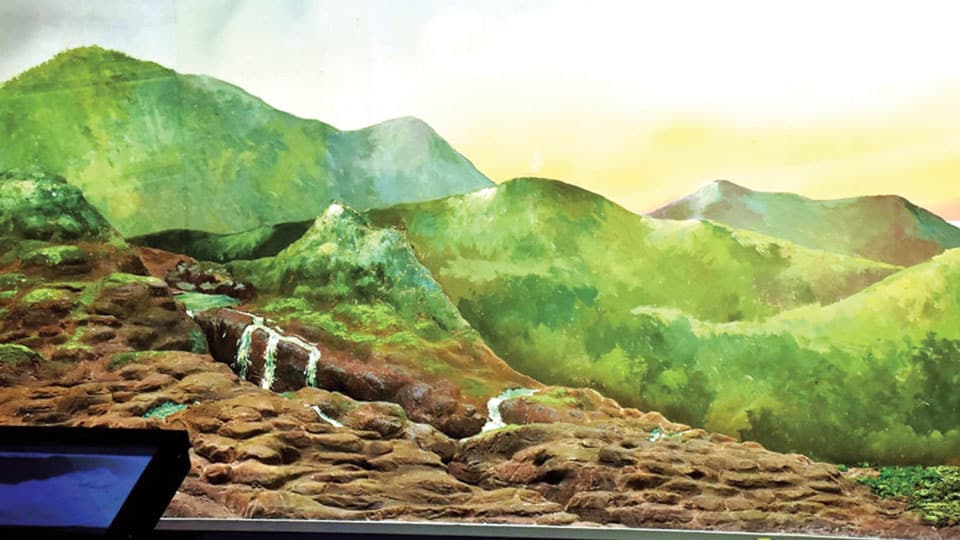
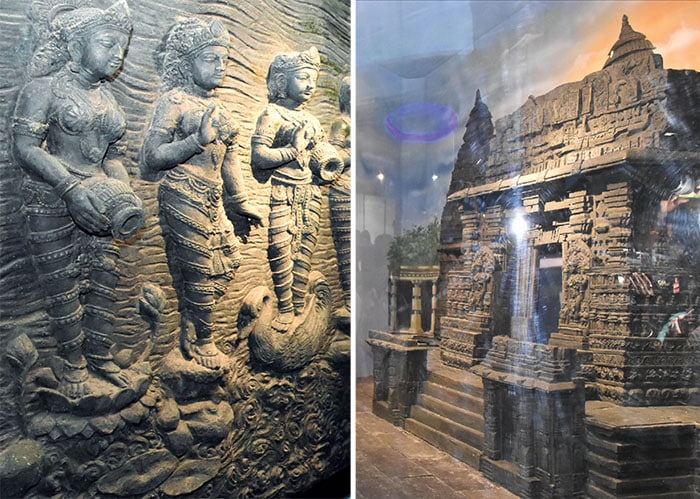
The Cauvery Gallery that has been set up at Karnataka Exhibition Authority (KEA) Grounds showcasing the life, culture and biodiversity of the River from its birth at Talacauvery in Kodagu till it reaches the Bay of Bengal at Poompuhar in Tamil Nadu will be open to the public on July 13.
The visually appealing Gallery with many 3-D presentations has been built jointly by Karnataka Knowledge Commission and Tourism Department. It has been modelled as per the design, specifications and imagination of the National Academy of Sciences, India (NASI) and has been built at a cost of Rs. 3.5 crore.
KEA Chairman Hemanth Kumar Gowda told Star of Mysore that Tourism Minister Anand Singh will inaugurate the Gallery on July 13 at 11 am in the presence of Mysuru District Minister S.T. Somashekar. In-Charge Mayor Sunanda Palanetra, MPs V. Sreenivasa Prasad, Pratap Simha and Sumalatha Ambarish, MLAs G.T. Devegowda, Tanveer Sait, S.A. Ramdas and L. Nagendra will be the guests.
NASI-NCSM project conceptualisation
The project is based on research conducted by the National Council of Science Museums (NCSM), an autonomous society under the Ministry of Culture. Officials of the NASI and the State Tourism Department had signed an agreement to establish the gallery in the KEA complex (at Kannada Karanji). It is the first river gallery in South India.
The Gallery highlights the geological and ecological characteristics of the Cauvery River apart from projecting the social and cultural characteristic features of civilisation that have evolved along the river bank.
NASI is the implementing agency and would train the authorities from Mysuru on how to maintain and administer the gallery. The NASI and NCSM have completed the establishment of the Brahmaputra River gallery project in Guwahati, Assam, and the Ganga River gallery project in Allahabad.
15,000 sq.ft. area covered
The Cauvery Gallery has been built on an area of 15,000 sq.ft. and highlights the geological and ecological characteristics of the Cauvery apart from projecting the social and cultural characteristic features of civilisations that have evolved along the banks of the river.
Artefacts and dolls tell the story of the Cauvery River from Talacauvery (birthplace in Kodagu) to Poompuhar. Pictures, live visuals and models of the river flowing from one part to another criss-crossing the hills and plains narrate the story giving an audio-visual and also pictorial presentation to the viewer.
Ticket pricing
The mega project includes multimedia features and an electronic display to provide visitors with an immersive experience of life and culture along the Cauvery. After the viewers see the gallery, there will be a 20-minute short film on Cauvery.
Adults will have to pay Rs. 20 for an entry ticket while children have to pay Rs. 10. The Gallery will be open from 10 am to 6 pm and the timings will be extended based on the tourist response and tourist seasons.
source: http://www.starofmysore.com / Star of Mysore / Home> News / July 09th, 2022
Emme Suggi Utsava commenced in Nagaralli in Somwarpet.
‘Emme Suggi Utsava’ dedicated to Goddess Kootinadu Sri Sabbamma Devi in Nagaralli near Somwarpet commenced on a traditional note on Sunday, with the observation of ‘Emmege Honnu’ ritual. Prayers were held on the occasion.
The festival, which is held once in 12 years, is observed by 18 villages of Somwarpet and Sakleshpur taluks.
After offering prayers to Sabbamma Devi, monitory contributions were collected by the villagers to purchase buffalo and ox.
The animals are to be bought in Konanuru village and are brought to Nagaralli by walk. A black coloured woollen blanket (kambali) is contributed by the Bangira family of Kooti village.
As a part of the festival, the families living in 18 villages are to follow certain rules for 30 days between November 26 and December 27.
Eating in hotels and houses of relatives is not allowed. Beverages like coffee, tea and boiled items are not to be consumed outside the house.
Also, after the ‘Devara Billu’ ritual, no auspicious events should be held in the 18 villages.
Sabbamma Devi Suggi Utsava Samiti president K T Joyappa, Prakash, U K Somashekhar, Dinesh, Revenna, Bangira Ganesh and villagers representing 18 villages were present.
source: http://www.deccanherald.com / Deccan Herald / Home> State> Mangaluru / by DHNS, Somwarpet / November 30th, 2020
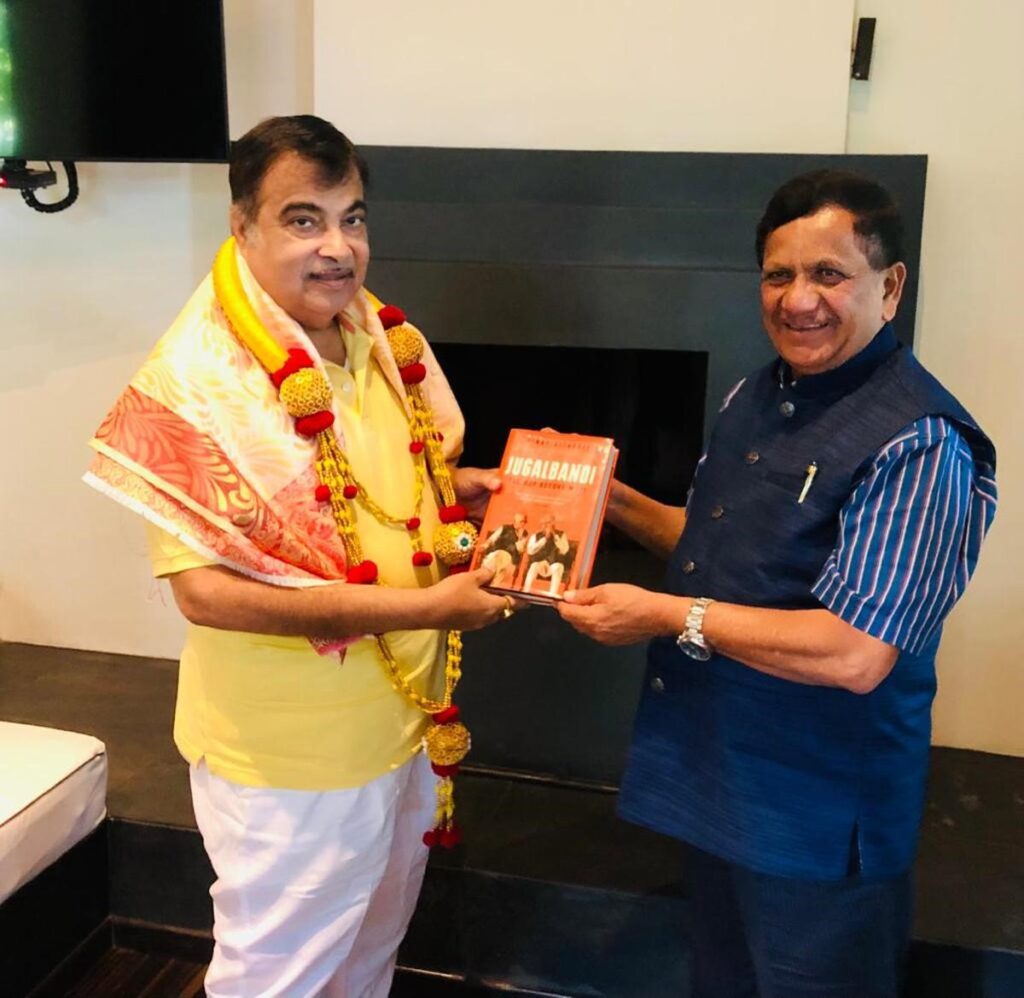
Former Speaker K.G. Bopaiah felicitating Union Minister for Road Transport and Highways Nitin Gadkari in Madikeri on Monday. | Photo Credit: SPECIAL ARRANGEMENT
Union Minister tells MLA to adopt ‘Nagpur model’ to improve yield of Kodagu oranges whose production is on the wane
Union Minister for Road Transport and Highways Nitin Gadkari has promised to look into the demand for highway improvement and expansion in Kodagu if a proposal in this regard came to his office from the State government.
Mr. Gadkari gave this assurance when former Speaker and MLA K.G. Bopaiah met him in Madikeri. Mr. Gadkari is on a private visit to Kodagu with his family members and was staying in a resort in Madikeri.
Mr. Bopaiah shared details on the highways and the steps to be taken for tourism development in the district. “The works will be considered on priority if the Centre gets the proposal on the list of works to be taken up for highway development,” the Minister told the MLA, at the meeting.
Mr. Gadkari spoke about Kodagu’s tourism potential and employment it brings to locals.
Mr. Bopaiah felicitated Mr. Gadkari and presented him with a book besides honey, spices and coffee for which Kodagu is famous. Mr. Gadkari complimented the purity and freshness of the honey.
Expressing concern over the drop in the yield of Kodagu oranges, the Union Minister told the MLA to take steps in this regard, creating an environment for rejuvenating the yield on the model developed in Nagpur which is also known for oranges, besides taking steps for improving the variety.
source: http://www.thehindu.com / The Hindu / Home> News> National / by Special Correspondent / Mysuru – June 13th, 2022
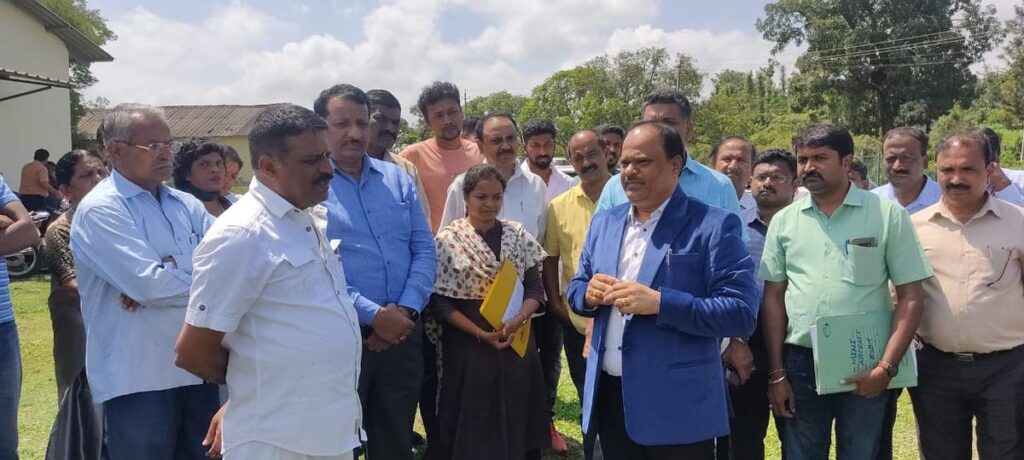
MLA Appachu Ranjan and KSIIDC MD M.R. Ravi during the inspection of land for building a heliport, near Kushalnagar on Monday. | Photo Credit: SPECIAL ARRANGEMENT
Seaplane operations can be launched at Harangi, says official
The State Government has proposed to develop an airstrip and a heliport near Kushalnagar for the benefit of tourists visiting Kodagu, one of the major hill stations in South India.
Chief Minister Basavaraj Bommai had announced in his recent budget to develop heliports at three places, including one in Kodagu. In this connection, a team of officials led by Karnataka State Industrial and Infrastructure Development Corporation (KSIIDC) Managing Director M.R. Ravi, accompanied by Madikeri MLA Appachu Ranjan, inspected the land where the facility has been proposed near the Sainik School at Kudige village.
Speaking to reporters, Mr. Ravi said 49 acres of government land was available near Kushalnagar and it was identified for developing an airstrip. “Since no land was available for developing the heliport at Madikeri, which was the first choice, we thought of developing the airstrip as well as the heliport on the 49-acre plot near Kushalnagar. We need just 5 acres for the heliport and the rest can be developed as an airstrip which can be used for the landing and takeoff of the 20-seater planes,” Mr. Ravi said.
Seaplane operations
Mr. Ravi said plans are afoot for launching the operations of seaplanes in Kodagu in a bid to boost tourism since the infrastructure for their operations was available at Harangi. “If everything goes as planned, seaplanes can land on and take off from Harangi waters. This can help improve connectivity to tourists who can afford such a trip. This can benefit adventure tourism for which Kodagu is considered one of the key destinations.”
Mr. Ranjan said the officials from the Airport Authority of India had visited Kushalnagar in connection with the proposed launch of airstrip operations. However, it did not materialise though the land for the same was identified.
Kodagu needs air connectivity as over 25,000 tourists descend on the hill station during weekends, registering 100 percent occupancy of hotels, resorts and home stays. The air connectivity can further boost tourism and the heliport is one such plan proposed by the government for which all support will be extended, he added.
source: http://www.thehindu.com / The Hindu / Home> News> National> Karnataka / by Special Correspondent / Mysuru – May 30th, 2022
The virtual museum will likely stand completed and be accessible globally by February next year and the groundwork for the project is ongoing.
Dudi, a traditional drum of the Kodavas, made of metal base and animal hide. Image meant for representational purpose only.
Madikeri :
The Kodava community has a unique culture juxtaposed with tribal and martial history. While the unique traditions are highly revered in the district, research work on the history or culture of the community is less. However, this loophole is now being addressed by the Indian Foundation for the Arts (IFA), which will soon set up an interactive Virtual Museum of Kodava Heritage and culture called the – Sandooka Museum.
The virtual museum will likely stand completed and be accessible globally by February next year and the groundwork for the project is ongoing. The museum will be an interactive online space that will provide a glimpse into the history, traditions, land, lives, customs and beliefs of the Kodava community.
We are putting together various videos, pictures, audios and text for the project. There are numerous village festivals in Kodagu and each Kodava clan has its own annual rituals. At the ground level, we are visiting the villages, Kodava families, temples and Kodava organizations to avail authentic materials for the museum,” explained M Nitin Kushalappa, an author who is involved in the museum project with the IFA.
“We do not acquire the materials from the people but make copies of the same, which will be uploaded online,” he added.
“This might be the first virtual museum of the sort in India. Our approach is based on community collaboration and we have an open call announced in which we are inviting people to share their own stories and experiences of Kodava culture. Be it a family photograph or heirloom, documentation of a festival or ritual, or even images of public artifacts that they would like to talk about. The open calls will select stories from among those sent in a feature on the website and that it is ‘The Living Museum of Kodava Culture,’ “explained Lina Vincent, the project director.
The advisory committee led by Rathi Vinay Jha, CP Beliappa and Hemanth Sathyanarayan is guiding the project team led by project director Lina Vincent, design team Saurav Roy and Upasana Roy alongside Nitin. The team is currently involved in recording folk songs and other audio and video clips from the people from the community. The team is open to accepting contributions from the community members.
Kodavas are indigenous residents of Kodagu and the population of the community is just 1.25 lakh. The majority of the Kodavas are settled in Kodagu. The community has rich tribal and folk culture that is being passed on from generations. Not many works have taken shape in documenting the rich culture of the community. The establishment of a virtual museum archiving the traditions of the community is welcomed by the residents of the district.
source: http://www.newindianexpress.com / The New Indian Express / Home> States> Karnataka / by Prajna GR, Express News Service / May 29th, 2022
Annual Kunde Habba concludes with bawdy abuses in tribal belts of Kodagu, Hunsur
Gonikoppa:
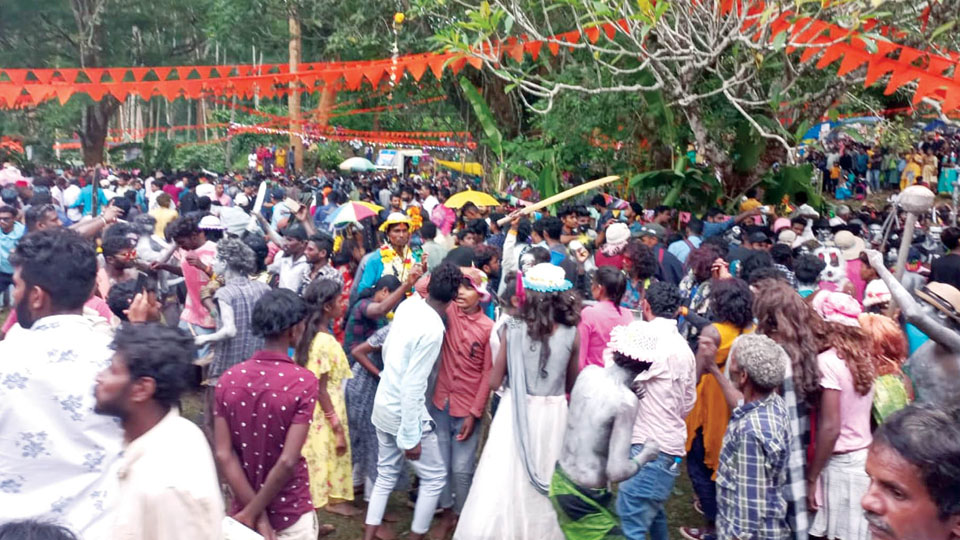
Yesterday, the fourth Thursday of May saw the culmination of ‘Kunde Habba’ in parts of tribal-dominated South Kodagu, Hunsur and Hanagodu that borders Nagarahole Tiger Reserve.
It is a peculiar festival where choicest abuses are hurled against the Tribal Gods Ayyappa and Bhadrakali and this is a tradition diligently followed by the tribal communities — predominantly, Jenukuruba, Betta Kuruba, Kuruba and Yerava communities — for centuries.
They are the original inhabitants of Kodagu and forests are their homes. Now due to strict forest laws, they are displaced and many work as labourers in estates and fields. The influential among them have got a good education and are settled in cities also. However, most of them depend on Government welfare schemes for survival.
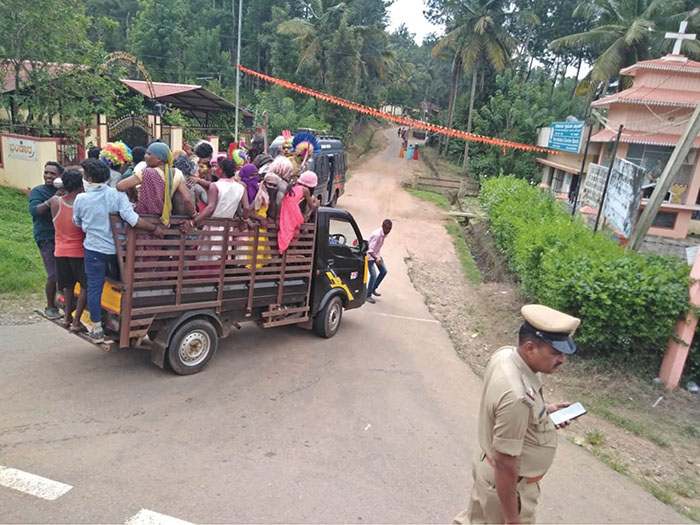
Usually, the festival begins three days before the last Thursday of the May month and it is celebrated with pomp and gaiety. Bawdy abuses rent the air in South Kodagu, especially Gonikoppa, Ponnampet, Pollibetta, Balele, Maldare, Siddapura, Thithimathi, Devarapura, Periyapatna, fringes of Nagarahole Tiger Reserve, tribal settlements and now the festival has extended till Hanagodu and Hunsur, thanks to hundreds of Government-sponsored settlements.
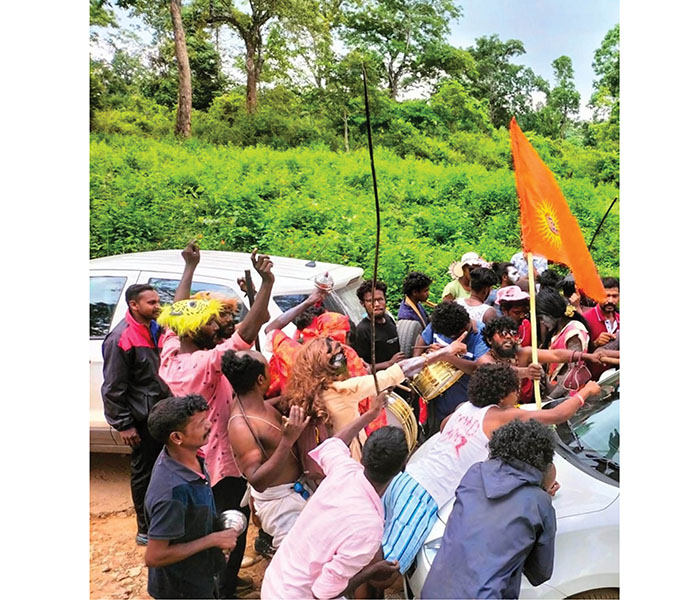
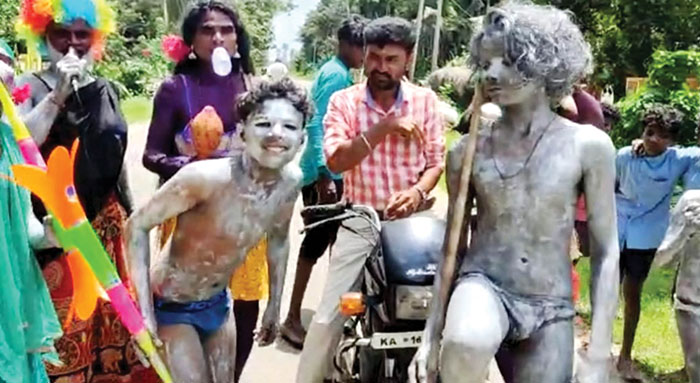
The highlight of this festival is participants hurling vulgar abuses and collecting alms. Weird attires, gaudy outfits with props that signify vulgarity are worn and vulgar abuses are hurled at every passer-by. The tribals hold long bamboo poles in their hands along with beating objects including empty plastic drums, and vessels. The sound of beating objects rends the air as tribals make merry.
Cross-dressing is a common practice for tribals during the fest. Wearing weird and garish make-up and getting dressed up in women’s clothes, men hurling abuse and singing vulgar songs demanding money from people are also part of the festival. Though vulgar abuses are hurled at women, they do not mind as they know that they are not the actual targets.
Smeared in mud and colourful paints, they head out on a procession to openly dismiss the God who once abandoned his tribe. The tribal communities believe that Lord Ayyappa and Goddess Bhadrakali betrayed the tribal people and in revenge, they abuse them to get back their affection on the fourth Thursday of May.
Legend has it that when Lord Ayyappa and some tribals went to the forest to hunt, he met Bhadrakali and fell in love with her. The smitten Lord went with Bhadrakali and forgot the tribals who felt ignored and cheated. They later started observing the day as a festival to commemorate the incident by abusing the Gods.
After marching on the roads and collecting alms even by stopping vehicles and crowding in front of shops, the tribals converge at the Bhadrakali Temple in Devara Kadu (sacred grove) at Thithimathi. They dance around the Temple and even here, they hurl choice obscenities in praise of their deities. But the liberty of abusing the Gods is taken only during Kunde Habba. On other days, the Gods are revered and ardently worshipped.
source: http://www.starofmysore.com / Star of Mysore / Home> News/ May 27th, 2022
Panchayat delegation to meet Forest, Tourism Ministers; will explain tourist inconvenience
Kushalnagar:
There is a renewed demand for a hanging bridge for River Cauvery at Dubare Elephant Camp in Kodagu, one of the main tourist attractions. The sanctioned project has been shelved now.
The Nanjarayapatna Gram Panchayat will push for the project and there are plans to meet Forest Minister Umesh Katti and Tourism Minister Anand Singh in the coming days.
The Panchayat is upset that its demand for hanging bridge has not been met despite funds being sanctioned twice and it has blamed the Forest Department for putting a spanner in the works, by citing procedural and permission issues.
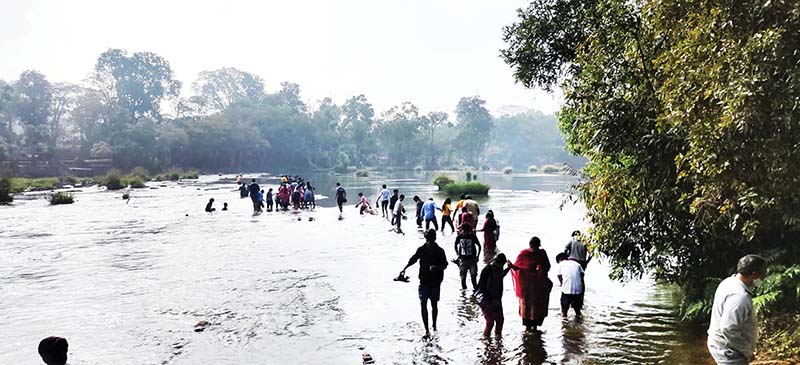
River Cauvery flows in full force here and the two sides can only be accessed by motorised boats at present. The Panchayat President and members said that in the absence of a hanging bridge, tourists are risking their lives to cross from one side of the river to another.
While one side of the river bank is controlled by the Tourism Department, the other by the Forest Department that runs an elephant camp there. The suspension bridge was conceptualised to be 110 metres in length and 1.8-metre width and way back in 2015-2016, the Kodagu Tourism Department first sent the proposal at an estimated cost of Rs. 2.35 crore.
Two proposals not materialise.
It was to have three columns — two at the sides and one in the middle — as it is 1.8 metres wide. Other hanging bridges usually have only two columns. The Tourism Department sanctioned Rs. 1 crore for the project and consulted Girish Bharadwaj, popularly known as the ‘Bridgeman’ of India.
But the Forest Department denied permission and objected to the bridge construction by a third party, Nanjarayapatna Panchayat President C.L. Vishwa told Star of Mysore this morning.
In the second proposal, the Tourism Department wrote to the Forest Department and said that funds can be sanctioned by the Tourism Department and Forest Department can take up construction as per their norms after getting clearances. Even this did not take shape. “The Forest Department is not obliging and the officers are citing rules and other procedural issues,” he said.
Due to this bureaucratic back and forth, the Rs. 1 crore released was returned to the Government. “The Forest Department runs boat service from one side to other and there are only two mechanised boats that can accommodate only 15 but over 20 are accommodated without life jackets. Thousands of tourists miss seeing the elephants and the elephant camp that is only open from 8.30 am to 11.30 am. Only over 100 tourists can take the boats in over 10 to 12 trips,” he said.
Tourists risk lives
Due to the heavy rush for boats, many tourists take the risk of walking across the river on slippery rocks. Many deaths and accidents have occurred due to this and the Forest Department has to take the blame, Vishwa added. “The Department’s callousness is endangering the lives of people and without getting a chance to see the elephants, tourists refuse to pay the parking charges and this leads to fights,” he said.
The Panchayat will write to the Taluk Executive Officer, Kodagu Deputy Commissioner and Zilla Panchayat CEO seeking immediate construction of a hanging bridge. “We will even meet the Forest and Tourism Minister and explain the inconvenience to the tourists and also the risks involved in the absence of a hanging bridge,” he said.
source: http://www.starofmysore.com / Star of Mysore / Home> News> Top Stories / May 22nd, 2022
WELCOME. If you like what you see "SUBSCRIBE via EMAIL" to receive FREE regular UPDATES.
Read More »