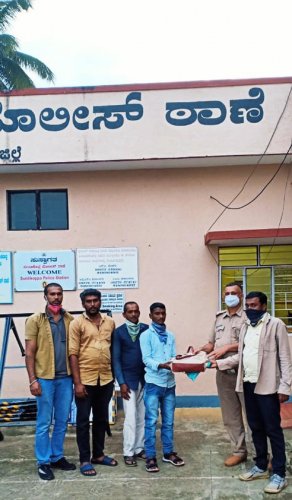
Auto drivers Sunil and Mujeeb returned a bag with cash, a mobilephone and documents to its owner at Suntikoppa in the presence of the police
Two honest auto drivers have returned a bag containing Rs 28,000 in cash, a mobile phone and documents to its owner.
Auto drivers Mujeeb and Sunil had found a bag lying on the ground at Panya Junction in Madapura. After opening the bag, they found that it had cash, documents and a mobile phone.
The duo handed the bag over to Autorickshaw Drivers and Owners’ Association president A M Shareef, who in turn handed it over to PSI Puneeth Kumar.
The police informed the owner of the bag.
It is said that plantation labourers Ravi and his wife were travelling in an auto and did not realise that their bag had fallen while they were travelling.
source: http://www.deccanherald.com / Deccan Herald / Home> State> Mangaluru / by DHNS, Suntikoppa / October 27th, 2021
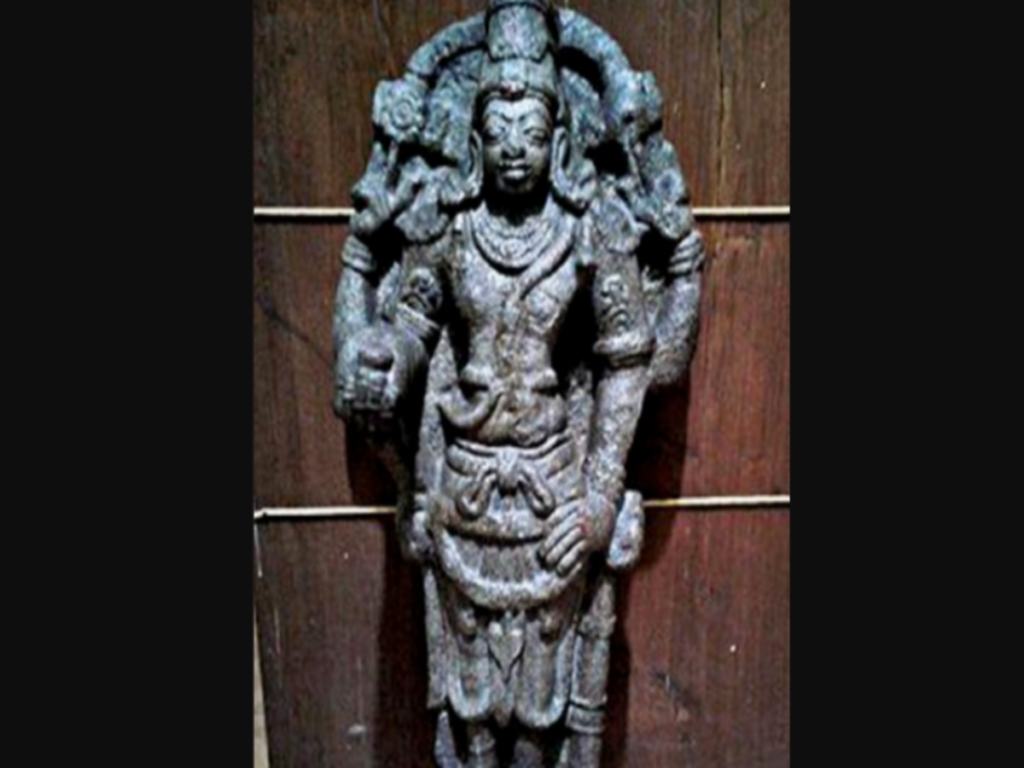
Idols of Lord Vishnu dating back to the 12th and 13th centuries are among the latest additions to the Kodagu District Museum on the premises of Madikeri Fort.
Museum curator Rekha said there are more than a thousand rare antiques at the museum.
Appealing to residents of Kodagu to hand over any rare historic idols they may stumble upon in their villages,, she said, “Many villagers have discarded many such ancient idols and artistic figures in rivers. When they find broken idols, they believe it brings bad luck and throw it away. Such monuments are valuable even if they are broken.
If they are confused, they can contact me for any guidance.”
The museum also houses the Kodava Odikathi, shaped in the form of the letter ‘V’, and the sickle, which is shown to the visitors.
“In 1975, Field Marshal Cariappa donated many valuable artefacts. We have kept them in a gallery. Many of these artefacts were made from plaster in Morocco. The museum also has many attractive items that date back to the days when Kodagu was ruled by various kings,” Rekha added.
source: http://www.timesofindia.indiatimes.com / The Times of India / Home> City News> Mysuru News / TNN / October 24th, 2021
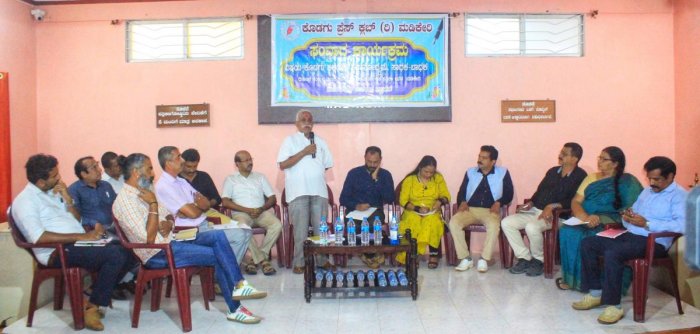
Chamber of Commerce president M B Devaiah speaks during a discussion on the pros and cons of tourism in the district, held at Kodagu Press Club, Madikeri, on Tuesday.
Various stakeholders in the tourism sector gave their suggestions towards developing sustainable and eco-friendly tourism in Kodagu, during a discussion on the pros and cons of tourism in the district, held at Kodagu Press Club, Madikeri, on Tuesday.
Chamber of Commerce president M B Devaiah said that it is the foremost duty of the people of Kodagu to preserve the environment of the district. Businesses can be carried out while maintaining ethics. Money is not everything.
“Nature-friendly industries should be set up in the district to provide jobs for people,” he added.
Pravasodyama Avalambitara Okkoota president K K Manjunath Kumar said that tourism contributes immensely to the development of a country.
Tourism in Kodagu has been generating good revenue, he said and pointed out that the countries which are backward in tourism are backward in development as well.
Resort and Hotel Owners’ Association president Nagendra Prasad said that there has been a significant rise in investment in the tourism sector in the district after the market for coffee fell. There are 1.50 lakh people in the district who are depending on tourism activities for their livelihood.
Kodagu Press Club president Ajjamada Ramesh Kuttappa in his introductory remarks, said, “Every citizen of the nation has a right to carry out legal work in any part of the country to make a living. No restrictions can be imposed on him or her in carrying out a job. A forum has been formed to discuss the problems of people working in the tourism sector and to find possible solutions.
Hotel, Lodges and Restaurants’ Association advisor Chidvilas said that coffee growers switched to homestay and hotel industry after they suffered losses in the coffee industry. He also advised imposing a total ban on plastic at tourist destinations in the district.
Kodagu Samrakshana Vedike convener Chammatira Pravin Uttappa said that there is a need to curb illegal activities which are carried out in the name of tourism.
“Insulting the traditional Kodava attire in some resorts should stop immediately. Tourism activities should stop during the Cauvery fair,” he added.
District Working Journalists’ Association president Savitha Rai, writer Bharadwaj K Anandateertha, Kodagu Hitarakshana Samiti president Rajiv Bopaiah, Travel Association president Cheyyanda Satya Ganapathy, Kodagu Tourism Association president Madetira Timmaiah and others were present.
source: http://www.deccanherald.com / Deccan Herald / Home> State> Mangaluru / b y DHNS, Madikeri / October 05th, 2021
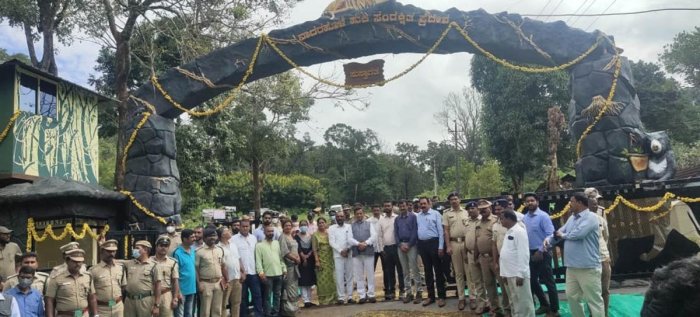
Virajpet MLA K G Bopaiah inaugurated the outpost and new welcome arch of Nagarahole Tiger Reserve, built at a cost of Rs 9 lakh, on the occasion of the 67th Wildlife Week on Sunday.
He said that the security has been upgraded with the new facility, so as to prevent the trespassing of people into the reserve forest. CCTV cameras have also been installed at the entrance.
Bopaiah also directed the forest department officials to take necessary measures to provide accessibility to fodder and water for elephants, bison and other herbivorous animals.
Saplings that provide fodder for such animals should be planted inside the forest area, he said.
“This will prevent the wild animals sneaking into human habitations, in search of food. Steps should also be taken to prevent the harm caused to the agriculturists living near the forests,” he added.
The MLA also inaugurated two safari tempo taxis for the benefit of visitors at Nagarahole. He also went on a safari in the new vehicle.
State Western Ghats Task Force chairman Shantheyanda Ravi Kushalappa, Nagarahole Tiger Reserve director D Mahesh Kumar, Nagarahole wildlife sub division ACF K P Gopal, Hunsur forest division ACF Satish and others were present.
source: http://www.deccanherald.com / Deccan Herald / Home> State> Mangaluru / by DHNS, Gonikoppa / October 03rd, 2021
Non-traditional coffee growing regions in India are having a moment in the sun
(Nathan Dumlao, Unsplash)
There was a time when coffee beans in India were assumed to have come from the South of India and the lush, verdant hills of Baba BudanGiri (regarded as the birthplace of coffee in India), Nilgiris and Kodagu in Karnataka that are known to be the key coffee producing regions in the country. Increasingly, places like Araku Valley near Visakhapatnam, Koraput in Odisha and Northeastern states such as Meghalaya and Nagaland as newer areas from where your favourite roasters have sourced their beans.
While coffee has traditionally been grown in South India and a majority of well-known estates continue to supply the bulk of coffee beans to roasteries across the country, the rise of these so-called non-traditional areas has been some time in the making. The coffee world took notice of this when Araku Coffee, that sources its beans from the eponymous valley comprising highlands of the Eastern Ghats, won the Gold Medal for the best coffee pod in the Prix Epicures OR 2018 Award in Paris, France, a first for any Indian coffee brand. The next year, a GI tag followed for Araku Valley coffee, giving its identity a permanent market and the scope to demand better price for its coffee.
What comes as a surprise is that just two decades ago, there was no Araku coffee and no market selling these coffees even though the region has a century-old relation to coffee plantation. Instead, tribals grew cash crops while the region was part of the Red Corridor for Naxal insurgency. This writer’s visit to Araku Valley by train in 2009 was suspended after major Naxal activity was detected the previous night with a high possibility of the tracks being blown apart, the station superintendent at the time informed.
Cooperatives like Girijan Co-operative Corporation and NGOs like Naandi Foundation worked with tribals in the region and over the years, a collective group effort with 10,000 farmers from 520 villages joined Araku’s coffee cooperative to cultivate 12,300 acres of land with world-class coffee. It has been described as the largest bio-dynamic coffee cooperative in the world.
“We empowered tribals to give us the best coffee and that led to a revolution in quality. Around 12 years ago, most coffees scored around 60 but today the score is over 85,” Manoj Kumar, CEO of Naandi Foundation and co-founder of Araku Coffee says. The widely accepted definition of specialty coffee is coffee scoring 80 points or above on a 100-point scale by the Speciality Coffee Association of America (SCAA).
To qualify as a specialty coffee, the beans have to be graded by certified coffee tasters known as Q graders. Coffee scoring 80–84.99 is graded Very Good, coffee that scores 85–89.99 is graded Excellent while Coffee scoring from 90–100 is graded Outstanding.
Araku’s success on the global stage set the stage for other places to bring out their coffees. Koraput, a region bordering Araku that finds itself in Odisha with issues related to Naxalism, has seen its fortunes rise as tribals engage in producing coffee that are wowing coffee lovers with its nuanced flavour profiles. “Coffee grown in forests like Koraput are semi wild grown coffees compared to coffee estates, which are a deliberate attempt to grow coffee. This biodynamic form of coffee is one of the key reasons coffee drinkers will find hints of Indian gooseberry and pepper that are also grown in the forest. This attribute has made Koraput coffee much sought after,” Debu Mishra, who started Tribe-O Koraput coffee and retailed with Mumbai-based Dope Coffee Roasters last year before expanding to other roasters says. When I tried this coffee last year, there was a natural acidity to the beans that can sometimes be difficult to discern with estate-grown coffees in my collection.
For its part, Dope Coffee expanded and bought 600 kilos of coffee from Durgamadhab estate in Koraput early this year after working with Tribe-O Project, Koraput. As Riyaaz Amlani, CEO of Dope Coffee says, “Customers today care where their coffee comes from. As roasters, it’s exciting to experiment with these beans that have great texture and density. Next year, we’re planning to help the estate with harvesting and post-harvesting processes as well.”
The Northeast, too, has seen local coffee brands grow. Meghalaya’s Smoky Falls Tribe Coffee sources the bean from farmers in the Jaintia hills and Khasi hills. Nagaland’s Été gets its beans from farmers in the state. Vivito Yeptho, co-founder and managing director of Nagaland Coffee Pvt Ltd, has found takers in his home state and few repeat customers across the country who buy their beans. “If you taste coffees from South India, they have distinct notes which are familiar to most. Then again, not everyone will enjoy Nagaland coffee that has a different taste profile with spicy notes,” he says.
Subko Coffee Roasters co-founder Rahul Reddy says: “The quality of the cup of coffee and its traceability is gaining traction. At Subko, we go by Lot numbers (specific quantities of beans collected from specific areas/portions, usually nanolots or microlots, on a coffee farm instead of picking all the coffee grown on the estate at one go) because everything is variable in coffee. The way I see it, as a roaster you are a curator of nuance,” adding that Garo Hills coffee from Meghalaya is among their highest-selling coffee.
The rise of coffee in non-traditional areas is still too small compared to overall coffee production in India. For example, of the 3,34,000 MTs of coffee produced in India in 2020-2021, only 11,500 MT came from non-traditional areas (comprising of North East, Odisha and Andhra Pradesh), according to the Coffee Board of India. However, coffee from these areas is projected to grow to 12,870 MTs for the 2021-2022 harvest season.
India’s most well-known roasters Blue Tokai has still to source coffee beans from these regions. Matt Chitharanjan, co-founder of Blue Tokai says that he would only consider selling coffees from non-traditional places if the coffee score crosses 82, which it hasn’t so far. “A coffee score below 82 is not unique for us. Then you’re just selling the coffee on its story. Araku is an exception but when we worked two years ago to elevate coffee scores in Andhra Pradesh we only saw a marginal improvement from 76 to 78. The real challenge is crossing that barrier.”
The rise of coffee in non-traditional areas is still too small compared to overall coffee production in India. For example, of the 3,34,000 MTs of coffee produced in India in 2020-2021, only 11,500 MT came from non-traditional areas (comprising of North East, Odisha and Andhra Pradesh), according to the Coffee Board of India. However, coffee from these areas is projected to grow to 12,870 MTs for the 2021-2022 harvest season.
India’s most well-known roasters Blue Tokai has still to source coffee beans from these regions. Matt Chitharanjan, co-founder of Blue Tokai says that he would only consider selling coffees from non-traditional places if the coffee score crosses 82, which it hasn’t so far. “A coffee score below 82 is not unique for us. Then you’re just selling the coffee on its story. Araku is an exception but when we worked two years ago to elevate coffee scores in Andhra Pradesh we only saw a marginal improvement from 76 to 78. The real challenge is crossing that barrier.”
Sunalini Menon, President, Coffeelab, Bengaluru says that the rise of coffees outside Chikmagalur can be attributed to a few reasons. According to her, “Talking about involving indigenous communities to produce coffee makes for a good story. Araku Coffee paved the way and made people realise that. The coffee from these regions has also seen simultaneous improvement. I am impressed with the how far coffee from Koraput has come. Finally, new coffee entrepreneurs need to stand out and sourcing coffees from non-traditional places is one surefire way of doing that.”
Beginner’s guide to buying coffee beyond Chikmagalur 1. Khar Single Estate Coffee from Nagaland Coffee 2. Durgamadhab Estate from Dope Coffee 3. Tribe Koraput Naturals from Dope Coffee 4. Garo Hills Experience Lot #2 from Subko Coffee Roasters 5. Tribe-O Project Koraput coffee from Marcs Coffees
Priyanko Sarkar is a Mumbai-based journalist and writer covering the beverage industry.
source: http://www.lifestyle.livemint.com / Mint Lounge / Home> Food> Drink / by Priyanko Sarkar / October 01st, 2021
WELCOME. If you like what you see "SUBSCRIBE via EMAIL" to receive FREE regular UPDATES.
Read More »