Introduction
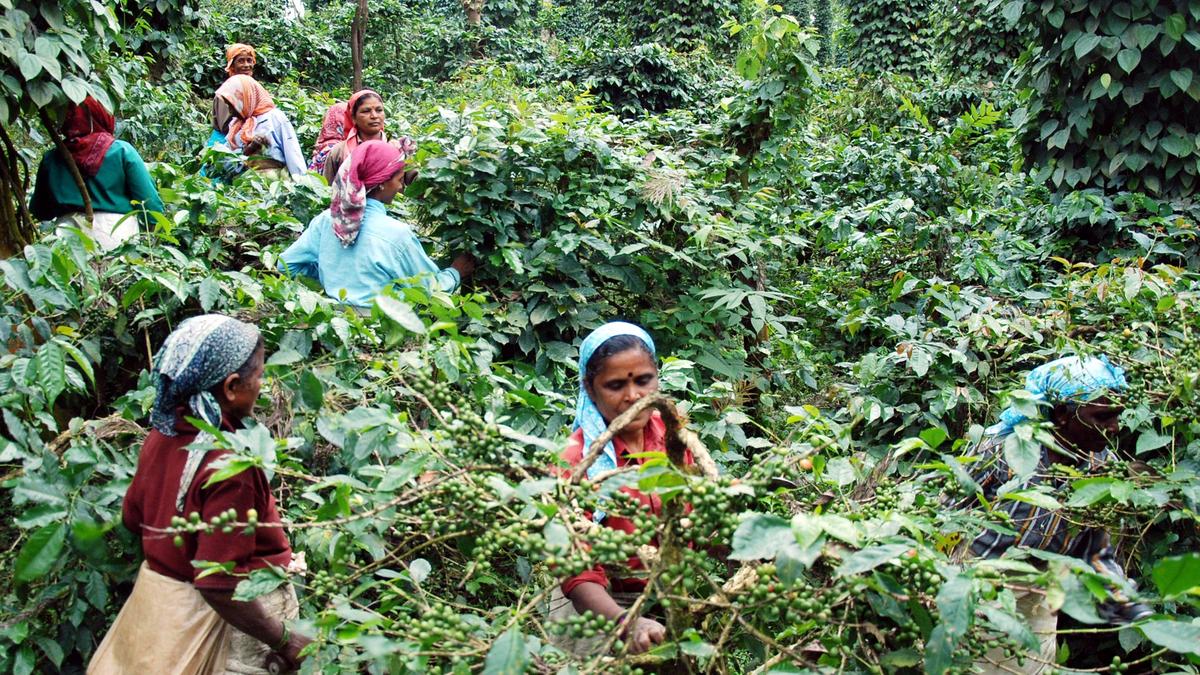
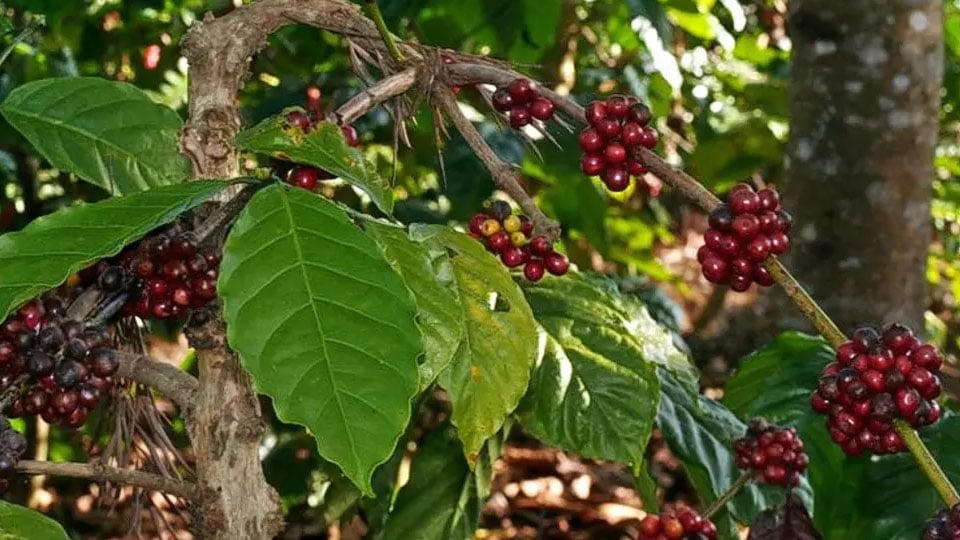
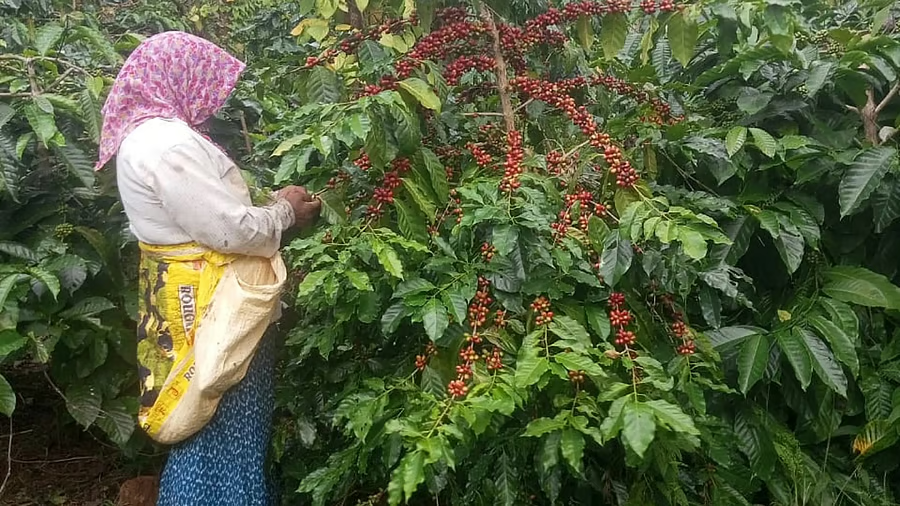
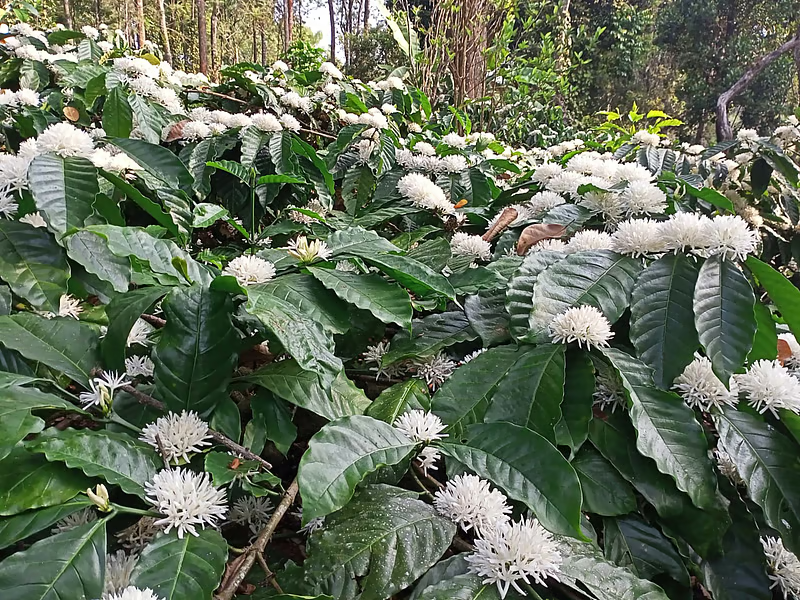
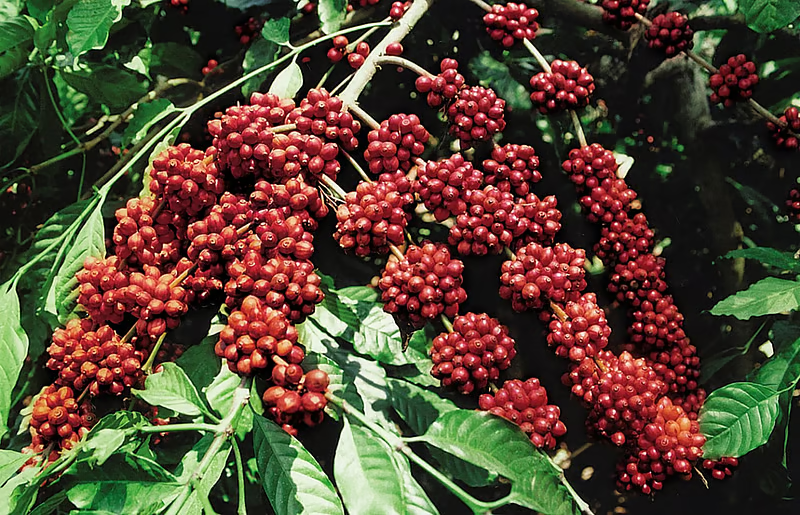
Legend has it that India’s coffee journey began around 1600 AD when Sufi Saint Baba Budan planted seven coffee seeds brought from Mocha port in Yemen in the Baba Budan Giri hills of Chikkamangaluru, Karnataka. Initially grown as a garden crop, coffee cultivation gradually expanded, leading to the establishment of commercial plantations in the 18th century. Since then, Indian coffee has evolved into a thriving industry with a distinct global identity on the world coffee map. Indian coffee is cultivated under a unique two-tier shade system of evergreen and leguminous trees, with nearly 50 varieties enhancing soil health and biodiversity. Grown across 4.91 lakh hectares in the Western and Eastern Ghats and the North Eastern region, coffee serves as both an environmentally sustainable and economically vital plantation crop. The coffee sector sustains the livelihoods of over two million people, who are engaged in cultivation, processing, and trade. Dominated by smallholder farmers, who account for nearly 99 percent of holdings and 70 percent of the country’s overall production, it stands as a vital pillar of India’s rural economy.
Coffee plantations also serve as vibrant spice gardens, cultivating a variety of spices alongside coffee, including pepper, cardamom, vanilla, orange, and banana. The Western Ghats, which form one of the 25 biodiversity hotspots in the world and Eastern Ghats, provide ideal conditions, with Arabica thriving in the cooler highlands and Robusta in the warmer, humid regions. India’s Robusta commands top premiums globally, while its Arabica is prized for its superior quality and distinct flavour. India is now one of the world’s leading coffee producers, ranking as the seventh-largest producer of coffee and contributing about 3.5 percent to global coffee production, according to the Coffee Board of India. India produces approximately 3.6 lakh tonnes of coffee annually, with nearly 70 percent exported to 128 countries, underscoring the growing global demand for Indian coffee.
Overview of India’s Coffee Sector
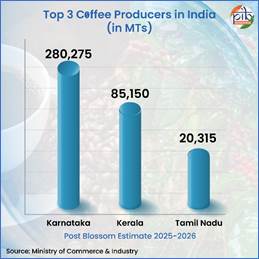
The coffee industry in India is primarily concentrated in the major coffee-growing states of Karnataka, Kerala, and Tamil Nadu, which collectively account for nearly 96 percent of the country’s total coffee production. Among these, Karnataka leads with a production of 2,80,275 metric tonnes (Post Blossom Estimate for 2025–26), followed by Kerala and Tamil Nadu.
India’s coffee-growing landscape is divided into 13 distinct agro-climatic zones, each with a unique identity and recognition for its coffees in global markets. These zones are categorized into three broad groups: a) traditional regions comprising Karnataka, Kerala, and Tamil Nadu; b) non-traditional regions–Andhra Pradesh and Odisha; and c) the North Eastern regions, including Assam, Arunachal Pradesh, Manipur, Meghalaya, Mizoram, Nagaland and Tripura. Coffee plays a vital socio-economic role in the tribal belts of Andhra Pradesh, Odisha, and the North-Eastern states, offering sustainable livelihoods while promoting rural development and ecological balance. The recognised coffee regions include Anamalais (Tamil Nadu), Araku Valley (Andhra Pradesh), Bababudangiris (Karnataka), Chikkamagaluru (Karnataka), Coorg (Karnataka), Nilgiris (Tamil Nadu), Sheveroys (Tamil Nadu), Travancore (Kerala), and Wayanad (Kerala).
Regional recognition of Coffees from India
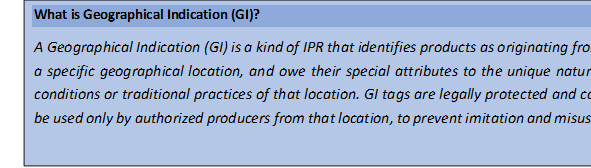
India holds Geographical Indication (GI) tags for five regional and two specialty coffees, a recognition that enhances their premium value in international trade. The country’s varied elevations, rainfall patterns, and soils conditions, contribute to the rich diversity and exceptional quality that define Indian coffee. The Department for Promotion of Industry and Internal Trade (DPIIT), Ministry of Commerce and Industry, Government of India, has granted Geographical Indication (GI) tags to five Indian regional coffee varieties: Coorg Arabica Coffee, Wayanad Robusta Coffee, Chikmagalur Arabica Coffee, Araku Valley Arabica Coffee, and Bababudangiris Arabica Coffee. Additionally, Monsooned Malabar Robusta Coffee, a unique specialty coffee from India, has also received GI certification.
Specialty coffees represent the finest quality beans, distinguished by their exceptional flavor, aroma, and appearance. These coffees are produced through careful cultivation, selective plucking, and meticulous processing, resulting in distinctive flavours that cater to discerning consumers worldwide. Owing to their uniqueness and craftsmanship, specialty coffees fetch premium prices and form an increasingly dynamic segment of India’s coffee sector. Indian planters have mastered the art of producing globally acclaimed specialty coffees, including:
- Monsooned Malabar AA – Known for its smooth, mellow flavour and low acidity, developed through a unique monsooning process along India’s western coast.
- Mysore Nuggets Extra Bold – One of India’s finest Arabica coffees with large beans, rich aroma, and full-bodied flavour.
- Robusta Kaapi Royale – A superior Robusta variety known for its bold flavor, excellent crema, and ideal for espresso blends.
This recognition has empowered Indian coffee producers to preserve the unique characteristics of region-specific coffees, elevate the global profile of Indian coffee, and secure better prices for their premium varieties. Collectively, these distinguished coffees reflect India’s harmony of tradition, innovation, and excellence, establishing the country as a significant player in the global coffee industry.
Establishment of the Coffee Board
In the 1940s, India’s coffee industry faced a severe crisis, caused by World War II, declining prices, and widespread infestations of pests and diseases. To safeguard and revive the sector, the Government of India enacted the “Coffee Act VII of 1942”, leading to the establishment of the Coffee Board of India under the administrative control of the Ministry of Commerce and Industry. The Board comprises 33 members, including the Chairman, and the Secretary, & the Chief Executive Officer along with representatives of coffee growers, traders, curing units, labor, consumers, state governments of major coffee-producing regions, and Members of Parliament. The Coffee Board’s primary mandate is to support and develop the entire coffee value chain through research and development. Technical and financial assistance, promotion in domestic and international markets. It works to improve production, productivity, and quality, expand exports for higher value realization, and strengthen infrastructure, such as drying yards and pulper units under the Integrated Coffee Development Project (ICDP).
Role of Coffee Board
The Research Department of the Coffee Board, headquartered at the Central Coffee Research Institute (CCRI) with five regional research stations, is dedicated to developing high-yielding, disease-resistant varieties and standardizing modern cultivation technologies to enhance productivity and quality. The Promotion Department focuses on expanding India’s footprint in global markets while stimulating domestic coffee consumption.
Under the Export Promotion Scheme, transit / freight assistance are provided for value-added coffees exported in retail packs as “India Brand” and for export of high-value green Coffees to far off destinations such as the USA, Japan, Canada, Australia, and New Zealand, South Korea, Finland, Norway and Denmark while maintaining strong trade ties with the European Union, Russia, and the Gulf Cooperation Council (GCC) countries. The Board actively represents Indian coffee at major international trade fairs and organizes the Flavour of India – The Fine Cup Competition, to identify premium coffees and connect them to global buyers. Domestically, to boost coffee awareness and culture, the board operates a network of 12 India Coffee Houses across major cities and participates in national exhibitions and trade fairs, promoting Indian coffee and highlighting its health benefits to consumers.
Export of Coffee
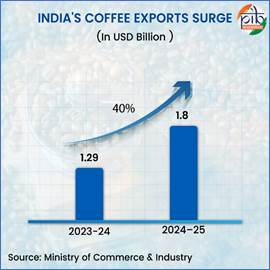
India has emerged as a significant player in the global coffee trade, ranking as the fifth-largest exporter of coffee among coffee-producing nations and contributing around 5 percent of total coffee exports from Coffee producing countries worldwide. Over the past four years, India’s coffee exports have consistently exceeded USD 1 billion, reaching a record USD 1.8 billion in FY 2024–25, reflecting an impressive 40 percent growth from USD 1.29 billion in the previous year. Despite global geopolitical challenges, exports during April–September 2025 stood at USD 1.07 billion, registering a 15.5% increase over the same period in 2024. India is one of the major hubs for instant coffee production and exports, with value-added products accounting for nearly 38 percent of total coffee exports.
As one of the world’s most widely traded and consumed commodities, coffee continues to hold immense economic and cultural significance. The top 5 export destinations for Indian coffee are Italy (18.09percent), Germany (11.01percent), Belgium (7.47percent), the Russian Federation (5.28percent), and the United Arab Emirates (5.09percent). The recent surge in India’s coffee exports has strengthened the global reputation of Indian coffee and improved income realisation for growers, particularly in the key coffee-producing states.
Policy and Trade Reforms Boosting the Coffee Sector
GST Reduction on Coffee Products
The reduction of GST from 18 percent to 5 percent on coffee extracts, essences, and instant coffee is a major fiscal step for the sector. This change is expected to lower retail prices by 11–12 percent, encourage domestic consumption, and enhance profitability for small processors. The initiative will also strengthen the domestic market base and enhance India’s per capita coffee consumption.
India–United Kingdom Comprehensive Economic and Trade Agreement (CETA)
The recently concluded India–UK Comprehensive Economic and Trade Agreement (CETA) marks a key milestone in bilateral trade relations. The pact offers tariff advantages for Indian value-added coffees, particularly instant coffee. The United Kingdom, which already accounts for 1.7 percent of India’s coffee exports, will now provide duty-free access for Roast & Ground and instant coffee, enabling Indian exporters to compete more effectively with suppliers from Germany, Spain, and the Netherlands. The agreement establishes a robust foundation for increasing exports of value-added coffee products to the UK.
India–EFTA Trade and Economic Partnership Agreement (TEPA)
The India–European Free Trade Association (EFTA) Trade and Economic Partnership Agreement (TEPA), signed on 10 March 2024 and effective from 1 October 2025, is the first Free Trade Agreement (FTA) by India to link investment with job creation. Under TEPA, Switzerland, Norway, and Iceland will offer zero percent duty on all coffee imports from India. TEPA provides the most favorable market access to Indian Coffees in the EFTA market. TEPA may help coffee exporters access premium markets in Switzerland, Norway, and Iceland, providing an opportunity to position India’s high-quality, shade-grown, handpicked, and sun-dried coffees in the EFTA market. The agreement enhances export opportunities for value-added coffee, such as roasted and instant coffees.
Fine Cup Awards: Showcasing India’s Finest Coffees
The Flavour of India – The Fine Cup Award, instituted in 2002 by the Coffee Board of India, celebrates excellence in Indian coffee and aims to place the country’s finest brews on the global map. As part of this initiative, the Coffee Board launched the Know Your Kaapi (KYK) programme in 2022–23, a specialised cup quality evaluation platform to assess and reward exceptional coffees across six categories.
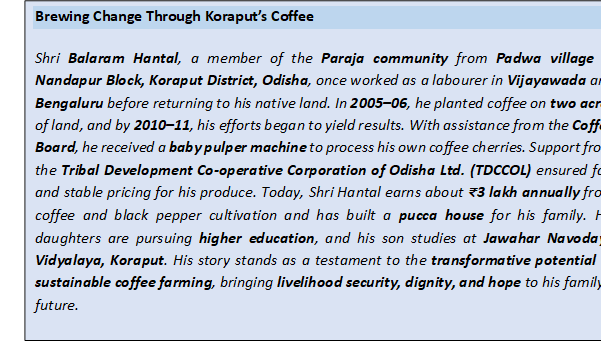
In a remarkable achievement, Koraput Coffee won two Fine Cup Awards during KYK 2024, one each for the washed process and natural process categories. This recognition has enhanced he brand’s prestige and firmly positioned Koraput Coffee on India’s specialty coffee map, reflecting the rising prominence of tribal and high-altitude coffees from Odisha.
Involvement of TDCCOL in Coffee Procurement and Marketing
The Tribal Development Co-operative Corporation of Odisha Ltd. (TDCCOL), established in 1967 under the ST & SC Development Department, Government of Odisha, serves as the state’s apex cooperative institution for tribal welfare. It plays a vital role in safeguarding the economic interests of tribal communities by ensuring fair prices for Minor Forest Produce (MFP) and Surplus Agricultural Produce (SAP), while promoting sustainable livelihoods across Odisha.
Since 2019–20, TDCCOL has taken a pioneering role in coffee procurement in Koraput district, known for its ideal conditions for high-quality Arabica coffee. The organisation transitioned from centralised mandis to doorstep procurement, ensuring fair pricing and promoting financial inclusion for tribal farmers.
Key highlights:
- End-to-end management: Managing the entire value chain, from procurement to drying, grading, and marketing.
- Fair pricing: Annual procurement rates aligned with ICTA market prices, with direct payments to farmers’ bank accounts.
- Socio-economic impact: The initiative has reduced distress migration and improved rural livelihoods.
- Value addition: Launch of the “Koraput Coffee” brand on 11 September 2019, offering sustainably sourced, rich-flavored coffee now recognized nationally.
TDCCOL has established eight “Koraput Coffee” cafés across Odisha – four in Bhubaneswar, one in Puri, two in Koraput, and one at Odisha Bhavan, New Delhi, further promoting the brand’s unique identity and sustainable origins.
The Coffee Board of India also supports TDCCOL through the Integrated Coffee Development Project (ICDP), providing technical and financial assistance for infrastructure such as drying yards and coffee pulpers.
Future Outlook: Scaling New Heights in Coffee Production
India’s coffee industry is poised for robust growth, with the overall market projected to expand at a compound annual growth rate (CAGR) of 8.9 percent by 2028. The out-of-home coffee segment is witnessing even faster growth, expected to rise at a CAGR of 15 to 20 percent, reaching a value between US$2.6 billion and US$3.2 billion by 2028. Furthermore, the Coffee Board of India has set an ambitious goal to scale up national coffee production to 9 lakh tonnes by 2047, reinforcing India’s emergence as a leading global coffee producer.
Conclusion
India’s coffee story is one of resilience, innovation, and transformation. From the humble beginnings in the Baba Budan Giri hills to earning global acclaim, Indian coffee has evolved into a symbol of quality, sustainability, and inclusive growth. The country’s unique ecological diversity, coupled with the commitment of millions of smallholder farmers, has created a coffee landscape that blends tradition with modern enterprise. The Coffee Board of India, through its ongoing support for research, development, export promotion, and domestic market expansion, has played a pivotal role in driving this transformation.
The emergence of specialty coffees such as Monsooned Malabar, Mysore Nuggets, and Koraput Coffee has strengthened India’s reputation as a producer of premium, globally competitive varieties. The success of tribal cooperatives like TDCCOL in Odisha has exemplified how coffee can be an instrument of socio-economic empowerment and sustainable livelihood creation. Furthermore, policy measures, such as the GST reduction and free trade agreements, including the India–UK CETA and India–EFTA TEPA, have further expanded opportunities for value-added coffee exports, marking India’s growing influence in the global coffee industry.
As the industry moves forward with a clear vision to enhance production to 9 lakh tonnes by 2047, India’s coffee sector stands at the threshold of a new era. With its focus on quality, sustainability, and equitable growth, India continues to brew a success story that is deeply rooted in its soil yet celebrated worldwide.
References
PM India
https://www.pmindia.gov.in/en/news_updates/pms-address-in-the-127th-episode-of-mann-ki-baat
Ministry of Commerce and Industry
Niryat
Coffee Board of India
https://coffeeboard.gov.in/index.aspx
https://coffeeboard.gov.in/RTI/Annual%20Report2023_2024_Hindi_Eng.pdf
https://coffeeboard.gov.in/coffee-regions-india.html?page=CoffeeRegionsIndia#int
https://coffeeboard.gov.in/RTI/CB%20Eng-AR_2022_23%20Final.pdf
https://coffeeboard.gov.in/coffee-statistics.html
https://coffeeboard.gov.in/Specialitycoffee.aspx
https://coffeeboard.gov.in/coffee-regions-india.html
https://coffeeboard.gov.in/aboutus.aspx
https://coffeeboard.gov.in/Publications/July14/Cover%20Story_pg18_23.pdf
Indian Brand Equity Foundation
https://ibef.org/exports/coffee-industry-in-india
PIB Press Release
https://www.pib.gov.in/PressReleasePage.aspx?PRID=2182006
https://www.pib.gov.in/Pressreleaseshare.aspx?PRID=1569831&ref=finshots.in
https://www.pib.gov.in/PressReleasePage.aspx?PRID=2182006
https://www.pib.gov.in/PressNoteDetails.aspx?NoteId=154945&ModuleId=3
https://www.pib.gov.in/PressReleasePage.aspx?PRID=2173138
*******
source: http://www.pib.gov.in / PIB Head Quarters / by PIB Delhi / November 29th, 2025