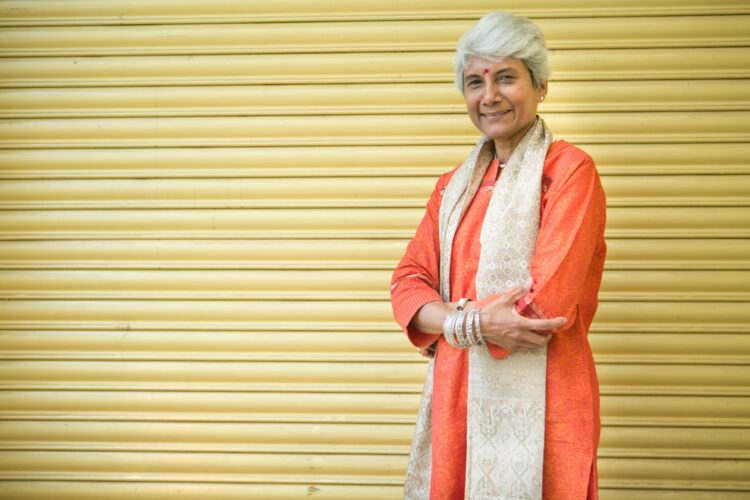
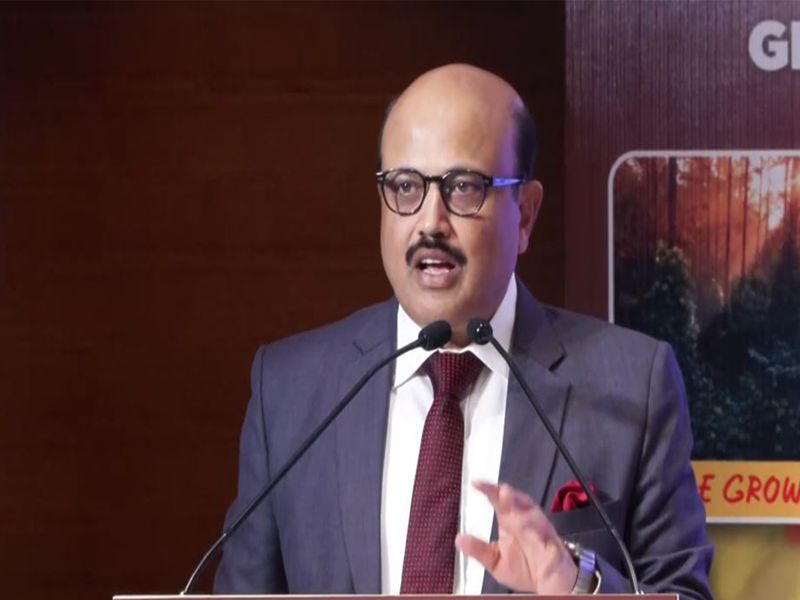
Sunalini Menon started working for the Coffee Board of India in 1971. Image CoffeeLab
The Specialty Coffee Association (SCA) has announced the candidates for its latest SCA Board of Directors Elections.
Following nominations and then interviews with the SCA Nominations Committee, Ahmed Bin Sulayem, Executive Chairman and CEO of DMCC; Sunalini N. Menon, President of Coffeelab Limited; and Karsten Ranitzsch, Global Head of Coffee at Nestle Nespresso S.A have been shortlisted.
From 1 to 30 September, a Nominations by Petition period will commence. Applicants not selected through the nominations and interview process who collect at least 100 signatures from SCA professional members or the primary contact of a company member can be added to the final ballot by petition.
The final ballot will be announced on 13 October. SCA members will be invited to vote for the new director from 1 to 30 November, with the result of the election to be announced on 15 December.
The SCA Board of Directors consists of 15 volunteer members, supported by CEO Yannis Apostolopouloss and the SCA staff. According to the organisation, the board supports the work of the SCA and provides mission-based leadership and strategic governance.
The SCA is the world’s largest coffee trade association. It was established in 2017 with the merger of the Specialty Coffee Association of America and the Specialty Coffee Association of Europe.
source : http://www.gcmag.com / Global Coffee Report / Home> News / by Kathryn Lewis / August 28th, 2026
In this photo essay, we showcase more exhibitors at IICF 2026, along with expert insights.
Bengaluru recently hosted the 2026 edition of the India International Coffee Festival (IICF) at Chamara Vajra, Jayamahal Road. See our earlier coverage of the World Coffee Conference in 2023 here.
“We estimate that 20,000 visitors attended the three-day IICF event. The energy on the floor was indicative of strong commercial engagement,” Hamsini Appadurai, President of the Specialty Coffee Association of India (SCAI), tells YourStory.
The festival featured India’s geo-tagged coffee varieties such as Coorg Arabica Coffee, Wayanad Robusta Coffee, Chikmagalur Arabica Coffee, Araku Valley Arabica Coffee, and Bababudangiris Arabica Coffee. There were also international brands such as MilkLab (Australia), Astoria Coffee Machines (Italy), and Probat Coffee Roasters (Germany).
IICF had parallel workshops on Farm to Cup: Post-Harvest Processing 101; Robusta Tasting: Processing Methods; Roasting Fundamentals: Profile Building & Tasting; Coffee Species Showcase & Guided Tasting; Manual Brewing and Espresso Brewing; and Marketing Specialty Coffee: Storytelling & Tasting;
There were panel discussions on a range of provocative topics: Why Biodiversity Is the Foundation of Coffee’s Future; and The New Coffee Farmer: Balancing Yield, Quality, and Profit in a Changing Market.
Many visitors said they appreciated the opportunity to learn about coffee trends and network with coffee lovers and industry professionals. “Exhibitors were pleased with the promotion of the shared vision and passion of the industry,” Appadurai adds.
She explains that the Australia delegation places IICF right up there along with other global events such as World of Coffee Dubai, World of Coffee Indonesia, World of Coffee Bangkok, FHA Singapore, and Melbourne International Coffee Expo.
“The festival was a rich source of inspiration and strategic thinking. One initiative already taking shape for the next edition is a dedicated micro-lot auction for roasters, an exciting development that we believe will add significant value to the specialty coffee ecosystem,” Appadurai says.
Last year, Nestlé India strengthened its premium at-home offering by bringing Nespresso to the country. “With this, we cater to consumers seeking super premium coffee experiences at home,” says Sunayan Mitra, Director – Coffee and Beverages, Nestlé India.
It has expanded its NESCAFÉ Ready-to-Drink cold coffee portfolio, and developed NESCAFÉ Ice Roast. At IIFC, it showcased Duo Gusto, a pioneering solution that dispenses both hot and cold beverages from a single machine. “Innovation in cold beverages is equally central to Nestlé’s out-of-home strategy,” he adds.
Next year’s IICF will have more stalls. “We would like to secure a larger venue, and significantly increase our international visitor footprint. The vision is to position IICF as a truly world-class destination event for the global specialty coffee industry,” Appadurai describes.
“Coffee is an experience, not merely a beverage We are witnessing a meaningful shift from coffee as a functional caffeine fix to coffee as a lifestyle and cultural statement,” observes Komal Sable, Co-Founder, South India Coffee Company.
Gen Z is driving experimentation and discovery. “Younger consumers are far more open to exploring new formats and alternative milk pairings,” she adds.
Sustainability and ethical sourcing are now baseline expectations. “But they must coexist with convenience. Today’s consumer demands transparency and responsibility, delivered in formats that fit seamlessly into a fast-paced lifestyle,” Sable explains.
Coffee makers are responding to these trends and shifts. “They need to be agile, transparent, and have stronger storytelling. Responsibility must begin at the origin,” she affirms.
Producers also bear a responsibility to better educate roasters, buyers and end consumers about the expertise, risk and dedication involved in cultivating quality coffee. “When that story travels clearly through the value chain, it builds a deeper, more authentic respect for origin,” Sable suggests.
Coffee thus lends itself well to purpose-led enterprise. “It brings together agriculture, branding, community, and commerce in a deeply meaningful way. The growth of specialty coffee and direct-to-consumer models has also lowered the barriers to entry,” she says.
More women are stepping into roles that were historically male-dominated. “These include estate leadership, green buying, roasting, and supply chain management,” she observes, citing diverse examples from Kaveri Coffee, Coromandel Coast, Sangameshwar Coffee, and Coffee Mechanics.
“Creating intentional platforms that spotlight women in coffee is essential not only for representation but also for building lasting confidence, access and opportunity within the ecosystem,” Sable emphasises.
Coffee today is not simply about selling a beverage. “It is about shaping culture. And women are trailblazing that shift in remarkable ways across every level of the industry,” she says with pride.
However, the coffee industry is facing challenges like unpredictable rainfall, rising temperatures, and shifting crop cycles that directly affect quality, yields and costs at origin. “Supporting producers and investing in long-term ecosystem partnerships is not a choice — it is essential to the future of coffee,” she cautions.
SCAI and the Coffee Board of India are committed to driving knowledge transfer within the industry. “We will have expanded workshops, masterclasses and curated learning experiences. The best is very much yet to come,” Appadurai signs off.
Now what have you done today to pause in your busy schedule and harness your creative side for a better world?
(All photographs taken by Madanmohan Rao on location at IICF 2026.)
source: http://www.yourstory.com / Your Story / Home> Food & Beverages / by Madanmohan Rao / March 08th, 2026
India’s rich coffee heritage took center stage at the AI Impact Summit 2026 in New Delhi, where global leaders and tech CEOs sampled the country’s GI-tagged coffees.
At the India AI Impact Summit 2026 in New Delhi, alongside discussions on artificial intelligence and global collaboration, another distinctly Indian story brewed quietly but powerfully. The Commerce Ministry unveiled the Bharat GI Coffee Lounge, showcasing India’s exclusive Geographical Indication (GI)-tagged coffees.
Leaders including Google’s Sundar Pichai and OpenAI’s Sam Altman sampled these varieties, with Pichai himself praising the Malabar Arabica.
The showcase highlighted how India’s coffee heritage, rooted in specific regions and traditions, is now being positioned as a global brand.
Chikmagalur Coffee: Often called the birthplace of coffee in India, Chikmagalur in Karnataka is where the first coffee beans were planted centuries ago. The GI tag recognizes its unique flavour profile – smooth, mildly acidic, and aromatic. Chikmagalur coffee is prized for its balanced taste, making it a favorite among connoisseurs who prefer a class
Bababudangiris Coffee: Named after the revered Sufi saint Baba Budan, who is said to have introduced coffee to India, this variety comes from the Baba Budangiri hills in Karnataka. It is known for its full-bodied flavour, with notes of chocolate and spice. The GI tag ensures that this historic and culturally significant coffee is protected and celebrated worldwide.
Coorg Coffee: Coorg, also in Karnataka, is famous for its lush plantations and distinctive coffee. Coorg coffee is rich, bold, and slightly bitter, often described as earthy with a lingering finish. The GI tag highlights its regional authenticity, and it remains one of the most exported Indian coffees.
Wayanad Coffee: From Kerala’s Wayanad district comes a coffee that thrives in the Western Ghats’ biodiversity. Wayanad coffee is smooth, with fruity undertones and a gentle acidity. The GI tag emphasizes its eco-friendly cultivation practices, often grown alongside spices, which add subtle complexity to its flavour.
Araku Valley Coffee: Produced by tribal farmers in Andhra Pradesh’s Araku Valley, this coffee is celebrated for its organic cultivation and social impact. Araku coffee is mild, with floral notes and a clean finish. The GI tag not only protects its identity but also supports the livelihoods of indigenous communities, making it a symbol of sustainable agriculture.
Monsooned Malabar Coffee: Though not always listed among the original five, Monsooned Malabar from Kerala and Karnataka has become iconic. Beans are exposed to monsoon winds, swelling and mellowing to produce a unique, low-acid, heavy-bodied coffee with a distinctive flavor. Sundar Pichai’s approving sip at the AI Summit brought this variety into the global spotlight.
source: http://www.news18.com / News18 / Home> Showsha> English edition / curated by Sujata Singh / eidted by Priyanka Das / February 20th, 2026
India International Coffee Festival 2026 in Bengaluru from Feb 12. Showcasing India”s coffee ecosystem, quality, and diversity.
pix
Bengaluru, (PTI) :
The India International Coffee Festival beginning from February 12 is expected to attract over 20,000 visitors, officials said on Monday.
The three-day festival will be held at Chamara Vajra, Jayamahal here with the support of the Specialty Coffee Association of India (SCAI), Coffee Board of India and presented by NESCAFA, Nestle India, they said.
The festival brings together the entire spectrum of India’s coffee ecosystem on a single platform, officials said.
Addressing a press conference here, Kurma Rao M, CEO and Secretary, Coffee Board of India termed the India International Coffee Festival (IICF) as the country’s only dedicated coffee festival.
He said IICF 2026 will convene coffee growers, processors, exporters, roasters, equipment manufacturers, cafe brands, baristas, and consumers.
Positioned as an industry-led forum, the festival focuses on collaboration, knowledge exchange, innovation, and market access at a time when India’s coffee sector is transitioning towards quality-led growth, he added.
“Indian coffee is gaining recognition for its quality and diversity. Platforms such as IICF play an important role in connecting producers with markets, encouraging best practices, and supporting the long-term growth of both domestic consumption and exports,” Rao told reporters here.
IICF organiser and SCAI president Hamsini Appadurai said, “India’s coffee sector is steadily moving from a commodity-led approach to a quality and experience-driven market.”
“This edition of IICF reflects that shift with greater scale, deeper business engagement, and a strong focus on showcasing the diversity and potential of Indian coffee across domestic and global markets,” she said.
According to a statement, the festival, which is structured around a farm-to-cup framework, offers insights into production, processing, roasting, and brewing through curated tastings, workshops, and cupping sessions.
These experiences highlight regional coffee profiles, processing techniques, and flavour development, encouraging informed consumption and a deeper appreciation for quality and traceability, it said.
The 2026 edition will also host the National Coffee Championships, where winners from regional rounds will earn the opportunity to represent India at international competitions, reinforcing India’s presence on the global coffee stage, Rao said.
Source: PTI By Rediff Money Desk, Bengaluru
DISCLAIMER – This article is from a syndicated feed. The original source is responsible for accuracy, views & content ownership. Views expressed may not reflect those of rediff.com India Limited.
source: http://www.money.rediff.com / rediff / Home> Market News / by Rediff Money Desk, Bengaluru / by PTI / February 09th, 2026
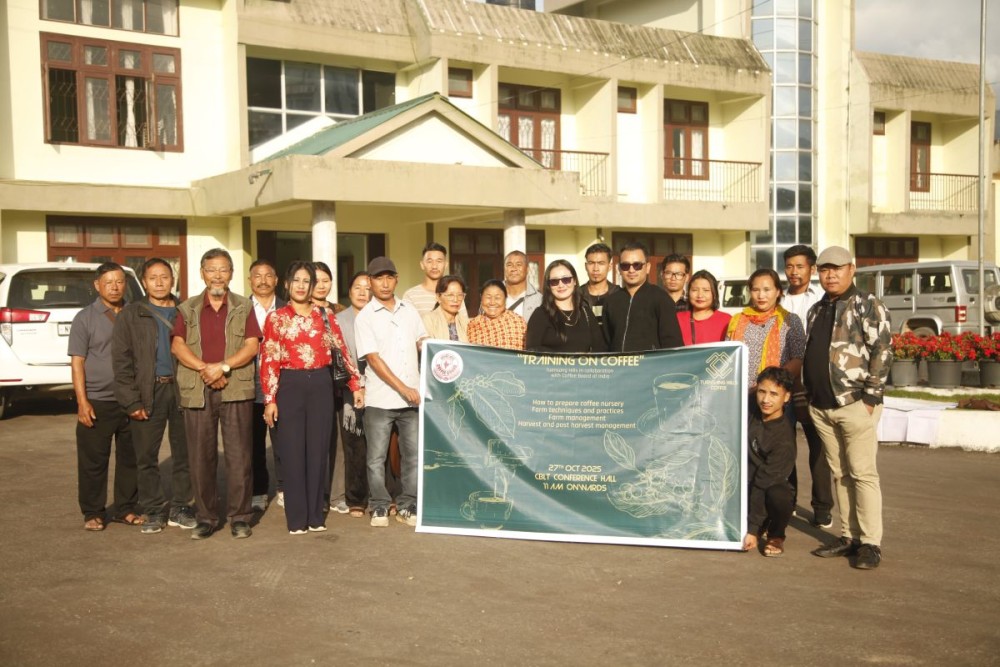
Officials from CBI and Founder and Co-founder of Tuensang Hills with the participants along with the officials of Land Resource Department. (morung photo)
A one-day training programme on coffee cultivation was held in Tuensang to build technical knowledge among local farmers in Nagaland.
The training, organised by Tuensang Hills Coffee in collaboration with the Coffee Board of India (CBI), was conducted at the Chang Baptist LashongThangyen (CBLT) conference hall in Tuensang Town on October 27.
The programme aimed to equip farmers with expertise in key areas, including nursery preparation, advanced farm techniques and practices, farm management, as well as harvest and post-harvest handling.
Around 30 participants took part in the session, which was facilitated by DipanjaliKemprai, Senior Liaison Officer, and N ImtisungchitImchen, Assistant Extension Officer, both from the Coffee Board’s Mokokchung office. Officials from the Land Resources Department, Tuensang, also attended the training, underscoring the department’s continued support in promoting coffee cultivation in the district.
Founder of Tuensang Hills Coffee, PangshaChingmak, said the training was initiated to empower farmers with practical skills and promote coffee as a viable livelihood option in Tuensang district. He highlighted the district’s suitable terrain and climate for coffee cultivation and emphasized plans for sustained follow-up programs and field support to assist farmers after the training.
Responding to questions, Kemprai explained that the collaboration began when Chingmak approached the Coffee Board with details of his startup, Tuensang Hills Coffee, which has been selected for incubation under AIC CCRI-CED. “Our office came forward to boost his startup by providing technical knowledge to the farmers to produce good quality coffee,” she said.
Kemprai added that the Coffee Board continues to support farmers across Nagaland through the Integrated Coffee Development Project, offering subsidies, training, and assistance from “bean to cup.” She also mentioned plans to strengthen market linkages to ensure better prices for local produce and to organize more quality-improvement trainings in the future.
On challenges faced in promoting coffee cultivation in the Northeast, Kemprai noted that small and scattered farm holdings, poor road connectivity, and limited manpower make regular monitoring difficult. To bridge communication gaps, the Board has created WhatsApp groups for quick dissemination of information and encourages farmers to access details of schemes and technical support through the official Coffee Board website.
Highlighting the growing recognition of Naga coffee, Kemprai said, “The future of Naga coffee looks promising. Many entrepreneurs and farmers are coming forward, and Nagaland coffee is gaining recognition for its organic nature and quality.” She cited the state’s achievements at the Aurora International Taste Challenge winning a silver plaque in 2021 and a gold award in 2023 as evidence of its rising reputation in the specialty coffee market.
The training concluded with interactive discussions and a call to strengthen community-based efforts for sustainable coffee cultivation in Eastern Nagaland.
source: http://www.morungexpress.com / The Morung Express / Home / by Morung Express News / October 28th, 2025
Commerce Secretary Rajesh Agrawal emphasised the need for diversifying coffee cultivation in India, highlighting the sustainability of Indian coffee grown alongside forests.
Speaking at the inauguration of the Coffee Experience Zone and Expo, organised by the Coffee Board, Agrawal noted a significant rise in coffee exports that had doubled in recent years.
He said the growing domestic demand for coffee, driven by India’s expanding middle class, and predicted a surge in consumption.
Agrawal also highlighted the rise of new entrepreneurs in the coffee sector, particularly in instant and specialty coffee.
source: http://www.tribuneindia.com / The Tribune / Home> Business / by Tribune News Desk / October 03rd, 2025
A unique Coffee Dasara blending festive spirit with agricultural pride will be held on Sept. 24 (Wednesday) at Gandhi Maidan in Madikeri, celebrating Kodagu’s deep-rooted coffee culture.
The event will honour coffee growers and provide valuable insights into cultivation techniques, announced H.T. Anil, Convener of Coffee Dasara.
Launched last year under the vision of Madikeri MLA Dr. Mantar Gowda, Coffee Dasara returns this year following an overwhelming response. The second edition is being organised in collaboration with the Coorg Planters’ Association.
The programme will begin at 10 am at the Sakamma Memorial Hall, named after Kodagu’s trailblazing coffee entrepreneur, the late Sakamma — Karnataka’s first woman coffee entrepreneur. Coffee stalls will be opened in her memory, celebrating her legacy.
A lecture series from 10.30 am to 1 pm will offer practical knowledge and expert guidance to coffee cultivators. At 1 pm, ten distinguished coffee growers from Kodagu will be felicitated for their exceptional contributions to the coffee industry.
Coffee on the menu
Adding a delicious twist to the festivities, culinary competitions will showcase coffee’s versatility in cooking and baking. Categories include coffee-flavoured cakes, cupcakes, brownies, biscuits, puddings, beverages, and chocolates — all celebrating coffee as both a drink and a delicacy.
This year’s Coffee Dasara will feature 35 stalls highlighting coffee-related products, information and innovations. Speciality brews will be served by local cafés, while major exhibits will be set up by the Indian Coffee Board, Horticulture Department, Industries Department, HOPCOMS, Nandini Dairy and the Kodagu Coffee Growers’ Cooperative Society, among others.
Coffee Dasara continues to honour Kodagu’s rich coffee heritage by blending tradition, innovation and community pride. This vibrant event not only celebrates the region’s global reputation for coffee cultivation but also strengthens the bond between growers, producers and coffee lovers.
source: http://www.starofmysore.com / Star of Mysore / Home / September 22nd, 2025
The festival celebrated India’s growing coffee culture and featured a vibrant mix of food stalls, lifestyle brands, and live music, creating a lively atmosphere for attendees.
The India International Coffee Festival (IICF) 2025 was held from April 25- 27 at Marakata, Chamara Vajra, on Jayamahal Main Road, Bengaluru. Organised by the Specialty Coffee Association of India (SCAI) with support from the Coffee Board of India, the event brought together some of the country’s finest brewers, baristas, and coffee enthusiasts.
Following its successful 2024 editions in Delhi, Mumbai, and Bengaluru, the festival offered three days of competitions, discussions, entertainment, and interactive experiences. Highlights included the semi-finals and finals of the National Barista Championship (NBC), National Latte Art Championship, National Brewers Cup (NBrC), and the grand finale of the National Filter Coffee Championship.
DM Purnesh, President, Specialty Coffee Association of India (SCAI) said, “IICF has always been an inspiration for coffee lovers, industry experts, and brands. As we return with the much-anticipated semi-finals and finals, we’re proud to once again spotlight and celebrate the country’s finest coffee talent. With seasoned baristas, industry pioneers, and even discerning coffee critics in attendance, IICF 2025 promises to be an unmissable event for anyone passionate about the art of coffee.”
The festival celebrated India’s growing coffee culture and featured a vibrant mix of food stalls, lifestyle brands, and live music, creating a lively atmosphere for attendees. Experts, top growers, roasters, and equipment makers participated, sharing insights into brewing trends and innovations.
Sreeram G, Director, Marketing, Specialty Coffee Association of India (SCAI) said, “The India International Coffee Festival is not just about competition; it’s about connection. This festival serves as a dynamic platform for networking, innovation, and celebrating coffee as a lifestyle. It brings together coffee professionals, aficionados, and industry leaders to exchange ideas, explore emerging trends, and experience the rich intersection of coffee, cuisine, and craftsmanship.”
source: http://www.bwhotelier.com / BW Hotelier / Home> F&B / by BW Online Bureau / April 08th, 2025
The sharp rise on February 11 was attributed to severe crop losses in Brazil and Vietnam — world’s leading coffee producers — due to adverse weather conditions.
The sharp rise on February 11 was attributed to severe crop losses in Brazil and Vietnam — world’s leading coffee producers — due to adverse weather conditions. (Shutterstock)
Bengaluru:
Coffee prices in Karnataka’s Kodagu and Chikkamagaluru markets that recently surged to historic levels was driven by a global supply crunch, according to officials familiar with the matter. Arabica Parchment, a premium coffee variety, soared to ₹29,600 per 50 kg bag in Chikkamagaluru, while Kodagu recorded an even higher price of ₹29,800, marking an unprecedented peak.
The sharp rise on February 11 was attributed to severe crop losses in Brazil and Vietnam — world’s leading coffee producers — due to adverse weather conditions. Experts predicted that recovery will take at least five to eight years, as new coffee plants require time to mature and yield produce.
“Coffee prices are heavily influenced by weather conditions, and it’s impossible to assume that current prices will remain steady,” Coffee Board president Dinesh Devavrinda told HT. He advised growers, particularly those with outstanding bank loans, to capitalise on the price surge by opting for the One-Time Settlement (OTS) scheme, which covers the principal amount up to ₹5 lakh.
India produces approximately 365,000 tonnes of coffee annually, with 70% of the yield exported to European markets. Karnataka is the country’s largest coffee producer, accounting for 70% of national output, with Kodagu alone contributing 32%. The state has 246,000 hectares of coffee estates, yielding 220,000 tonnes annually, while Kodagu, spanning 4,102 square kilometers, produces around 120,000 tonnes from 110,000 hectares of estates.
At the beginning of the year, coffee prices were volatile, but a steep upward trend emerged over the past 10 days, with daily price hikes ranging between ₹500 and ₹1,000 per bag. On January 1, Arabica Parchment was priced at ₹17,000 per 50 kg bag but by the end of the month, it rose to ₹23,500. Other coffee varieties also saw significant increases: Robusta Parchment reached ₹24,500, Arabica Cherry was sold at ₹17,000, and Robusta Cherry hit ₹13,500 in Kodagu markets.
According to market analysts, the absence of buffer stock this year has further aggravated the supply shortage, pushing prices to record highs.
Rajiv Kushalappa, managing director of Leonflix Fintech Ventures Pvt Ltd, a Bengaluru-based coffee export firm, pointed to the impact of global shortages. “Thousands of coffee estates have been destroyed in Brazil and Vietnam, leading to a severe supply crunch in the international market. With no buffer stock available this year, prices have skyrocketed and are likely to remain high for some time,” he said.
For coffee growers, the soaring prices offer much-needed financial relief. “This is the first time I am getting such record prices. Growers have long struggled with high production costs, disease outbreaks, and labour shortages. Arabica coffee estates require significant manpower, and labor costs have risen due to shortages. These higher prices will help growers maintain their estates,” Sannuvanda Kaverappa, a grower from Napoklu in Madikeri, said.
Kodagu, nestled in the Western Ghats of Karnataka, is India’s largest coffee-producing region, contributing nearly 32% of the country’s total output. The district, spanning 4,102 square kilometers, is home to vast coffee estates spread across 1.1 lakh hectares. Known for its rich biodiversity and hilly terrain, Kodagu primarily cultivates Arabica and Robusta coffee varieties. Coffee farming, introduced by British planters in the 19th century, remains the backbone of the local economy, with thousands of small and large growers dependent on it. The region’s coffee is highly sought after in international markets, with 70% of India’s coffee production being exported.
source: http://www.hindustantimes.com / Hindustan Times / Home / by Coovercolly Indresh / February 18th, 2025
On Friday, the farm gate price of raw Robusta coffee berries in Wayanad market rises to a record ₹251 a kg, a significant increase from ₹171 a kg during the same period last year.
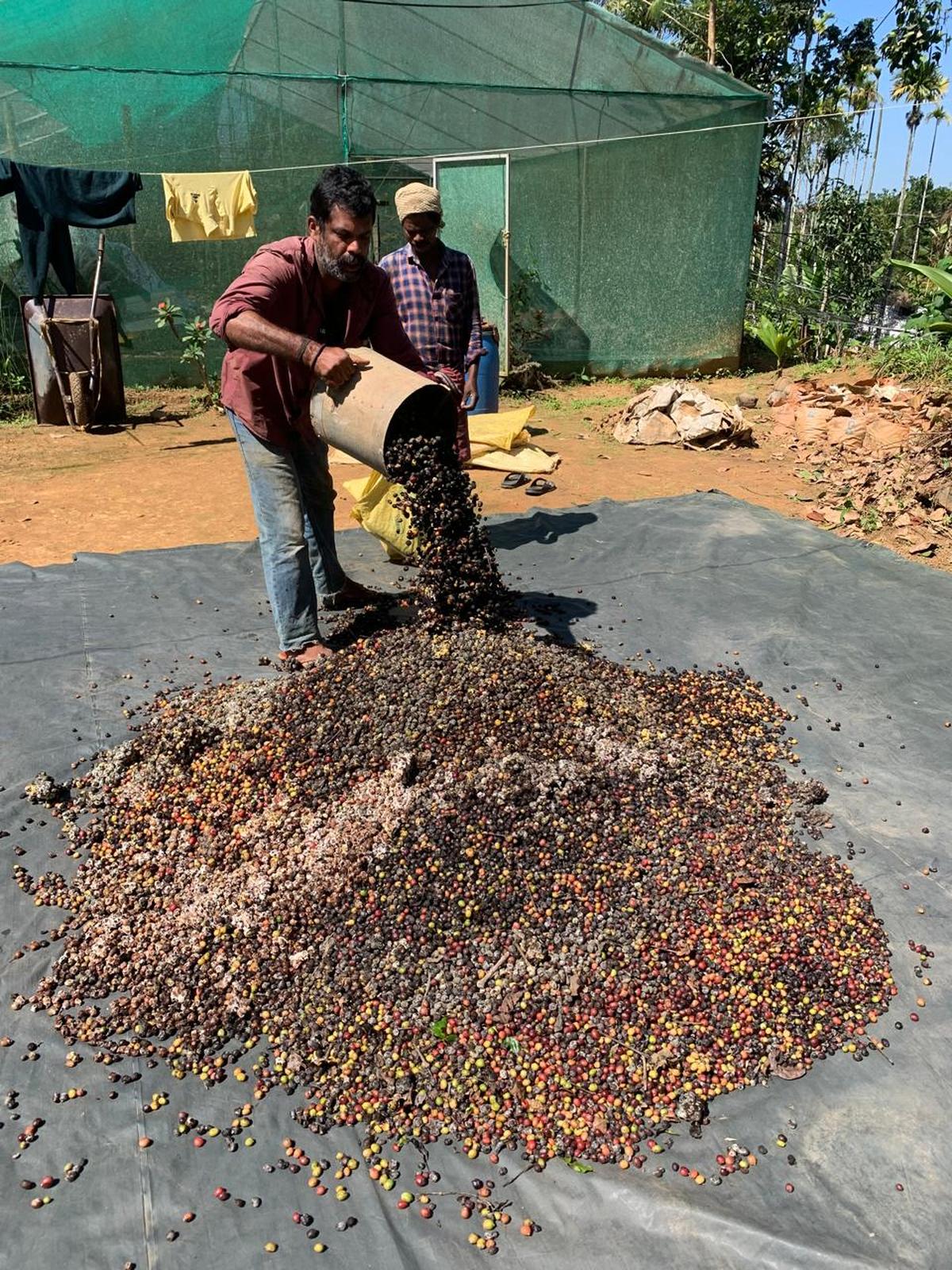
A farmer at Meenangadi in Wayanad district drying coffee berries. | Photo Credit: Special Arrangement
Robusta coffee farmers in south India are celebrating a bountiful harvest season, with prices reaching new heights. On Friday, the farm gate price of raw Robusta coffee berries in Wayanad market soared to a record ₹251 a kg, a significant increase from ₹171 a kg during the same period last year. This time in 2022, the price was even lower at ₹80 a kg.
Though the harvest is almost over, a shortfall in supply has contributed to the surge in prices, according to market sources. Many farmers are opting to hold onto their produce, anticipating even higher prices in the coming days. Concurrently, the spot price for Robusta coffee beans has risen to ₹450 a kg.
Sources say a sharp decline in Robusta coffee production in Brazil, a leading coffee producer, due to drought-like conditions is also driving up the prices. Reports indicate that Brazil’s coffee stock has plummeted to below two million bags (60 kg each) this year, down from nearly 5.5 million bags last year.
Additionally, the coffee market in Vietnam, another key Robusta producer, has been temporarily closed due to lunar holidays, further tightening supply.
The dearth of rainfall is the major concern of farmers now, especially small-scale coffee farmers, as irrigation facilities are out of their reach. Many farmers living on forest fringes are also grappling with increased wildlife crop raids, posing additional challenges.
In a related development, the price of Arabica coffee seeds has also reached an all-time high at an auction held in Bengaluru, fetching ₹605 a kg, up from ₹456 a kg during the same period last year.
According to the Coffee Board of India’s Post Blossom Estimate, the total coffee production in India for the 2023-2024 fiscal is projected at 3,74,200 tonnes, including 2,61,200 tonnes of Robusta coffee, of which Wayanad contributes 61,050 tonnes.
source: http://www.thehindu.com / The Hindu / Home> News> India> Kerala / by E M Manoj, Kalpeta / January 31st, 2025
WELCOME. If you like what you see "SUBSCRIBE via EMAIL" to receive FREE regular UPDATES.
Read More »