Vice Admiral adds new Navy attractions to Gen. K.S. Thimayya Museum at Madikeri
Modules of INS Shivalik, Sindhughosh Class submarine and AK230 Navy gun mount
Madikeri:
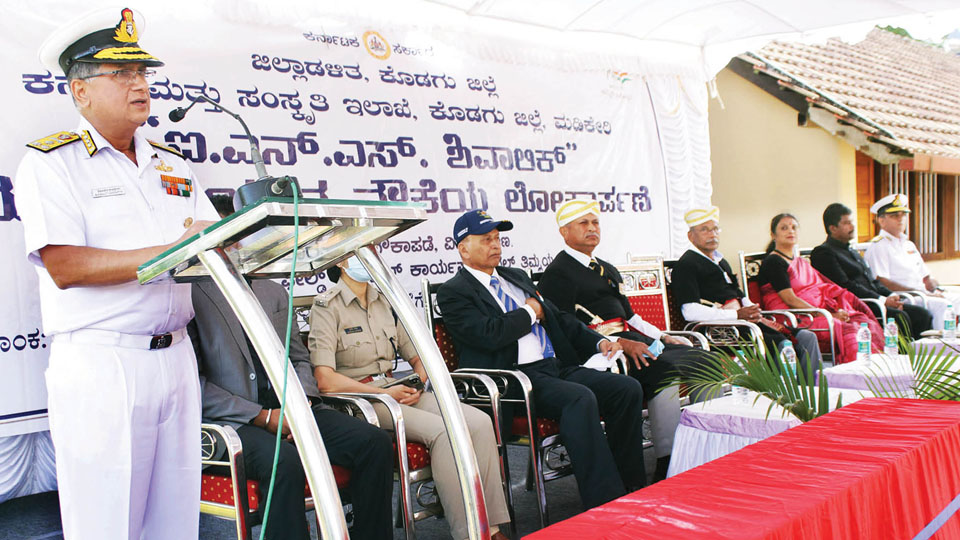
The INS Shivalik (F47) ship module was declared open for public viewing at ‘Sunny Side,’ General Kodandera S. Thimayya’s house in Madikeri that has been converted into a Museum and a War Memorial.
The 24-feet model, along with a Russian-made AK230 Navy gun mount (anti-aircraft gun) and a module of Sindhughosh Class submarine had arrived at the museum two weeks ago and they were dedicated by Vice Admiral Biswajit Dasgupta, Flag Officer Commanding-in-Chief, Eastern Naval Command yesterday. He was accompanied by his wife Roopa Dasgupta.
The modules were brought to Madikeri from Visakhapatnam Naval Base. INS Shivalik is designed to escape detection by normal radars and surveillance equipment and is one of the formidable stealth frigates in naval prowess. Apart from India, only the US, Russia, UK, France, Sweden, Japan, Italy and China have the capability to build stealth warships of this size and class.
Impressed by the museum and also the culture of Armed Forces in Kodagu, Vice Admiral Biswajit Dasgupta said that the district has emerged as an inspiration to thousands of youth to join the Defence Forces. He said that it was an honour for him to inaugurate critical exhibits at the museum.
On the INS Shivalik, he said that the frigate was built in India and is one among the many warships built by India. “Shivalik was built at Mazagaon Dock. India has four public sector Defence shipyards — Mazagaon Dock Shipbuilders Limited (Mumbai), Garden Reach Shipbuilders and Engineers Limited (Kolkata), Goa Shipyard Limited (Goa) and Hindustan Shipyard Limited (Visakhapatnam). The Cochin Shipyard is also capable of making warships and INS Virat was built there,” he said.
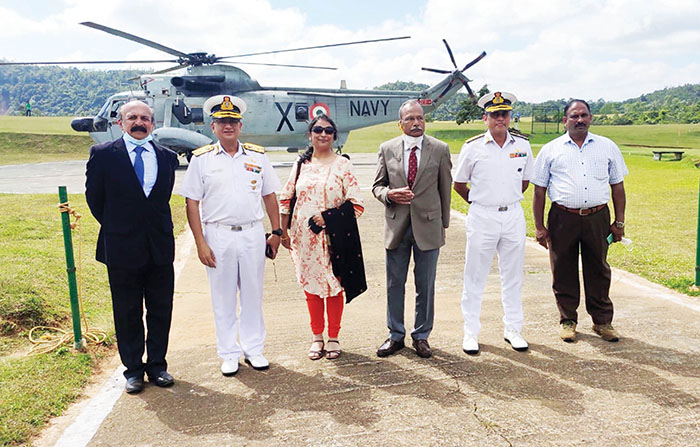
Field Marshal Cariappa and General Thimayya Forum Convener Major (Retd.) Biddanda Nanda Nanjappa (extreme left), Vice Admiral Biswajit Dasgupta, Flag Officer Commanding-in-Chief, Eastern Naval Command and his wife Roopa Dasgupta, Forum President retired Colonel Kandrathanda C. Subbaiah, Rear Admiral Iychettira B. Uthaiah and Madikeri Tahsildar Mahesh at the helipad in Madikeri when the guests arrived
‘Aatma Nirbhar’ Bharat
“The first indigenous warship was built by the Indian Navy in the 1960s where the concept of ‘Aatma Nirbhar’ Bharat was diligently followed. In the future, the Navy has plans to build 41 warships in the Indian Shipyards and 39 will be fully indigenous. Moreover these are the most advanced machines that have a formidable fire power that can shatter any other powerful ships of any country,” he said.
Giving a patient ear to the office-bearers of the Field Marshal Cariappa and General Thimayya Forum that played a pivotal role in converting the rickety house of the celebrated General that once housed the RTO office into a swanky museum, Vice Admiral Biswajit Dasgupta said that the dedication of the Forum, the respect shown by the people of Kodagu to the Armed Forces and also the dedication towards preserving heritage were commendable and inspirational.
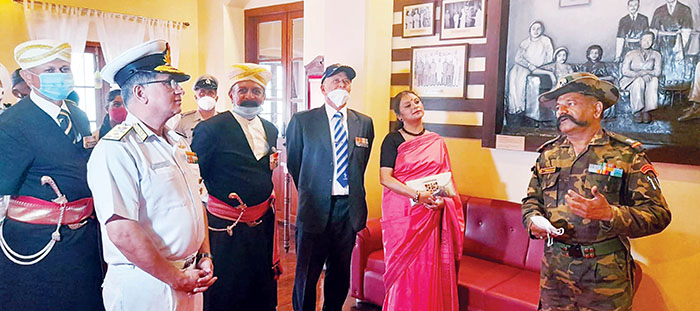
Picture shows the dignitaries inside the ‘Sunny Side’ Museum.
AK230 Navy gun mount
On the AK230 Navy gun mount, he said that it has been designed to engage air and surface targets, such as anti-ship missiles, aircraft, helicopters, other types of air strike weapons, as well as small-size surface ships. It can fire 2,000 bullets from its barrel in one minute. The Navy still uses such guns and also the advanced ones, he added.
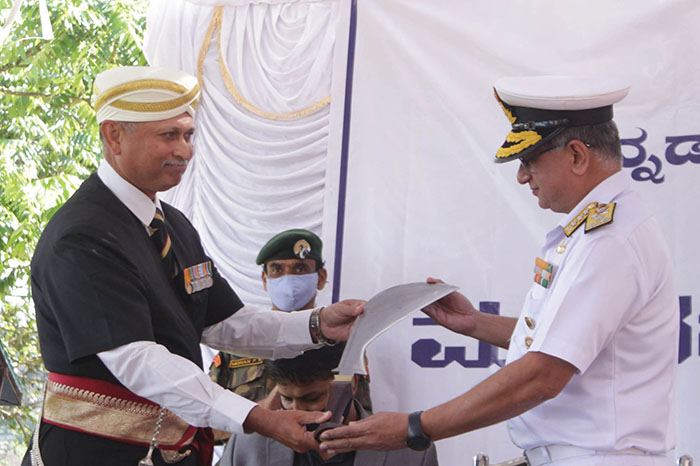
He appreciated Rear Admiral Iychettira B. Uthaiah for his efforts in bringing in the Navy equipment to the museum. The module of the Sindhughosh Class submarine was unfurled by Rear Admiral Uthaiah who handed it over to Major General (Retd.) Kuppanda Nanjappa of the Forum.
CDS late Gen. Bipin Rawat remembered
Forum President retired Colonel Kandrathanda C. Subbaiah narrated the story of establishing the museum and recalled the contribution of late Chief of Defence Staff Gen. Bipin Rawat, late Lieutenant General Biddanda C. Nanda and former Army Chief General Dalbir Singh Suhag. A minute’s silence was observed in honour of Bipin Rawat, his wife and other officers and soldiers who were killed in the recent chopper crash at Coonoor.
Kodagu Deputy Commissioner Dr. B.C. Satish presented a ‘thook bolcha’ (traditional Kodava lamp) to Vice Admiral Biswajit Dasgupta and his wife while Lieutenant General Pattacheruvanda Thimmaiah presented ‘Odikathi’ (traditional sword of Kodavas) to Vice Admiral Biswajit Dasgupta and also to Rear Admiral Uthaiah.
Before dedicating the Navy war machine modules, the dignitaries paid respects to the Amar Jawan War Memorial. They later went around the museum and were impressed by the collection
Forum Convener Major (Retd.) Biddanda Nanda Nanjappa, officer from Visakhapatnam Naval Base Nishanth B. Badoria, Kannada and Culture Department Director Darshana, SP Kshama Mishra, Sainik School Principal Col. G. Kannan, Vice-Principal Lt. Col. Seemanth Tripati, Squadron Leader R.K. Dey, students of the school and a large number of uniformed retired soldiers were present on the occasion.
source: http://www.starofmysore.com / Star of Mysore / Home> News / December 14th, 2021
Colonel Chengappa and his wife were there to receive them outside their charming, colonial-era cottage, located on top of a hill and only a short walk away from the town.
Sketch of the characters | Illustration: Danesh Bharucha
The taxi was waiting for them at Coimbatore station for their early morning arrival. The 70 km ride to Kotagiri, located at about 1800m above sea level, offered stunning views of picturesque tea plantations dotting the road on either side, with a circle of misty blue hills wrapped in dense Shola forests enveloping the entire landscape. It is these mist-clad hills that had given the name “Nilgiris” to this range of mountains in South India, since ‘Nilgiri’ literally means “Blue Mountain.”
Colonel Chengappa and his wife were there to receive them outside their charming, colonial-era cottage, located on top of a hill and only a short walk away from the town. Colonel Chengappa was a tall and sturdy man with an erect posture that belied his seventy-odd years. He sported a thick, military-style moustache under a large, fleshy nose and a high forehead topped with a balding pate with straggly wisps of grey hair on the sides and on his temples.
A caricature of Colonel Chengappa. | Illustration: Danesh Bharucha
Standing by his side was his wife, a slightly plump woman in her mid-sixties, with a kindly, smiling face and a pair of glasses with circular frames that emphasized the roundness of her face. The house had a quaintly rustic air about it with its high sloping roof, flower patterned window curtains and red oxide tiled flooring. The two bedrooms had large, brass four poster beds with white mosquito net canopies and the snug coziness of the small sitting room was enhanced by ample leather armchairs around a brick fireplace and hearth.
At one end of the garden was a wooden shed that the Colonel had converted as his study. His study was his own private domain to which no intruders were allowed. The door of the study was kept permanently locked and only the Colonel had access to this exclusive haven where he isolated himself for long hours during the course of each day.
Inside the shed was a large roll-top desk with several drawers and cubbyhole compartments. One drawer was stacked with letterheads, envelopes and blank sheets of paper, whilst another was filled with medals and mementos. The small compartments on either side were crammed with fountain pens, ballpoint pens, pencils, paper clips, staple pins and other miscellaneous stationery items.
Next to the writing desk was a wooden bookcase with a sliding glass door containing row upon row of hardbound books, ranging from classical tomes and contemporary novels to volumes of the Reader’s Digest collection of condensed stories, books on warfare and military strategy, and self-help and do- it-yourself manuals.
The opposite wall was lined with two large wooden stands with several dust-covered shelves piled high with back issues of sundry magazines, sheaves of newspaper cuttings bundled together with string and a large heap of filed correspondence, both personal and official. Two shelves contained an array of sport trophies, collectables and souvenirs gathered from the Colonel’s several trips around the world, whereas the lowest shelf contained several tin boxes filled with old family photographs.
When they had moved from the city to their retirement home in the hills, the Colonel’s wife had suggested that they clear some of the clutter and get rid of some of the unwanted stuff. But the Colonel had been adamant. He was a hoarder and loathed discarding anything.
“These are my most valued possessions and I would never consider giving anything away,” he remonstrated with his wife. “Who knows – one day some of these items might come in use.” Knowing how stubborn her husband could be, his wife let the matter drop and the move to the hills was completed lock, stock and barrel, with nothing discarded or left behind. The Colonel’s precious possessions were left intact and found their new home in his den in the converted shed.
One morning the Colonel’s seclusion in his den was interrupted by an urgent summons from the town’s Municipal Council, of which he was an active member. He popped his head into the window to tell his wife that he was going down to the town, and left hurriedly, accompanied by the person who had come to fetch him. Lakshmi was helping her mother in her cake-making whilst young Shruti stood by waiting to lick the leftover batter off the sides of the cake bowl.
Twelve-year-old Aarti was pottering around in the garden, restless and angry with herself for having forgotten to bring along her favourite story books. She stomped around from one end of the garden to the other and stopped before her grandfather’s study. She was surprised to see that the door to the shed, which normally was always locked in the Colonel’s absence, had been left open. She hesitated, remembering her grandfather’s commandment that no one was allowed inside his study. But curiosity got the better of her and, opening the door a fraction, she quietly tiptoed in.
She stared wide-eyed around her in amazement at the wide assortment of objects that crowded the little room. Ignoring the writing desk, she walked towards the bookcase. Should she take one of her grandfather’s books? There were so many, surely he would not mind parting with one of them? She gingerly slid aside the glass sliding door and rifled through the stack of books on the lower shelf which she thought might contain an interesting story book. Her eyes settled on a book with a charming cover of a street scene with white snow-capped roof tops and gentle snowflakes falling on an old-fashioned street lamp. It was “A Christmas Carol” by Charles Dickens. She was sure she would like the story and closing the bookshelf she tucked the book under her arm and turned around to leave.
She passed one of the wooden stands and her eye was caught by a biscuit tin on the lower shelf with a picture of a fluffy looking grey kitten with a bright red ribbon around her neck. Aarti loved cats and this new discovery was too tempting to let by. She crouched low and opened the tin. It was full of old photographs and right on top of the pile she saw a familiar looking picture of a girl around her own age. She let out a squeal of delight as she realised that the girl in the picture was none other than her own mother. She was on the verge of going through more photos when she heard the sound of approaching footsteps on the gravel outside. She quickly shut the box of photos and stood up just as she saw her grandfather enter through the door of the shed.
Aarti had been caught by her grandfather on forbidden territory. Not just that, she had taken one of his books without his permission and she would now have to bear the consequences. However, not one to be easily flustered, she quickly gathered her wits about her and faced him boldly: “Grandpa, I was looking for something to read and since the door of your study was open, I came in and picked up one of your books. I am sorry. I hope you don’t mind.”
She was expecting to be severely reprimanded but to her surprise, her grandfather just glared at her and said:
“It’s OK. Just be sure you put it back when you have finished reading the book.”
Relieved, she mumbled a quick thank you and, her heart thumping, she rushed out of the shed and back into the house. At the lunch table that afternoon no mention was made of the morning’s incident either by the Colonel or by his granddaughter. But later in the privacy of their bedroom Aarti confided to her mother and related to her exactly what had transpired:
“I am sorry Mummy; it was wrong of me to have taken the book without asking. But Grandpa has so many books in his study. Wouldn’t it be nice for him to give some of them to us? Shruti is still young, but surely he must know how fond both of us are of books and reading. Do you know, he actually asked me to put back the book after I had finished reading it?”
Lakshmi tried to calm and sooth her daughter:
“Aarti, I know how upsetting this must be for you. But that is the way Grandpa is. Don’t let it bother you. Sometimes people do get a bit funny in their old age.”
“I understand, Mummy. But in his study Grandpa also has so many old family photographs. I saw a lovely picture of you when you were my age. I would like so much for him to share these memories with us. We could all sit together and enjoy seeing them. I am sure Grandma would like that too.”
“I will speak to him, Aarti, and we will try and get something organized. I know you would love to see some of his travel souvenirs too.”
Author’s Note: Will the Colonel be persuaded to unlock his past and share his memories and possessions with his family? You must read the full story to find out. Be prepared for a surprise !!! (Colonel Chengappa’s Legacy » is available in a collection of 15 illustrated short stories entitled « The Missing Tile and Other Stories » in Kindle and Paperback versions on all Amazon platforms worldwide.)
Bangalore-based writer, Saeed Ibrahim, is the author of two books – “Twin Tales from Kutcch,” a family saga set in Colonial India, and “The Missing Tile and Other Stories,” a collection of 15 short stories. Saeed was educated at St. Mary’s High School and St. Xavier’s College in Mumbai, and later, at the University of the Sorbonne in Paris. His other writings include newspaper articles, some travel writing, several book reviews and two essays for the Museum of Material Memory. His short stories have been published in “The Deccan Herald,” “The Beacon Webzine,” “Bengaluru Review,” “The Blue Lotus Magazine” “Borderless Journal” “Muse India” and “Outlook India.”
source: http://www.outlookindia.com / Outlook / Home> Outlook Weekender / by Saeed Ibrahim / September 13th, 2022
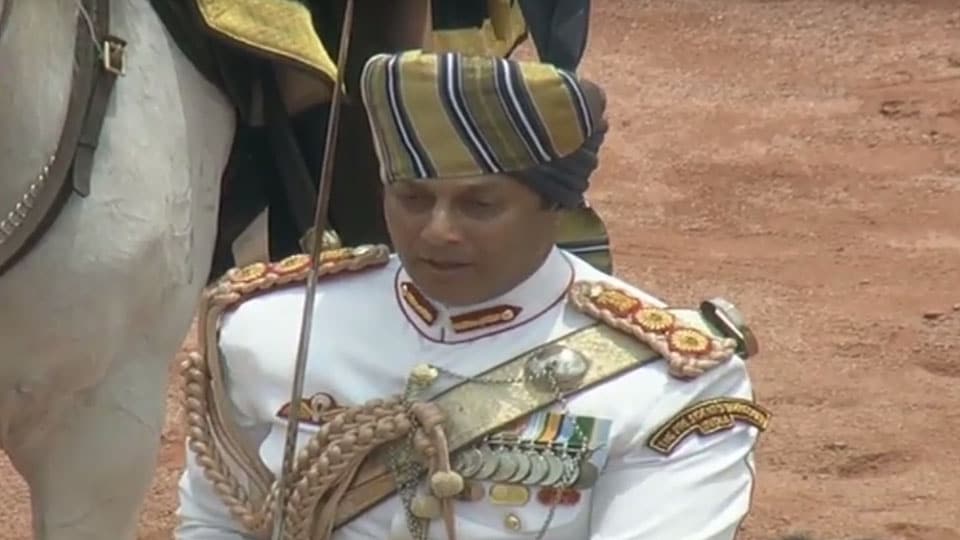
It was a proud moment for Colonel Bommanda Dhiraj Chengappa from Kodagu as he led a contingent of 46 horse-mounted Bodyguards and presented the National Salute to President Ram Nath Kovind.
The President’s Bodyguards also escorted Kovind to the Parliament House for the swearing-in.
Later, both President Kovind and ex-President Pranab Mukherjee were given an Inter Services Guard of Honour separately.
On conclusion of the Guard of Honour, The President’s Bodyguards escorted Mukherjee from the forecourt to the Iron Gate of the Rastrapathi Bhavan.
source: http://www.starofmysore.com / Star of Mysore / Home> News / July 25th, 2017
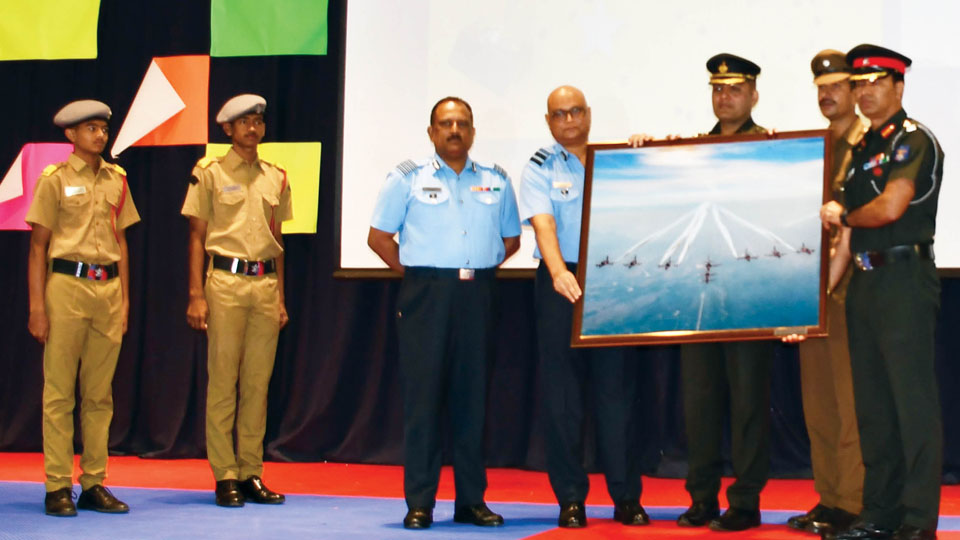
Air Vice Marshal P.K. Ghosh, Senior Officer-in-Charge Administration, Training Command, Indian Air Force, Bangalore and Chairman, Local Board of Administration, Sainik School Kodagu, chaired the 24th meeting of the Local Board of Administration of Sainik School Kodagu recently.
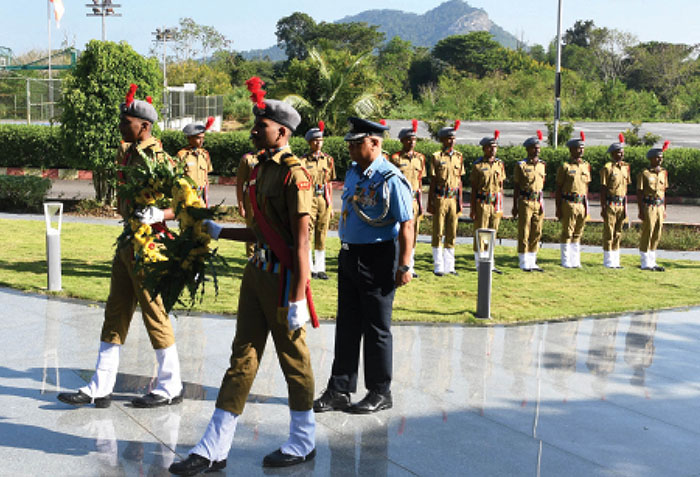
The Chairman was escorted to War Memorial of the school by the Horse Cavalcade where he laid the wreath and paid homage to war heroes.
A special assembly was organised in honour of the Air Vice Marshal P.K. Ghosh which began with a vandana prayer dance by girl cadets. The event preceded by a skit on ‘Women Empowerment’ and ‘Kamsaale’, a folk dance form of Karnataka, followed by a group song embracing the folk culture of Karnataka and our sister State West Bengal under a unique initiative of Government of India, namely Ek Bharat Shreshth Bharat Abhiyan, was presented during the programme.
The Chairman thanked the Government of Karnataka and Kodagu District Administration for their unflinching financial support for the growth of the school.
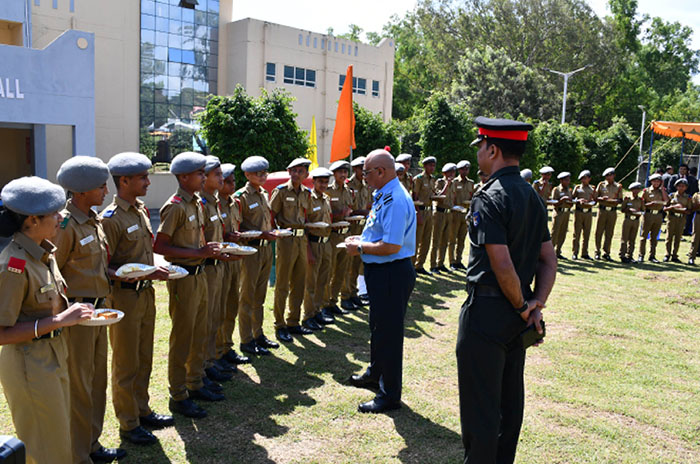
The Chairman interacted with the staff and cadets and inaugurated a weather station recently installed at the school. The weather station is equipped with many advanced weather instruments like Sunshine Recorder, Open Pan Evaporimeter, Cup Type Anemometer, Stevenson Screen, Wind Vane and Rain Gauge which would be instrumental in imparting quality education amongst the students in the coming years.
Gp. Capt. R.R. Lall, Command Education Officer, Bangalore, Dr. Nanjunde Gowda, Additional Deputy Commissioner, Kodagu district, Lt. Col. Ajit Singh, School Administrative Officer, Dr. V. Prasad, Associate Professor, Representative from Regional Institute of Education, Mysuru, Vedamurthy, DDPI, Kodagu District, M.G. Mallikarjun, Executive Engineer, CPWD, Mysuru, M.S. Chandrashekhar, Assistant Engineer (Civil), CPWD, T. Nagendra, Assistant Engineer (Electrical), CPWD, Mysuru, Asha Ram, Junior Engineer, CPWD, Mysuru and Prakash Krishnabhatta Joshi, Parent Member were present in the Local Board of Administration Meeting.
Col. G. Kannan, Principal and Member Secretary, briefed all the training and administrative aspects of the school and the progress made in the past six months. The members deliberated and arrived at various policy decisions for future development of the school.
source: http://www.starofmysore.com / Star of Mysore / Home> News / October 21t, 2022
The body of Subedar Napanda C. Mahesh (44), a native of Taakeri in Somwarpet taluk, who was serving in theIndian Armyat Joshimath in Uttarakhand and died following a heart attack on Oct. 11, reached his native place.
All preparations for the last rites have been done at Taakeri in Somwarpet taluk.
The body was kept at Kirugandur School Grounds from 10 am to 2 pm today for the public to pay their last respects.
Last rites were performed after the Indian Army officials paid their tributes
source: http://www.starofmysore.com / Star of Mysore / Home> News / October 14th, 2022
Sqn Ldr Devayya’s heroics to shoot down a PAF Starfighter in 1965 are among IAF’s finest hours. But he wasn’t lucky like Abhinandan & perished with his Mystere.
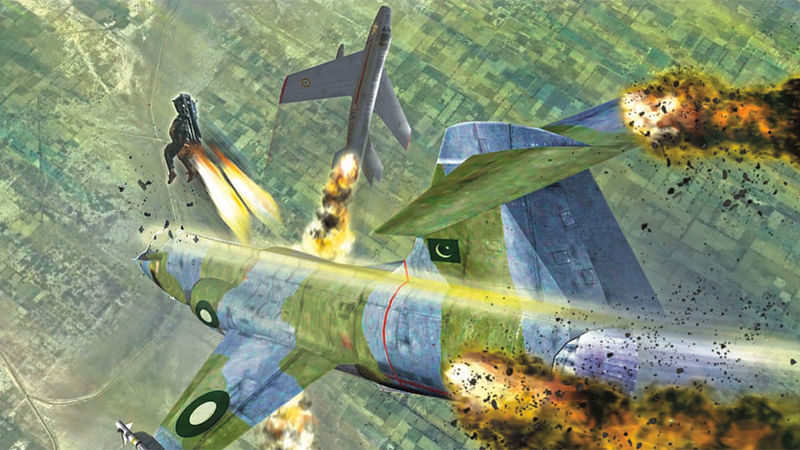
Flight Lieutenant Amjad Hussain ejecting from a Starfighter after being shot down by Squadron Leader Ajjimada Bopayya Devayya | Graphic: by special arrangement
The dogfight in the 1965 Indo-Pakistan War is counted as among the finest in IAF’s history. Squadron leader Devayya, who was on standby, was part of the mission that went in. When he joined the air battle, he was intercepted by an enemy F-104 Starfighter flown by Pakistani Flight Lieutenant Amjad Hussain.
What follows is the ensuing combat between the heavy and slow-moving IAF Mystere and the faster and more modern F-104 Starfighter from Pakistan.
Late into the night of 6 September 1965, coded IAF Command tasking orders for authorizing multiple strikes against the PAF on 7 September were issued to the bases of Agra, Adampur and Halwara. The main components of the attack force were Canberra Bombers (5 Sqn) from Agra, Mysteres (1, 8 Sqn) from Adampur and Hunters (7 and 27 Sqn) from Halwara. In spite of the chaos relating to the Pakistan Army’s Special Service Group (SSG) paratrooper drops over Adampur and Halwara, as well as the incessant B57 night bombing raids over these airfields on the intervening nights of 6/7 September, these bases buzzed with activity during late night/early morning, preparing and arming their aircraft and holding elaborate mission briefs. Though the intelligence was limited on the PAF’s disposition, all air warriors at these bases were motivated and primed to hit back at the PAF. They wanted to pay them back in kind — tit for tat post the PAF’s strikes on 6th September!
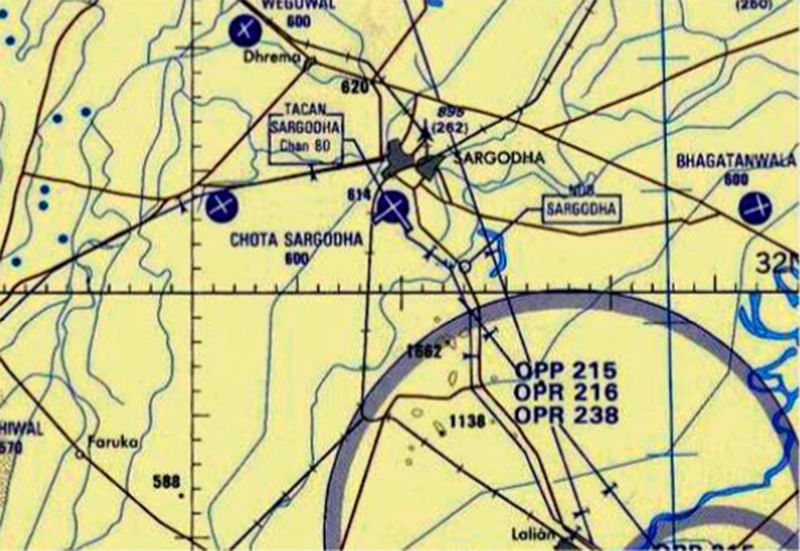
Their primary target was the Sargodha Complex!
The Sargodha complex of airfields shown on a wartime Pakistan Air Force (PAF) map | Courtesy: Sameer Joshi
Sargodha during those days, minus the bases inside the Soviet Union, was probably the most well defended target across Asia. The PAF knew that with pre-emptive strikes on 6 September, they had stirred a Hornet’s nest and the IAF would strike with vengeance at this most strategic base. However, it was confident, that with an advanced early warning and multilayered defensive capability, only the most diehard IAF strike elements would be able to get through to Sargodha. And there they would be blown away to smithereens by the high-density ack-ack.
The PAF had grossly under estimated the tenacity and resolve of the IAF fighter pilots who were ready to absorb a high rate of attrition to hit back at the PAF at Sargodha. The IAF hit the Sargodha complex all through the day with daring raids. Over ten PAF jets were destroyed on the ground during these strikes. On this day, the infamous and false claim of ‘5 IAF Hunters shot down in 30 seconds’ over Sargodha, by Sqn Ldr MM Alam of the PAF was propagated by the PAF as a propaganda twist to the events of that day. However, the most significant dogfight of the 1965 war was also fought between a PAF Starfighter and an IAF Mystere jet that day. The story of which is most inspirational and beyond belief.
20 miles east of Sargodha, Pakistan. 0530 hours PST, 7 September 1965
‘Eagle, this is Sierra Control,’ the strained voice of PAF’s GCI control at Sakesar, boomed loud and clear in the ears of Flight Lieutenant Amjad Hussain. Hussain was piloting a F 104 Starfighter of 9 Sqn PAF ‘Griffins’, holding in a racecourse orbit 25 miles east of Sargodha at 15,000 feet. ‘Eagle, Sargodha is under attack. Sargodha’s ‘Killer’ (Base Air Defence) control spots three plus IAF fighters attacking the airfield. We are vectoring ‘Vulture’ and ‘Hawk’ CAPs to cover the eastern exits of the IAF aircraft inside the inner defence ring. Proceed ten miles southeast and hold anchor at 15,000 feet. No joy with the enemy aircraft presently. Stay clear of base. Guns are free over the airfield. Over anchor point, change over to Killer Control and monitor progress.’ Sakesar GCI vectored the Starfighter (Eagle) and Sabres (Vulture and Hawk) CAPs at the pre-determined points on the defensive circles around Sargodha, just as the first wave of IAF Mysteres of 1 Sqn ‘Tigers’ was striking Sargodha.
‘Roger, Eagle copies that!’ Hussain acknowledged the call and turned hard right in his sleek Starfighter, the most potent aircraft in the PAF’s arsenal. He went to full afterburner to go to supersonic speeds. The fuel-guzzling J79 turbojet responded without any lag as high-pressure jet fuel was injected in the combustion chamber to burn in mere nanoseconds. This produced the obligatory thrust through the High Pressure turbine, propelling the Starfighter to a commanding Mach 1.2 within a short period. As Hussain arrived over the position advised by GCI control, he throttled back to 450 knots, returning to subsonic speeds. The sonic boom distracted the villagers from their daily chores at Kot Nakka near Pindi Bhattian.
He grinned at the prospect of winning a Sitara-e-Jurat, the PAF’s award for getting an air-to-air kill in the coming moments. After all, nothing could stand in face of the mighty One O Four!
Amjad Hussain settled down in an orbit at 12,000 feet and started visually scanning the approaches from Sargodha determinedly to spot the IAF aircraft well in advance. He changed his R/T frequency to ‘Killer’ control, the CAP controller at Sargodha airfield, who was relaying a continuous commentary on the IAF’s raid. Amjad’s stomach tightened as he heard the call from Killer control, ‘strike exiting towards south east.’ He put the Starfighter in a gradual dive, which gave him better visibility and put the armament master ON.
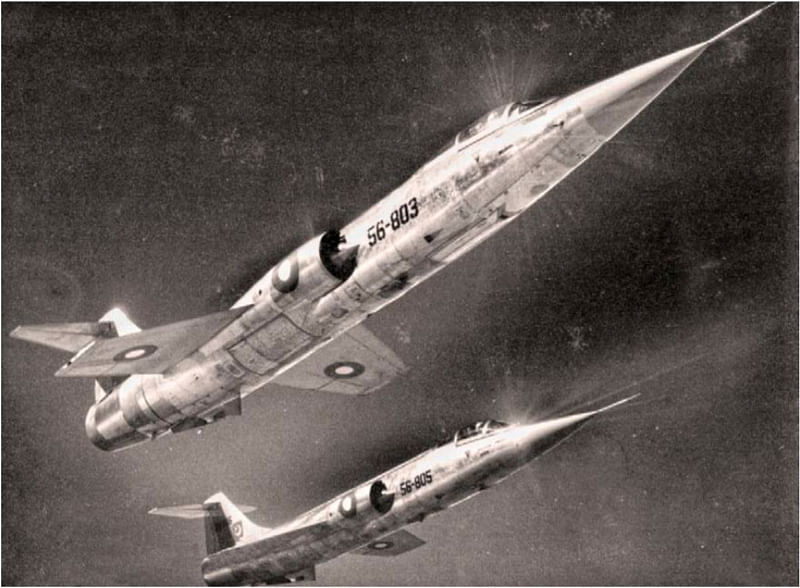
A F-I04A Starfighter was the deadliest aircraft in Pakistan Air Force’s fighter fleet | Courtesy: Sameer Joshi
In the 1965 conflict, the F104A Starfighter was the most advanced aircraft in the PAF service. It was superior to all aircraft in the IAF’s inventory. The F104A was a supersonic interceptor with a needle nose, short wings to aid supersonic flights and a ‘T’ tail to aid stabilization at those speeds. Its acceleration was superior than anything in the world and could climb to its operational ceiling of 50,000 feet in sixty seconds. The short wings were needle thin so as to have the least amount of atmospheric drag and the aircraft would easily reach its top speed of Mach 2.2 in a very short duration of time. The pilot in a Starfighter was literally sitting on a rocket engine due to this unmatched performance.
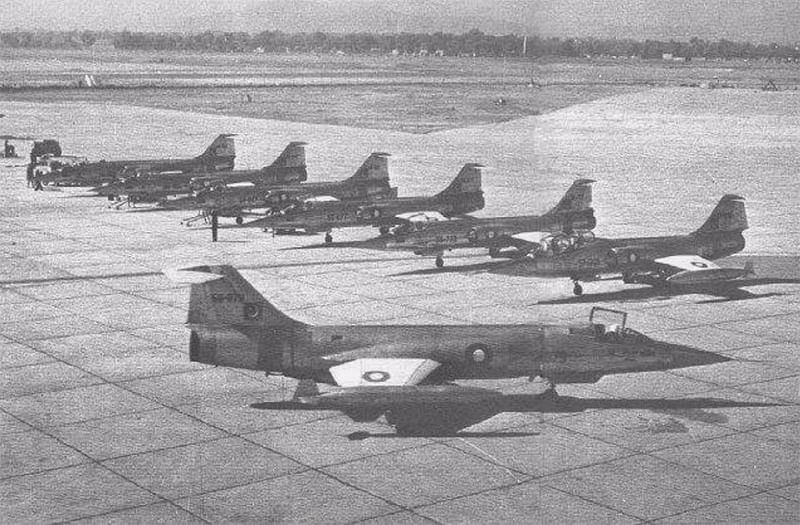
Pakistan Air Force’s 9 Squadron Starfighters in dispersal at Peshawar | Photo: By special arrangement
The Starfighter was armed with two Sidewinder AAMs and a six-barrelled Vulcan 20 mm rotary revolver cannon. The cannon, mounted in the lower part of the port fuselage, was fed by a 725-round drum behind the pilot’s seat, giving only a continuous 7 second burst of fire. The gun’s location was advantageous as the gun-flash was not in the pilot’s line of sight, therefore not robbing him of night-adjusted vision. An AN/ASG-14T ranging radar helped the Starfighter get an accurate range feed for its Gyro gun sight and the Sidewinders. The two AIM-9B Sidewinder air-to-air missiles were carried on the wingtip stations, which could also be used for fuel tanks. While the Sidewinder gave a definitive stand-off engagement capability, the Vulcan cannon was the most powerful gun on any airborne platform in the world.
15 miles South-East of Sargodha, Pakistan. 0534 hours PST, 7 September 1965 ‘Contact with single bogey on radial one two zero. It is hugging the ground,’ Amjad exclaimed excitedly on spotting a single Mystere aircraft. ‘Go for the kill and lookout for the remaining fighters,’ bawled the Sargodha CAP controller. ‘Roger Wilco,’ Amjad dived towards the low-flying Mystere. At 5000 feet and closing in 2000 yards behind the Mystere, he got an intermittent lock on the right Sidewinder and fired the missile. The missile missed the target and exploded harmlessly on the ground. Hussain continued to close in rapidly and switched over to guns. At 600 yards, Amjad opened up with the deadly six barrelled 20-millimeter cannon. The millisecond burst of the 6000 rounds per minute cannon sounded like a canvas being ripped and seemed to slow down the Starfighter in its mighty recoil.
” He saw the Mystere pass through the tracer line of his bullets. ‘Splash One,’ Amjad gave a victor’s war cry over the R/T and pulled out of his dive to turn right, attempting to pick up the other IAF aircraft.
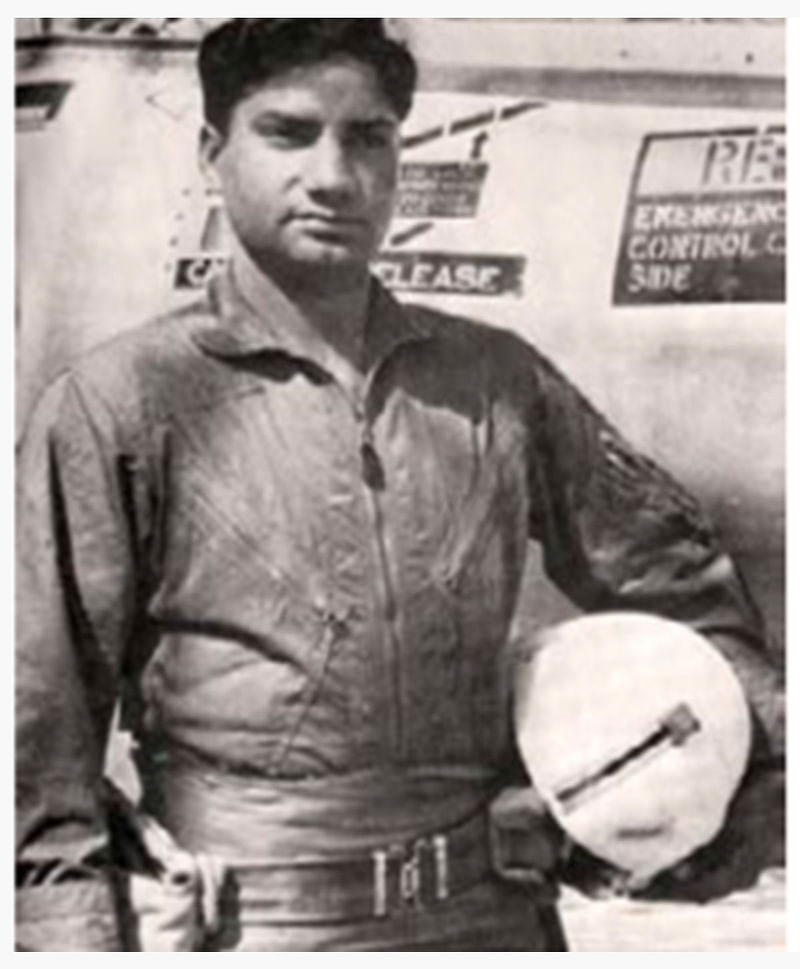
Flight Lieutenant Amjad Hussain | Photo: By special arrangement
Amjad carried out a slow roll and while passing inverted, hanging on his seat belt, he saw an IAF Mystere closing in rapidly behind him at roughly sixty-degree pitch at seven o’clock. ‘Contact with a second bogey. Engaging him,’ Amjad called out on R/T, while manoeuvring to neutralize the Mystere’s aggressive pitch towards him. He carried out a rolling reversal towards the Mystere and they crossed at a high angle off. Amjad Hussain reversed to find the Mystere cutting in rapidly inside his turn again.
He saw muzzle flashes from the nose profile of the Mystere and tracers passing too close for comfort. Hussain went to afterburner settings and pulled up in a yo-yo manoeuvre to zoom up and get a height advantage, as well as cut down his forward travel to maintain with his adversary. He dropped down on the Mystere, who again pulled up towards him, forcing Hussain to carry out another yo-yo. Dropping again, in his exuberance to cut inside the Mystere’s turn, Hussain went for a horizontal hard turn towards the Mystere. The wily Mystere pilot timely reversed towards the Starfighter and forced Hussain to get into horizontal scissors. The Starfighter was not made for low speed, high angle of attack combat and its short, negative camber wings were woefully inadequate to generate a meaningful lift at low speeds. Hussain’s Starfighter juddered near stall limits carrying out low speed scissors with a very skillful IAF Mystere pilot. The Mystere pilot had craftily trapped Amjad Hussain in a turning fight, where the Starfighter’s superior performance was progressively bled off.
‘Damn’, Hussain thought, ‘weren’t the IAF fighter pilots supposed to be dead scared of a Starfighter?’ The Mystere was manoeuvring very skillfully and managing to engage the Starfighter with vengeance. The IAF pilot appeared like a quintessential Teutonic Knight to Hussain, hell bent on dispatching him to Valhalla in the‘never say die’ code of a fanatical warrior!
As the two fighter pilots tediously battled it out over the village of Kot Nakka for their respective Air Forces in a classic one versus one situation, the question rattling Amjad Hussain’s brain continuously was, ‘Who the hell was this guy?’
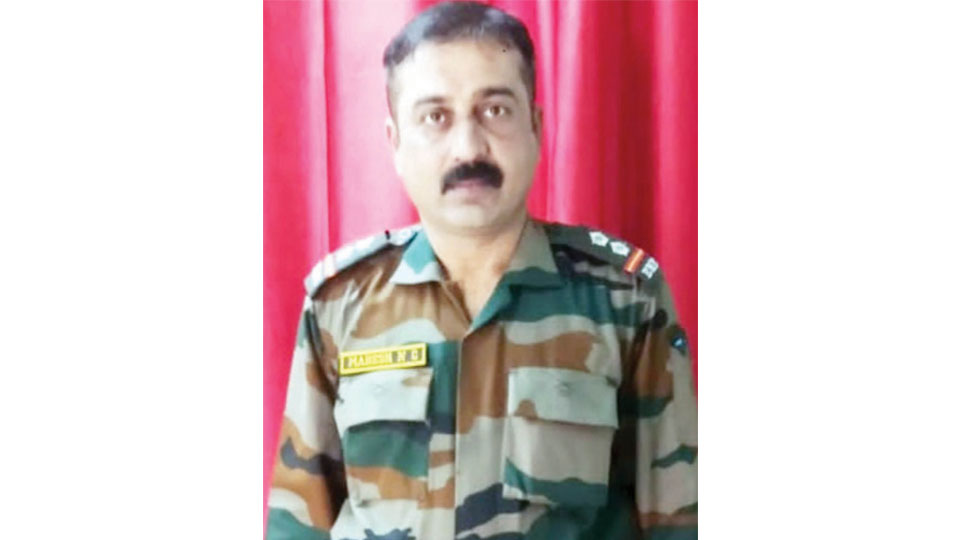
Amjad Hussain’s adversary was a bold IAF Squadron Leader by the name of Ajjimada Bopayya Devayya or ‘Tubby’ as he was christened in the squadron.
A fighter pilot, whose peers described him as an ‘unusual chap, one of those World War types’! A descendant of the humble Kodava warriors from Coorg in South India, Devayya was a true soldier who lived by the virtues of honour, integrity and persistent bravery. He grew up reading about the chivalrous dogfights of the bygone era and epitomized idols like Von Richthofen, Douglas Bader, Eric Hartmann and other knights of the skies. Hence, it was only natural for Devayya to become a fighter pilot in the Indian Air Force.
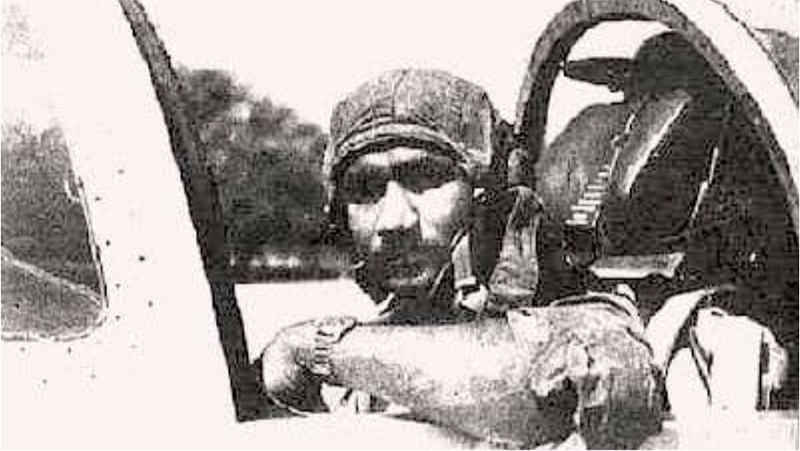
Squadron Leader Ajjimada Bopayya Devayya | Photo: By special arrangement
On that fateful day, Devayya, part of the IAF’s ‘Red’ formation made up of 1 Sqn Mysteres, was lagging behind Taneja and Verma when they were exiting in a south east direction at 200 feet.
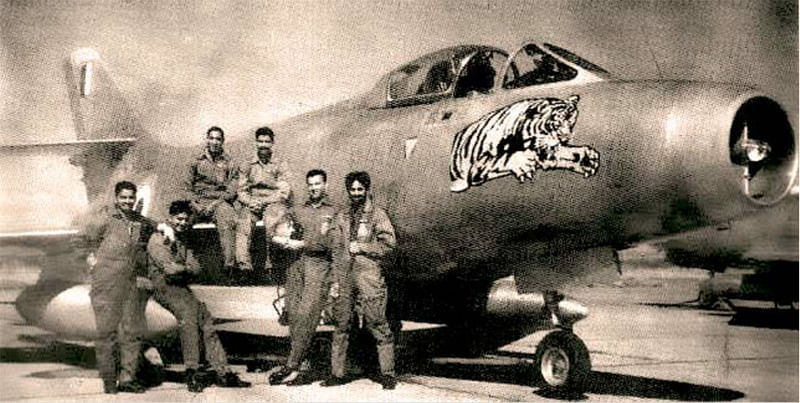
Pilots of 1 Squadron ‘Tigers’ standing next to a Mystere IV aircraft during the 1965 war | Photo: By special arrangement
At about 15 miles from Sargodha, he spotted Amjad Hussain’s Starfighter in a threatening dive, with his guns blazing. Devayya carried out a late ‘Rip’ maneuver to turn rapidly into the Starfighter, which saved him from certain death. However, a small proportion of the Vulcan’s rounds may have found their mark, destroying the VHF radio setup of the Mystere, amongst other unknown damage. His bête noire, the Starfighter turned away, blissfully unaware to the fact that Devayya had survived the attack.
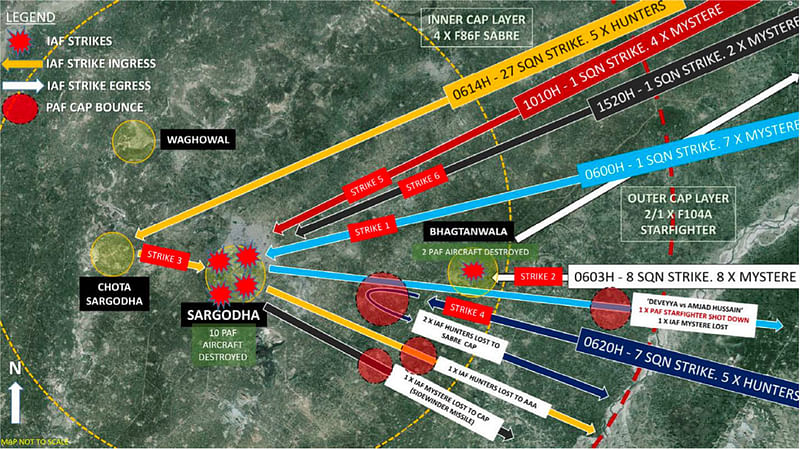
Indian Air Force counter strikes over the Sargodha complex | Map: Sameer Joshi
At this juncture, nursing his engine at low levels, he could have easily continued towards India, as his aircraft was flyable. Also, a low fuel reserve prevented the Mystere from engaging in wishful air combat of any manner. Devayya spottedthe Starfighter commence a slow roll in search of his compatriots. He realized that the unsuspecting Taneja and Verma would be easy kills for the undetected Starfighter. With no radio, Devayya could not warn others of the evolving threat from the Starfighter. Only he stood between the Starfighter and sure shot destruction of his comrades. Devayya did not flinch as he hauled his stick hard in his stomach and went to max engine rating to reach for the Starfighter hawking about 3000 feet high.
‘Tubby’ Devayya knew for certain that whatever the outcome of the impending engagement, he would not be returning home!
However, as he closed onto the Starfighter, saving the lives of his comrades was paramount on the mind of this gallant knight of the sky. A fact made more remarkable when we compare the capabilities of the Mystere with the Starfighter.
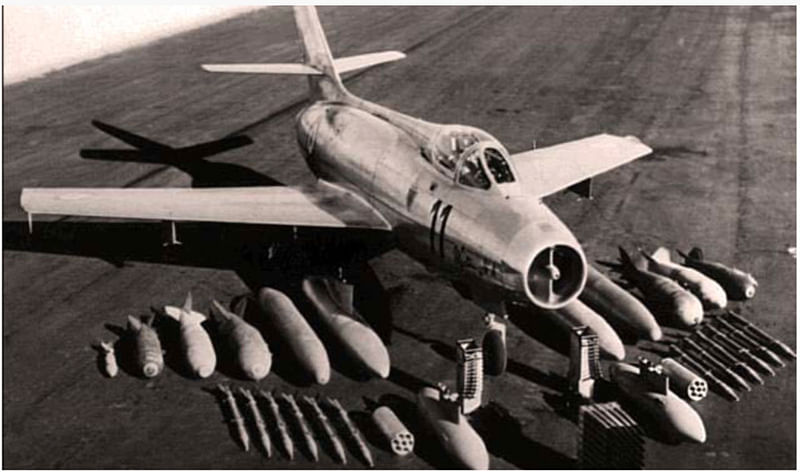
A Mystere IV displaying its complete weapon arsenal | Photo: By special arrangement
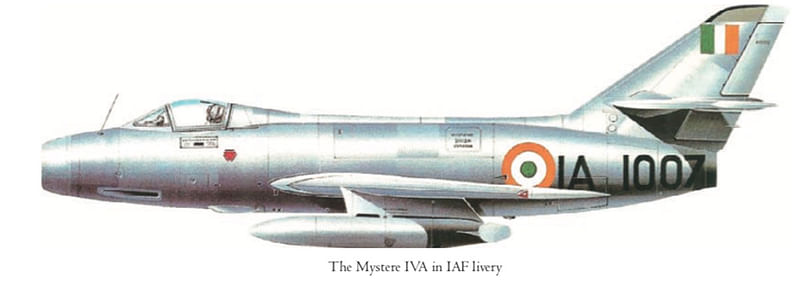
In terms of air combat capability, the Mystere was no match for the Starfighter. The Dassault Mystere IV was a subsonic fighter-bomber with a maximum speed of 690 knots at sea level and a combat ceiling of 49,000 feet. It had a 3500 kg thrust, Hispano Suiza Verdon 350 turbojet, with a first generation centrifugal flow compressor, which had a very sluggish engine response. Its rate of climb of 7500 feet per minute was nothing to be proud of.
In terms of performance, it was not suited for air combat operations. However, with two 30 mm DEFA cannons and an armament load comprising of retractable/ wing mounted 80mm SNEB/T 10 rockets and a bomb carriage capability of 1000 lbs under each wing, it was the perfect interdiction and strike aircraft. When flying at tree top levels at top speed, it could escape any PAF aircraft — except the Starfighter!
Village Kot Nakka, Pindi Bhatian, Pakistan. 0539 hours PST. 7 September 1965
Devayya successfully managed to engage the Starfighter flown by Amjad Hussain. He knew he could neutralize the Starfighter’s performance advantage if he could engage the Starfighter in horizontal maneuvering, where the Mystere would be able to ‘turn’ better than the Starfighter. After a couple of yo-yos, the Starfighter made the mistake that Devayya was waiting for.
The Starfighter pilot, in an attempt to get behind the Mystere, reduced his speed rapidly and carried out a turn in the horizontal plane to bore sight the Mystere for a gun solution. Grabbing this chance, Devayya turned hard into his adversary and managed to ‘force’ the Starfighter into horizontal scissors. Thereafter, with better handling and turning rate of the Mystere at lower speeds, Devayya began to reduce the angle required to get a shot at the Starfighter.
With each passing scissor, the fight moved to lower levels, increasing the difficulties of the battling pair! Devayya was gaining on the Starfighter, but was not there as of yet. He decided to gamble the last few knots of speed he possessed. As the Starfighter was coming for the next cross, Devayya turned hard into the Star-fighter, bleeding off his speed at a rapid rate, but was able to cut inside the turn of his adversary by his desperate action. Hence, when he reversed, he had the Starfighter within his gun sight. Devayya knew this was his only chance.
Point blank, at around 250 yards from the Starfighter, Devayya pressed the firing button. The 30 mm HE shells of the DEFA cannon caught the Starfighter in their spread some-where close to the vertical stabilizer at the rear part of the aircraft. The Starfighterwas terminally hit.
A shocked Amjad Hussain found his control jammed and the Starfighter plum-meting towards the ground. The Starfighter’s rear stabilizer was ripped away by the Mystere’s fire. Hussain ‘punched’ out. Hussain survived a harrowing low-level ejection from the doomed Starfighter and landed safely by parachute near Kot Nakka village. ‘Tubby’ Devayya’s last few moments of predicament will always remain a mystery.
After shooting down the Starfighter, his Mystere crashed close to Hinduana village, some distance away from Kot Nakka. Devayya had crashed with his stricken aircraft. It is possible, that after taking the shot at the Starfighter,Devayya was unable to eject out in the SNCASO ejection seat of his battle-damaged Mystere. Villagers found his body intact, thrown away from the burning wreckage of his Mystere by the force of the impact. Devayya was buried by the villagers in the nearby fields.
Amjad Hussain achieved what he so desperately sought that day, an award of Sitara-e-Jurat for shooting down Devayya’s Mystere. He, however, lived his life knowing that a gifted and very brave IAF pilot, while flying an inferior aircraft to his Starfighter, had got the better of him.
Unknown to Taneja and Verma, given the combat edge of the Starfighter, Devayya had saved them from certain doom. That Devayya stayed behind and managed to shoot down a supersonic, missile armed Starfighter, against all odds whilst operating a possibly damaged Mystere, speaks highly of the professional integrity, bravery and flying skill he possessed. Devayya amply substantiated the adage — it is the man behind the machine who matters most!
Taneja dejectedly reported Devayya as ‘missing in combat’ after Verma and he landed back at Adampur.
The story of this fantastic one versus one duel and Devayya’s heroism would have passed into obscurity, with Devayya’s fate remaining unknown, ironically, had it not been for the official publication of PAF’s history of the 1965 Air War with India in 1979, authored by John Fricker.
Aftermath 1979–88
Published in 1979, The Official History of the PAF in 1965 War was a book commissioned by the PAF to showcase the ‘comprehensive’ wins of the PAF over the IAF in the 1965 war as part of a dedicated propaganda effort to cloak the massive defeat suffered by the Pakistani Armed Forces. This obsequious tribute to showcase the larger than life role models like Sqn Ldr MM Alam and others, was biased in content to a great extent. However, John Fricker, the writer, did admit to the loss of a PAF Starfighter over Sargodha, which was reportedly shot down by an IAF Mystere on 7 September 1965. This may have been based on official PAF feedback after the loss of the Starfighter.
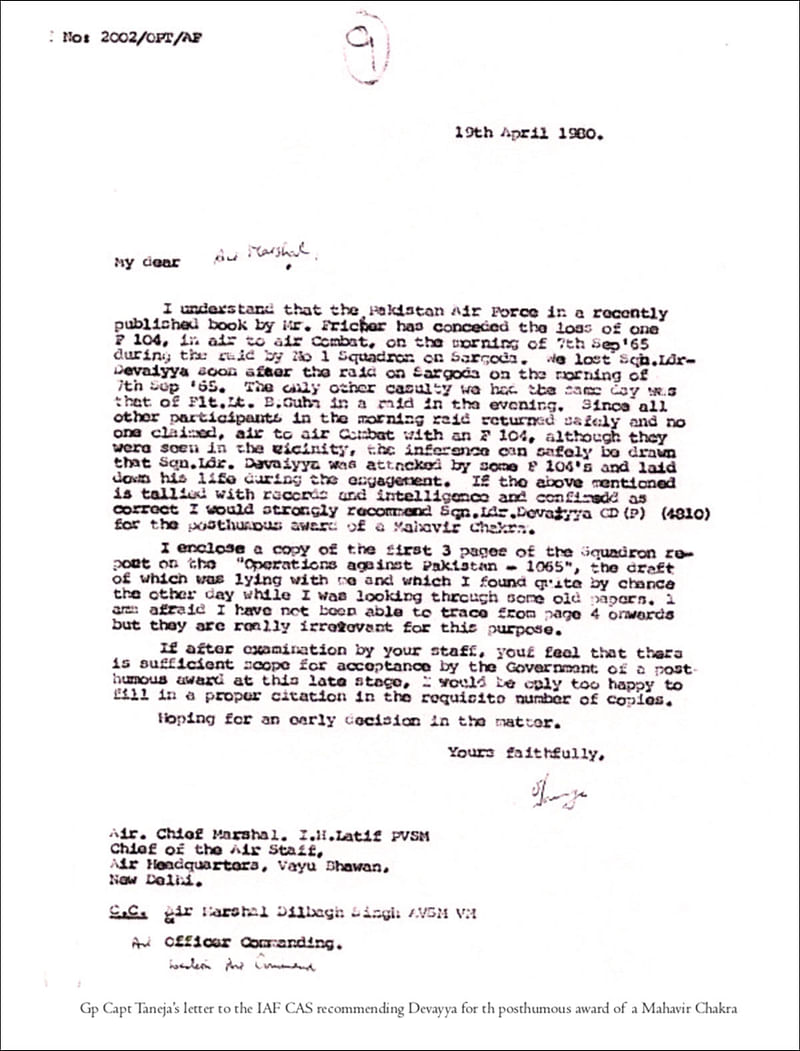
Letter recommending Squadron Leader Ajjimada Bopayya Devayya for the Mahavir Chakra
Now retired, Group Captain Omi Taneja, the 1 Sqn strike leader on that fateful day over Sargodha, happened to see this historical record and deduced that the Mystere pilot who had shot down a Starfighter, had to be A.B. Devayya. Flight Lieutenant U.B. Guha flew the only other Mystere lost by IAF on that day. A Sidewinder missile had unquestionably shot down Guha, which had been fired from a PAF Sabre.
Hence Devayya was the pilot who had shot down Amjad Hussain.
Also, Amjad Hussain was shot down again in the 1971 war against India. While interrogation as a POW, he recalled his fight with an IAF Mystere, admitting that he had ‘collided’ with the IAF jet. This provided the first clue to the inspirational dogfight between Hussain and Devayya.
In 1980, Taneja, after confirming the same details from various other sources, was left awed by this inspiring tale of valour and sacrifice. He reasoned that the Indian nation needed to know about the supreme gallantry and sacrifice of A.B. Devayya. He compiled Devayya’s story and wrote to the then IAF Chief of Air Staff, recommending Sqn Ldr AB Devayya for the awardof a Maha Vir Chakra, the second highest gallantry award of the Indian nation. Based on available evidence, the IAF was successfully able to convince the Indian government that A.B. Devayya had indeed shot down a F104 Starfighter.
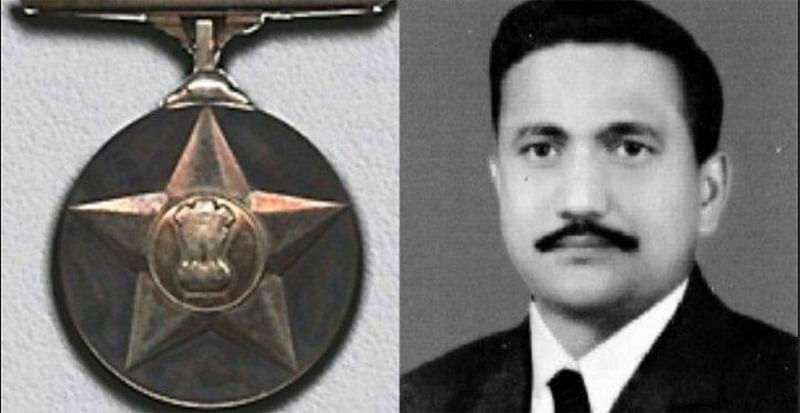
In 1988, about 23 years after his valiant tale of glory near Sargodha, Devayya’s widow, MrsSundari Devayya received the Maha Vir Chakra from a grateful Indian nation.
The Maha Vir Chakra was awarded to Squadron Leader Ajjimada Bopayya Devayya in 1988 | Photo: By special arrangement
For many decades this famous dogfight has confounded historians and air enthusiasts alike. Devayya’s story is highly inspirational! He lived and died a Knight’s death, buried in an unmarked grave somewhere in Hinduana village deep inside Pakistan, at the Valhalla of his choosing!
Rest peacefully now, O brave knight, may the clouds welcome you in their final embrace.’
— A quote on the grave of a famous WWII German ace
This article was originally published in the Medium.
source: http://www.theprint.in / The Print / Home> Defence / by Sameer Joshi / September 07th, 2019
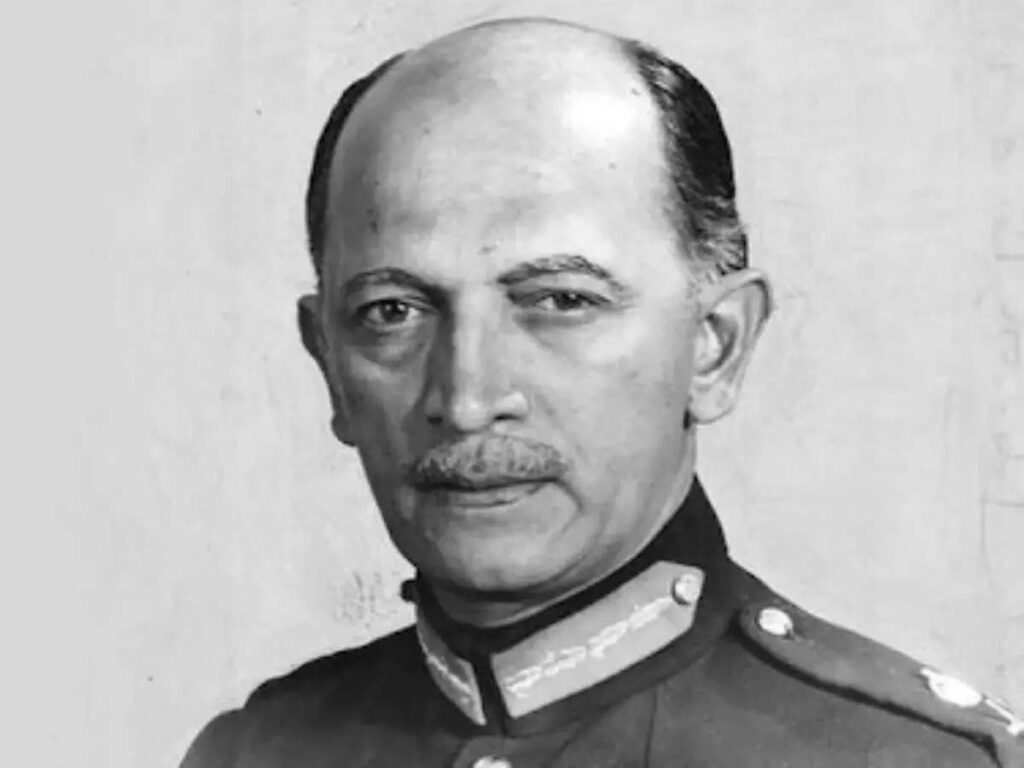
KM Cariappa was the first Field Marshal of the Indian Army in independent India who was made the Chief of Army Staff on 15 January 1949. He started his job with the appointment of a Second Lieutenant in the Rajput Regiment of the Indian-British Army. Along with being the first army chief, Cariappa was the first five star rank officer of the Indian Army. KM Cariappa served the country by serving in the army for 30 years and retired in 1953. But it was not at all that after retirement he stopped his service. Even after retiring, he continued to contribute to the army in one form or the other. On 15 May 1993, KM Cariappa merged with the Panchatattvas.
There is a very popular story about KM Cariappa when he told Pakistan not to release his son and treat him like other prisoners of war. But why did he say this, let us know. The talk is about the 1965 war when it was the last day of the Indo-Pak war. On this day Squadron Leaders KC Cariappa, AS Sehgal and Kukke Suresh were given orders to bomb Pakistani positions. But in the first round of bombing, Pakistani soldiers attacked the aircraft of AS Sehdal with anti-aircraft guns. Although AS Sehgal survived the attack, he had to go back to the base camp.
After his departure, KC Cariappa and Kukke remained in the field and were busy destroying the positions of their enemies. But in the meantime Cariappa’s plane became a victim of continuous Pakistani bullets. Cariappa’s plane got damaged and landed like a ball of fire in Indian territory but Cariappa’s body fell on Pakistan side. After falling, Pakistani soldiers surrounded him and took him into custody. When KC Cariappa was caught, he was asked if he was a relative of KM Cariappa, he told the Pakistanis only his name and rank.
As soon as the President of Pakistan Ayub Khan came to know that KM Cariappa’s son had been taken into custody by Pakistan, he immediately made an announcement over the radio that KM Cariappa’s son had been taken into custody. He conveyed information to KM Cariappa through the Pakistani High Commissioner in India that his son could be released if he wanted, but KM Cariappa, a firm believer in his principles, refused. He said that KC Cariappa is not only his son but the whole country, so he should also be treated like other prisoners of war, but if he wants to leave then other prisoners of war will also have to be released. Other prisoners of war are also like my sons. KC Cariappa remained in the custody of Pakistan for several days and was later released along with other prisoners.
source: http://www.newsdayexpress.com / Newsday Express / Home> Career / by Bhagyashree / August 17th, 2022
Call to help preserve memories of a vanishing people
While modernisation has opened many opportunities for the well-qualified, it has also distanced the young from their heritage and culture. This is even more accentuated amongst Kodavas living outside Kodagu. There is a need to establish a platform where young Kodavas could learn and keep in touch with the community’s heritage, cultural practices, folklore, music, dance, festivals and history, says Mrs. Codanda Rathi Vinay Jha, IAS (Retd.) and Chair, India Foundation for the Arts (IFA), who has initiated establishing a Virtual Museum of Kodava Heritage & Culture named ‘Sandooka,’ a treasure trove of information. —Ed
Kodavas are a micro-minority community in India, who live in Kodagu (Coorg) in Karnataka State. It is estimated that there are about 1,50,000 ethnic Kodavas within and outside Kodagu.
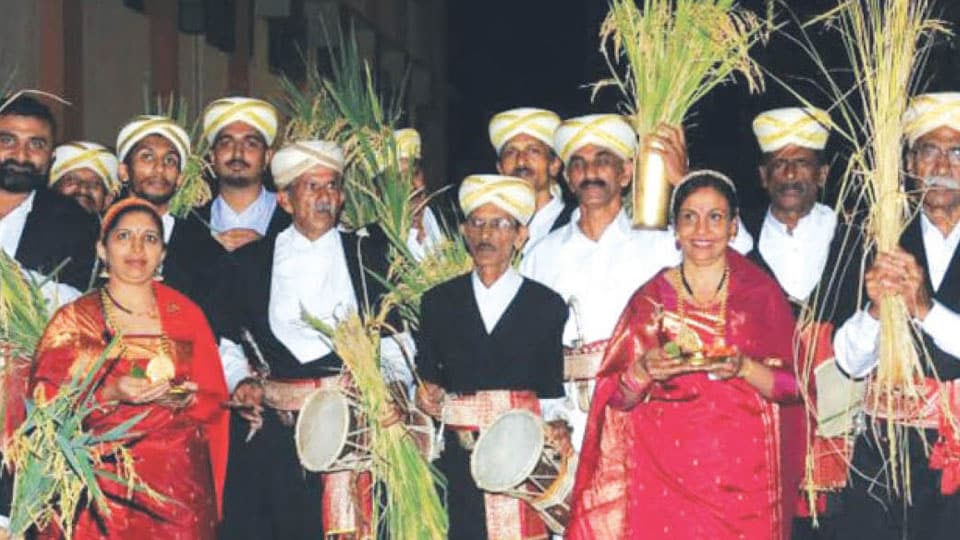
Kodavas, by virtue of living quite isolated in a densely wooded hilly terrain on the Western Ghats of India since time immemorial, have developed their own unique culture, physical attributes, cuisine, language, attire, religious rituals and practices.
Over the centuries, Kodavas adapted themselves to the harsh weather conditions, dangers from wild animals and the inhospitable terrain of Kodagu and transformed the land to an idyllic haven it is today. With the passage of time, they toiled literally with bare hands to cultivate paddy in the valleys.
With the forests providing bountiful supply of wild game, they became expert hunters initially with bows and arrows, and later with firearms which enabled them to emerge as a warrior race. They transformed the fertile land and were able to grow enough paddy that they could export to neighbouring areas.
The interactions with immediate neighbours in present day Kerala, Mysuru and Mangaluru, influenced the Kodava language, places of worship, construction of their dwellings and some of the religious practices as well. However, Kodavas still retain their fundamental philosophy of ancestor and nature worship. They come under the broad umbrella of Hinduism.
Kodagu was ruled by Kodava Nayakas or Palegars who were basically warlords. The Haleri dynasty established their rule in Kodagu after cleverly replacing the hopelessly divided Nayakas during the early part of the 17th century. The Haleri Rajas ruled for over two centuries until the British takeover of the administration in 1834 after deposing the last Raja. During the rule of the Haleri Rajas and later the British, Kodavas remained the prominent community very much involved in the administration.
During the British rule, education was introduced and this brought about quantum changes in the lifestyle of the Kodavas. Kodavas found several employment opportunities. Introduction and scientific cultivation of coffee and spices vastly improved the economy of the region. Kodava culture and ethos found expression in the writings by the British, European and Kodava authors.
By the time India got her independence, many Kodavas held important and high-level offices in sectors such as the Defence Forces, Administration, Revenue Department, Forest Department, Police, in the field of Education, Engineering and Medicine.
Kodavas have several distinctive elements in their social, cultural and religious practices. One of them is the deferential status given to women. There is no dowry system in the community. Centuries ago, widow remarriage was permitted. This enlightened attitude is now reflected in well-educated Kodava women shining in a variety of fields.
After India’s independence many Kodavas ventured out of Kodagu seeking better opportunities in education, employment, business and sports. Kodavas are now spread all over the globe. The last three decades has seen a large number of Kodavas migrating outside the country. There is now a sizable number of Kodava diaspora in the US, Canada, UK and Australia. In many cases, there are a couple of generation of Kodavas born and brought up outside Kodagu and outside India as well.
While modernisation has opened many opportunities for the well-qualified, it has also distanced the young from their heritage and culture. This is even more accentuated amongst Kodavas living outside Kodagu. There is a need to establish a platform where young Kodavas could learn and keep in touch with the community’s heritage, cultural practices, folklore, music, dance, festivals and history.
It is with this aim in mind that Mrs. Codanda Rathi Vinay Jha, IAS (Retd.), as Chair, India Foundation for the Arts (IFA), initiated establishing a Virtual Museum of Kodava Heritage & Culture (VMKHC). This project is evocatively named — Sandooka — a treasure trove of information. IFA has successfully supported several path-breaking projects in the field of art and culture.
Sandooka will be a living museum that will be interactive and open to receiving relevant new materials from the public. People, especially the future generations of Kodavas, will have an easily accessible platform to gather details of their heritage. Weblinks will also be given to some of the websites dealing with Kodava culture. It is hoped that this treasure trove of information will be of immense help to those who wish to carry out further research on Kodavas. VMKHC will cover the following aspects of Kodagu and Kodavas:
1. Customs and Rituals
2. Cuisine
3. Architecture
4. Clothes and Jewellery
5. Art & Craft
6. Landscape
7. Literature and Folklore
8. Community Histories
9. Festivals
The project is generously funded with a Corporate Social Responsibility (CSR) grant from Recaero India Pvt. Ltd., which is a pioneer in the field of aerospace engineering and is headed by Vinay Jha, IAS (Retd). A highly professional team has been forged to deal with every aspect of the project. The team comprises:
Lina Vincent – Project Head; Upasana Nattoji Roy – Designer (Switch Studio); Saurav Roy – Designer (Switch Studio) and Mookanda Nitin Kushalappa – Researcher.
IFA office-bearers are: Arundhati Ghosh (Executive Director) and Darshana Davé (Project Co-ordinator); Advisory Group: Rathi Vinay Jha, C.P. Belliappa and Hemanth Sathyanarayana.
Sandooka invites submission of Kodava artefacts, rare photographs, antiques including jewellery (photos) and anecdotes of yore. All accepted materials will be given due recognition and credits. Sharing your valuable knowledge and collections will enrich the contents of Sandooka.
For details of submission of materials, please visit: www.sandookamuseum.org
source: http://www.starofmysore.com / Star of Mysore / Home> Feature Articles / by C.P. Belliappa / August 01st, 2022
Yesterday morning as I sat at my working desk, there sat a brown cover addressed to me on the table.
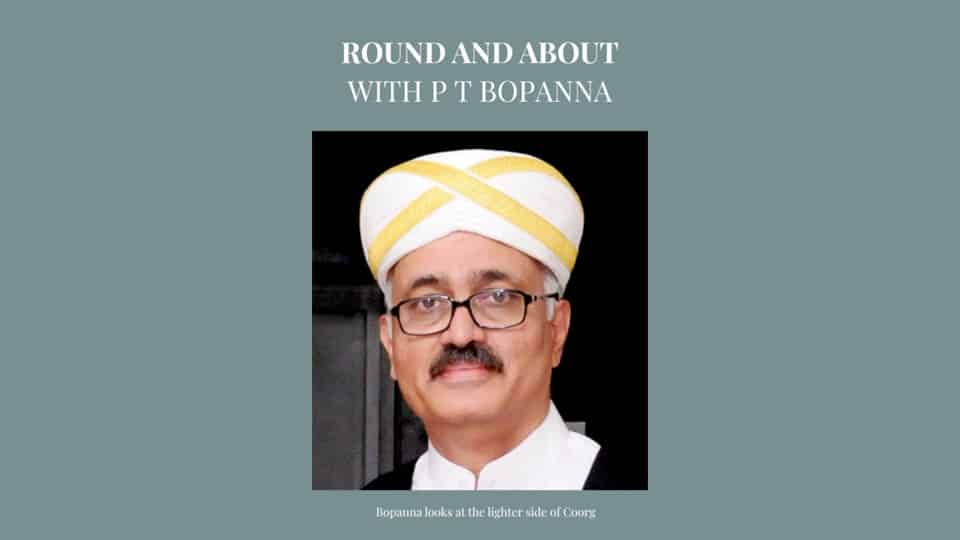
It came from Palanganda T. Bopanna, a journalist author from Bengaluru. Inside was a thin book with a thick hard cover embellished with the photograph of the author in his ethnic Kodava headgear of a peta adorned with a pattern of golden strap crossing each other as if hugging the peta.
The title of the book is quite revealing and says what it contains:
Round And About With P.T. Bopanna’ with a bottom line: Bopanna looks at the lighter side of Coorg. Himself being a Kodava (Coorg), his writings here are of Kodagu related subjects or about himself with VIPs. I finished reading it in one hour and here I am writing about it. This was possible because each of the 25 pieces inside, including the Foreword by the Kodava iconic Fashion Guru of India Prasad Bidapa and the Epilogue, are no longer than two or three pages in fairly larger font and pictures. Good reading for those familiar with Kodagu (Coorg) and the people written about in the book.
There is a Preface also by the author and I was delighted to find the names of Mr. Boverianda Chinnappa and Mrs. Nanjamma Chinnappa, now residents of Mysuru, being mentioned for their “valuable suggestions” in bringing out this thin book of 68 pages. “The couple has been a source of strength to me in my book and web ventures,” he writes in gratitude.
As a Kodava myself, I know there are any number of Kodavas all over the world engaged in different activities and pursing professions who have become great achievers. Kodava people belong to a microscopic minority as a population who lived in a land of their own known as Kodagu ruled by Nayaks and then Kings and then the British, now a district in Karnataka.
The land area cannot increase but population increases. As a result when the family grew, its land-holding was not sufficient for running the family. Perforce they got themselves educated and some members had to leave Kodagu and then Kodava (Coorg) diaspora became a reality. Fortunately those who went out of Kodagu, a great majority of them, are doing well and very well. Some of them became celebrities and some are recognised by the governments. But there are other achievers who remain without public recognition but doing very well in their given profession, business or industry.
One example for anonymous achievers and distinguished persons among Kodavas is given in the book itself in the person for whom the book is dedicated (page 3). He is Pemanda Monappa Belliappa, a retired IAS Officer of Tamil Nadu.
Acknowledged as an outstanding administrator, Belliappa was decorated with MBE (Member of the British Empire) by the Queen of England. More than this, he established ‘Pemanda Monappa Scholarship’ in Cambridge University in perpetuity, in the name of his father, Pemanda Monappa, former Karnataka Inspector General of Police. Nearer home, he has also made handsome donation to the Coorg Education Fund, Madikeri. People like Belliappa are indeed the pride of Kodagu. There are many such Stars of Kodagu!
Bopanna, who claims to be a chronicler of Kodagu or Kodavas, may also venture to trace all those achievers among them, after independence of our country (1947) and publish a book with their biodata. This would be a great contribution from him to the Kodava people.
source: http://www.starofmysore.com / Star of Mysore / Home> Columns > Abracadabra / by K.B. Ganapathy / July 20th, 2022
WELCOME. If you like what you see "SUBSCRIBE via EMAIL" to receive FREE regular UPDATES.
Read More »