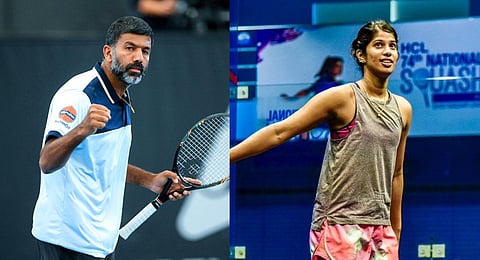
With the announcement of Padma Shri to two natives of Kodagu, the district takes pride in the same as two among the seven Padma Shri awardees in sports field are from here.
Kodagu natives-sportspersons, Rohan Bopanna and Kuttanda Joshna Chinappa
Madikeri :
It is a pride moment for Kodagu as two natives from the district will be conferred with the Padma Shri award. Rohan Bopanna, who emerged as World No.1 in International Men’s Doubles tennis two days ago and Joshna Chinappa, International Squash player, will receive the award from President Droupadi Murmu.
A native of Garaganduru of Madapur in Kodagu, Machanda Rohan Bopanna is the son of Bopanna and Mallika. He rose to the world’s number one ranking after his stupendous performance in the men’s doubles at the Grand Slam Australian Open. He also holds the record of being the oldest World No. 1 player. Teaming up with Australian player Mathew Ebden, 43-year-old Rohan Bopanna will play the finals at the Australian Open today.
“Rohan has emerged as a world-class player through various levels of achievement in the field of tennis. The hard work put in by Rohan for this is unimaginable and it is a prideful movement for the family,” shared Rohan’s father MG Bopanna. Rohan was honored by the state with Ekalavya Award in 2005.
Kuttanda Joshna Chinappa, another native of the district, is the daughter of Anjan Chinappa. Aged 37, she has won several gold medals in squash including at the World Squash Doubles Championship, South Asian Games, Asian Individual Squash Championship and Common Wealth Games. Now settled in Tamil Nadu, Joshna’s tryst with squash began at a very young age.
Taking part at the Republic Day celebration at Gonikoppal on Friday, Joshna spoke with the media persons and shared, “I started to play squash after I received encouragement from my parents. The encouragement that I received as a child has helped me evolve in the game. I take pride in playing for the nation.” She thanked all her coaches and trainers for her achievement.
With the announcement of Padma Shri to two natives of Kodagu, the district takes pride in the same as two among the seven Padma Shri awardees in sports field are from here.
source: http://www.newindianexpress.com / The New Indian Express / Home> Other / by Express News Service / January 26th, 2024
At this year’s Republic Day parade in New Delhi, the focus will shift towards celebrating ‘Nari Shakti’ (women power) and achievers at ‘Kartavya Path.’ The opening spectacle will feature a hundred talented women artists playing traditional Indian instruments. This marks departure from previous displays, which heavily emphasised military prowess, aligns with the themes of “Viksit Bharat” (Developed India) and “Bharat Loktantra Matrika” (India, mother of democracy). Notably, the emphasis on women empowerment and achievements takes precedence without diminishing the showcasing of military might.
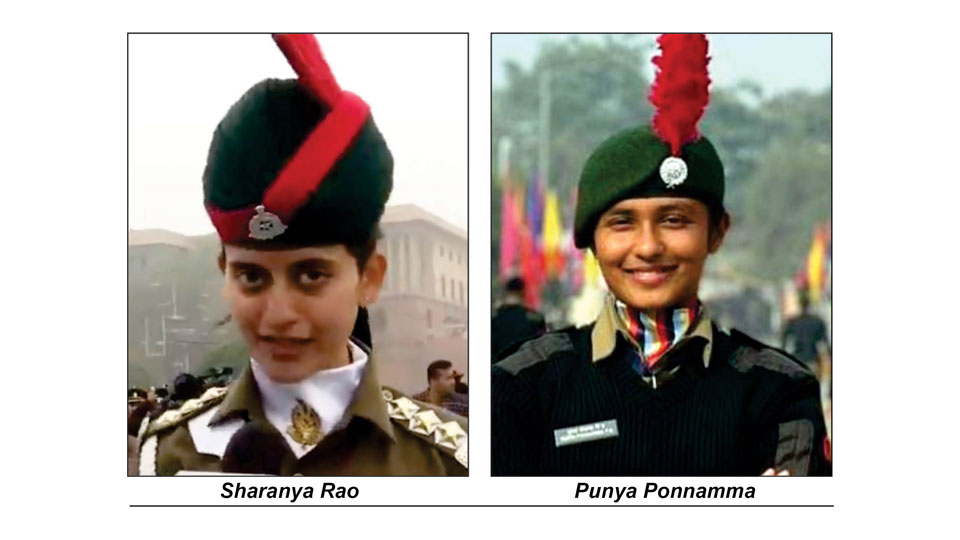
Adding to the significance, two outstanding female officers from Kodagu will shine in the 2024 Republic Day Parade. Captain Sharanya Rao will lead the Army Wing of the Tri-Service Contingent of Women, marching proudly along the ‘Kartavya Path,’ while Punya Ponnamma will command the All-India NCC Women’s Contingent.
Sharanya Rao hails from Kukkloor village near Virajpet and is the daughter of Harish Rao, Manager of Bittangala Golf Club and Mythili Rao, a lecturer at SMS College. After completing her schooling at St. Anne’s School, she did her PUC in Cauvery College. She completed her Mechanical Engineering at Coorg Institute of Technology (CIT), Ponnampet and did her MSW in Alva’s College, Moodbidri. At present, she is serving as Captain in Kargil Sector, Jammu and Kashmir.
Capt. Sharanya Rao, an all-rounder who excelled in both academic and sports, was awarded Best Outgoing Student of CIT Award in 2018. She marked her academic excellence by being one amongst the University topper and her sports excellence by representing the University in handball and women’s hockey event.
“I am the Supernumerary Officer and will be leading the Army component of the Tri-Services contingent. It is a proud moment because, for the first time in history, a Tri-Services contingent would be marching,” she said.
Punya Ponnamma is from Madikeri and is the daughter of Circle Police Inspector Anoop Madappa and Vinita Dechamma, a lecturer at Field Marshal K.M. Cariappa College. As an NCC cadet, she has participated in several camps and displayed excellent performance. She is currently pursuing third year law studies at Christ University, Bengaluru.
source: http://www.starofmysore.com / Star of Mysore / Home> News / January 24th, 2024
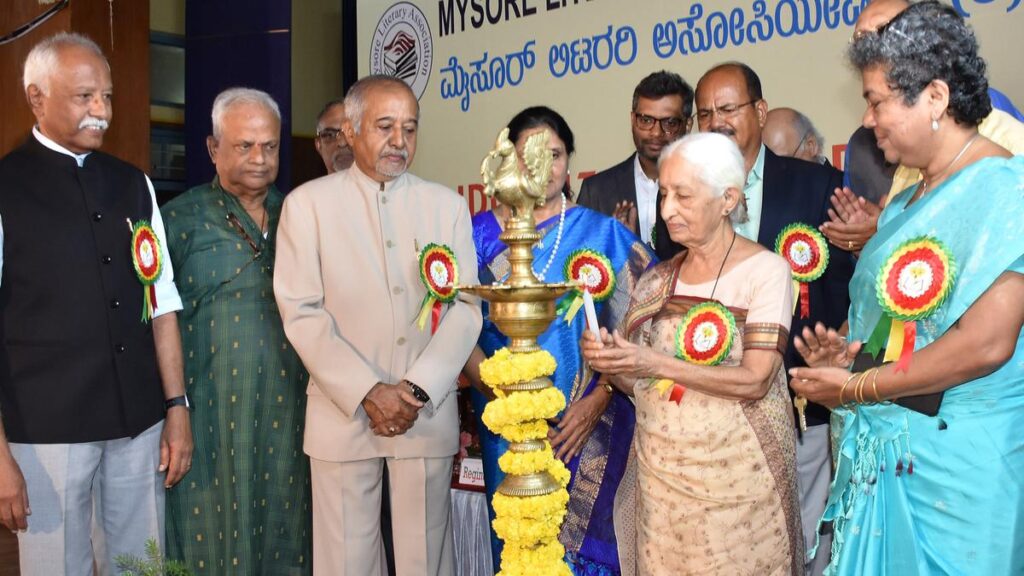
B. Nanjamma Chinnappa inaugurating the Mysuru Literary Festival organised by Mysore Literary Association on Sunday. Prof. K.C. Beliappa, founder president of the Association and others are present. | Photo Credit: M.A. Sriram
The ancestral homes of Kodava clans known as Ainmanes are on the brink and only 30% of such homes that are known to exist or have been documented, have survived, said statistician and writer B. Nanjamma Chinnappa, in Mysuru on Saturday.
She was speaking at the 5th edition of the Mysuru Literary Festival organised by the Mysore Literary Association at the Maharaja’s College Centenary Hall.
It is reckoned that there are about 1700 okkas or patrilineal clans and Ms. Nanjamma Chinnappa and her husband had studied and documented 800 Ainmanes besides photographing them about 20 years ago.
She said different clans among Kodavas had their ancestral house which was a meeting point and was central to the Kodava culture but was fast disappearing. Ainmanes were beautiful structures akin to Totti Mane with pillars and courtyard open to sky with woodwork rendered by carpenters from Kerala, she said.
Ms. Nanjamma Chinnappa said they uploaded their documentation of Ainmanes on a website and the directory is complete with the status of each of these ancestral homes.
She also explained how various aspects of Kodava culture and traditions including folk songs, were compiled and documented by her grandfather Nadikerianda Chinnappa in 1924 in a book titled ‘’Pattole Palame’’ and she and her husband went about translating them into English.
During the field work Ms. Nanjamma Chinnappa and her husband travelled extensively, met senior citizens to get a grasp of certain words that had gone out of vogue and came across these Ainmanes that were subsequently documented.
She said her grandfather realised that English would dominate the future and the local culture could be obliterated if not documented for posterity and compiled the traditions and culture of Kodavas and published it in 1924. The Ms. Nanjamma Chinappa translated the Pattole Palame into English.
On a positive note Ms. Nanjamma Chinnappa said today the youngsters take pride in their Kodava culture though some of the traditions have changed with the passage of time. However, she struck a note of caution about the Kodava language itself and said only about 2 lakh people speak the language and the UNESCO in 2009 had classified it as among ‘’vulnerable’’.
Prof. K.C. Belliappa, founder president of the Association and former Vice-Chancellor of Rajiv Gandhi University in Itanagar, Arunachal Pradesh, and others were present.
Other speakers included Prof. R. Indira, sociologist, N. Manu Chakravarthy, cultural critic, Prof. H.S. Shivaprakash, poet and playwright etc.
source: http://www.thehindu.com / The Hindu / Home> News> India> Karnataka / by The Hindu Bureau / January 21st, 2024
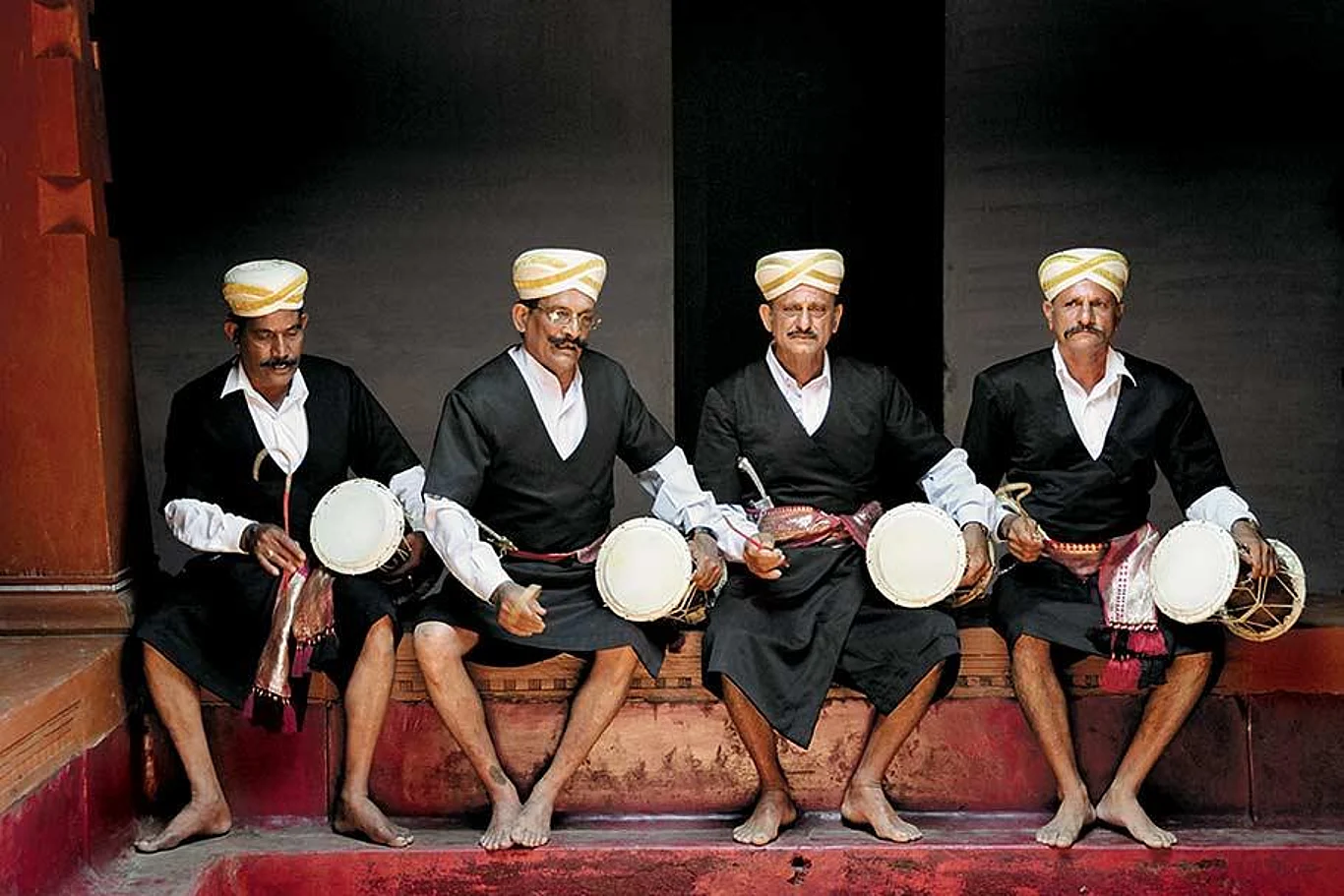
Kodagu’s rich oral tradition was used to hand down the history, culture and social practices of the people. From the book The Vanishing Kodavas (Eminence Designs, Rs 7,500). Text by Kaveri Ponnapa. Four dudipatkaras (bards) sing the history of the clans
A new book chronicles the cultural history of an enigmatic hill people.
The Kodavas, an agricultural and martial hill community known for their oral cultural traditions, are thought to have migrated to and established themselves in the Western Ghats region of Kodagu.
Despite numerous theories about their origins, none have been conclusively proven.
Organised into patrilineal descent groups, they engaged in agriculture and warfare. They were governed by local chieftains who pledged allegiance to various larger kingdoms during their early history.
Later, a dynasty of Lingayat kings, supported by a council of chieftains, assumed control. In her book “The Vanishing Kodavas”, Kaveri Ponnapa chronicles her observations on field excursions throughout Kodagu, meticulously recording village festivals across several cycles, actively engaging in and observing ancestor propitiations, as well as documenting the significant life events within the community.
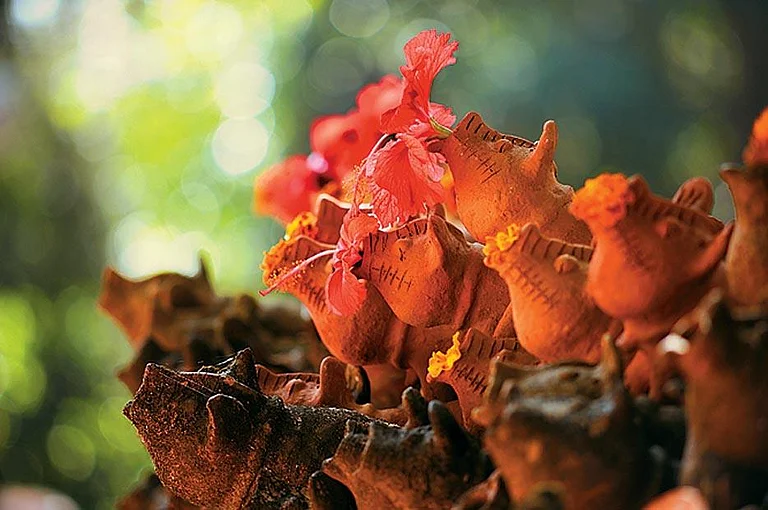
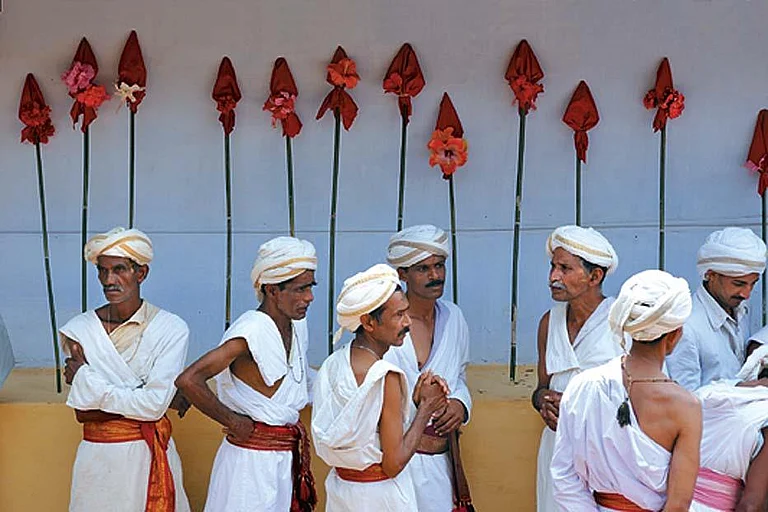
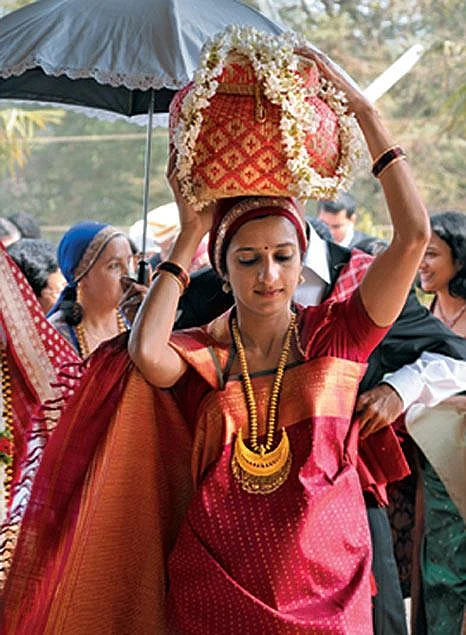
The Coorg valley is also referred to as the Scotland of India for it’s ethereal beautyIn the area of Coorg (Kodagu), terracotta tradition may be traced from the Megalithic period. A few terracotta figurines are known from the dolmen site of Moribetta (Cole 1868 and 1869)The person performing ‘bhuta kola’, a traditional dance wears special makeup, jewellery and costumes. He dances to very unique tunes of musicIn the olden days, a simple white length of cloth, tied around the head was worn as a headdress, or mande tuni as referred to in the Coorg dialect. On ceremonial occasions, this was replaced by a cream and gold mande tuniPariyakali harks back to the days when war was a constant reality in Kodava life and men were expected to display their fitness and prowess on many social occasionsAlong with the Saree, Coorgee women wear a piece of cloth on their head similar to the saree known as ‘the vastra’, and they adorn themselves with gold beaded jewellery to add to the beautiful attireThe ‘Kodava costume’ for men is called ‘Kupya’ which is a collar less half sleeve knee length jacket secured at waist with a maroon sash with gold embroidery called as ‘Chela’ and a knife is tucked into the ‘Chela’ that is referred to as ‘a peechekatti’ which represents their culturePuthari, Kodagu’s annual harvest celebration, is the most important festival across Kodagu, a landmark in the agricultural and social calendar
source: http://www.outlooktraveller.com / Outlook Traveller / Home> India / by OT Staff / January 20th, 2024
Loss of habitat and knowledge could adversely impact diets of tribal communities living in Western Ghats .
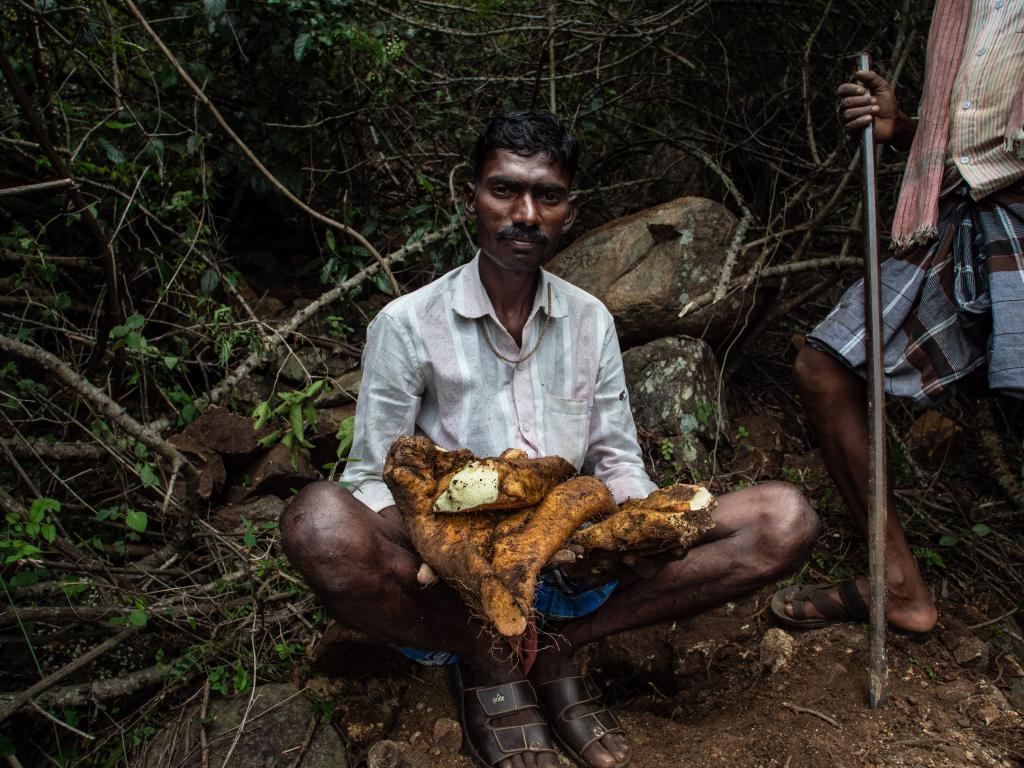
A tribal man foraging benne genasu or sweet potatoes. Photo: ATREE
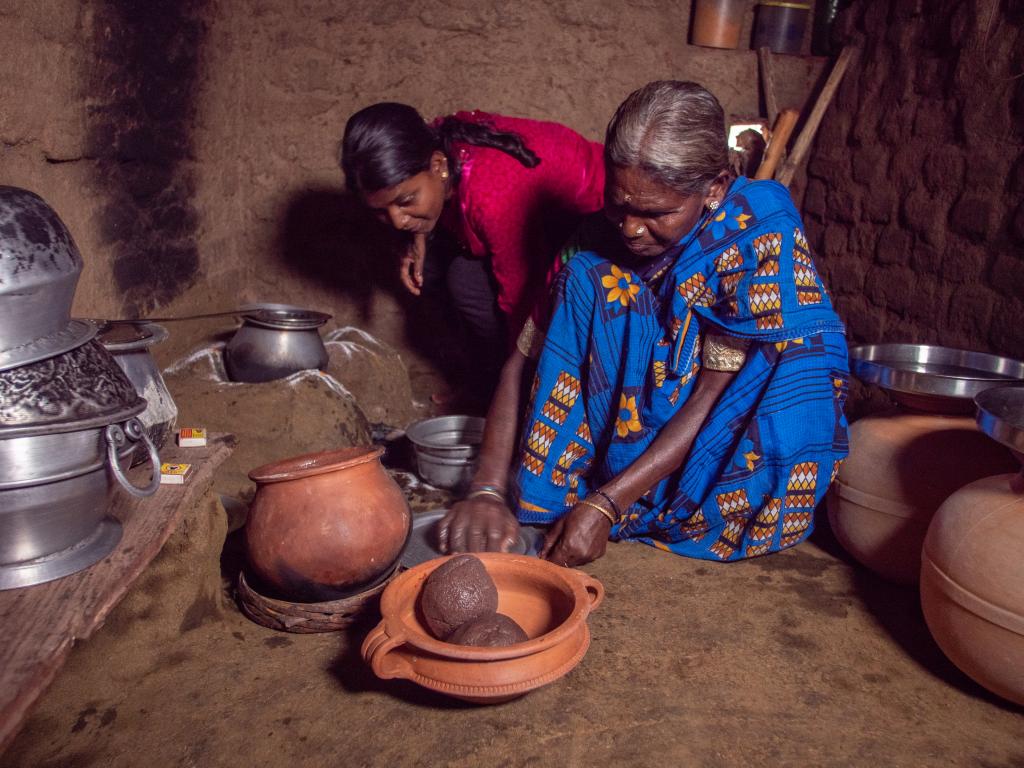
During summers, members of the indigenous group Soliga form teams to collect honey. The honey bees make their hives in the cracks and crevices of rocky cliffs in the Western Ghats. Collection is not an easy task but the Soligas have centuries of experience and know exactly what to do. They hang from the cliff edges using ropes made from vines and bamboo to first smoke the bees away from the hive and then collect the combs in baskets. The work is done during the night, which makes it more difficult.
Indigenous groups Soligas and Yeravas have been living in the Cauvery Basin and the surrounding hills of peninsular India for thousands of years. A recent book has looked into the diets of these communities, giving fresh insights into the foods that these two tribes forage from the forests.
Honey is an important part of the diet for the Soliga people, who still forage large parts of their food from the biodiversity-rich Ghats. The Western Ghats are one of the world’s biodiversity hotspots, with over 5,000 flowering plants, 139 mammals, 508 birds and 179 amphibian species. Many of these are part of the diet of the tribal communities in the region.
Soligas, one of the oldest indigenous communities in the country, are the original inhabitants of Karnataka and live mostly in the Chamarajanagar and Mandya districts. The Yeravas, on the other hand, came to the state from Wayanad district in Kerala and settled in Kodagu district of the state.
The recently launched Forgotten Trails: Foraging Wild Edibles, authored by Malemleima Ningombi and Harisha RP, chronicled the foods that these two tribes forage from the forests. Such foods form around 25 per cent of the Soligas diet and around 30 percent of the Yerava diet, said Harisha RP, who is a conservation biologist at Ashoka Trust for Research in Ecology and the Environment or ATREE.
Women cook ragimudde (finger millet balls). Photo: ATREE
There is not much difference between the diets of these two communities other than that Yeravas use more tubers than Soligas. There are some 10-12 wild food plants that are unique to each community as they live in different landscapes, he added.
The Soligas and the Yeravas cook using the simplest of recipes — their sambar recipe is extremely similar — but the ingredients can change according to the season. The area witnesses four main seasons: Summer, monsoon, retreating monsoon and winter.
In the summers, they relish fruits like wood apples and mangoes and greens such as mushte soppu (Holostemma annulare), kaddi soppu (Jasminum sp) or anne soppu (Celosia argentea).
Mushrooms become part of the Yerava diet during monsoons, when they emerge overnight from barren land. Doddbidru or Indian thorny bamboo, shoots up during the rainy season too. The bamboo shoot sambar is consumed with much enthusiasm by the Soligas.
Cold and local multicoloured corn roasted over the fire used to be consumed often during retreating monsoons. However, this has become rare as communities have stopped cultivating the crop because it was frequently raided and destroyed by animals.
In winter, when warm foods are needed, the Yeravas, who work as labourers in coffee plantations, depend on the wild berries of various nightshade plants and edible ferns that grow along the streams.
The authors highlighted that the food that Soligas and Yeravas depend on for survival is now affected by changes in land use and shifting policies. Worse, traditional knowledge is steadily being lost as young people are migrating out. This knowledge is important for foraging for the right food.
For example, the Soligas have learned that bamboo shoots have to be uprooted and de-skinned with bare hands to ensure that they do not become poisonous. Similarly, the Yeravas know first, that all mushrooms are not edible and, second, that care has to be taken that they do not mature and get infested with insects. The skill of collecting the right ones at the right time is getting lost among the younger generation.
There have been efforts to ensure that the next generation understands the value of these plants. For instance, the Soliga community-run business ADAVI promotes the processing and value addition of some cultivated foods and nontimber forest products. The book has documented the wild plants in the area, along with recipes to prepare food from them. This, too, will help preserve and pass on traditional knowledge to the next generation.
The foraging trips help members of the tribe bond and help the next generation assimilate the skill. Foraging together, bonding, coexisting, laughing, arguing, taking risks, making do with what is found and sharing are what bring the community together, said the authors.
source: http://www.downtoearth.org.in / Down To Earth / Home> News> Food / by Vibha Varshney / January 14th, 2024
The need to shift to a better job urged Bhavani, a cleaner at the panchayat, to try and apply for the 10th board exams.
Madikeri :
A digital library in a rural part of Kodagu is helping shape a new life for a panchayat cleaning staff.
Bhavani HD (48), who never had the luxury to attend school, has now completed 10th grade after receiving help at the digital library even as she hopes for a promotion in her 12-year-old career.
A resident of Maldare village in Virajpet taluk, Bhavani hails from a poor family. She did not enjoy the right to attend school during her childhood and started off earning a living by working as a daily wager.
She then applied to work at the Maldare Grama Panchayat and has been working as the cleaning staff there for the past 12 years. She is shortly to be deployed as a civic worker who has to collect and dispose of garbage.
“I cannot lift heavy weights. I have undergone five surgeries including tubal ligation, uterus, piles, appendix, and a leg surgery. I requested a different job profile due to my illness and the then PDO had suggested that I could have applied for an attendee post at the panchayat if I had passed 10th grade,” shared Bhavani.
The need to shift to a better job urged Bhavani to try and apply for the 10th board exams.
“My dream of attaining an attendee post led me to the digital library at the panchayat. I obtained support from the library supervisor Sujitha,” Bhavani said.
“From the Grama Digi Vikas portal, I helped download the study materials for Bhavani. The study materials are easy to understand and they are in the form of videos. Bhavani visited the library every day and studied for the board exams,” shared Sujitha KV, the library supervisor who learned about the ordeal of Bhavani and stepped in to help.
For three months, Bhavani spent a few hours every day studying at the library. She wrote the board exams in March last year.
“But I passed only in Kannada. However, by god’s grace, I cleared all the subjects during the supplementary examination,” explained Bhavani.
Following this success, Bhavani is now confident of availing the attendee post.
However, Bhavani has a long fight before she gets to her dream post at the panchayat, as several panchayat members have failed to see her efforts and are demanding a male candidate for the attendee post over Bhavani.
While her hard work led her towards completing the 10th grade, it has not yet paid off due to the unprecedented developments at the panchayat.
source: http://www.newindianexpress.com / The New Indian Express / Home> States> Karnataka / by Prajna GR, Express News Service / January 03rd, 2023
While a majority of science projects are done using the internet, Shreesha went a step ahead, and did a real world project.
Alongside help from other students, Shreesha led an awareness campaign to help preserve the stream | eps
Madikeri :
An honest effort from an eighth grade girl of the government school at Kodagarahalli of Suntikoppa in Kodagu district has helped preserve a local stream.
The work for her science project has now earned the respect of the district administration and district police, who have ordered that CCTV cameras be installed to prevent dumping of waste near the stream.
Shreesha AS, daughter of Suntikoppa residents Shiju and Sandhya, is a student of the Kodagarahalli Suntikoppa Nadu Government High School. She was nominated to represent the school at the 31st National Children’s Science Convention, where she won the ‘Young Scientist’ recognition for her presentation — ‘Pollution across river banks’.
While a majority of science projects are done using the internet, Shreesha went a step ahead, and did a real world project. With the help from her father, she visited the stream near her locality to collect inputs for her project. She surveyed the Haraduru stream, collected details about its importance to the locality. She recorded sound bytes from local residents and learnt that the stream has been the lifeline of the locality for ages.
Staff deployed near stream to stop littering
The survey, however, also introduced her to the sad state of affairs of the stream where she found loads of plastic and other garbage dumped by its banks. From coffee pulping to plastic waste, the stream was being polluted by a few locals and tourists who visited the spot.
Shreesha compiled the story and submitted a report on the pitiable condition of the water body to the district administration, district police and the local panchayat. Her efforts persuaded SP K Ramarajan to deploy the staff near the stream to stop littering. Further, the administration has ordered the local body to install CCTVs to control garbage dumping at its banks. With the help from her classmates, Shreesha also led an awareness campaign across the locality even as residents were urged to take responsibility in preserving the stream.
source: http://www.newindianexpress.com / The New Indian Express / Home> States> Karnataka / by Express News Service / January 01st, 2024
He was speaking at the inauguration of the Global Kodava Summit organized by the Connecting Kodavas Trust organization in Madikeri on Friday.
Virajpet MLA AS Ponnanna. (Photo | Twitter, @ASPonnanna)
Madikeri :
“The Kodava community must unite to fight for the rights. Our ancestors fought to protect our land and culture. Let this fight continue. But fight for your rights and do not mock other communities or religions. Love every community,” called out Virajpet MLA AS Ponnanna.
He was speaking at the inauguration of the Global Kodava Summit organized by the Connecting Kodavas Trust organization in Madikeri on Friday.
Ponnanna appreciated the efforts of the trust in bringing the community together. He urged the trust to lay a foundation for the rightful voicing of the communities’ needs and said, “Let there be resolutions formed in this summit on what our rights are and what needs to be done to preserve the community. I will extend my full support to attain these resolutions,” he assured.
He opined that political maturity is needed amongst the community to attain support for the fight towards rights. He highlighted that the land problems concerning Jamma land, preservation of gun rights and ethnographic studies are the issues that must be fought unitedly under a strong leadership. He urged for the preservation of the land, nature, culture and relationships.
MLC Shantharam Budna Siddi, who was present as the chief guest, urged the youth to come forward to work for the society. He assured to extend his support in the legislature for the ST tag fight of the Kodavas.
Chethan Singhai, Chief Consultant of the National Curriculum-Ministry of Education, urged the community to focus on education and appreciate the values of culture. He called out to the community to focus on locality that he said is largely rooted in values.
Human activist Rashmi Samath called out to the youngsters to come back to their roots.
source: http://www.newindianexpress.com / The New Indian Express / Home> States> Karnataka / by Express News Service / December 30th, 2023
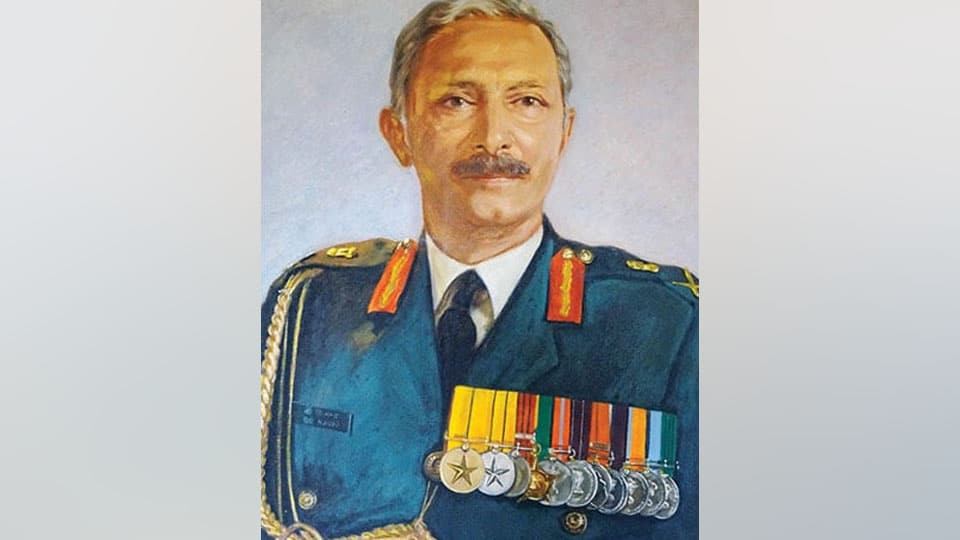
I wish to thank Santhosh Thammaiah for his touching and respectful tribute (“The Soldier who Saved Siachen”) to my late father, Lt. Gen. B.C. Nanda in SOM dated Dec. 26, 2018. I am immensely proud of what my father achieved in his professional career and, most of all, of what he meant to me as a beloved father.
I would, however, like to correct a portion of the account here: My father’s role model was his father, B.S. Chengappa (Chief Conservator of Forests, Andaman Islands) whose extraordinary work and contributions are held in high regard. It is from him that my father’s lifelong association with, and love of, nature and environmental issues came. It was during the early years of his childhood in Andaman Islands that my father’s keen observations of natural life began. This was the bedrock of my father’s interest in nature and environment.
As a young boy of 7, my father was able to assist a visiting English Naturalist in compiling an extensive list of local names for the fish of the Andaman waters — knowledge that he had imbibed through his passion for fishing, combined with a sharp eye and ear for all things in the natural world. Anyone who knew my father would know what an amazingly keen and astute observer of animal and bird life he was.
After my father retired from an illustrious career in the Indian Army in 1989, he devoted tireless hours to various causes, be it the issues and concerns of ex-servicemen, adventure sports foundations, or giving fresh direction and impetus to the Coorg Wildlife Society, to name but a few.
Over the years, my father, on his regular visits to Kodagu, visited Field Marshal Cariappa’s residence, to pay his respects as a nephew.
Also, my parents had always planned to retire in Kodagu.
Thank You once again for this tribute to my father.
Note: I had not met Lt. Gen. Nanda personally, but had seen him from afar and heard about his interaction with people living in remote villages beyond Gaalibeedu. I was told he was visiting Sri Bhadrakali Temple at Monnangeri, staying overnight in the humble house of a local. I heard of Gen. Nanda’s humility and love of nature when I visited his host’s house about five years ago.
My contact with him was mostly per letters on issues concerning Kodagu and Kodavas. On reading his daughter Shalini’s letter, I tried to look for Gen. Nanda’s letters in my file and was able to find just one written by hand. It is an eloquent testimony to what his daughter has written and his abiding love for Kodagu. Hence, I reproduce it here below. – K.B. Ganapathy, Editor-in-Chief
Dear Sir,
Thank you for sending me a copy of your letter dated 10.8.2003 addressed to Mr. Ulliyada M. Poovaiah. I fully endorse your view that the Kodavas must be united. We are at the moment making efforts towards that end. I am sure you are aware of what is happening.
When I retired from service after 40 years in uniform, the Govt. of India sent me messages after messages asking me if I wanted a job. I declined as I needed to attend to my personal affairs that had been totally neglected. Any query to Mr. K.C. Pant, Mr. Jagmohan or Mr. Naresh Chandra will confirm what I say. Also Mr. Arun Singh. Later it was Mr. Moily. Now that I think back— may be that if I had accepted those offers — Kodavas would have benefited in some ways. It was just that those living in comfort in Kodagu were swallowing up my heritage and my land — I needed to put this in order.
I continue to dedicate myself to Kodagu and the Kodavas. With best wishes and regards
Yours sincerely,
B.C. Nanda
(15th Sept., 2003)
source: http://www.starofmysore.com / Star of Mysore / Home> Voice of the Reader / January 04th, 2019
Palekanda Bopaiah (95) and Palekanda Belliappa (86) reside in Kadanuru and Gonikoppal of Kodagu.
Belliappa, Machamma and Bopaiah (L to R) from Kodagu have left for Sydney to take part in the championship
Madikeri :
While most people of their vintage would be nursing various aches and suffering from age-related issues, here are two elderly athletes, siblings aged 95 and 86, who have trained themselves hard to take part in their first-ever international meet to be held in Sydney soon.
Palekanda Bopaiah
Palekanda Bopaiah (95) and Palekanda Belliappa (86) reside in Kadanuru and Gonikoppal of Kodagu. They have taken part in several Master Games Championships held across the country and won 13 medals so far. However, this is their first international meet.
“The Master Games Championships will be held in Sydney from March 10 to March 15. It has been our long-cherished dream to take part in this tournament and we have been able to do it with the support of our family,” said Belliappa. They have shelled out Rs 2.45 lakh for the flight and other expenses for the tournament.
Belliappa said that he wrote to the Kodagu-Mysuru MP, Kodagu DC, Sports Department officials and even the Prime Minister, requesting financial support. “But we did not receive any reply. Though the DC wrote to the Bengaluru office, they denied funds. However, our family came forward and collected funds,” he added.
Brothers want to take part in five categories each
At a family get-together, arranged recently at the house of one of the siblings, the family gathered, wished them luck and handed over the funds. Bopaiah is a retired Army man, while Belliappa worked at the National Government Factory. The elderly brothers have already left for Sydney. While Bopaiah will take part in the javelin throw, discus throw and shot put, Belliappa will participate in 100 and 200m races and 1,500m walking race.
“While other international players can take part in seven different events, we have been given the option to take part in three each. We will try to convince the authorities to let us participate in at least five categories,” explained Belliappa. The two brothers hope to win at least two medals each and bring laurels to the country.
Another senior athlete from Kodagu, Machamma (77) from Hudikeri, president of the Karnataka Master Games Association, will represent India in Sydney. After the Australian Championships, the brothers hope to take part in the Master Games Championship in South Korea in May. “We hope to find sponsors,” he said.
source: http://www.newindianexpress.com / The New Indian Express / Home> States> Karnataka / by Prajna GR, Express News Service / March 06th, 2023
WELCOME. If you like what you see "SUBSCRIBE via EMAIL" to receive FREE regular UPDATES.
Read More »