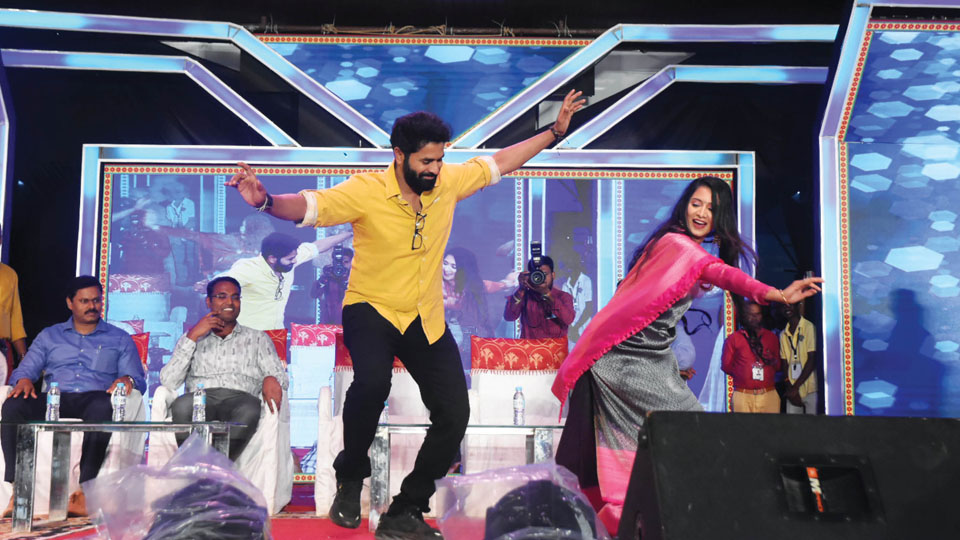
Actress Harshika Poonacha and Director Nagendra Prasad
‘Kannada not just a language but a feeling and a way of life’
Mysore/Mysuru:
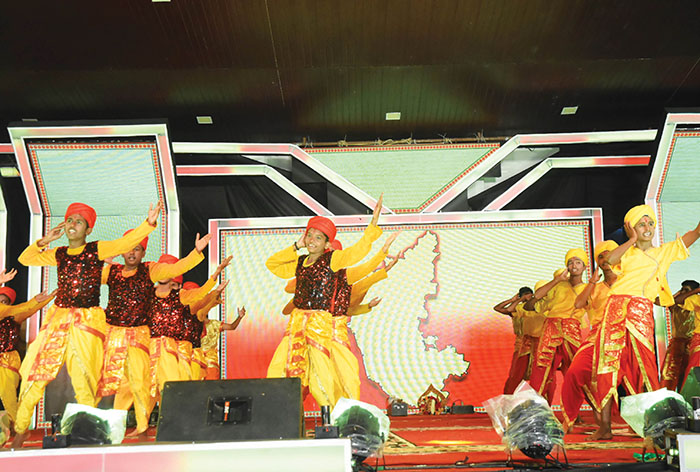
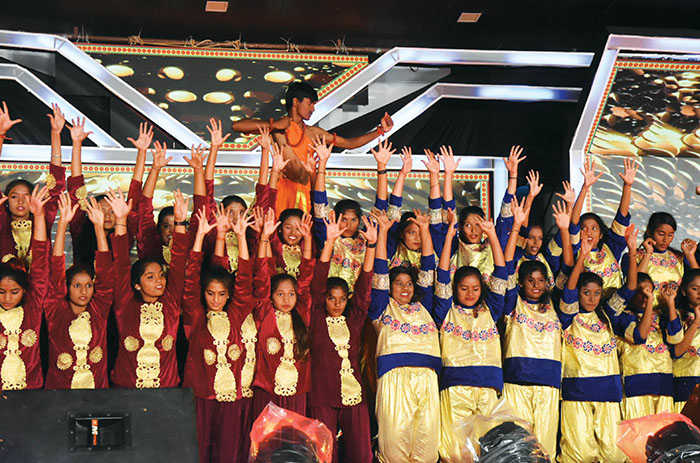
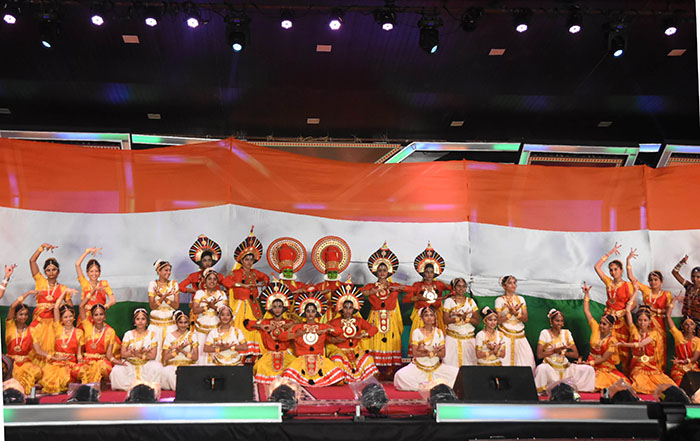
The usually busy Manasagangothri Road in the University of Mysore campus gets busier after 4 pm these days as hundreds of youths pour into the Open Air Theatre where Yuva Sambhrama is being held as a prelude for Yuva Dasara.
While youths on stage forget themselves while performing foot-tapping music, the crowd in front of the stage too are mesmerised by the performances. Over the last couple of days, the place is becoming a popular joint for youngsters to hang around after a gap of two years and they are leaving no opportunity in making its maximum use.
Last evening, there were many stellar performances from various educational institutions where the message of Kannada being a feeling or a way of life and not just a language was spread by the performers, holding the Kannada flag. The performance by the students of DPBS Government PU College, Periyapatna, extolling the Kannada language, attracted many and even the audience sang and danced.
Likewise, students of the JSS Academy of Higher Education and Research, dressed as peacocks, performed to Kannada tunes while the students of Maharaja’s PU College highlighted the contribution of Vijayanagar rulers, Madakari Nayaka and Onake Obavva who sacrificed so that the Kannada language and culture can thrive.
Students of Bettadapura Government Junior College, Maddur Government Women’s College also performed on Kannada themes and also highlighted how the farmers of Karnataka form a backbone of the State and country. Through their impressive performances, they conveyed the message of urgently saving the lives of farmers who are being driven to commit suicide by banks and money lenders.
Performers from JSS College Ooty Road and Hardwicke Independent PU College commemorated the sacrifices made by the country’s soldiers. While students of CFTRI School performed an adventurous song, students of Mathrumandali College and Cauvery Institute of Health Sciences brought the memories of Kittur Rani Chennamma, Dr. Vishnuvardhan and Dr. Puneeth Rajkumar.
Students from Badariprasadji PU College, Siddarthanagar, performed clips from Ramayana while students of Gundlupet Government First Grade College threw light on the practices followed in border areas. Performers from Holenarasipur Paduvalahippe Sri H.D. Deve Gowda First Grade College enacted Krishna Leela on stage.
The main attraction of the evening was actress Harshika Poonacha who danced to Kodava Vaalaga. Actor-Director Nagendra Prasad accompanied her on stage(first picture on top). Another dancer was Dance Director Kulbhushan who performed for a Puneeth Rajkumar movie song.
source: http://www.starofmysore.com / Star of Mysore / Home> News / September 21st, 2022
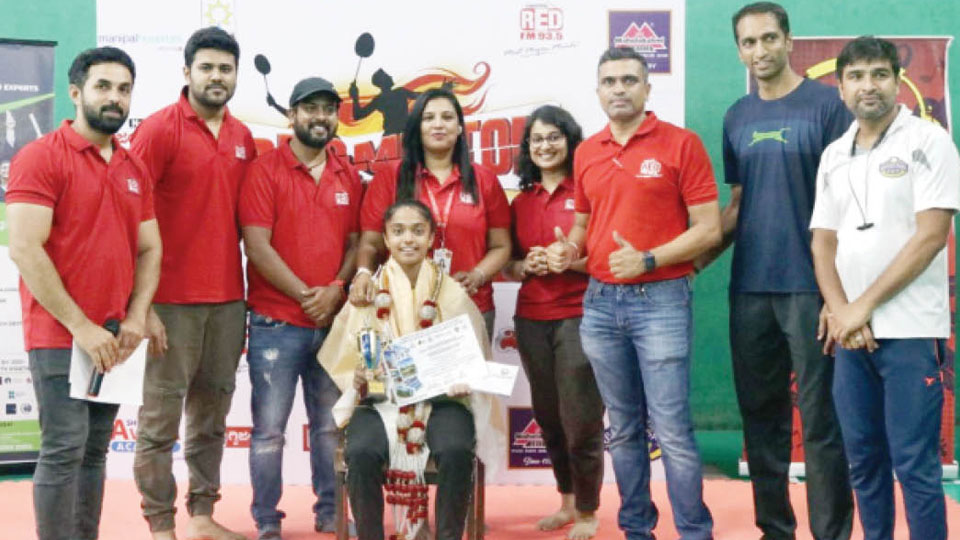
Diya Bheemaiah, 9th std. student of Pragathi Elite Public School, Bogadi, won 3rd place in Doubles in All India Ranking Badminton Tournament held at Goa.
She is Karnataka No. 1 in Singles, Doubles and Mixed Doubles U-15 category. ICSE School Games State-level U-17 winner, she is selected for ICSE Nationals.
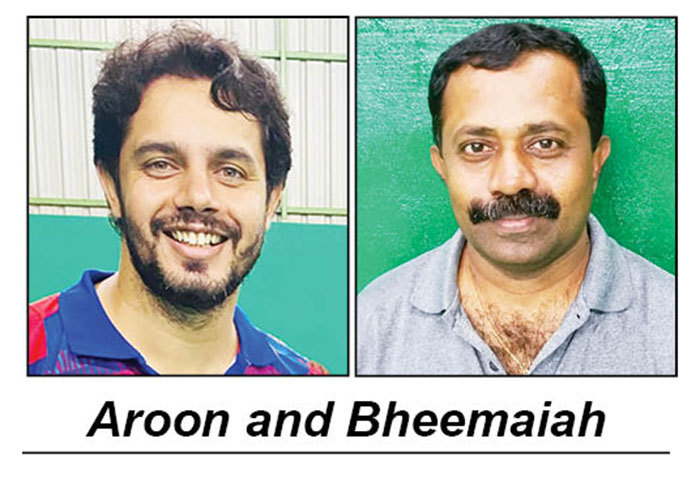
Coached by B.P. Bheemaiah and Aroon Pemmaiah, she was feted by Sports Park Management and 93.5 Red FM team recently.
She is seen with (from left) RJ Deepak, RJ Punith, RJ Sunil, RJ Rashmi, RJ Sahana, B.V. Raghav, S. Srikanth and M.R. Sudheendra.
Diya Bheemaiah, 9th std. student of Pragathi Elite Public School, Bogadi, won 3rd place in Doubles in All India Ranking Badminton Tournament held at Goa.
She is Karnataka No. 1 in Singles, Doubles and Mixed Doubles U-15 category. ICSE School Games State-level U-17 winner, she is selected for ICSE Nationals.
Coached by B.P. Bheemaiah and Aroon Pemmaiah, she was feted by Sports Park Management and 93.5 Red FM team recently.
She is seen with (from left) RJ Deepak, RJ Punith, RJ Sunil, RJ Rashmi, RJ Sahana, B.V. Raghav, S. Srikanth and M.R. Sudheendra.
source: http://www.starofmysore.com / Star of Mysore / Home> Sports / August 25th, 2022
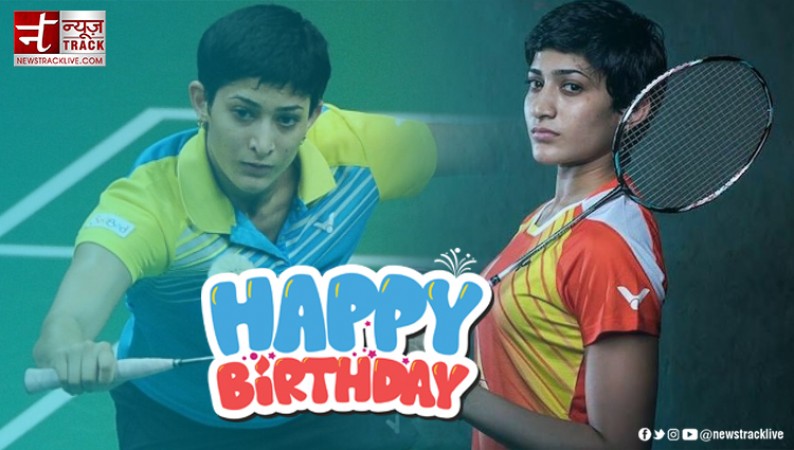
Today is the birthday of two-time Olympian and Commonwealth Games gold medallist Ashwini Ponnappa. She was born on this day in 1989. Ashwini is the first Indian woman badminton player to win a medal in the doubles category of the World Badminton Championships with her doubles partner. Since childhood, she started taking interest in badminton.
Ashwini’s mother inspired her to play badminton at the age of two and a half and got admission in the academy. It is difficult for her to say when the passion for the game was born in Ashwini Ponnappa as she joined it at a very young age. The Indian badminton player has won many medals in the doubles category in her career. This includes two gold, two silver and one bronze medals in the Commonwealth Games. Apart from this, she has won four gold medals in the South Asian Games.
Ashwini Ponnappa and Jwala Gutta won the gold medal at the 2010 Commonwealth Games in Delhi. Born on September 18, 1989, in Bangalore, Ashwini Ponnappa recognized her talent and started making a career in badminton from an early age. Ashwini Ponnappa, a specialist in doubles badminton, had her first win at the national level in 2004 at the national championships in the sub-junior girls’ doubles category.
source: http://www.english.newstracklive.com / News Track / Home> Trending / by Laxman Chaurasiya / September 18th, 2022
Ganesh, the son of producer Bellamkonda Suresh, who makes his debut with the family entertainer, celebrates his birthday today .
Swathimuthyam
Swathimuthyam, the family entertainer starring Ganesh and Varsha Bollamma in lead roles is the underdog among all the Dasara releases on October 5. Directed by debutant Lakshman K Krishna, the film is bankrolled by Suryadevara Naga Vamsi under the leading banner Sithara Entertainments. Mahathi Swara Sagar scores the music for the film, whose teaser trailer was launched today, commemorating the birthday of the lead actor Ganesh.
In the special birthday glimpse, the soon-to-be married couple, played by Ganesh and Varsha Bollamma, is in the middle of an interesting conversation. While an innocent Ganesh attempts to say something to his fiancé, she questions him in return, if he has any problem. He brushes aside any such problems. After a series of incidents, the girl even tells him ‘I think I know why you have been single all your life.’ The chemistry between the lead pair warrants your attention.
The family entertainer has all the ingredients to make for an ideal festive release – romance, family drama and memorable music. This is the debut project for Ganesh, son of producer Bellamkonda Suresh and brother to Bellamkonda Sai Sreenivas. Naresh, Rao Ramesh, Subbaraju, Vennela Kishore, Harshavardhan, Pammi Sai, Sapthagiri, Goparaju Ramana, Siva Narayana, Pragathi, Surekha Vani, Sunaina, Divya Sripada are also part of the cast.
Nee Chaaredu Kalle and Dum Dum Dum are the two songs from the film that have already been launched. Suryaa cranks the camera for the film which is edited by Navin Nooli and has art direction by Avinash Kolla. PDV Prasad is the presenter. The banner’s other major release this year is Sir/Vaathi, actor Dhanush’s first straight Telugu film helmed by Venky Atluri. Samyuktha Menon is cast as the female lead in the same.
source: http://ottplay.com / OTTplay / Home> News / by Srivasthan Nadadhur / September 14th, 2022
Exclusive interview with writer Kaveri Ponnapa By Sujata Rajpal
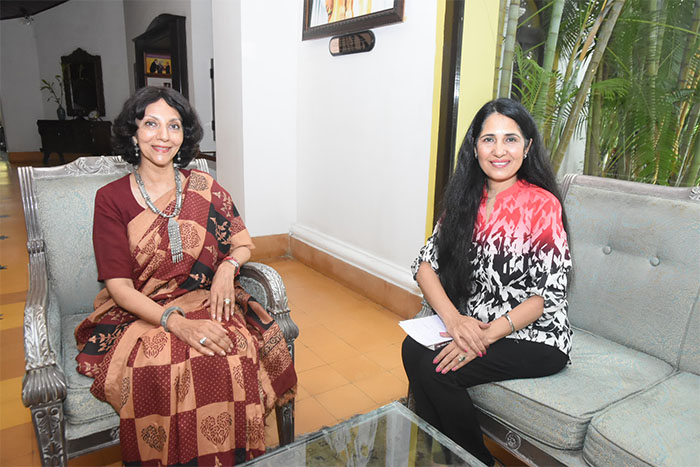
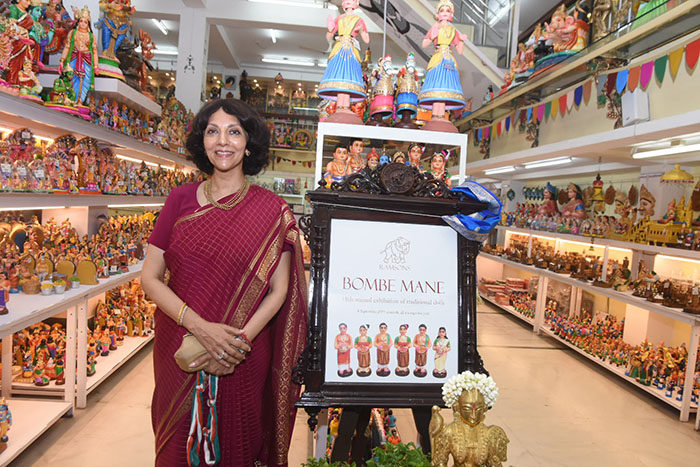
Kaveri Ponnapa, the author of The Vanishing Kodavas (published in 2013), is the first writer to bring out a scholarly researched work on the history of Kodavas and their fast vanishing culture and traditions. She is also an independent writer on food, art and culture. Kaveri Ponnapa was in Mysuru recently to unveil the special display section at Ramsons Bombe Mane. Sujata Rajpal spoke to her in an exclusive interview for Star of Mysore.—Ed
Star of Mysore (SOM): What inspired you to write ‘The Vanishing Kodavas’?
Kaveri Ponnapa (KP): I shifted to Bangalore twenty-five years ago. Since then, I have been frequently visiting Coorg where I have strong roots. It gave me an opportunity to observe various aspects of its culture which were hitherto unknown to me. It was engaging as well as engrossing to meet new people, visit ancestral homes, attend village festivals and participate in the rituals. I also observed that this culture that I am so proud of, is fast disappearing. It is especially true for the younger generations, who are not aware about Kodavas’ rich cultural heritage. With a background in Social Anthropology — my Master’s Dissertation at SOAS was on aspects of Kodava culture — I saw the importance of documenting various aspects of our culture before they disappeared completely. This is happening to small cultures across the world.
SOM: You took 15 years to write this book. What made you keep going for so long?
KP: This book required an enormous amount of field work, travelling, learning, unlearning, participating in festivals, observing rituals and much more. I had to make multiple trips to the villages to familiarise myself with the ethos fully. The research material had to be collated and presented in a coherent way as the study had to make sense to the readers. The book has about 340 photographs of people, places and the socio-cultural activities. They are intended to provide visual documentation of our culture.
I had estimated it would take me four-five years to finish the book, but it took fifteen years as I needed to be satisfied with my work. I had to do justice to the custodians of our culture who were feeding me the inputs. My community’s faith in me kept me going for a decade and a half. When the book was ready and I presented it to the elders of the villages, they were unanimous in their opinion about the impact the work would have especially on the younger generation.
It feels wonderful when people walk up to me and say kind words in appreciation of this cultural study. Young people in particular, tell me how much they have learnt about our culture, how proud they are to own the book and how it has helped them connect back to the land: it’s the best compliment for a writer.
I am currently working on the second edition of this book, but I am unable to say how much more time it would take; it is work in progress. It’s heartening that people who own a copy now want a book for their children and grandchildren. The first one is a collector’s copy, the next will probably be a less lavish, more affordable paperback.
I would love to get the book translated into Kodava language so that more people have access to this work, but it would be quite a challenge to find a translator who is passionate and committed.
SOM: What challenges did you face in writing this voluminous book?
KP: When I started work on this book, I didn’t know a single person in the villages. I had to approach complete strangers to get inputs. I am so grateful that every door that I knocked at opened. In Coorg, every few kms, there is a variation in speech, traditions, customs and rituals; collating that information itself was a challenge. Many festivals in Coorg are celebrated on the same day and it was not possible to attend all together, so I had to leave some for the following year. In many cases, permission had to be taken for taking photographs as photography was not permitted for some sacred ceremonies. I had to be extremely patient. Things took time, but ultimately everything flowed smoothly.
SOM: Do you have any tips for aspiring writers who would want to write about their communities?
KP: I would urge aspiring writers to begin from the grassroots. It’s important to go to the basics to learn about one’s culture. One must be a keen observer in the field. Prepare to be surprised, to learn and to unlearn. The study must have citations and an accurate bibliography of books that you have actually read and referred to, to lend credibility to the work. Academic research is only as good as the latest research. One should be prepared to incorporate the latest findings as today’s research may not be relevant tomorrow. Also, reading feeds writing, so read as much as you can.
Writer Kaveri Ponnapa with Sujata Rajpal.
SOM: How did you get interested in writing on food, specially?
KP: Cooking is my passion. Some of the finest prose in English literature is writings on food. I began to write articles on food much before my debut book was published. My writing on food and wine is published in leading magazines and newspapers in the country.
SOM: What are your impressions about Mysuru?
KP: I come to Mysuru as often as possible. Every time I visit this beautiful city, I am enamoured by its people, their simplicity, its architecture, the food and its heritage. The walking tours, the magnificent Devaraja Market, First Rajkumari Palace in Manasagangothri, the beautiful collection of paintings at Ramsons, the small pockets of culture here and there which connect you to your past — everything is spectacular about Mysuru. Mysuru is known for its handlooms. L. Kadaiah’s Silk House on Sayyaji Road is my favourite saree shop as it has lovely collection of handloom sarees. I always carry something with me from Guru Sweets. I love the city and its people who are so very gracious, courteous and generous. If I have even half a chance I would live here.
SOM: How did you get interested in Dasara dolls?
KP: I have been a lover of handicrafts and handlooms all my life; I have seen dolls of different regions. Rajasthan has Gangaur, a festival of dolls. It is by chance that I am here to inaugurate Bombe Mane. Two months ago, when I visited Mysuru, I happened to go to Ramsons painting gallery and met its owner R.G. Singh there. He asked me to visit again in September for Bombe Mane. I was not sure if it would be possible for me to come to Mysuru so soon, but things fell in place and I am here. Ramsons art gallery is doing a phenomenal job of reviving art through exhibitions and sale of handicrafts. Bombe Mane is a great platform to tell age old stories.
SOM: Have you watched Mysore Dasara festival?
KP: It was thirty years ago when I made a trip to Mysore to watch the famous Dasara festival. My aunt took me to a friend’s house whose balcony opened into the road from where the procession had to pass. From that balcony, I watched the entire procession. What a magnificent sight it was! The beautiful memories were made for life. That was the only time I watched the Mysore Dasara as now it is too crowded. The ideal would be to have vantage points to watch the procession. Despite the crowds, the involvement of public in festival celebrations is heart-warming.
SOM: How did you get interested in cooking?
KP: Cooking is my passion. I have been interested in cooking for a very long time. The seeds of this passion were sown by my grandmother who was a fabulous cook. Be it pickle, jam, traditional Coorg food, she was an expert in everything. At that time, I was not so much interested in cooking, but I was intrigued by its ingredients; I would ask grandma so many questions about cooking that she would have to chase me out so that she could cook in peace.
In recent years, I have trained chefs from ITC, Taj and have had successful food festivals. Cooking is fundamental to life, it is meditative and relaxing as one needs to observe keenly, be very attentive, and use all the senses. And, of course, there is no price to the joy of feeding people and seeing a satisfied smile after a meal. Kodava (Coorg) cuisine is my favourite cuisine. I can have that every day. The dishes are rooted in the land, exotic and seasonal.
SOM: Are Kodavas really vanishing and is there a way to prevent it?
KP: It doesn’t refer to the numbers as such, but the culture is eroding primarily because of tourism, migration, change in policies relating to land holdings etc. It depends completely on the younger generations if they can sustain the culture and follow traditions.
source: http://www.starofmysore.com / Star of Mysore / Home> Feature Articles / by Sujata Rajpal / September 12th, 2022
The first book of poetry by acclaimed curator, writer and speaker Dr Nima Poovaya-Smith celebrates her profound curiosity about wild cats.
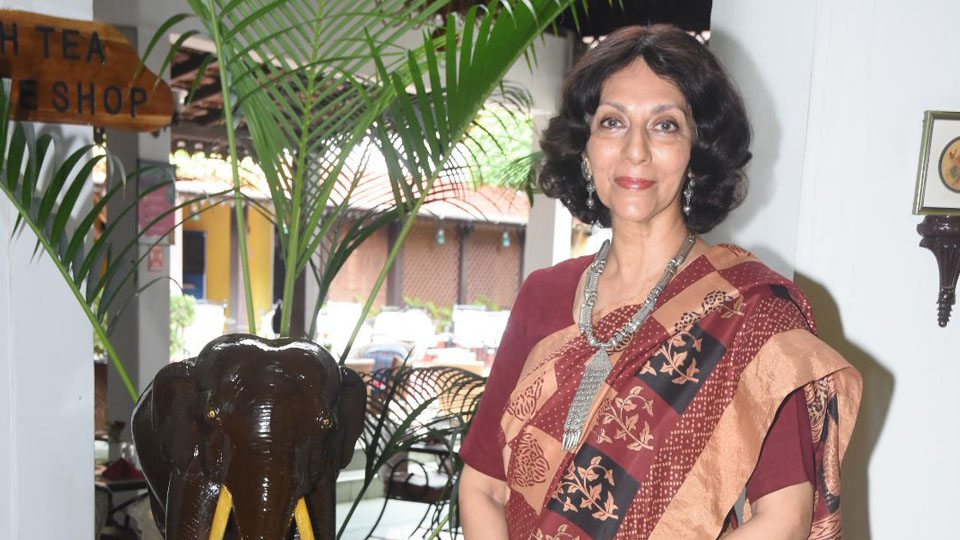
Dr Nima Poovaya-Smith OBE is a prominent figure in the cultural, academic and public sectors, well known for her work on transcultural and post-colonial South Asian museum collections in Bradford and multidisciplinary arts projects across the region and beyond. Less well known is her affinity with cats of all persuasions, wild or domestic.
The Wild Cats Compendium, Poovaya-Smith’s first solo collection of illustrated poetry, will be launched at Ilkley Literature Festival on 13 October 2022.
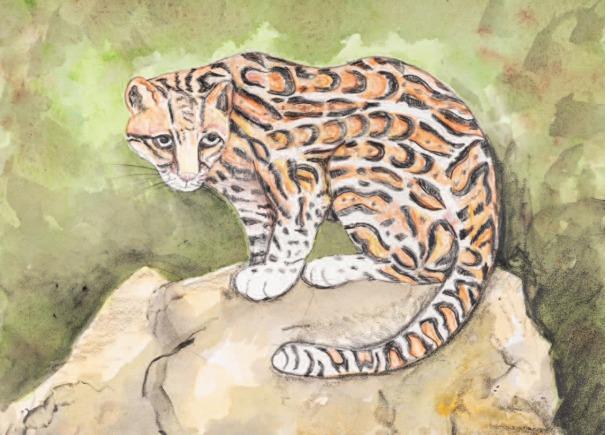
The Compendium is first and foremost a love letter to all felines large and small. Legends and fables of the cat world, as well as their often bleak, everyday lives is explored by Poovaya-Smith, in this collection of 45 poems. There is the reed or jungle cat who may have once dined with the Crown Prince of an Egyptian Pharoah and ended up interred with him; an ocelot gifted to Salvador Dali who tried unsuccessfully to run away and the smallest feline in Southern Africa – the black-footed cat – which eats almost a fifth of its body weight night after night.
Environmentalist Benjamin Lascelles, who has written the End piece comments that Compendium “captures the essence of the many species brilliantly and highlights the many threats they face. The geographic, conservation and threat references are meticulously researched and powerfully conveyed.”
Nima Poovaya-Smith says: “I have always taken a deep interest in cats. Wild or domestic, they are some of nature’s most charismatic creatures. I am enthralled by the facts and fables that surround them. I am certainly not the first, nor will I be the last, to find these animals so captivating. Across the world, we have had a special relationship with the feline species for thousands of years. They have been celebrated in literature and art as well as music and dance. I found particular delight in gleaning more information about lesser-known small cats. Each one is characterful enough to hold its own with the bigger, more iconic cats. The more I learned, the more enigmatic and fascinating they became. I hope that the emotions I experienced exploring the feline world – joy and a deep sense of loss – will resonate with all readers.”
Writer, historian, journalist and author of Victoria and Abdul, Shrabani Basu in her Foreword to The Wild Cats Compendium states: “Nima Poovaya-Smith takes us into the myth and magic of the cat world. Through her beautiful poems, we get a glimpse into their lives as pampered pets or solitary creatures. She questions, probes, and enlightens us, not just about the tiger or the lion, but also about some of the lesser-known species of the cat family. A cat, they say, has nine lives. Poovaya-Smith’s forty-five poems give them many more.”
The different species of cat in Compendium are each accompanied by images – twenty-eight of which are new works by seven different artists. There are also some earlier works by contemporary artists and six historic Illustrations from the 19th century.
source: http://www.ilkleygazette.com / ILKLEY GAZETTE / Home> Local News> UK News / by Claire Lomax / September 09th, 2022
The fest will likely be organized using nearly Rs 1.50 crore funds and the family has sent a proposal to the state requesting sanctioning of Rs One crore funds.
For representational purposes (Photo | PTI)
The iconic Kodava Hockey Namme will take place next year following a break of four years. The same was confirmed in a press conference by the Appachettolanda Family on Tuesday.
“After 2018, the hockey fest did not see the light of the day due to natural disasters and pandemic situations. However, the 23rd annual fest will be hosted in 2023 in a grandeur manner. The fest will be held at Napoklu General Thimayya Ground. Over 350 Kodava families are likely to take part in the tournament,” confirmed Appachettolanda Manu Muthappa, the president of the hockey fest.
The hockey tournament will begin on February 20 and will go on till March 6. The website and the logo will be released on 2nd October at Napoklu Kodava Samaj. The fest will likely be organized using nearly Rs 1.50 crore funds and the family has sent a proposal to the state requesting sanctioning of Rs One crore funds. The press conference was headed by the Appachettolanda family patted Mittu Erappa and other family members.
‘Kodava Hockey Namme’ has been organized in the district for 22 years. However, the event was cancelled in 2018 due to floods and a pandemic situation. The 2023 event will be the 23rd year of the hockey fest. The hockey tournament played among the Kodava community has gained international fame as the tournament has broken the ‘Limca Book of Records’ and ‘Guinness World Record’ for the highest number of team participation.
The 2018 Kulletria Cup Hockey saw participation from 333 Kodava families. It was in 1997 that the first Kodava family hockey tournament was played and was organized by the Pandanda family. The game started off with international rules and standards and it continues to provide a stage for youngsters and seniors alike to unravel their passion for hockey.
source: http://www.newindianexpress.com / The New Indian Express / Home> States> Karnataka / by Express News Service / September 06th, 2022
‘We started shooting on my birthday and I met Amitabh Bachchan sir for the first time then’
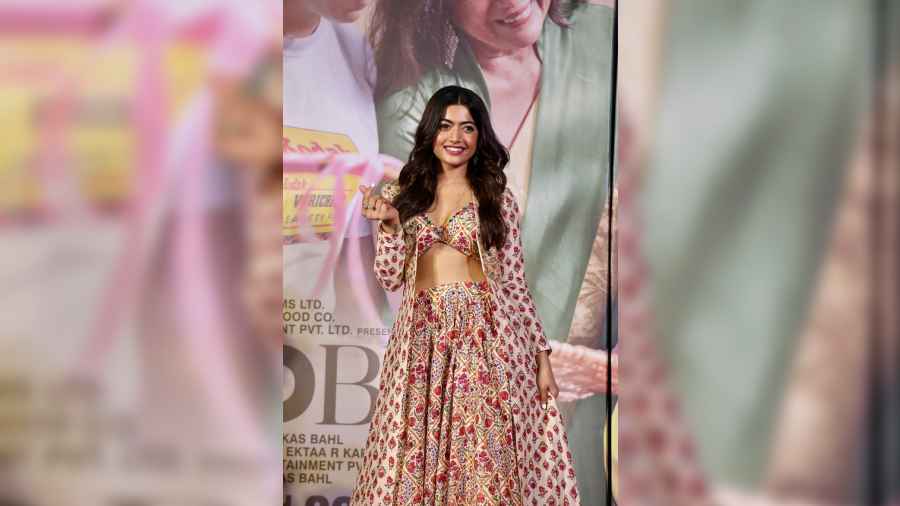
Rashmika Mandanna is a complete entertainment package and her fans couldn’t be any more excited about her upcoming lineups making it to the theatres. Today, the trailer of her most awaited film Goodbye starring Amitabh Bachchan was released! While the trailer looks very promising and the bond between Rashmika Mandana and Amitabh Bachchan was surreal, a clip of her talking about BIG B in a media interaction has been making rounds on the internet.
The actress can be seen talking about how she first met the legendary Amitabh Bachchan and how they slowly developed an endearing relationship during the shooting of GoodBye. Rashmika said, “We started shooting on my birthday and I met him for the first time then. I remember this day very clearly as I was waiting for him since I wanted to say hey. While I was standing in the corner, he crossed me and he went away”.
As Rashmika flashed a big smile and went on to introduce her, the actor seemed to have been lost in his thoughts. About which, the actress says “I wanted to introduce myself but of course, sir was busy thinking about the scene and what to do and not to do”. The actress later went in, and quickly introduced herself, as she took some nervous breath “Hey sir, I am Rashmika and I will be playing your daughter”, then found her exit.
Now while Rashmika and Mr. Bachchan shared a bond that was growing slowly with Amitabh Bachchan. One fine day Rashmika finds herself to be out of words when BIG B tweeted about her. About which the actress says “One day I entered the sets and everybody was like “Did you check your tweeter?’ and when I did, I saw that Bachchan sir had posted a picture saying “Pushpa”.
While Rashmika seems to be unstoppable with the kind of project she has been doing lately, she had also quoted that “I am living my dream of working with two icons of Indian cinema”
Meanwhile, the actress will also be seen in Pushpa 2 along with Allu Arjun and Animal with Ranbir Kapoor.
source: http://www.telegraphindia.com / The Telegraph Online / Home> Entertainment / by The Telegraph Bureau, Mumbai / September 06th, 2022
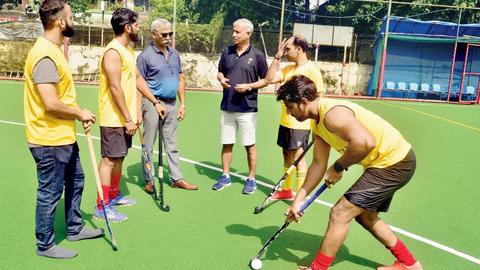
Team members Rohan Nanjappa, BK Muthana, Nitin Chengappa and BK Appachu with manager Jagdeep Nanjappa and Coorg Association Mumbai president and former India captain MM Somaya at St Stanislaus Sports Complex in Bandra where they have played tournaments in the past. Pics/Shadab Khan
An organisation founded by the people of Karnataka’s Kodagu district has persevered for 100 years in the city by supporting the Coorgi community and celebrating its culture, while forging deep ties with Mumbai.
Last week, Mumbai*s Coorgi community celebrated Kailpodh, a festival to signal the end of transplantation of the paddy crop. Agricultural implements and weapons were worshipped. “Our festivals,” says MM Somaya, president of the Coorg Association Mumbai (CAM) and former India hockey captain, “help us get back to our roots.”
Coming up next, say CAM members, is Kaveri Sankramana in mid-October that celebrates the birth of the river in Coorg. November will bring with it the harvest festival, Puttari. On these occasions, the Association*s catering committee meets in the office building in Airoli to prepare traditional delicacies such as pandhi curry (pork curry), kadambuttu (rice dumplings), akki oti (rice roti) and thambuttu (a sweet dish made with bananas). “This has been the tradition since the establishment of the Association,” says Lekha Nanjapa, head of the catering team, “Initially, people carried food from their homes, but gradually, we started gathering a day before to cook in the community kitchen, spending a fun afternoon over stories and gossip. The kitchen has old brass cauldrons with kalai coating, large enough to cook 20-25 kilos of food at one time.”
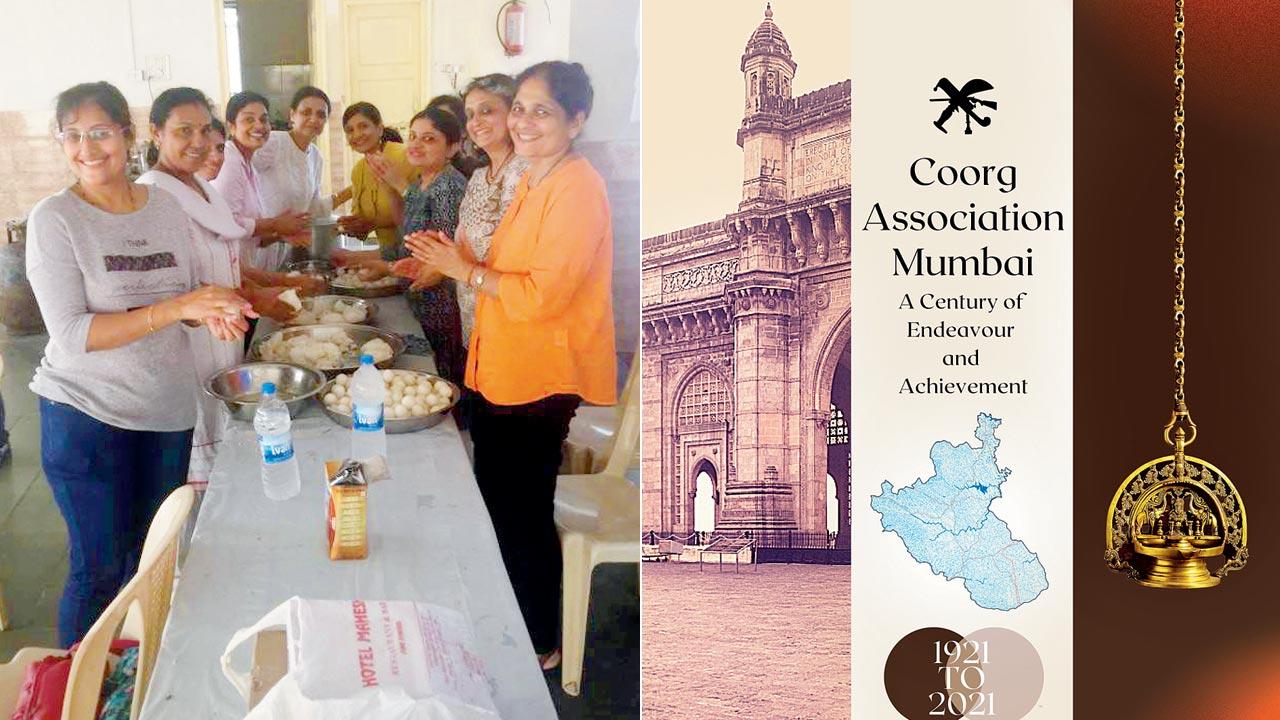
Members of the Association*s catering committee meet at the office in Airoli on the eve of festivals such as Kailpodh to prepare pandhi curry and kadambuttu; (right) CAM celebrated its centenary last year, and the members have just released a book carrying a compilation of stories, anecdotes and accounts to mark the occasion
Members of the Association*s catering committee meet at the office in Airoli on the eve of festivals such as Kailpodh to prepare pandhi curry and kadambuttu; (right) CAM celebrated its centenary last year, and the members have just released a book carrying a compilation of stories, anecdotes and accounts to mark the occasion
CAM celebrated its centenary last year, and the members have just released a book to mark the occasion. Carrying a compilation of stories, anecdotes and accounts written by members, Coorg Association Mumbai: A Century of Endeavour and Achievement, hopes to find its way to Coorgi associations in other parts of the country too.
CAM, says Somaya, was launched as a way for the community to gather and observe customs unique to their culture. Among the efforts that have kept the members close is the setting up of the Association building in Airoli in 1996. Apart from serving as a venue for events and a way to raise money for charity, it also has residential rooms available at nominal rates to youth coming in to Mumbai from Coorg for education and work. “The objective,” Somaya explains, “is to guide the younger generation and give them a chance to get a foothold in the city.
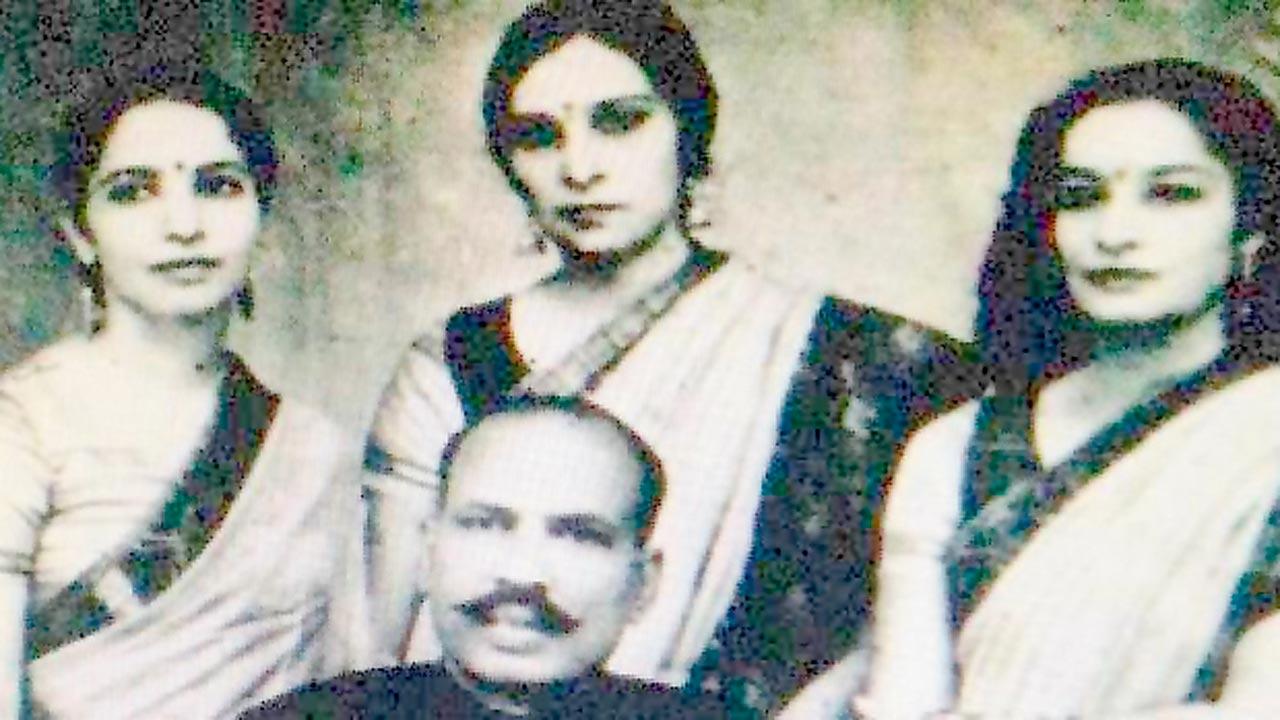
Among members of the Kodava community who flourished in Bombay were the Codanda Poovaiah sisters, prominent in Indian dance. Their bungalow at Chowpatty was regularly visited by practitioners
Among members of the Kodava community who flourished in Bombay were the Codanda Poovaiah sisters, prominent in Indian dance. Their bungalow at Chowpatty was regularly visited by practitioners
CAM*s social service initiatives include extending support to the home district at the time of natural disasters, and helping deserving candidates study further. Somaya speaks of two young girls, daughters of displaced families, who are presently studying engineering at the Coorg Institute of Technology, Ponnampet, and whose college fees, boarding and lodging expenses are being borne by CAM.
Nitin Chengappa, a senior bank executive who lived in Chennai, Kolkata, and Delhi before moving to Mumbai 18 years ago, says that the bond between its members sets the Mumbai Association apart. “I have been part of the Coorg Association in every city I have lived in, but the ties here are very strong,” he notes. “It comes from the fact that generations have lived in Mumbai, so there is a sense of ownership. The core team are family members of those who have been involved since the foundation of the Association.”
Community members have also, MM Somaya points out, merged well with the city pursuing careers in administration, the armed forces, business and sport, which has only served to further strengthen the ties. “Our people have contributed to the society here,” he states, listing individuals like Kodandera C Madappa, who held the post of Director General (Shipping) in Mumbai; Bollera C Cariappa, who used to be CIDCO Chairman and later served as head of Bombay Municipal Corporation; Kuppanda M Chinappa, the Managing Director of TATA Electric, and the Codanda Poovaiah sisters who were prominent names in Indian dance.
But the activity that has glued this small community and CAM*s members together is undoubtedly their love for sport, especially hockey. The Coorg XI Hockey team, founded by Kandarthanda Kuttappa, was registered with the Bombay Provincial Hockey Association in the 1930s and still plays in the Mumbai Hockey League. “We have endeavoured to use sport as a unifier,” admits Somaya, the Association encouraging its growth by picking up budding players from Coorg and bringing them to Mumbai to get exposure, while also supporting other games such as cricket and bridge. After a 25-year gap, when no team was playing in the league, Biddanda Jagdeep Nanjapa took over its running in 2001. Since then the team has played at prestigious national-level tournaments such as the Bombay Gold Cup.
For Nanjapa, who was born and brought up in Mumbai, the attachment to CAM has been generational. It started with his father, who migrated to the city in the 1940s and continues with his sons, who are now active members. This separates him from the floating Coorgi population that comes to Mumbai to work. The generational association has also meant that the family has borne witness to the institution*s evolution. “Things were tough initially – recession in the 1930s brought in Kodavas who found living in Coorg difficult and ventured to different parts of the country. We used to book outside halls, take small donations and were just about meeting expenses. Today, our people are doing better. The Association is also able to generate income by renting out the hall at the office building [for functions]. We are faring well as a community and as an Association.”
source: http://www.mid-day.com / mid-day.com / Home> Sunday Mid-day / by Sucheta Chakraborty / September 04th, 2022
WELCOME. If you like what you see "SUBSCRIBE via EMAIL" to receive FREE regular UPDATES.
Read More »