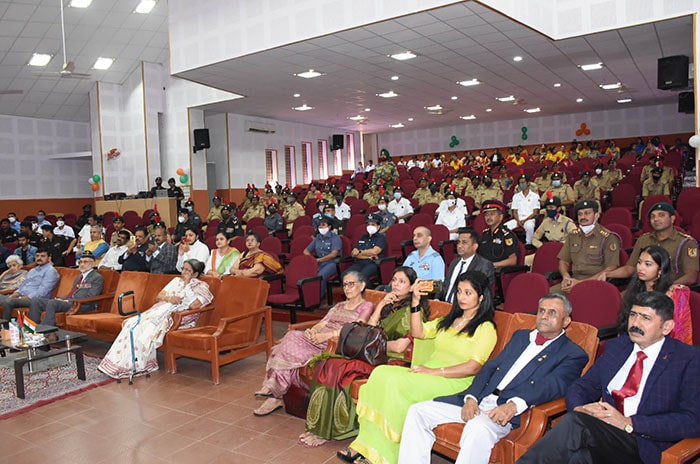
Virajpet MLA A.S. Ponnanna, who also serves as the Legal Advisor to the Chief Minister, Somwarpet MLA Dr. Manthar Gowda and Mysuru-Kodagu MP Yaduveer Krishnadatta Chamaraja Wadiyar have called for peace between communities in Kodagu following tensions at the Maha Mrithyunjaya Temple in Kattemad village on Dec. 27.
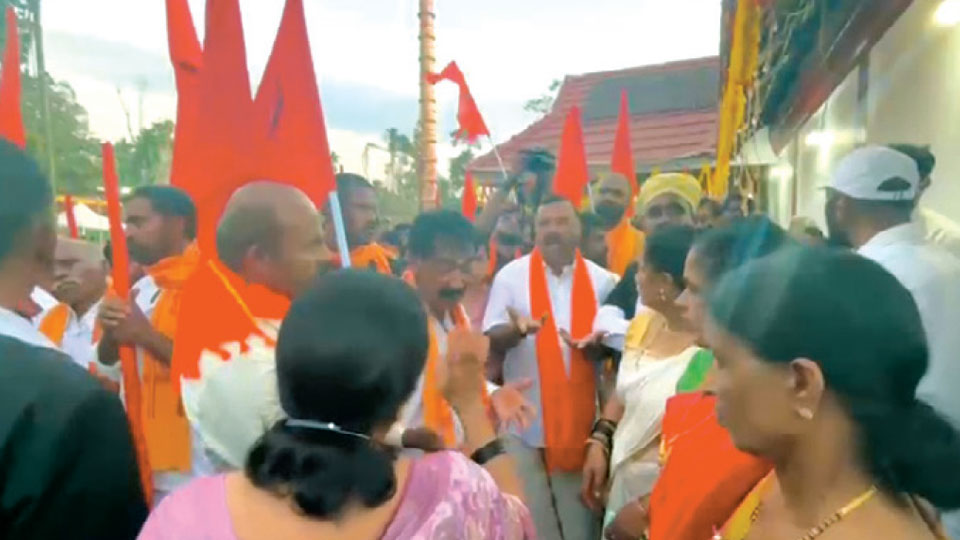
The incident occurred when over 20 Kodava community members, including women in traditional attire, were prevented from entering the Temple wearing traditional dresses by individuals from another community, claiming to represent the Temple Management Board.
Reports suggest that individuals demanded Kodavas either remove their traditional attire or leave the Temple premises. The altercation occurred on the final day of the festival at the Mrithyunjaya Temple. It was claimed that the Temple’s by-laws prohibit traditional attire, a contention that Kodava community members vehemently disputed.
The Police intervened to defuse the situation. Both groups filed complaints and counter-complaints at the Madikeri Rural Police Station. Footage of the incident, which has gone viral on social media, has drawn widespread criticism for causing disrespect to the Kodava community in their homeland.
MLA Ponnanna called upon everyone to uphold peace and harmony. “I appeal to the Temple management to revoke this by-law and allow traditional attire from all communities. Historically, traditional attire has been a vital part of the district’s cultural heritage, embraced by various communities,” he said.
MLA Dr. Manthar Gowda also expressed his surprise over the incident, noting that Kodagu is known for its communal harmony and peaceful coexistence among communities. He urged all parties to maintain peace and ensure that the situation does not escalate.
Mysuru-Kodagu MP Yaduveer Krishnadatta Chamaraja Wadiyar strongly condemned the incident and denounced acts of mutual hatred and disruptions to societal peace, emphasising that such incidents should never happen. He called for addressing differences through dialogue and fostering a harmonious environment.
In response to the incident, various organisations have announced plans for a massive march titled ‘Kodava Nadige Kattemadu Kade’ soon.
Virajpet Kodava Samaja’s Honorary Secretary Maletira Srinivas accused certain politically motivated individuals of attempting to strip the Kodava community of their rights and insulting Kodava women.
source: http://www.starofmysore.com / Star of Mysore / Home> News> Top Stories / December 29th, 2024
Training sparks debate over elephant transfers toAndhra Pradesh; local Mahouts, Kavadis unhappy
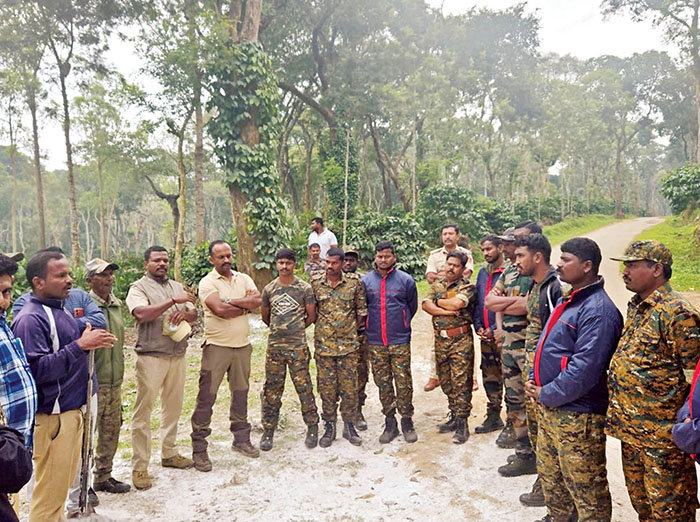
A team of 21 elephant handlers, including 17 Mahouts and four Kavadis from Andhra Pradesh, is undergoing specialised training in handling Kumki elephants at Dubare Elephant Camp in Kodagu.
The training, which began in mid-November, is set to conclude on Dec. 10, after which the team will return to Andhra Pradesh. Kumki elephants are trained to tackle wild elephants, safeguard human settlements and support wildlife conservation, including forest patrols and crop protection.
This training is part of a Memorandum of Understanding (MoU) signed in Vijayawada between the Andhra Pradesh Forest Department and Karnataka in September 2024. The agreement seeks mutual cooperation in addressing wildlife challenges and it was formalised in the presence of Andhra Pradesh Dy.CM Pawan Kalyan and Karnataka Forest Minister Eshwar B. Khandre.
However, reports suggest that Karnataka may be planning to transfer four to six trained elephants to Andhra Pradesh under the guise of this training programme.
Andhra Pradesh has an urgent need for Kumki elephants, with only two elephants — Jayanth (67) and Vinayak (54) — stationed at the Naniyala forest camp in Chittoor district and are reaching retirement age. This shortage has hampered efforts to protect wildlife, prevent the theft of sandalwood and red sanders trees, conserve forests and mitigate man-animal conflicts.
Sources informed Star of Mysore that the training might be a cover for relocating elephants to Andhra Pradesh. Mahouts and Kavadis in Dubare are unhappy with the move, citing Karnataka’s own shortage of trained elephants.
“It takes four to five years to tame and train an elephant to follow commands. We build a deep, familial bond with these animals through immense sacrifice and effort. Transferring them would not only sever this bond but also leave us jobless,” said one mahout.
Forest officials, however, denied any finalised plans, stating they have not received Government orders to shift the elephants. Some mahouts countered, claiming that a proposal was discussed months ago and that Karnataka is quietly laying the groundwork for the transfer.
Reports indicate that many elephants in Dubare have already been introduced to Andhra Pradesh handlers, who are being trained to manage them. The plan reportedly involves sending a specific number of elephants to support wildlife operations in Andhra Pradesh, with fears they might not return after their assignments and will be kept there for that State’s services.
Meticulous training on all elephant aspects
The training programme for elephant handlers from Andhra Pradesh at Dubare Elephant Camp focuses on understanding elephant behaviour and mastering specific cues to control and direct them effectively. Under the guidance of lead trainer J.K. Dobi, the training employs a range of techniques, including the use of specialised tools, handling chains and creating loud noises to ward off wild animals.
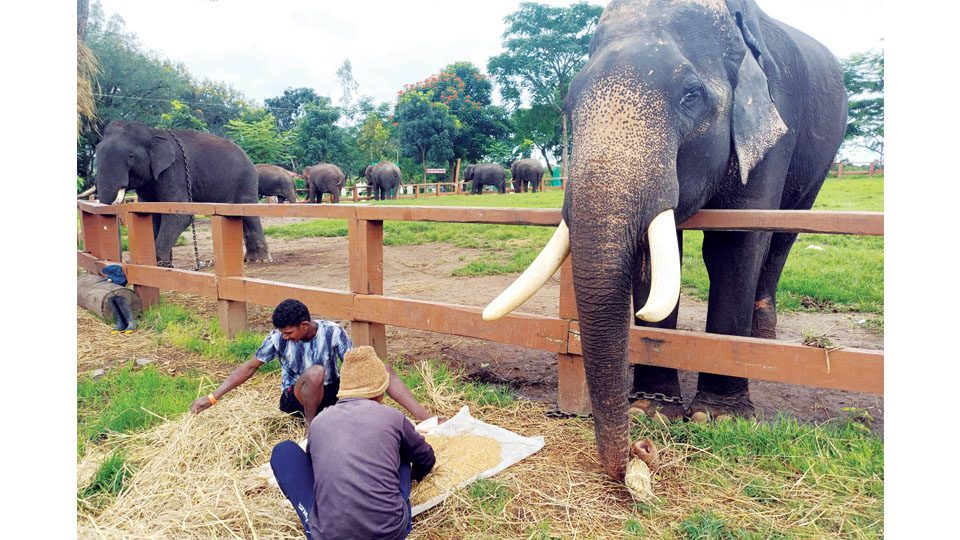
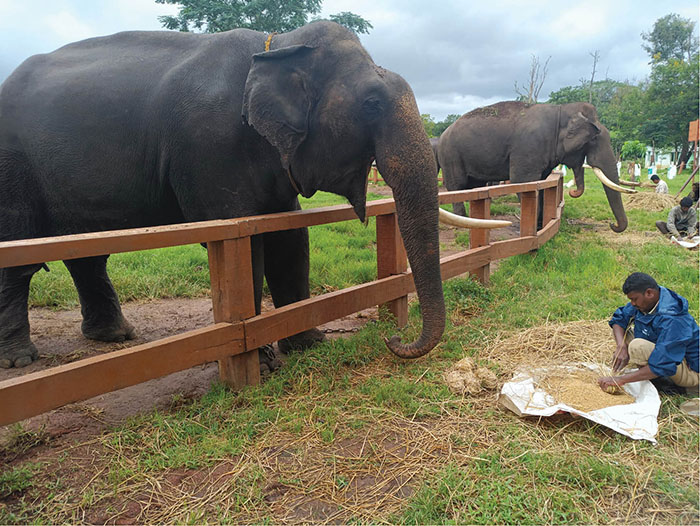
The handlers are trained with elephants Dhananjaya, Kanjan, Vidyashree, Vijaya and Rama in foundational skills such as touching, bathing and interpreting signals. They are taught commands in specific languages, methods for balancing atop elephants and techniques like tapping the elephant’s ear with their foot or patting its head for direction.
Additionally, they learn about elephant dietary requirements, including the cooking process, ingredients and feeding schedules.
To provide a comprehensive understanding, the team has been taken to other elephant camps across Kodagu and Mysuru districts, including Harangi, Mathigodu, Balle, and Veeranahosahalli. Here, they are familiarised with the unique conditions and challenges specific to each camp, ensuring their preparedness for diverse environments.
Karnataka must prioritise its elephant needs
According to Forest Department officials, Karnataka plans to send four trained elephants to Andhra Pradesh to assist in wild elephant capture and training operations only. Since 2013, Karnataka has handed over 59 trained elephants to various States. The Forest Department must be transparent and avoid concealing facts.
Andhra Pradesh initially requested 22 elephants, but the number was scaled down to eight after Karnataka refused. Even now, sending elephants to Andhra Pradesh is not the right move. We need elephants for Dasara, other tasks and as a tourist attraction at elephant camps. Our resources are already stretched with limited elephants in the State. To capture and tame an elephant it costs Rs. 14 lakh and to fit a radio collar, it requires Rs. 22 lakh.—Joseph Hoover, Conservationist & Wildlife Activist
source: http://www.starofmysore.com / Star of Mysore / Home> Feature Articles / by Joseph Hoover, Conservationist & Wildlife Activist / December 09th, 2024
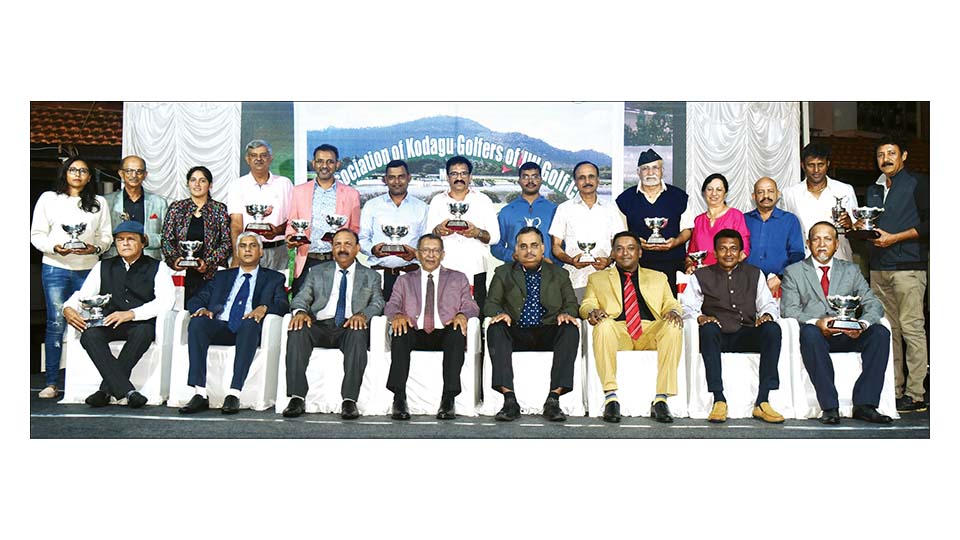
Following are the prize winners of the 23rd Edition of Kodagu Golf Open Championship-2024 held at J.W. Golf Club, Mysuru, on Nov. 30 and Dec. 1:
Strokeplay Gross – Field Marshal Cariappa Memorial Trophy, sponsored by K.C. Biddappa: Shridhar Singh (74 Gross) – Winner; K.A. Anil Kumar (77 Gross) – Runner (Better Back 9 Over M.C.S. Manohara).
Strokeplay Net (H/C 0 to 12) – Gen. K.S. Thimmaiah Memorial Trophy, sponsored by Mandovi Motors: I.K. Anil (68 Net) – Winner (Better Back 9 Over Sonam Chugh); Sonam Chugh (68 Net) – Runner (Better Back 9 Over M.C.S. Manohara).
Strokeplay Net (H/C 13 to 18) – Sqn. Ldr. M.B. Chittiappa Memorial Trophy, sponsored by Mallengada B. Nanaiah: J.N. Arjun (62 Net) – Winner; Ram Kevalur (68 Net) – Runner (Better Back 9 Over K.C. Vishwananda Bhat & Janardhan Babu).
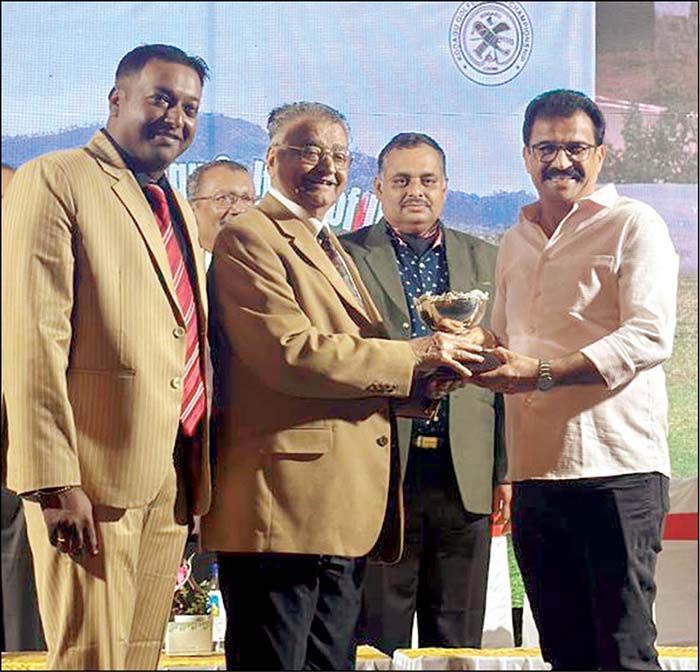
K.B. Ganapathy, Founder-Editor, Star of Mysore and Mysuru Mithra, seen presenting the trophy to K.C. Vishwananda Bhat (38 Points), runner of Stableford Net (H/C 0 to 18) – Kodagu Warriors Trophy sponsored by Star of Mysore, as others look on.
Stableford Net (H/C 0 to 18) – Kodagu Warriors Trophy, sponsored by Star of Mysore: Dr. T.M. Prashanth (39 Points) – Winner; K.C. Vishwananda Bhat (38 Points) – Runner (Better Back 9 Over Janardhan Babu).
Stableford Net (H/C 19 to 24) – Kodagu Challenge Trophy, sponsored by P.C. Naren Uthaiah: B.S. Sathyanarayan (40 Points) – Winner; Madhushree Srinivasan (38 Points) – Runner (Better Back 9 Over A.S. Somesh, K.N. Theerthananda & M.B. Nanaiah).
Stableford Net (H/C 0 to 18) – Kodagu Warriors Trophy, sponsored by Star of Mysore: Dr. T.M. Prashanth (39 Points) – Winner; K.C. Vishwananda Bhat (38 Points) – Runner (Better Back 9 Over Janardhan Babu).
Stableford Net (H/C 19 to 24) – Kodagu Challenge Trophy, sponsored by P.C. Naren Uthaiah: B.S. Sathyanarayan (40 Points) – Winner; Madhushree Srinivasan (38 Points) – Runner (Better Back 9 Over A.S. Somesh, K.N. Theerthananda & M.B. Nanaiah).
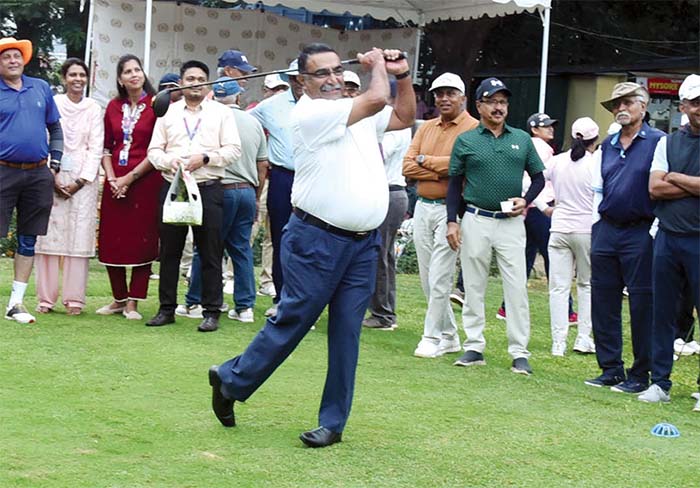
P.M. Ganapathy, Senior Member, Association of Kodagu Golfers of JWGC, teeing of the Kodagu Golf Open Championship-2024 on Nov. 30.
Best Lady Golfer – Stableford Net (H/C 0 to 24), sponsored by C.B. Changappa: Priya Kushalappa (36 Points) – Winner.
Fortunate Golfer – Sponsored by Brig. N.N. Madappa: M. Ramesh – Winner.
Nearest to the Pin – 2nd Hole – Sponsored by Col. C.P. Medappa: A.S. Somesh (7 Feet 2 Inches) – Winner.
Nearest to the Pin – 6th Hole – Sponsored by Travel Parkz: Dr. Anthony Fernandes (8 Feet 5 Inches) – Winner.
Nearest to the Pin – 12th Hole – Sponsored by Praveen Chengappa: Ram Kevalur (11 Feet 10 Inches) – Winner.
Crooked Line – 16th Hole – Sponsored by K.B. Kushalappa: Rick Van Vliet (On The Line) – Winner.
A total of 270 golfers took part in the Championship, according to a press release from Tournament Sub-Committee Chairperson Sonam Chugh and Hon. Secretary V.G. Achar.
source: http://www.starofmysore.com / Star of Mysore / Home> Sports / December 03rd, 2024
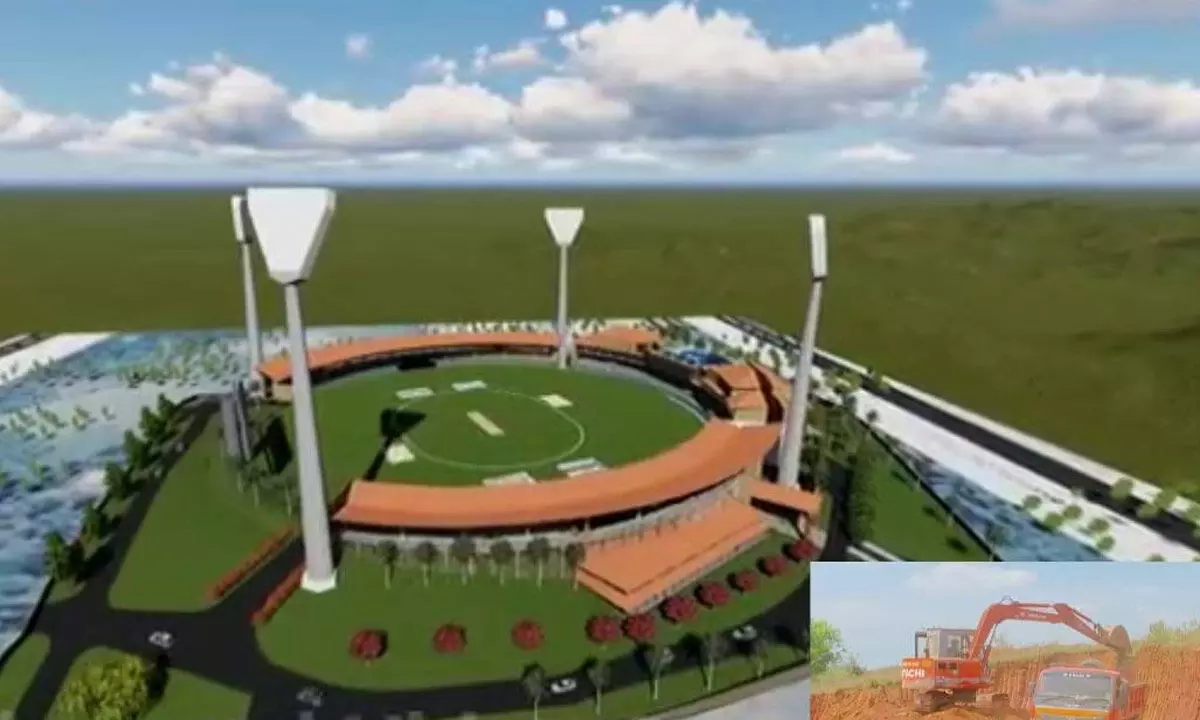
The design and layout of the ground will follow the model of the famous Dharamshala cricket stadium in Himachal Pradesh, though it will be slightly larger than Bengaluru’s Chinnaswamy Stadium
Madikeri:
After decades of persistent demand, the long-awaited dream of having a dedicated cricket ground in Kodagu district is finally being realized. Construction work has begun on an international cricket stadium near Palemadu village, situated in the scenic Madikeri taluk. This marks a significant milestone for the region, which has long yearned for a sporting facility capable of hosting major cricket events.
The Kodagu district administration has earmarked 12 acres of land for the construction of the stadium, with the project estimated to cost around Rs 50 crore. The design and layout of the ground will follow the model of the famous Dharamsala Cricket Stadium in Himachal Pradesh, though it will be slightly larger than Bengaluru’s Chinnaswamy Stadium. This ambitious project will involve leveling half of a nearby hill, a complex and costly process to create a world-class sporting venue.
The construction of this stadium has been met with both excitement and opposition. For years, there were protests against the proposed location, primarily due to the presence of a graveyard on the land. Local residents from Paisari village, in particular, were firm in their stance, demanding that no cricket ground should be built over the graveyard. Despite the protests, the project had to be put on hold for some time. However, the issue was eventually resolved when former District Collector Dr. BC Satish intervened and convened a meeting to find a solution. It was decided that one acre of land would be set aside for the cemetery, while the rest would be used for the cricket ground.
Though some residents still insisted on reserving two acres for the cemetery, the Karnataka State Cricket Association (KSCA) was determined to move forward with the project. Their resolve to build the ground regardless of the protests has finally borne fruit. With all hurdles cleared, construction work has now commenced, with heavy machinery such as JCB and Hitachi excavators already working to level the land.
The project is expected to be completed within the next four years, bringing a major sporting facility to the district.
A boon for local sports enthusiasts.
This stadium will be a game-changer for the region, providing a much-needed infrastructure for local sports enthusiasts and opening doors to higher levels of competition. Currently, Kodagu boasts an astro turf hockey stadium, but there has been a glaring absence of facilities capable of hosting even state-level sports events. The new cricket stadium will not only enhance the region’s sports infrastructure but also serve as a hub for aspiring athletes.
While the construction of the cricket stadium is a significant step forward, sports enthusiasts in the district are also calling for the development of other key sports facilities. In particular, there are increasing demands for the creation of an athletics stadium, similar in scope and scale to the upcoming cricket ground, to accommodate track-and-field events and other athletic competitions.
The lack of such facilities has been a hindrance to the growth of athletics in the region, and many believe that the creation of a dedicated athletics venue would be the next logical step in the district’s sporting evolution.
Once completed, the international cricket stadium is expected to attract attention from national and international teams, potentially putting Kodagu on the map as a major sporting destination. It could host not only first-class cricket matches but also training camps, junior cricket tournaments, and a variety of other sports events, providing ample opportunities for local players to showcase their talent. Moreover, the stadium will have a significant economic impact on the area, boosting tourism, creating employment opportunities, and contributing to the development of infrastructure such as hotels, transportation, and sports-related businesses. The local community is expected to benefit greatly from the influx of visitors and sports professionals.
As the work on the cricket ground progresses, the residents of Kodagu have a reason to celebrate, as they will soon have a venue that will foster local talent and bring national-level events to the region. However, the demand for more sports facilities remains strong, and local authorities will likely have to address the call for an athletics stadium and other sporting infrastructure to meet the growing needs of the district’s sports enthusiasts.
In the coming years, Kodagu’s landscape will be transformed into a thriving hub for sports, creating opportunities for youth, bringing pride to the community, and fostering the next generation of athletes. The international cricket stadium is just the beginning.
source: http://www.thehansindia.com / The Hans India / Home> News> State> Karnataka> Bengaluru / by The Hans India, Hans News Service / November 30th, 2024
‘Vijay Shrankla Aur Sankritiyon Ka Maha Sangram’ celebrated
Mysuru/Mysore:
Marking 75 years of Independence as also 50 years of India’s victory over Pakistan in the 1971 war leading to the creation of Bangladesh, the National Cadet Corps (NCC) is celebrating the occasion as ‘Vijay Shrankla Aur Sankritiyon Ka Maha Sangram’ across the country from Nov. 28 to Dec. 19 this year.
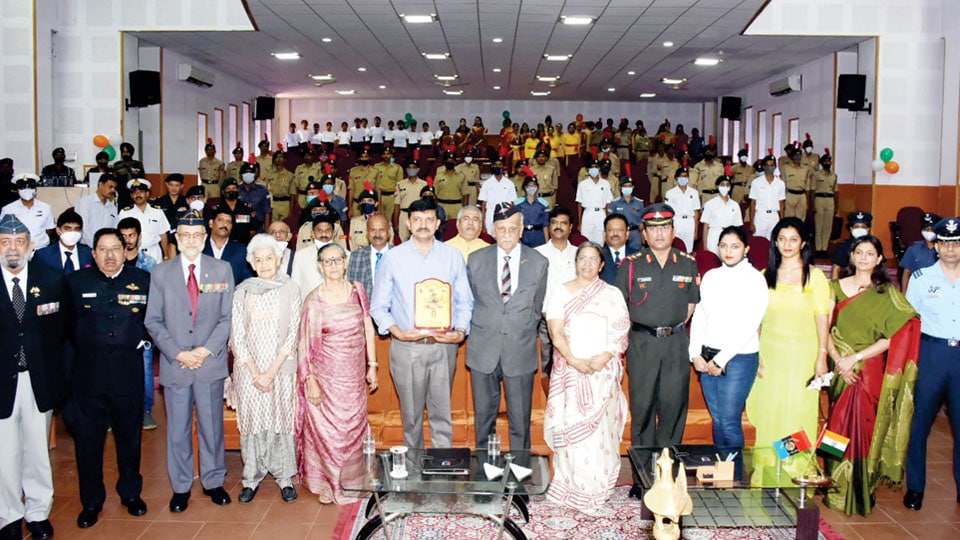
As part of the celebrations, the Mysuru NCC Group felicitated the Next of Kins (NoKs) of the two martyrs — Flying Officer K.P. Muralidharan of 20 Air Squadron and Risaldar B.M. Kaveriappa of the 66 Armoured Regiment — at a programme held at Cauvery auditorium in Karnataka State Open University (KSOU) premises on Hunsur Road here this morning.
The NoKs who were felicitated are Lalita Krishna Kumar, sister of Flying Officer K.P. Muralidharan and B.M. Machaiah, son of Risaldar B.M. Kaveriappa.
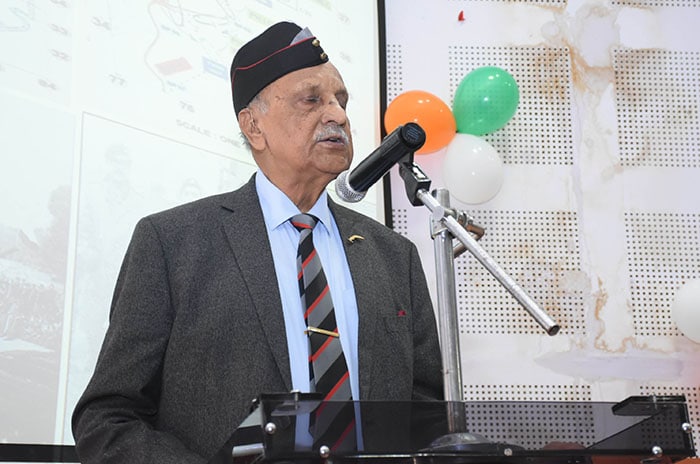
Maj. Gen. (Retd.) C.K. Karumbaya, SM, was the chief guest. Maj. Gen. (Retd.) S.G. Vombatkere, VSM was the guest of honour.
As part of the celebrations, 75 NoKs of martyrs of 1971 war will be felicitated at 75 locations across the country.
Defence Officers, Junior Commissioned Officers and Other Ranks posted locally at Mysuru including NCC Group Commander Col. R.R. Menon, NCC cadets and Associate NCC Officers, Air Veteran Mandetira N. Subramani, President, VeKare Ex-servicemen Trust, Mysuru were present on the occasion.
About Flying Officer K.P. Muralidharan: Flying Officer Kotteiezath Puthiyavettil Muralidharan hailed from Nilambur Kovilakom in Mallapuram district of Kerala. Born on Oct. 6, 1945, he was commissioned into the India Air Force on Oct. 29, 1966 at the age of 21. During the 1971 Indo-Pak War, Muralidharan was serving with 20 Sqn. known as ‘Lightnings’ and was based at Air Force Station in Pathankot. He took off in his Hunter (A-462) for a mission from Pathankot and was involved in a dog fight with enemy aircraft. He was last seen flying north of Peshawar in combat with a PAF Sabre and was shot down by the enemy Sabre. His aircraft crashed inside the enemy territory.
Risaldar B.M. Kaveriappa: Born on Feb. 4, 1931 at Kadangamarur in Virajpet of Kodagu district, Kaveriappa joined the 66 Armoured Regiment in September 1969 and was appointed as a Troop Leader which he served till the last day of his life.
Kaveriappa was in command of 1 Troop Bravo Squadron. While moving to reinforce 3 Troop, his tank was hit by an enemy RCL Gun and he along with his crew were killed.
source: http://www.starofmysore.com / Star of Mysore / Home> News / November 30th, 2021
In my previous article, I featured an Ethiopian coffee export company who ran her business based on trust. This is factored in two ways; dealing with her farmers and clientele. In this day and age, we can learn a thing or two by understanding the wisdom behind why some people do the things they do, treading a harder path and not resort to shortcuts. They are in it for the long term, not focused on the short term gains. I have nothing but high regard for individuals like Medina.
Continuing a similar conversation, I have been focusing on what exactly is happening at the farm level by getting in touch with the producer directly. In this article, I talk to the owner of a coffee estate farm based in India. Sumaira gives us an insight about how her family’s coffee estate started in the late 18th century, processing techniques employed on her farm, the specialty coffee movement in India, and much more.
source: Rasulpur Coffee Estates
Can you tell me a bit about yourself and Rasulpur Coffee Estates?
I am Sumaira, the owner of Rasulpur Coffee Estates & Roasters . We are located in the Rasulpur village, Coorg district, in the hot spots of the Western Ghats, India. My entrepreneurship journey has had its shares of ups and downs. I took up a career as an interior designer and worked as a business head for a furniture empire in India. Later on, I moved to the UAE and explored the real estate industry and the coffee sector. I envisioned starting up something of my own, being from a family of coffee planters and having the self-confidence and determination to start my own business. Something clicked the moment I realized how the coffee industry is growing day-by-day.
To add, I am a fifth generation coffee planter who introduced specialty coffee at our estate. We introduced better equipments and techniques, and new processing and fermentation methods which I’ll get into a little later. A laboratory is set up for roasting and cupping to create different roast profiles and new blends at our estate. We believe in helping and encouraging our coffee community, especially the neighboring small and marginal coffee growers to analyze their coffees, and improve their harvesting and processing methods to fetch a better price for their coffee.
The journey of Rasulpur Coffee Estates started in the late 18th century when our ancestors migrated to the Western Ghats of India i.e. Coorg at the time of the British rule, as their main occupation was trading in coffee and spices. They travelled to different parts of Coorg, as they developed a liking towards coffee estates and the greenery, purchased plenty of estates, learnt the methods of coffee cultivation, and started exporting coffee to foreign countries. England was one of the major countries to which coffee was exported to from our estates in that period with the help of the Coffee Board.
We named the estate and brand ‘Rasulpur Coffee’ after the village, Rasulpur, which is on the banks of the Kaveri river in Kodagu district is named after Mr. Rasul Khan, our first generation planter. He cleared the land, started cultivation, built dams for irrigation, made the place livable and initiated agricultural works. Looking at his abilities and progress, the government named this village after him.
In time, our second, third and fourth generation planters purchased more coffee plantations and improved the methods of cultivation, processing, and introduced pulping and irrigation. An R&D team was also set up and a variety of experiments are conducted to this day. The goal here is to enhance the quality of the crops, and advance the processing and post harvesting methods. Our coffee is featured in auctions, supplied for projects, sold locally and exported to wholesalers, cafes, and restaurants. We also ferment micro lots as per requirements from our roasters and young entrepreneurs who are venturing into the coffee industry.
What kind of processing is done on the farm?
Processing on our farm is done in three different ways along with few specialty processing methods, all of which change the sweetness, body and acidity of brewed coffee. These are natural/sun dried, washed, and honey processed.
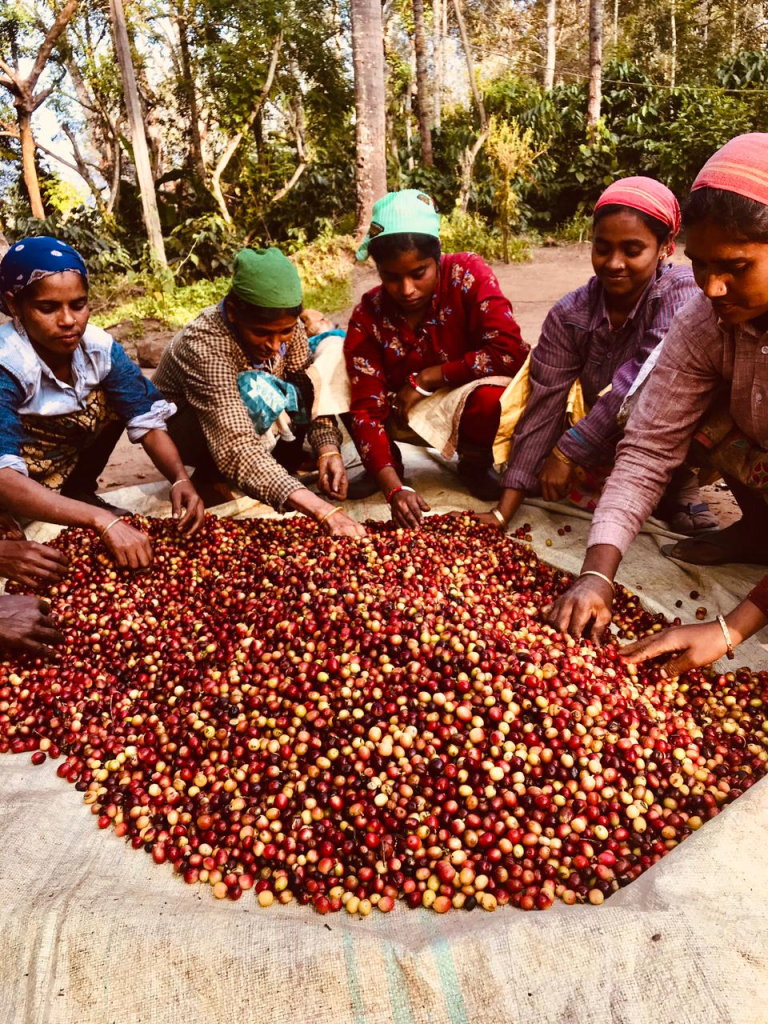
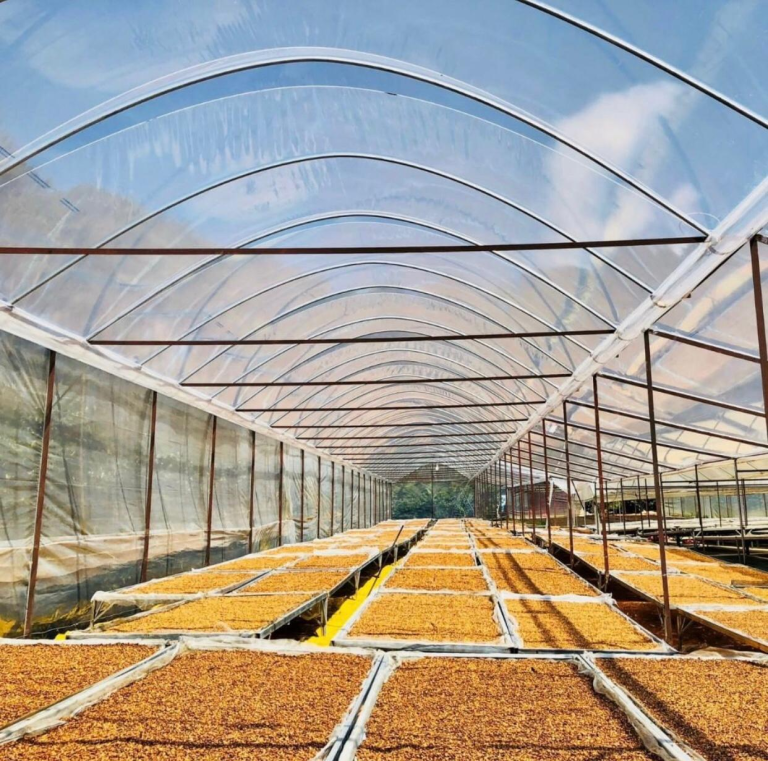
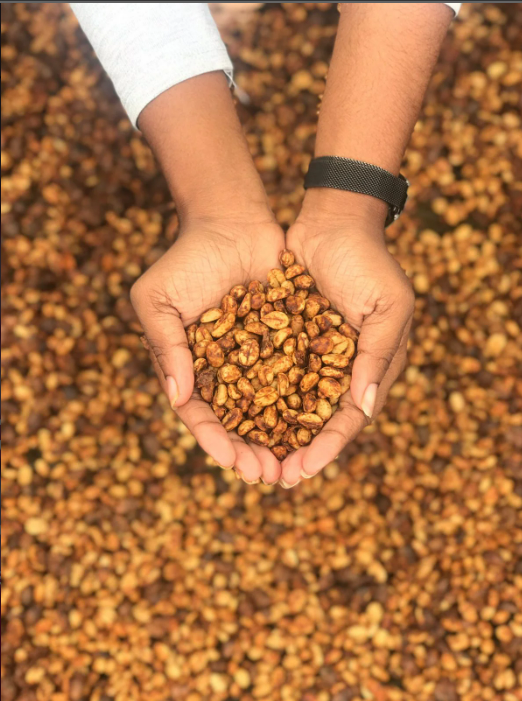
Natural/sun dried process. A natural processed coffee, also referred to as dry processed, is a traditional yet common way to process coffee today. Originating in Ethiopia, it involves drying out freshly picked coffee cherries with the seed still inside. To do this, we place the cherries on drying beds in the sun. These beds are either patios or raised drying tables. The cherries have to be rotated and turned to prevent mold, and takes about seven to eight days to ferment. During this time, the sugars and mucilage (the sticky substance that coats the seed) will latch onto the seeds, develop flavours and make them sweeter. Once the coffee is dry, a machine separates the pulp from the seed. Natural coffees are heavy bodied, and have deep, complex tasting notes. This development comes from the way the cherry ferments differently. Natural processed coffees can be difficult to replicate because of the inconsistencies in fermentation. However when done right, these coffees can also be some of the sweetest you’ll taste. It is juicy, syrupy and well worth the extra effort.
Washed process. Unlike natural, washed processed coffees are called the opposite, i.e. wet processed. In this scenario, machines called pulpers remove the seeds from the cherries before drying them. However, it is not just any cherry that gets the seed removal treatment. These cherries must have the perfect amount of ripeness to make sure they are sweet enough. To accomplish this, they go through a sorter and are segregated according to density. Once these pulpers remove the skin and pulp from the seeds, they are placed in tanks full of water. The water separates the rest of the mucilage and fruit caked onto the seed. Finally, the seeds are dried on the beds in the sun. Washed processed coffees have cleaner, and more crisp tasting notes when compared to natural processed coffees. The body of a brewed washed coffee is lighter. There is typically more brightness as well, because of a cleaner acidity that balances out the sweetness of the coffee. They are just as fruity as natural coffees, but the flavor notes are easier to differentiate.
Honey processed. This method is a combination of both natural and washed. It is a rare and demanding method, and not as commonly practiced as the previous two. However, it produces a unique cup of coffee, with flavours similar to both of the previously described processing methods. During honey processing, a pulper removes the seed from the cherry before it undergoes a drying process. However, it does not go into washing tank to remove the mucilage. That mucilage, which is what the ‘honey’ refers to stays on the seed and is now dried in the sun. The amount of mucilage left behind determines the sweetness, and there are even machines to control the amount on the seed. Like natural process, the seeds are dried on beds. The flavor components of honey coffees are varied and complex. Like washed coffees, they have lighter body and are very syrupy and sweet. Acidity is present but more mellow when compared to washed coffees.
Specialty processing. This is an emerging field and we use unique methods like anaerobic, aerobic, natural fermented, and fruit fermented to name a few. We ferment our coffee in a temperature controlled environment, with or without oxygen, followed by controlled drying to bring out unique and funky flavors out of the coffee.
source: Rasulpur Coffee Estates
What is the current state of the specialty coffee industry in India?
The coffee culture in India has evolved over the past decades. The nostalgia-inducing coffee houses were popular meeting grounds until the 1980’s. In the 90’s, cafe culture took over the country and coffee became the trendy drink to try.
Cafes are becoming the primary hangouts for youngsters and coffee found an emerging and appreciative audience. In the past two decades, we have seen a surge of cafes all over the country. They have materialized as a central hub for meeting, whether casual or business, and also doubling up as co-working spaces.
The 2020 pandemic impacted the industry In multiple ways and its effects were manifold. Logistics of coffee exports are pretty bad even today. Traditional coffee plantation owners who supply heavily within India and export to Europe are left with excess stock of coffee that could no longer be shipped to international markets.
Coming to the Indian coffee space, in recent years, the spotlight is on specialty coffee. This movement is picking up speed with many brands and roasters setting up shop. Analysis gives us a deeper understanding on how speciality coffee has emerged as the current buzzword in coffee circles. Current generation and millennials have emerged as the major chunk of consumers of specialty coffee within India.
Increased awareness and interest about coffee augmented by growing exposure to worldwide trends due to rising international travel and social media saw many of them exploring specialty coffee and manual brewing techniques. Lockdowns put a halt to the possibility of exploring cafes and thus many coffee consumers in the country turned to home brewing.
Many retail specialty coffee brands saw skyrocketing sales in 2020 as consumers invested in manual brewing equipment ranging from French Press, Moka Pots, Chemex and Aeropress. The new generation of coffee consumers respect the people behind the product, want to better understand the ‘farm to cup’ journey and are willing to invest in educating themselves on all nuances of coffee.
A few years back, this was largely unheard of. Farmers were just one aspect of the coffee supply chain, but hardly ever found the spotlight on them. Now plantation owners are keen on sharing their stories and experiences, information on their crops and the work they put in to make that perfect cup of coffee.
One can safely say that specialty coffee will not just be a passing trend, but en route to becoming one of the mainstays of the Indian coffee space in the coming decade.
I think there is a lack of communication between the consumers and farmers. I know some of the consumers, including me, have started to pay attention to where exactly the coffee is coming and from which farm. What do you think can be done to fill this gap?
The missing ingredient is awareness. People need to be educated about Indian coffee. The new-generation farmers need to collaborate with the Coffee Board of India and conduct events to promote coffees originating from India within the country and internationally.
Joint efforts need to be made by all coffee enthusiasts to encourage the consumption of coffee by making people understand the benefits of drinking coffee. The government has to support and help promote farmers to come forward and establish their own brands.
Being honest and transparent ensures the consumers and clients knows about the past, present and the way you are going to build a future. Bringing credibility to the table builds trust factor for the brand with the consumers.
I know some of the issues the farmers are facing currently are the increasing production costs, what steps are you employing to change that? Have you increased the price of your coffee to reflect that?
Whether we like it or not, coffee is getting more expensive. It’s important to look at some of the reasons why this is happening, before you potentially do one of the following:
Buy less sustainable and ethical coffee because it’s cheaper or
Lay blame on the wrong people for higher prices.
There are many factors influencing the cost of coffee from climate change, disruptions to global shipping, consumer demand, and packaging cost. While the need to use more environmentally-friendly packaging for coffee cups and bags is real, so too is the cost for shops switching to compostable or recyclable materials. We have also witnessed fluctuating shortages of packaging stock forcing some companies to find more costly short term solutions to packaging which comes at a higher cost.
Lastly, coming to the cost of quality, producing coffee of higher quality simply costs more. Coffee must be cared, harvesting and processing is hard work. It requires time and physical effort if you want to achieve the highest quality standards. You can’t have it both ways.
source: Rasulpur Coffee Estates
What are your thoughts on transparency? Has it benefitted you in any way?
Yes, by ten-fold. Transparency has improved our overall trust factor in this industry. It solves many problems and even stops disasters before they happen. It expands relationships, increases productivity, strengthens innovation, and improved our revenue.
What is the future of specialty coffee?
By far, the most interesting and exciting coffee segment of the moment is specialty coffee. It is rapidly expanding in India and across the globe as consumers continue to seek out the best cup of coffee to enjoy.
When it comes to coffee quality, specialty coffee is the ‘cream of the crop’ and is likened to fine wines due to its distinctive characteristics and delicious flavour that can only be achieved under certain growing conditions.
In today’s market, specialty coffee has become an intricate science and a global phenomenon that is seeing rapid growth across all sectors. More estates are coming into this specialty game, that will give ‘Indian specialty coffee a lot of mileage.’
What do you do in terms of R&D on Rasulpur Estate
We are currently doing research on developing a hybrid plant which is resistant to white stem borer and leaf rust. These are the two biggest pests and diseases faced by all Arabica growers throughout the world. International Coffee Organization (ICO) is working with different countries to find a solution for this.
This R&D program has been ongoing for the past four years on a 40 year old, 30 ft tall, Arabica plant labelled by us as Rasulpur Arabica. So far, the results look promising and it is resistant to these diseases. We have propagated progenies of this plant by clonal cutting, seed and tissue culture, and cross-bred this plant with other varieties of Arabica.
source: Rasulpur Coffee Estates
About Rasulpur Coffee Estate
Rasulpur Coffee Estates & Roasters is based out of Rasulpur village in Coorg district in the hot spots of the Western Ghats, India. The Estate is run by Syeda Sumaira, a fifth generation coffee planter and entrepreneur.
Fun fact: Coffee farms are the best place to get first hand knowledge about the beverage, how it is grown, harvested and processed. Rasulpur Coffee Estates organizes coffee tours, get in touch with them to find out more.
source: http://www.fltrmagazine.com / FLTR / Home> Insight> People / by Naveed Syed / August 11th, 2022
The journey of coffee in India and the Soliga community’s role in conservation.
“The first record of coffee in India is around 1799, when the British set up an experimental plot in Thalassery, Kerala. From then on, coffee planting came to the Nilgiris, Coorg (now Kodagu) and other parts,” says Arshiya Bose. | Photo Credit: AMANDA PEROBELLI
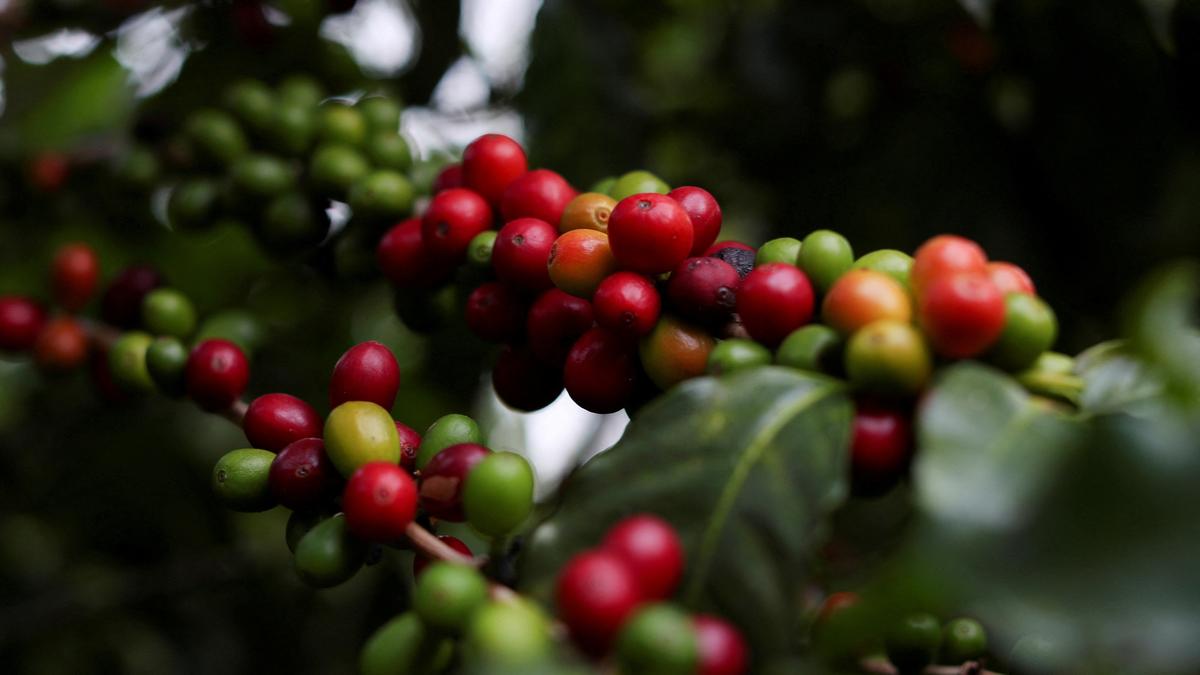
What will your cup of coffee taste like by 2050? Worse, will you even get your cup of coffee? Alarmist as this question might sound, these questions are being asked for the last 10 days. A study published on PLOS One, a peer-reviewed open-access journal published by the Public Library of Science in January 2022 (Expected global suitability of coffee, cashew and avocado due to climate change), predicts an overall decline in the world’s suitable growing land for arabica coffee by 2050.
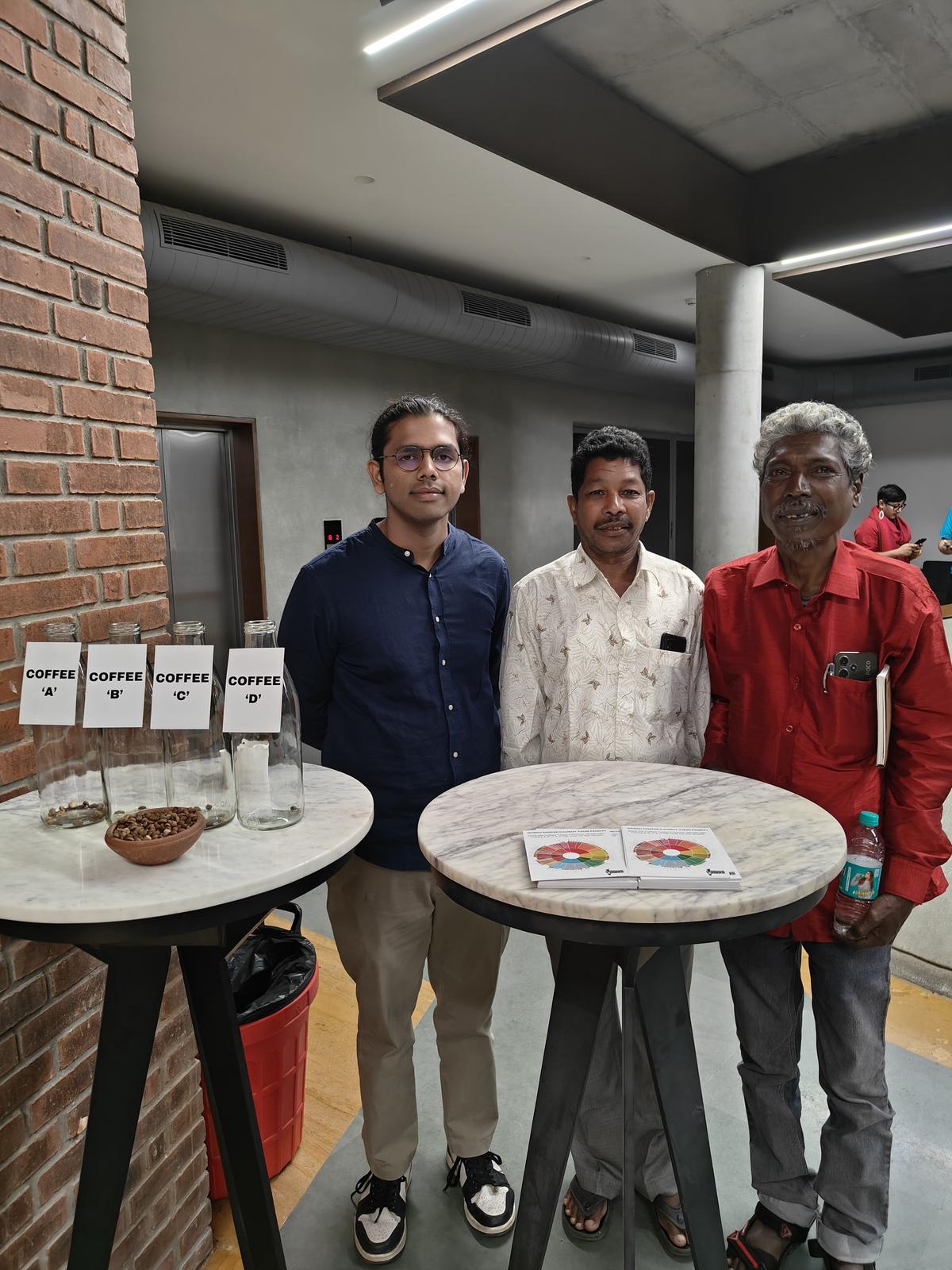
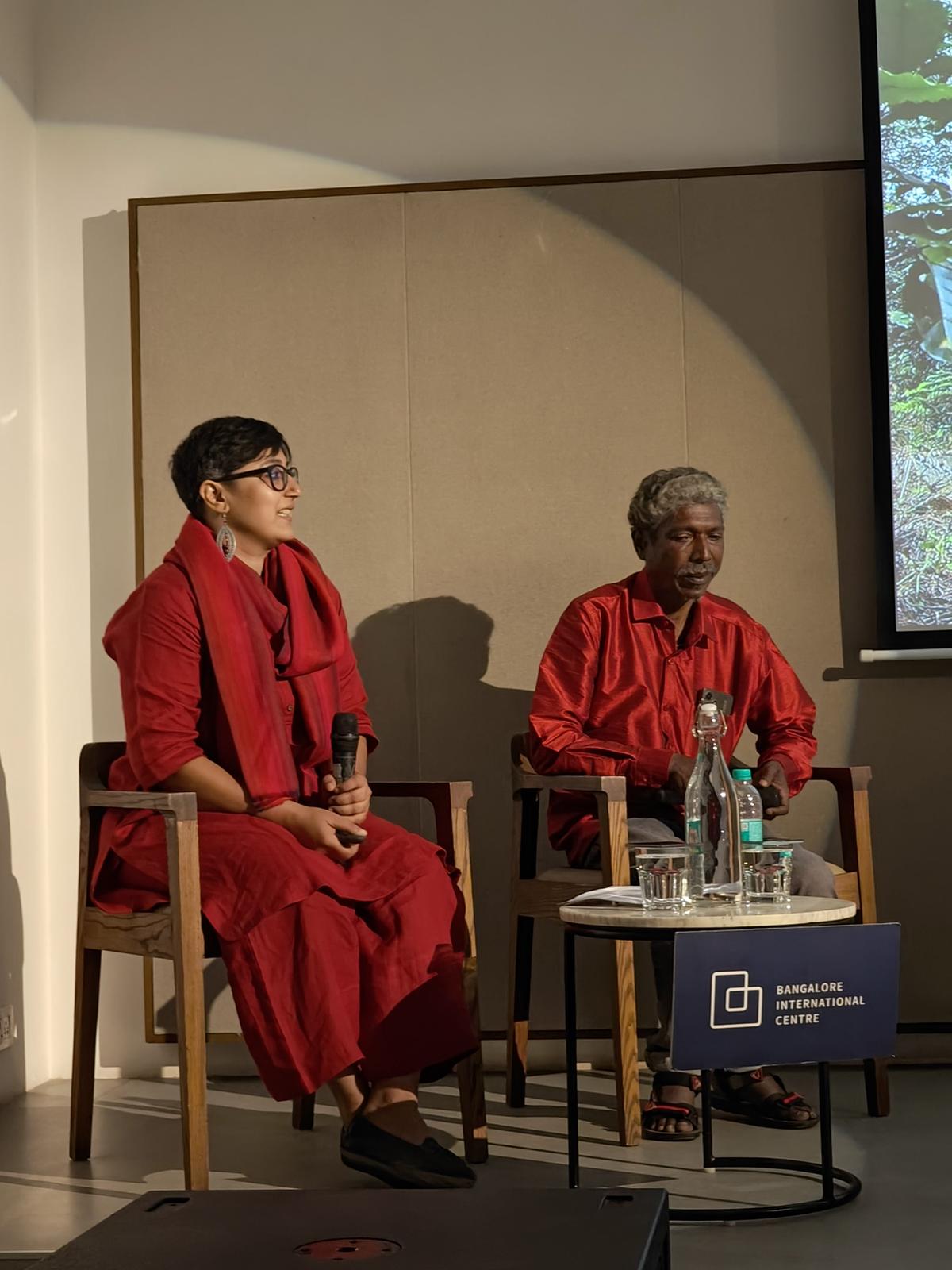
Amidst the worry of what the future holds for coffee, a recent panel discussion at Bangalore International Centre (BIC) explored the ecological history of coffee in India, the impacts of coffee production on biodiversity, producer observations of everyday climate change on their farms and how the Soliga, an indigenous community, grows coffee on the Biligiri Ranganatha Tiger Reserve Hills (B.R. Hills) in Karnataka.
M. Kethe Gowda and M. Sannarange Gowda. | Photo Credit: SPECIAL ARRANGEMENT
In B.R. Hills area
M. Sannarange Gowda from the Soliga community, who grows coffee on his biodiverse farm in B.R. Hills, leads various capacity-building programmes for regenerative agriculture. The co-founder of a community-led YouTube channel, Kaadina Makkalu, says that the community started growing coffee initially as it was not something that animals preferred eating. M. Kethe Gowda, co-founder of the channel who has over two decades of experience in ecological research on bees and honey, native tree species, and birds, advocates for holistic farming practices that conserve local ecosystems and biodiversity. He leads experimental work on non-chemical approaches to managing pest and disease outbreaks and is passionate about community outreach.
Sannarange Gowda says, “We grew crops like ragi, maize and so on, which would frequently be destroyed or eaten by animals like deer, elephant, wild boar, monkey and birds in the forest and the hill area… Over a period of time, the Horticulture Department started encouraging people in podus (settlements) to grow coffee, because wild animals would pass through the farms and not feed on them. We needed registered land to grow coffee and could not just grow it anywhere. We finally got a piece of land, and since then, we started growing coffee.”
Kethe Gowda goes back to a time when his ancestors lived in the forest, and there were various podus inside the forest. “There we grew crops like ragi, maize, hyacinth beans, dal, pumpkin, mustard and more. The Forest Department at one point wanted all of us inside the forest to live outside the forest, because when tiger reserves were established, that was the rule. We were told we would be given land close to the B.R. Hills area, but we had to come out of the forest.“ Kethe Gowda says that it did not feel right for them to move out of the land they have always called home for centuries.
“We told the forest officials that our crops were ripe, and we could not leave until they were harvested, but they brought in tamed elephants to destroy our crops and asked us to leave. So, this is how we came out of the actual forest and lived in the B.R. Hills area,“ he explains.
Arshiya Bose and M. Sannarange Gowda. | Photo Credit: SPECIAL ARRANGEMENT
A colonial project
Arshiya Bose, who holds a PhD in Geography from the University of Cambridge, U.K., and a Post-Doctoral Fellowship from ETH-Zurich, says that according to legend it was a Sufi saint, Baba Budan, was brought coffee seeds to India. But coffee as we know it today, grown in commercial plantations, was a colonial project.
British planters who came over from Sri Lanka started growing coffee. “The first record of coffee in India is around 1799, when the British set up an experimental plot in Thalassery, Kerala. From then on, coffee planting came to the Nilgiris, Coorg (now Kodagu) and other parts,” says Arshiya, who is the founder of Black Baza Coffee which she started in 2016. It is a social and conservation enterprise that partners with smallholder coffee producers in India’s Western Ghats biodiversity hotspot. Coffee’s journey to India
“What is fascinating about the way the colonial coffee project went forward is that many of the British planters who were here were actually Naturalists back home in England. So, they kept a very detailed record of not only how they grew coffee, but also what kind of wildlife they saw. There was a prolific writer and journal keeper, Edwin Lester Arnold, who found himself in Coorg around the mid 1800s. In one of his books he describes what kind of wildlife was there. He writes how coffee growers borrowed their coffee planting method from how they cultivated wheat back in England and Europe,” she explains.
Much has changed since that time and Indian now produces a lot of coffee, being the eight largest coffee producing country in the world as of 2022.
Unlike the British coffee plantations, the Soligas continued growing coffee amid the forest. | Photo Credit: Abhishek Chinnappa
Impact on biodiversity
Arshiya explains that unfortunately, in the process of large-scale cultivation and development of plantations, there has been a huge impact on the kind of biodiversity that existed.
“If you take the map of rainforests in the world or coffee plantations in the world, these maps often overlap almost identically,” she says, adding that there is huge loss of forest cover in India to coffee plantations in districts like Kodagu. Arshia argues that for long-term resilience, coffee should be grown amid trees. “It regulates the kind of humidity, soil moisture coffee needs, and provides the buffer against any kind of extreme events that may happen around you,“ she adds.
Unlike the British coffee plantations, the Soligas continued growing coffee amid the forest. “We continued to grow coffee under the forest canopies, which is very beneficial. There were jamun, ficus and other threes, because of which wildlife like sloth bear, white-cheek barbet, deer etc. came to feed on the fruit, excrete in the same spot, which would in turn into manure for the coffee plants. I am proud of the wildlife that comes to our farm, which shows how healthy our farm is,” Sannarange Gowda explains with pride.
source: http://www.thehindu.com / The Hindu / Home> News> Cities> Bengaluru / November 29th, 2024
The ambitious project to construct a hanging bridge over the River Cauvery at Dubare Elephant Camp in Kodagu is poised to further transform this popular tourist destination.
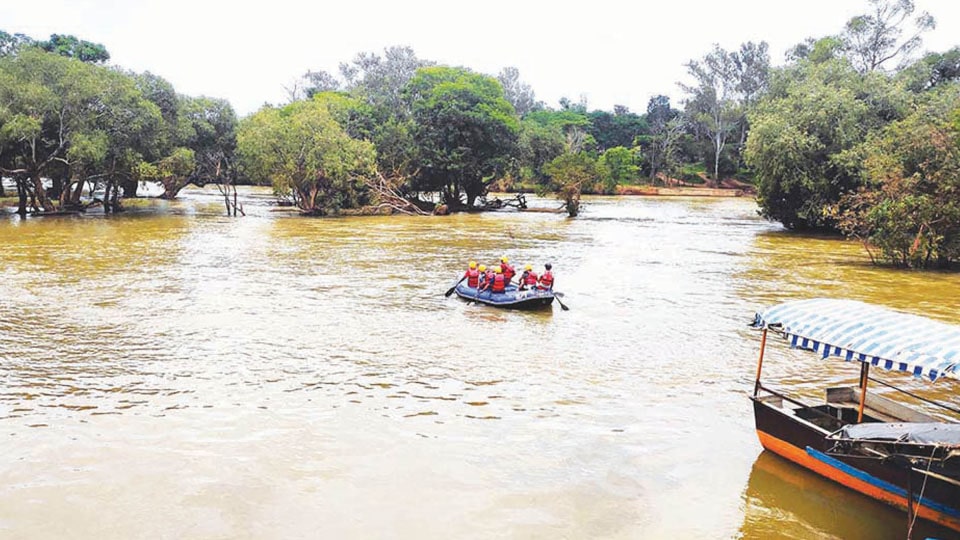
Dubare draws thousands of tourists each month and the addition of a hanging bridge connecting both riverbanks promises to be a significant attraction. Currently, one side of the river is managed by the Tourism Department, while the Forest Department oversees the opposite side, home to the renowned elephant camp.
Presently, tourists can only traverse the river via motorised boats. Due to the high demand for boat rides, many visitors risk crossing on slippery rocks — when the water level is low, leading to accidents and prompting criticism of the Forest Department.
The original hanging bridge plan envisioned a 110-metre structure supported by three columns — two at the ends and one in the centre — with an estimated cost of Rs. 3 crore.
Two poles instead of three
However, the new proposal extends the bridge length to 210 metres, supported by only two poles, eliminating the central column thanks to enhanced suspension wire technology. The revised design will be higher at the centre than at the ends for added stability.
This updated project is estimated to cost Rs. 6 crore. The bridge will have a walking width of 1.5 metres and will be constructed above last year’s flash flood level to ensure safety.
Hanging bridge expert Patanjali Bharadwaj has finalised the design, materials and total project cost, including labour. Unlike the previous proposal where land ownership was shared between the Tourism and Forest Departments, the new project will be built entirely on Forest Department land, streamlining the approval process.
Budget estimate of Rs. 6 crore
The design and location survey have been completed and submitted to the Public Works Department (PWD). A budget estimate of Rs. 6 crore has been forwarded to the Finance Department for final approval. Patanjali Bharadwaj has designed the bridge and calculated the material cost as per the PWD budget list and provided the cost estimate.
The State Government and the PWD have granted in-principle approval and the project has been included in the Forest Department’s Action Plan, receiving sanction from the Forest Minister.
Funding will come from the Kodagu Foundation, which pools entry fees collected at various parks, trekking spots and forest guest houses, supplemented by government funds.
The PWD will supervise the construction, with the tender process set to begin following financial clearance. If funding is timely, the bridge could be completed within six months, with an expected finish date in 2025.
Boating to be discontinued
Bhaskar, Deputy Conservator of Forests (DCF), Madikeri Circle, explained the project’s earlier challenges. “Previously, land issues stalled progress due to the split ownership between the Tourism and Forest Departments, complicating clearances under the Wildlife Act. This time, we selected land solely managed by the Forest Department, eliminating these administrative obstacles. We are committed to seeing the project through. Once operational, boating services will be discontinued, though river rafting will continue,” he said.
For context, Patanjali Bharadwaj is the son of Padma Shri awardee Girish Bharadwaj, known as the ‘Bridge Man’ for constructing over 100 suspension footbridges across India. Girish Bharadwaj founded ‘Rational Engineering Industries’ in 1975 in Sullia, Dakshina Kannada, now known as Ayasshilpa. Patanjali is continuing his father’s legacy with this new project.
Revenue boost
The Dubare Elephant Camp operates daily from 9 am to 11 am and 4 pm to 5.30 pm. Forest officials report that the site welcomes an average of 500 to 700 tourists daily and has four boats for river crossings.
“During festivals and weekends, when over 2,000 tourists visit daily, managing the crowds becomes difficult. Weight restrictions limit boat capacity, forcing many visitors to leave without experiencing the elephant camp. The hanging bridge will resolve these issues and is expected to boost revenue,” officials added.
source: http://www.starofmysore.com / Star of Mysore / Home> News / November 24th, 2024
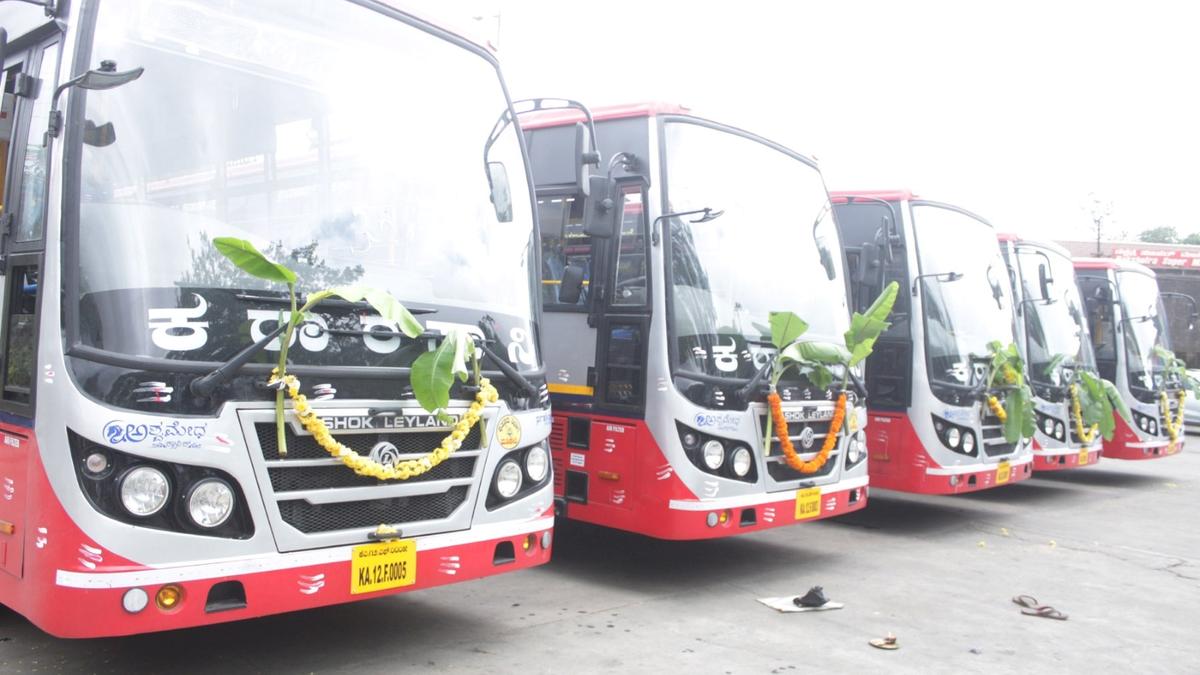
KSRTC buses with the registration of Madikeri RTO were added to the existing fleet of buses operated by the Madikeri depot on Thursday.
Five ‘Ashwamedha’ buses were the new buses with KA-12 vehicle registration that were flagged off in Madikeri by MLA Mantar Gowda.
The five buses will operate as Dasara special in view of the Navarathri celebrations. After Dasara, the buses will be operated in Kodagu district, said the MLA, after flagging off the buses at a function held in Madikeri.
The MLA said he had urged Minister for Transport Ramalinga Reddy for allocating buses with KA-12 registration (Madikeri RTO), during his recent visit to Shanivarasanthe in Kodagu district. Responding to the request, the Minister sanctioned the buses with the Madikeri registration, he said, while expressing happiness over the sanction of buses with Madikeri registration.
More KSRTC buses will ply in Kodagu in the coming days. Women can travel in the newly allotted buses as part of the Shakti scheme, he added.
The five buses have also got fancy registration numbers KA-12 F-01, F-02, F-03, F-04, F-05, the MLA said.
source: http://www.thehindu.com / The Hindu / Home> News> India> Karnataka / by The Hindu Bureau / October 10th, 2024
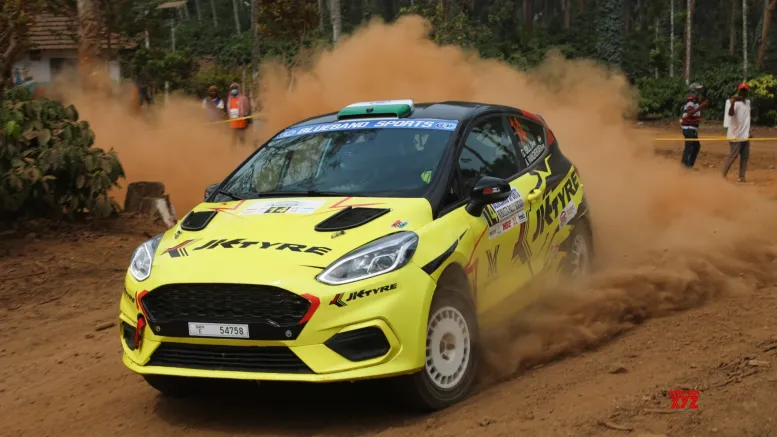
Arjuna Awardee Gaurav Gill and co-driver Aniruddha Rangnekar overcame initial hiccups and performed admirably to take the lead after Day 1 in the Robusta Rally, the fifth and penultimate round of the fmsci Indian National Rally Championship 2024 here, on Saturday.
Gill, the Speed Maestro from Delhi, was forced to start on a cautious note as their intercom failed resulting in no calls and he had to drive from memory. After losing 17.4 seconds to Karna Kadur, who was fastest in Stage 1, Gill bounced back brilliantly to clock the fastest times in the remaining five Stages and took a handsome lead of over 53 seconds by the end of the day.
“It has been a perfect day. The stages were rougher than I expected with massive stones and boulders but we managed to overcome all odds as our tyres performed well. We had decent speeds and the goal is to bring back the car home tomorrow,” said Gill, the seven-time National champion.
Championship leaders Karna Kadur and co-driver Musa Sherif of Arka Motorsports were second overall followed by Hassan’s Jason Saldhanha and local co-driver Timmu Uddapanda.
Jason Saldhanha overtook former National champion Aditya Thakur (Chettinad Sporting) in the final stage of the day and was also leading in INRC2 class with Thakur in second place ahead of Jahaan Singh Gill of Snap Racing. Chettinad Sporting’s Daraius Shroff from Mumbai, the championship leader in the INRC3 category took a 20-second lead over Abhin Rai.
Fabid Ahmer, Harkrishan Wadia, Philippos Matthai, and Chetan Shivram were some of the top casualties on Day 1. On Sunday, the rally will run another six Special Stages at Woshully and Margoli estates.
Provisional Results after Day 1 (Leg 1 – Saturday):