Category Archives: Science & Technology

New Discovery By Kodagu-Born Dr. Jagadeesh Moodera And Team At MIT

DrJagadeeshKF05may2020

Quantum Physics deals with the behaviour of subatomic particles and is arguably the most complex branch of Theoretical Physics. I do not profess to understand this highly abstract subject but know that classical laws of Physics fail at quantum levels.

It boggles the mind when told that a subatomic particle exists simultaneously at two different spots. One location could be on your table and the other on the surface of Jupiter!

English Physicist Paul Dirac theoretically proved way back in 1930s that fundamental particles known as fermions should have a counterpart somewhere in the universe with an opposite charge – known as anti-particle.

Complicated. Difficult to fathom. I fail to comprehend. Based on this theory it is theoretically possible to have ‘teleportation’ that are portrayed in science fiction movies and books.

Coorg-born Physicist Dr. Jagadeesh S. Moodera has been a scientist at Massachusetts Institute of Technology (MIT) since 1981. He has several path-breaking research papers to his credit. My wife and I had the good fortune of a guided tour of his laboratory at MIT during our visit to Boston to attend the Kodava Convention-2019, in September last year.
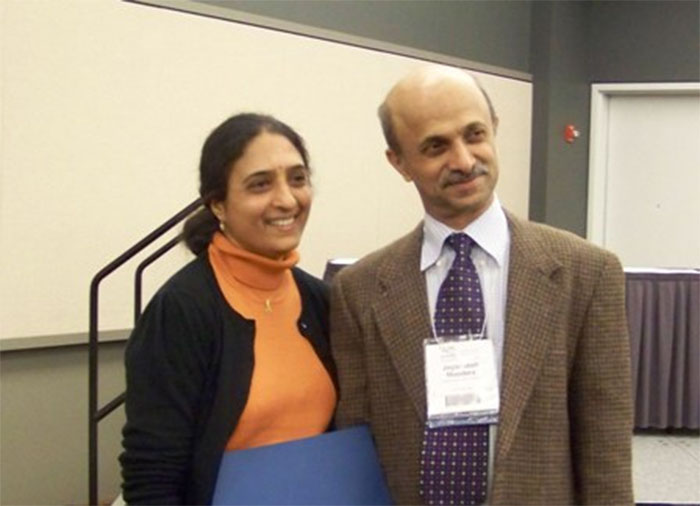
DrJagadeesh02KF05may2020

Dr. Jagadeesh explained the intricacies of the experiments that he and his team were involved in. It was fascinating to see a huge setup with myriad tubes, probes, cables and instruments in order to create a 100% vacuum in a space of about 2 cubic centimetres.

Part of the experiment was conducted in this small space which was absolutely contamination free. There was another setup equally complicated where a space was created for the experiment which was free of any kind of vibration – not even that created by the traffic in the streets distance away, or footsteps of students in the nearby corridors. In addition, this space is cooled to -273 degree centigrade (that’s as close as one could get to -273.15 degree centigrade which is absolute zero). The experiments were conducted under these ideal conditions and usually between 10 pm and 6 am when chances of vibration were the least.

The experiment Dr. Jagadeesh and his colleagues have been working on since 2012 was to discover what Italian Theoretical Physicist Eltore Majorana, extending on Paul Dirac’s theory, had postulated in 1937 that there should be some subatomic particles that are indistinguishable from their anti-particle.

Scientists have been looking for these particles named Majorana fermions. Many theories have emerged over the years. Theoretical Physicists at MIT and elsewhere predicted that Majorana fermions may exist on solids such as gold under certain conditions. Dr. Jagadeesh and his team were on a mission to discover the existence of the elusive Majorana fermion.

The experiment, extremely complicated, needed many long hours in the laboratory. Dr. Jagadeesh explained how the delicate research was carried out at nano-particle level and observed through Scanning Tunneling Microscope (STM). STM is capable of ‘feeling’ the presence of atoms and molecules. 3mm x 3mm was the size of the surface on which the experiment was carried out, consisting of nano-wires of gold, grown on superconducting material: Vanadium.

MIT News dated 10th April 2020 has announced the successful sighting of the mysterious Majorana fermion by Dr. Jagadeesh Moodera and team. This is a major breakthrough. In Dr. Jagadeesh’s words ‘We have shown they are there, and stable, and easily scalable.’ Please visit webpage: http://news.mit.edu/2020/first-majorana-fermion-metal-quantum-computing-0410

The finding that Majorana fermions are scalable and could be made into qubits (individual computational units) is spectacular. These qubits could be used to build the most powerful and error free quantum computers. This will be a step closer to the phenomenon known as Singularity, which predicts that by the year 2042 AD there will be computers that will have computing power of all the human brains put together!

Once Singularity is achieved, humans need not invent anything further. Solutions to the most complex problems will be arrived at within seconds. If we had these computers today, a remedy for the current Covid-19 would have been found in a jiffy!

Dr. Jagadeesh’s wife Dr. Geetha Berera is a senior lecturer in MIT and we had an opportunity to visit her laboratory as well. The couple are totally dedicated to academics and research. Every year they visit Coorg and conduct a Quiz programme for school students. They are in the process of starting a school in Coorg under their organisation – CREATE Gurukula Trust – focusing on encouraging young minds in research activities. Meritorious students at Coorg Institute of Technology (CIT) are recipients of annual scholarships and awards instituted by Dr. Jagadeesh and Dr. Geetha. Dr. Jagadeesh and Dr. Geetha are eminent role models for young Kodavas to emulate.

source: http://www.starofmysore.com / Star of Mysore / Home> Feature Articles / by C.P. Belliappa / May 04th, 2020
Mysuru-Educated Innovator Creates Respiration Rate Monitor For COVID-19 Patients

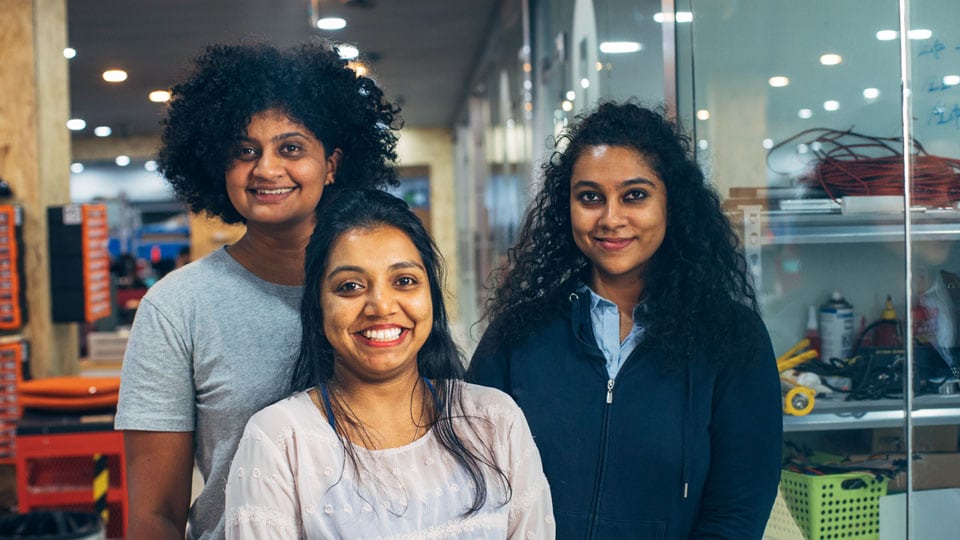
(from left) Sanchi Poovaya, Ranjana Nair and Aardra Kannan Ambili)

Mysore/Mysuru:

Unique among many medical solutions offered to combat COVID-19 is the new breathing monitor for Coronavirus patients developed by a Bengaluru-based start-up RayIoT and it is a matter of pride that a Kodagu-born and Mysuru-educated innovator is behind the device.

She is Ammanichanda Sanchi Poovaya, a young but experienced engineer, innovator and entrepreneur. She co-founded healthcare start-up RayIoT Solutions Inc. and is the Chief Operating Officer of the start-up that has already made a mark in innovative healthcare products.

Her start-up creates innovative healthcare and baby-tech products using Artificial Intelligence (AI) and Internet-of-Things (IoT) technologies. Very recently, Sanchi Poovaya and her other two co-founders Aardra Kannan Ambili (Chief Technology Officer) and Ranjana Nair (Co-founder and CEO) built a remote respiration monitoring system for COVID-19 patients that allows doctors to remotely monitor less critical patients while seriously ill ones get more attention.

Connected workflow sends alerts to the doctor in case of any abnormal variations in the patient’s vitals. With the high effectiveness of using respiration rate as a predictive vital, early detection especially among at-risk caregivers is a possibility.

CodavaCovidInnovator02KF27apr2020

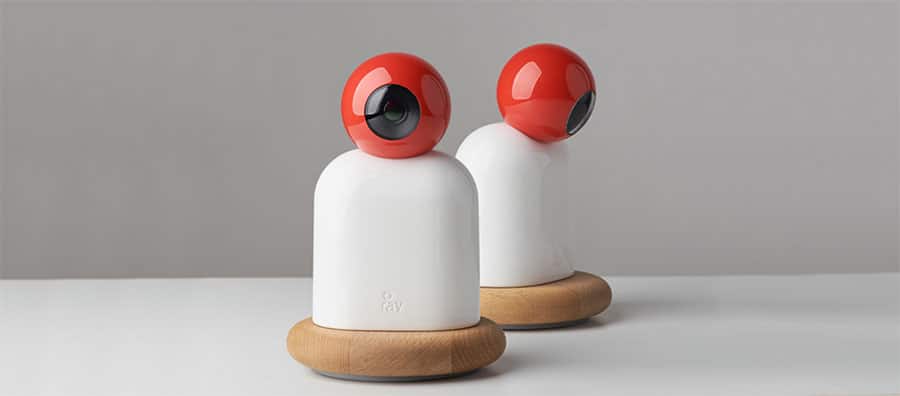
“It is a non-contact, Wi-Fi enabled, affordable respiration rate monitor for Coronavirus patients that can run as mini ICU units. In its current form, RayIoT will work as a mini ICU monitoring unit. The algorithms of Artificial Intelligence will allow doctors and other health professionals to track the respiration rate of multiple patients through an app from anywhere in the world,” Sanchi Poovaya said.

In a pandemic like COVID-19 where doctors are falling ill with excessive patient inflow, and the management of quarantined patients have become difficult, the device wirelessly tracks patient’s respiration rate, heart rate, blood pressure and temperature.

Since all the devices can be connected to one central database, using RayIoT, healthcare professionals can monitor more than one lakh patients at a time continuously. By just tracking respiration rate, they will be able to intelligently categorise quarantined patients into mild, severe, and critical cases, she said.

“The idea of a remote respiration monitoring system came to us when a celebrity, who was converting his 14-room sprawling bungalow into a quarantine facility, reached out to us. His problem was remote access to doctors, nurses and medical equipment to fully equip his quarantine facility.”

The team had to come up with a low-cost solution that could monitor the vitals of hundreds of patients at any given point of time and connect to doctors through video when the patients are moving into a severe or critical stage. “The solution also helped Government Task Forces who are monitoring huge swathes of population by providing them a single source of truth with our quarantine database,” Sanchi reveals.

RayIoT has been created by same team that is behind Raybaby (the world’s first non-contact sleep and breathing monitor for babies. This product has won many awards and was mentioned in CNN as one of the must have home gadgets.

Ammanichanda Sanchi Poovaya completed her schooling at Good Shepherd, Ammathi in Kodagu, and JSS Public School, Mysuru. She completed her Mechanical Engineering at the National Institute of Engineering (NIE), Mysuru and MS in Mechanical Engineering from Cornell University, New York.

Sanchi Poovaya is the daughter of Ammanichanda Sunil Poovaya (ex-Merchant Navy) and Shiela Poovaya (Pattada, Betoli). They live in Hosur, Bengaluru.

source: http://www.starofmysore.com / Star of Mysore / Home> Covid News / April 26th, 2020

Sacrifices made by medical staff invaluable: MLA Appachu Ranjan

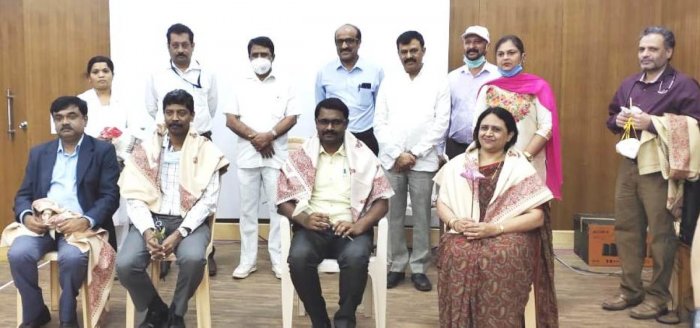
The doctors of the district government hospital were felicitated on the occassion of World Health Day, in Madikeri on Tuesday. MLA M P Appachu Ranjan, MLC Sunil Subramani and DHO Dr Mohan were present. DH Photo

Medical personnel have been working day and night to protect the health of people, by putting their own health at risk. The sacrifices made by them are invaluable, said MLA Appachu Ranjan.

He was speaking after felicitating doctors on the occasion of World Health Day observed at district government hospital in Madikeri on Tuesday.

“It is important to recognise the achievements of doctors, nurses and other medical staff. Due to the precautionary measures taken by the district administration and the efforts of health department personnel, we have been able to control the spread of COVID-19,” he added.

MLC Sunil Subramani said that the district administration, police department, medical personnel, civic workers and elected representatives in the district have been working in coordination to combat Covid-19.

District Health and Family Welfare Officer Dr K Mohan, Kodagu Institute of Medical Sciences Dean Dr Cariappa, Superintendent Dr Lokesh, Dr Aziz and Dr Manjunath were present.

source: http://www.deccanherald.com / Deccan Herald / Home> State> Karnataka Districts / by DHNS, Madikeri / April 07th, 2020

Sourcing life-saving blood in the time of coronavirus

After initial setback and ‘nil’ donations, donors, although in small numbers, are turning up at blood banks
After facing shortage of blood soon after the lockdown with some of the blood banks registering almost ‘nil’ donations, the situation appears to be better now with voluntary blood donation gaining some traction. However, the blood scarcity has not fully eased with restrictions continue to be in place.

Despite limited donors and blood units, the situation was being managed with family members, friends and relatives of in-patients bringing donors by getting passes from the police to donate blood.

So far, blood transfusion to patients of thalassemia, haemophilia, sickle cell anaemia and other blood disorders, who require blood, has not been affected.

In the blood bank of JSS Hospital here, over 100 children with thalassemia had been getting free transfusion. Some require transfusion once or twice a week and the hospital has managed to arrange blood units for them in spite of the lockdown which has hit voluntary blood donations in the absence of camps. JSS Blood Bank has around 260 units of blood.

In Madikeri, the local thalassemia patients, who were being treated in Mangaluru, were now being treated in the district hospital with the blood bank sourcing blood units to them.

Ravi Karumbaiah of the blood bank said, “The lockdown has curbed their movement to places where they were being treated earlier. Blood transfusion to these patients is now being done locally as priority cases since they are unable to commute. The donors are coming forward and the situation is better compared to the previous week.”

In the case of K R Hospital Blood Bank here, the available blood units could last for about a month despite 75 per cent drop in blood donations.

Blood Bank Officer B.S. Manjunath said, “People have realised the situation and are donating blood, though small in numbers, after removing their misapprehensions. We have in storage about 309 units of blood and 800 units of plasma. Donations are certainly down by 75 per cent with numbers dropping to as low as 12-13 from 40-50 daily. There have been no camps since March 10 after the COVID-19 scare began.”

However, for thalassemia, sickle cell anaemia, cancer and other patients who need regular transfusion, there was stock and required units were provided for transfusion at the hospital. “Those patients have no problems at all,” he said, adding that the number of blood units would depend on the severity of cases.

Representatives at Jeevanadhara Blood Bank and the Blood Bank of St. Joseph’s Hospital here said lockdown curbs had hit voluntary donations, resulting in blood shortage.

“We have a database of frequent donors and call them if we need blood for patients with negative blood groups which was not common to source, particularly during delivery cases. In such rare cases, we ourselves send ambulances to pick up the donors because of lockdown,” said a source at the Jeevanadhara Blood Bank.

In spite of drop in road accidents and surgeries, the demand for blood has not dropped because of delivery cases, life-saving surgeries and transfusion to aged persons, he added.

A staffer at the JSS Blood Bank said, “In view of the current situation, blood units were also being provided to outsiders in case of emergencies.”

source: http://www.thehindu.com / The Hindu / Home> News> States> Karnataka / by Shankar Bennur / Mysuru – April 10th, 2020

Kodagu district administration offers telemedicine facility

Soon after launching an online supermarket for door delivery of essentials to the people confined to their houses during lockdown, the Kodagu district administration has taken its e-initiative forward by offering telemedicine facility.

Making use of technology, the Kodagu district administration has started a website www.kodaguedoc.letstart.in for the benefit of dispensing telemedicine at a time when most health facilities, including clinics, across the State have shut.

People feeling unwell or having flu symptoms need to sign up, fill in details, sign in, and register before making appropriate selections for self or a family member and call the doctor. Patients or their attendants registering on the website through a mobile phone can make use of the option to call the doctor available on the website or call 9480610807.

The doctor, who will receive the call at the control room of the telemedicine facility, will provide consultation to the caller after taking the registration ID and prescribe necessary medication through an SMS. The prescription can also be downloaded from the website.

Though the doctors offering telemedicine facility will mostly address common complaints of flu and cough, necessary guidance will also be provided to patients with symptoms of COVID-19.

The telemedicine facility is also aimed at checking the rampant practice of self-medication among the people since the neighbourhood clinics have been closed.

After a large number of people begun taking medicine over the counter, the district administration has directed drug stores in the district to stop dispensing medicine without a prescription that is less than a week old.

To popularise the telemedicine facility, the district administration has come out with a short video which provides new users with details on how to sign up and register.

The facility offered by the Kodagu district administration follows the launch of an online supermarket to deliver groceries, vegetables, fruits, and milk to doorsteps by involving grocery stores and other establishments dealing with essentials.

source: http://www.thehindu.com / The Hindu / Home> News> States> Karnataka / by Special Correspondent / Mysuru – April 17th, 2020

Telemedicine fever clinic launched in Kodagu

The district administration has launched an online telemedicine fever clinic, for consultation with doctors.

The website is www.kodaguedoc.letstart.in

A control room has also been set up with a doctor and the number is 9480610807.

People having fever and other symptoms of Covid-19 can log into the website and register. Later, with the help of the registration ID number, the person should call the control room number.

The doctor in the control room will obtain the registration ID and will prescribe the medicine through the website.

The person should later log into the website again and download the prescription and consult the doctor online.

The website will be operational soon, Deputy Commissioner Annies Kanmani Joy said.

source: http://www.deccanherald.com / Deccan Herald / Home> State> Karnataka Districts / by DHNS / April 15th, 2020

Judge inspects facilities in hospital

District and Sessions Judge V V Mallapura and Legal Services Authority Member Secretary Noorunnisa visited district hospital in Madikeri.

District and Sessions Judge V V Mallapura and Legal Services Authority Member Secretary Noorunnisa visited the district hospital and Ashwini Hospital in Madikeri and inspected the facilities at the hospitals.

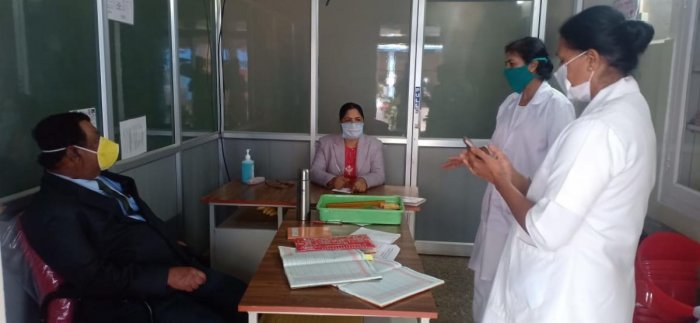
The judge collected details about the measures taken to check the spread of Covid-19 from doctors, paramedical staff and nurses.

Following the directions of the High Court, the judge also gathered information on stock of medicines, masks, hand gloves, sanitisers and ventilators at the hospitals.

Kodagu Institute of Medical Sciences Dean Dr Cariappa and others were present.

source: http://www.deccanherald.com / Deccan Herald / Home> State> Mangaluru / by DHNS, Madikeri / April 11th, 2020

For safe collection of throat swab samples from patients

COVID-19 hospital in Madikeri gets novel sample collection kiosk; doctors claim it saves on the use of one-time PPE kits by the sample collector

In a bid to make collection of throat swabs from persons with COVID-19 symptoms secure, a walk-in sample kiosk for the collection of samples has been developed in the COVID-19 hospital of the Kodagu Institute of Medical Sciences (KIMS) in Madikeri.

The box-shaped see-through structure has been set up in a separate room at the hospital’s isolation ward where a health worker collects samples from each person from inside the protected compartment, without exposing himself or herself to the patient.

A pair of gloves is attached to the booth from outside through which the sample is drawn. This evades the person from wearing a Personal Protective Equipment (PPE) kit to collect the sample as the kiosk’s protective shield minimises the use of PPEs during sample collection, a doctor claimed.

The waste generated from the use of the one-time kit was reduced as well.

The frontline medical worker enters the kiosk under protection wearing mask, gloves and shoes as per the sample collection guidelines and inserts his or her hands into the sticking out gloves. The patient with symptoms will be sitting on a chair in front of the gloves. Using the collection tubes, the throat secretions are collected. The patient has to throw the disposable items into the dustbin kept next to the kiosk before leaving the sample collection room.

After each patient gives his or her throat secretion, the room is disinfected and the gloves are changed before the next patient gets in. The sanitizing is done by a person wearing PPE.

KIMS Director and Dean K.B. Cariappa told The Hindu that the kiosk gives a kind of confidence to the health worker collecting the sample from the patient since the cabin had a sealed protective shield.

“The kiosk saves on the PPE kits used while collecting the samples. If necessary, the health worker can also wear the PPE kit for additional safety. Even without the kit, the kiosk is safe and prevents the possible threats of infection,” he said.

The kiosk in Madikeri has been set up at a cost of ₹20,000.

The teaching hospital of KIMS has been converted into the 250-bed COVID-19 hospital and the in-patients of the hospital (non-COVID-19 cases) had been shifted to a private hospital taken over by the district administration in view of the pandemic.

source: http://www.thehindu.com / The Hindu / Home> News> States / byShankar Bennur / Mysuru – April 10th, 2020

NGO hands over 4 ventilators, essentials to district administration

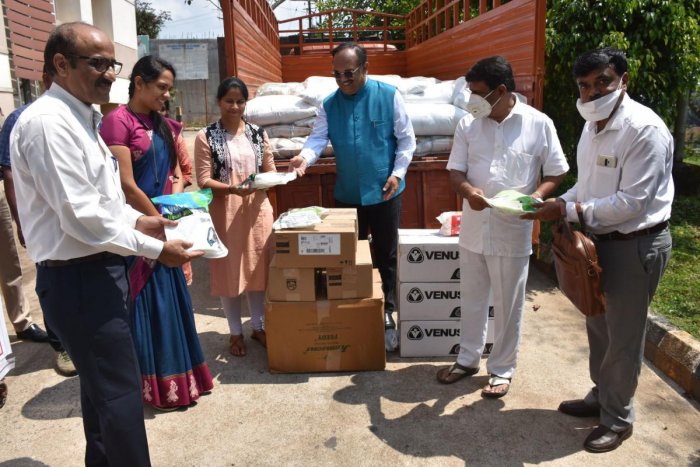
MobiusKF08apr2020

Mobius Foundation, a Delhi based NGO, handed over four ventilators to Kodagu district administration, for the treatment of COVID-19 patients.

Also, essential items for daily wage workers and the financially deprived, who are affected by the lockdown, were supplied by the NGO.

The items were handed over to the ‘Hasida Hottege Tanivu Pettige’ initiative, conceptualized by District Superintendent of Police Dr Suman D Pennekar.

Mobius Foundation convener Madhu Bopanna also handed over masks and medical kit for the medical staff, police and journalists.

Speaking on the occasion, he said that the organisation has contributed an amount of Rs 1 crore for PM CARES Fund on COVID-19. About 2,000 kg of lentils and 2,000 litres of oil have been contributed to ‘Hasida Hottege Tanivu Pettige’ initiative.

“It is the duty of every individual and organisation to help the needy during such a situation,” he added.

Madikeri MLA Appachu Ranjan, Deputy Commissioner Annies Kanmani Joy, Superintendent of Police Dr Suman D Pennekar and Kodagu Zilla Panchayat Chief Executive Officer K Lakshmi Priya were present.

Mobius Foundation had also lent a helping hand to the district during the flash floods and landslides.

source: http://www.deccanherald.com / Deccan Herald / Home> State> Mangaluru / by Aditya K A / DHNS, Madikeri / April 07th, 2020

Two Day Kisan Mela Conducted at KVK, Gonikoppal, Kodagu ( Athur Farm )

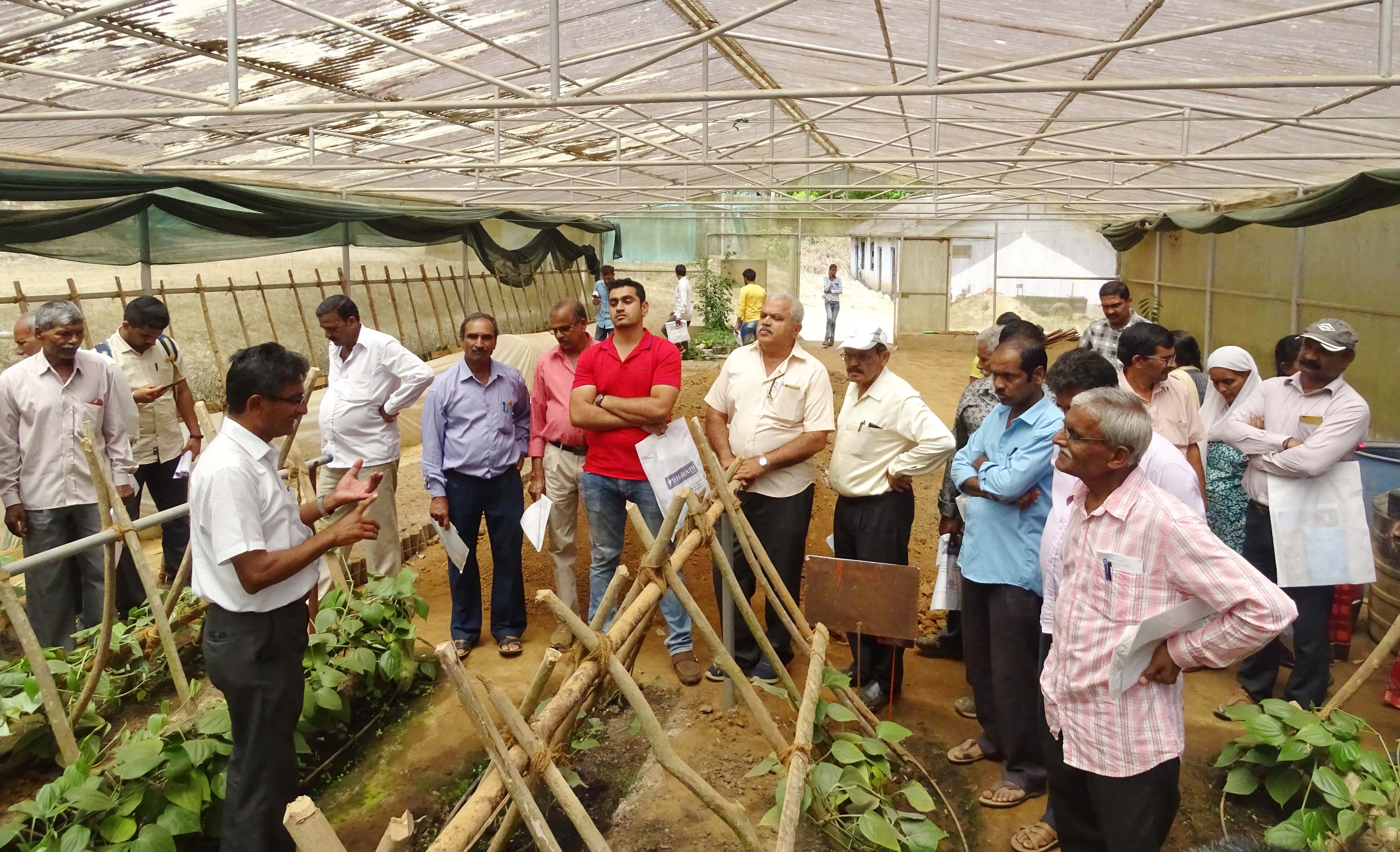
KisanMelaKF18mar2020

A two day district kisan mela and Krishi Abhiyana programme was held at Athur farm of KVK Gonikoppal from 11th to 12 March, 2020. An array of farmers friendly technologies were on display in the Krishi Mela organized in collaboration with the Agricultural Technology Management Agency (ATMA). Dr. Shankara Hebbar, Principal Scientist, IIHR Bangalore gave a brief introduction about vegetable cultivation and polyhouses. Later Joint Director of Agriculture, Kodagu Dr. K Raju said that the programme was to create awareness among district farmers about latest agricultural technologies and schemes. Dr. Saju George, Head, KVK spoke on the different demonstrations units in the KVK Demonstration farm.

The programme was inaugurated by Shri. B A Harish, President, Zilla Panchayath, Kodagu.The Chief Guest Smt. Sarojamma, Zilla Panchayath Member , inaugurated the Exhibition stalls. Dr. C. G. Kushalappa, Dean, College of Forestry, Ponnampet also addressed the inaugural session. Dr. M R Dinesh, Director, IIHR, Bangalore, in his presidential address highlighted different farmer friendly technologies of horticultural crops, machineries, bio-fertilizers, bio-pesticides, micro nutrient formulation, incubation facilities for entrepreneurship available through ICAR-IIHR, which can be extended to the Kodagu district farmers through the KVK Gonikoppal. He said that there is lot of potential in the district for the adoption of horticultural technologies and thereby increasing increasing farmers income.

During the inaugural session , Shri M.M Aiyyappa, a farmer from Virapet was felicitated for brining the AMC technology to Kodagu through KVK. Shri Kishor Nachappa the farm journalist was felicitated for his role in promoting farm technologies through farm journalism. Smt Suja, was felicitated for her success in mushroom cultivation after undergoing training at KVK through ASCI sponsored skill development training programme. The Agriculture department felicitated the Kodagu district farmers for their achievements.

In the technical session, Dr. Shivaprasad, Deputy Director, gave a talk on the importance of soil testing and INM practices in coffee. Mr. Devaiah, K. A. Subject Matter Specialist spoke on the trellies method of black pepper multiplication. Sri. Thimmiah, S. C. Krishi Pandit, spoke on his experiences of mechanization in paddy for better realization of yield.In the second day technical session, Dr. S. J. Ankegowda, Principal Scientist & Head, Regional Station, IISR, Appangala gave a talk on holistic management of black pepper in the coffee based farming system. Dr. A. S. Shanthesh, Chief Veterinary Officer, Department of Animal Sciences and Veterinary Sciences, Virajpet taluk spoke on the importance of livestock for milk, meat and manure in the mixed farming system. Dr. S.C. Suresh, Subject Matter Specialist (Livestock) spoke on scientific piggery farming. Smt. Veena Sudheer, awardee farmer shared her experience of integrated farming system. Mr. K P Subbaiah, President, Puthari Farmers Producers Organization spoke on recent developments in marketing of coffee and initiatives of Puthari FPO.

In the Valedictory session, Mr. Srinivas, P. V., DDM, NABARD, Kodagu spoke on the different NABARD schemes for farmers, rural institutions. Mr. Vijay Angadi, Programme Officer, All India Radio, Madikeri spoke on the relevancy of this type programme and he opined that in coming programmes a separate session can be conducted on organic farming. Farmers were also taken to different demonstration plots in KVK Viz. vegetable demonstration plot where different varieties (Chilli- Arka Meghana & Kyathi, Brinjal -Arka Keshav, Pole bean- Arka Sukomal, yard long bean- Arka Mangala, cowpea- Arka Suman, Dolichos- Arka Adarsh were raised in one acre with raised bed, polyethene mulch with fertigation, different livestock units –piggery, Goatary, Diary, Poultry, Fodder crops, Propagation unit of Black pepper, arecanut, coffee, Solar irrigation unit, farm machineries unit etc. during the occasion.

More than 20 exhibition stalls were arranged for the benefit of the farmers on the occasion involving the government, private and FPOs. More than 750 farmers witnessed the event in two days and interacted with the scientists, specialists and officials. Overall the participating farmers appreciated the efforts and felt that such melas give the farmers the technological guidance for increasing the farmers income in a sustainable manner.

source: http://www.iihr.res.in / ICAR – Indian Institute of Horticultural Research / Home / March 2020