Category Archives: Science & Technology

440kV Power Line Gets Expert Panel Nod

Bangalore :

An expert committee has given the go-ahead for the proposed 400-kV Mysore-Kodagu-Kozhikode power line passing through eco-sensitive forest zones. It said the power line can follow the original alignment, despite serious apprehensions expressed by environmentalists in Kodagu district.

Speaking to reporters here on Wednesday, Power Minister D K Shivakumar said the state government had constituted a three-member expert committee headed by R S Shivakumara Aradhya to examine the issue. The committee has submitted its report and has recommended the construction of the line on the route originally proposed by the Power Grid Corporation of India Limited (PGCIL)

He said the work on the double-circuit transmission line, which had secured forest clearance, was halted following objections raised by environmentalists and a few elected representatives from the region.The committee, in its recommendations, also suggested certain remedial measures to deal with environmental issues. This included regeneration of vegetation along the 3.93-km stretch in Dubare and Devamachi reserve forests.

It recommended working out a plan to mitigate elephant-human conflicts in coffee plantations, paddy fields and settlements in Kodagu district during the cutting of trees and construction of tower lines.

The remedial plan should be prepared and implemented by the Forest Department in consultation with experts as well as local stakeholders, with funding from the PGCIL, it said and suggested better compensation to paddy growers than what was proposed by the PGCIL.

The committee felt that about 6,000 trees have to be cut in a 12-km stretch of coffee plantations in Kodagu and another 2,247 trees in the forest stretch to build the proposed line. It acknowledged that the line passes through 4.5 km of reserve forest in Virajpet, Madikeri and Hunsur forest divisions, which fall within the buffer zone of the tiger reserve.

Various environmentalist organisations, including Coorg Wildlife Society, had strongly protested against the project fearing large-scale damage to forests.

source: http://www.newindianexpress.com / The New Indian Express / Home> States> Karnataka / by Express News Service / August 28th, 2014

‘Madikeri to get water from Kundamestri shortly’

The work on a temporary project to supply water from Kundamestri is nearing completion. The water from Kundamestri is likely to be supplied to the citizens of Madikeri by the week end.

Sand bunds have been laid to store water. The collected water will be supplied to Kootuhole through pipes. After filtering the water at a Filter house at Stuart Hill, water will be supplied to the citizens.

Madikeri reels under water crisis every year during summer. The work on Kundamestri project was initiated to mitigate water crisis.

However, owing to delay in release of funds, the work could not be completed. Now the estimated cost of the project has been escalated.

The Kundamestri project is being implemented by Karnataka Water Supply and Sewage Board. It will take another one year to complete the work.

Board Executive Engineer Balachandra has expressed confidence of completing the work. The project has been taken up keeping in mind the development of Madikeri in the next 50 years.

When the water level declines in Kootuhole, water will be supplied from Kundamestri to Kootuhole.

source: http://www.deccanherald.com / Deccan Herald / Home> District / Srikanth Kallammanavar / Madikeri – DHNS, July 26th, 2014

Coffee waste may fuel your car now

Scientists have created a new biofuel to get the cars running using ground coffee. The study by University of Bath found that different varieties of coffee, including Robusta and Arabica, have reasonably standard composition and relevant physical properties of fuel, suggesting that all coffee waste could be a “viable” way of producing biodiesel.

Chris Chuck, a research fellow at the university, said that around eight million tonnes of coffee are produced globally each year, and ground waste coffee contains up to 20% oil per unit weight. This oil also has similar properties to current feedstocks used to make biofuels. Spent coffee grounds are waste and there’s a real potential to produce a truly sustainable biofuel using these, he added.

source: http://www.timesofindia.indiatimes.com / The Times of India / Home> Science / Agencies / June 18th, 2014

Keep power line project off Kodagu, urges Greens

On the one hand, greens have been demanding to explore alternative routes to lay 400 kv high tension line between Mysore-Kozhikode, and on the other hand, Power Grid Corporation of India (PGCI) says that the alternative routes were discussed way back in 2009 and they were rejected.

The Members of Kaveri Sene, Coorg Wildlife Society and Kaveri Bachao Andolan have said that felling of trees will have its impact on the bio-diversity and environment of the region. Hence, the project should be kept out of the purview of the Kodagu district.

Power Grid Corporation Chief Manager C D Kishor told Deccan Herald that all the three suggestions put forth by the protesters were discussed and rejected.

The route proposed by the protesters are as follows:

Route 1—Upgrading 220 kv line that provided connectivity between Karnataka and Kerala. Upgrading of the line falls under Bandipura National Park.

After the implementation of Forest Conservation Act 1980, no development work can be initiated inside National Park where tigers habitate.

Hence, the proposal was rejected.

Route 2—Laying electric wire on D-line of Nagarahole National Park.
However, the route was rejected as the width of the D-line is only 15 metre. The width required for laying high-tension wire is 45 metres.

Hence, it would require felling of trees on minimum of 30 meter after the D-line. On an average about 17,515 trees would have been felled if the route was approved.
Hence, both the State and Central governments had rejected the suggestion.
Route3—Underground cable.

The proposal was rejected as it was an uphill task to lay underground cable for 55 kms. To lay underground cable, a separate road will have to constructed to take up repair work in the underground cable.

Present route

At present, the high-tension line will pass through Hunsur, Piriyapattana-Devamacchi forest-Maldare-Hundi-Mayamudi-Bekkesodlur-Nalkeri-Kutta-Kerala.

Delay in work

The length of Mysore-Kozhikode line is 210 kms. The line will pass through 92 kms in Kerala.

The work in Kerala and Mysore has been completed. Owing to the protest by environmentalists, the work was stalled in Kodagu district.

Technical committee

Following the protest, the State government has constituted a technical committee to explore the possible alternative routes.

The committee has been directed to submit report within 15 days.

Kaveri Bachao Andolan Convenor B C Nanjappa said “our concern is environment of the district. We had suggested three alternative routes. If it was not acceptable, then let the technical committee constituted by the government explore an alternative.”

source: http://www.deccanherald.com / Deccan Herald / Home> District / by Srikanth Kallammanavar , Madikeri / DHNS – May 06th, 2014

PGCIL keen on completing Mysore-Kerala project

KodaguMapkf08mar2014
Power Grid Corporation of India Ltd., a Government of India enterprise, which is drawing the 400 KV D/C transmission line from Mysore to Kozhikode in Kerala via Kodagu district, has blamed certain non-governmental organisations of placing hurdles to the implementation of the project citing environmental reasons.

Of the 210-km transmission line, work has been completed in a stretch of 155-km (92 km in Kerala and 63 km in Karnataka). The balance 54.5-km line needs to be drawn in Kodagu, through 38 km of paddy fields and across 12 km of coffee plantations. Works covering a distance of 4.5 km in reserve forests in Kodagu has been completed. The Coorg Wildlife Society and Cauvery Sene have been opposing the project.

The apprehension created by the NGOs among the people over the project is unfounded, says S. Ravindar Kumar, Additional General Manager, PGCIL, who is in charge of the Karnataka projects. He told The Hindu that the project was entrusted to the PGCIL to evacuate power from Kaiga 3 and 4 nuclear plants, with the prior approval of the Union government. The Union Ministry of Environment and Forests had given clearance for the lines in Kodagu.

As many as 2,450 trees were cut in Kodagu to draw the line across a stretch of 4.5 km reserve forests. An estimated 6,000 trees would have to be cut in the 12-km stretch of coffee plantations and about 300 in the 38-km stretch of paddy fields. However, the contention of the NGOs that over 50,000 trees would be felled to draw the line via Kodagu was far from the truth, Mr. Kumar said.

The PGCIL had commenced the Mysore-Kozhikode line works in December 2005, which was to have been completed in 2007. But, the Kodagu stretch has remained a bone of contention. It has also planned to earmark Rs. 60 crore for payment of compensation to farmers and has already deposited Rs. 10 crore in the Kodagu district treasury. Farmers could be paid Rs. 15 to Rs.18 lakh per acre as compensation in coffee plantations and Rs. 2 lakh per acre of paddy field, Mr. Kumar said.

The alternative routes suggested by the NGOs: utilising the 220 kV Kadakola-Kaniyampetta corridor (through the Bandipur National Park) would not be possible as it is the only inter-State feeder and de-energising it cannot be done since it is critical to meet the demands of north Kerala. The second alternative, that the existing D-line could be made use of (via Nagarahole National Park) was rejected by the State and Union governments.

source: http://www.thehindu.com / The Hindu / Home> News> National> Karnataka / by K. Jeevan Chinnappa / Bangalore – March 05th, 2014

German technology for book stalls

GermanKF12jan2014
Madikeri :

More than 300 book stalls that have come up in a sprawling 1 1/2 acre area in the town, as part of the literary fest, is expected to be a hit among the participants and the general public.

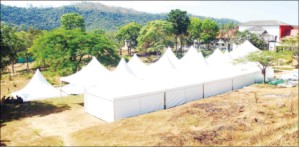
The book stalls are set-up using German technology, adjacent to Field Marshal K.M. Cariappa College ground, with each stall measuring 10×15 ft.

A 16-member Committee is supervising the maintenance of these stalls, with one stall reserved exclusively for Kodagu writers.

Apart from the book stall, commercial stalls featuring fancy stores, food outlets, textiles etc., too have come up. Also several women self help groups (Sthree Shakthi Sanghas) have taken up some stalls in order to promote their products.

The Committee has fixed a rent of Rs. 2,500 to each stall for the 3-day literary fest, with book-sellers from different parts of the State including Bangalore, Dharwad, Udupi, Gadag, D.K. and Mysore districts having booked the stalls.

‘Kodagu-Bedagu’ handbook to be distributed at Kannada meet

Madikeri, Jan. 6 (KBM&DM)- A handbook on Kodagu district titled “Kodagu-Bedagu” is ready for free distribution among those arriving for the All India Kannada Literary Meet to be chaired by renowned writer Na. D’Souza tomorrow at Madikeri.

The 20-page handbook, contains information on the geographical features of Kodagu district, a former Princely State, and its magnificent scenic valleys and other spots. It contains vital information on all religious places, including the dress code to be observed while visiting some prominent temples and tourist spots across the district.

The handbook, brought out with an attractive cover page, contains detailed information on the famous tourist spots in Madikeri including the Fort, Raja’s Seat, Archaeology Museum, Omkareshwara Temple, St. Michael’s Church and other scenic spots like Abbey Falls, Makkalagudi Betta, Talacauvery-Bhagamandala, Padi Shri Igguthappa Temple, Thadiyandmol Hill, Yemme Madu, Sufi Shahid Dargah, Rajiv Gandhi National Park in Nagarahole, Irupu Falls, Cauvery Nisargadhama, Harangi Dam, Dubare camp, Virajpet’s St. Anne’s Church, etc.

Handbook Committee President H.T. Anil said that the Committee had earlier planned to bring out a more exhaustive 48-page handbook but it was later scaled down to 20 pages on account of cash crunch.

The handbook will be distributed free of cost amongst more than 8,000 representatives and journalists attending the meet.

source: http://www.starofmysore.com / Star of Mysore / Home> Feature Articles / January 06th, 2014

Farmers to get 50 per cent subsidy for solar fencing

The government will provide 50 per cent subsidy to farmers to put up solar fences on their farms, said Minister for Forests B. Ramanath Rai on Thursday, as an obstacle against entry of wild animals and to reduce man-animal conflict

During his visit to the Karnataka Pradesh Congress Committee (KPCC) office here, the Minister told presspersons that the department had put up elephant-proof trenches and installed solar-powered fences around some stretches of the reserve forests and national parks. “This is part of the Karnataka Sustainable Forest Management and Bio-diversity Conservation Programme. However, if farmers want to get solar fences installed by private companies, we will grant them 50 per cent subsidy,” he said.

The Minister said his department was not against development. However, only such projects that will directly benefit people will be permitted. People who submit applications for land in deemed and reserve forests should keep in mind the various rules governing forests in the State.

The Minister said the process of resolving the confusion over the C and D categories of land (degraded forest land) had commenced. “According to the law, there is no provision to regularise encroachments on forest land after April 27, 1978. However, we have received over one lakh applications seeking regularisation of land. A Cabinet subcommittee has been formed to study the issue and take a decision,” he said.

Posts to be filled

He said 700 posts in the department would be filled shortly. “The department is also encouraging farmers to grow sandalwood. We are giving away saplings at Re. 1 and Rs. 2 each to farmers. These farmers will also get an incentive of Rs. 10, Rs. 15 and Rs. 20 for each sapling annually, in the first, second and third year respectively, to ensure its growth,” the Minister said.

source: http://www.thehindu.com / The Hindu / Home> News> National> Karnataka / by Special Correspondent / Bangalore – January 03rd, 2014

‘Create awareness on Aids’

AidsKF10dec2013There is need to create an awareness on HIV/Aids among people, said Zilla Panchayat Vice President Biddanda Usha Devamma.

She was speaking at a World Aids Day programme organised by the district administration, zilla panchayat, department of health and family welfare, District Aids Control unit, district Legal Services Authority, here on Monday. Zilla Panchayat standing committee (education and health) Mani Nanjappa, Zilla Panchayat Chief Executive Officer Srividya, District Health Officer Dr O R Srirangappa and others were present.

Protest

The contract workers of Karnataka State Aids Prevention Society staged a protest demanding the fulfillment of their demands, by wearing black badge.

The staff members of ICTC, ART, DSRC, Link ART and blood bank took part in the protest.
Addressing the protesters, Contract Workers district unit leader Sadananda said that Karnataka tops in controlling the spread of Aids. However, the workers who have been striving for the purpose are not given facilities.

The protesters urged to regularise the services of contract labourers and double the wages of the contract workers. The wages which were pending for the last few months should be released at the earliest.

Mudigere

Students who become victims of wrong selections, tend to miss a lot of opportunities in life, said JMFC Principal Civil Judge Padmaprasad.

He was speaking after inaugurating legal literacy programme jointly organised by the law department, NSS unit and health department, to observe World Aids Day at Government Boy’s PU College on Monday.

“Adolescence is a period which takes youth in wrong direction. Only those who aim high and are spirited throughout, achieve in their lives.”

“Life gives several opportunities, therefore students should come out of negative and unwanted thoughts that come to their mind. Even the parents should shower love on children so that they will not succumb to bad habits,” he said.

Taluk Health Officer Dr Yogesh called ‘awareness’ as the only medicine for Aids.
Students should educate themselves about Aids and also spread awareness in the society, he said.

source: http://www.deccanherald.com / Deccan Herald / Home> District / by DHNS – Madikeri / December 02nd, 2013

Coffee growers spar over poly wrap method to curb white stem borer

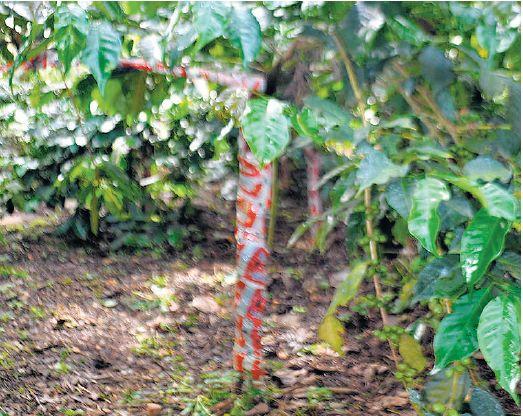
Better solution: An arabica plant stem wrapped with cellophane tapes to prevent it hosting the white stem borer on a coffee estate in Kodagu. / The Hindu

Results are good, says Coffee Board; some planters raise environmental concerns
An ingenious method has been found to control the ruinous white stem borer in coffee estates where the arabica variety is grown. But coffee planters are split over the effect of the solution with some even questioning its impact on the environment.

According to A.K. Bhandari, coffee planter and former President of the United Planters Association of Southern India, wrapping the stem of the arabica plant with cellophane, called poly wrap, helps in containing the borer menace. The wrap prevents the female beetle from laying eggs in cracks and crevices of the plant.

“We came across this solution some two-and-a-half years ago when some planters used old plastic to wrap the stems. It prevented the borer from laying eggs and controlled the spread of the pest,” he said.

Coffee white stem borer, Xylotrechus quadripes, is a pest found in arabica coffee causing huge yield loss. A blackish brown coloured beetle, it can also be found on rosewood, sandalwood and teak.

Ten to 12 days after the female beetle lays the eggs on the stem, the larvae enter the woody tissue and burrow up to the roots. This leaves the plant impaired and the only known solution is uprooting the plant totally and burning it.

“Poly wrap physically stops the insect from laying eggs on the plant. Growers had, at one point of time, wrapped plants with old fertiliser bags. Now, they have begun to use strip wraps and the results have been good,” said Jawaid Akhtar, Coffee Board Chairman.

History traces the borer menace to 1837 and the first reference was made in 1838 by H. Stokes, Mysore Commissioner. In 1868, the Madras Commissioner had reported the ravages of the borer in Mysore and Coorg.

YIELD LOSS

“We have been suffering from the borer menace for over a decade now. It has affected arabica production. In some estates, nearly 50 per cent of plants had to be uprooted,” said Bose Mandanna, a grower in Kodagu and former vice-chairman of Coffee Board.

The borer menace has resulted in arabica production stagnating around one lakh tonnes annually for almost a decade after rising to a record 1.21 lakh tonnes in 2001-02 (October-September) season. Its share in total coffee production (robusta makes up the rest) has decreased from over 50 per cent in the 1980s to around 30 per cent now.

This year, out of the estimated 3.47 lakh tonnes production, arabica output has been pegged at 1.11 lakh tonnes. However, growers expect it to be lower than 90,000 tonnes.

“The poly wrap seems to be working very well. Most of the growers have reported 99 per cent success. About 10 estates can be taken and the experiment tried for 2-3 years,” said Bhandari.

The Coffee Board had sent an advisory on the poly wrap but not much progress seems to have been made.

“Labour shortage is the reason why poly wrap has not picked up. Also, there was short-supply of wraps. That has ended now as supply is ample. Results are encouraging and the wrap does not affect the plant’s growth,” said Akhtar.

But, there are voices of dissent too.

“The poly wrap was tried in small pockets and it has not been successful when tried on a large-scale. It prevents plants from growing. The bark growth is stunted and we feel this is not a scientific solution,” said the Karnataka Planters’ Association Chairman, Nishant Gurjer.

Some of the corporates involved in growing coffee have now begun to experiment the method. “We have begun the poly wrap on Coffee Board’s suggestion and are assessing the results,” said an official of Tata Coffee at its Margolly estate in Kodagu.

However, concerns are being raised over its effect on the environment.

“When the poly wrap gets old, it could lead to environment problems since it won’t disintegrate easily,” said Mandanna.

Gurjer agrees. “Plastic will add to the mechanical damage to the plants,” he said.

Other growers say that until a better solution is found, the poly wrap method should continue.

source: http://www.thehindubusinessline.com / Business Line / Home> Industry> Agri-Biz / by M. R. Subramani subramani.mancombu@thehindu.co.in / November 07th, 2013

Govt gives green signal for high-tension power lines

Amidst opposition from the environmentalists, the State government has given green signal to the Kodagu district administration to re-start the work on Mysore-Kozhikode 400 KV high-tension electricity supply lines.

In a letter written to the the Kodagu DC, State Forest, Environment and Ecology Dept Principal Secretary S Sivashailam has said, “If the electricity wire, that passes through 55 km area in Kodagu is laid above 15 metres above the ground, it would not harm the elephants. Therefore, the electricity wire laying work can be re-started.” It can be noted that normally electricity wires are laid 9 metres above the ground.

The letter, has evoked opposition from the environmentalists. Recalling the recent High Court judgement which had directed the government to re-consider all the work that passes through elephant corridors, an environmentalist said that Lingapur, Maldare, Thithimathi, Kanur, Nalkeri, Kutta and surrounding areas where the proposed hi-tension wire passes through, are habitats of elephants. Several trees will have to be cut for laying the hi-tension wire, which will adversely affect the animal habitat, the environmentalist said.

Following the opposition from the environmentalists, Deputy Commissioner Anurag Tiwari had written to the government on October 21, requesting the government to re-consider the matter. In reply, forest department principal secretary has directed the DC to start the work.

Government’s letter

The letter by the forest department chief secretary, states further, “the State government while giving permission to the work on March 1, 2012, had imposed a condition to the Powergrid Corporation that the hi-tension wire which passes through reserved areas of elephants in Kodagu and Mysore, should be laid six metres above the normal height.

The elephants even if they raise their trunk, can not reach the wire at 15 metres height. Therefore, laying wire at this height, would not harm elephants.”

Further, the letter clarifies that the High Court in its judgment on October 8, too has imposed a condition that the electricity wire should be in such a height that elephants should not be able to reach it. Hence, laying wire at 15 metres height would abide by the HC directive too.

The 120 km long 400 KV hi-tension wire from Mysore to Kozhikode will pass through 55 km land in Kodagu. Of this, 4.45 km is forest land, while the remaining is private land and plantations.
The wire laying work has been completed from Mysore to Lingapur (Mysore-Kodagu border) on the one side, and from Kozhikode to Manandavadi (Kerala-Kodagu border) on another side. As the work faced severe opposition from environmentalists in Kodagu, the work was halted for sometime. If the project is implemented, it would provide 520 MW power to Karnataka and 260 MW to Kerala from Koodankulam nuclear power plant.

source: http://www.deccanherald.com / Deccan Herald / Home> District / by Srikanth Kallammanavar, Madikeri / DHNS / October 24th, 2013