Category Archives: Sports

Sandalwood biggies bike ride to Madikeri

This might sound unusual but then it happened for real. It is heard that recently some of the top shot heroes of the Sandalwood circuit went on a bike ride all the way up to Madikeri.

Leading from the front were Kicha Sudeep and challenging star Darshan. The bike gang also had the likes of Ravishankar, Chiranjeevi Sarja, Praveen and others.

All of them were in Bullet motorbikes and it is heard that they spent two days in Madikeri before returning to Bangalore. Sources say they spent the days having fun at a farmhouse belonging to Darshan’s friend.

source: http://www.BharatStudent.com / Home> News> Kannada Film News / July 16th, 2012

MTV adventure bikes a result of co-branding with Firefox Bikes


MTV Consumer Products have taken into their domain bags, stationery, debit cards, mobile phones and bed linen and has licenses with CitiBank, BILT, Micromax, Lava Mobiles and the like. They have now announced their new venture that is partnering with Firefox Bikes thereby taking their growth to a new level. The MTV Firefox association was spoken about extensively at the Delhi Auto Expo 2012. Since Youth Channel MTV tied up with Firefox Bikes, it was only natural that MTB biggies attended the launch ceremony.

VJ Nikhil Chinappa, MTV Roadies season 9 winner Vikas, VJ Bani and VJ Rannvijay attended the launch of Firefox MTV bikes in the New Delhi on Tuesday. They were all seen astride these spectacular sports bike models like the 24 Thor, 26 Smoke, Dirt and Hades which are all priced between Rs.10,000 and Rs.16,000. The company is growing at a rate of 60% over last three years and this year too they are poised to gather momentum as they partner 22 new categories. Partnering with Firefox bikes is a rather new segment that the company is entering into. The Channel was launched in 1981 and ever since then has grown by leaps and bounds to change the way of TV viewing and the music industry.

MTV fans are connected on a global basis even outside TV with exciting products to choose from. MTV Indian market is large and has caused a significant way in which people do business today. The launch of MTV adventure bikes paves the way for more MTV licensed products and would see them venturing into new and bolder areas.

source: http://www.rushlane.com / Home> General News / July 19th, 2012

India’s One Big Shot at Olympic Glory

The field hockey team holds the country’s greatest hope for a medal at this year’s games—but its heyday may be too far in the past.

AP Images
In India, cricket is the national obsession, but it is actually field hockey that is its official game, with a more deeply embedded history within this patchwork of nations. Field hockey is the country’s most decorated international sport, and the men’s national team is the most accomplished in the Olympic event’s history—winners of 11 medals, including eight gold, dating back to 1928.

As the world’s second-fastest growing economy strives for more influence among the most powerful nations on earth, many of India’s 1.2 billion citizens view field hockey as the country’s best shot at making a statement on sport’s largest international stage—given that cricket is not an Olympic sport. Indian field hockey has fallen off in recent years though because of a lack of success, with the national team hitting rock bottom in 2008 when it failed to qualify for the Olympics for the first time ever. Hockey’s “Black Day,” as it is known, was a near-lethal blow to a sport that has been in freefall since India won its last Olympic medal, a gold, in 1980. Support for hockey has waned ever since.

But buried deep within many Indians is a hope that hockey glory will return. That longing was mirrored in Chak de! India, an award-winning 2007 film starring Bollywood’s top star, Shah Rukh Khan. It chronicled the rise of the women’s national hockey team. Today, there is even talk that Khan, whose image graces billboards and auto-rickshaw rearview mirrors nationwide, will play Indian hockey legend Dhyan Chand—the Pelé of hockey—in another upcoming film.

“I think there is always a potential for hockey,” said Arjun Halappa, a former captain of the national team, as well as one of the country’s top players the last decade. “Everyone might say hockey is gone, but still if you look into India, emotion is always there for hockey. After cricket, you can draw a crowd only with hockey.”

A RIGHT TURN and a drive down a back road from the congestion and chaos of the main drag takes visitors to the Sports Authority of India complex at the center of the southern city Bangalore. The sprawling campus is a lush and peaceful village protected from the usual accompaniments of a large Indian city—street noise, discarded food containers littering the ground, and people, everywhere. Its distance from the hustle and bustle allows it to stay free of all the clutter and dust. It is an oasis in the desert.

It’s still above 80 degrees as this late-March evening nears 6 p.m. and water is sprayed onto the Astroturf, a practice that helps slow the pace of the playing surface. The players have just finished warming up on the nearby track and are sipping cups of hot tea. The smell of burning leaves and garbage lingers in the air.

National team coach Michael Nobbs, a tall, portly Australian brought on to reestablish the team on the international scene, drops the ball on one end of the pitch. Bursts of Indian blue from players’ jerseys, with highlights of orange and white, surge through the waning day’s light. Soggy footsteps are everywhere. A brood of brown-feathered kites, long-winged birds of prey, circles high overhead.

At the other end of the turf, the short corner experts—a distinct position comparable to soccer’s star penalty kickers—are working on their first session of swings during this training camp. The band of three practices the drag-flick, essentially a 75 mph wrist shot about 15 yards from the goal. Among the trio is Sandeep Singh, the biggest name in Indian hockey right now. The 26-year-old Sikh from the northern state of Haryana has suddenly become the face of the sport after an impressive showing at the victorious Olympic qualifier held in Delhi in late-February.

Sandeep, a former captain of the national team and a winner of the 2010 Arjuna Award, the nation’s top sports honor, is the David Beckham of Indian hockey. He is a talented specialist, but his defense and value outside of this knack for set pieces has in the past been called into question. After a stunning performance to help push India over the top and back into the Olympics, which included 16 goals on penalties in six matches, he is riding a sudden wave of celebrity, endorsements and bonus money as the sport moves toward professionalization.

He has a long neck and at 6’1″ is taller than most Indians. His legs sprawl out as he sits on a metal bench chatting after practice. As is customary among Sikhs, he dons a turban—his a white wrap around his head and a coil of covered hair at its front–to go with his youthful face and well-kept beard. The Olympic rings permanently inscribed on his right arm signify him as only one of two members on the current squad to have played in the Games before, in 2004.

“In the past, we were just playing for our self-respect and country respect,” said Sandeep. “We [were] just playing for our country, plus we want to wear Tiranga, the three colors of the flag. Now in hockey, money is coming and sponsors are coming, so now is good. But before, no sponsor, no money. We [were] just playing for our country, not for money, not for nothing.”

While tradition dictates that nearly all of the national team players are given well-paid, mostly symbolic government jobs—Sandeep is a deputy superintendent of police in his home state; others are provided positions with the military or in the public sector—players have begun trying to cash in more aggressively. Sandeep and another Indian thought of as one of the best in the world, Sardara Singh—the two are unrelated, Singh is the Smith of India—have already signed deals with companies such as Reebok, Mountain Dew, and the Jaypee Group, a large Indian engineering conglomerate. Sahara, a corporate financial firm that also invests heavily in cricket, along with telecommunications giant Aircel, have stepped up as primary sponsors of the team. The national and state-level governments also frequently shower players with monetary rewards for successful tournaments.

“Everybody wants money,” said Sandeep. “If we have good money in hockey, no problem. We have small money, but everybody wants money. That’s why there are problems.”

Indeed, for those players either not on the national team or not featured as stars, the money does not come quite as easily as it does for Sandeep and Sardara. On top of that, though the enthusiasm for hockey has been reignited, a now-typical Indian conflict—old world tradition versus potential new world success—threatens to derail the sport altogether. Enter the privately sponsored World Series Hockey (WSH) league, which aims to make hockey the “‘sport of choice’ for young Indians,” and has started signing players to huge contracts. The draw to play for the unsanctioned tournament seems clear—a choice that the sport’s governing body subsequently deemed worthy of disqualification from the Olympic team.

A group of veterans from the national team has been cast off for joining the WSH, including Arjun Halappa. Perhaps more notably, Rajpal Singh, the most recent captain of the national team, who was awarded the Arjuna trophy in 2011, was also booted from the squad.

Just this past September, under the newly hired Nobbs, Rajpal guided India—without Sandeep and Sardara because both were serving behavior-related suspensions—to a penalty shot victory over archrival Pakistan in the final of an international tournament in China. Shortly after, Rajpal spoke out about the poor treatment of players by the federation and found himself stripped of his captain role. The coaching staff soon floated questions about his physical fitness level following a recent marriage and appendix surgery, both of which saw him miss significant time, and he was eventually sacked.

“There are more politics in sports than in politics,” said Indian hockey historian K. Arumugam, who is finishing his 14th book on the subject. “Politicians here have even said that. [The government] has a long way to go, but they’re going in the right direction. But the federations, they don’t have any motives to go in the right direction because they are not run by competent people. They certainly don’t change their mindset.”

Disappointed to not be on the Olympic roster, the 29-year-old Rajpal, a wiry man with penetrating brown eyes and a long face blanketed by a scraggly, jet-black beard, explained his feelings on the unlikelihood of ever representing his country on the grandest of international sporting platforms, a common dream among many Indians, following a World Series match in the capital city of Delhi in March.

“Hockey for me is special,” said Rajpal. “I always play for the passion. I play hockey because I love to play, not play for the Olympics. But this is not the end of the road. I always play good hockey, whether for my club, my state, or my country.”

While the Indian team recently managed to qualify for the 2012 Olympics, with a spate of coach firings and strategy overhaul since 2008, and now this player turnover, it is clear Indian hockey is at a turning point.

“It’s on its last legs, though everyone wants it to survive,” said Sharda Ugra, deputy editor of India Today. “Whichever way it goes, it will signify the resurgence, or the end.”

THE GOLDEN ERA of Indian hockey began when Dhyan Chand led the team to three consecutive gold medals. The team added three more, for a total of six in a row, the next three Olympics. India utterly dominated the sport during this period, going undefeated in international competition between 1928 and 1956, adding five more medals—two gold—to bring the total to 11 overall.

That hockey medals account for more than half the country’s 20 Olympic medals over 112 years, dating back to India’s first appearance in 1900 as a British occupied territory. Aside from a bronze in wrestling in 1952, since the hockey team’s first medal in 1928, the country did not medal in any other sport until 1996.

Twenty medals is a paltry take for a country of more than 1.2 billion people. Compare that to Brazil, a place often grouped with India because of their corresponding stages of recent economic development. The South American country has won more than India’s total haul in just the last two summer Olympics combined. China—another natural comparison to India because of the two countries’ similarly sized populations—won 100 medals in just the last summer games alone, which it hosted in Beijing in 2008. Even tiny Jamaica, with a population of less than 3 million people—fewer than some parts of Delhi—has won 55 medals, in seven fewer Olympic Games.

India’s Olympic record is one of the globe’s worst. Despite all this and the many systemic problems within Indian field hockey, come the end of July with the beginning of the Games of the XXX Olympiad, all eyes will be trained on London to watch the Indian team.

“What really gets Indians kicking is an India versus Pakistan match,” explained Gaurav Singh, who is trying to start a foundation to recapture interest in hockey at the grassroots level under the name of his grandfather, hockey legend Dhyan Chand. “The passions are running high and if they come out winning, the streets are jam-packed, flags are waving everywhere, and that’s what sport is supposed to do–make [people] feel like they, while watching from the stands, have achieved something.”

Hockey may not be the answer to the country’s acute problems—according to the government’s own estimates, about 450 million live on less than $1.25 a day. While between 50 and 100 million have risen above the poverty line over the last 20 years, India’s economic and social problems are vast at least in part because of the government’s ineffectiveness. But a rejuvenated national team can boost some broken spirits, raise morale and unify this sundry of statesmen. For now, these hopes rest on the team’s performance in London.

“You have the youngest population on the planet,” said coach Michael Nobbs in his heavy Australian accent. “You have 400 million 15 year olds and under. You have 200 million middle class and up. You have the greatest talent pool in the world. You just have to pump the funds in for these kids and you will have Olympic medals jumping out of your ass within 10 years, no doubt about it.”

Nobbs often says that the plan he has installed is one of long-term goals, not necessarily of short-term results. He says that his target is for his 10th-ranked team in the world is to finish in the top six or eight out of the 12 countries appearing in London this summer. Australia, Germany, and The Netherlands remain the teams to beat in the only event for which the United States didn’t even qualify. But anything less than a podium finish might not be enough for some. “Everybody wants to bet on the winning horse,” said Gaurav Singh.

Indian hockey’s future and survival depends on the support of the country’s citizens. Although the team has qualified for the Olympics, they were outscored 21-3 in four friendlies—all losses—in early May against three of the top four teams in the world. A week ago, India traded disappointing one-goal games with the 12th-ranked South African team. The men in blue then lost in their final two warm-up matches before the Olympics, to No. 4 Great Britain and No. 5 Spain, both of which should be a contenders at the Games—the same status India is striving to achieve to once again inspire the next generation of Indian players, as well as its people.

source: http://www.theatlantic.com / Home> Entertainment / by Kevin Fixler – Kevin Fixler is a writer based in Oakland, California. His work appeared on Yahoo! and ESPN / jULY 19TH, 2012

Yoga camp gets good response

Mangalore:
The six-day free yoga camp, organized by Mangalore University (MU) under National Service Scheme (NSS), has received an overwhelming response, with 320 students from different parts of Kodagu and Dakshina Kannada district taking part. The camp is on in MU campus since July 10.

International yoga referee Gopalakrishna Delampady said the camp is being organized to enhance the memory of students and to help them maintain good health. “Usually, only a few youths in 18-20 age group participate in yoga camps. This year, good number of students are taking part in the camp,” he added.

source: http://www.articles.timesofindia.indiatimes.com / Home> City> Mangalore / TNN / July 15th, 2012

‘Wearing braces for 10 years was a nightmare’

Every time, little Joshna visited her ailing great-grand uncle K.M. Cariappa in hospital, she would eye the bottle of candy by his bed. But the country’s first Field Marshal would stop her advances and agree to part with the treat on one condition.

“He insisted that I sing the national anthem for him. And each time, I obliged for the sake of the toffee,” says Joshna Chinappa, the 25-year-old pin-up girl of Indian squash.

As trivial as it may seem, this incident probably sowed the first seeds of national pride in the mind of the Coorg girl.

Joshna, like her illustrious ancestor, has done the country proud with her prowess in the glass court.

As she talks about her childhood sitting pretty in skinny jeans and a printed tee, I glance around the sparsely-furnished room. The first thing that catches the eye is a large, framed photograph of Joshna.

She strikes a starlet-like pose with oversized glares covering her eyes and open hair framing her longish face.

Next to the picture is a wooden and glass cabinet but I’m surprised to find no proud displays of her many trophies and shields.

The only other piece of furniture, apart from the chairs we sit on and a round coffee table, is a mattress, strewn with cushions, on the floor.

“We are renovating and so, most items have been packed in boxes,” Joshna’s mother says as she walks in and catches me surveying the room.

I spot a couple of broken racquets on the mattress even as Mrs. Chinappa attempts to clear the mess. Joshna looks slightly disturbed and asks her mum to throw the racquets away.

“I don’t want to see another broken racquet,” she says.

A little over two months ago, Joshna bounced back from a painful knee injury that kept her out of action for eight months, to help India win its first gold medal in the Asian Championship in Kuwait.

Weeks later, she went on to win her maiden Chennai Open tournament.

“It wasn’t easy. The first month after the surgery, I could barely walk. At one point, I wasn’t sure if I would ever be able to play again,” she says.

In August 2011, while playing in the Hamptons Open in New York, Joshna fell, tearing a ligament in her right knee.

But all that’s in the past now and if anything, she is glad to have had an experience that, she says, changed her outlook towards life. “The poet Alfred Tennyson said, ‘The shell must break before the bird can fly.’ I think the verse best describes my life at the moment,” says Joshna who idolises sprint queen P.T. Usha for her determination in the face of adversities.

‘Hated going to school’

Joshna’s entry into squash at the age of 10 was an excuse to get away from class tests and homework. “I hated going to school and decided the only way out was to take up active sports. But my mum would have none of it,” she says.

Her parents made sure she studied and got through school and college.

Joshna went on to do a Bachelor’s in English literature from Ethiraj College. “Of course, today I’m glad I earned a degree,” she smiles, and one can’t help but notice that her trademark braces are off. “I finally got them removed after 10 years. It was a nightmare,” she shudders.

Not a party animal anymore

A typical day for Joshna begins at 7.30 a.m. when she wakes up and heads for training.

This is followed by a workout at the gym session, breakfast, and later, lunch.

The second training session begins in the afternoon and the third, one later in the evening. “On most days, it is late in the night by the time I get home,” she says.

At the end of a long and tiring day, she prefers the company of solitude.

“I hole up in my bedroom with some music and nobody dare knock at my door,” she says with a near-menacing look in her eyes. She uses the time to surf the web and catch up on news from across the world. Seems like a pretty sober life for a young celebrity.

“I used to go out and party a lot until a few years ago. But I train a lot harder now than I used to. It is tiring and not worth the while to do anything else after spending so many hours working out during the day.”

Joshna is the youngest national champion in the country having clinched the senior title as a 14-year-old, a record unsurpassed by any Indian till date.

She has participated in numerous international tournaments and her passport is bursting at its seams.

Rice, rasam and pickle

And like most Indians, it is home-cooked food she misses the most when travelling. “I am extremely fond of south Indian cuisine, and cannot live without rice, rasam and mango pickle,” she says.

Though she is quite strict about her dietary intake, it is only human to indulge in the occasional binge. “Chocolates are my weakness and there’s nothing I like more than curling up with a bar of my favourite chocolate,” she says.

As independent and carefree as she sounds, Joshna is quite close to her family. She is especially fond of her younger brother who sneaks in an extensive ‘wishlist’ in her kitbag each time she goes abroad. “He is very shy and, I think, a little scared to ask too many things of me directly,” says the doting sister.

source: http://www.thehindu.com / Home> In School / by Julie Merin Varghese / Chennai, July 09th, 2012

Excited to be Olympics-bound: Ashwini Ponnappa

Hyderabad:
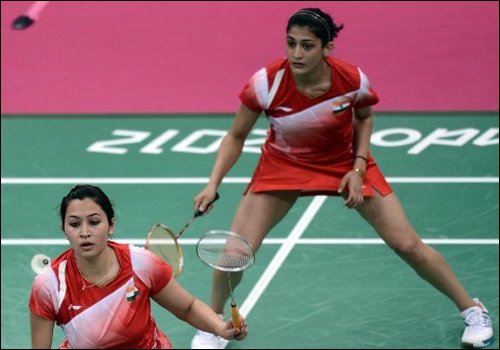
Badminton ace Ashwini Ponnappa, who will be among five shuttlers carrying India’s medal hopes at the London Olympics, is excited to be playing her first Olympics.

“I am very excited that for the first time I am going to the Olympics. Every sportsperson dreams of representing his or her nation at the Olympics. I am really happy that I have been given the opportunity to represent the country,” the 24-year-old athlete said.

Practising every morning and evening under the watchful eyes of coach Syed Mohammed Arif at the Lal Bahadur Shastri Indoor Stadium and under Edwin Iriawan at the Gopichand Academy at Gachibowli, Ashwini will be pairing with her senior, Jwala Gutta, in the women’s doubles.

The girl from Bangalore, settled here for last few years, is looking forward to giving her best, focussing on staying calm and relaxed.

“Both Jwala and I are working very hard. We are giving our best on court, making sure that we get everything right for the Olympics,” said the charming athlete.

The pair, which won the bronze medal at the World Championship last year and gold in the 2010 Commonwealth Games, currently ranks 19th in the world.

“Yeah. I am confident, but at the same time you can’t be overconfident. It really depends on how you go and play there. I know Jwala and I can get a medal. But in the end it entirely depends on how we go and play there. The important thing is that two of us are going early there and hope to start very well.”

The shuttlers will leave for London July 24. Ponnappa is satisfied with the time they would get to practise there before the mega event. “Too much time is also not good. We can train here and go.”

The courts in London are not new for Ashwini, who hopes to improve their performance over the last year’s World Championship.

“We had the World Championship in the same arena (Wembley) where we are going to have the Olympics badminton event. We got the bronze last time. I hope it will be a better medal this time. Firstly getting a medal but better than what we did last time in the World Championship.”

Asked whether there would be pressure of expectations, Ponappa said: “Pressure is bound to be there because everyone expects us to do well, but there is no time to think about that. All I am going to focus on is to just go there and play well.”

“There is no point in focussing on pressure. It will be better to focus on the game and how we are going to play.

“Irrespective of whom we have to play we are going to give our best. Hopefully we win each and every match,” she said while “hoping to have a good draw.”

On who would be the main opponents, Ashwini said one can’t underestimate anyone. “Everyone is going to work extra hard for the Olympics. Everyone is going to play really well. At the same time everyone is beatable.”

She admits the toughest challenge would come from the Chinese. “But even they are beatable. It depends on how we play and are mentally prepared,” Ashwini added.

source: http://www.timesofindia.indiatimes.com / TOI Home> Olympics 2012 / by IANS / July 09th, 2012

Terror attacks spoilt our mood: MP Ganesh

The 1972 Munich Olympics was a good experience but also a sad one because of the terrorist attack on Israeli athletes. We were to play against Pakistan in the semifinals and there was a break of one day. But a lot happened in that one day. That incident spoilt our mood and it should never happen again because Olympics is an event that unites people and to win a medal is something great.

But apart from that tragic incident, I was a bit disappointed because India could not do well in the semifinals against Pakistan. We got 18 penalty corners but could not convert any. We lost that match.

Apart from the sad incidents, the Munich Olympics was also a great opportunity for us to meet some of the best athletes in the world. We met the American swimming great Mark Spitz, who got seven medals. BP Govinda and I are good friends and we used to sit together for breakfast and that gave us an opportunity to run into several top players.

The facilities at the Munich Games were also top class and it was supposed to be the best Olympics conducted till then. For instance, there was a very good information centre and any kind of data about any player could be accessed there. Taking part in the Olympics is something that is truly wonderful for any sportsperson.

—Former hockey forward MP Ganesh played in the 1972 Munich Olympics. He spoke to Vivek Phadnis

source: http://www.dnaindia.com / Daily News & Analysis / Home> Sport> Report / by Vivek Phadnis / Agency: DNA / Tuesday, July 03rd, 2012

Kodava kings

Nikkin Thimmaiah, Ponanna, Kariappa and Nachappa

They are known for their valour and their hockey skills. Taking a step ahead in their commitment to the national sport of the country, seven Kodavas from the city have got together to form the Coorg’s Orange Club. This month the club is hosting its first 5-A-Side, Rink Hockey Tournament. Known for sending hockey champs to the national team, the Kodava community is on par with the Punjabis in training skilled players.

With this short format game, similar to the 20-20 cricket format, the organisers are hoping to get more youngsters involved. For the first tournament, 40 Kodava families and 40 sanghas have registered their teams. In an attempt to recreate the nostalgia of earlier times, the club wants to take hockey to every school, college and IT-company of the state. “We want every school child to carry a hockey stick like it was earlier in our childhood days. Hockey needs to get back its due credit,” says Kambeyanda Mohan, one of the organisers.

To kick-start a movement of sorts, the Orange Club thought it was ideal to begin with a new-format tournament. “We have come up with the 5-A-Side format, where only five players from each team can compete on field. The duration of each match will be 10 minutes and can stretch maximum up to 12.5 minutes and will be played on a smaller turf,” says Machetira Jenith Aiyappa, one of the organisers. While the preparations are in full-swing, national champions have been roped in to act as mentors for the juniors.

“We have set an example to many youngsters. But now it is our turn to motivate them and train them,” says Kariappa AD, junior nationals’ player. Though their enthusiasm and will power knows no bounds, a few think this format is also a challenge to show their skills. “The turf is smaller for this format and is totally different from other championships. We need a lot of stamina and endurance to show our skills,” says Nikkin Thimmaiah, another junior nationals player.

Men, women, kids and senior citizens have been encouraged to participate. Particularly girls are being encouraged to take up the sport. “Hockey has been a community sport for the Kodavas. But our idea is to make it a sport of all communities across the state. So for the first time, we have brought together six hockey legends to help us with the mentoring of participants and players who will join the club,” adds Jenith. Dr Mollera P Ganesh, BP Govinda, Paikera E Kalaiah, Maneyepanda M Sommaiah, Lt Col Baleyada K Subramani, Anjaparvanda B Subbaiah are the six senior-most players who will be mentoring the players.

source: http://www.DeccanChronicle.com / Home> Tabloid> Bengaluru / by Ayesha Tabassum / DC / July 04th, 2012

India beat France 4-0 to Win Test Series 2-0 as Pradhan Sommanna and Nithin Thimmiah Debut

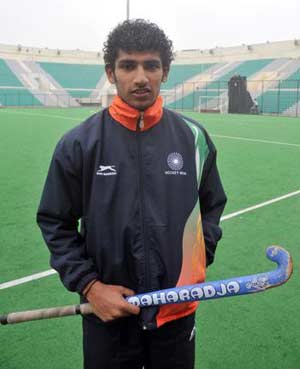
Debutants Pradhan Sommanna and Nithin Thimmaiah

Olympic bound Indian team started their last outing before the Games on high note, when they outclassed the French team to win 2 match test series with 2-0. India won the first match on green surface 8-2, while defeated France in 2nd Match 4-0 on blue surface (similar to Riverbank Arena, London Olympics Venue for Hockey) in Lille, France.

Indian outfit continued their Hero FIH Road to London (Men), Delhi 2012′s form where India defeated France 6-2 and 8-1 in League Stage and Finals respectively.

In the first test match of the series, it was France who drew first blood through Fabien Magner, but India did not take much time to equalize through young SK Uthappa. Sandeep Singh earned the lead for India and Gurvinder Singh Chandi doubled it to 3-1. Arnaud Becuwe reduced the margin for margin on penalty corner in the dying minutes of first half.

After the lemon break, Shivendra Singh scored two goals in quick succession and Raghunath converted PC in 5th minute of 2nd half to make it 6-2. Sarvanjit Singh and Sandeep Singh’s field goals completed the tally (8-2) of match which saw the international debuts of Nithin Thimmaiah and Pradhan Sommanna.

In the Second match of the series, Indian team kept their sheet clean, but could score only 4 goals through Sardara Singh, Sandeep Singh, VR Raghunath and Danish Mujtaba. India scored 3 off 4 goals on Penalty Corners while one field goal.In this test series 8 Indians registered their names on scoreboard.

On July 2, Indian team will leave for Spain to play two test matches each against Spain and South Africa from 5-11 July at Santander, before taking part in a 3 Nations Invitational Hockey Tournament at the same venue, where India will face off Great Britain and hosts Spain (Detailed Schedule of the europe tour can be found here).

Result Game 2 Saturday, June 30 in Le Touquet
India – France: 4-0 (HT: 2-0)
Indian Scorers: Danish Mujtaba, Sardara Singh, Sandeep Singh, VR Raghunath

Result Game 1 Thursday, June 28 in Lille
India – France: 8-2 (HT: 3-2)
French Scorers: Fabien Magner, Arnaud Becuwe
Indian Scorers: SK Uthappa, Sandeep Singh (2), Gurvinder Singh Chandi, Shivendra Singh (2), VR Raghunath, Sarvanjit Singh

Photo Credits: Rohan Jawale

source: http://www.thefansofhockey.com / News / July 01st, 2012

Hockey: India beat France, 8-2


Lille (France):
Indian hockey team’s preparations for next month’s Olympic Games began on a confident note with a 8-2 route of France in the first of the two friendly matches here.
]
After France scored first, SK Uthappa equalised for India while Sandeep Singh’s penalty corner strike gave India 2-1 lead. Gurvinder Singh Chandi made it 3-1 but France reduced the margin through a penalty corner variation just before the interval.
India added five more goals without reply in the second half. Two minutes after resumption, Shivendra Singh scored a field goal — a deflection off a VR Raghunath attempt — and backed it up with a second strike off a Gurbaj Singh pass within a minute.

Raghunath scored a penalty corner goal in the 40th minute to put India 6-2 ahead.Later, Sarvanjit Singh scored a field goal before Sandeep Singh, playing as centre forward, added a field goal to complete the rout.

source: http://www.daily.bhaskar.com / Home> Sports> Other Sports> News / PTI / Sunday, June 01st, 2012