Satara, Jul 6 (PTI) Three nature conservationists from Satara in Maharashtra claimed to have “rediscovered” a “nearly extinct” damselfly species ‘Lestes patricia’ after almost 100 years.
A colony of this sub-species, christened ‘Lestes patricia taamrpatti’, was discovered by Dr Shriram Bhakare, Sunil Bhoite and Pratima Pawar-Bhoite from Umrodi Dam area, situated at the foothills of the northern Western Ghats in the district.
According to the researchers, a single male specimen of Lestes patricia, endemic to the Western Ghats, was first discovered in 1922 from Kodagu (Coorg) district in Karnataka and the only specimen currently available is at Natural History Museum, London.
“The discovered colony of new species closely match the specimen of the single known male of Lestes patricia fromthe London-based museum. However, there are stable differences between the newly found species and description of Lestes patricia,” said Bhoite.
“While comparing the body structure and features of the newly found species with an existing specimen of Lestes patricia from the London-based museum, stable differences were found. That is why the sub-species from the damselfly family has been named Lestes patricia taamrpatti,” he added.
Dr Bhakare, an ophthalmologist from Satara, said the reason behind adding the word ‘taamrpatti’ was because thepecies has a coppery red-brown uniform band bordered by black.
“The likelihood the newly discovered population is, in fact, a distinct species cannot be ruled out, but cannot be confirmed until further, fresh specimens of Lestes Patricia are made available from the locality in Kodagu.
“Since the stable features observed in the newly discovered population preclude it from being indisputably placed under Lestes patricia, yet given the lack of comparative material, it is not possible to place it as a new species with certainty,” he added.
So the newly discovered population from Maharashtra is tentatively placed as a subspecies of Lestes patricia, Bhakare informed.
He said a research paper on discovery of the nearly extinct species was published in Bionotes Journal recently.
The researchers said 10 specimens, comprising six males and four females, have been collected for examination. Of the 10, two male and two female specimens have been deposited with Bombay Natural History Society (BNHS), while the rest will be kept at other depositories in the country for further research.
PTI COR SPKBNM BNM
source: http://www.theweek.in / The Week / Home> Wire Updates> National / by PTI / July 06th, 2020
SV Sunil’s decision to call time came a day after drag-flicker Rupinder Pal Singh and defender Birendra Lakra announced their international retirements.
SV Sunil said it was time for him to make way for younger players and help to build a winning team for the future. Courtesy: The Hockey India
Veteran India men’s hockey team striker SV Sunil on Friday announced his international retirement, bringing the curtains down on a 14-year-long career during which he was a part of the 2014 Asian Games gold-winning side.
Sunil’s decision to call time came a day after drag-flicker Rupinder Pal Singh and defender Birendra Lakra, who played starring roles in the Indian hockey team’s historic bronze medal-winning Tokyo Olympics campaign, announced their international retirements on Friday.
The 32-year-old Sunil, hailing from Karnataka, was not a part of the team that competed in the Tokyo Olympics. Sunil, said it was time for him to make way for younger players and help to build a winning team for the future. The senior player appeared in 264 India matches, striking 72 goals.
“… time to take a break. More than 14 years after I wore India colours for the first time, I have decided to make myself unavailable for the national camp which begins next week,” Sunil, who gew up playing hockey with a bamboo stick due to his family’s limited resources, said in a statement on his Twitter handle.
“It was not the easiest decision to make, but it was not the toughest either, given that I did not make it to the team for the Tokyo Games. The omission put a question mark on my future as a player, in the 11-a-side format.
“With the 2024 Paris Olympics three years away, I think, as a senior player it is important that I make way for youngsters and help in building a winning team for the future,” he added.
The Arjuna awardee from Somwarpet in Coorg made his international debut in 2007 at the Asia Cup which India won after beating Pakistan in the Final.
There was no looking back for the speedy striker after that and he was a part of India’s incredible rise in global hockey.
The two-time Olympian (2012 and 2016) remained a key player in the Indian forward-line for over a decade with fine performances.
He was in the Indian team that won gold in the 2011 Asian Champions Trophy and silver in the same event in 2012.
He also won gold and bronze medals in the 2014 and 2018 Asian Games respectively besides a gold in the Asia Cup 2017.
He played an instrumental role in the team’s historic silver medal wins at the 2016 and 2018 FIH Champions Trophy.
In his long career, Sunil also led the forward-line in 2015 World League Final where the team won a bronze Medal and he was also part of the team that won bronze in the same event in 2017 in Bhubaneswar.
He also has a silver medal from the Commonwealth Games 2014 to his credit.
Congratulating Sunil for his contribution to Indian hockey, Hockey India President Gyanendro Ningombam said, “SV Sunil has been an inspiration to an entire generation of young hockey players.
“His commitment to the game and discipline was unmatched and he has given Indian hockey some very memorable performances.”
Sunil said he will continue to be available to play the shorter form of the game (5-a-side hockey).
He said the gold in the 2014 Asian Games was the turning point of his career.
“I am grateful that I represented my country at two Olympic Games — in London in 2012 and in Rio in 2012.
“I have seen a lot on and off the pitch in the past 14 years. I have battled personal tragedies, career-threatening injuries and other setbacks to remain focussed on giving my best for the country.”
source: http://www.outlookindia.com / Outlook / Home> Sports / by Outlook Web Desk / October 01st, 2021
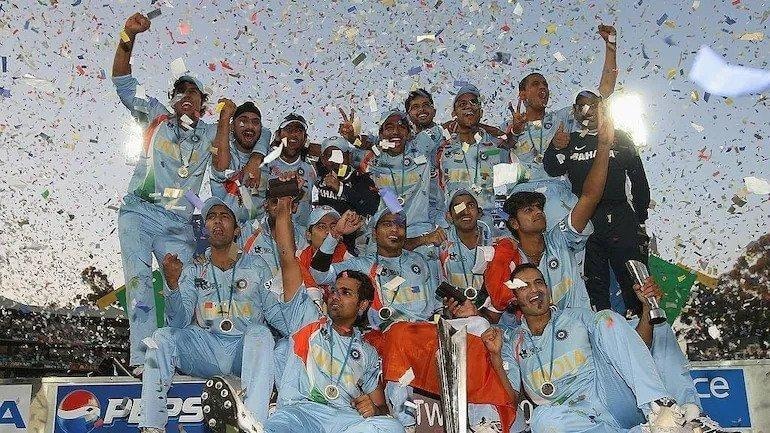
Robin Uthappa has said that the memories from India’s 2007 T20 World Cup win are still fresh in his memory. Uthappa also hopes that Rohit Sharma and the current Indian team will be able to win the T20 World Cup this year.
Uthappa was an integral part of the Indian team that won the T20 World Cup in 2007 (Courtesy: Reuters)
HIGHLIGHTS
Robin Uthappa was an integral member of the 2007 T20 World Cup squad
Uthappa opened up on the memories from the triumph
The former cricketer hopes the current Indian team can win this year’s World Cup
Former cricketer and member of India’s first T20 World Cup triumph, Robin Uthappa, has said that the memories from the outing in 2007 are still fresh in his memory.
India won the inaugural edition of the T20 World Cup exactly 15 years ago on this day and Uthappa was an integral part of the team. He scored a fifty in India’s opener against Pakistan and was also one of the bowlers who had success during the famous bowl out as well.
As quoted by NDTV, the former cricketer said that the memories from the World Cup triumph are still fresh in his memory and also wished the current Indian team all the best ahead of this year’s edition.
“I cannot believe that it has been 15 years since we won the T20 World Cup. For me, it feels as if it was just a few years ago. The fond memories from our first-ever T20 World Cup win are still fresh in my memory. I can still remember bowling in the bowl-out and tipping my hat in celebration as we won!”
“I would like to wish the Men in Blue all the very best as they go Down Under to try and repeat history and get us back the ICC Men’s T20 World Cup with ‘Mission Melbourne’. It’s a special experience to win the World Cup and I wish Rohit and the boys play their hearts out to repeat the feat we achieved 15 years ago!”
Uthappa also said that he still gets goosebumps thinking about the final against Pakistan and said he is hoping that Rohit Sharma and his men can repeat the feat.
“I still get goosebumps when I think about the finals and how we won it in the last over. We played our very best in that World Cup and to be rewarded in the end with the trophy was just one of the most special feelings in my life.”
“I can still picture the team and the crowd celebrating for India as Sreesanth caught Misbah in that final over. I hope that the Indian team is fully prepared for ‘Mission Melbourne’ and aiming to bring the trophy once again to India. I wish them all the very best!” said Uthappa.
source: http://www.indiatoday.in / India Today / Home> News> Sports> Cricket / by India Todat Web Desk / New Delhi – September 26th, 2022
Meghalaya’s Shillong and Karnataka’s Coorg are similar, says Ratan Bhattacharjee
Coorg
One of the most popular poems by Wordsworth is ‘The Solitary Reaper’ about a highland girl reaping the harvest in a pasture in Scotland with a song on her lips. This is a familiar sight for a visitor to Shillong or Coorg.
Shillong is the 330th most populous city in India with 143,229 people according to the 2011 census. It is said that the rolling hills around the town reminded the British of Scotland. So did Coorg down south in Karnataka. They found the mist-laden pastures of Shillong and Coorg to be the closest to the paradise they knew back home and began referring to these two hill stations as the Scotland of the East.
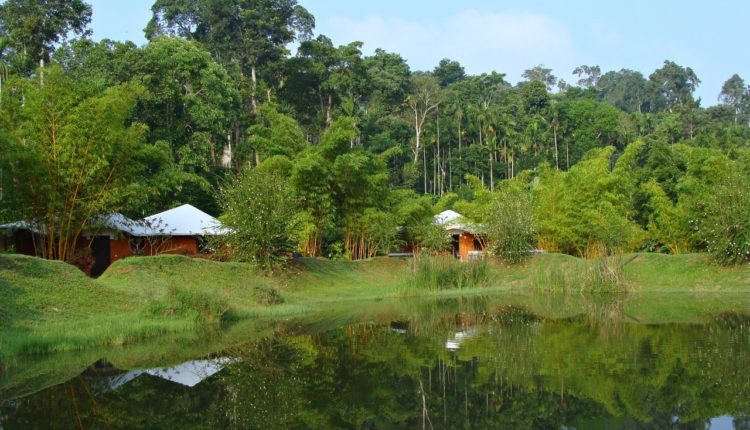
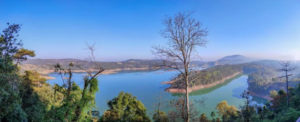
There are indeed many similarities between Shillong, Meghalaya’s capital, and Scotland. Shillong’s landscape is beautified with rolling, cloud-kissed hills bestowed with lush greenery. It is often difficult to tell Scotland from Shillong from photographs without any captions. One has to take a backseat in a car on the roads to Cherrapunji, Mawlynnong and the curvaceous Shillong Bypass and let the hair flutter in the breeze and draw in the hypnotic sub-Himalayan panorama. The glittering waterfalls along the roads and the lakes in and around Shillong – boating on Umiam or Ward’s Lake is otherworldly – have a stunning resemblance to those in Scotland. Then there are several places untouched by mass tourism where you can pitch a tent and connect with nature. Shillong and Scotland also have culture connect – the Scottish are as colourful as the Khasis and are proud of their heritage.
Located along the Western Ghats, Coorg is a coffee-producing hilly area well-known for its jaw-dropping scenery and opulence. This misty landscape nurtures a rich culture and a unique clan – the Kodavas who are specialised in martial arts and are widely known for their hospitality. Heavenly Coorg is ideal for lazing around or going on a challenging trek or indulging in an adventure at Abbey Falls or relishing the spicy curries and the heart-melting handmade truffles.
Shillong
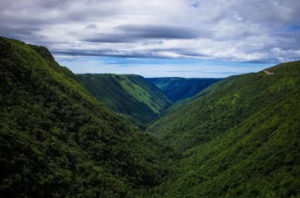
Coorg is also called Scotland of India because of its hills – Karkala, Savandurga and Nodda – lording over the coffee plantations. They are lush green mountains of foggy rolling hills with miles of walking trails. The climate is as cool as in Shillong, albeit a shade warmer than in Scotland. Madikeri or Mercara, the headquarters of Coorg is a beautiful hill town. The Chiklihole Reservoir is a wonderful place far from the madding crowd. The Dubare Elephant Camp will please wildlife enthusiasts as much as the Harangi Dam or Honnamana Kere Lake. Kotebetta is the third highest peak in Coorg. Mallalli Falls is one of the best places reminding at every moment of the beauty of the Scottish Highlands or Elephanta and Seven Sisters Falls in Meghalaya.
Coorg is the coffee cup of India and there is no doubt that the people there have Celtic roots, as their traditions and rituals reflect. They celebrate many festivals such as Makar Sankranti, Ugadi and Easter. The locals celebrate Christmas by lighting candles in their homes. The traditional dress of the Coorgis is similar to the Scottish kilt. Their attires have interesting patterns and designs. The cuisine of Coorg, like Shillong’s, has something in common with Scottish dishes made from pork and beef.
Coorg is also home to some magnificent forts and palaces that date back to the medieval era. These structures are a testament to its rich history and culture. One of the most popular forts in Coorg is the Madikeri Fort. Mudduraja, the prominent Haleri king built this fort in the 17th century. It is made from granite and features several turrets and bastions. The British army rebuilt this imposing structure in the late 1800s, and it now serves as a hotel and museum. Other notable colonial bungalows include the Raj Bhavan (Governor’s House) and the Deva Raya Paana (Toddy Tapper’s House). The British built them between the 18th and 19th centuries.
Like Shillong, Coorg is known for its “perfect weather” in spite of the incessant rains. The temperature is mild and comfortable, and the weather is usually sunny with a few scattered showers. This makes Coorg a popular tourist destination like Shillong, especially during the summer months. Coorg and Shillong are also connected to Scotland through the celebration of music in its many forms. All are great hosts of music festivals.
That’s astounding nature, as many would say. Just like Shillong and Coorg that find so many points of commonality, other places in India find resemblances with foreign destinations too. Some of them to find appropriate mentions would be Andaman and Nicobar Islands and Phi Phi Islands, Thailand, Gulmarg, Jammu and Kashmir and Switzerland, Gurudongmar Lake, Sikkim and Jökulsárlón Lake, Iceland, Thar Desert, Rajasthan and Sahara Desert, Africa and Chitrakote Falls, Chhattisgarh and Niagara Falls. There are many more, as travel enthusiasts would enlist them. However, it resounds that scenic beauty in India is infinite beginning with Shillong, itself.
Just like the Scottish hold immense pride in their culture, land and its people, similarly, the Khasis of Shillong, and the Kodava’s of Coorg hold their culture and indigenous identities in high regard, worshipping their ancestors and preserving their folklores.
Julia London once said about Scotland: “There are few places in my life that I’ve found more ruggedly beautiful than the highlands of Scotland. The place is magical – it’s so far north, so remote that sometimes it feels like you’ve left this world and gone to another.” This holds true for Shillong and Coorg too.
(Ratan Bhattacharjee is a contributor at The Shillong Times)
source: http://www.theshillongtimes.com / The Shillong Times / Home> Sunday Pullout / by Ratan Bhattacharjee / September 25th, 2022
The average coffee production in Brazil is 60 million bags a year, whereas in India, it is below six million bags.
Farm gate price of raw berries touch a record ₹106 a kg against ₹80 last year
Lending fresh hopes to coffee farmers, the price of the Robusta variety of coffee has reached an all-time high, thanks to a sharp decline in production.
The farm gate price of raw Robusta coffee berries touched a record ₹106 a kg in Wayanad market on Friday, as against ₹80 a kg during the corresponding period last year.
The State government had announced that it would procure coffee from farmers at a minimum support price (MSP) of ₹90 a kg when the market price of raw coffee was ₹61 a kg two years ago.
A sharp decline in coffee production in Brazil, a major coffee-producing country, owing to severe frost was the major reason for the rise in price, trading sources said.
The average coffee production in Brazil is 60 million bags (a bag of 60 kg) a year. But the production declined to 50 million bags this season. A drought-like situation in the coffee-growing regions of that country during the post-harvest period also contributed to price hike, sources said.
The average coffee production in India is below six million bags a year. A huge disparity in production and supply was the major reason for the price hike. Moreover, the depreciation of Indian rupee to US dollar was also reflected in the rise in price, sources added.
“However, the current upswing in price will not benefit coffee farmers in the country as most of them have already sold the produce at a low price,” Prasanth Rajesh, president, Wayanad Coffee Growers’ Association (WCGA), told The Hindu.
“The fortune of Indian coffee farmers depends on the misfortune of farmers in Brazil,” Mr. Rajesh said, adding that such a situation should change as it would not offer a sustainable income to farmers.
A quick intervention by the Coffee Board to increase internal consumption of coffee is the need of the hour, he said .
Though the State government had announced an MSP of ₹90 a kg, most farmers are yet to benefit from it as the government has fixed a ceiling limit of one acre for procurement, he said.
All farmers, irrespective of land holding, should get the MSP since input cost, especially that of fertilisers, had gone up by more than 200%, he added. The Coffee Board has projected a crop size of 3.42 lakh tonnes in the country during 2021-22 in its final estimates.
source: http://www.thehindu.com / The Hindu / Home> News> India> Kerala / by E.M. Manoj / Kalpeta – September 24th, 2022
The fest will likely be organized using nearly Rs 1.50 crore funds and the family has sent a proposal to the state requesting sanctioning of Rs One crore funds.
For representational purposes (Photo | PTI)
The iconic Kodava Hockey Namme will take place next year following a break of four years. The same was confirmed in a press conference by the Appachettolanda Family on Tuesday.
“After 2018, the hockey fest did not see the light of the day due to natural disasters and pandemic situations. However, the 23rd annual fest will be hosted in 2023 in a grandeur manner. The fest will be held at Napoklu General Thimayya Ground. Over 350 Kodava families are likely to take part in the tournament,” confirmed Appachettolanda Manu Muthappa, the president of the hockey fest.
The hockey tournament will begin on February 20 and will go on till March 6. The website and the logo will be released on 2nd October at Napoklu Kodava Samaj. The fest will likely be organized using nearly Rs 1.50 crore funds and the family has sent a proposal to the state requesting sanctioning of Rs One crore funds. The press conference was headed by the Appachettolanda family patted Mittu Erappa and other family members.
‘Kodava Hockey Namme’ has been organized in the district for 22 years. However, the event was cancelled in 2018 due to floods and a pandemic situation. The 2023 event will be the 23rd year of the hockey fest. The hockey tournament played among the Kodava community has gained international fame as the tournament has broken the ‘Limca Book of Records’ and ‘Guinness World Record’ for the highest number of team participation.
The 2018 Kulletria Cup Hockey saw participation from 333 Kodava families. It was in 1997 that the first Kodava family hockey tournament was played and was organized by the Pandanda family. The game started off with international rules and standards and it continues to provide a stage for youngsters and seniors alike to unravel their passion for hockey.
source: http://www.newindianexpress.com / The New Indian Express / Home> States> Karnataka / by Express News Service / September 06th, 2022
Largest ever Family reunion in Virajpet on Dec. 24, 2022
Kodava Clan is hoping to establish a World Record by organising the largest ever Family reunion in Virajpet on Dec. 24, 2022 with more than 10,000 Kodavas inter-related to each other meeting at one location. This will be the first-of-its-kind attempt across the world to beat the existing world record of 4,514 people/family members meeting in France documented in the Guinness Book of World Records.
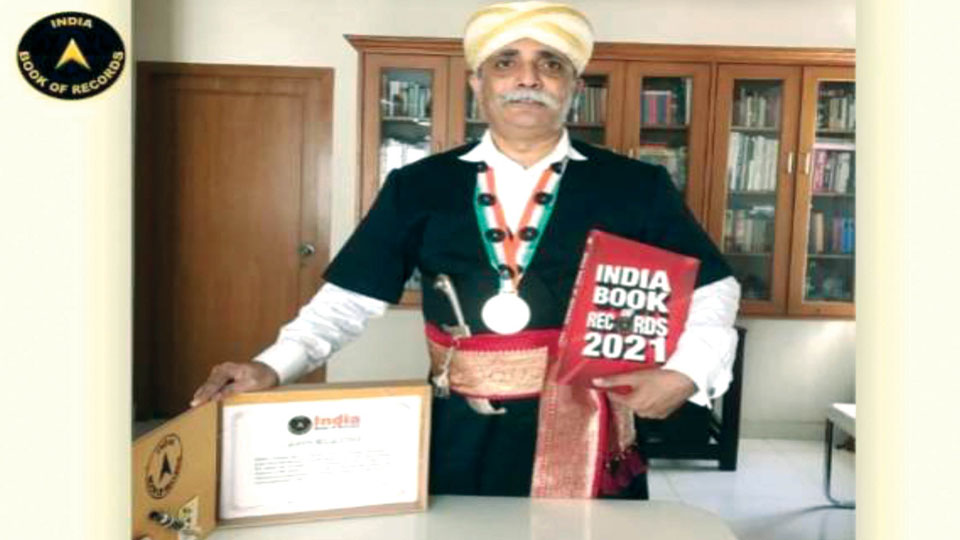
Kodava Clan, the company organising this event, is the first ever, one-of-its-kind interactive, crowd sourced virtual museum that has created the largest online family tree of the Kodava community or going back at least 15-16 generations in some cases and recognised by the Indian Book of Records.
Founded by Gummattira Kishoo Uthappa, the portal is the first online museum cataloguing data, statistics, history, culture and festivals, heritage, language of the Kodavas dating back from the 16th Century.
The Kodavas are a small but illustrious community that has contributed to the Indian Armed Forces, Government, Judiciary, Sports, Medical profession and many more across India and the world. The justification for this can be seen on the portal www.kodavaclan.com.
Kodava Clan is also a social networking site for the Kodava community to find or establish their familial association with other Kodavas, irrespective of the generation he/she maybe a part of, from any part of the world. Founder Kishoo states, “This is possible only due to the extensive research undertaken by our dedicated team in the last 5 years which includes collecting and verifying data from almost 750 Okkas we connected with.
Kodavas are proud of their culture and that is clearly exhibited in the information shared in the heritage section of the portal. The heritage section is a virtual museum with 10 categories, with over 2,500 articles in all, with achievers across sectors, Ainmanes or traditional family homes, cuisines, eminent people from the community, entrepreneurs, festival and customs, flora and fauna, history, Kodava Thakk (Kodava dialect), sports, statistics and tourism.
The Section is a ready reckoner for those requiring information on its history, unique traditional customs and rituals. Recognising the huge value in cataloguing its rich and unique heritage, scores of families have given contributions of articles, information and rare photographs to this site.
Kodava Clan has exciting and dynamic future plans for this virtual portal to make it more interactive and dynamic portal to keep any one engaged on the portal for any of his interest as it has covered the subjects of every walk of life.
As its community grows, Kodava Clan has also included an advertising feature to promote business houses and make it self-sustainable for the portal in the days to come.
source: http://www.starofmysore.com / Star of Mysore / Home> Feature Articles / August 26th, 2022
In today’s Finshots we talk about the main issues coffee farmers face in this country
The Story
Coffee!
Each day, over 1 billion people gulp down 2.5 billion cups of this steaming hot beverage. What was called the Devil’s Drink in the 1600s has now become a staple concoction across the world. And there’s one country that produces and exports most of this coffee — Brazil. In fact, it produces a staggering 40% of the world’s coffee and they are the undisputed leader.
But all’s not well with Brazil. The world’s biggest producer has been going through a bit of a rough patch. It has been hit by freakish weather — cold snaps and frost, combined with a lack of rain. Which in turn has led to a fairly lacklustre crop this year.
Now India is seeing a silver lining here. It thinks this could be an opportunity to export more of its own stuff. After all, the Coffee Board expects India to deliver a higher coffee output this year. And maybe Brazil’s loss could be India’s gain?
Well, not so fast. India really hasn’t been doing well on the export front of late. In fact, from FY12 to FY21, coffee exports have fallenby 3% annually. And that’s because Indian coffee farmers are dealing with their own problems.
For starters, there’s climate change.
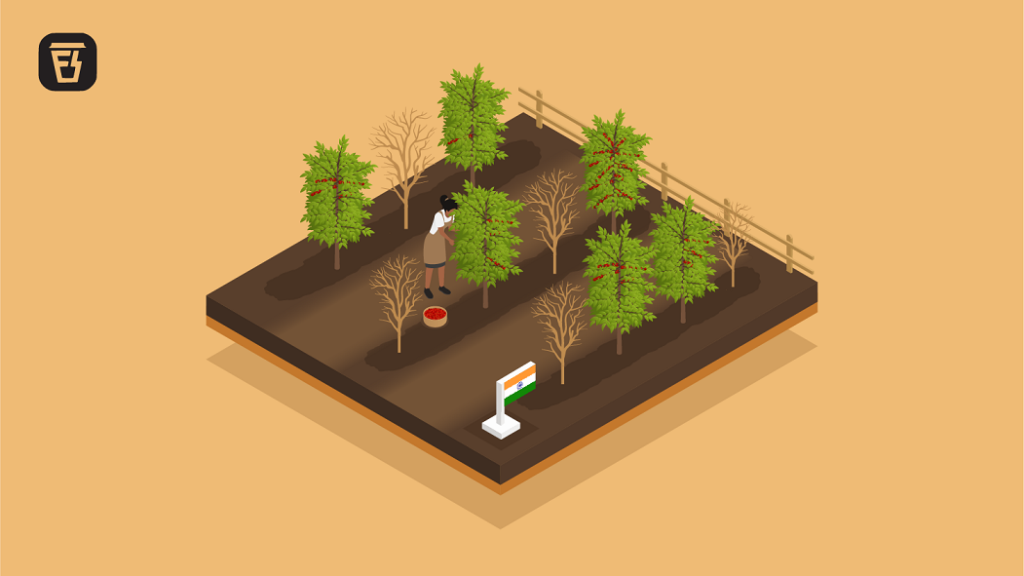
You see, nearly 80% of India’s coffee production comes from the two southern states of Karnataka and Kerala. But the past few years have been a damp squib. The rains have been erratic. Some years, the monsoon came early and other times it came with vengeance. When the rains came early, the coffee fruit ripened too soon and the output was no good. When it poured heavily, flooding and landslides wiped out the crops. Farmers simply couldn’t catch a break. And with crops destroyed, yields have dropped from 500 kg to 250 kg per acre for the arabica variant of coffee bean.
Then there’s the bit about prices.
In 2019, coffee prices in real terms (i.e after adjusting for inflation) were a whopping 45% below their 2011 level. In some sense, if you were a coffee farmer, you’d have to cut costs and raise output to maintain the same standard of living. In fact, in most cases, there were no improvements. Farmers lost money hand over fist. This was further exacerbated by the excess supply of coffee beans coming in from Brazil and Vietnam. Prices took a real beating.
But the costs weren’t following the same trends. It was becoming increasingly expensive to plant and harvest coffee. For instance, according to the Karnataka Planters Association, the cost per acre of producing the arabica coffee bean variant has soared from ₹50,000 to ₹85,000 per acre. This is just in the past 3 years. Fertilizer prices have shot up. Labour costs have also ballooned. And consequently, the coffee-growing business just isn’t that financially viable anymore. Many small farmers have sold their plantations. Or even begun cultivating other crops instead.
And finally, there’s the policy-related matter.
Even though coffee is a very important crop for India, it doesn’t come under the purview of the Ministry of Agriculture. That’s right! It’s actually a part of the Ministry of Commerce. And that classification creates its own issues. For instance, coffee growers may not get the same subsidies and benefits that are extended to India’s farmers. And that’s not us saying that. Even a senior liaison officer of the Coffee Board, Yercaud and Kolli Hills, said, “Currently, we do not provide any subsidy to farmers.” And unlike many other crops, there isn’t a minimum support price (MSP) scheme pan India that can help alleviate the stress.
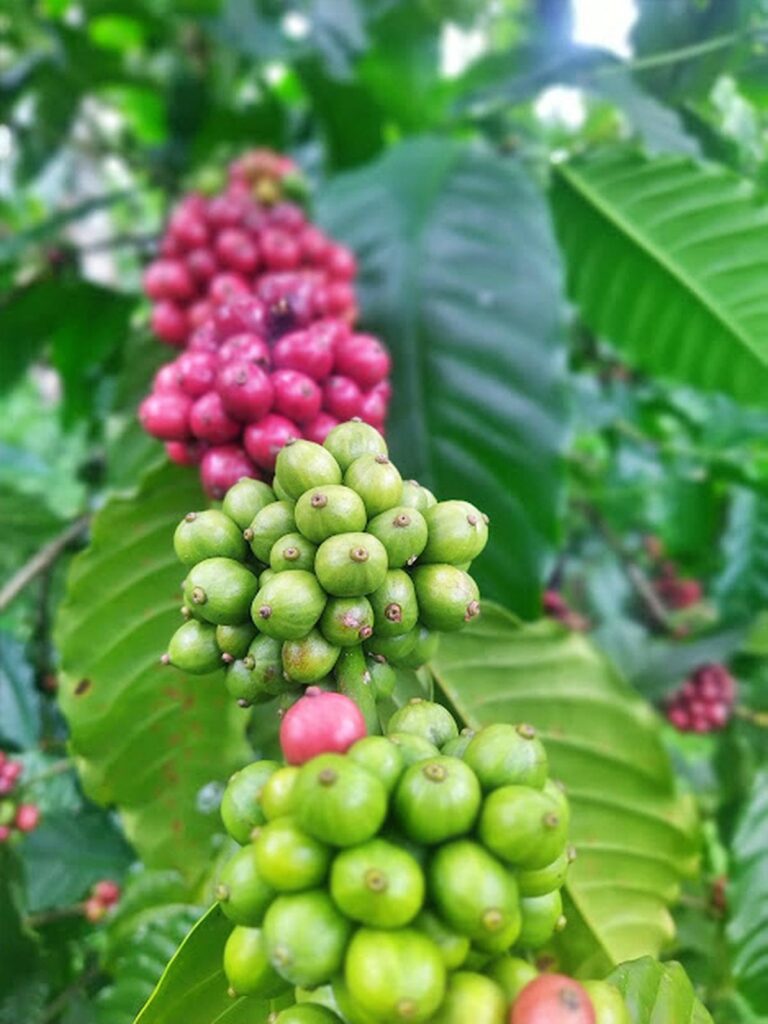
Now even if we were to ignore all these problems, India still wouldn’t be able to ramp up coffee production quickly. Simply because growing coffee is not an overnight affair. It takes 3–5 years for coffee trees to mature and yield bright red coffee cherries.
And what’s the government doing about all this?
Well, they are attempting to amend the decades-old Coffee Act of 1942 and replace it with the Coffee (Promotion and Development Bill) of 2022. While it’s too soon to spell out the specifics of the new Act, hopefully, it’ll have measures that’ll bring some respite to India’s struggling coffee farmers.
But wait…there still exists a long-term issue that no one’s paying attention to.
See, coffee is quite a sensitive crop. It needs the perfect temperature to bring out the best aroma and taste in the beans. Even if things get a little hotter, that can have an adverse impact on the quality of the beans. And temperatures in the coffee-growing regions of southern India are expected to rise by around 2 degrees Celsius by the mid-2030s. How are we going to combat this? No one knows yet.
So yeah, it doesn’t seem like India’s coffee farmers are going to be able to sit back on their porch with a cup of joe and relish the tough times in Brazil.
Heavy and unseasonal rains since July have led to most of the coffee dropping off the plants, which planters estimate has led to a 30-35% decline in production in the state.
Since 2018, problems for Karnataka coffee growers have only compounded, making it harder to survive on a product whose prices have seen violent fluctuations as it is connected to global markets while internally few factors have changed to help their cause.
Heavy and unseasonal rains since July have led to most of the coffee dropping off the plants, which planters estimate has led to a 30-35% decline in production in the state.
Ground reality
Coffee growers have multiple challenges such as increasing labour costs due to dire shortage, crop damage, landslides, human-animal conflict, unseasonal rainfall, price fluctuations and the recent proposal on eco-sensitive zones in the western ghats among others.
“The rains have been very heavy and prolonged downpour this time and especially high in the Western Ghats region has led to wet-foot conditions and dropping of coffee. The coffee, which is supposed to be harvested by December, is largely damaged and we estimate a 30% loss in crop,” said Bose Mandanna, a coffee planter and former member of the coffee board.
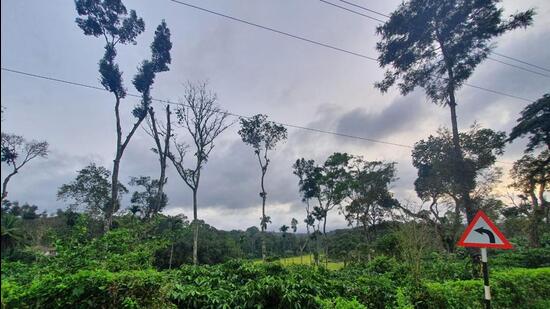
Hassan, Chikmagalur and Kodagu are the biggest growing coffee regions in the country, accounting for 241,650 tonne production out of total 342,000 tonne produced in India.
With at least 70-80% of the total produce exported globally, coffee was among the biggest foreign exchange earning sectors. However, the importance of this sector has declined over the years, especially the booming information technology and related industries which overshadow plantation revenues now.
“Coffee is a commodity where prices are determined at a global level. But having a strong domestic market is an insulation whenever there is a price variation. So, we don’t want to increase domestic consumption because our coffee is regarded as very high quality and has good demand in the international market. But if there is a bumper production in Brazil and Vietnam, the prices will collapse. At that time, the farmers should not feel that they have suffered a huge loss. That time having a strong domestic market is very important and the coffee board is balancing both,” said KG Jagadeesha, CEO & secretary of the Coffee Board of India.
Nature’s fury
In 2018, 39 villages near Madikeri and Somwarpet experienced several landslides as the downpour wreaked havoc in several parts of Karnataka, especially Kodagu, that resulted in permanent plantation land loss to over 8,000 people, according to Nanda Belliappa, a coffee planter in Huttihole Post, Madapur village near Madikeri.
Several planters have since gone to court seeking relief for permanent land loss due to landslides which they claim was “not an act of god but certainly was a manmade disaster”.
“The incessant heavy rainfall and the huge amount of water released from the reservoirs causing fluctuations resulted in hydrostatic pressure due to which landslides occurred at various places, more particularly in the 39 villages. The river water had entered the plantation zones that were quite far away from the river bed,” according to a petition filed in (Karnataka High court) in 2020.
Located near Harangi Dam, this belt saw the most amount of devastation, in which over 100 people in the state lost their lives.
Belliappa lost nine acres permanently and received ₹35,000 per acre compensation, which was capped at a maximum of 2 ha (1 ha=2.47 acres) or around ₹1.75 lakh as per the National Disaster Relief Fund (NDRF) norms.
“Around 8,000 planters have been displaced. Totally if you see around 900 ha are lost. We are demanding that we be given the same compensation when the government acquires land for roads or other developmental works. On that basis, if we have lost land, the government has to compensate on that level which is normally three or four times the guidance value,” Belliappa said.
Jagadeesha said: “NDRF norms are the same for all farmers as it does not differentiate between coffee or arecanut or anyone else. The compensation is paid at ₹36,000 per hectare for crop loss. For land loss it is a bit more. But the compensation which is paid to a paddy or agricultural farmer or ragi or jowar or coffee is the same. The demand by coffee growers is that plantation crops are different. Even in the (coffee) act, a small coffee grower is classified as 10 hectares whereas it is only 2 hectares. So, they are asking if compensation can be done up to 10 ha.”
He said post the 2018 landslides, a committee under the Karnataka chief secretary did send recommendations to the union government at least three times but are yet to hear back from the Centre.
“The committee unanimously recommended that the compensation be increased from ₹36,000 to ₹72,000 and the 2ha limit be increased to 10 ha. That recommendation has gone, but we have not heard anything. We have written three to four times from the coffee board. We are in favour of giving more compensation to coffee growers because the investment is more,” he said.
Proposed new coffee act
The union government has proposed to replace the 80-year-old Coffee Act with the Coffee (Promotion and Development Bill) 2022 that is expected to come up in the next session of Parliament. “These are very old laws and the idea is only to simplify them, make it easier to do business, ensure that the small people in the different areas like coffee growing, tea growing do not have to suffer from high levels of compliance burden,” Piyush Goyal, the minister for commerce and industry, had said, PTI reported in July.
Among the changes proposed in the new act is the shifting of coffee from the commerce and industries department to agriculture, which, it believes, would give the planters all the benefits from significantly large agricultural schemes.
But, how does this impact coffee growers?
Planters, who spoke to HT, said there was definitely more money and funds in the agriculture department, but fear that coffee would not be treated as a priority when compared to other crops such as paddy, wheat and others. They also said coffee requires officials with expertise in the subject.
“The situation today is that even after cultivating coffee under shade for about 170 years, we are still not globally recognised as shade-grown coffee. These are the things that the coffee board needs to do. The moment the shade is more, our yield productivity will come down to the tune of one-third of what Brazilians do. They have open field cultivation. Coffee boards need to promote, they should certify and see to it that sustainable activity which is practised in the coffee industry gets recognised globally,” said Vishwanath KK, an executive member of the Codagu Planters Association.
Vishwanath said the Indian council of agricultural research must do the research and the commerce ministry should focus on trading, promotion and other commercial activities. “The coffee board served its purpose. The last 20 years there is a clear disconnect between the farmers and the board and the research. Now, there has to be an opportunity for the commodity to take it to the next level,” he said.
Jagadeesha said the proposed coffee act is scheduled to come up in the next session of Parliament, but added that the proposal to change from commerce and industry department to agriculture will make no difference on the ground.
“One of the reasons is since the agricultural department has a bigger budget, the farmers may benefit from this. That too is only an expectation,” he said. However, he said this proposal has not moved on paper and since coffee was export heavy, it will remain with the commerce and industries ministry.
source: http://www.hindustantimes.com / Hindustan Times / Home> Cities> Bengaluru News / by Sharan Poovanna, Bengaluru / August 22nd, 2022
It is no secret that India is a cricket-crazy nation and it won’t be an exaggeration to say that life comes to a standstill when the Men in Blue are out on the field.
Ankita with her coach Shihan Keerti.
Madikeri :
It is no secret that India is a cricket-crazy nation and it won’t be an exaggeration to say that life comes to a standstill when the Men in Blue are out on the field. But there are other sportspersons, too, who are trying to carve out a niche for themselves. India’s success in the recent Commonwealth Games at Birmingham when the Indian Tricolour was hoisted scores of times in less-popular sports is a testimony to this.
Opting for such sport is Ankita BT from Madikeri, who is kicking high with karate. Already a junior black belt holder, this 21-year-old has bigger dreams, not just for her, but for the entire nation. Her tryst with karate began as a nine-year-old. “Karate always seemed challenging and I started training,” she recalls. She says there were not many takers for karate among girls and felt the need to break the stereotype.
Ankita, who has been training at Phoenix Academy India in Bengaluru, made her debut at the national championship when she was in Class 8 and craved to achieve more. Since then, she has participated in the All-Indian Independence Cup in 2015, Bangalore Open Karate Championship in 2016, All-India Independence Cup in Goa in in 2016, All-Independence Cup, All-Indian Sports Extravaganza VIE in 2017, Intercollegiate Karate Championship in 2017, KAI Nationals, Indian Seiko Kai Karate Championship and more. She has won several gold and silver medals in many of these competitions.
“Karate is recognised by the International Olympic Committee, but not by the Indian Olympic Association. Though the Karate India Organisation supports athletes to take part in the World Championships and other Asian Championships that help us attain the World Karate Federation ranking, it does not fund the players. Expenses are covered only for the Olympics and Asian Games and we have to spend our own money to take part in other international events,” she adds. A South zone and a state medallist, she is also the vice-chairperson of Women’s Sports Commission of Akhila Karnataka Sports Karate Association.
She is now in Thailand participating in the Open Karate-Do Championship that started from August 19. “I have been training regularly and my ambition is to take part in more challenging championships. I also look forward to participating in the Karate 1 Series A at Kocaeli in Turkey and Karate 1 Series A Jakarta Indonesia Championships in September,” she says.
But sourcing funds has been the biggest challenge and seeks support from the state and sponsors to achieve her goal of representing India and Karnataka at these championships. She says she wants to educate girls on the need for self-defence and motivate more women to join the sport.
source: http://www.newindianexpress.com / The New Indian Express / Home> Good News / by Prajna GR, Express News Service / August 21st, 2022
WELCOME. If you like what you see "SUBSCRIBE via EMAIL" to receive FREE regular UPDATES.
Read More »