Category Archives: World Opinion

NPSI Student’s Space Hotel Concept Bags First Place In NASA Contest

Mysuru:

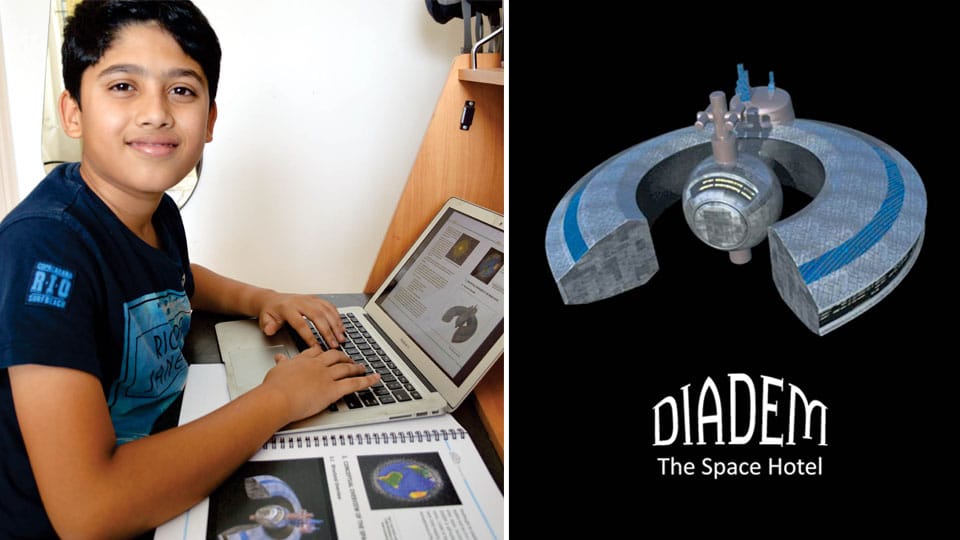
Mukkatira Neerav Aiyappa, a Class 7 student of National Public School International (NPSI), Mysuru, who participated in the Annual Space Settlement Contest, has bagged the first place in Grade 7 Category for his proposal of a Space Hotel ‘DIADEM.’

He presented a design of the Space Hotel in the orbital space settlement LEO (Lower Earth Orbit) at the contest jointly organised by National Aeronautics and Space Administration (NASA) Ames Research Centre, San Jose State University and the National Space Society (NSS).

This international competition invited all students around the world up to 12th Grade to participate in its 2018 edition.

Neerav will receive a NASA certificate and has been invited to attend the NSS 37th Annual International Space Development Conference to be held at Sheraton Gateway Hotel in Los Angeles, California, USA, from May 24 to May 27, 2018 for a poster and oral presentation of his winning proposal. His project and ideas will be used by NASA for its future space programmes.

Speaking to Star of Mysore, Neerav, who has been working on the project since 11 months, said that among various forms of tourism like eco-tourism, nautical tourism, wellness tourism and medical tourism, a new concept has emerged in the form of space tourism, kindling interest to explore various destinations. Rather than seeing comets, planets, and constellations on a telescope, space tourism provides a privilege of experiencing first-hand the beauty of comets, asteroids, stars and planets, he added.

Space tourism will not only provide new vacation experience but create a new view to the earth, transforming the thoughts and perception among humans socially, culturally and emotionally, inspire new careers for the generation of engineers and will open newer fields for research in space medicine, nanotechnology, physical sciences and others, he said.

Through his project, Neerav has created a ‘Space Hotel’ providing space tourists a unique experience of a lifetime and enrich space and its potentials. “My project aims to create a ‘wow’ factor in the field of travel, provides job opportunities, ability to renew space exploration and research, explores possibility of hypersonic travel and have a newer perspective of earth,” he said.

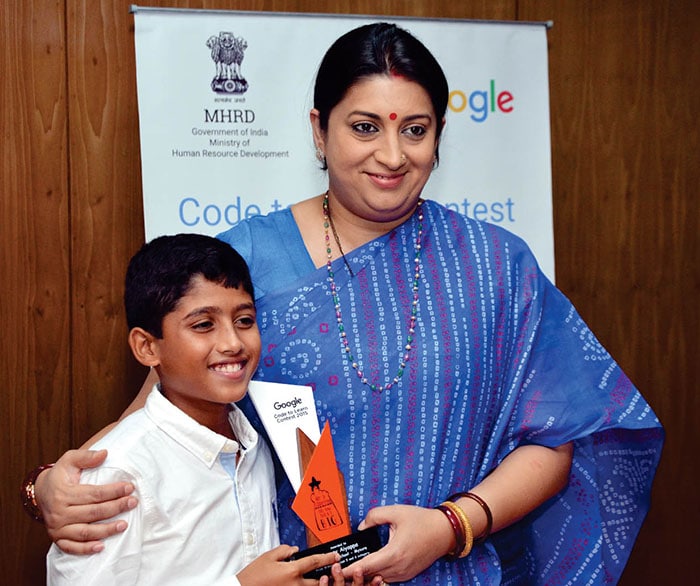
A file photo of the then Union Human Resource Development (HRD) Minister Smriti Irani felicitating Mysuru boy Neerav Aiyappa for winning Google India Code to Learn 2015 Contest.

In his project, Neerav has detailed out the concept of the space hotel, life support system, logistics of the space hotel, economy and time-line, space laws and code of ethics.

Neerav had won the Google India Code to Learn 2015 Contest where he created a game software project using “Scratch” programming called “Wings Over Waves.” The then Union HRD Minister Smriti Irani felicitated him under Rashtriya Avishkar Abhiyaan.

He was a finalist at RYSI Award (Raman Award) held on Mar. 5, 2018 at Panchavati (Sir C.V. Raman’s residence) in Bengaluru where he demonstrated the principle fluid and thermodynamics in intermediate category  with a working model.

Neerav is the son of Mukkatira Muthanna and Kavery, residents of Yadavagiri and grandson of Mukkatira Gappu – Janaki of Ponnampet and Guddanda Nanda – Kanthy of Virajpet.

source: http://www.starofmysore.com / Star of Mysore / Home> News / March 27th, 2018

Harangi Elephant Camp Takes Shape

To be ninth in Karnataka; third in Kodagu

Madikeri:

Works are in full swing to set up the third Elephant Camp in Kodagu at Harangi. The State Government has released Rs. 50 lakh for the project that is expected to ease the burden of the existing elephant camps.

Already, Kodagu has two elephant camps, one at Dubare and another at Mathigodu near Anechowkur Gate that borders Mysuru. There are eight elephant camps in Karnataka including the two in Kodagu and the Harangi Camp will be the ninth in the State.

The eight jumbo camps house more than 100 tamed elephants that are used to rescue wild animals and for logging purposes at Government timber depots. The new elephant camp is expected to reduce the burden on the nearby Dubare Elephant Camp, which currently has over 31 elephants, the highest in the State.

90 percent works complete

Over 90 percent of the works have been completed at the Harangi Elephant Camp and interestingly, the Camp houses a Tree Park, also in the same vicinity. From 2017 till 2021-22 Rs.1.38 crore has been released by the Government and works are on to create the Tree Park.

The Forest Department is establishing the elephant camp in a 40-acre land at Athur Reserve Forest beside Harangi Reservoir in Kushalnagar Taluk. The place, located near the Harangi Dam backwaters, is ideal to set up the elephant camp. The camp per se is eight to 20 acres. The Athur Range Forest extends up to 2,000 acres and it is an ideal elephant habitat with plenty of water and green swathes.

Four houses have been constructed for the mahouts and their families to stay, a vast kitchen has been constructed to prepare food for the elephants and store rooms has also been constructed. Basic facilities including toilets have been constructed for tourists who come there.

Abundant water source

Borewells have been sunk to provide a steady stream of water and as the land comes near the Harangi Dam backwaters, there is no shortage of groundwater. Electricity works are on now at the camp and enough care is being taken to ensure that the forest area is not damaged while erecting the power poles and when the power lines are drawn.

The funds for the camp have been released from Compensatory Afforestation Fund Management and Planning Authority (CAMPA). Apart from setting up a new elephant camp, there are plans to initiate other related development programmes including developing the camp as a tourist centre and at the same time provide shelter to the elephants.

Other tourism projects

The Government has also plans to closely develop Cauvery Nisargadhama in Kushalnagar and together with the new elephant camp in the region, the initiatives are set to boost eco-tourism activities.

Kushalnagar Range Forest Officer J. Ananya Kumar told Star of Mysore that once the Harangi Elephant Camp works are completed, five elephants will be shifted from Dubare Elephant Camp to immediately ease the burden. Later, 15 more jumbos will be shifted in phases. Appointment of staff and doctors will be decided by the State Government.

Among the State Government plans to improve tourism in Harangi are water sports on behalf of Jungle Lodges and Resorts, Jet Ski and para-sailing. The Kodagu District Administration is weighing various options for tourism promotion once the Harangi Elephant Camp is fully established.

source: http://www.starofmysore.com / Star of Mysore / Home> News / March 21st, 2022

A tribe nestled in the hills of Kodagu

A Kapala place of worship, Kodagu

Yavakapadi, a village in Kodagu houses the second palace of the Rajas who ruled the region between 1633 to 1834. It is called Naalnaad Aramane and is located among the hills in the forest. It is a two-storey structure built in the style of the traditional houses of Karnataka and Kerala. Beside this is the Aramane Government school, where the students seem to be distracted by tourists who come to the palace regularly .

Altogether, 13 students from the neighbouring tribal settlements study in the primary grades. And, nearby is a settlement called the Kaplakeri, the only one with members of the Kapala tribe.

Scholars claim that the tribe is a mixed race, the members are descendants of the Siddis.  It is said that when the Arab and Portuguese sailors brought Bantu speaking Africans from Ethiopia to India, they were employed in the courts of Indian kings. Some of them resided in Uttara Kannada, Belagavi and Dharwad districts. The Rajas of Kodagu had relatives ruling kingdoms such as Nagara, Sode, and Kittur in parts of these regions. If the Kapala really has Siddi ancestors, then the Rajas must have brought their ancestors to the palace.

There are many theories about the origin of the word Kapala. According to the researchers, the word meant a protector, as they guarded the king in former times. Yet, another theory says that the word Kapala comes from the word kafir used by the Arabs for non-Muslim African natives at one time.  

The Kapala community speaks the Kodava language, dresses like Kodavas and believes in the same religious practices. Every April they propitiate their gods in the theray ceremonies, the spirit worship of Kodagu. 

According to researchers, Ashok Patel and Sumitra, the tribe has 159 members and 33 families. The Raja had settled them behind the palace and gave them a piece of land. But now the land is not enough for them to make a living. Hence, the Kapalas earn by working in the neighbouring farmlands. They belong to three different kudi (clans): Aranat Kapala, Bollaat Kapala, and the Paalekat  Kapala. The different clans differ in the religious activities they take part in. They form blocks, or administrative divisions, along with the Adia, the Paale and the Kudiya tribes of the village.

Aranat Kapala is one among the different families remembered during festivities at the Padi Igguthappa Temple of Kakkabe. They claim to be from Arangutur village in North Malabar. Members of this family are ‘ceremonially possessed’ by the spirit of Kunhi Boltu.

During Shivaratri and other festivals the children of the Aranat Kapala dress up in disguises as part of the festivities. Thammi, a Paalekoot Kapala, and a member of the local gram panchayat, says, ‘‘the Kapalas are politically significant at the village level but insignificant at higher levels because of their small number.’’ 

The children study until the fifth standard at the Aramane School, where they are taught Kannada and English. Then they go to Kakkabe Government school which is three kilometres away. 

source: http://www.deccanherald.com / Deccan Herald / Home> Spectrum> Spectrum Statescan / by Mookonda Kushalappa / August 04th, 2018

Bryn Mawr Rehab program offering help to patients with long COVID symptoms

Philadelphia (WPVI) :

Federal officials say up to 23 million Americans may have developed long COVID health problems that last long after an initial infection.

Although research on long COVID is still in the early stages, there are already plenty of programs offering help.

Even simple things are big accomplishments for 71-year-old Rick Cannon, 18-months after he first got COVID-19.

“I remember being in the ER and then falling asleep. And that’s the last I remember till I woke up in middle November,” he said.

But it took another five months – until April 2021 – before Rick went home.

He was 121 pounds, couldn’t taste or smell, had stroke-like weakness on his left side, neuropathy and drop foot in both feet.

Dr. Mithra Maneyapanda of Bryn Mawr Rehab Hospital says every patient in the Post-COVID program is different – some with one symptom, some with many.

“Brain fog, trouble with memory, word-finding difficulties. They can also have physical symptoms, whether it’s difficulty with weakness, fatigue – some patients are still displaying shortness of breath and chest pains,” he said.

Others have mood issues. Because the causes are still unknown, the treatment focuses on each symptom.

“They might see physical therapy, occupational therapy, speech language pathologists, psychologists…,” said Dr. Maneyapanda.

Rick’s drop foot was surgically fixed, so his recovery is finally gaining speed.

“I can walk six or seven minutes without getting exhausted,” he said. “I can go up the steps, down the steps. I can get in the shower.”

Physical therapists say hard work by patients here and at home is paying off.

“I just had somebody the other day that said, ‘ have felt like myself for the past four days’,” said Julie Biely, P.T.

Each patient like Rick is also helping expand Bryn Mawr Rehab’s knowledge, and that will help future patients.

“Once the science catches up, we’ll have more targeted treatments to offer,” said Dr. Maneyapanda.

source: http://www.6abc.com / abc- Action News / by Tamala Edwards / March 17th, 2022

Bird-watching begins in Madikeri on April 8

After being deferred in January, the eighth edition of the Karnataka Bird Festival will be held in Madikeri from April 8-10, 2022.

Image used for representational purpose only. (Photo | Express)

Bengaluru :

After being deferred in January, the eighth edition of the Karnataka Bird Festival will be held in Madikeri from April 8-10, 2022.

The festival, organised by the Karnataka forest department and Karnataka Eco-Tourism Development Board, aims to draw attention of people to bird watching, spark interest among young wildlife enthusiasts, show people the bio-diversity of forests, and shift their focus from tiger-centric wildlife safari and tourism. 

“Every year a different location, region, bio-diversity, and a different bird is focused upon to increase awareness and ensure better conservation measures.

This year, the mascot is Baza bird,” a forest department official said. Baza is a migratory bird from the eastern Himalayas, China and South East Asia. Forest officials of the region have reportedly sighted a couple of the birds now, in the onset of summer. 

Kumar Pushkar, additional Principal Conservator of Forests and CEO of the Board told TNIE that the festival was postponed because of spike in Covid-19 cases. “We always wanted to host one is Kodagu because of its bio-diversity and the many species which can be sighted there. Baza was chosen because it is sighted in winters in this region.

There will be around six to seven different trails, which the deputy conservator of forest is finalising. The event will also cover Madikeri city, and will be inaugurated by forests minister Umesh V Katti,” he said. Experts from across the country will be brought to share their experience, knowledge. 

source: http://www.newindianexpress.com / The New Indian Express / Home> States> Karnataka / by Bosky Khanna, Express News Service / March 14th, 2022


Uncertainty looms over future of Ukraine returnees

Students are hoping for rehabilitation in India or admission in similar universities in European countries like Poland as a special case for Indian students

Uncertainty looms large over the fate of students who safely returned to India from Ukraine as some of them feel that continuing medical education in the war-ravaged country would be tougher, challenging and unreliable and parents may refuse to send them back in the present circumstances.

In Mysuru, Kodagu and Chamarajnagar, several students have returned safely and a few more are on their way. What has been bothering the returnees is “what next”.

Though discussions are ongoing in various circles on whether to permit the affected students to continue their education in Indian colleges, a clear picture on their future may emerge once all safely return to the country with the Centre’s ‘Operation Ganga’ in the final stages of evacuation in Ukraine.

“I’m worried about my future. I don’t know whether my parents will send me back to Ukraine if the situation returns to normal though it appears to be highly uncertain with Russian militia advancing. I am keeping my fingers crossed. I have put in three years and I was about to be promoted to fourth year. I am hopeful something will emerge as India will work out a solution in students’ interests,” said Likith, who returned from Kharkiv.

Like Likith, his friends and classmates in Kodagu and Mysuru are hoping that the medical colleges or universities in Europe may also consider admitting the affected students from Ukraine since the education system is almost similar in many European countries. In solidarity with Ukraine, the European institutions, as a special case, may admit the students, after fulfilling the formalities. Poland, Hungary and Slovakia and other countries may consider admission, they hope.

“I and my friends and I have decided to wait and watch the developments. We cannot say what happens in the days ahead. We are hoping that our interests will be protected,” said Likith, a student of Kharkiv National Medical University, who spent a harrowing time with eight others in a bunker in Kharkiv after the Russian invasion.

Sharukh M.Y., who returned to his hometown in Virajpet taluk in Kodagu on Sunday, is hoping that the government of India will come up with a plan to address the returnees’ plight.

“I am hoping that my university in Ukraine will start online classes at the earliest. It has told us it will update us by March 15. With the war on, everything appears uncertain. I’m in the sixth semester. I would have been promoted to fourth year but the crisis forced us to vacate. I am open to all options,” said Shah Rukh, who is a student of V.N. Karazin Kharkiv National University in Kharkiv.

source: http://www.thehindu.com / The Hindu / Home> News> National >Karnataka / by Special Correspondent / Myusru – March 07th, 2022

The story of Coffee in India

The story of the coffee in India began in 1670, thanks to a Sufi named Bada Budan who was responsible for bringing it to the country.

Two hundred years after that, and with the intervention of British entrepreneurs, coffee was already becoming an important and commercial crop, planted in more than 40 estates, including the Nilgiris Biosphere. 

This evolution led to the creation of The Coffee Board, an organization in charge of facilitating research, marketing, and distribution of coffee plants to the indigenous communities of the district. For a farmer, a day starts with a dark roasted coffee concoction mixed with jaggery.

Robusta and Arabica are the two types of coffee cultivated by farmers in The Nilgiris district. The coffee plantations grow at an elevation of 3500ft above sea level.

They are shade-grown and are intercropped with various crops like Silver Oak, Mango, Jackfruit, Millets, and Spices. The indigenous communities use traditional agricultural practices to grow and harvest coffee.

Bio-Organic inputs such as Panchakaaviya and Poochiverati, a concoction made by themselves are used in coffee cultivation. The producers use leaf litter as manure. 

The harvest which is usually between November and March has seen a huge change recently due to varied rainfall, and it’s quite often hindered by Wild Boars and Elephants. Monkeys are also a huge problem for the villagers. The harvest is done usually by the family members who carefully strip the cherries which are then sorted and pulped manually.

Pulping in a few villages has been made easy by the coffee board by providing machines to help with the process.

There is also a provision at the Production Units of Aadhimalai where the community can use the pulping machine and the drying yard. The Coffee parchment is then dried on the rooftops and in the front yards of their houses and is roasted manually as need be.

The rest of the coffee is then sold to Aadhimalai which is an indigenous community-owned Producer Company.

The community farmers sell coffee in every possible form, be it Coffee Parchment, Cherries, Dried Cherries, or Green Beans. The average yield of Coffee in the community-owned farms would come to around 35 tons. A premium price is paid to the producers. 

The coffee has a certification PGS (Participatory Guarantee System).
The Keystone Foundation plays a big role in facilitating the PGS certification which is a peer review system. The coffee at Aadhimalai is then marketed through Last Forest Enterprises as Roasted Beans and Coffee Powder. However, most of the coffee is sold as parchment to other dealers.


These processes have enabled the farmer to get the best price in the market.

  • Aadhimalai Pazhangudiyinar Producer Company Ltd
  • Aadhimalai Pazhanagudiyinar Producer Company Limited (APPCL) has been initiated to anchor livelihoods of indigenous communities by encouraging traditional organic food farming, handicrafts, livestock rearing, sustainable harvest of forest produce, conservation of natural resources, thereby securing the well-being of the landscape, value addition of harvests and trading.
    It is a company completely owned by the indigenous communities, one of the first of its kind at a national level.
  • Last Forest Enterprises
  • Last Forest is a social enterprise that was incubated by Keystone in the year 2010. Through its operations, the company supports indigenous communities to sustain themselves by empowering their skill sets and bringing economic growth.
  • Keystone Foundation
  • Keystone Foundation works with the indigenous people and local communities as their primary stakeholders and extends to various aspects of socio-ecological development that are categorized under Community Wellbeing, Biodiversity Conservation, and People and Nature Collectives.

source: http://www.slowfood.com / Slow Food / Home / by Jestin Pauls / March 08th, 2022

On a green path

From an abandoned barren land to a green lush private sanctuary, author Pamela Malhotra recounts the transformation.

Bengaluru : 

Pamela Malhotra’s From the Heart of Nature (`599, Penguin Random House) documents the story behind the creation of a private forest sanctuary in India. More than just the struggle, Malhotra also recounts how she connected with animals and trees both at a physical and spiritual level. 

What was the turning point in your life? 

My husband Anil and I shared that love of wildlife and that dream. This realisation initially came while living in the USA in the late 1970s and early 1980s, which is why we established our first small wildlife sanctuary on the Big Island of Hawaii in 1979. When we came to India in January of 1986, we were quite upset by the deforestation we saw, especially in the Himalayas. We had gone to Haridwar and fell in love with the Himalayas. So, we purchased land in the Uttarkashi region to help reforest that area. 

How did you zero-in on Kodagu?

There were land ceiling laws in the state (then Uttar Pradesh – now Uttarakhand) that limited a family to owning just 12 acres of land. There was not enough land for establishing a forest wildlife sanctuary through reforestation. Also, we had visited Nagarhole National Park in Jan 1986, where the then-Wildlife Warden of the Park urged us to establish our forest wildlife sanctuary in his home district of Kodagu. As a result my husband Anil travelled throughout southern India to see what he could find, finally finding suitable land in Kodagu. Purchasing larger pieces of land was possible here if the land was deemed ‘plantation’ and the purchaser was an agriculturalist which my husband was.

What were the initial struggles that you faced?

Accessing the land. It was almost impossible to bring in any kind of building materials for our home in the beginning due to the poor roads. So, my husband put loads of rocks and other road material into these dirt roads to help give us drivable access which was also a big boon for the local people. Another major challenge was the legal maze encountered in the district since lands were divided into several different categories, often with different rules/laws applying to different categories in terms of purchase and ownership. Acceptance by the local people was also initially a challenge, although the older generation did understand the importance of maintaining forests and not killing off all the wildlife. The most distressing challenges have been illegal logging and poaching of wildlife. 

The sanctuary is spread across 300 acres, what are the kinds of species that are found there?

Hundreds of species have made the sanctuary their full-time home and/or come visit frequently. A short list of species found here includes 100s of species of butterflies and birds including Great Indian Hornbills and Malabar Grey Hornbills, Bengal tiger, Asian leopard, Asian elephant, sloth bear, dhole (Indian wild dog), Gaur (Indian bison), species of deer (sambar, cheetal, muntjac/barking deer) etc. So diverse are the species found here that one Oxford scientist dubbed our sanctuary ‘Noah’s Ark’.

You first purchased the land for the sanctuary in 1992, to create a private sanctuary. How did you decide on writing a book?

I hope to sow the seeds of love of nature in the hearts and minds of all who read the book, and to create a sacred perspective when viewing and dealing with nature.

source: http://www.newindianexpress.com / The New Indian Express / Home> Cities> Bengaluru / by Monica Monalisa, Express News Service / March 02nd, 2022

Three girl students from Kodagu return safely from war-torn Ukraine

Amidst the blitzkrieg from the Russian military, three students from Kodagu managed to leave the conflict zones in Ukraine and safely returned to India much to the relief of their family members who were pleading for their safe evacuation ever since Russian forces invaded Ukraine.

Alisha Sayyad Ali, Siniya V.J. and M.P. Nirmala, who managed to reach the borders in available modes of transport from their respective cities, returned on Wednesday in the evacuation flights operated by the Indian government.

The girls’ return was confirmed to The Hindu by the Kodagu district administration, whose officials were in touch with the stranded students since the war broke out. A few of the students from Kodagu and Mysuru are said to have reached Poland and are waiting for their evacuation. All of them are safe.

Siniya, who landed in Bengaluru airport on Wednesday evening, was welcomed by her family members.

Jose, her uncle, said Siniya had to walk about 20 km from her shelter in Kyiv along with other students to the railway station to reach Livv. She was evacuated from Budapest in Hungary to New Delhi.

“Minutes before Siniya was supposed to board a flight to Dubai on February 24 from Kyiv to join her sister for a vacation, Russian forces attacked Ukraine and the flights got cancelled. She had to rush back to her accommodation in available means of transport for her safety. Her 40-kg baggage was stuck in Kyiv airport and she flew to India with only a few pairs of clothes as all her belongings are at the airport,” Mr. Jose said.

Alisha, a student of Ivan Francisco Medical University, has also returned.

M.P. Nirmala, a student of Bogomoleth National Medical University in Kyiv, was stranded at a school after the invasion. Her mother Rajani was praying for her early return, pleading with the authorities for her evacuation. Ms Rajani said, “My daughter landed in Delhi this morning and is on her way to Bengaluru.”

Karthik, brother of Likith, who was stranded in Kharkiv with eight others, said his brother and some of his friends have reached Poland. “It was tough for them to reach the borders but they managed and are now away from the conflict zone Kharkiv which is under siege. They are waiting for their turn to board the next evacuation flights,” he said.

source: http://www.thehindu.com / The Hindu / Home> News> National> Karnataka / by Special Correspondent / Mysuru – March 02nd, 2022

Worried father of Kodagu girl appeals to govt

He hopes govt. will help her continue her medical education in India after return

Akshita Akkamma, a medical student from Kudlur village near Kushalnagar in Kodagu, is safe and about to cross the Ukrainian border to get evacuated from the war-hit country. However, her parents back home in Kodagu are still nervous until she reaches her home.

Her father I.P. Ramesh, an agriculturist, said, “I don’t want to send my daughter back to Ukraine after her return. We had a tough time worried about her safety after the war broke out. Hearing about shelling and explosions in Kharkiv, we had sleepless nights. We were slightly relieved after she rang up to tell us she had reached Livv and boarded a bus to reach the border to fly back to India.”

Akshita is a second-year student at Kharkiv National Medical University. “I don’t want my daughter to go back as her safety is important for us. Therefore, I urge the Government of India to make arrangements for her study in the country in whichever college it is possible as my daughter has put in two years of her study in Ukraine,” Mr. Ramesh suggested.

The coffee grower added, “In an exceptional case, a provision can be made for students wishing to stay in India, to continue medical education. I don’t think this is unachievable.”

Mr. Ramesh said “Fellow student Naveen’s tragic death shocked us and our apprehensions went up further since my daughter was also in Kharkiv which was witnessing heavy bombardment. Ukrainians are said to be getting first priority and then the girl students for boarding trains,” said the girl’s father.

source: http://www.thehindu.com / TheHindu / Home> News> National> Karnataka / by Special Correspondent / Mysuru – March 03rd, 2022