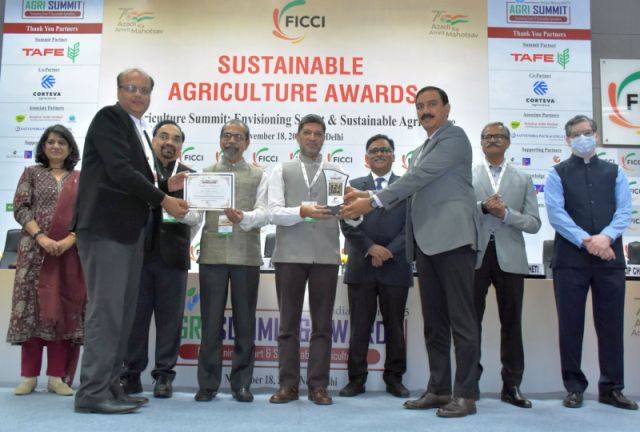
Kiran Ganapathy, Head of Plantations – Operations & Samir Palsule, Head – Business Excellence, Tata Coffee Limited receiving the FICCI award
Tata Coffee Limited (TCL) recently won the ‘Sustainable Agriculture Award’ at the Federation of Indian Chamber of Commerce and Industry (FICCI) Agriculture Summit and Awards 2021. The company was recognized for its Soil and Water Conservation initiatives undertaken at its plantations and instant coffee plants.
Kiran Ganapathy (Head of Plantations – Operations) and Samir Palsule (Head – Business Excellence) received the award on behalf of the company from members of the FICCI Agriculture Committee. The award was granted under the ‘Large Corporate’ category and TCL was conferred the award for significant on-ground interventions in sustainable agriculture development.
The entries were shortlisted and evaluated based on the agricultural challenges faced, the CSR initiatives to mitigate such challenges, the outcome and impact of the practices, its scalability and ways to extend the program to benefit small farmers.
The Agri summit brought key stakeholders and policymakers on a common platform to ideate an implementable strategy for smart and sustainable agriculture. It was attended by CEOs and business heads of the agri and food industry, policymakers, multilateral and bilateral institutions, NGOs, academicians, researchers, embassies, financial institutions, development organisations etc. who discussed and recommended practical pathways for the promotion and adoption of best sustainable agriculture practises on a large scale.
Chacko Thomas, Managing Director & CEO, Tata Coffee speaking on receiving the award said, “Tata Coffee is honoured to be recognized for its commitment to sustainable agricultural practices, and soil and water conservation are a key part of our sustainability strategy. We have adopted scientific ways to conserve water to store excess run-off from the rainwater, in healthy catchment areas. As a result, we now have 274 tanks with a storage capacity of 3.4 Mn cubic meters. This model has ensured that our irrigation is 95% self-reliant and no groundwater is ever exploited. Over the last few years, we have also successfully enhanced the soil fertility in the estates, through regular application of organic compost into the soil. Few other initiatives undertaken towards soil conservation include – contour planting, intercropping, planting of new trees and cover crops. We have also carried out several interventions in terms of training programmes and CSR awareness campaigns towards adopting improved technologies in all operations.”
source: http://www.thecsrjournal.in / The CSR Journal / Home> Categories> Agricultural & Rural Development / by The CSR Journal / December 09th, 2021
A lad from Virajpet taluk succeeded in gaining entry into India Book of Records by performing tough karate feats.
Madikeri:
A lad from Virajpet taluk succeeded in gaining entry into India Book of Records by performing tough karate feats.
K Rahul, 20, delivered 262 punches and kicks in 60 seconds to gain entry into the history book.
Rahul, a student of Uechiryo Karate school in Virajpet, strove many years to gain entry into the record book. The India Book of Records has issued an identity card, certificate and medal to Rahul.
Rahul was trained by karate expert H R Shivappa.
He also won hundreds of medals in district and State level competitions. Last month he won a gold medal in international online karate championship competition organised by World Union of Martial Arts Federation, World Karate Alliance in September 2021.
Rahul now aims to gain entry into Asia Book of Records.
He said karate is not merely a martial art for self defense, but offers a lot to sportspersons to achieve.
Kodagu, the smallest district in the State, has contributed hundreds of sports talents to the country. Many talented sportspersons have proved their mettle in international and national level sports competitions.
source: http://www.thehansindia.com / The Hans India / Home> News> State> Karnataka / by Hans News Service / December 06th, 2021
Shot in Kodagu, this short film that is winning several international awards, throws light on the fight against sexual abuse.
Bengaluru :
Three characters, 15 minutes and one message…that’s One Right Kick, a Kannada short film that has won 12 international awards in the category of Best Film on Women. Directed by Balachander Muthappa, the short film features Simhika PV, daughter of PV Shashikanth, former Karnataka Ranji cricket team head coach, as one of the lead roles, along with artistes Ramesh Patil and Mohan Kumar.
The film is based on the awakening of the power of self-defence within women who are victims of sexual abuse. Shot in Kodagu’s Somwarpet, the short film is based on the first spark of fear faced by any woman or girl across the globe. According to the director, the film narrates a story of a young innocent carefree girl who is subject to bad touch. Following an untoward incident which she is unable to express to her family or friends, there is a ‘simple survival technique’ that is choreographed to overcome fear and instill courage.
So far, One Right Kick has bagged awards at the Singapore International Short Film Festival, Indo-French International Film Festival, International Motion Picture Festival of India, Turkey Golden Wolf Film Festival, among others. According to director Muthappa, One Right Kick is the only Kannada film presented this year that will be screened at Pinewood Studio in the UK till December 13.
Simhika, who is a trained actor from Anupam Kher’s Actor Prepares, says, “Every parent is concerned when their girl child travels in public transport. When they experience any untoward incident, a girl cannot open up to society for help. This film breaks away from that and shows how a girl can muster the courage to fight back against such anti-social elements.”
She adds that essaying the role of a victim of sexual abuse was challenging. “Throughout the film, I had to express disappointment and fear and my expressions had to overpower dialogues,” says Simhika, who will be going to the US to pursue film studies at the New York Film Academy.
The film also carries very little scope for dialogues and deals with body movements and expressions. The “uneasy silence” throughout the film also symbolises how society still stays quiet on issues of sexual abuse, claims the director.
“We want this message to transcend borders. This film gives a different dimension on how to deal with sexual abuse in a public place using an unusual defence technique that target’s the criminal’s sensitive organ (sic),” says Muthappa, who also adds the film also deals with, fear, courage and survival. One Right Kick is expected to stream on an OTT platform for the first time in December.
source: http://www.newindianexpress.com / The New Indian Express / Home> Cities> Bengaluru / by Express News Service / November 28th, 2021
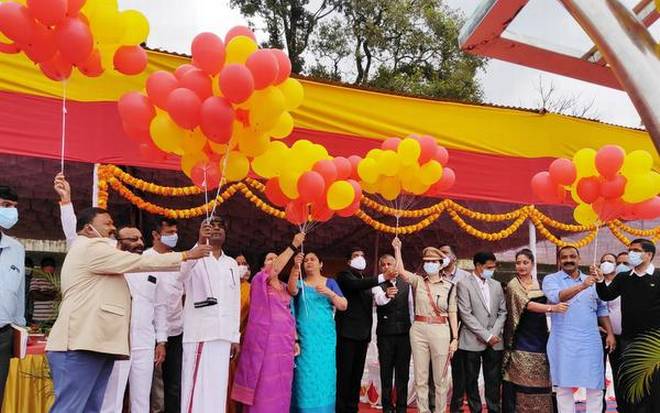
Minister in charge of Kodagu district Kota Srinivas Poojary and others at the Kannada Rajyothsava celebrations in Madikeri on Monday. | Photo Credit: Special Arrangement
Labs, libraries for 15 govt. schools: Minister
Minister in charge of Kodagu district Kota Srinivas Poojary on Monday said each household in the limits of 12 gram panchayats in Kodagu will be getting drinking water, 100 per cent segregation and collection of solid wastes, scientific handling of sewage generated daily besides the installation of solar projects and setting up of digital libraries in the respective villages.
All these works will be done as part of ‘Amrith’ Grama Panchayat programme which has been announced in the State identifying 750 GPs as part of platinum jubilee celebrations of Independence. The 12 GPs in Kodagu are Peraje, Kunchila-Kakkabbe, Maragodu, Kedamullur, Karmad, Nalkeri, Thithimathi, Koodumangaluru, Shirangala, Igooru, Haradooru and Dundalli, the Minister said in his speech during the Kannada Rajyotsava celebrations in Madikeri.
As part of the 75th independence daycelebrations, the State government has announced 13 special programmes and they include Amrith gram panchayat, Amrith rural housing scheme, Amrith farmer producer organisations, Amrith Nirmala Nagara, Amrith anganwadi centres, Amrith self-help micro enterprises, Amrith community development programme, Amrith health infrastructure upgrade programme, Amrith skill training programme, Amrith startup programme, and Amrith sports adoption programme.
As part of Amrith Rural Housing scheme which is being implemented in the district, housing will be provided to the homeless persons who will be identified in the 12 GPs in the coming days.
The Minister said farmers, fishermen and weavers will get financial support as the government has launched Amrith farmer producer organisations. Each organisation will get a sum of ₹30 lakh in a span of three years. Amrith Nirmala Nagar scheme has also been launched in the district where programmes will be taken up for maintaining hygiene in the limits of local bodies.
Amrith school scheme entails funding of ₹10 lakh to each identified school for developing buildings, labs, libraries, toilets and other facilities. The 15 schools identified in Kodagu are at Hodawada, Sampaje, Kadanga, Madapura, Kodlipet, Walnoor, Thagattur, Hebbale, Suntikoppa, Heggala, Pollibetta, B. Shettigeri, Thithimathi, Gonikoppa and Kutta.
In Kodagu, 25 anganwadi centres will be upgraded with each one of them getting a sum of ₹1 lakh under Amrith Anganawadi scheme.
The Minister said the government is committed to protecting Kannada and the culture of the land and expressed happiness that the use of Kannada language in digital mediums has been on the rise. Karnataka is rich in culture and tradition, he said, calling upon the youth to be part of the overall development of Karnataka.
He also called upon the people to adopt Kannada in their lives, showing interest in the language, literature, culture and art of the land, and become successors of the rich tradition of the land.
source: http://www.thehindu.com / The Hindu / Home> News> States> Karnataka / by Special Correpondent / Mysuru – November 01st, 2021
Government intervention sought to check cartels, say trade sources
With only a few weeks remaining for the coffee harvest to begin, a disparity in the prices of Robusta coffee in the international market and India has become a major cause for concern among growers in South India.
Though the price of coffee in India is usually based on international markets, especially the London market, a proportionate increase in the price of the produce overseas is yet to get reflected in the local market, according to trade sources.
While the price of Robusta coffee rose by about $70 a ton in the international market, the Indian market was yet to reflect the increase. According to Coffee Board data, the price of the produce (AB grade) in the international market was ₹165 a kg on October 29 but the growers here were getting only ₹140 a kg.
The trade sources contended that the likely reason for the disparity was ‘price cartelisation’ by some international buyers. Also, the number of buyers had been relatively low in India as the harvesting season here would begin only by the end of December, they added.
According to the board’s final estimates, the total coffee production in India during 2020-2021 stood at 3. 69 lakh tons, including 2.35 lakh tons of Robusta. Of this, a little more than 1.64 lakh tons were exported.
Recently, the Centre extended RoDTEP (Refund of Duties and Taxes on Exported Products) scheme to the coffee sector to boost exports. But the growers were not enthused, the sources added. Alleging that some international players were likely trying to enhance profits by not increasing the prices, the trade sources sought the Union Commerce Ministry’s intervention to stop such exploitation.
source: http://www.thehindu.com / The Hindu / Home> Business / by Staff Reporter / Kalpetta – October 30th, 2021
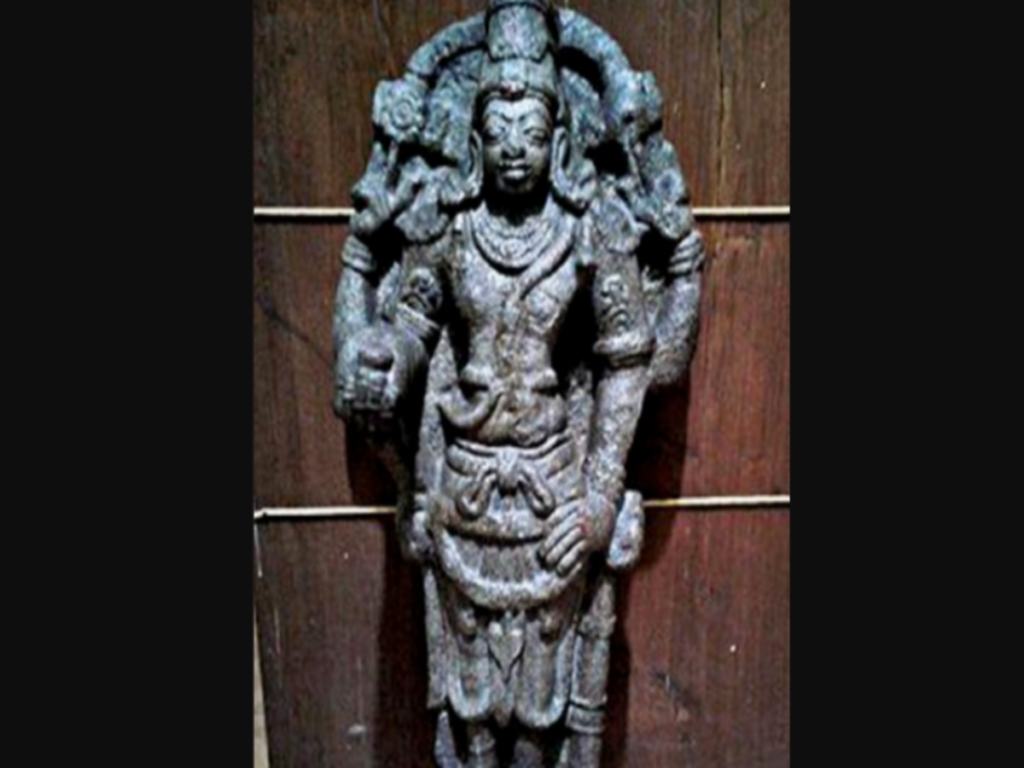
Idols of Lord Vishnu dating back to the 12th and 13th centuries are among the latest additions to the Kodagu District Museum on the premises of Madikeri Fort.
Museum curator Rekha said there are more than a thousand rare antiques at the museum.
Appealing to residents of Kodagu to hand over any rare historic idols they may stumble upon in their villages,, she said, “Many villagers have discarded many such ancient idols and artistic figures in rivers. When they find broken idols, they believe it brings bad luck and throw it away. Such monuments are valuable even if they are broken.
If they are confused, they can contact me for any guidance.”
The museum also houses the Kodava Odikathi, shaped in the form of the letter ‘V’, and the sickle, which is shown to the visitors.
“In 1975, Field Marshal Cariappa donated many valuable artefacts. We have kept them in a gallery. Many of these artefacts were made from plaster in Morocco. The museum also has many attractive items that date back to the days when Kodagu was ruled by various kings,” Rekha added.
source: http://www.timesofindia.indiatimes.com / The Times of India / Home> City News> Mysuru News / TNN / October 24th, 2021
When I read the poem ‘Elegy Written in a Country Churchyard’ by the English poet Thomas Gray (1751) many years ago, I found many quotable quotes in that rather long poem. But the one that remained in my memory and used it in some of my writings about our heroes and achievers who go unrecognised by the society is this particular quotation. I guess those are the four immortal sentences in that poem because, I know, in this world many achievers, geniuses and those who sacrificed their lives for the cause of humanity — gems of purest ray and flowers of great sweetness — are still remaining unknown and unrecognised. Let me quote those four lines:
Full many a gem of purest ray serene,
The dark unfathomed caves of ocean bear.
Full many a flower is born to blush unseen,
And waste its sweetness on the desert air.
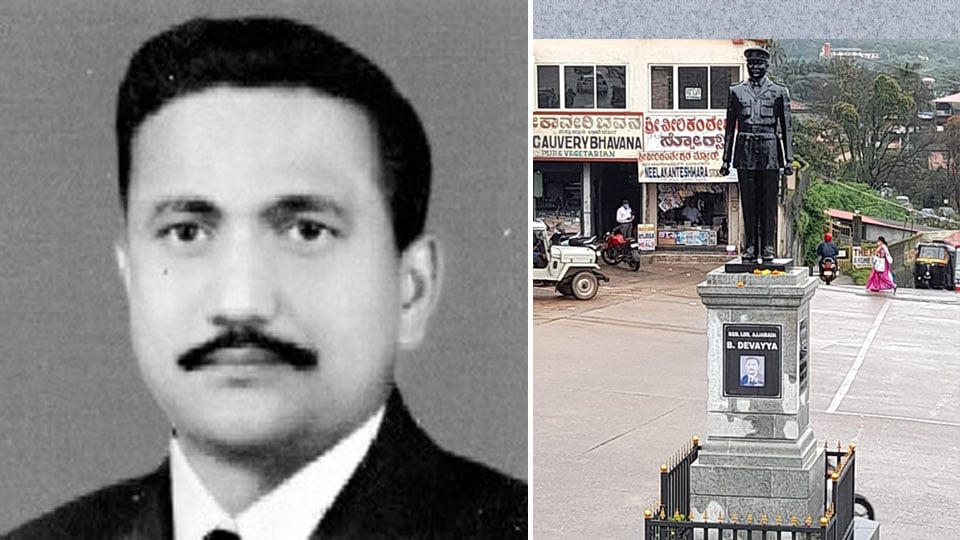
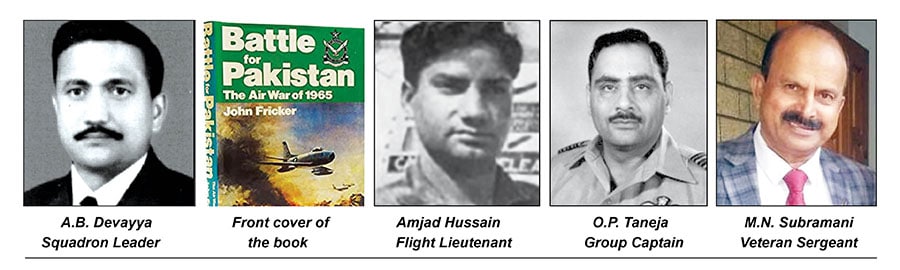
I remembered these verses of Thomas Gray’s poem while reading the report on the unveiling of life-size statue of gallant Fighter Pilot Squadron Leader Ajjamada Bopayya Devayya (A.B. Devayya) in Madikeri, Kodagu, on 7th September 2020. He too would have become a ‘gem of purest ray serene’ buried in the ‘unfathomed caves of ocean’ or would have been a flower born to blush unseen, but for the publication of a book titled “Battle for Pakistan” authored by John Fricker, an English journalist, based on interviews he conducted with Pakistan Air Force (PAF) Pilots.
The then Flight Lieutenant Amjad Hussain of PAF had narrated in that interview about the India-Pakistan War of 1965. He told the journalist that after accomplishing a successful raid over Pakistan’s Sargodha Airfield at the appointed time by IAF Fighter Aircraft, all Subsonic Mystere Aircraft, they were returning to their base in India. But the PAF’s Flight Lieutenant Amjad Hussain, who was piloting a superior aircraft to that of India’s, Supersonic Mach 2, F-104 Starfighter Aircraft, intercepted the Indian aircraft piloted by Squadron Leader A.B. Devayya.
About this incident, a reader of Star of Mysore, a veteran of IAF and the then President of Air Force Friends Association, Mysore, Mandetira N. Subramani, had written an article in Star of Mysore on 27.10.2000 (20 years back). There, in that article, he says “Neither the PAF pilot’s flying skill nor the F-104 Starfighter’s superior fire-power and speed deterred Squadron Leader A.B. Devayya. With single-minded devotion and rare courage, he ultimately succeeded in shooting down the PAF plane with the pilot Amjad Hussain safely ejecting.”
All the IAF Fighter Pilots, 6 of them, who were involved in the task of bombing the heavily defended Pakistan Airfield, returned to the Indian base at Adampur. But one pilot was listed as “missing in action.” He was Squadron Leader Ajjamada Bopayya Devayya. And he, apparently remained a “missing in action” officer all the years till the book titled “Battle for Pakistan” was published many years later and aroused the interest of another Indian IAF Officer Group Captain O.P. Taneja, Vir Chakra (retired).
Subsequently, mercifully, the Air Head Quarters conducted a careful investigation and innumerable interviews with the IAF Pilots who flew with Squadron Leader A.B. Devayya to confirm the veracity of what was written about Devayya in that book. Finally, he was conferred the honour of Maha Vir Chakra (MVC) posthumously. A martyr at last recognised. Thanks to people like the English journalist who wrote that book, to Flight Lieutenant Amjad Hussain of PAF for being so honest about a war situation, to Group Captain O.P. Taneja and nearer home our Veteran Sergeant M.N. Subramani (a retired Senior Non-Commissioned Officer of IAF), who pursued his efforts to get our people here to recognise and properly reward Sqn. Ldr. Devayya.
I am sure, M.N. Subramani must be among the most happy persons to see that statue unveiled on 7th September 2020, 55 years after the War Hero A.B. Devayya was martyred on 7th September 1965. And not to forget, it was M.N. Subramani, presently the President of VeKare Ex-Servicemen Trust (VKET), who was instrumental in naming our city’s Sainik Aram Ghar as Squadron Leader A.B. Devayya Bhavan, despite protests from a section of the people.
I remembered all these events after reading the statue unveiling report. We are fortunate that Sqn. Ldr. A.B. Devayya did not remain a “missing pilot” forever and an Air Force Officer with fame “unknown.” Let us remember the famous epitaph in the Kohima War Cemetery:
“When you go home
Tell them of us and say
For your tomorrow
We gave our today.”
Sqn. Ldr. A.B. Devayya was just 33. He gave his ‘today’ for our ‘tomorrow’.
Jai Hind
e-mail: voice@starofmysore.com
source: http://www.starofmysore.com / Star of Mysore / Home> Columns> Abracadabra / by K.B. Ganapathy / September 11th, 2021
Following hue and cry from the Kodava community that two Olympians from the community Subedar Chenanda Kuttappa (chief Indian boxing coach) and Kelappanda Ganapathy (sailor) were ignored by the Karnataka Government by not felicitating them for their participation in the Tokyo Olympics, the duo were called to the Banquet Hall of the Raj Bhavan in Bengaluru on Oct. 11 to be felicitated.
Governor Thaawarchand Gehlot distributed cash awards of Rs. 1 lakh each and mementos in the presence of Chief Minister Basavaraj Bommai and Sports Minister K.C. Narayanagowda.
While Kuttappa himself received the honour, Ganapathy’s mother Kelappanda Reshma Chengappa received the honour on her son’s behalf as he is heading to another sporting event in Spain.
source: http://www.starofmysore.com / Star of Mysore / Home> News / October 13th, 2021
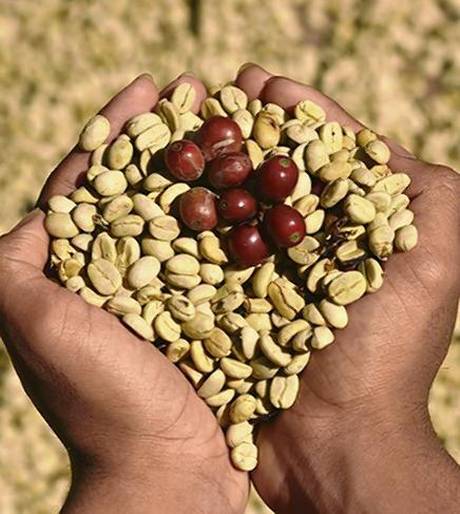
Non-traditional coffee growing regions in India are having a moment in the sun
(Nathan Dumlao, Unsplash)
There was a time when coffee beans in India were assumed to have come from the South of India and the lush, verdant hills of Baba BudanGiri (regarded as the birthplace of coffee in India), Nilgiris and Kodagu in Karnataka that are known to be the key coffee producing regions in the country. Increasingly, places like Araku Valley near Visakhapatnam, Koraput in Odisha and Northeastern states such as Meghalaya and Nagaland as newer areas from where your favourite roasters have sourced their beans.
While coffee has traditionally been grown in South India and a majority of well-known estates continue to supply the bulk of coffee beans to roasteries across the country, the rise of these so-called non-traditional areas has been some time in the making. The coffee world took notice of this when Araku Coffee, that sources its beans from the eponymous valley comprising highlands of the Eastern Ghats, won the Gold Medal for the best coffee pod in the Prix Epicures OR 2018 Award in Paris, France, a first for any Indian coffee brand. The next year, a GI tag followed for Araku Valley coffee, giving its identity a permanent market and the scope to demand better price for its coffee.
What comes as a surprise is that just two decades ago, there was no Araku coffee and no market selling these coffees even though the region has a century-old relation to coffee plantation. Instead, tribals grew cash crops while the region was part of the Red Corridor for Naxal insurgency. This writer’s visit to Araku Valley by train in 2009 was suspended after major Naxal activity was detected the previous night with a high possibility of the tracks being blown apart, the station superintendent at the time informed.
Cooperatives like Girijan Co-operative Corporation and NGOs like Naandi Foundation worked with tribals in the region and over the years, a collective group effort with 10,000 farmers from 520 villages joined Araku’s coffee cooperative to cultivate 12,300 acres of land with world-class coffee. It has been described as the largest bio-dynamic coffee cooperative in the world.
“We empowered tribals to give us the best coffee and that led to a revolution in quality. Around 12 years ago, most coffees scored around 60 but today the score is over 85,” Manoj Kumar, CEO of Naandi Foundation and co-founder of Araku Coffee says. The widely accepted definition of specialty coffee is coffee scoring 80 points or above on a 100-point scale by the Speciality Coffee Association of America (SCAA).
To qualify as a specialty coffee, the beans have to be graded by certified coffee tasters known as Q graders. Coffee scoring 80–84.99 is graded Very Good, coffee that scores 85–89.99 is graded Excellent while Coffee scoring from 90–100 is graded Outstanding.
Araku’s success on the global stage set the stage for other places to bring out their coffees. Koraput, a region bordering Araku that finds itself in Odisha with issues related to Naxalism, has seen its fortunes rise as tribals engage in producing coffee that are wowing coffee lovers with its nuanced flavour profiles. “Coffee grown in forests like Koraput are semi wild grown coffees compared to coffee estates, which are a deliberate attempt to grow coffee. This biodynamic form of coffee is one of the key reasons coffee drinkers will find hints of Indian gooseberry and pepper that are also grown in the forest. This attribute has made Koraput coffee much sought after,” Debu Mishra, who started Tribe-O Koraput coffee and retailed with Mumbai-based Dope Coffee Roasters last year before expanding to other roasters says. When I tried this coffee last year, there was a natural acidity to the beans that can sometimes be difficult to discern with estate-grown coffees in my collection.
For its part, Dope Coffee expanded and bought 600 kilos of coffee from Durgamadhab estate in Koraput early this year after working with Tribe-O Project, Koraput. As Riyaaz Amlani, CEO of Dope Coffee says, “Customers today care where their coffee comes from. As roasters, it’s exciting to experiment with these beans that have great texture and density. Next year, we’re planning to help the estate with harvesting and post-harvesting processes as well.”
The Northeast, too, has seen local coffee brands grow. Meghalaya’s Smoky Falls Tribe Coffee sources the bean from farmers in the Jaintia hills and Khasi hills. Nagaland’s Été gets its beans from farmers in the state. Vivito Yeptho, co-founder and managing director of Nagaland Coffee Pvt Ltd, has found takers in his home state and few repeat customers across the country who buy their beans. “If you taste coffees from South India, they have distinct notes which are familiar to most. Then again, not everyone will enjoy Nagaland coffee that has a different taste profile with spicy notes,” he says.
Subko Coffee Roasters co-founder Rahul Reddy says: “The quality of the cup of coffee and its traceability is gaining traction. At Subko, we go by Lot numbers (specific quantities of beans collected from specific areas/portions, usually nanolots or microlots, on a coffee farm instead of picking all the coffee grown on the estate at one go) because everything is variable in coffee. The way I see it, as a roaster you are a curator of nuance,” adding that Garo Hills coffee from Meghalaya is among their highest-selling coffee.
The rise of coffee in non-traditional areas is still too small compared to overall coffee production in India. For example, of the 3,34,000 MTs of coffee produced in India in 2020-2021, only 11,500 MT came from non-traditional areas (comprising of North East, Odisha and Andhra Pradesh), according to the Coffee Board of India. However, coffee from these areas is projected to grow to 12,870 MTs for the 2021-2022 harvest season.
India’s most well-known roasters Blue Tokai has still to source coffee beans from these regions. Matt Chitharanjan, co-founder of Blue Tokai says that he would only consider selling coffees from non-traditional places if the coffee score crosses 82, which it hasn’t so far. “A coffee score below 82 is not unique for us. Then you’re just selling the coffee on its story. Araku is an exception but when we worked two years ago to elevate coffee scores in Andhra Pradesh we only saw a marginal improvement from 76 to 78. The real challenge is crossing that barrier.”
The rise of coffee in non-traditional areas is still too small compared to overall coffee production in India. For example, of the 3,34,000 MTs of coffee produced in India in 2020-2021, only 11,500 MT came from non-traditional areas (comprising of North East, Odisha and Andhra Pradesh), according to the Coffee Board of India. However, coffee from these areas is projected to grow to 12,870 MTs for the 2021-2022 harvest season.
India’s most well-known roasters Blue Tokai has still to source coffee beans from these regions. Matt Chitharanjan, co-founder of Blue Tokai says that he would only consider selling coffees from non-traditional places if the coffee score crosses 82, which it hasn’t so far. “A coffee score below 82 is not unique for us. Then you’re just selling the coffee on its story. Araku is an exception but when we worked two years ago to elevate coffee scores in Andhra Pradesh we only saw a marginal improvement from 76 to 78. The real challenge is crossing that barrier.”
Sunalini Menon, President, Coffeelab, Bengaluru says that the rise of coffees outside Chikmagalur can be attributed to a few reasons. According to her, “Talking about involving indigenous communities to produce coffee makes for a good story. Araku Coffee paved the way and made people realise that. The coffee from these regions has also seen simultaneous improvement. I am impressed with the how far coffee from Koraput has come. Finally, new coffee entrepreneurs need to stand out and sourcing coffees from non-traditional places is one surefire way of doing that.”
Beginner’s guide to buying coffee beyond Chikmagalur 1. Khar Single Estate Coffee from Nagaland Coffee 2. Durgamadhab Estate from Dope Coffee 3. Tribe Koraput Naturals from Dope Coffee 4. Garo Hills Experience Lot #2 from Subko Coffee Roasters 5. Tribe-O Project Koraput coffee from Marcs Coffees
Priyanko Sarkar is a Mumbai-based journalist and writer covering the beverage industry.
source: http://www.lifestyle.livemint.com / Mint Lounge / Home> Food> Drink / by Priyanko Sarkar / October 01st, 2021
Kodagu has the honour of having enriched our armed forces since ages. Now, eight soldiers from the district have been selected for the United Nation Peacekeeping Force in Lebanon.
Soldiers who are currently serving in various regiments in the Army will join the camp soon.
Pemmanda S. Ravindra from Ponnampet, Karotira Lokesh from Pollibetta, Vinod Kalappa from Galibeedu; Ponnachettira Palangappa from Kalur village, Sathish. V. Doddaiah from Shanivarasanthe, Dinesh Pujari from Chamundeshwari Nagar in Madikeri, Deekshith Shetty from Bhagavathi Nagar and Bharath Pujari from Kaggodlu village.
The United Nations Peacekeeping Force is employed by the world organisation to maintain or re-establish peace in an area of armed conflict. More than 5,500 Indian military and Police personnel are serving in peace operations in Abyei, Cyprus, Democratic Republic of Congo, Lebanon, Middle East, Somalia, South Sudan and the Western Sahara.
As of March 2021, a total of 19,075 personnel have been deployed in the UN mission in South Sudan.
Now the eight soldiers from Kodagu will take part in the UN Peacekeeping Forces camp in Lebanon.
source: http://www.starofmysore.com / Star of Mysore / Home> News / September 12th, 2021
WELCOME. If you like what you see "SUBSCRIBE via EMAIL" to receive FREE regular UPDATES.
Read More »