Category Archives: World Opinion

Free COVID Healthcare Centre Opens At Gonikoppal

Lopamudra Medical Centre, Karuna Trust, donors and volunteers make the much-needed facility a reality

Mysore/Mysuru:

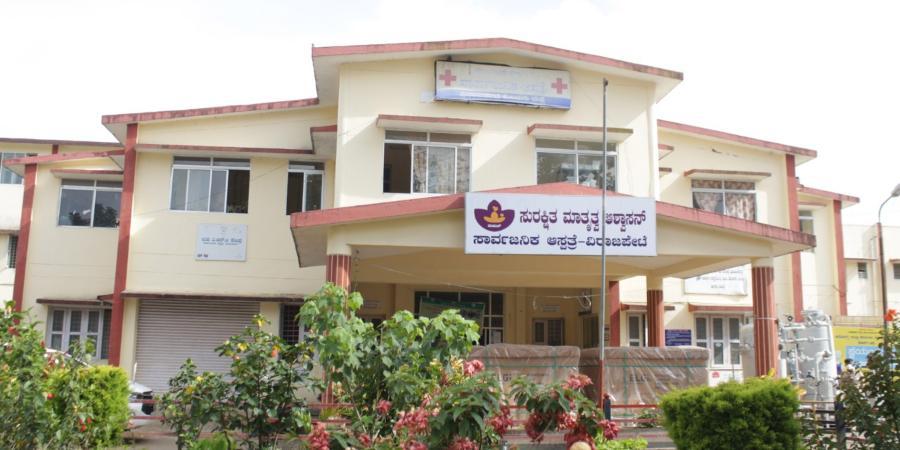
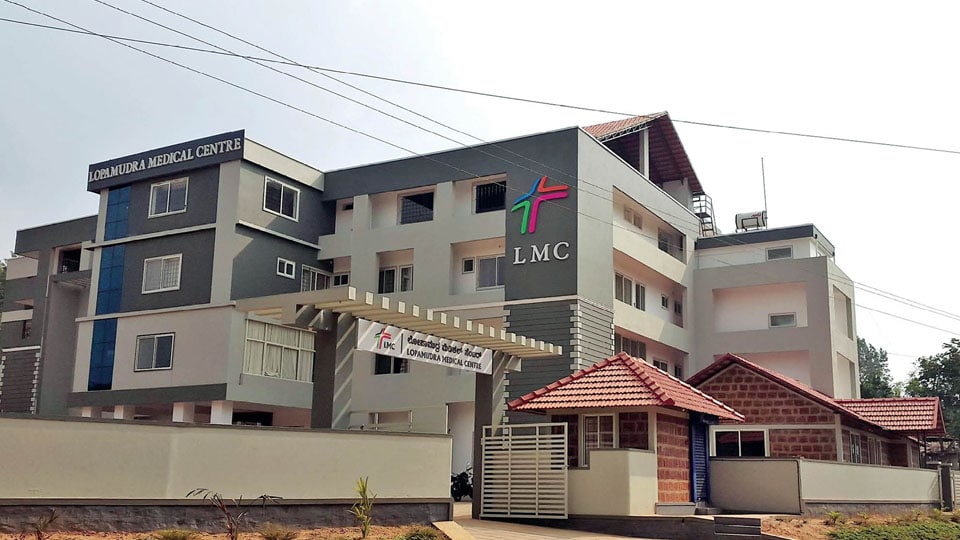
A 30-bed dedicated COVID Healthcare Centre has begun functioning at Lopamudra Medical Centre (LMC) at Gonikoppal in South Kodagu. COVID patients will be treated here free of cost. This Hospital will prove a boon to patients in South Kodagu who were earlier forced to travel either to Mysuru or Bengaluru that are already under pressure due to mounting infections. 

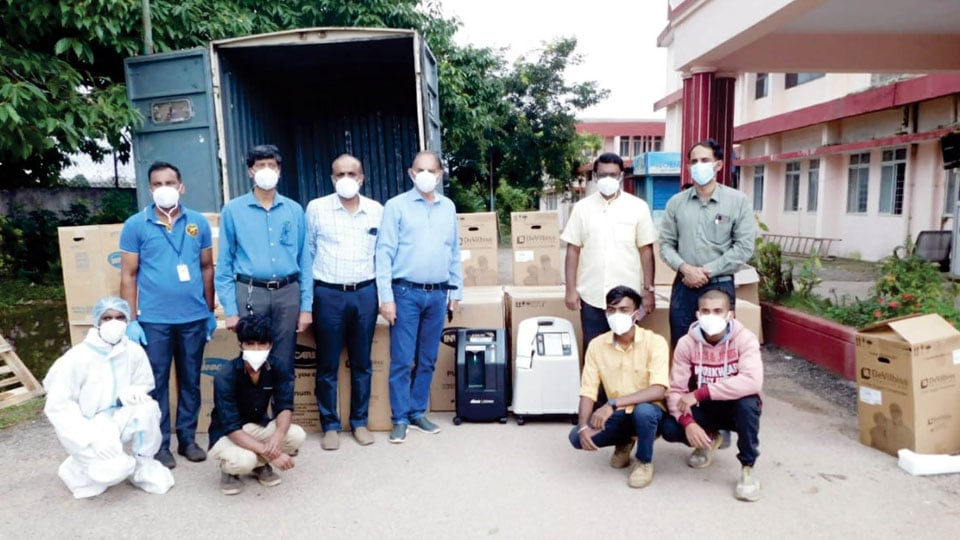
The facility was inaugurated last evening by Kodagu District Minister V. Somanna who holds the Housing portfolio. He assured the Hospital authorities that he would take measures to give 30 oxygen cylinders to 30 beds and an additional stock of 60 cylinders as a back-up. 

The COVID Healthcare Centre has been established by Karuna Trust, a Charitable Trust that has enabled integrated rural development and empowered the masses, Kodava Koota in the US, Kodava Deenabandhu Charitable Trust, Kodava Samajas and a dedicated team of volunteers, donors and various organisations, who have spared no efforts in making the COVID Centre a reality. 

Businessman Jammada Aiyanna, Dr. Kalyatanda Gautham Subbaiah from University of Florida, Brigadier (Retd.) Maletira Devaiah, Kokkanda Pavan Aiyappa, Cheppudira Geetha Chengappa, Karuna Trust Joint Secretary Venkat Chekuri, Ponnampet Kodava Samaja President Chottekmada Rajeev Bopaiah and several others have made invaluable contribution to the facility. 

They have raised funds alongside the Karuna Trust for infrastructure and also equipment and even many residents of Kodagu have contributed to the noble cause. The centre officially began functioning on May 15 under the leadership of Mukkatira Amrit Nanaiah, Consultant Physician and Diabetologist, and is located on the third floor of the LMC at Athur village, two kilometres from Gonikoppal. 

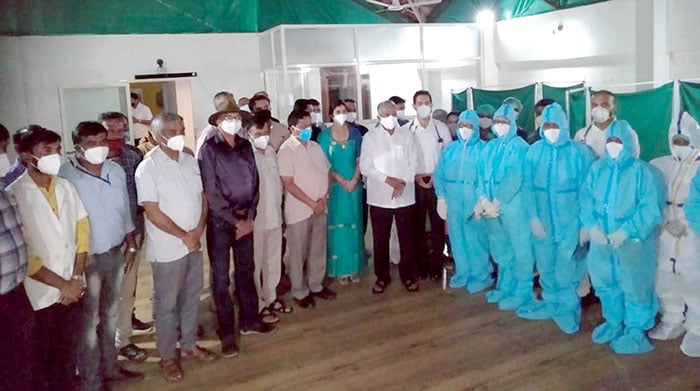
Minister Somanna, MLA K.G. Bopaiah, Dr. Amrit Nanaiah, Dr. Sudarshan and hospital staff during the inauguration last evening.

Apart from Madikeri District Hospital and the Kodagu Institute of Medical Sciences there is no hospital in Kodagu to treat COVID patients. Thanks to the negligence of the Government and elected representatives who did not bother all these years to set up an advanced hospital. In this direction, the COVID Healthcare Centre at LMC will help save lives at the time of crisis. 

The COVID Healthcare Centre will have 15 beds with piped oxygen, five beds with oxygen concentrators and 10 beds with BiPAP machines, a sort of a ventilator that is used to treat chronic conditions that affect breathing. The centre will have a pharmacy and lab facility and will be a high dependency unit. Separate entrances have been made to facilitate the entry of COVID patients so that other patients who come to the LMC are not affected in any way. 

The LMC administration and the Karuna Trust will take care of providing doctors and nurses including consultations from doctors who are working in foreign shores. Donors are contributing to purchase oxygen, medicines including life-saving ones and also free food to the patients. On an average, a COVID patient has to spend lakhs of rupees for treatment and this healthcare centre provides free treatment and quality care. 

The centre will treat moderate COVID patients, who will be referred by the Kodagu District Administration and Deputy Commissioner Charulata Somal has assured full support. The authorities are providing ambulance facility to the centre and the administration has assured to provide hassle-free oxygen supply from Mysuru. 

A 200 Kilo Litre oxygen unit will be installed at the LMC facility by Karuna Trust. Well-known social worker and tribal activist recognised for his work with the Soligas in B.R. Hills Dr. H. Sudarshan is a guiding force behind the COVID Healthcare Centre and he is also the founder and Honorary Secretary of the Karuna Trust.

Dr. Mukkatira Amrit Nanaiah

‘Committed to treat patients’

The hospital has become a reality, thanks to the efforts of Karuna Trust. We have an aim to provide the finest care and are committed to treat patients in complete transparency and the centre is a zero-billing facility. Our intention is to come to the rescue of patients who are in need of medical care. The COVID Healthcare Centre has been created in such a way that it is bifurcated from the other treatment units of the hospital. 

Dr. Kalyatanda Gautham Subbaiah, Clinical Assistant Professor, Department of Medicine, Division of Infectious Diseases and Global Medicine, College of Medicine, University of Florida, who has treated over 1,000 COVID patients in the US, will guide doctors at the facility.  Dr. Mukkatira Amrit Nanaiah, head of Lopamudra Medical Centre

source: http://www.starofmysore.com / Star of Mysore / Home> News / May 16th, 2021

“I didn’t even dare walk out to him”- Robin Uthappa opens up on the threat he received from Shoaib Akhtar

Robin Uthappa recently shared an intriguing anecdote from his international cricket days where Shoaib Akhtar  had threatened the batsman not to play one of his trademark ‘walking shots’. The speedster had said that he might even bowl a beamer in response if he sees Uthappa walking down the pitch again.

India  won the 5-match ODI series in 2007 against Pakistan by a margin of 3-2, and Robin Uthappa was part of India’s ODI set-up at the time. The batsman recently spoke about the threat he received from Shoaib Akhtar for playing one of his ‘walking shots’.

“We were playing a game in Guwahati. And since it’s in the east of India, it gets dark there early. Back then, we did not have two new balls. After 34 overs, we used to get a ball which used to be 24 overs old but slightly better. Shoaib was bowling and Irfan and I were batting. I think we needed 12 to win off 25 balls or something like that.

“I remember he bowled a yorker to me. I missed it from the arm and only saw it coming straight into the blockhole. I stopped the ball dead there. That was 154 something clicks. Next ball was a low full toss and I hit the ball for four. So after that, we needed 3 or 4 runs to win and I told myself, ‘Man, I have to walk out to Shoaib Akhtar and hit him. How many times will I get that opportunity.’ He bowled a length ball and I did it; it took the edge and it went for four. We won the match,” Robin Uthappa said on ‘Wake Up With Sorabh’ YouTube channel.

Adding further to the story, the Karnataka batsman said:

“We went to Gwalior for the next game (4th ODI) and I remember we all were having dinner together. I think we hung out in someone’s room and having a meal. Shoaib bhai was there as well. He came to me and said ‘Robin… well played. Good game’. And then he said ‘One more thing… you walked out and hit me today. If you do that again, even I don’t know what will happen… you might get a beamer directed at your head.’ After that, I didn’t even dare walk out to him.” Robin Uthappa said.

_________________


T20 World Cup@T20WorldCup

Happy birthday to Robin Uthappa! He was a part of India’s successful 2007 @ICC Men’s

#T20WorldCup campaign and was among their top five run-scorers

👏

Nov 11, 2020

________________

Robin Uthappa didn’t have the best of times in the 2007 ODI series against Pakistan, scoring only 31 runs across 4 innings. Yuvraj Singh was the star of the show for India, winning the Man of the Series award for his performance against the arch-rivals.

Robin Uthappa didn’t get a game for Chennai Super Kings in IPL 2021

_____________

Chennai Super Kings – Mask Pdu Whistle Pdu!@ChennaiIPL·Robin says 𝗽𝘂𝗹𝗹 up y😷ur masks cause it’s high time.


Apr 29

_____________________

The 35-year-old was part of the 2021 edition of the IPL for the Chennai Super Kings. However, before the tournament was postponed, Robin Uthappa failed to get a game for the Chennai outfit.

With Ruturaj Gaikwad and Faf du Plessis showing impressive form at the top of the order, the veteran batsman could not break into the playing XI.

The batsman’s best days in the IPL came in KKR’s jersey when he won the Orange Cup during the 2014 season and helped the Kolkata franchise win their second title.

source: http://www.sportskeeda.com / SportsKeeda / Home> Cricket> News / by Ayush Chaurasia, Analyst / May 16th, 2021

Now, a 30-bed centre in Kodagu to treat COVID-19 patients free of cost

“The facility will have 15 beds with pipelined oxygen, five beds with oxygen concentrators and 10 beds with Bipap machines (a type of ventilator),” said Venkat Chekuri, joint secretary of Karuna Trust.

The COVID care centre in Kodagu (Photo | Special arrangement)

Madikeri :

A 30-bed Dedicated Covid Healthcare Centre (DCHC) will be inaugurated at a private hospital in Gonikoppal to provide improved treatment to COVID patients free of cost. The DCHC has been established following efforts by the Karuna Trust – a charitable trust that has enabled integrated rural development.

The facility will start functioning from May 15 at Lopamudra Private Hospital in Gonikoppal. “The facility will have 15 beds with pipelined oxygen, five beds with oxygen concentrators and 10 beds with Bipap machines (a type of ventilator),” explained Venkat Chekuri, joint secretary of Karuna Trust.

He explained that the facility has seen the light of day following efforts from Kodava Koota members in the US, Concerned Citizens of Coorg organization members and members of Kodava Samaj who have raised funds alongside Karuna Turst to establish the DCHC. The centre will have a pharmacy and lab facility and will be a high dependency unit.

“The centre will treat moderate COVID patients who will be referred by the district administration. The centre will provide free treatment to the patients alongside three meals a day and snacks. The administration of Kodagu alongside DC Charulata Somal has offered complete support and the ambulance facility to the centre is being provided by the district administration. The administration has also assured to provide hassle-free oxygen supply to the centre from Mysuru,” explained Venkat. He further added that a 200-litre oxygen unit will shortly be installed at the centre by the trust.  

The trust will bear the rent charges for the place provided at the private hospital and will have doctors and nurses appointed by the trust itself. “Dr Sudarshan, the founding member of the trust, is guiding the entire project. Also, Dr Gautham Subbaiah, assistant professor at the University of Florida – who has treated over 1000 COVID patients in the US – will guide local doctors in treating the patients. Experts from the University of Florida will review the ground work at the centre,” added Venkat.

source: http://www.newindianexpress.com / The New Indian Express / Home> States> Karnataka / by Prajna GR, Express News Service / May 14th, 2021

This Coorg coffee cultivator wants to grab a slice of India’s packaged coffee market

Launched 3 years ago, Levista is eyeing expansion in south India, Mumbai and Delhi

S. Shriram, vice-president-sales and marketing at Levista

Coorg in Karnataka, is among the foremost coffee growing regions in India. SLN, a three-decade old coffee plantation company in the region is now aiming to grab a slice of the Rs 2,200-crore annual packaged coffee market, which is dominated by big players like Nestle (Nescafe), Hindustan Unilever (Bru) and Tata Coffee.

SLN launched its own brand of coffee called Levista three years ago and has ever since expanded to 40,000 retail outlets, predominantly in Tamil Nadu and Karnataka. It has now set its sights on expanding across other markets, starting with the rest of south India.

“Of the Rs 2,200 crore market annually, over 80 per cent of the coffee consumption happens in the five southern states and Union territories. Therefore, we aim to reach a significant market share here rather than being sparsely spread all over the place,”  S. Shriram, vice-president sales and marketing at Levista, told THE WEEK.

“At the moment, we have a deep presence in Tamil Nadu and Karnataka. We launched our coffee in Goa in February and business is growing steadily. We will be entering the Andhra Pradesh and Telangana market by Sankranti and will penetrate deeper in there. Kerala will follow next.”

The company has the markets of Mumbai and Delhi-National Capital Region on the radar, too, however, it has not finalised a launch date yet, added Shriram.

Levista is also available on online platforms, including Amazon and it is also scaling up on other e-commerce platforms to reach a wider audience.

“Players like Big Basket have also aided our brand coverage, as has Flipkart. We have been recently on boarded through Udaan that reaches small retailers as well as hyperlocal players MilkBasket,” said Shriram.

While south India has a strong tradition of filter coffee, the rest of the country has largely been a tea drinking market. However, things have started changing with penetration of cafes like Cafe Coffee Day and Starbucks in the last decade. International coffee brands like Lavazza are also expanding in the country, buoyed by rising coffee consumption here.

“There is a huge scope for us to grow. The coffee market has been growing steadily. Out of home coffee consumption through cafes has already hit a pan-India presence and thanks to this familiarity, more new consumers are sipping coffee at home, through packaged coffee,” noted Shriram.

Levista’s parent SLN currently has a capacity upwards of 50,000 metric tonne per annum, and Shriram says the company will be able to produce enough coffee for the domestic market as well as for exports.

Talking of exports, the brand is already present in Singapore, Malaysia, Middle East, Maldives and Sri Lanka, reaching out to the south Indian consumers in these markets. The company intends to have a larger international presence next year, added Shriram.

source: http://www.theweek.in / The Week / Home> News> Business / by Nachiket Kelkar / November 20th, 2020

The couple showcasing coffee’s dark side

Raghunath Rajaram and Namisha Parthasarathy are trying to simplify coffee with a radical approach that involves reinventing the flavour wheel and learning about coffee’s colonial hangover.

Ārāmse Coffee started out as a small in-person gathering organised by the duo in Mysuru in August 2019. (Cottonbro, Pexels)

We enjoy coffee from around the world, but fail to see beyond labels and brand names into the world of cultural identity and the farms and roasteries that work behind the scenes to bring us our daily cup of joy. It’s a topic that Raghunath Rajaram and Namisha Parthasarathy, a couple that co-founded coffee subscription company Ārāmse Coffee, spoke eloquently on coffee’s best brand ambassador James Hoffmann’s YouTube channel a month ago when the latter opened his channel to content creators.

The Beginning

Ārāmse Coffee started out as a small in-person gathering organised by the duo with coffee lovers in Mysuru to understand the growing speciality coffee scene in August 2019. These were more informative for Rajaram who confesses that he used to drink filter coffee “with milk along with three spoons of sugar” before his wife introduced him to good coffee while they were staying in Shoreditch in East London. “That, along with an introductory class to the Specialty Coffee Association (SCA) gifted by Namisha sent me down the coffee rabbit hole,” he says laughing.

When the couple came on a visit to India in 2019, the idea was to take up yoga but they landed up creating coffee workshops in Mysuru. “We started six-person workshops featuring two roasters and two different types of brewing. It was a tech-free way to spend half a Sunday and learn more about coffee,” Rajaram says about the beginning of Ārāmse Coffee.

Soon, the pandemic hit and the team had to quickly pivot from in-person meetings to something else. They went about it in two ways. First was to recreate the south Indian filter that Rajaram has grown up drinking since childhood and a prototype of which they are expecting to showcase at The London Coffee Festival later this year or in early 2022. The second was to create a community of coffee lovers online by starting coffee videos and later branching out to coffee products and a coffee subscription package to generate revenue. They are currently focussed on scaling up their subscription service and adding more content whilst in India.

Rajaram is especially happy with the direction of the coffee subscription model. “It’s a recommendation-based subscription that we offer through various roasters. We match the MRP so you are not overpaying for each subscription,” he explains. With a coffee experience tailored to individual palates and that can be further customised with ‘My Coffee Journey’ by the user, Rajaram says the system has been custom coded to scale, with the recommendation-based technology getting better with each order as it learns more about the user’s palate.

Raghunath Rajaram and Namisha Parthasarathy of Ārāmse Coffee.

The Conundrums

Whilst creating content and working on their own filter, the couple were also keen on exploring the impact of colonialism on coffee in a producing nation like India.

The couple is flummoxed by the fact that despite being the seventh-largest producer of coffee in the world, we still bulk produce and send some of our best beans to Europe and other countries. “Historically, Indian coffee has largely been bulk processed, white labelled and exported to countries like Italy, Germany and Belgium,” they say.

Parthasarathy is, in fact, working on a project for her certification in the SCA Sustainability Program that explores the localisation of coffee flavour wheels as one small way of making coffee more inclusive, especially for producers in the Global South. It’s a topic that leads to the SCA Flavour Wheel.

The Flavour Wheel

Globally, the SCA has a flavour wheel that roasters, baristas and everyone in the business refers to while describing any coffee. Rajaram says, “The problem is that the flavour wheel was largely developed in the US and UK and this could lead to some implicit biases as to what flavours are desirable and which aren’t. Tasting notes like Earthy, which are very sought after in the subcontinent, would make coffee folks in the Global North cringe as this is considered a flaw amongst those circles.”

According to the couple, having a localised flavour wheel for each place would make coffee a lot more inclusive and accessible. “We have our own unique fruits and spices that could easily make their way into these wheels.”

It’s a topic that sounds familiar to Debabrat Mishra, founder of Koraput Coffee, that’s working with tribals in Odisha to make coffee beans. According to Mishra, the wheel needs new flavours that have not been considered until now. “Our coffees have notes of green chilli, white pepper and even gooseberry because of cross microbe activity between the trees and coffee plants in Koraput. The SCA flavour wheel and way of scoring coffees that prioritises automation over traditional methods needs to change,” he says.

The SCA needs to acknowledge the shortcomings in its flavour wheel and adopt a country-specific approach, which is unlikely; or, every country could create a flavour wheel that best represents the coffee flavours found in its beans, which is too ambitious. So technically nothing can be done at the moment, except more education amongst coffee lovers.

source: http://www.lifestyle.livemint.com / The Mint / Home> Mint Lounge> Food> Drink / by Priyanko Sarkar / May 03rd, 2021

Rebecca And Victoria

Pocahontas, the beau-tiful daughter of the American Indian chief of the Powhatan Confederacy, was born in 1596 in what is now known as Jamestown, Virginia, in the USA.  Her rank was that of a Princess. 16th and 17th century saw rapid colonisation of the Americas by the European nations.  History is replete with the brave fights the native Americans put-up against the white man who came with superior weapons and technology, and ultimately subdued the original inhabitants.

Chief Powhatan was a formidable opponent of the alien settlers.  One of the British colonisers who encountered chief Powhatan was John Smith.  In a skirmish, the British were outnumbered, and John Smith was taken prisoner.  When Smith was about to be executed, the then 11-year-old Pocahontas intervened and saved his life. John Smith was held captive for a while by the Powhatan chief. The young and impressionable Pocahontas was intrigued by the white man.  She used to visit the prisoner frequently and in time learnt a smattering of English from him.  John Smith subtly introduced Pocahontas to Christianity.

Years later, during the first Anglo-Powhatan war in 1613, Pocahontas was taken hostage by the British.  During this period, she was taught English and the scriptures in more detail. Soon her indoctrination was complete. In  1614 Pocahontas was baptised and was given the name Rebecca.

Fast forward to 1852.  The 11-year-old Gowramma, the favourite daughter of the last Raja of Coorg, was taught English and the scriptures by the British during their exile in Benares. The Raja and Princess Gowramma land in Victorian England in 1852.  Presented at Queen Victoria’s court, the queen took the vulnerable Gowramma under her wing as her God-daughter and encouraged her baptism.  Gowramma was given the name Victoria.  Queen Victoria bestowed Gowramma with a rank equivalent to that of an European Princess. 

During her captivity, Rebecca Pocahontas fell in love with John Rolfe, a British tobacco trader and grower. John  Rolfe was a widower. 18-year-old Rebecca married the much older John Rolfe in  1614.

When Victoria Gowramma was 19 years old, she got romantically involved with a British army officer: Lieutenant Colonel John Campbell, who had served in India.  He was a widower, and 30 years her senior.  They were married in 1860. 

John Rolfe and Rebecca Pocahontas had a son named Thomas Rolfe.  In 1616, John Rolfe brought his wife and infant son to England. Pocahontas was presented at the court of King James I, where she was given a reception with protocol normally extended to a daughter of a king.  

In March 1617 John Rolfe and his family boarded a ship to sail back to America.  Rebecca Pocahontas suddenly took ill and had to be taken  ashore.  Within days Rebecca died, and it is suspected that the cause of her death was either pneumonia or tuberculosis.  She was 21 years old.

Victoria Gowramma and John Campbell had a daughter named Edith Victoria.  Gowramma suffered from tuberculosis and succumbed to the disease in 1864 at the age of 23. 

Rebecca and Victoria, separated by nearly 250 years, had uncanny similarities in their lives.

source: http://www.starofmysore.com / Star of Mysore / Home> Feature Articles / by C.P. Belliappa / April 30th, 2021

Climate change puts morning cup of coffee under threat

Who on earth would like to miss a morning cup of hot steaming coffee?

Climate change could make about 50-88% of coffee-producing areas unsuitable and lead to an increase in pests and diseases, affecting its production and quality. There is an urgent need for research to save the bean from extinction.

Who on earth would like to miss a morning cup of hot steaming coffee?  Coffee is becoming more popular, especially among the young around the world. Around 2.5 billion cups of coffee are consumed every day. The demand for coffee is projected to by 2050. But the question is: Can coffee supply be sustained?

Coffee is produced in around 70 countries but the dominant among them are Brazil, Vietnam, Columbia, Indonesia, Ethiopia, Honduras and India. Coffee is also the second-most traded commodity after petroleum oil, employing over 125 million people around the world. Most of the coffee grown is made up of two types: Coffea arabica and Coffea robusta, with the former making up 70% of all coffee grown globally.

In India, robusta dominates in terms of production. Karnataka is the dominant state producing coffee in India, accounting for nearly 70% of the total production, followed by Kerala. Together, they account for about 90% of the production. In India, the area under coffee cultivation is 4,16,741 hectares (ha). There are 3,79,697 coffee holdings, out of which most are smallholdings of less than 10 ha in size.

Weather and long-term climate patterns are very critical for growing coffee. Temperature and rainfall conditions are the main drivers determining the yield, production and quality. Altitude is another key factor. Robusta is slightly hardier, as it evolved in lowland equatorial Africa, but grows well in areas with abundant rainfall, which should be well distributed. The optimum temperature range for robusta is 24 to 30°C, but it is less tolerant to very high or very low temperatures. Currently, the annual and seasonal temperature and rainfall variability lead to fluctuations in yield in almost all coffee-growing countries, affecting supply and price.

Climate change is projected to impact all crops, including plantation crops. Changing climate and associated pest and diseases could adversely impact coffee-growing areas. Higher temperatures will not only favour the proliferation of certain pests and diseases but also kill large swaths of insects that pollinate coffee plants. As temperature rises, coffee ripens more quickly, leading to a fall in quality. Rising temperature is expected to make some areas less suitable or completely unsuitable for coffee cultivation.

A recent review of studies in 2020 concluded that all studies based on modelling predict that areas suitable for coffee cultivation could decline by about 50% under moderate climate change projection scenarios by 2050 for both arabica and robusta. Another study published in the journal Proceedings of the National Academy of Sciences concludes that the area unsuitable for coffee cultivation could be as high as 88% in Latin America, the dominant producer, by 2050. About half of the land around the world currently used to produce high-quality coffee could be unproductive by 2050, according to a recent study in the journal Climatic Change.

Thus, multiple studies show that climate change will have an extremely negative effect on future coffee production worldwide in terms of suitable cultivation areas, pest and diseases. Howard Schultz, who was the chairman of Starbucks — the largest global coffee chain — till 2017, is quoted to have said, “Climate change is going to play a bigger role in affecting the quality and integrity of the coffee.”

Coffee is a globally traded product and any impact on it in one part of the world will impact the rest, including India. International prices will determine the investment, income and survival of Indian coffee growers. If there is surplus production in Brazil and Columbia, prices in the international market will collapse. This will lead to a decline in market prices for Indian coffee, due to which farmers will experience heavy losses.

Research in India

There is limited research on the impact of climate change on coffee production in India. There are two ways the impact can be assessed: first, by long-term monitoring of changing climate and response of coffee production, which may take decades.

Modelling is another option to project the impact of climate change. There is limited modelling efforts globally and in India, in particular. With the current knowledge, one can conclude that climate change will have serious implications for coffee production and quality. We may have to brace for the disrupted supply of coffee and loss of aroma. According to climate change models, an increase of 20% to 25% in monsoon rainfall is projected for the Western Ghats districts of Karnataka and Kerala, along with the increased occurrence of high-intensity rainfall events. Further, increased warming of around 2 degrees Celsius is projected by the mid-2030s for these districts.

India has a Central Coffee Research Institute under the Coffee Board. Research on developing climate-resilient coffee varieties and cultivation practices would require several years or decades. Further, there is a need for extension service to train farmers in new practices, especially since a majority are smallholdings. In the meantime, coffee growers may need increased protection, price and insurance support from the Government of India and Karnataka.

In response to the risk of climate change on coffee, a global alliance of companies has been formed (‘Coffee and Climate’) with an objective to develop and implement coping strategies and to support smallholders to adapt to climate change, and ultimately to increase the resilience of entire coffee landscapes. Even Starbucks is conducting dedicated research and training of coffee growers in adaptation to climate change. Hope the Coffee Board also takes serious note of the threat of climate change and implement strategies to develop resilient varieties and practices, not only to help coffee growers sustain production, but also to ensure that hundreds of millions of coffee lovers continue to enjoy their morning cup.

(The writer is a retired professor, Indian Institute of Science, Bengaluru) 

source: http://www.deccanherald.com / Deccan Herald / Home> Opinion> Perspective / by N H Ravindranath / April 22nd, 2021

International Hockey Umpire Mundanda Anupama Passes Away

She was the first woman referee from India to officiate in 88 international hockey matches

The first Indian woman umpire who started her international career in 2004 and the first woman referee from India to officiate in 88 international hockey matches Mundanda (Puchimanda) Anupama, wife of Mundanda Mithun Mandanna of Nelaji village in Kodagu, passed away in Bengaluru this morning. She was 41.

She was selected by the Federation of International Hockey as one of the youngest umpires among ten men and women in the world. She had a passion for sports when she was nine and since then she never looked back. She was the first woman referee from India to officiate in 88 international hockey matches, junior world cup and three Commonwealth Games.

Born to Puchimanda Shivappa and Shanthi Shivappa (Achhandira) at Bittangala, Anupama was awarded the Best Umpire (Women) India by Sardar Gyan Singh Memorial Hockey Society in 2007. Anupama represented India in the umpires seminar held at Singapore, Hyderabad, Chennai, Chandigarh and New Delhi and represented Karnataka as a player in the sub-junior and senior women’s National Hockey Championships. She officiated as the umpire in the four-nation tournament held at Singapore in 2007 and refereed the finals between Australia Vs Malaysia.

She was the umpire in the three-nation tournament held at Italy and also umpired the Central American and Caribbean games, Santo Domingo, Dominican Republic in 2006. In 2008, Anupama officiated as the umpire for two four-nation tournament at Rotterdam in Holland and also at Bremen in Germany. Anupama umpired the Junior Asia Cup held at Malaysia in and was the umpire in the youth Olympic Games held at Australia in 2009.

She started her sports career at the age of nine as an amateur athlete at Sports School Kudige in Kodagu. At 13, she joined the Sports Authority of India, Madikeri, where she got into hockey. She represented the State in sub-junior and senior national championships several times. She has also officiated in events in Asia, Africa, and America and European continents.

She had a passion for umpiring and she cleared the umpiring exam in 2001 and first officiated as an umpire at Cheppudira Family Hockey Tournament in Kodagu and went onto make international name and fame. Anupama’s goal was to be an Olympics umpire. “I am happy I chose this profession. This motivates me to focus more on the job and I will be happy if one day I get to officiate in the Olympics,” she had stated in one of her interviews.

Recently Anupama was selected as Executive Council Member by Karnataka State Hockey Association.

source: http://www.starofmysore.com / Star of Mysore / Home> Sports / April 18th, 2021

A rediscovered species brews promise for coffee’s future

The coffee species Coffea stenophylla, which bears black fruit rather than the red fruit typical of the two coffee species that are widely grown commercially, is seen in Ivory Coast in this undated photograph.   | Photo Credit: REUTERS

Stenophylla was found to have a complex flavour profile, with natural sweetness, medium-high acidity, fruitiness and good “body” — the way it feels in the mouth

In dense tropical forests in Sierra Leone, scientists have rediscovered a coffee species not seen in the wild in decades — a plant they say may help secure the future of this valuable commodity that has been imperiled by climate change.

The researchers said on Monday that the species, called Coffea stenophylla, possesses greater tolerance for higher temperatures than the Arabica coffee that makes up 56% of global production and the robusta coffee that makes up 43%. The stenophylla coffee, they added, was demonstrated to have a superior flavour, similar to Arabica.

Botanist Aaron Davis, who led the study published in the journal  Nature Plants, said stenophylla was farmed in parts of West Africa and exported to Europe until the early 20th century before being abandoned as a crop after robusta’s introduction.

Many farmers throughout the world’s coffee-growing belt already are experiencing climate change’s negative effects, an acute concern for the multibillion dollar industry.

This handout photograph released by Royal Botanical Gardens on April 19, 2021, shows the tasting of Coffea Stenophylla at Union Coffee in London on August 28, 2020.   | Photo Credit: AFP

Arabica’s flavour is rated as superior and brings higher prices than robusta, which is mainly used for instant coffee and coffee blends. But Arabica has limited resilience to climate change and research has shown its global production could fall by at least 50% by mid-century.

Stenophylla grows at a mean annual temperature of 24.9℃ — 1.9℃ higher than robusta coffee and up to 6.8°C higher than Arabica coffee, the researchers said.

The stenophylla rediscovery, Davis said, may help in the “future-proofing” of a coffee industry that supports the economy of several tropical countries and provides livelihoods for more than 100 million farmers. While 124 coffee species are known, Arabica and robusta comprise 99% of consumption.

“The idea is that stenophylla could be used, with minimum domestication, as a high-value coffee for farmers in warmer climates,” said Davis, head of coffee research at Britain’s Royal Botanic Gardens, Kew.

“For the longer term, stenophylla provides us with an important resource for breeding a new generation of climate-resilient coffee crop plants, given that it possesses a great flavour and heat tolerance. If the historic reports of resistance to coffee leaf rust and drought tolerance are found to be correct, this would represent further useful assets for coffee plant breeding,” Davis added.

Leaf rust is a fungal disease that has devastated coffee crops in Central and South America.

The study included flavour assessments involving 18 coffee-tasting experts. Stenophylla was found to have a complex flavour profile, with natural sweetness, medium-high acidity, fruitiness and good “body” — the way it feels in the mouth.

In December 2018, Davis and study co-authors Jeremy Haggar of the University of Greenwich and coffee development specialist Daniel Sarmu searched for stenophylla in the wild. They initially spotted a single plant in central Sierra Leone. About 140 km away in southeastern Sierra Leone, they found a healthy wild stenophylla population.

“Both locations were thick tropical forest, but stenophylla tends to occur on drier, more open areas: ridges, slopes and rocky areas,” Davis said.

Stenophylla had not been seen in the wild in Sierra Leone since 1954 and anywhere since the 1980s in Ivory Coast, Davis said. A few examples were held in coffee research collections.

Davis said stenophylla is threatened with extinction amid large-scale deforestation in the three countries where it has been known to grow in the wild: Sierra Leone, Guinea and Ivory Coast.

Unlike the red and occasionally yellow fruit of Arabica and robusta plants, stenophylla’s fruit are intense black. The coffee beans are inside the fruit.

“I think we’re hugely optimistic for the future that stenophylla can bring,” said Jeremy Torz, co-founder of the specialty coffee business Union Hand-Roasted Coffee in East London where part of the taste-testing was held.

source: http://www.thehindu.com / The Hindu / Home> Sci-Tech> Science / by Reuters / April 20th, 2021

Former hockey umpire Anupama Punchimanda succumbs to COVID-19 at 40

Anupama had officiated in junior women’s World Cup and the Asia Cup among other major hockey events.

Former hockey umpire Anupama Punchimanda succumbs to COVID-19 at 40

One of India’s former international hockey umpires Anupama Punchimanda lost her battle with COVID-19 in Bengaluru on Sunday. She was 40!

Punchimanda, a former national level player, took to officiating early in her career and excelled as an umpire. 

She oversaw a number of big-ticket events like the 2005 Junior Women’s World Cup in Santiago, Chile, the 2013 Hockey World League Round II in New Delhi and the 2013 Women’s Asia Cup in Kuala Lumpur.

“Anupama Punchimanda was one of the first few women in India to umpire at very reputed international tournaments,” Hockey India president Gyanendro Ningombam said in a statement.

“We at Hockey India share the grief of her family and friends and we extend our deepest condolences to Anupama’s family members.”

Punchimanda’s death comes just a few days after former Indian footballer and Olympian Ahmed Hussain died following complications related to the novel coronavirus. Hussain was 89 years old.

India have been dealing with a second wave of COVID-19 over the past few weeks with the ministry of health and family welfare reporting 1.8 million active cases as on April 18 with 177,150 reported deaths.

source: http://www.olympicchannel.com / Olympic Channel / Home / by Naveen Peter / April 18th, 2021