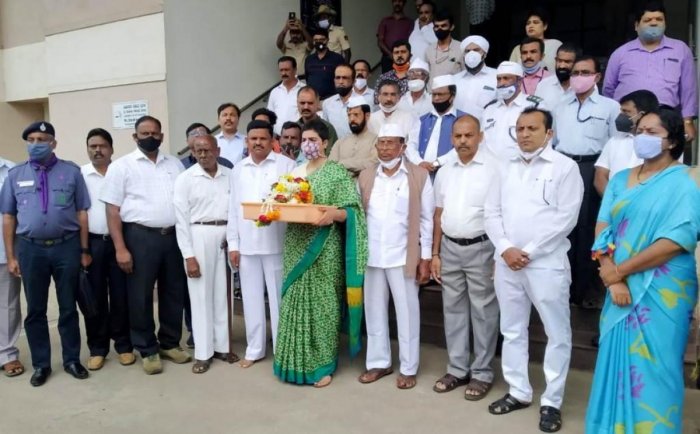
The ashes of Mahatma Gandhi were decked with flowers on account of Martyrs’ Day in Madikeri on Saturday.
The district administration and Sarvodaya Samithi observed Martyrs’ Day in Madikeri on Saturday.
The ashes of Mahatma Gandhi were taken out from the district treasury in district administration complex and floral tributes were paid to them.
All-religion prayers were offered and the Scouts and Guides sang Bhajans. Religious leaders recited the Bhagavad Gita, the Bible and the Quran on the occasion.
Speaking on the occasion, former minister M C Nanaiah said that it is an honour that Kodagu district has the ashes of Mahatma Gandhi.
A memorial should be constructed at Gandhi Mantapa on the lines of Raj Ghat to keep the ashes of Gandhi, he said.
“We have been demanding a memorial at Gandhi Mantapa for the last 15 years, which has not been fulfilled so far,” he added.
Deputy Commissioner Charulata Somal, Superintendent of Police Kshama Mishra and others were present.
source: http://www.deccanherald.com / Deccan Herald / Home> State> Mangaluru / by DHNS, Madikeri / January 31st, 2021
India’s Rohan Bopanna will emerge from his 14-day quarantine in Melbourne later on Saturday with a spring in his step after his quest for a new doubles partner for next month’s Australian Open finally ended.
The former doubles World No. 3 is one of 72 players who have been confined to their hotel rooms in Melbourne after fellow passengers on the flights that brought them to Australia tested positive for COVID-19.
Compounding his problem, Bopanna was forced into searching for a new partner after Joao Sousa was unable to travel to Australia on time after testing COVID-19 positive.
“Playing with Ben McLachlan from Japan in Australian open,” Bopanna told Reuters in a message on Saturday.
McLachlan is a New Zealand-born player who represents Japan. He will team up with China’s Duan Yingying for the mixed doubles.
In next week’s ATP event at Melbourne Park, Bopanna will partner Denmark’s Frederik Nielsen in the men’s doubles.
Denied training like most other players, Bopanna earlier told Reuters he had been relying on exercise bands and mats to stay fit.
Conceptualized by Lowe Lintas, the TVC draws parallel between sound and emotion
TATA Coffee Grand, the packaged coffee brand from the house of TATA Consumer Products, unveiled its recent campaign that aims to create a new language for coffee – Shik-Shik-Shik that evokes emotions and excitement amongst consumers. The campaign synonymises the word ‘Coffee’ with the sound of coffee ie. Shik-Shik-Shik – the sound that is created by shaking the coffee pack!
Depicting the southern part of India and building an emotion around coffee moments, the TVC, conceptualized by Lowe Lintas, draws parallel between sound and emotion, Coffee is a word but Shik-Shik-Shik is an emotion. The film opens on an early morning in a radio station where the Radio Jockey calls for a Shik-Shik-Shik and the audience is introduced to TATA Coffee Grand. She then takes us on a journey of how Shik-Shik-Shik is echoing in South India with everybody calling coffee the Shik-Shik-Shik way, to relish the taste, the flavour and the decoction crystals that is exclusive to TATA Coffee Grand.
Speaking about the campaign, says, Mr. Puneet Das, SVP – Marketing, Beverages – India, TATA Consumer Products, “We’ve been excited about the idea of the ‘sound of coffee’ for a while now. Through this campaign, we have built the proposition of ‘The sound made by our tata coffee grand pack, which has big granules and decoction crystals that make a great cup of coffee’. A simple and powerful narrative is linked to a simple action of shaking the pack, remembering that unique sound, replacing coffee with shik shik shik when asking for it. We are hopeful that the disruptive unique sound of Shik-Shik-Shik will soon become an overarching synonymous word for coffee.”
Sagar Kapoor, Chief Creative Officer – Lowe Lintas, said, “It’s always a great opportunity when your brand has a product differentiation. Leaping to the creative idea from the differentiator lands on a disruptive idea, more often than not. With Tata Coffee Grand we had the decoction crystals. Besides delivering a superior cup of coffee, these crystals also make a unique’ Shik-Shik-Shik sound when one shakes the pack. So great coffee was always known by its aroma, it will now be known with its sound. That led us to the idea of ‘Great coffee will now be known as Shik-Shik-Shik. Going ahead we will engage with the consumer in many ways with the ‘Shik-Shik-Shik device,”
The campaign is live on TV in Tamil Nadu, Karnataka and Andhra Pradesh, showcasing TATA Coffee Grand as a differentiated product which is driven by innovation and consumer centricity.
source: http://www.exchange4media.com / exchange4media / Home> Internet Marketing News> Latest Internet Marketing News> Marketing / by exchange4media.com / January 23rd, 2021
IAS officer Charulata Somal has been appointed as the Deputy Commissioner of Kodagu District. She took charge this morning from Zilla Panchayat CEO Bhanwar Singh Meena who was functioning as in-charge DC.
Charulata replaces previous DC Annies Kanmani Joy, who has left to the United States on a long leave to join her husband. Charulata Somal is a 2012-batch IAS Officer from the Karnataka cadre. Brought up in Mumbai, she did her graduation in Economics Honours from St. Stephen’s College of Delhi University.
She has served as Deputy Secretary, Chief Minister’s Secretariat. She has also served as Commissioner, Shivamogga City Corporation with additional charge as Managing Director, Shivamogga Smart City Corporation. She has been the CEO of Kodagu Zilla Panchayat and as Managing Director, Karnataka Urban Infrastructure Development and Finance Corporation.
Charulata is the first IAS officer to have gone on Antarctica expedition twice in 2016. She had got an opportunity to be a part of the International Antarctic Expedition led by Robert Swan for ‘A Leadership on the Edge Program to the Last Wilderness on Earth.’ Robert Swan is the first person in the history to have walked unsupported to both the South Pole and the North Pole back in the 1980s.
With 140 participants across the globe and themes focusing on sustainability, energy and climate change, the 15-day expedition in March 2016 was an inspiring experience for Somal. Her second chance to go to Antarctica was in November the same year when Swan invited her for an 80 Degrees South Expedition.
source: http://www.starofmysore.com / Star of Mysore / Home> News / January 23rd, 2021
Deputy Commissioner Annies Kanmani Joy inspects the dry run for the vaccination in the district hospital in Madikeri, on Friday.
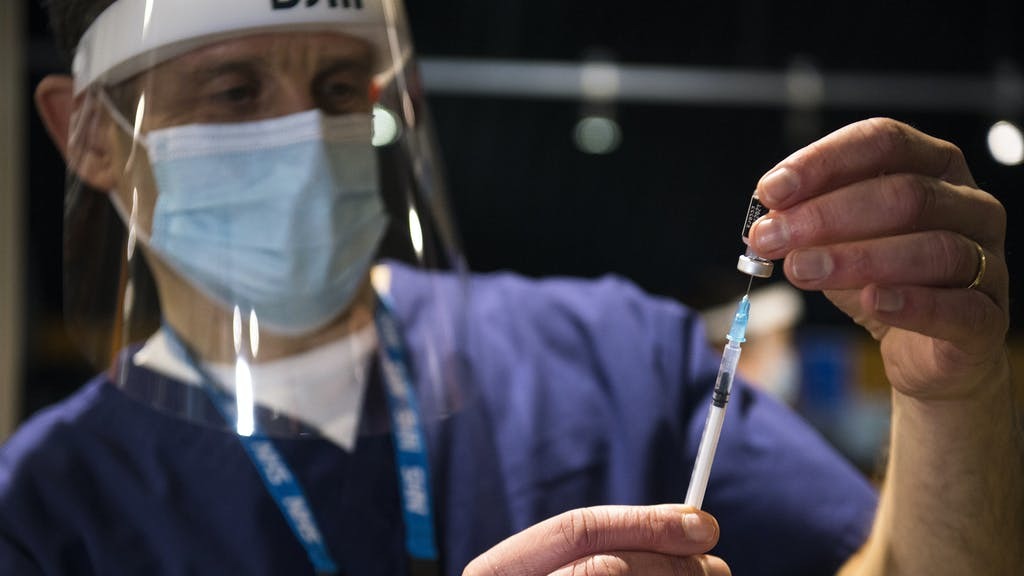
Covid warriors were administered with mock vaccination as a part of the Covid-19 vaccination dry run held in the district hospital in Madikeri and across various health centres in Kushalnagar and Virajpet, on Friday.
Deputy Commissioner Annies Kanmani Joy inspected the vaccination and enrollment centres and monitored the preparations towards software registration process, storage of vaccines, transportation, de-freezing processes and other mock exercises as a part of the dry run.
She said that the dry run was held in six centres in the district, namely, district hospital in Madikeri, taluk hospital in Somwarpet, Community Health Centre in Kushalnagar, Primary Health Centre in Kakotuparambu village, Institute of Dental Sciences in Virajpet and Urban Health Centre in Madikeri.
Kodagu Institute of Medical Sciences (KoIMS) Director Dr Cariappa, District Health and Family Welfare Officer Dr K Mohan and others were present.
During the dry run held at PHC, Kakotuparambu, medical officer Dr Shrishaini said that 25 health workers were selected for administering the mock Covid-19 vaccination. Those who received vaccination were required to enrol their names by providing Aadhaar card number. Before obtaining vaccination, they were made to wait in a room.
Later, the documents were scrutinised online and the vaccination was administered. The details of the persons getting the vaccination were uploaded online. After vaccination, the person has to take rest in the observation unit for 30 minutes, she said.
If the person experienced any side effects, he/she will be provided with treatment as per the necessary precautionary measures. If there are no side effects, the person will be sent home, she added.
Taluk Medical Officer Dr Yatiraju said that the actual Covid-19 vaccination programme is likely to begin from next week.
The health centres were completely sanitised for the mock vaccination programme.
District Health and Family Welfare Officer Dr Mohan inspected the dry run held at the Community Health Centre in Kushalnagar.
Speaking on the occasion, he said that health workers, Asha and anganwadi workers will be administered with Covid-19 vaccination in the first phase.
District Surveillance Officer Dr S Gopinath was present.
source: http://www.deccanherald.com / Deccan Herald / Home> State> Mangaluru / by DHNS, Madikeri / January 09th, 2021
Rohan Bopanna will partner Portugal’s World No 75 Joao Sousa to begin the 2021 season, including at the Australian Open.
Indian tennis ace Rohan Bopanna (File photo)
Chennai :
Rohan Bopanna will partner Portugal’s Joao Sousa (World No 75) to begin the 2021 season, including at the Australian Open. “I was going to play with Austria’s Jurgen Melzer initially but after the dates changed, that wasn’t feasible. So I have decided to play with Sousa,” he told TNIE .
The first event they will play as a pair is at an ATP 250 event in Melbourne, beginning January 31. Post that, they will play at the Australian Open. Because of the regulations, it’s not going to be easy, it’s something the 40-year-old concedes. For him to play the event beginning January 31, he has to be onsite from January 15.
“I am leaving India on January 14, serve my two weeks of quarantine, do multiple Covid-19 tests and get ready for the 250.” The one good thing is that they will be allowed to practice during the quarantine. “We can practice five hours everyday, but the five hours will include everything… gym work, physio, recovery work in the pool as well as playing on the court.”
However, World No 39 isn’t complaining. “I am just happy because playing amid the pandemic is not easy, so, yeah.” He had been subjected to about 40 Covid-19 tests while he was playing from August to November. More tests await. “There will be one before I leave, one upon arrival and five tests in two weeks before quarantine finishes.”
His plans — including finding a partner — after the Australian swing is evolving. “The one good thing is I am not defending a lot of points in that three-month stretch right to the French Open. I have to play with somebody which will enable to play in the Masters events.” Right now, though, his focus is on Melbourne. Do well there and he will begin an important year — his 23rd on the professional circuit — with the right foot forward.
source: http://www.newindianexpress.com / The New Indian Express / Home> Sport> Tennis / December 25th, 2020
Filter kaapi is an integral part of southern Indian food culture — it’s also the best part of my day
South Indian filter coffee (Getty Images)
This story first appeared on Food52, an online community that gives you everything you need for a happier kitchen and home – that means tested recipes, a shop full of beautiful products, a cooking hotline, and everything in between!
In April, my stainless steel coffee filter ran dry. Which is to say, I ran out of my favorite coffee — in the midst of a lockdown, no access to my Indian grocery store, and broken supply chains (both retail and by way of visiting aunties loaded with gifts). Anyone whose day begins with the certainty of that one precisely made cup would understand when I say: I was sad.
In the end I substituted, managed, survived. (OK, I may have begged a friend across town to mail me the dregs of her stash.) There were certainly far bigger worries to wade through, but its absence was felt. In a shaky world, it was the reassurance of that morning routine that I craved.
Filter coffee, or filter kaapi, is an integral part of South Indian food culture — and, for me, one steeped in nostalgia. When I was a child, unbeknownst to my mother, my grandmother gave me my first diluted half-mug, which carried with it the same sneaky thrill as that first furtive sip of beer a few years later.
As a teenager, the smell of freshly filtered coffee was my cue to get out of bed. As I shuffled down the stairs, my mother would be halfway through making coffee in her gnarled saucepan. Milk boiled first, to which a thick decoction (the coffee extract in the filter) was added — but never boiled — followed by sugar. The liquid was then deftly and repeatedly juggled between saucepan and mug to give it extra foam (norai)—this bit of food theater is entrenched in kaapi tradition (at many coffee houses you can see it poured from a meter high ).
Our days began with the first sip and the crackling of a newspaper, my dad reaching for a pen to begin the crossword. Coffee consumed, we’d quickly fall into our practiced rhythms. There was no lingering or going for another mugful. This was a one-and-done kind of affair.
Because, when made right, one filter kaapi is all you need .
* * *
Though deeply ingrained in morning routines today, coffee isn’t native to India, let alone South India. Regardless of whom you speak to, its arrival is shrouded in myth. Did that one Sufi pilgrim really smuggle in seven beans from Yemen in the 16th century? Did the French introduce it? What is clear is that it proliferated under British rule, as Sandeep Srinivasa carefully reconstructs in his timeline of coffee in India. By the mid 1800s, coffee plants began to thrive in South India’s hilly regions, which proved to possess the perfect growing conditions for the crop.
Coffee drinking in South India had a shaky start. Seen as a predominantly upper-class Brahmanical drink, coffee played a direct role in the early-mid 1900s, as Srinivasa writes, in the Tamil caste’s struggle for equal access to the coffee houses of the time. By the time the struggle reached its zenith in the early 1940s, the Coffee Board of India (formed to promote coffee production) was born, and South India was producing enough arabica and robusta beans not just for export, but also to be consumed domestically.
It isn’t just the beans that make South Indian filter coffee so unique, though — it’s a combination of how those beans are roasted and ground, brewed, and eventually served. A lot of these practiced rituals, along with the impenetrable sentiment for them, are passed down within families.
One of my own abiding memories from when we lived in Mumbai was accompanying my mother to a neighborhood called Matunga, a South Indian stronghold, to buy our monthly supply of coffee. There, I’d stand by as she oversaw the grind, enjoying the opportunity to practice her Tamil in what was often a lopsided conversation. On the drive home, the car’s recirculated air would be flush with the aroma escaping from the loosely bound packs of coffee. That unmistakable smell was largely thanks to the particular addition of chicory to arabica beans — in my mother’s case, in a golden ratio of 1:5.
Indeed, the subject of chicory — a caffeine-free coffee substitute used for its resemblance in color and aroma — cleaves South Indian coffee lovers down the middle. Purists hate when it appears in their coffee blend; others, like me, love its special touch of bitterness and strong aroma. (On my first visit to New Orleans, I gushed over the coffee at Cafe Du Monde, which is a mix of chicory and coffee — a rare sighting in these parts.)
According to Srinivasa, the addition of (and substitution with) chicory in filter coffee, as we know it today, took off during World War II, when coffee trade routes were disrupted and the industry suffered a setback. However, in this fascinating account tracing the roots of filter coffee, writer Vikram Doctor finds an antecedent as far back as 1876, in a Scottish drink called Camp Coffee . When mixed with hot milk, Doctor notes that the sweetened coffee-chicory essence tastes remarkably like filter coffee.
The other distinguishing feature of filter kaapi is the filter apparatus itself. A simple but effective device, it is a stainless steel or brass percolator divided into two halves, with a plunger, and an airtight lid. The bottom of the upper half is pierced with the tiniest holes, through which the coffee drips into the container below. While similarly constructed percolators find mention in cookbooks like in Culinary Jottings for Madras, which dates as far back as 1878, as Doctor mentions here , the one in use today might well be a homegrown, practical, metal version of the foreign percolators introduced to India.
I think back to my own great-grandmother, who enjoyed working with her trusty metalsmith to design rustic versions of all sorts of non-native cookware — doughnut makers and dessert molds and egg poachers — and the evolution of filters from do-it-yourself to commercially produced seems entirely plausible.
Across the oceans today, in my Brooklyn home, filter coffee gives me the familiar foundation I need to start each day. Each morning, I get out my single-serving percolator (most filters for home use are sized for one or two) and measure out two heaping teaspoons of coffee. I take care to press down with the plunger — not firmly enough and you risk the hot water running through too quickly, too hard and it goes all clogged-drain on you — before I pour over the boiling water, and wait it out. It’s this slow-brewing process that makes the coffee so special. As Vikram Doctor tells me: “The initial heat gets some of the bitter aromas that you get from espresso, but not all of it, and then the longer brewing gets the mellow flavours.”
To the patient go the spoils.
A couple months into running out of coffee this past spring, and in an attempt to find a more sustainable supply, I came across a pandemic mini-miracle: Ministry of Kaapi , a supplier of “damn fine Indian coffee” right here in New York. Founder Danée Shows was introduced to South Indian coffee when her husband Shiv’s sister sent them a batch from India. She loved it so much, she searched high and low for replenishment here in the U.S. — and failed. Taking matters into their own hands, they set up shop, selling everything from coffee blends to paraphernalia, including the traditional tumbler and davara set that’s part of the ceremony of serving filter coffee (and is widely used today, but has its own troubled origins).
Shows enjoys the challenge of introducing kaapi to a new audience that often mistake it for American drip coffee (“it is a drip but a very slow one”). And for those intimidated by the filter or the brew time, they offer bottled decoction (liquid coffee extract) that can be stored in the fridge for up to a month. “Stocking your fridge with decoction means freeing up time, while still savoring a super fresh, small-batch brew,” she says.
At-the-ready decoction is a thrilling convenience, even for someone like me who carries her filter everywhere she goes. In India, friends tell me about iD coffee, decoction sold in sachets that have been a game-changer for those unfamiliar with the filtration process — North Indians particularly, but not exclusively, are more used to tea—but who crave the filter coffee made at friends’ homes.
My own mother is very used to requests for filter coffee from her (pre-pandemic) guests, and she’s always thrilled to oblige. Her only caveat: “Do you have 30 minutes? Because that’s how long it will take.” My father at this point would shift uneasily in his seat, having already prepared his goodbyes. He’d no doubt find a bottle of decoction or a stock of sachets very handy in these situations.
For the daily, and very necessary, morning cup, however, I will always enjoy the meditative ritual of slow-brewing that single, singularly delicious cup. On days when I know I’ll be short on time or patience, I let it drip the previous night, and it tastes just as delicious. But I almost never skip the frothing trick — the stretch-pouring between saucepan and mug — a bit of early-morning daredevilry to arrive at a coffee that hits the spot every time: smooth, strong, aromatic, with a lofty, wobbly crown of foam.
Hot tips:
Pick a ratio of chicory-to-coffee that you enjoy (15:85, 20:80 . . .) You can also just pick a “pure filter coffee” (without chicory).
Store your ground coffee in the fridge so it stays fresh longer (and retains its aroma).
If you’re short on time, set the filter to drip before you go to bed. In cooler months, it will stay fresh on the counter. If it’s very warm, you might consider storing your decoction overnight in the fridge (once it has dripped).
Decoction can stay in the fridge for up to a day.
When making your cup, boil the milk, then cut the heat and add the decoction, ie, don’t boil the decoction with the milk — it loses flavor.
While the traditional way to drink it is hot, Partnerships Editor (and fellow filter-coffee fan) Erin Alexander loves drinking it cold with milk and ice (like an iced latte). “I know it’s against the rules, but it’s sooo much better than regular iced coffee,” she says. My thoughts on that? Have it as you will, as long as you enjoy it!
ARATI MENON
source: http://www.salon.com / Salon / Home / by Arati Menon / December 24th, 2020
Sanjana Kattera, a corona warrior who was part of the Oxford COVID-19 vaccine trial team, is ‘Coorg Person of the Year, 2020’, according to a release.
Kodagu-born Dr. Sanjana was involved in treating COVID-affected children. A paediatrician, she was part of the vaccine trial team at the Liverpool School of Tropical Medicine in the United Kingdom. The release said Dr. Sanjana served patients selflessly by risking her life, especially when PPE suits were in short supply initially.
Dr. Sanjana was selected ‘Coorg Person of the Year’ in a poll conducted by www.coorgtourisminfo.com, Kodagu’s first news portal, promoted by senior journalist P.T. Bopanna.
She worked with phase I/II of the trial with the age group 18-55 years by initially screening and recruiting patients as part of the eligibility criteria.
Dr. Sanjana, daughter of Suresh Kattera and Smitha Suresh, did her schooling in the United World College South East Asia (UWCSEA) in Singapore.
She studied medicine at the University of Edinburgh in the U.K. After completing her medicine, she specialised in paediatrics in a hospital in the U.K, and is currently training in NHS, Liverpool. She will be completing her Membership of the Royal College of Paediatrics and Child Health (MRCPCH) early next year.
The corona warrior had a tough competition for the ‘Coorg Person of the Year’ title from M.A. Ganapathy, IPS, director-general of the Bureau of Civil Aviation Security (BCAS), the release added.
source: http://www.thehindu.com / The Hindu / Home> News> States> Karnataka / by Special Correspondent / Mysuru – December 21st, 2020
Joshna’s contemporary Dipika Pallikal has competed in 297 PSA Tour matches. England’s Alison Waters (487) and Camille Serme (France, 439) have topped the list in the women’s category.
Joshna Chinappa achieved the unique feat in the CIB-Black Ball Squash Open in Cairo (Egypt). – RITU RAJ KONWAR (FILE PHOTO)
India squashplayer Joshna Chinappabecame the first Indian female player and second (male and female) to play 400 PSA Tour squash matches.
The 34-year-old achieved the unique feat in the CIB-Black Ball Squash Open in Cairo (Egypt).
The Indian, seeded 10, defeated Julianne Courtice of England 10-12, 11-6, 11-9, 12-10 in the women’s first round.
Only Saurav Ghosal (444) has played more than Joshna.
Joshna’s contemporary Dipika Pallikal has competed in 297 PSA Tour matches. England’s Alison Waters (487) and Camille Serme (France, 439) have topped the list in the women’s category.
source: http://www.sportstar.thehindu.com / SportStar / Home> Squash / by Team SportStar / Chennai – December 09th, 2020
For Poonam Thimmaiah, jewellery designing began as a means to cope with personal tragedy and turned into a passion project and finally a full-time career.
Following the devastating tragedy of losing her baby, Kodagu’s Poonam Thimmaiah, now a New Yorker, embarked on a personal journey of change, which led her to pursue her keen interest in jewellery designing and sustainable art. Poonam, who started her own brand of jewellery – Maalicious – had her work featured in the New York and Paris fashion weeks this year, just a year after she established the company. Her journey of overcoming tragedy to embracing art and making it big is an inspirational one.
In 2017, Poonam, who was working at JP Morgan in New York, had a miscarriage. Her journey into jewellery designing started as an escape from the tragedy. She returned to India to be with her family in Mysuru during this difficult time and it was here that she decided to pursue her passion.
NY Fashion week. Maalicious earrings in collaboration with Lola Elan clothing and Ochini Milinery headpiece.
When Poonam visited her Alma Mater, JC Engineering College in Mysuru, she learned of a jewelry designing course for the children with physical disabilities. Poonam, who has always made her own jewelry in the past, worked with these kids on her first collection. Together, they made earrings using sustainable materials like clay, wood and thread. “That’s when I discovered that this is what I should be doing. Along with these students, I learned a lot about the art of jewelry designing,” Poonam says.
Poonam Thimmaiah at her outlet in New York
She taught the group of 10 children in the programme how to sculpt, draw and paint. In the process, she says, she rediscovered the talent she had for designing jewellery. A few months later, Poonam went back to New York and quit her job. She decided to start designing jewellery and felt sure that she wanted to bring back the touch of handicraft to her work.
It was later in 2017 that Poonam contacted an acquaintance, Sruthi Mascarenas, a sculptor working with clay in Goa, and commissioned her to make the earrings that she had designed. Poonam says that she wanted every piece of jewellery she designed to tell a story – one of historical relevance to India. In her first piece, she envisioned a clay plate with a painting of Queen Victoria meeting her namesake – a young woman from Kodagu.
“The piece is called Victoria Repeated. It’s a picture of Victoria from Kodagu meeting Queen Victoria and both of them are wearing a lot of jewellery. These earrings were made of clay and hand-painted. It was featured in Flying Solo’s (a fashion retail space in New York) collection in the Paris Fashion Week,” Poonam adds.
In 2019, Poonam established Maalicious officially and in the year running up to it, she decided to commission her work to women in the business of making handicrafts in India. She contracts her metal and stone work to a group of 25 women in Jaipur. Anything to do with tassels, she commissions it to an artist in Mumbai, and jewellery made of polymer clay is commissioned to an artist in Chennai.
Amrita Shergill earrings. Amrita Sher-Gil, the most famous Indian painter. Today, she is known as India’s Frida Kahlo. The earrings are made by Shruti Mascarehnas.
“With Maalicious, I want to rejuvenate traditional art and workmanship with Indian charm and a touch of urban flair. I have earrings that have Amrita Sher-Gil on it. A lot of people know about Frida Kahlo and not many in other countries are aware that we have someone of our own – Amrita Sher-Gil. I also wanted to use sustainable materials like clay, wood, silk and thread. We’ve started customising our earrings so anyone can get any picture they want painted on their earrings,” Poonam says.
Celebrity endorsement: Divya khosla Kumar in Drokpa earrings, made by artisan Soniya.
Malicious began retailing with Flying Solo’s retail unit in New York and became an instant hit. With celebrity stylists visiting the store, her pieces began selling out. In 2020, Poonam carried out various social media campaigns. “We did a lot of virtual pop-ups and this summer was really good. We had a lot of celebrity endorsements on social media. Actor Divya Khosla Kumar wore our jewellery, Raadi Shetty, American influencer who is big here, endorsed our jewellery. We had a lot of Instagram influencers endorse us,” she says.
This year, Flying Solo selected Poonam’s jewellery designs to be featured for their show in the New York and Paris fashion weeks. Fourteen of her pieces were featured in the New York Fashion Week and eight in the Paris Fashion Week. Flying Solo had curated its show by collaborating with 63 designers from 14 countries. Poonam says her work was chosen as each of her designed pieces are made by hand and use sustainable materials.
“I felt like I’ve created something, where I was spoken of as a designer. People at the fashion week asked me what my inspiration was. It went from a passion project when I was pregnant and became something big during the fashion week. It’s really nice to have the appreciation. It gives me confidence,” Poonam says.
source: http://www.thenewsminute.com / The News Minute / Home> Features> Fashion / by Theja Ram / November 12th, 2020
WELCOME. If you like what you see "SUBSCRIBE via EMAIL" to receive FREE regular UPDATES.
Read More »