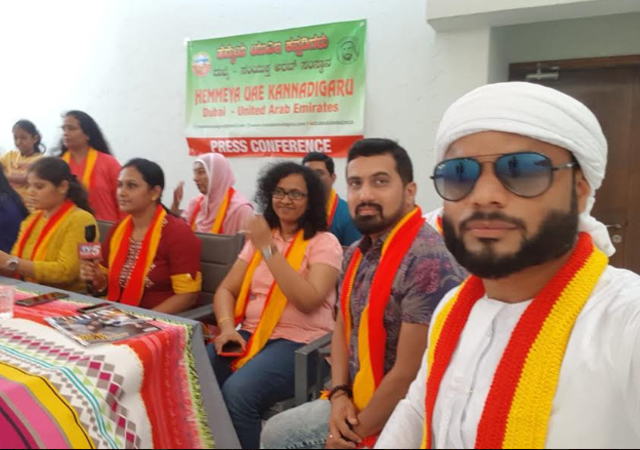
Hemmeya UAE Kannadigaru, Dubai’ team will be celebrating Dubai Dasara Kreedotsava – 2019 on October 11, at the Etisalat Sports Academy here.
Several Kannada kids, women, men, athletes, sportspersons will be participating in this mega sports event this year.
The second Dubai Dasara Koota is being organized by ‘Hemmeya UAE Kannadigaru Dubai’ family, which will begin at 8 am on the said date. It will be inaugurated and presided over by an international sports star, Arjuna award winner, Ashwini Nachappa.
The programme will be officially initiated by the lighting of sports lamps by the chief guest and the rendering of the state anthem. This will be followed by several sports activities including athletics, throwball, volleyball, football, kabaddi, kho kho, musical chair, lemon and spoon race and frog race for kids, rangoli and Gombe competition for ladies and many other games.
This year, ‘Hemmeya UAE Kannadigaru Dubai’ decided to identify people of Karnataka with stellar contributions to sports by honouring them with ‘Kreeda Ratna’ award. The award will be presented by Ashwini Nachappa.
Well-known anchor and voice-over artist from Karnataka Shruti will be anchoring the programmes of the day.
‘Hemmeya UAE Kannadigaru Dubai,’ has requested all the non-resident Kannadigas currently living in Dubai to attend this sport meet in large numbers and contribute to the success of this mega sports event.
The press conference organized to announce the programme was attended by members of the team, Shashidar, Rafiq Ali, Sudeep, Senthil, Madhu Gowda, Anitha Ram, Mamatha Raghavendra, Mamatha Senthil, Pallavi, Hadiya, Dr Savita, Vishnu Murthy, Venkatesh and Satish.
source: http://www.daijiworld.com / DaijiWorld.com / Home> Middle East / by Media Release / October 10th, 2019
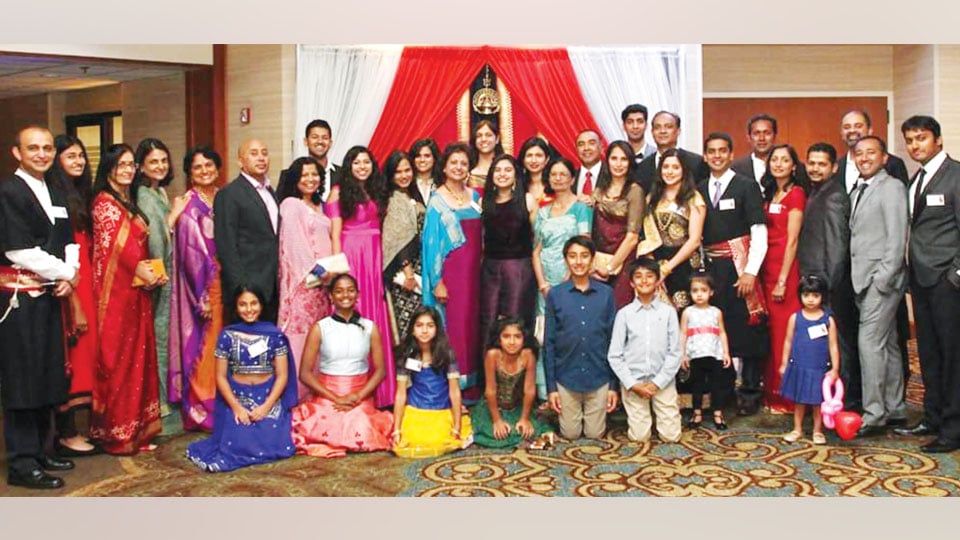
The North American Kodava Convention was hosted by Kodavas of Greater Boston area from Aug. 30 to Sept. 1.
Kodavas from across Continental US, Hawaii, Canada, India and UAE joined the convention that was one of the largest gathering of Kodavas in North America. Over 400 people attended the event.
The community came together as ‘Okka’ at the convention which was aimed at bringing the community closer, renew old relations and forge new ones, facilitate connections for youngsters who are growing up in a foreign land to their Kodagu roots and to help preserve and nurture the rich Kodava heritage, culture and language.
The event was organised at Marriott Copley Hotel in the heart of Boston. The weekend festivities kicked off with an informal meet of the gathering on the evening of Aug. 30 at the hotel lounge, followed by ‘Oorkuduva’ evening on Aug. 31 at the world-renowned MIT Media Lab, to showcase the intellectual side of Boston.
The ‘Oorkuduva’ evening had presentations regarding the origin of culture and biodiversity in Kodagu related to genealogy, including preliminary data from the ‘Kodava Genome Initiative’, which was presented by Prof. Maanasa Raghavan and her Ph.D. student Arjun Biddanda.
The evening also included a talent show of Kodava children in the art of public speaking, piano recitals, jazz-saxophone performance and singing. It was an idyllic setting for an ‘Oorkuduva’ gathering at the MIT Media, overlooking the Charles River and spectacular views of Boston skyline.
There was Kodava Vaalaga after dinner which got most of the guests onto the dance floor. The party then shifted to the Marriott Copley Hotel where Deep Chinappa entertained guests with his rock band, the ‘Deep C Divers’.
There were several daytime activities including tours of various historical and cultural Boston landmarks, walks along the popular Freedom Trail, kayaking on the Charles River and tours of MIT and Harvard campuses. The highlight of the Convention was the gala reception on Sept. 1 at the Grand Ballroom of the Hotel.
It was a Kodava wedding muhurtha-like atmosphere where guests sported their traditional attire. The programme included Kodava folk dances like ‘puthari kolaat’ by Kodava men, an up-tempo exhilarating ‘bode namme’ style carnival dance.
The programme also had panel discussions that covered topics like, “Our enchanting Kodagu: Change is inevitable! The resources are at their limits. How do we advance our beloved Kodagu on a global scale in a sustainable way, while preserving our unique culture, family values, and one-of-its-kind natural bounty? What role each person can play towards achieving these goals? How do we inspire youngsters and serve as role models to excel in whatever field they choose?”
The panellists included Belliappa Cheppudira, an educationist, coffee planter, an entrepreneur, an accomplished novelist and author of several books including ‘Tale of a Tiger’s Tail’, ‘Yarns from Coorg’, ‘Nuggets from Coorg History’, and ‘Victoria Gowramma: The Lost Princess of Coorg’.
Others were Dr. Zarin Machanda, Assistant Professor at Tufts University and Director of Kibale Chimpanzee Project in Uganda and Dr. Naren Anjaparavanda, Professor of Paediatrics at the University of Cincinnati.
After the discussion, the guests were treated to delicious authentic Kodagu food including ‘kadambuttu,’ ‘nooputtu,’ ‘Onakyerchi’ ‘nucchi kum’ curry, ‘kadale payasa’ and of course the traditional ‘pandi’ curry.
The evening’s programme also included an annual update from Kodava Koota and presentation of high school achievement awards sponsored by Bachranianda Muthappa and Rani Education Fund.
The convention ended with a resolve to organise the next convention at San Francisco Bay Area in 2020.
source: http://www.starofmysore.com / Star of Mysore / Home> News / September 22nd, 2019
India’s first environment school — World Environment School — is all set to be opened in Coorg, Karnataka. It will also be the first school in entire South Asia to take a leading role in promoting and delivering environmental education with sustainability at its core. Spread over a hundred acres across the beautiful hills of Coorg, the school’s focus will be to build strong environmental and moral values among its students.
Mobius Foundation, a non-profit organization working towards environmental sustainability, in partnership with the UK-based Whitgift School announced the launch of this initiative at International Conference on Sustainable Education.
“WESc will be operational from 2021 for Grade 6 to 12 students from India and around the world. The school will cater to the parents who want the next generation to be actively involved in the protection and sustainability of the environment apart from a world-class education,” said Pradip Burman, Chairman, Mobius Foundation.
WESc will offer an international curriculum with affiliation from Cambridge Assessments and International Baccalaureate.
“The need for environmental education is growing rapidly as the degradation of the environment is taking place at a fast pace and we have taken a lead role in this direction by launching India’s first environment school,” said Chris Ramsay, Head Master, Whitgift.
source: http://www.dailypioneer.com / The Pioneer / Home> India / by PNS, New Delhi / September 12th, 2019
Unexpected wonders abound when immersed in the Coorg culture of southern India.
A thunderclap heralds the first, early rains of the monsoon season minutes after my arrival in the misty highlands of Coorg in southern India. From the deck of the Taj Madikeri Resort and Spa, cantilevered over a seemingly infinite valley, I have a dress-circle view of the approaching stormfront and rolling peaks silhouetted to the horizon. Swallows pirouette as front office manager Anant Marwah describes the coming wet season, when clouds billow into the open foyer and pass through the body like shivers. “You should see the monsoon — it’s amazing,” he says. “Mother Nature does most of the work here.”
Despite its name the resort is not, in fact, in Madikeri, the hill-station capital of Coorg district in Karnataka state. This is frustrating because I’d hoped to be staying in the heart of the land eulogised by Irish writer Dervla Murphy for its sacred forests and coffee-scented hills. But my disappointment is short-lived. The property, 1200m above sea level and 9km from Madikeri down a broken road flanked by rice paddies and the odd azure kingfisher, turns out to be a microcosm of Coorg culture.
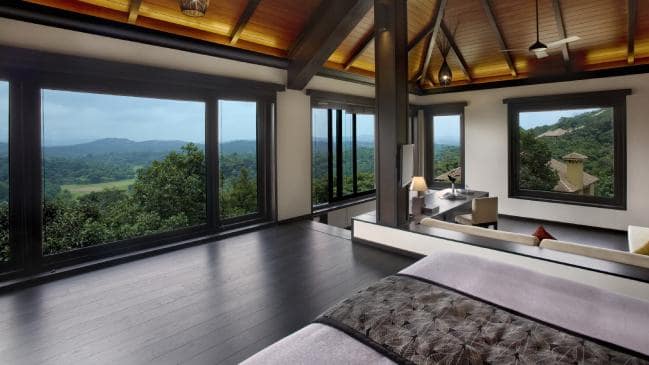
A guestroom at the Taj Madikeri
Its 63 cottages and villas, carefully built over seven years to minimise disruption to the landscape, sit cloistered in 12ha of rainforest and coffee plantations. Constructed from recycled timbers and bricks made on-site from marsh soils (the quarry is now a pretty lake between the herb garden and main pool), the cottages’ external walls are coated in natural mud paint so as not to disturb wildlife. Pitched-roof interiors feature vast, screened windows over the semi-wilderness, fireplace snugs and fish-trap decorations woven by local tribal people. Barking deer stalk the grounds at night.
But it is the indigenous Kodava staff who give the hotel its strongest character and meaning. Colonel Pattamada Muthana, retired, commutes daily from Madikeri to the hotel’s onsite “conservatory”, a compact museum where he shares his people’s story with guests. Displays depict Coorgi dress, marriage rituals, faith and other traditions.
Dressed in camel corduroys, braces and impeccably polished boots, his kind face framed by specs and a faintly regimental moustache, Colonel Muthana explains how the Kodava view themselves as a distinct tribe, despite not being recognised as such by the Indian government.
“For some reason we were not scheduled, maybe because nobody knows our origin,” he suggests. But many Kodava suspect their ancestors were followers of Alexander the Great, who fled here after the Macedonian king’s failed bid to conquer India.
Guide Amaanda Pradhan Poovanna, known as Pradhan, picks up the Kodava creation story during a dawn hike to the top of Nishani Peak.
“It’s still believed we don’t belong to India, that we are descendants of Persians,” he explains as we pass by tiger pug marks, perhaps a week old, on the track.
The Kodava language, a hybrid of southern tongues and about 200 Persian words, and their distinctive features set them apart from other Indian peoples. “The ladies are fairer and they have blue eyes. The men have broader noses and curly hair, and most of them are from the warrior race.”
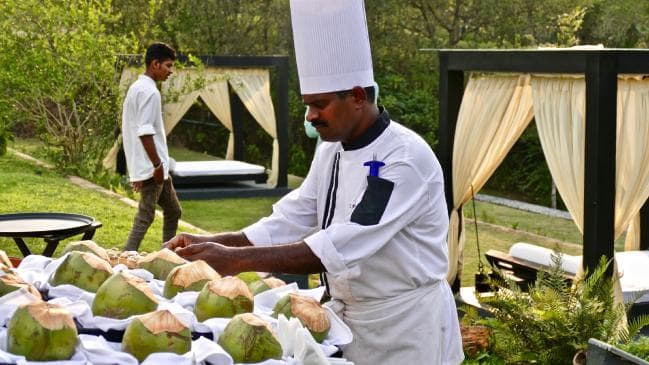
Coconut refreshment station at the end of a nature walk.
Kodava men often seek army careers. “If there are two sons, one will definitely be in the army,” Pradhan explains. “The other will be in sports. I am the only son, so my parents didn’t let me join the army. But I play hockey, for 15 years now.”
The cries of jungle fowl and yellow-throated bulbuls greet us as we emerge from a shola grove on to a grassy summit with a mesmerising sweep of highland scenery.
“What you are breathing is the purest oxygen, totally unpolluted,” he grins. I learn so much from Pradhan about life in Coorg (also known as Kodagu in post-colonial India), from the timing of the harvest calendar — cardamom in October, arabica coffee berries and rice in November-December, robusta berries in January, pepper in March — to the local diet of smoked boar meat and booze.
The Kodava are keen and resourceful drinkers, making wine out of everything from coffee to bird’s-eye chillies. “Without liquor and meat nothing happens in Coorg,” Pradhan assures me.
Privileged access and insights into local traditions are hallmarks of my 10-day, tailor-made swing through South India with Adventure World Travel. Even if I had been staying in the heart of Madikeri, I can’t imagine understanding the region as well as I do within the confines of the Taj resort.
Every aspect of the hotel is steeped in Coorgi culture, from ritual gudda baths of wood-heated local water rich in minerals and fragrant with lime leaves, to the seasonal and regional menus of executive chef Jose Thachil. Hel hails from neighbouring Kerala so is well versed in South India’s spice bounty of pepper, cloves, cardamom and kokum that has lured Roman, Greek and Arab traders to the Malabar Coast since ancient times. He prepares fish steamed in cardamom leaves and pork slow-braised in a cocktail of spices and laced with syrupy black kokum vinegar, a staple Kodava condiment so tart it makes the cheeks flinch.
On a nature walk through some of the resort’s 70ha green belt, Pradhan shares his ancestral knowledge of forest medicines.
Wild tobacco is used on the skin as a leech repellent during the monsoon. Peppercorns and basil are blended into a paste to “keep the throat clear”; Brahmi leaves are considered very good for children’s hair and memory. “If you eat one Brahmi leaf, one basil leaf and one neem leaf every morning, you will stay away from all the diseases,” he says.
There are thousands of wild elephants in these hills, though we see none. Leopards also prowl the highlands, and king cobras, the world’s largest venomous snake, come in XL sizes here. The biggest one discovered to date was 8m long.
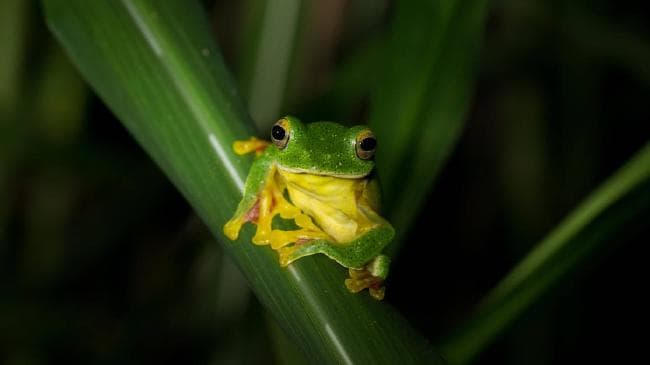
A Malabar flying frog. Picture: Alamy
Above us, flying lizards, frogs and squirrels have adapted to life in the treetops. Frogs thrive in the annual six-month monsoon, from May to October. The Malabar gliding frog is just one of more than 40 species, which include dancing frogs and purple frogs. Mushrooms are abundant too, including a fluorescent green fungus that switches on and off like a light. Only four of the 400 types are edible and Kodava children are taught to tell them apart from an early age.
We trace the boundary of a sacred grove where a temple dedicated to the fearsome Kali, goddess of destruction, protects the wilderness from trespassers.
These devara kadu, or “forests of the gods”, were once common across India but succumbed gradually to agriculture and development. They persist in the south, particularly in Kerala and Coorg, where, says Pradhan, “we value the importance of the wildlife and forests because they give us food, oxygen and rainfall”. He opens my eyes to Coorg’s charmed surroundings. After dinners I sit outside my jungle house in the blackness as fireflies blink brightly all around me.
Insect orchestras with frog percussion sections serenade me to sleep each night. The sweet song of the Nilgiri coucal and the dirge of the tone-deaf Malabar whistling thrush wake me at sunrise.
On the last morning, bags packed and waiting for a jeep to collect me, I’m taking one last, deep draught of my surroundings when something crashes into the tangle of branches outside my windows. I step closer to see what it is and stand eye-to-eye with a Malabar pied hornbill. It looks as shocked as I do to find itself so close to such an exotic creature, and stays frozen in a bid to blend into its surroundings. This is not easy when you are a large black bird with an enormous yellow bill and casque, so we just stand there, staring at each other, in a fitting farewell to an adventure defined by unexpected wonders.
Kendall Hill was a guest of Adventure World Travel and Taj Madikeri Resort & Spa.
In the Know
Adventure World Travel tailors holidays, from flights to accommodation and experiences. Its 11-night South India itinerary from Chennai to Bangalore via Tanjore, Hyderabad, Bekal and Coorg includes stays at members of the luxury Taj Hotels group, breakfasts, internal flights, tours and activities, all transfers and sightseeing by minibus. From $7295 a person twin-share.
Singapore Airlines has excellent connections between eight Australian cities and South India, flying to Chennai, Bengaluru, Hyderabad and Kochi via Singapore.
UAE Kannadigas and Tuluvas bid an emotional farewell to creative art director B K Ganesh Rai, who had come from the land of warriors and natural beauty Kodagu district of Karnataka, 25 years ago and is going back to his native after retirement.
The farewell function took place on Friday, August 2 at 11 am at the Fortune Plaza auditorium at Al Ghusais in Dubai.
The convener of UAE Kannadigaru and Tuluvara Sanghatane, which consists of 40 pro-Karnataka organizations, Sarvotham Shetty welcomed the gathering.
B K Ganesh Rai was serving as the creative art director and manager at the Gulf Public Relations and Advertising section, which is one of the B R Ventures group of companies that is owned by senior entrepreneur of UAE Dr B R Shetty.
Sarvotham Shetty lauded the social service done by Ganesh Rai by getting involved in various pro-Karnataka organizations that are active in UAE.
He also congratulated Majula Ganesh Rai, wife of Ganesh Rai and their children Monish Rai and Aishwarya Rai.
Ganesh Rai is sculptor by profession. In addition, he is an expert artist and computer graphic designing. He himself is a blood donor. He has played a stellar role in organizing the blood camps by pro-Karnataka associations. He has designed more or less all the emblems of Kannada associations. In addition, he has depicted the rich cultural heritage of Karnataka through various digital displays and canvas. He has also designed the invitation cards of meetings, functions, Sneha Milana, sports meets, leisure outings and literature conventions. Ganesh Rai, who is a writer also, has published articles about great personalities before and after the programmes of various organization in web media. He has also compered many Kannada events and participated as the chief guest.
Honorary accreditation certificate from Dubai government health authority
Ganesh Rai started blood donations camps from the time he was the president of Sharjah Karnataka Sangha and continued to organize blood donation camps through all pro-Karnataka associations from 2007 to 2019. Recognizing Ganesh Rai’s efforts in organizing blood donation camps, the Dubai government health authority conferred the honorary accreditation certificate on him. This letter was handed over to Ganesh Rai by Balakrishna Salian, organizer of blood camps and Sarvotham Shetty.
Felicitation to Ganesh Rai and family
Ganesh Rai and his family were felicitated in the presence of presidents and office bearers of pro-Karnataka organizations in UAE. Sarvotham Shetty, Premnath Shetty, Balakrishna Salian and Satish Poojary conducted the felicitation. Sampath Shetty read the letter of honour.
Ganesh Rai acknowledged the felicitation offered and thanked the office bearers and members of various associations. He also recalled the encouragement, support, honour and opportunity given to him during his journey of achievement in art.
Organizations served by Ganesh Rai
During his stay of 25 years in UAE, Ganesh Rai has served in Abu Dhabi Karnataka Sangha, Karnataka Sangha Dubai, Karnataka Sangha Sharjah, Karnataka NRI committee UAE, Al Ain Kannada Sangha, India Social and Cultural Center Abu Dhabi, UAE Tulukoota, Namma Tuluver, Tulu Siri Dubai, Dhwani Pratistana UAE, Kannadigaru Dubai, UAE Bunts, Billava Family Dubai, Byaris Cultural Forum Dubai, Mangloor Konkans Dubai, Gammat Kalavider Dubai, Yaksha Mitraru Dubai and Padmashali Samudaya UAE. Mogaveers UAE, Amchigele (GSB) Samaja UAE, Basava Samiti UAE, Ganiga Samaja UAE, Kulala Vrinda UAE, Vokkaliga Samaja UAE, Vishwakarma Seva Samiti UAE, Kodagu-Dakshina Kannad Gowda Samaja, Kodava Samaja, Devadiga Sangha Dubai, Kundapur Devdiga Mitraru (KADAM), Ramakshatriya Sangha UAE, Magadeepa cultural committee, Rajaka Samaja UAE, Tulu Pateruga Tulu Oripaga UAE, Varamahalaxmi Pooja Samiti, Samoohika Sri Satyanarayana Samiti, Brahmana Samaja UAE, Theeya Samaja, Karnataka journalists’ association UAE and Karnataka association Blood Donors’ Group.
Satish Poojary, one of the organizers of UAE Kannadigaru and Tuluvaru compered the event in a grand manner.
source: http://www.daijiworld.com / DaijiWorld.com / Home> Middle East / Media Release / August 05th, 2019
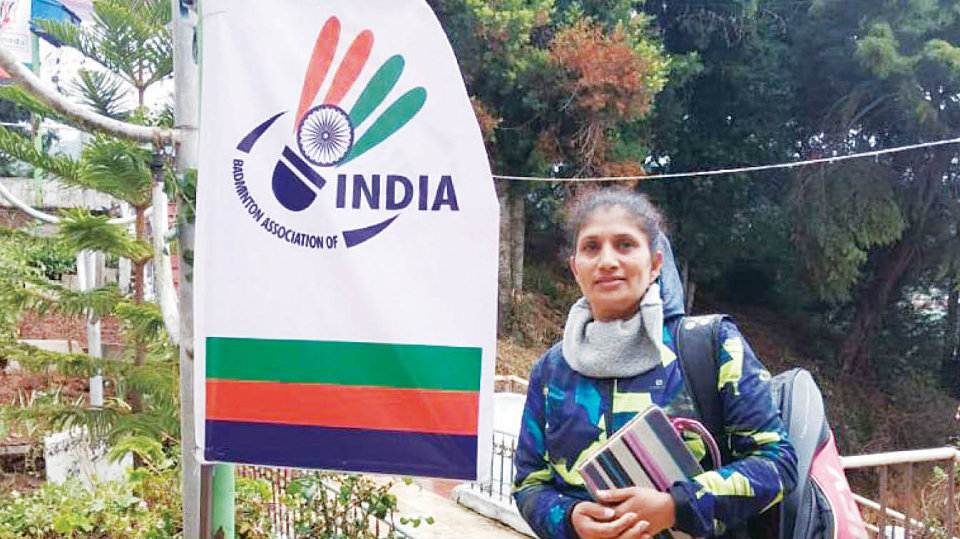
Thathapanda Jyothi Somaiah, daughter of Thathapanda Dally Somaiah and Pookunji Somaiah (Thamane Chettolira) has left for Poland to represent India in World Seniors Badminton Tournament 2019. The tournament will be played from Aug. 4 to 11.
The 2019 BWF World Senior Championships, officially BWF World Senior Badminton Championships Katowice 2019, is a tournament which will be held at Spodek in Katowice, Poland.
This is an individual championship with men’s and women’s singles and doubles, and mixed doubles events. The age categories are divided as: +35, +40, +45, +50, +55, +60 +65, +70 and +75.
The World Senior Championships is a prestigious individual event for players and the winners of each category is awarded a gold medal and crowned World Senior Champion in their particular age category. The runner-up gets a silver medal while the third place winner gets a bronze medal. Jyothi studied in Government Primary School, Maragod and Junior College, Madikeri. She graduated from of FMKMC College, Madikeri and did her B.Ed at Sarvodaya College, Virajpet.
Jyothi has the credit of being a Kodavathi to take part in Republic Day Parade at Delhi in 1984. She has worked as an announcer on AIR, Madikeri.
source: http://www.starofmysore.com / Star of Mysore / Home> Sports / August 02nd, 2019
MANEYAPANDA – Bidappa G., MD July 23, 2019, age 83.
Forever husband of Barbara G. (nee Marker) Maneyapanda; loving father of Dinesh, Jeremy Maneyapanda and Chanda (Jason) Agro; cherished grandpa of Jacob, Cameron, Zachary and Alexander; caring brother of Ponnappa (Chitra), Belliappa (Shaka), Poonacha (Jamuna) and the late Kuttamma (late Ganesh); dear brother-in-law of Gary (Jan) Marker and the late Robert (Carol) Marker; also survived by nieces, nephews and friends. He did what he loved until the very end.
The family will be present on Saturday from 12-3 PM at the (Tonawanda Chapel) AMIGONE FUNERAL HOME, INC., 2600 Sheridan Drive (corner of Parker Blvd), where Funeral Services will follow at 3 PM.
Friends invited.
Share condolences at www.AMIGONE.com
Funeral Home: Amigone Funeral Home, Inc.
source: http://www.buffalonews.com / The Buffalo News / Home> Deaths> Death Notices / July 25th, 2019
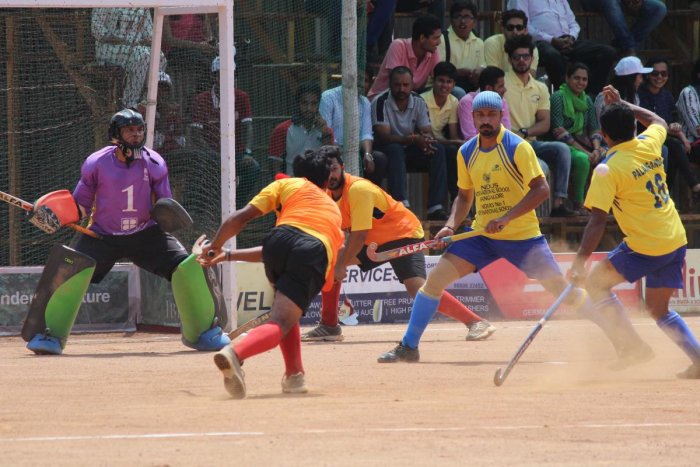
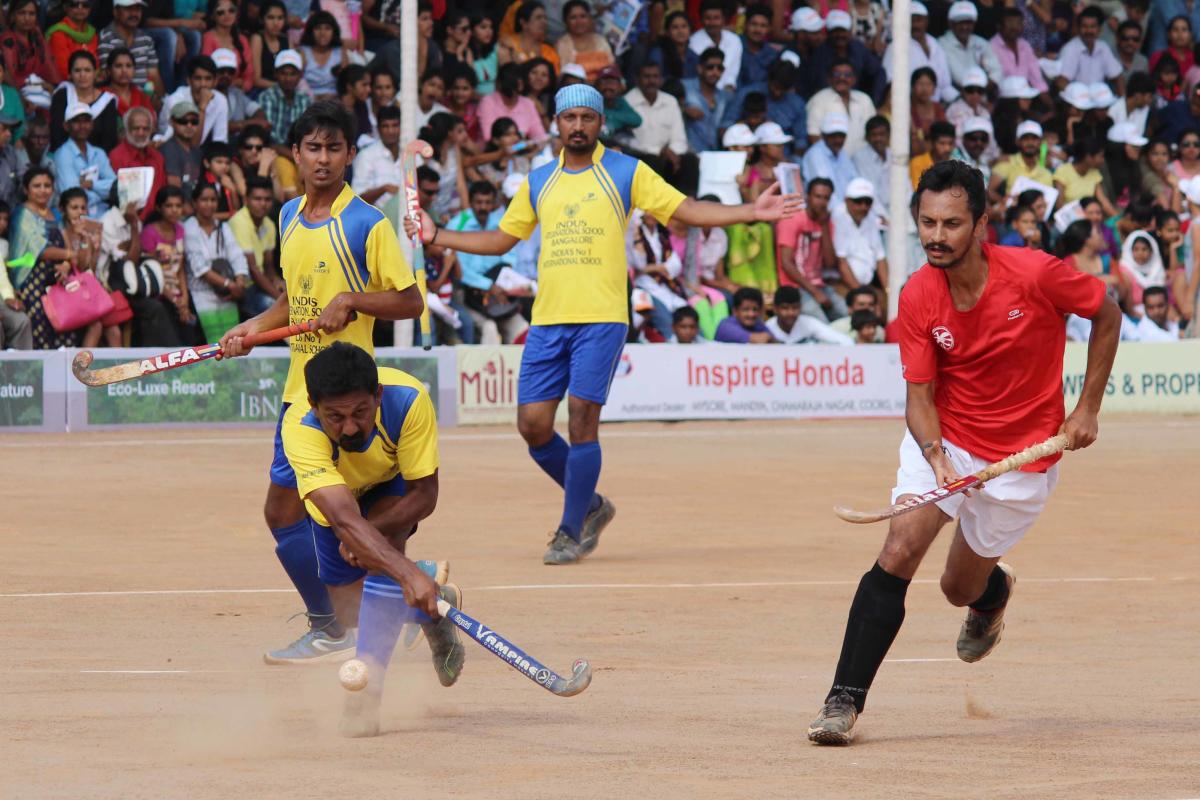
Aiming for a Goal: A match in progress during the Kodava Hockey Festival 2016 in Madikeri, Kodagu. Photos by DH, Niran Shantheyanda
Kodavas loved to pursue two patriotic passions. One was to be part of the nation’s defence forces and the other was to play the national sport. Hence, it was said that a Kodava was born with a hockey stick in one hand and a gun in another.
Hockey was not just a sport in Kodagu, it was a way of living. Kodagu’s children practised and excelled in hockey. There was untapped talent in Kodagu but there was no way to demonstrate it.
Aiming for a Goal: A match in progress during the Kodava Hockey Festival 2016 in Madikeri, Kodagu. / Photos by DH, Niran Shantheyanda
Considering this, Pandanda Kuttappa (Kuttani) and his brother Kashi Ponnappa decided to begin the annual Kodava hockey festival in 1997. “I wanted this festival to be of use to children. I wanted them to get a chance to play for India,” says Kuttappa , former first-division hockey umpire.
That year, Kuttappa’s extended family helped organise the event. Teams from 60 Kodava clans came to participate. The Kaliyanda team won the Pandanda cup. The event is called a festival (namme, in Kodava language), and not a tournament because it helps bring people together to celebrate. Each year one Kodava clan conducts the tournament and the cup is named after the clan. The Kodava Hockey Academy governs the annual festival.
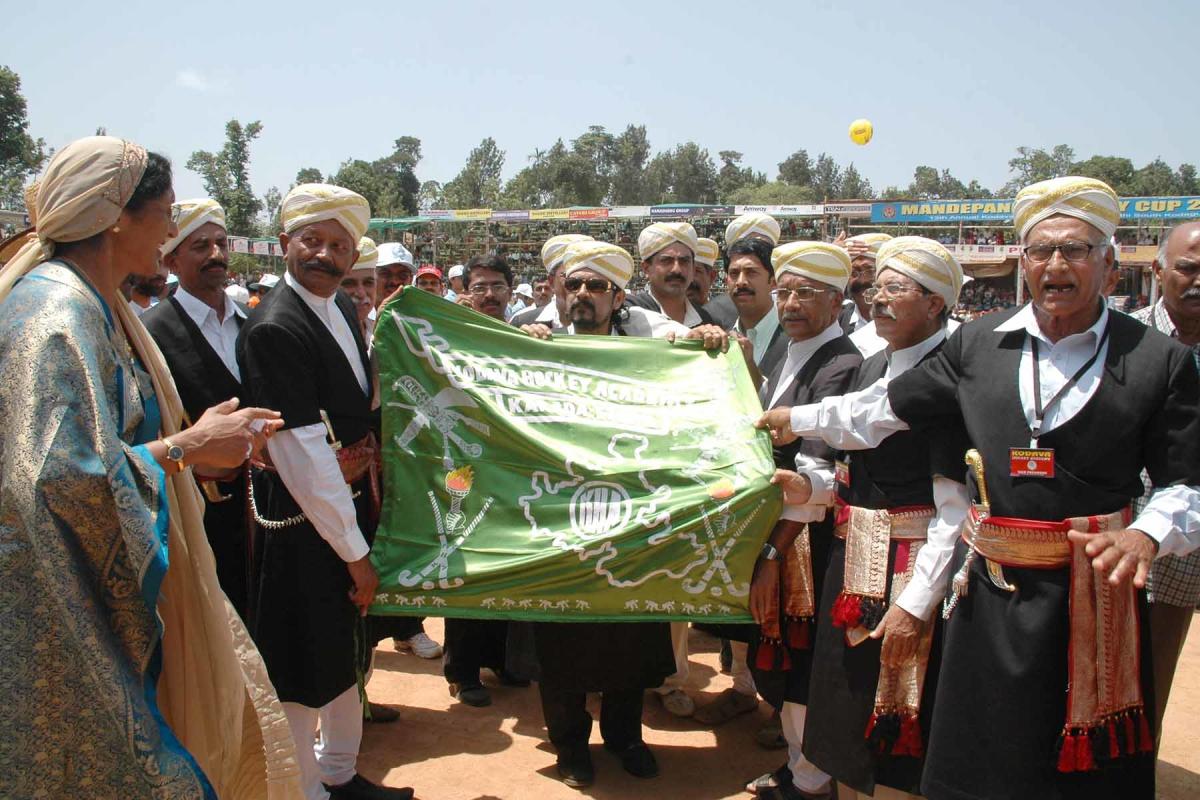
Members releasing the banner of a hockey tournament.
The academy also decides which family can organise the tournament in a particular year. As of now, families have been selected to organise the tournament until 2025.
According to Shantheyanda Ravi Kushalappa, any family that wants to organise the festival should apply to the Kodava Hockey Academy. The application will be checked and considered on a first-come- first-serve basis. The selected family will have a year to prepare for conducting the event. The state government partly funds the event on most years. Lok Sabha MP for Mysore-Kodagu also grants some money. The rest of the money is collected by the family through donations.
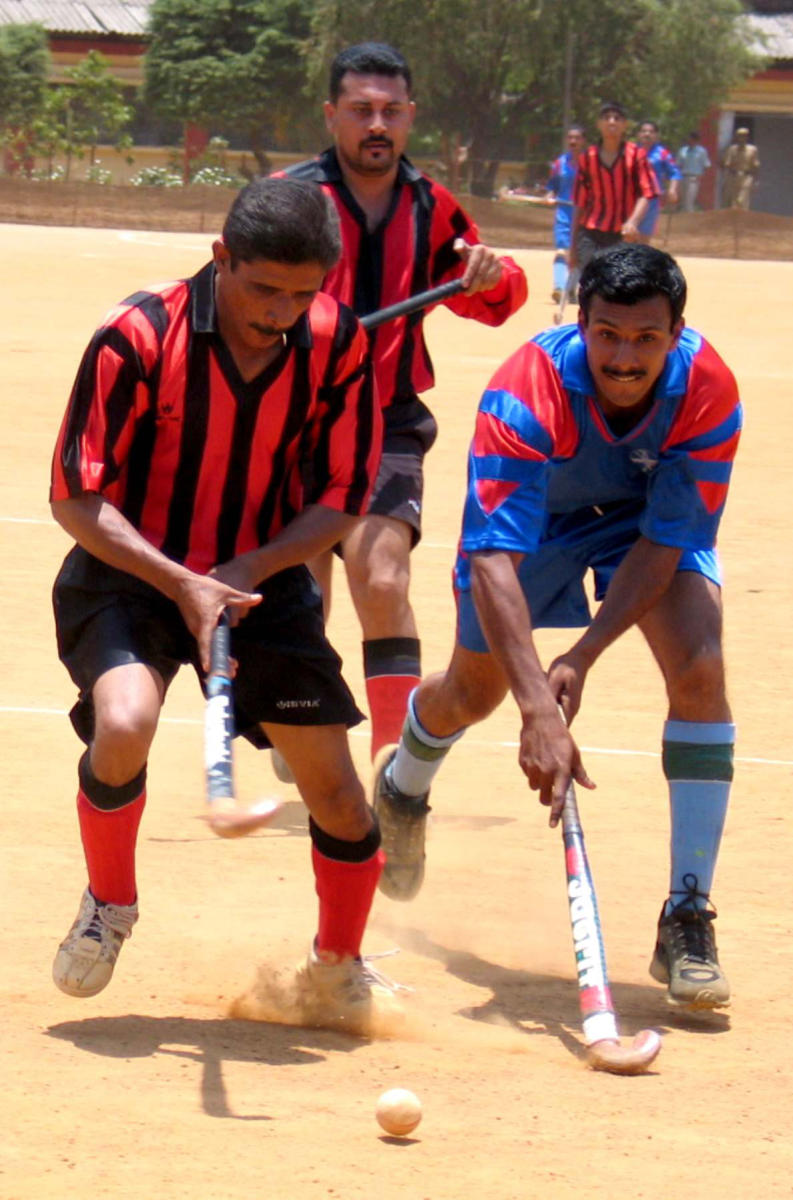
Kodava hockey festival.
The family puts together a committee which is responsible for organising the event. They select a convenient ground and arrange all the facilities near the family’s ancestral residence.
According to the Limca Book of Records, the Kodava hockey festival is both the largest and the longest hockey tournament in India. This is probably the world’s largest family tournament as well. In 2018, 329 teams participated in the Kulletira Cup held in Napoklu.
Men, women and children take part in the tournament. There is no bar on age or gender. Among the prominent women players are goalkeeper Shivachaliyanda Nilan (Ekalavya awardee) and Malamada Lilavati.
In 2014, the Thathanda family organised a rink hockey event for 35 families. Later, two formats were supported: league matches for champions who regularly made it to the semifinals and knockouts for others.
In recent times, a number of similar family tournaments such as Kodava cricket, badminton, tug-of-war and golf, Kodagu Gowda cricket, Kodagu Heggade hockey, Amma Kodava cricket, Yerava cricket, Kodagu Muslim football and volleyball events are held in Kodagu.
The champions
There are a few strong family teams who often make it to the top. The Palanganda team has won the festival the highest number of times (five) so far. They entered the finals eight times (between 2006-2016).
Kodagu has produced several Hockey Olympians like Maneyapanda M Somaya, Mullera P Ganesh, B P Govinda, Arjun Halappa, S V Sunil among others. Most of the winning teams have Olympians in their midst. The Koothanda team, led by former Olympian K K Poonacha, comes a close second, having won the festival four times (including the 1999 draw with Kulletira team) between 1998-2008. The Cheppudira team, with another Olympian C S Poonacha, were the runners-up in the 2001 edition.
Olympian goalkeeper Anjaparavanda B Subbaiah’s team has been consistent over the years since 1997. They were winners twice and in the finals five times. Subbaiah attributes the team’s success to the remarkable individual efforts of its players.
The Kaliyanda team won thrice and came second twice. The Nellamakkada team won thrice and hosted the 2001 Cup. Kulletira won all the three times it came to the finals. The Mandepanda team won the tournament once.
In the 2018 finals, the defending champion Chendanda scored two goals and didn’t allow Anjaparavanda to score. Two Olympians were on the field: Nikkin Thimmaiah, a young forward, and Subbaiah, veteran goal-keeper.
“The hockey festival brought the family together. The family members stay in different villages. Earlier, there were no interactions between them, and they didn’t know each other (for many decades),” says Subbaiah. This has been the case with many Kodava families.
The kids of Kodagu are taught to wield the hockey stick at a young age. Their parents make crude hockey sticks and play the game with them after school hours.
Every summer, during the months of April and May, this festival brings together members of joint families. The relatives living in the cities, in the army or elsewhere converge in Kodagu. Uniforms and kits are prepared and at least eleven players are registered. For weeks, the teams practice playing with their hockey sticks on fallow fields and empty grounds.
Personal touch
My family team, the Mookonda team, is quite strong having players like Nikhil, Jnapak who trained in Sports Authority of India.
The first time I watched a Kodava hockey festival game was in our hometown Ammathi. It was the 2001 Cup. Cousins, aunts and uncles came together after a long time. Even my paternal grandmother, who was bed-ridden at the time, requested us to take her to the stadium to watch the hockey game.
The air was filled with slogans being shouted out cheering our home team: “Come on, Mookonda! Steady, Ammathi!”
We also went to watch the Muckatira family match during the 2002 Chekkera Cup in Hudikeri. Even while the sun was beating down upon us and we were all sweating, we cheered the team enthusiastically.
Paused by calamity
Floods and landslides ravaged parts of Kodagu in 2018. In order to show solidarity with the victims, the 2019 hockey festival was initially cancelled. However, the cancellation was not appreciated.
“A year break would make youngsters lose a chance to practice and display their skills,” says Hockey Coorg treasurer Palanganda Lava. Paikera E Kalaiah, who played in the 1975 Hockey World Cup, presides over Hockey Coorg.
Therefore, Hockey Coorg organised a 2019 family tournament with 146 teams in Kakotparamb. Funds were handed over to the calamity victims during the closing ceremony.
In 2020, the Harihara Muckatira family will host the event.
As families bond during this annual festival, hockey players, both young and old, exhibit their talent.
source: http://www.deccanherald.com / Deccan Herald / Home> Spectrum> Spectrum Top Stories / by Mookonda Kushalappa / July 13th, 2019
According to industry reports, coffee shops and cafés market in India is projected to grow at a CAGR of over 11 per cent during the period 2016-2021.
A cup of coffee is all it takes to get one’s day started
While the essence of coffee is lost amongst major players in the industry, a group of coffee lovers are taking their adulation for the beverage to a larger audience, nudging them to wake up and smell what real coffee is.
In this quest, they are also bringing forth the significant role India plays as a major player in the production of good coffee.
According to industry reports, coffee shops and cafés market in India is projected to grow at a CAGR of over 11 per cent during the period 2016-2021.
This high growth is primarily on account of the growing coffee culture among the young population, especially the millennials, rising disposable income among other factors.
“This coupled with the implementation of various government plans to develop smart cities, etc., is projected to drive growth in Indian market for coffee shops / cafés over next many years,” shares Aharnish Mishra, co-founder of Bizibean, which got involved in the B-to-B R&G (Roast and Ground) coffee segment from 2004. They were naturally inclined to foray into the retail segment.
“This was a natural extension to our roasting business. We thought the market is ready for a brand that epitomises gourmet coffee and offers its patron speciality coffee both in bean form as well as RTD form,” he says.
While there has been a growth in the coffee market, it is still in its infancy as compared to the global market.
“People are only just beginning to learn the basics and are willing to experiment with different coffees and brewing equipments,” says Krittivas Dalmia, Co-Founder, Kaffa Cerrado, adding, “There is a very small percentage of the market willing to experiment. So there’s a long way to go before we can become a mature coffee market.”
Desi cuppa
The Indian fresh R&G coffee market for domestic consumption is a very small one and is geographically concentrated in the southern part of the country.
Mishra believes that there is no mainstream coffee variety and due to the cost factor, cheaper Robusta blended with a little Arabicas and Chicory is the de facto coffee blend consumed at home.
“The Indian coffees that are internationally popular but find little takers in the domestic market are Monsoon Malabar AA, Mysore Nugget Extra Bold, Plantation AA and Robust Kapi Royale,” he adds.
However, according to Dalmia, there are a lot of plantations that have started selling under their own branding or as a single plantation. “These are all unique because of the different practices and procedures they follow in processing and harvesting the coffee. The beauty of the third wave is that it’s all unique,” says Dalmia.
Brewing hot in India
“Traditionally this role of educating and growing the market is taken up by the bigger players like CCD/ Starbucks in conjunction with the government bodies like Coffee Board of India,” says Mishra, adding, “Sadly, in India this hasn’t happened with the result that the smaller and newer player have to expend energy and resources to nurture the market.
“At BiziBean, we assume the role of missionaries and spread the story of the coffee bean by bean! We have taken the kiosk format route with value pricing strategy to make the experience of having or buying coffee a very pleasurable one.
“All our counter staff is well versed with the intricacies of coffee and performs the role of guides to our patrons.”
On the other hand, Dalmia works with the farmers in bringing out their story and flavour in the way they roast. “The more we’re able to educate our consumers on that, the more they’re willing to try.
So it’s a lot of work in educating the consumer by everyone in the coffee chain right from the farmer to the roaster to the barista and coffee shop,” he states.
The competition is usually in terms of cafes or instant coffee space. There isn’t much completion when we talk about home coffee, feels Ajai Thandi, Co-founder of Sleepy Owl.
“Rooted in the spirit of Make in India, their vision was to rethink the in-home coffee experience while wanting their patrons to have the best quality coffee as conveniently as possible and consume it its best; using the best quality coffee sourced directly from Indian farmers.
source: http://www.newindianexpress.com / The New Indian Express / Home> Lifestyle> Food / by Express News Service / July 08th, 2019
United Arab Emirates Kannada Doctors expressed gratitude to Hemmeya UAE Kannadigaru family for arranging meet and greet of Kannada doctors’ in Dubai on behalf of National Doctors’ day.
The stage was set on June 28 at Hotel Conrad, Sheikh Zayed Road in the city for the joyous celebration of ‘Doctors’ day’ and proud United Arab Emirates Kannada Doctors’ first ever get together in Dubai.
Hemmeya UAE Kannadigaru Dubai Family, the pioneers of promotion of Kannada language and culture in the UAE since four years organized the first ever gathering of Kannada Doctors with the theme ‘UAE Kannada Doctors Meet & Greet’.
Over 100 eminent doctors from all across the seven emirates attended this maiden occasion. The UAE national anthem, Indian national anthem, Karnataka state anthem ‘Jai Bharatha Jananiya Tanujaathe’ filled the hall with great spirit.
‘Kannada Deepa’ was lit by Dr Guru Madhva Rao, President, RAK Medical and Health Sciences University along with the Hemmeya UAE Kannadigaru organizing members with the prayers of well being to humanity.
Dr Savitha Mysore from Hemmeya UAE Kannadigaru family warmly welcomed the guests musing about their medical college days, professional challenges, dedication, success stories and explaining the purpose of the formation of the group and its vision.
Vishnu Murthy shared Hemmeya UAE Kannadigaru’s works, vision and mission to promote the Kannada Language and culture and sought the doctors’ support to take it to newer heights, which was warmly reciprocated with assurance and applause.
Self-introduction of the Doctors had many nostalgic moments as each one of them shared their home towns, education, specialization, workplace, worldwide and UAE experiences and love for Kannada. Teachers found their students and vice versa.
A special cake cutting celebration was arranged by Hemmeya team celebrating Doctors’ day. The cake was cut by Dr Guru Madva Rao, Dr Vasanth, Dr Anil Kumar, Dr Aris, Dr Shanthi, Dr Ragavendra Bhat, Dr Mamatha, Dr Fauzia, Dr Godfred, Dr Vasanth, Dr Anil along with all the other doctors.
Several key points on forming the Doctors’ Associaton, conduting Medical CME, cultural meets, professional workshops, and Doctors’ protection were discussed. Dr.Guru Madva Rao welcomed all the doctors to RAK University Campus with open arms and to utilize the facilities for professional development.
Rafiq Ali Kundanda Kunjila and Dr Lekha Thammaiah explained how lives are lost during golden hour of emergency and patients had to be rushed from Kodagu to far away Mangaluru, Mysuru or Bengaluru due to lack of facilities and made an appeal for an early set up of Super-speciality Hospital in Kodagu supporting the ongoing campaign in Karnataka. Doctors supported the noble cause by raising their hands and speaking in one voice that it is long overdue for decades and an absolute necessity to save lives. A video appeal was recorded for submission to the Government of Karnataka.
Vote of thanks was rendered by Dr Lekha Kodagu, from Hemmeya UAE Kannadigaru group, in which she thanked all the doctors for their precious presence and appealed to connect all the Kannada doctors, and to work for the professional development, give employment opportunities to Kannadigas and promotion of Kannada culture and language was well received.
The lunch with the North Karnataka cuisine of ‘Jolada Rotti Oota’ was followed by singing of Kannada songs by the multi-talented Dr Santosh, Dr Manjunath, Dr Mamatha and Dr Lekha.
The doctors immensely appreciated and thanked the organizing members of Hemmeya UAE Kannadigaru family Rafiq Ali Kodagu, Sudeep Davanagere, Senthil Bengaluru, Shashidhar, Mamatha Sharja, Hadiya Mandya, Pallavi Basavaraj, Vishnu Murthy Mysore, Dr Savitha Mohan, Dr Lekha Thammaiah for bringing all the minds and hearts together and expressed their strong support to their future events and initiatives through active participation.
Programme video youtube link
source: http://www.daijiworld.com / DaijiWorld.com / Home> Middle East / July 04th, 2019
WELCOME. If you like what you see "SUBSCRIBE via EMAIL" to receive FREE regular UPDATES.
Read More »