The actor pointed out that anyone would have wanted to lap up the offer but she being realistic had to let go off the opportunity.
Digital Native
The Tollywood flick Jersey is all set to be remade in Hindi and Shahid Kapoor has been roped in to reprise the role done by Nani in the original version. Mrunal Thakur will be playing the female lead.
But did you know that Rashmika Mandanna was the first choice and that she rejected the offer? Yes, the actor revealed in an interview that right now, she is only interested in doing commercial movies. The actor pointed out that anyone would have wanted to lap up the offer but she being realistic had to let go off the opportunity. She had said, “Imagine doing something like ‘Jersey’ and not being able to pull it off.” Rashmika went on to add, “If I am a part of a film, it has to be because I need to give in to the film. I will not accept any film to which I feel I can’t give a lot to. Jersey remake was huge. Anyone would do it but then I don’t want to come to set and be all tired. I feel they (the film’s makers) deserve more. Someone who can give in energy.”
The Hindi remake will also be directed by Gowtam Tinnanuri, who had wielded the megaphone for the Telugu version. The technical crew includes Sachet-Parampara and Tanishk Bagchi for music and John Stewart Eduri for background score with Anil Mehta in charge of cinematography and Ritesh Soni for editing.
Jersey had Nani and Shraddha Srinath playing the lead pair with Sathyaraj, Brahmaji and Ronit Kamra in supporting roles. Jersey was bankrolled by Suryadevara Naga Vamsi under the banner of Sithara Entertainments and helmed by director Gowtam Tinnanuri. The film had the Rock Star Anirudh composing the tunes, Navin Nooli in charge of the editing and Sanu Varghese cranking the camera.
Content provided by Digital Native
source: http://www.thenewsminute.com / The News Minute / Home> Flix> Tollywood / March 30th, 2020
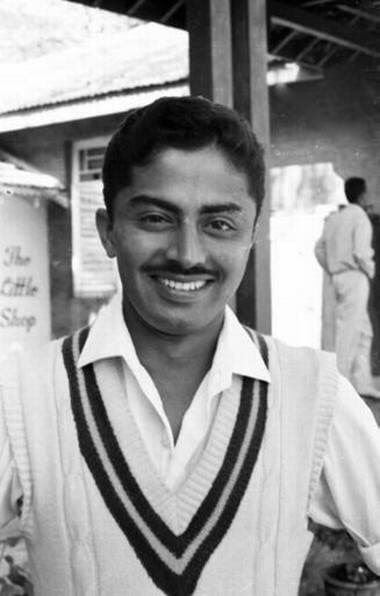
“You got me into trouble with my family, Ram,” he complained to me nearly two decades ago, but his warm smile and the twinkle in his eyes suggested he was not really upset with me for having described him as a ladies’ man in my book on Tamil Nadu cricket. Patamada Karambiah Belliappa who died in Bengaluru on 19th February barely a month short of his eightieth birthday, might have been the envy of young cricketers of my generation for his good looks and charm, but he was much more than that — one of the finest cricketers of the state and a popular captain of Jolly Rovers Cricket Club and the Tamil Nadu cricket team from around 1966 to 1973 when he played his last Ranji match.
“Good morning Mr. Chinmayananda,” my father would address my cousin with a prominent jawline, who would retort with “Yes Mr. Belliappa,” aimimg a barb at Father’s expanding avoirdupois. I cannot help remembering the irony of this playful exchange nearly sixty years ago, everytime I think of Belli — as the diminutive wicketkeeper-batsman was known in the cricket world — slim and elegant as he was throughout his playing days. In fact, he was the cynosure of all eyes, appearing dapper as ever while being felicitated at a Jolly Rovers reunion in July 2015, along with the other members of the iconic team he had first led in the 1966-67 season to the first division title, followed by many more such triumphs in the Madras cricket league in the years to come. Only a touch of grey hair betrayed his 75 years then; he looked smart and trim that evening as he had in front of and behind the stumps for Loyola College, Jolly Rovers and Madras in the summer of his youth. He accumulated his 4000 plus runs in first class cricket by steady application, craft and intelligence rather than extravagant artistry or fireworks. He likewise collected more than a hundred victims caught or stumped with unfussy efficiency without attempting anything flashy.
I had a taste of his batting skills — at my expense — during a practice game at Chepauk in the late 1960s, when I troubled him with my off-spin for nearly 45 minutes, before losing my patience and feeding him a couple of half volleys, which he promptly despatched to the boundary. My captain V.V. Kumar came up to me and said, “Never give easy runs to a batsman; when you have him under your control, just strangle him. A player of Belli’s class needs only a sniff of a chance, no matter how defensive he may look.”
Belliappa made a quiet Ranji Trophy debut in the 1959-60 season when Madras was led by C.D. Gopinath, and later played under the captaincy of A.G. Kripal Singh, Test cricketers and outstanding batsmen both, before he was elevated to the captaincy in the 1966-67 season. He later made way for S. Venkataraghavan—being groomed for the Indian vice captaincy as Ajit Wadekar’s deputy — and played under the off spinner for a couple of seasons more.
Belliappa’s best years as an opening batsman were marked by a successful partnership with the fleet footed K.R. Rajagopal when the pair dominated league cricket and made entertaining runs for the state. The attacking Rajagopal was himself considered unlucky to miss selection to the 1968 tour of Australia under M.A.K. Pataudi’s leadership despite scoring nearly 800 runs in the Ranji season preceding that tour. Rajagopal was also a brilliant wicket keeper, but it was his captain Belliappa who did duty behind the stumps for Madras. Originally from Bangalore, Raja played for both his home state and Madras.
Belliappa scored four first class hundreds in an era when centuries were relatively rare. One of them, 104 for South Zone against the Mike Smith-led Marylebone Cricket Club did not earn him a place in the Indian team, but if Belli was hurt by selectorial rejection, he never showed it by word or deed. He continued to soldier on for state and club for nearly ten more years until he called it a day at age 33 in the 1973-74 season.
After his playing days Belli moved to Canada, returning to India in the recent past. He is survived by his wife, a daughter and a son.
source: http://www.madrasmusings.com / Madras Musings / Home / by Partab Ramchand / Vol. XXIX No. 24, April 01- 15, 2020
One of India’s most decorated tennis player’s Rohan Bopanna celebrates his 40th birthday today (March 4, 2020). Bopanna is one of the country’s most acknowledged players in the doubles and mixed doubles format. The tennis star achieved a career-high ranking of No.3 in doubles on July 22, 2013. Bopanna has been the part of Indian Davis Cup team since 2002 but burst onto the scene during the 2007 Hopman Cup when he partnered Sania Mirza and won the mixed-doubles game against the Czech Republic. On Rohan Bopanna’s birthday, we take a look at some lesser-known facts about him. Rohan Bopanna Gets Wild Card in Doubles at Tata Open Maharashtra 2020.
Born in Bengaluru, India, Bopanna began playing tennis at an early age as his father wanted him to pursue an individual sport. The tennis star’s first ATP title came during the 2008 Countrywide Classic tournament in Los Angeles in the men’s doubles category where he partnered Eric Butorac. Rohan Bopanna partnered with Pakistan player Aisam-ul-Haq Qureshi in 2007 and the duo went on to win a number of titles including four Challenger titles and the Johannesburg Open win in 2010.
Lesser-Known Facts About Rohan Bopanna
– Rohan began playing tennis at age 11 as his father wanted him to pursue an individual sport.
– Six-time grand slam champion Stefan Edberg was his idol while growing up.
– Rohan Bopanna made his debut in 2002 Davis Cup against Australia and turned pro in 2003.
– Bopanna won his first ATP title at the 2008 Countrywide Classic tournament where he partnered Eric Butorac.
– Bopanna has a total of 19 career titles in the doubles category.
– Rohan Bopanna teamed up with Aisam-ul-Haq Quereshi of Pakistan and reached his maiden Grand Slam final at the 2010 US Open.
– In 2010, Rohan Bopanna and Aisam-ul-Haq Quereshi won the Peace and Sport’s Image of the year award.
– Bopanna won the 2017 French Open Mixed Doubles title with Canadian Gabriela Dabrowski.
– Rohan Bopanna is married to Supriya Annaiah.
The Indian Tennis Ace has kicked off 2020 in style winning the Qatar Open Men’s Doubles title along with Dutchman Wesley Koolhof in January. Bopanna is slated to partner Sania Mirza during the 2020 Tokyo Olympics and will look to get his hands on the elusive gold medal. The duo previously finished fourth during the 2016 Olympics in Rio.
source: http://www.latestly.com / LatestLy / Home> Sports> Tennis / by Team LatestLy / March 04th, 2020
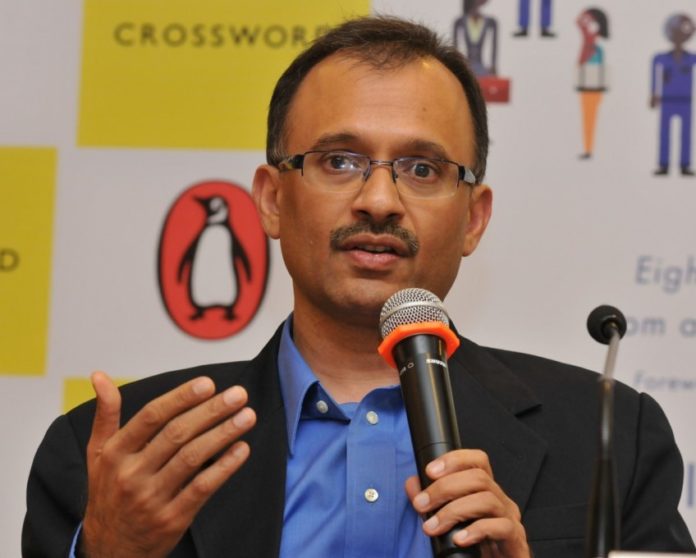
An excerpt from Harish Bhat’s book “An Extreme Love of Coffee”. Harish Bhat is the author of the bestselling book “Tatalog” and chairman of Tata Coffee Ltd.
Author Harish Bhat. Harish is chairman of Tata Coffee Ltd. and brand custodian of Tata Sons Pvt. Ltd.
Three shrines of coffee have I now foreseen, three goddesses that nurture our love for the bean. From river to ocean, each shows you the way. Find me these shrines, and then will I say: Here’s my treasure, let it fill up your day.
Rahul read the lines aloud to Neha for the tenth time that morning. What did they actually mean? Both of them looked at each other silently and acknowledged that they were stumped. Totally clueless.
Outside, dawn had broken and they could hear the high-pitched charr-charr notes of a single woodpecker breaking the stark silence of the coffee plantations around them. Inside, most of the coffee beans had fallen off the bed and were strewn all over the floor. It had been a memorable night and now they knew for sure that coffee was a great stimulant.
But where was the stimulant that would help them figure out this puzzle, one written by a mysterious monk who had died long ago, leaving a great treasure hidden? Where were these three shrines that the monk had spoken of? Where exactly should they begin?
Pooviah brought them their morning coffee in an elegant tray with a pot and two cups of white bone china. ‘Sir, I used those pink coffee beans you gave me to make coffee for Madam and for you today. The smell of this coffee is getting better with each passing day, Sir.’
The old woman’s coffee! In the midst of all the other excitements of the past two days, Rahul had nearly forgotten about this. ‘Yes, yes, Pooviah, please pour coffee for us.’
The walnutty flavour came back to them once again. Superb! As they sipped the coffee, Neha leant back and read the puzzle once again. Suddenly, she could clearly see the author himself, the venerable monk. He appeared vividly in her mind. Orange-robed monk, fat, bald and peaceful, walking somewhere. Where was he walking to? And then, behind the monk, she saw flowing waters. A few words from the puzzle swam in front of her now-dilated pupils: From river to ocean, each shows you the way.
She sat up with a start. ‘Rahul, listen. Listen to me. We need to go to a river, one that will show us the way to the first shrine. That’s what the monk meant when he wrote “from river to ocean”. The river first, and then the ocean will show us the way. That’s why he put those words in his note, to give us a clue. I can see him in my mind, Rahul. He is walking by that river, right over there, right now.’
Rahul glanced at the lines once again. What Neha said made sense. They had nothing else to go on anyway. Then, he remembered something, a local guidebook kept in their room that he had briefly gone over yesterday. It spoke of a river nearby. He went into the room, brought out the small guidebook, turned a few pages, and began reading aloud:
The Kaveri is the patron goddess of all coffee growers in Coorg. Flowing through the beautiful coffee plantations and nurturing them like her own special children, the Kaveri is the great river of this region. Originating in the foothills of the Western Ghats, the river meanders through the region of Coorg and the vast Deccan plateau before it eventually flows into the Bay of Bengal. The Kaveri quenches this region’s thirst for water and makes it one of the most fertile lands known to mankind. From these lands of the Kaveri come some of the finest coffees the world has ever known.
Rahul turned to Neha. ‘Neha, I think you are absolutely right. We must go to the Kaveri. That’s where we will begin.’
He continued reading the guidebook.
The Kaveri is not merely a river, but a goddess who is worshipped by everyone in this coffee growing region of Coorg. The unique coffee of Coorg springs from the sweet waters of this sacred river. Coffee requires a lot of water for its flowering, and the Kaveri provides it in abundance. The varieties of coffee grown on the fertile banks of the Kaveri are known for their robust body, light acidity and soft liquor, making them some of the most sought-after beans in the world.
Rahul paused here, absorbing this beautiful description of the coffee. ‘Robust body, light acidity, soft liquor, wow! I must taste these coffees from the banks of the Kaveri.’ Then he saw something in the guidebook which made his pulse quicken. He read it out in hushed tones:
There are many shrines built for the Kaveri, to worship and celebrate this goddess, who is the presiding deity of the region. The best known shrine is located at the source of the river called Talakaveri. The river originates near this shrine, as a spring, and the water then flow underground to emerge as the magnificent Kaveri some distance away. The road to Talakaveri is surrounded by coffee plantations and suffused by the intoxicating aromas of coffee. Many monks and holy people visit this shrine throughout the year.
Rahul turned to Neha. ‘We must go to Talakaveri, Neha. I am sure that is where our Japanese monk has left directions for us. He must have visited this shrine and left something there. This is a shrine of the river that nurtures coffee, and so it is a shrine of coffee itself. That is what the monk must have meant. This is where our search must begin.’
Excerpted with permission from An Extreme Love of Coffee: A Novel, Harish Bhat, Penguin India. Read more about the book here and buy it here.
source: http://www.thedispatch.in / The Dispatch / Home> Book House / by Harish Bhat / March 30th, 2020
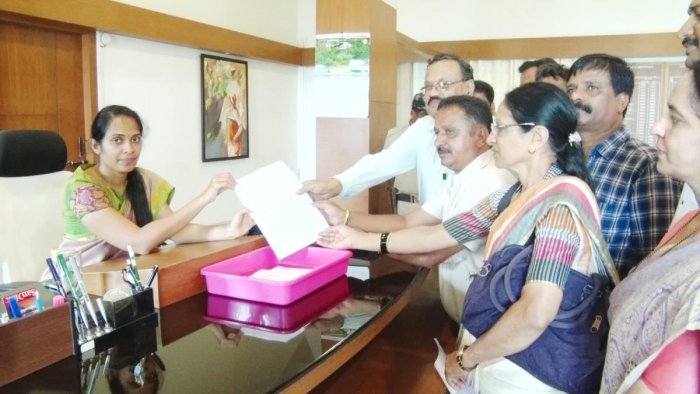
Office-bearers of Somwarpet Taluk Abhivruddhi Horata Samiti submit a memorandumto Deputy Commissioner Annies Kamani Joy.
Office-bearers of Somwarpet Taluk Abhivruddhi Horata Samiti submitted a memorandum to Deputy Commissioner Annies Kanmani Joy urging to retain Madapura, Garvale and Haraduru Gram Panchayats in Somwarpet taluk.
The members expressed their discomfort on the omitting of three Gram Panchayats from Somwarpet in the map prepared by the revenue department.
Somwarpet Taluk Abhivruddhi Horata Samiti president M B Abhimanyukumar said that the process is on carve out Kushalnagar taluk from Somwarpet taluk.
Earlier, it was decided to declare the region comprising Garvale, Madapura and Haraduru as Madapur hobli. But, as it was concluded that a new hobli will not be formed, it has now been decided that the three Gram Panchayats will be retained with Suntikoppa hobli. However, the GPs will be part of Kushalnagar taluk according to the recent decision, which is not correct, the activists said.
This will create a huge inconvenience to the people from these three villages, in terms of trade and government works.
Somwarpet Taluk Abhivruddhi Horata Samiti general convener S Mahesh said that Garvale, Madapura and Haraduru panchayats should be clubbed into a separate hobli and should be called as Madapur hobli.
ZP vice president Lokeshwari Gopal, association general secretary K N Deepak, vice president B B Satish, treasurer Muralidhar, office bearers Bharat Kumar and Kavitha Viroopaksha were present.
source: http://www.deccanherald.com / Deccan Herald / Home> State> Mangaluru / by DHNS, Madikeri / March 03rd, 2020
Family tragedy prompted Kambihalli Estate’s revival in Karnataka
In addition to growing coffee, the women of Kambihalli Estate also run Halli Berri cottages, a luxe homestay. (Christabel Lobo)
When Nalima Kariappa took over the day-to-day management of her family’s 200-acre coffee estate in Chikmagalur, in the southwestern Indian state of Karnataka, after her husband’s death in 2007, she never imagined just how far the family business would come.
“Frankly, I wanted to close and go after my husband was diagnosed with cancer. At the point that he was preparing the estate’s affairs, we had decided that we would sell and go settle in Mysore or Coorg,” says Nalima. “But toward the end, I think he got emotional and sentimental and said no.”
Nestled in the foothills of the Baba Budangiri mountain range, the Chikmagalur district is a densely forested region in which coffee plants flourish. Legend has it that Baba Budan, a revered Sufi ascetic, smuggled seven unroasted seeds of the coffee plant from Mocha in Yemen on his journey back to India in 1670. Until then, coffee cultivation was exclusive to the Middle East and the sale of seeds was strictly forbidden; only roasted or ground beans could be exported.
Baba Budan’s first coffee farm started a practice in India that thrives in estates like Nalima’s Kambihalli centuries later. Today, the state of Karnataka is the largest producer of coffee in the country, with Chikmagalur the second most productive district in India, growing an estimated 78,000 tons of coffee in 2018-19.
While most of India’s coffee estates are now owned by large corporations, a few still belong to families like the Kariappas, who are hoping to keep the tradition alive.
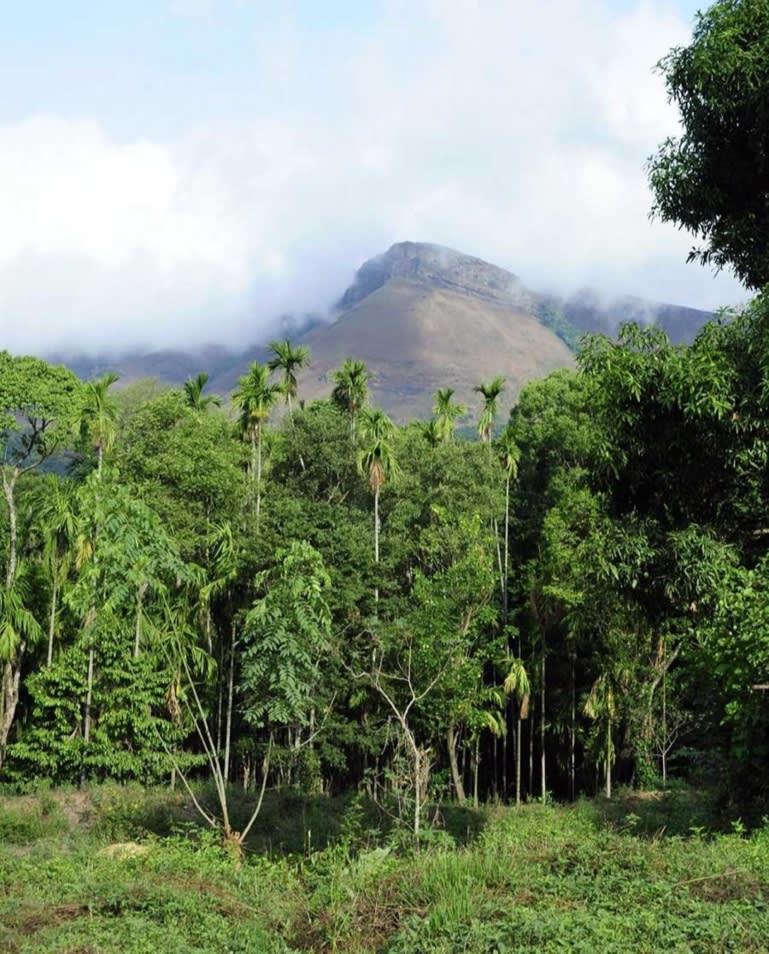
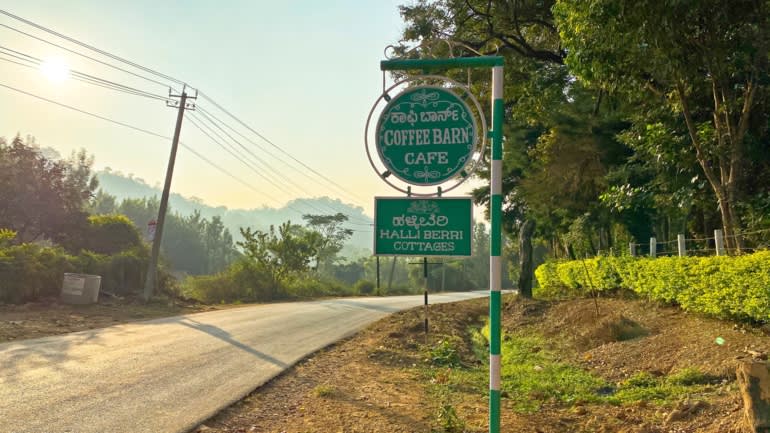
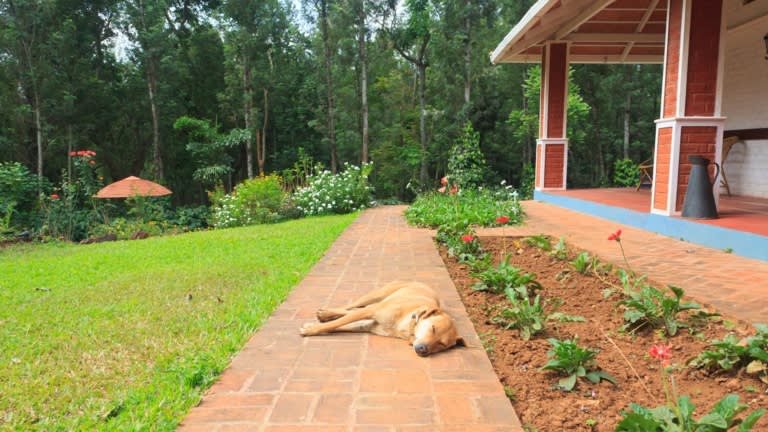
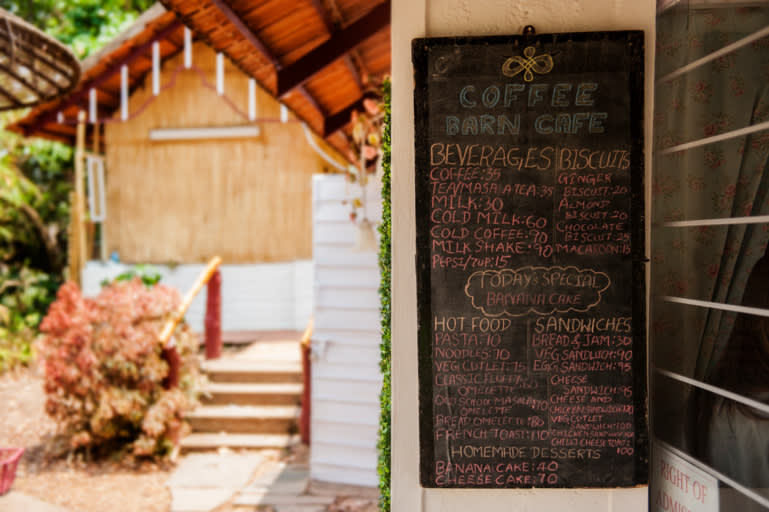
Top: Nestled in the foothills of the Baba Budangiri mountain range, the lush estate also grows Areca palms, cinnamon and cardamom plants. Middle: A sign for Coffee Barn Cafe, a casual spot along the main road run by the Kariappa women. Bottom: Lucky, one of the estate’s two guard dogs, takes a mid-afternoon nap. (Top photo courtesy of Halli Berri; middle and bottom photos Christabel Lobo)
In 1948, after cashing out of his inheritance, the grandfather of CP Kariappa, Nalima’s husband, moved from his hill station hometown of Kodagu, formerly known as Coorg, and headed north to Chikmagalur, where he purchased 40-50 acres of lush, fecund land to open the Kambihalli Estate.
Named after the iron-rich soil that the area is known for — kambi is iron in the local Kannada language, halli means village — the estate grew over the years to its current size of almost 180 acres.
As a result of her husband’s untimely death, Nalima and her three daughters — Maanavi, Anusha and Tejini — found their way along an uncharted path. In 2008, they opened the Coffee Barn Cafe, a casual spot along the main road for travelers. It was around the same time that they had their coffee beans certified by the Rainforest Alliance, an international nonprofit focused on ensuring that farmers meet adequate international standards of environmental, social and economic sustainability.
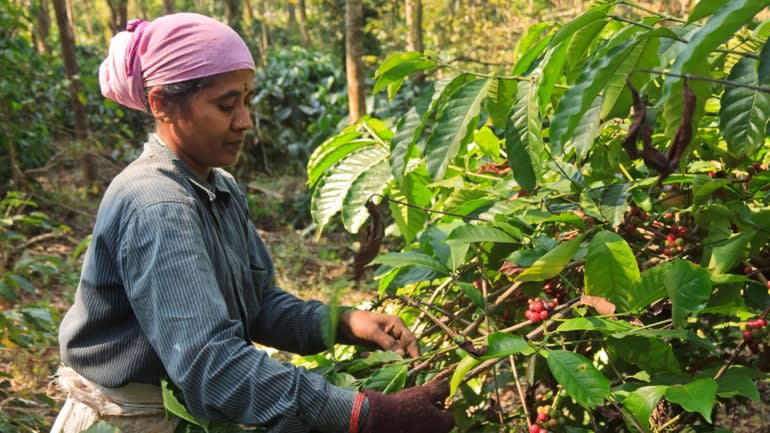
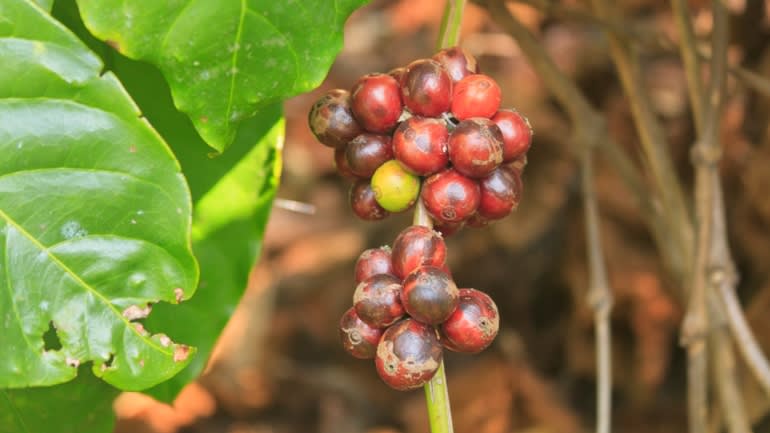
Top: A permanent worker deftly picks cherries. Kambihalli has a permanent workforce of approximately five people that work year-round. Middle: Ripened robusta cherries ready to be picked during harvest. Bottom: Fresh-brewed cups of coffee are not the only thing on Coffee Barn Cafe’s menu. Customer favorites include their homemade cheesecake and cookies. (Top and middle photos Christabel Lobo; bottom photo courtesy of Halli Berri)
In 1948, after cashing out of his inheritance, the grandfather of CP Kariappa, Nalima’s husband, moved from his hill station hometown of Kodagu, formerly known as Coorg, and headed north to Chikmagalur, where he purchased 40-50 acres of lush, fecund land to open the Kambihalli Estate.
Named after the iron-rich soil that the area is known for — kambi is iron in the local Kannada language, halli means village — the estate grew over the years to its current size of almost 180 acres.
As a result of her husband’s untimely death, Nalima and her three daughters — Maanavi, Anusha and Tejini — found their way along an uncharted path. In 2008, they opened the Coffee Barn Cafe, a casual spot along the main road for travelers. It was around the same time that they had their coffee beans certified by the Rainforest Alliance, an international nonprofit focused on ensuring that farmers meet adequate international standards of environmental, social and economic sustainability.
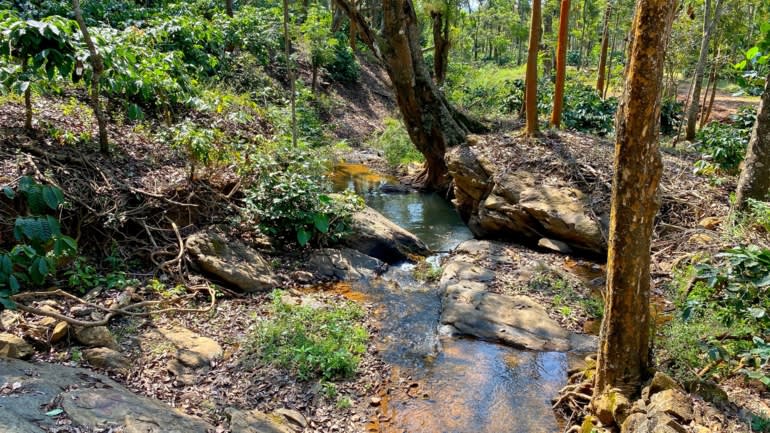
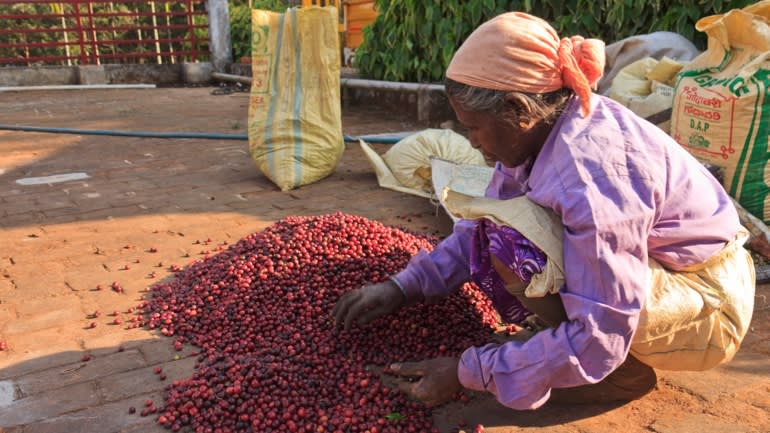
Top: The 200-acre estate offers well-marked trails, many that run along the river, for visitors to explore. Bottom: Manual sorting for underripe or overripe cherries is always carried out before the day’s harvest can be weighed and processed. (Christabel Lobo)
India is one of several countries where coffee plants grow under the shade of a verdant rainforest canopy. These trees not only prevent soil erosion but provide an additional source of income for coffee farmers — intercropping with pepper vines, areca palms, cardamom, cinnamon and orange trees is common practice.
The canopy promotes a thriving and diverse ecosystem for wild animals and birds to inhabit. Sambar deer, leopards, peacocks, wild boar, giant flying squirrels and 32 species of migratory birds call the Kambihalli Estate home.
During harvest season, typically December to March, the estate is abuzz with activity from dawn till dusk. Contract workers begin hand-picking ripened berries, commonly known as coffee cherries, averaging approximately 1,000 kg per day. This cumbersome process begins after green, unripe cherries from arabica coffee plants have turned a bright or dark red color, signaling peak ripeness.
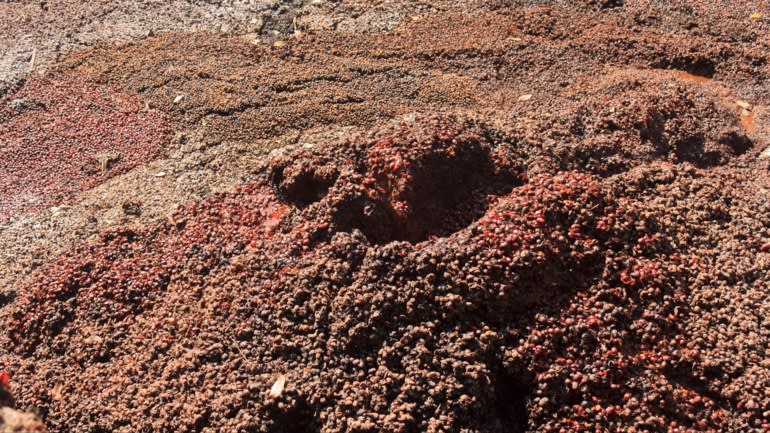
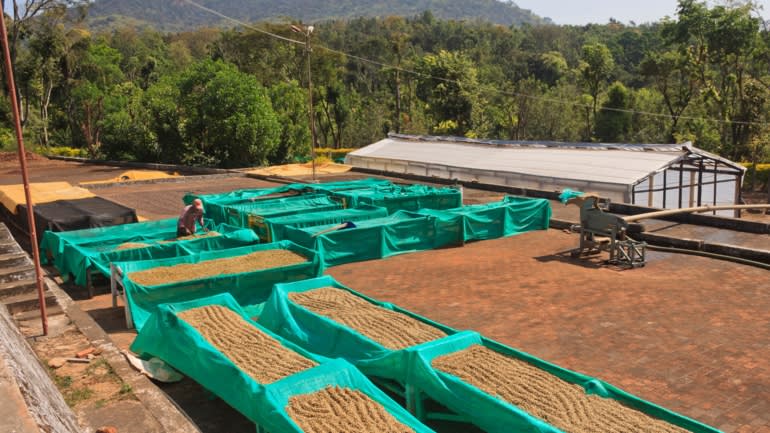
Top: The skin and pulp collected during processing ends up in a huge pile that is eventually converted into manure used to fertilize the soil for next year’s harvest. Bottom: Separated coffee beans are left to dry out in the sun for several days before they can be de-hulled and sent off-site to be roasted and packaged. (Christabel Lobo)
Once picked, the ripe cherries are immediately processed to ensure quality and freshness. Unripe or overripe ones are separated by hand before the day’s harvest can be weighed. Kambihalli makes use of the wet-process method, separating the beans from the skin. This results in a cleaner coffee that is fruitier in flavor, and overall is a less labor- and resource-intensive process.
The skin and pulp collected during the process are eventually converted into manure and used to fertilize the soil for another year of growth. The separated coffee beans, now referred to as washed, are then left to dry in the sun for several days. Finally, they go through hulling, where the dried husks are removed before being sent off-site, where they are graded, roasted, powdered and packaged.
Kambihalli sells its robusta beans in the wholesale market, while its arabica beans are marketed as Halli Berri, which plays on the term “coffee berry.” (It is not meant to have any connection with the actor Halle Berry.) Served throughout the estate and sold at their on-site cafe, a freshly brewed cup of Halli Berri’s single origin ground coffee has a slightly acidic flavor profile with notes of cinnamon, citrus and nuts — all thanks to the iron-rich soil and intercropped plants.
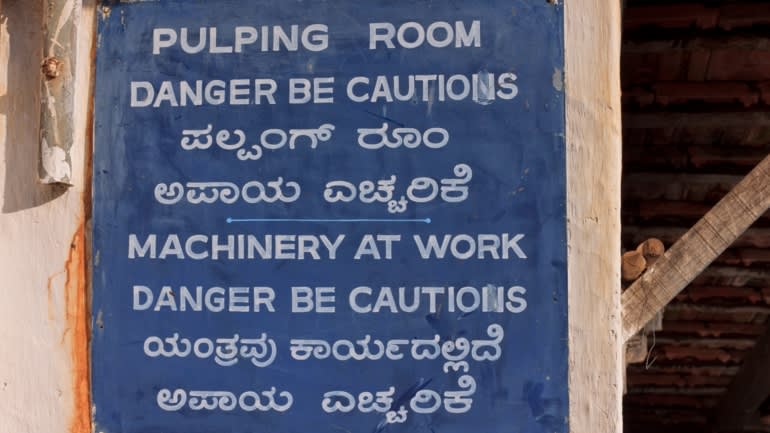
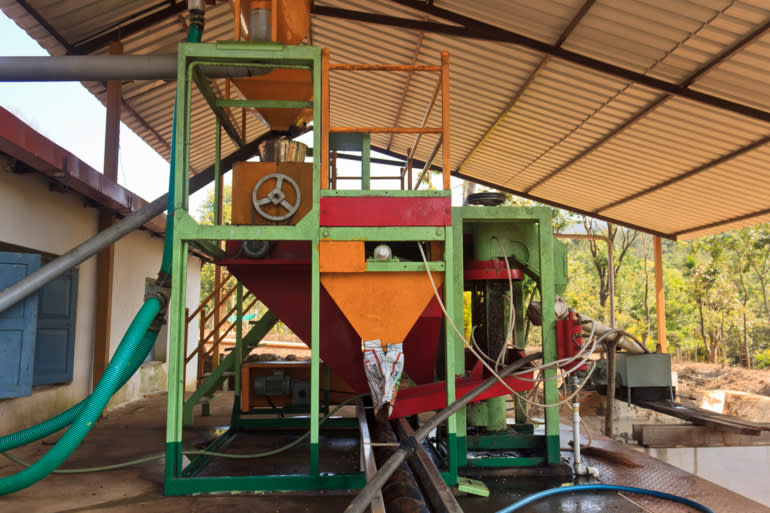
Top: Kambihalli uses a wet-process method to separate the beans from the skin. The day’s harvest, after being weighed, passes through the pulping room where the bean is separated from the skin and pulp. Bottom: The machine used to separate the coffee bean from its skin and pulp. (Christabel Lobo)
It has not been easy, of course. Infestation by white stem borers, pests notorious for attacking the stems of arabica plants, early on in Nalima’s tenure led to a drastic decrease in annual coffee production, which she says is just now starting to recover.
“From 10 loads — each load is 10 tons — we’ve gone down very drastically to producing just three loads,” she says, attributing it to her lack of experience in coffee farming. “We lost a lot of acreage to the infestation. As a result, we had to cut everything down and start planting robusta instead.”
Today, Kambihalli grows an equal amount of robusta and arabica coffee plants; arabica ripens faster and tastes better but robusta is more resilient to insect attacks. According to the Rainforest Alliance, diversification is the key to helping farmers protect themselves from market volatility and the increasing effects of climate change.
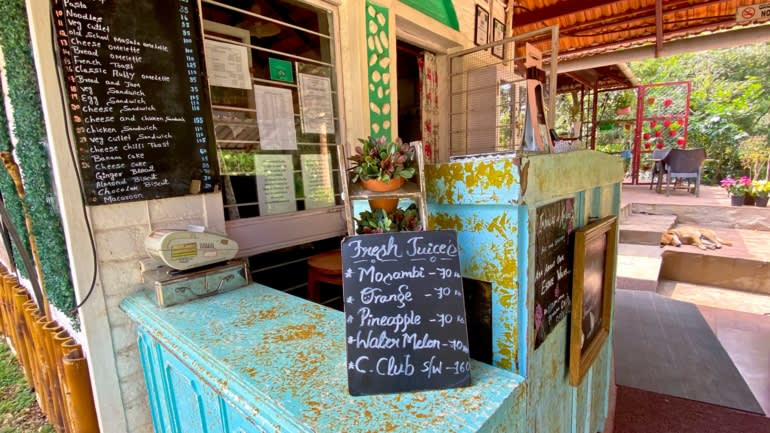
Top: Fruit from the local farmers market is used to make the selection of seasonal fresh juices on offer at Coffee Barn Cafe. Middle: The colonial-style cottages at Halli Berri are bright, TV-free spaces with distinct handmade Athangudi-tiled floors. Bottom: A cozy private veranda overlooks the verdant rainforest canopy with the Baba Budangiri mountain range in view in the distance. (Top photo Christabel Lobo; middle and bottom photos courtesy of Halli Berri)
Charan Kumar of the Indian Coffee Board says that while most of the coffee made in the Chikmagalur region is exported, the board is pleased Kambihalli chooses to sell its arabica within the country. However, “As India currently stands fifth in terms of worldwide coffee production, many [producers] still choose to sell directly to the wholesale market for a guaranteed source of income.”
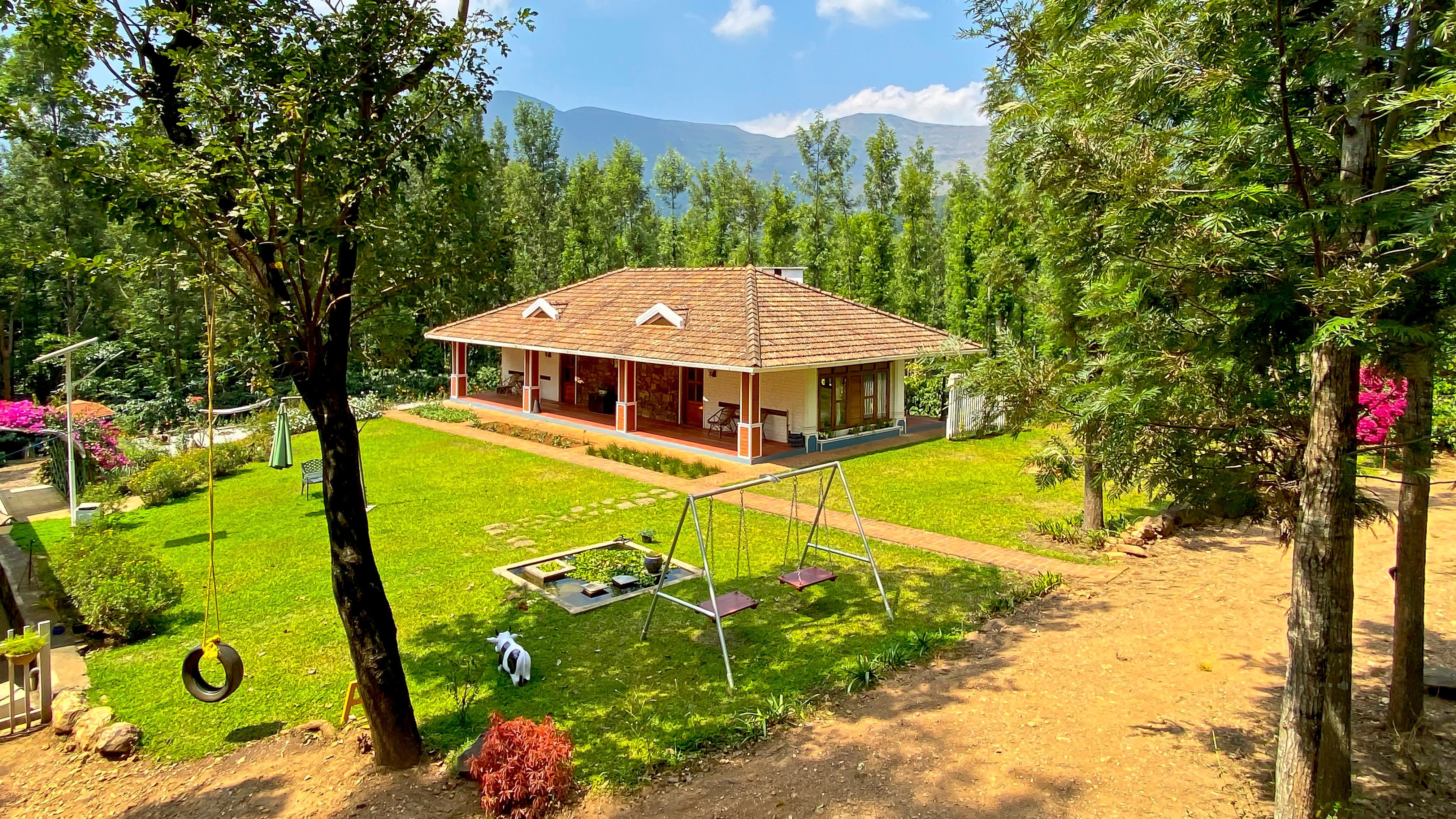
Halli Berri is also the name of the luxe homestay which the Kariappa women run on-site. “Whenever relatives came, or guests came, we would put them up there, and they would love it,” says Nalima of the colonial-style cottages with rustic details and antique furnishings initially built for her daughter Anusha. “People started asking to book rooms, and I said, ‘Why don’t we just start doing that?'”
In 2010 they converted part of the property into a getaway for up to 18 guests, which is not just TV- and WiFi-free but emphasizes sustainability: Solar lights are used on the garden pathways at night, while the bathrooms utilize recycled water and are stocked with homemade soaps, shampoos and shower gels.
A series of trails through the expansive property offers visitors a chance to be mindful — the only guaranteed sounds are of the birds playfully chirping, frogs croaking, brooks babbling and the wind rushing through the treetops.
“I never even thought that we would make it this far,” Nalima says with a sigh as she reflects on Kambihalli’s success. “I’ll admit I was a little bit weary. But thanks to the support of our family and through word-of-mouth, we’ve made it work.”
As harvest season comes to a close, Nalima’s plans for the year include a focus on bean specialty and taste. “If we put a little more effort into the use of organic fertilizers, we found that we’re getting a better taste that our customers thoroughly appreciate. So even if I am a little brand, my coffee can be far superior, which I think is the way forward for us.”
source: http://www.asia.nikkei.com / Nikkon Asia Review / Home> Life / by Christobal Lobo, Contributing Writer / March 25th, 2020
Coorg Wildlife Society (CWS) Hon. Treasurer C.S. Poovaiah, has tendered his resignation from the post over violations of the Society bylaws by certain individuals in CWS.
In his letter to the President of CWS dated Feb. 18, 2020, Poovaiah has stated, “It is with anguish and a heavy heart I am writing this letter to you. As per the bylaw, the Secretary is responsible for administration and approving the bills of CWS and hence prudently has not authorised him to sign cheques on behalf of CWS to avoid conflict of interest. The bylaw authorises only the President or the Executive Vice-President and Hon. Treasurer to sign cheques (the signature of the Treasurer is mandatory) to prevent any financial fraud.”
Continuing, he has stated that the malafide approval given at the AGM to pay Rs. 90,000 to Col. C.P. Muthanna, former CWS President, towards his lawyer’s fees for his personal Public Interest Litigation (PIL) filed in the High Court much against the written disapproval of such payments by the auditors shows favouritism and cronyism.
Poovaiah said that the urgency in which the cheque for Rs. 90,000 was given to Col. Muthanna within a few hours after the AGM, without preparing the minutes of the AGM and without consulting the Treasurer and without obtaining the signature of the Treasurer, is a gross violation of all financial norms and the bylaws of CWS.
Pointing out that his complaint was treated very casually, Poovaiah has stated that CWS is being run as per the whims and fancies of a few individuals in CWS.
source: http://www.starofmysore.com / Star of Mysore / Home> News / March 04th, 2020
The following members were elected as office-bearers and Directors of Kodagu Sahakara Sangha, Mysuru, for the period 2020 – 2025:
President – A.C Nanjamma (Chambanda); Vice – President – Munjandira A. Ravi; Treasurer- Byrettira K. Ganapathy; Executive Director- Ponjanda Lovely Appaiah; and Directors – Ponnimada K. Biddappa, Munjandira G. Devaiah, Ittira G. Kashiappa, Thathanda M. Bheemaiah, Kandanda Bose Achaiah, Meederira K. Prakash, Mukkatira C. Aiyappa, Chendanda S. Nirmala and Ittira Jyothi Kashiappa, according to a press release from the Sangha.
source: http://www.starofmysore.com / Star of Mysore / Home> In Briefs / March 07th, 2020
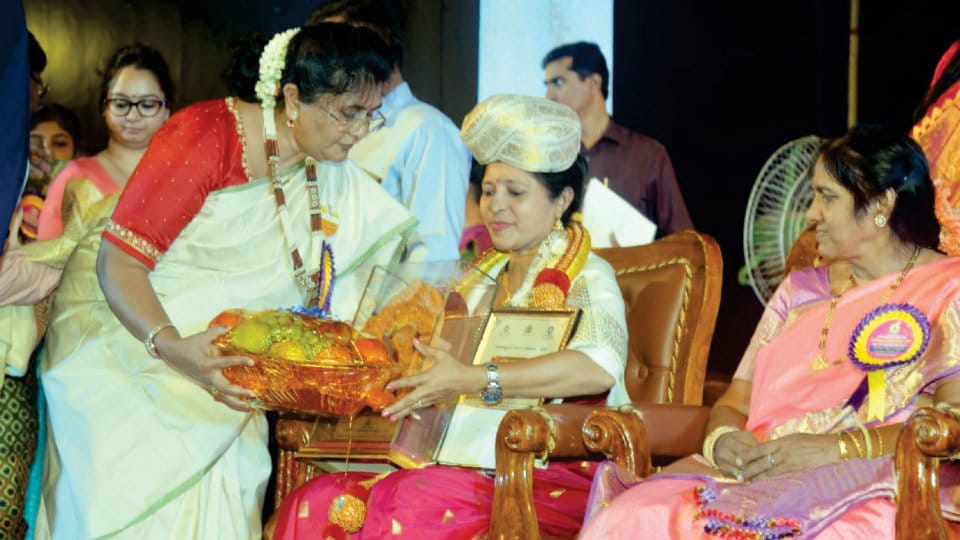
Noted theatre personality from Kodagu, Addanda Anitha Cariappa was among the 20 women achievers from different fields who received the coveted Kittur Rani Chennamma Award at a programme organised by Women and Child Development Department at Ravindra Kalakshetra in Bengaluru, marking International Women’s Day on Sunday last.
Women and Child Development Minister Shashikala Jolle conferred the award to the 20 distinguished personalities. The award carries a cash prize of Rs.25,000 and a citation.
Anitha Cariappa, wife of Mysuru Rangayana Director Addanda C. Cariappa, is a resident of Ponnampet in Virajpet taluk, South Kodagu.
Active in theatre for the past 40 years, she is the only actress who has relentlessly engaged herself in promoting Kannada and Kodava theatre in Kodagu, where little theatre activities take place.
Acting as a link between Kannada and Kodava languages in Kodagu district, she has performed in over 80 plays and acted in many Kodava movies.
source: http://www.starofmysore.com / Star of Mysore / Home> News / March 10th, 2020
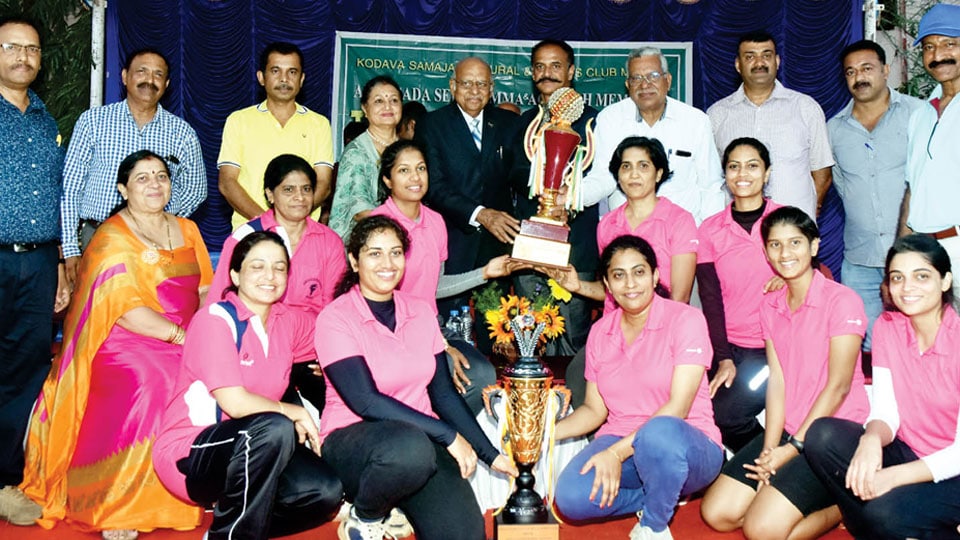
Nellakki Kodava Koota in Vijayanagar 2nd Stage won the Overall Championship in the Mysuru Inter-Kodava Associations Games Meet held at Cauvery Institutions Grounds in Kuvempunagar here recently.
Kodava Samaja Cultural and Sports Club had organised the Adengada Seethamma and Achaiah Memorial Throwball Tournament for Women as part of the Mysuru Inter-Kodava Associations Games Meet.
Nellakki Kodava Koota bagged the trophy emerging as the winners with Igguthappa Kodava Kshemabhivruddhi Sangha, Hebbal, as the runners-up.
Shot-Put — Below 10 years: 1. K. Anuj Achaiah; 2. K. Shourya; Below 20 years: 1. M. Pavan; 2. P. Sumukh Nanaiah; 20 to 50 years: 1. M. Roshan; 2. A. Praveen; Above 50 years: 1. A. Subbaiah; 2. P. Thimmaiah.
Bucketing Tennis Ball (Below 10 years): 1. M. Keerthana Ponnamma; 2. B. Vidisha Kaverappa.
Shot-Put (Below 20 years): 1. P. Vidisha Ponnappa; 2. C. Dechamma.
Dr. A.A. Kuttappa and Geetha Kuttappa distributed the prizes.
Punya Nanjappa and Rochelle Dilip were felicitated on the occasion for their achievements.
Club President M.P. Nanaiah, Vice-President K.D. Muthappa, Secretary K.N. Kushalappa, Joint Secretary M.K. Prakash, Treasurer I.A. Chengappa, Committee Member M.S. Bopanna and others were present.
source: http://www.starofmysore.com / Star of Mysore / Home> Sports / December 30th, 2019
WELCOME. If you like what you see "SUBSCRIBE via EMAIL" to receive FREE regular UPDATES.
Read More »