Category Archives: Famous Personalities of Kodagu / Coorg

School Annual Day

The 37th Annual Day of Sree Cauvery School, Indiranagar, Bengaluru, will be held at its premises on Dec.20 at 4.30 pm.

Kodava Samaja-Bengaluru President and senior advocate Muckatira T. Nanaiah will be the chief guest.

Kodava Samaja Education Council Chairperson Dr. K.K. Seethamma will preside.

source: http://www.starofmysore.com / Star of Mysore / Home> In Briefs / December 19th, 2019

‘Kolata’, sports mark Huthari celebrations

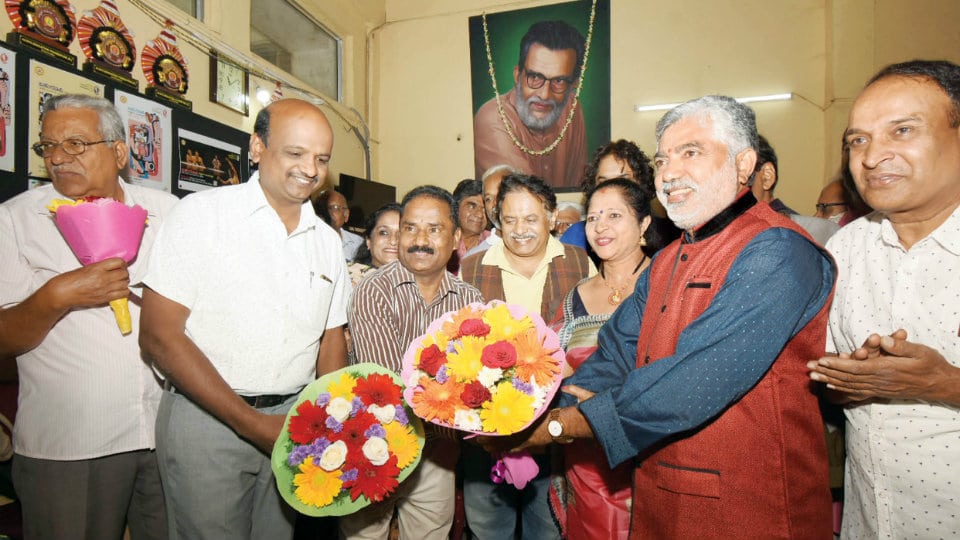
Kodava men perform ‘Huthari Kolata’ on the premises of the Old Fort in Madikeri on Thursday.

Celebrations of Huthari continued with ‘Kolata’ and various sports events on the very next day of Huthari festival in the district on Thursday.

The Pandira family and the management committee of the Omkareshwara Temple organised the ‘Huthari Kolata’ on the premises of the Old Fort in Madikeri.

‘Ummattat’, ‘Bolakkat’, ‘Kolat’, ‘Pariya Kali’, ‘Chowli Aat’ and ‘Kattiyat’ were performed by teams from the Kodava Samaja, the Pandira family and the Pommakkada Koota.

Children added sheen to the Kolata by tapping their feet to the music of the traditional Kodava Valaga, which came as the icing on the cake.

Speaking on the occasion, MLA K G Bopaiah said that Kolata is celebrated soon after Huthari festival in Kodagu. Kolata was performed on the premises of Old Fort since generations, he said.

Stating that a week-long Huthari Kolata will be celebrated in ‘Uru Mand’ and ‘Naad Mand’, the MLA stressed on the need to cherish and preserve the tradition.

Since 2008, Kodagu has been enjoying holiday for Huthari and Kaveri Sankramana, after the government recognised the festivals, he added.

History

The Pandira family members of Hebbettageri village have been performing ‘Huthari Kolata’ or Puttari Kolata, on the premises of Old Fort, since the time of the reign of royal kingdoms in Kodagu.

The paddy is harvested during the festival and brought to homes.

The Puttari Aramane Kolu was held in high regard in the palace in older days and the same is continued today.

‘Will accept minister’s post if offered’

Speaking to reporters, Bopaiah said that he is not in the race for a minister’s position. However, if offered, he will accept the same with humility and work with conviction and handle with responsibility.

He meanwhile stated that he is an honest member of the party and does not believe in lobbying. He denied pressuring any leader to give him the minister’s post. “I have fetched a lot of grants to Kodagu and will continue to strive to solve people’s problems,” Bopaiah added.

source: http://www.deccanherald.com / Deccan Herald / Home> State> Mangaluru / by DH News Service, Madikeri / December 12th, 2019

IPL 2020 Auction: Robin Uthappa Is The Only Indian With 1.5 Crore Base Price, 3 Others With 1 Crore Base Price

The upcoming Indian Premier League 2020 is going to be a massive event for obvious reasons. A lot of star cricketers, who skipped IPL 2019 are going to involve in the IPL 2020 auction, which certainly draws the attention of the franchise owners and the fans. In the latest development, the officials revealed the list of players with their base price for the IPL 2020 Auction. The right-handed Robin Uthappa is the only Indian with INR 1.5 Crores Base price alongside nine overseas players.

The Karnataka Batsman Robin Uthappa is one of the few players who have featured consistently across all the years of the Indian Premier League. And also, he is one of the highest run-scorers in IPL with 4411 runs in 170 games. Despite having enormous experience in this format, Robin Uthappa failed to gain the trust of Kolkata Knight Riders, who released him from the team.

Jaydev Unadkat, Yusuf Pathan placed in INR 1 Crore Bracket:
He was retained for INR 6.4 crores before going into the IPL 2019 edition, but unfortunately, couldn’t deliver the required goods. Robin scored 282 runs off his 12 games for KKR, which came at a strike rate of 115. Alongside Robin Uthappa, nine other overseas players are placed in the same amount.

Other Indian stars, Piyush Chawla, Yusuf Pathan and Jaydev Unadkat, have set their base price at INR 1 crore. In total 23 players are listed under that category. Leaving out three Indians, a total of 20 overseas players named in the chart. Surprisingly, none of the Indian players listed in the INR 2 Crores category.

With INR 2 crore as the highest reserve price, seven overseas players – Pat Cummins, Josh Hazlewood, Chris Lynn, Mitchell Marsh, Glenn Maxwell, Dale Steyn & Angelo Mathews have opted to be slotted in the highest bracket. A total of 186 Indian players, 143 overseas players & 3 players from Associate Nations will be up for grabs in the VIVO IPL 2020 Player Auction in Kolkata.

List of Capped Players as per their base price:

Base Price (INR) Total Indians Overseas
2 Crore 7 – 7
1.5 Crore 10 1 9
1 Crore 23 3 20
75 Lakhs 16 – 16
50 Lakhs 78 9 69

List of Uncapped Players as per their base price:

Base Price (INR) Total Indians Overseas
40 Lakhs 7 1 6
30 Lakhs 8 5 3
20 Lakhs 183 167 16

source: http://www.cricketaddictor.com / Cricket Addictor / Home> Blog Post> News / by Prashanth Relangi / December 13th, 2019

C B Muthamma: India’s First Woman IFS Officer | #IndianWomenInHistory

MuthammaKF17dec2019

A survey conducted in 2019 revealed women in India are paid 19% less than men. While the participation of women in the workforce is only 26%, with merely 9% being in any kind of leadership position, the practices of sex-based bias and stereotypes at formal and informal workplaces gravitate from structural violence over their bodies to seeking organisation’s permission to be under wedlock as in the case of the first Indian woman Ambassador: C B Muthamma.

Image source : Twitter

Early life
Chonira Belliappa Muthamma, the first woman to clear the Indian Civil Services examinations, the first woman Indian Foreign Service (IFS) officer, the first Indian woman diplomat, later the first Indian woman Ambassador (or High Commissioner), was born in Virajpet in Karnataka’s Kodagu (then Coorg), a coffee-growing district in southern India on January 24, 1924. Muthamma’s father, who was a forest officer, passed away when C B Muthamma was nine years old. Being a single parent raising four children, her mother made it a priority to give them the best possible education. She did her schooling in St Joseph`s Girl School in Madikeri. Later, she moved to Chennai to pursue her undergrad from the Women’s Christian College and her Master of Arts degree in English Literature from Presidency College, Chennai.

IN THE END, SHE WAS GIVEN ABYSMALLY LOW MARKS, IN SPITE OF WHICH SHE TOPPED THE FOREIGN SERVICE LIST AND BECAME THE FIRST WOMAN IFS OFFICER IN 1949. WHEN SHE ENTERED THE SERVICE, MUTHAMMA WAS MADE TO SIGN AN UNDERTAKING THAT SHE MAY BE REQUIRED TO RESIGN FROM HER JOB ONCE SHE GOT MARRIED.

In 1948, a year after independence, C B Muthamma cleared the UPSC examination, becoming the first woman to join the Indian Civil Services. Her struggles started with the UPSC Board interview where the Board members tried to persuade her to change her first option for the IFS. In the end, she was given abysmally low marks, in spite of which she topped the Foreign Service list and became the first woman IFS officer in 1949. When she entered the service, Muthamma was made to sign an undertaking that she may be required to resign from her job once she got married. “This was clearly against the Constitution, but in those early days, it did not occur to me to challenge that rule…there was an attitude of vengefulness on the part of the men—a feeling that should be kept in their places, and that they should be encouraged to leave,” she cited this incident in her collection of essays, aptly entitled, Slain by the System.

Muthamma Vs Union of India

With this bizarre rule intact at the Ministry of External Affairs, Mira Sinha Bhattacharjea and Rama Mehta were among those who had to leave the service, points out Kishen Rana in the Indian Foreign Affairs Journal. In addition to facing everyday prejudices against women in Indian society, which got reflected in the ministry, Muthamma was not accepted by several Ambassadors citing various reasons as to why it was inappropriate to send a woman to the station. Finally, she was first posted to the Indian Embassy in Paris. It was there she understood that it is not only Indian diplomats who had problems with a female colleague, but also her peers in other Embassies who were equally not at ease in dealing with a woman in workplace. She then served in Rangoon, London, and on the Pakistan and America Desks in the Ministry of External Affairs in New Delhi.

SHE WAS FIRST POSTED TO THE INDIAN EMBASSY IN PARIS. IT WAS THERE SHE UNDERSTOOD THAT IT IS NOT ONLY INDIAN DIPLOMATS WHO HAD PROBLEMS WITH A FEMALE COLLEAGUE, BUT ALSO HER PEERS IN OTHER EMBASSIES WHO WERE EQUALLY NOT AT EASE IN DEALING WITH A WOMAN IN WORKPLACE.

The tipping point for her was when she was overlooked for promotion to Grade I, the highest level of Secretary to Government of India, of the IFS. In 1979, she brought the petition against the government, the Appointments Committee of Cabinet (ACC) and Ministry of External Affairs, on the grounds of professional gender bias and discrimination contradicting Article 14 (equality before the law) and Article 16 (equality of opportunity in matters of public employment) of the Constitution.

She further challenged Rule 8(2) of IFS (Conduct & Discipline) Rules, 1961 which stated that, “a woman member of the service shall obtain the permission of the Government in writing before her marriage is solemnised. At any time after the marriage, a woman member of the Service may be required to resign from service, if the government is satisfied that her family and domestic commitments are likely to come in the way of the due and efficient discharge of her duties as a member of the service,” and Rule 18(4) of IFS (RCSP) Rules, 1961 which noted that, “no married woman shall be entitled as of right to be appointed to the service.”

The Supreme Court Bench headed by Justice V.R. Krishna Iyer commented that this, “…bespeaks a story which makes one wonder whether Articles 14 and 16 belong to myth or reality.” Solicitor General, Soli Sorabjee opposed the petition saying that the rule overlooking women for ambassadorship was justified. He argued that the chances of leakage of confidential information of strategic significance were a dangerous risk, and so Muthamma’s case to be made an ambassador was rightly rejected.

Though C B Muthamma was promoted to Grade I and posted as India’s Ambassador to Hungary while the trail was ongoing, the Court struck down the blatant prejudice against women’s rights in India by the iconic judgement of the Bench headed by Justice V.R. Krishna Iyer.

Expert Judgements
“That on numerous occasions the petitioner had to face the consequences of being a woman and thus suffered discrimination though the Constitution specifically under Article 15 prohibits discrimination on grounds of religion, race caste, sex or place of birth and Article 14 of the Constitution provides the principles of equality before law….”

“If a fragment of these assertions were true, unconstitutionality is writ large in the administrative psyche and masculine hubris. If there be such gender injustice in action, it deserves scrupulous attention from the summit…“

“If a woman member shall obtain the permission of the government before she marries, the same risk is run by the government if a male member contracts a marriage. If the family and domestic commitments of a woman member of the Service is likely to come in the way of efficient discharge of duties, a similar situation may well arise in the case of a male member. In these days of nuclear families, inter-continental marriages and unconventional behaviour, one fails to understand the naked bias against the gentler of the species.”

“If a married man has a right, a married woman, other things being equal, stands on no worse footing. This misogynous posture is a hangover of the masculine culture of manacling the weaker sex forgetting how our struggle for national freedom was also a battle against woman’s thraldom.”

“Freedom is indivisible, so is Justice. That our founding faith enshrined in Articles 14 and 16 should have been tragically ignored vis-a-vis half of India’s humanity, viz., our women, is a sad reflection on the distance between Constitution in the book and Law in Action.”

“In the rat race of Indian official life, seniority appears to be acquiring a religious reverence. We have had the advantage of the presence of the learned Solicitor-General, appearing for the Union of India. With characteristic fair-ness he has persuaded his client to agree to what we regard as a just gesture, viz., that the Respondent-Union of India will shortly review the seniority of the petitioner, her merit having been discovered and her seniority to Grade II being recognised.”

The Court dismissed the petition but directed the Government to review the petitioner’s case in light of the only remaining element of her complaint—that relating to the promotion of people junior to her. The Court emphasised the need to overhaul all service rules to remove discrimination.

This ruling served as an aid at many women’s meeting in support of their struggle for equality. She thus became the first woman from within the service to be appointed Ambassador. Later, she served as ambassador in Accra in Ghana, and afterwards, she was made the Indian Ambassador to The Hague in the Netherlands. She retired as one in 1982 after 32 years of service.

A Trailblazer For Working Women
Foreign Secretary Nirupama Rao recalls C. B. Muthamma as someone who’d waive away references to being the ‘first woman diplomat’ by saying, “Someone’s got to be first—I was old enough to have been there first.” Arundhuti Ghosh, the fiery diplomat who fought for India’s concerns on nuclear issues in Geneva, remembers her as a formidable personality and feminist who always showed consideration for people who worked below her. “For example, once she pointed out that Joint Secretaries have two air conditioners in their office rooms while non officer-grade staff had none and she gladly gave up her own A/C to share with other staff. That was Muthu for you,” Gosh said.

After retiring, she continued to be an activist. C B Muthamma was nominated as the Indian member of the independent Palme Commission, a non-governmental Commission on Disarmament and Security Issues, which reported directly to the United Nations. The spinster remained active in social movements, helping riot victims and citizen groups, her philanthropy knew no bounds. In her book the Slain by the System (2003), a collection of essays criticising of the Indian political system and its political class, she writes, “Looking back, I cannot help but conclude that my tenure with the external affairs ministry was one long tussle with the anti-women bias.” She also co-authored The Essential Kodava Cookbook (2000), compiling forgotten recipes from Coorg for the culinary enthusiast inside her. She passed away on October 14, 2009 in Bangalore at the age of 85.

C B Muthamma proved that as long as social justice is an integral part of our constitutional fundamentals, gender justice will remain a non-negotiable article of faith. She not just managed to get the Supreme Court agree that gender discrimination did exist in the foreign office but also broke many visible and invisible barriers to set a level playing field for women in IFS, women in civil service and women in all workforce.

References
1) The Better India
2) Ministry of External Affairs
3) Indian Kanoon
4) The SOP

source: http://www.feminisminindia.com / Feminism in India / Home> History / by Nivedita Jayakumar / December 16th, 2019

Portable Memorials: Portrait Miniatures

Attributed to Ozias Humphry (British, 1742–1810), Dodda Vira Raja (or, Vira Rajendra Wodeyar), Ruler of Coorg 1780-1809, c. 1787. Watercolor on ivory. Gift of Shirley Latter Kaufmann in memory of Harry and Anna Latter, 74.649.

New Orleans, LA :

The New Orleans Museum of Art (NOMA) presents the museum’s Latter-Schlesinger Collection of Portrait Miniatures. Cradled in the palm of the hand or worn close to the heart, portrait miniatures were never intended for public consumption, but rather, functioned as personal tokens of affection, love, or memorial. Drawing from NOMA’s permanent collection, the installation of more than 100 portrait miniatures is now on view in the Lupin Foundation Decorative Arts Galleries on the museum’s second floor.

“NOMA’s Latter-Schlesinger Collection of Portrait Miniatures, given in 1974 by Shirley Latter Kaufmann in honor of her parents, Harry and Anna Latter, is one of the singularly important collections at this museum,” said Susan Taylor, NOMA’s Montine McDaniel Freeman Director. “Ranging from the court of Henry VIII to Napoleonic France, the collection includes masterful examples of the important artists and techniques used in the art of miniature portraits.”

Andrew Plimer (British, 1763–1837), Henrietta Ponsonby, Countess of Bessborough, c. 1795. Watercolor on ivory, frame with pearls. Gift of Shirley Latter Kaufmann in memory of Harry and Anna Latter, 74.654.

Portrait miniatures were the passion of New Orleans collectors Harry and Anna Latter. In 1957, the Latters traveled to London to oversee a government project and dedicated the trip to the pursuit of English portrait miniatures. After her parent’s passing, Kaufmann gifted the comprehensive collection to NOMA, where she was a trustee for more than twenty years and board president in 1978. The family continues Kaufmann’s tradition of supporting the museum through the Milton H. Latter Educational and Charitable Foundation, which sponsored the design and fabrication of a custom cabinet for the magnificent collection.

Nicholas Hilliard (English, 1547–1619), Portrait of an Elizabethan Court Lady, c. 1590. Watercolor on parchment. Gift of Shirley Latter Kaufmann in memory of Harry and Anna Latter, 74.337.

Portrait miniatures feature details of historic lace, jewelry, ornate hairstyles, royal adornments and military regalia, all executed by the artist sometimes using a single hair as a brush. The earliest 16th-century miniatures were painted with watercolor onto vellum (animal skin) or cardstock, but by the 18th-century heyday of portrait miniatures, artists painted on thin sheets of ivory for a natural luminescence to the watercolor portraits. NOMA’s collection includes master miniature artists Nicholas Hilliard (English, 1547-1619), John Hoskins the Elder (English, c.1590-1665), Samuel Cooper (English, 1609-1672), Richard Cosway (British, 1742-1821), and George Engleheart (British, 1752-1829). On view are examples of portraits framed with the sitter’s hair, intricately arranged and braided, and two “lover’s eye” miniatures, capturing just an intimate close-up of the sitter’s eye, recognizable only to her dearest confidants.

A tablet produced by NOMA details the stories behind these portrait miniatures, with the stories of royalty and historic celebrities, the highly-skilled craft of miniature painting, and the Latter family collection.

NOMA’s installation was made possible with the support of the Milton H. Latter Educational and Charitable Foundation.

source: http://www.artandobject.com / Art & Object / Home> Museum / December 11th, 2019

Running closer to nature

This year, the marathon was completely eco-friendly and trash-free, with water being served in coconut shells, food in banana leaves and plates made out of areca leaves.

Nikki Ponnappa (left) along with Milind Soman (in grey) and members of The Coorg Wellness Foundation

Bengaluru :

Bengaluru-based golfer Cheppudira Nikki Ponnappa can never decide what she is passionate about more – her love for sports or working towards saving the ecology of her hometown, Kodagu. The international-level golfer recently arranged the fifth edition of Barefoot Marathon, which happened on Sunday in Kodagu. The marathon was an initiative by her organisation, The Coorg Wellness Foundation, in association with avid marathon runner and her friend, Milind Soman.

This year, the marathon was completely eco-friendly and trash-free, with water being served in coconut shells, food in banana leaves and plates made out of areca leaves. The warm-up exercise before most marathons is usually Zumba, but keeping up with local traditions, Valaga music, which is traditional Kodava music, pumped up the participants. The highest prize being `42,000 for 42 km, the marathon had some interesting rules for the prizes that were distributed.

The cash prize went to runners from the neighbourhood area, while the non-local runners got to bring home produce by local farmers, which included rice, coffee, spices etc. All the funds collected from this event will go towards betterment of the families who lost everything in the landslide that hit Coorg in 2018.

More than 400 people participated in this marathon. Ponnappa says the main objective of the run was to bring people closer to nature. “When you run barefoot and feel the soil, it makes you feel closer to Mother Nature. Barefoot is a symbolic way to do something auspicious, plus it has lot of scientific benefits too. We have many nerve points in our feet and these runs work wonders for them.

It was great to see so many people travelling to Coorg, especially from Bengaluru, to participate in this marathon,” says Ponnappa, who was first introduced to golf at the age of 14-15 by her father, who was then serving in the Indian Army. She is also a certified coach and a social activist. Ponnappa’s organisation, the Coorg Wellness Foundation, which was set up in 2014, works towards the development of the people of Kodagu and its eco-system. Along with free education and boarding, they also provide training to join the Army.

source: http://www.newindianexpress.com / The New Indian Express / Home> Cities> Bengaluru / by Monika Monalisa / Express News Service / December 10th, 2019

Merging border with dance

New Delhi, (IANS) :

Rasaja Foundation, in collaboration with Business & Community Foundation (BCF) will organise a discussion ”Merging Border” with artists Lata Pada (Sampradaya Dance Creations, Canada), Dr I Wayan Dibia (scholar, author and dance choreographer, Indonesia), Shila Mehta (Nupur Zankar Academy of Performing Arts, New Jersey, Belgium and Mumbai) and Hema Rajagopalan (Natya Dance Theatre, Chicago) followed by ”Nimitta” a solo kathak performance by Shila Mehta, portraying “Shikhandi” from Mahabharat on December 12 at Sri Aurobindo Society in New Delhi.

”PRALAYA”, a collaboration in Bharatanatyam and Baliness dance by Sampradaya Dance Creations, Canada, a modern retelling of the Mahabharata with special focus on the game of dice between the Pandavas and the Kauravas will be staged on December 13 at Kamani Auditorium in the capital.

The presentation, conceptulised and directed by Lata Pada, includes choreography by Lata Pada & I Wayan Dibia, music by Praveen D. Rao, costume Design by Sandhya Raman, visual Design by Jacques Collin and lighting design by Deepa Dharmadhikari.

Their Indo–Balinese collaboration that premiered in Toronto in November 2016 and went on to do an eight-city tour in Canada, has now begun its international tour across seven cities in India and a stint in South East Asia-Indonesia.

–IANS / Sukant/prs
source: http://www.outlookindia.com / Outlook / Home> The News Scroll / December 10th, 2019

Classrooms, computer lab inaugurated at Govt PU College

MLC Sunil Subramani and Deputy Commissioner Annies Kanmani Joy inaugurate classrooms and computer laboratory of Government PU College in Madikeri.

Acharya Patashala Shikshana Datthi Samsthe has constructed classrooms and computer laboratory at Government PU College in Madikeri. The classrooms and lab were inaugurated by MLC M P Sunil Subramani.

Speaking on the occasion, he said, “Members of organisations play a vital role in the growth of government schools.

He lauded Acharya Patashala Shikshana Datthi Samsthe for contributing to the construction of classrooms at a time when the district faced floods.

Deputy Commissioner Annies Kanmani Joy appealed to the members of various organisations in joining hands with the district administration to rebuild Kodagu.

Acharya Patashala Shikshana Datthi Samsthe President T V Maruthi said, “The organisation decided to contribute to Kodagu district when the district was affected by natural calamities in 2018. Two classrooms, a computer lab and a hi-tech toilet have been constructed at the college at a cost of Rs 52 lakh.”

Bodha Swarupananda Swami of Ponnampet Ramakrishna Sharadashrama called upon the students to inculcate the teachings of Swami Vivekananda.

source: http://www.deccanherald.com / Deccan Herald / Home> State> Mangaluru / by Adithya K A / DHNS, Madikeri / December 07th, 2019

Ashwini Ponnappa on Mission Women’s Doubles

Ashwini Ponnappa (left) and Sikki Reddy, India's top women's doubles players
Ashwini Ponnappa (left) and Sikki Reddy, India’s top women’s doubles players

The Red Bulls Shuttle Up is a start up to encourage girls to take up doubles

Hyderabad:

Seasoned Ashwini Ponnappa, who combined beautifully with the indomitable Jwala Gutta by winning the Commonwealth Games gold and World Championship bronze, is on a mission. She is making an earnest attempt, through Red Bull’s Shuttle Up, to promote women’s doubles in a big way in the country.

The 30-year-old doesn’t mince words by saying that the women’s doubles is not getting the due in the country although it is a lot better than what it was a couple of years ago.

“There is exposure, better training facilities and a lot of youngsters are taking to doubles now. There are also a couple of coaches for doubles. However, I feel the women’s doubles is not getting the due. We don’t have women’s doubles in Premier Badminton League (PBL). It is quite sad and disappointing. Something needs to be done as regards to women’s doubles. The Red Bulls Shuttle Up is a start up to encourage girls to take up doubles. It is giving them a platform to play and hopefully it will help the growth of women’s doubles in the future. I would have loved to play with the youngsters but I got injured and I can’t play. When you have this kind of tournaments, one can see the rise of women’s doubles in the country,’’ said Ashwini at the Shuttle Up tournament finals.

She said she was very fortunate to have someone like Jwala as her doubles partner. “My style and Jwala’s game worked. It clicked from the word go. I became Jwala’s partner when I was young and I was very keen on putting up a good show. She was an experienced player and had done well in the senior circuit. Jwala and I had the advantage of experience and youth. My power from the back and Jwala’s net play proved successful. It was a wonderful combination. Now a lot of girls have taken up the doubles but they need to be guided. We have to work hard to bring out successful doubles players.’’

According to Ashwini, women’s doubles in international competition has grown phenomenally. “It is lot different now. Like when I played with Jwala, I could smash from the back and Jwala used to do brilliant job at the net. Right now, most of the Japanese have a very good attack as well a strong defence. They play at an incredible speed. We need to do a lot of work in this aspect. It is not about tossing and tapping. We can get away here but not in international circuit. There is a mixture of attack and defence. Women’s doubles has one of the longest matches in the world. Fitness has gone to another level. That is the critical point in women’s doubles. We need to work in right direction and that is important.’’

She added that she and Sikki Reddy had had some good matches this year. “But unfortunately these matches were not converted into wins. We had some tough first round matches. It is sad we lost to some close matches. Our choice of tournaments could have been better in this Olympic year. Hopefully next year, we will have better planning. Most importantly, we should be injury free.’’

The doubles expert was all praise for Satwiksairaj Rankireddy and Chirag Shetty. “It is one pair that has clicked beautifully. They understand each other perfectly. Satwik is a stronger player and Chirag is very good in creating openings for him. Their game style and goals are very good. The self-belief has helped them a lot. They have challenged and beaten most of the top players. We need more and more Satwiks and Chirags for the good of doubles in the country.’’

source: http://www.telanganatoday.com / Telangana Today / Home> Sport> Badminton / by N Jagannath Das / December 09th, 2019

How her sporting family helped Ashwini Ponnappa become a consistent force in badminton

An excerpt from She Dared: Women in Indian sport, a book on the stories of leading women in Indian sport by Abhishek Dubey and Sanjeeb Mukherjea.

AshwininKF28nov2019

The women of the family and society form the fulcrum of many of the rituals related to the weddings in Kodagu (Coorg).The conducive ecosystem for the growth and development of the girl child manifests itself in the personas of the two Ashwinis who hail from this region – Ashwini Nachappa, in the closing decades of twentieth century India, and Ashwini Ponnappa in the opening decades of twenty-first century India.

As Ashwini Nachappa says, ‘The name “Ashwini” means “a female horse”.’ The two mares from Coorg have been brand ambassadors of Indian sports in terms of talent, strength, articulation and finesse. If Ashwini Nachappa galloped to success in athletics, Ashwini Ponnappa has been the stable and consistent force in the Indian badminton story. The two Ashwinis spread across generations give us the trailer of what the daughters of the country can achieve if they get a congenial environment for their growth. We have been through the pages of the sporting journey of India’s Florence Griffith Joyner or Flo-Jo, i.e. Ashwini Nachappa. It’s the turn of Ashwini Ponnappa now.

Born on 18 September 1989 in Coorg, Karnataka, Ashwini Ponnappa has sports flowing in her genes. ‘My dad M.A. Ponnappa was a hockey player. We have uncles who were hockey players and relatives who were into athletics and cricket. So, yes, we do belong to a sporty family. This has helped in my career as well. Dad was pretty fit and helped me with my physical fitness during tournaments, and in the off season when we didn’t have any training. Mum helped me with my diet and made sure that I ate right. More importantly, she helped me in keeping calm. The most important aspect is that they were with me always, irrespective of what happened in the match, and encouraged me to follow my dream of playing badminton and doing really well,’ says Ashwini.

Sports teaches us many things in life. And this is what one expects from parents who understand the meaning of sports. But did she take up sports as she happened to be from a sports family? ‘More than the sports family itself, I was a hyperactive child, and to keep me busy, my parents put me into sports. One thing followed another. Both my parents were working, and to keep me engaged, they put me in badminton. As is common amongst many of the players, I began with enjoying the game and playing with my parents. Thus, it all started as fun with badminton. Then I started attending coaching sessions. Actually, right next to Dad’s bank, there was a single badminton court which also had a coach. So it was convenient, as Dad used to drop me off there and then pick me up. After this, as this became part of my routine, Dad and mom started taking turns to pick me up and drop me off.’ Ashwini takes us down memory lane. This picking up and dropping off continued in the coming years with a new set ofchallenges. Professional sports demands frequent travel. In the case of a girl child, this becomes critical. For Ashwini Ponnappa, it was more challenging than usual—especially with both of her parents working. Her father used to travel with her for most of the tournaments, as her mother was at home looking after her younger brother who had asthma.

Among other things, what sports teaches us in life is the ability to take both victory and defeat in stride and move ahead. This lesson of sports, if learnt well, helps the best of the sportspersons not to take or put undue pressure. When a sportsperson is able to reach this zone, they perform their best.

Ashwini Ponnappa says, ‘There was no pressure as such from my parents to take up badminton. Most of us start as singles players and it was the same in my case. Gradually, I started moving up through the different age categories. I was runners- up in under-10, but the champion in under-13. Actually, it was from there that things started picking up for me. The state championships was followed by the nationals. I still remember that when I actually beat my partner, there was a change in the way I approached my game.’

Professional sports demand that one peaks as one starts entering the prime of one’s youth. This means forgoing many things that look like a sacrifice in the eyes of others. But for those who take up sports as their passion and a way of life, these are not sacrifices, but the means to achieve their end. Ashwini Ponnappa says, ‘I saw the best of both the worlds—school life and badminton. I was fortunate to have very good teachers in school. It was in the later stages i.e., when studies started getting serious in class VIII, that I started paying all my attention to badminton. And the fact that I was just an average student and more inclined towards badminton made my decision of taking up sports easier.’ And then she goes on to elaborate this further when she says, ‘I do remember my prelims happened when I was busy with my nationals. I fared badly in my prelims, but my teachers were very confident that I would do well in my board exams. They would say, “Don’t worry, you will do well.” My parents also did not put any pressure on me. It was during this time that I put in a lot of effort in my studies and I felt really happy when I did well.’ Ashwini does understand the significance of easing off the pressure during this crucial phase.

She says, ‘I had no pressure. I have seen my peers struggling to get permission to go for tournaments. But contrary to this, I easily used to get my leaves and had the liberty to leave the class early for my training sessions. For instance, my school closed at 3:30 pm, but I was allowed to leave at 2:30 pm. so that I could get an hour extra for my practice.’ Sports teaches us to be multitaskers in the formative years of our life. ‘At a young age, you learn how to juggle between your studies and sports, and I think this toughens you,’ she says. What was the regimen that gave her the initial rigorous training in multitasking?

‘My daily routine then was quite different because I had to manage both, my school, and then my college, along with training. Luckily, I had wonderful principals both in school and college. I was given permission to take off early from college to train. So my daily routine was waking up and starting my day with physical fitness exercises at the ground at around 6 am, then rush home to get ready for school which started at 8:30 am ‘Then I would leave school at around 2:30 pm for practice, even though school got over at 3:30 pm. I would finish practice and head back home at around 6:30 pm. So my entire day was filled with training sessions and practice, along with resting and eating,’ says Ashwini. If youngsters try multitasking as a routine early in life, it helps them in so many other aspects later on in life. One aspect follows another and eventually a beautifully-crafted success story emerges.

Excerpted with permission from She Dared: Women in Indian Sport published by Rupa Publications India. The book is available on Amazon for Rs 242 only.

source: http://www.thenewsminute.com / The News Minute / Home> Book Excerpt / by Abhishek Dubey and Sanjeeb Mukherjea / November 26th, 2019