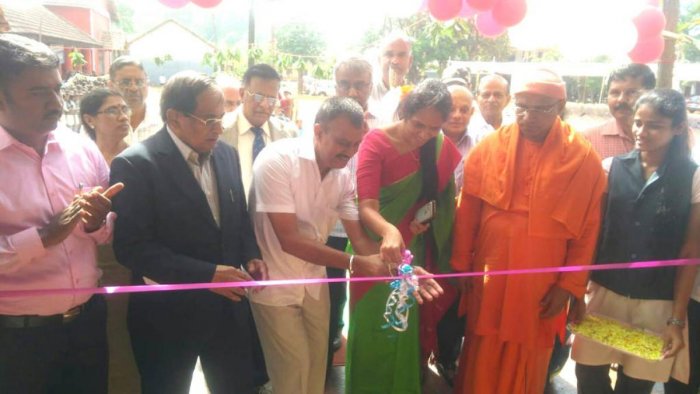
MLC Sunil Subramani and Deputy Commissioner Annies Kanmani Joy inaugurate classrooms and computer laboratory of Government PU College in Madikeri.
Acharya Patashala Shikshana Datthi Samsthe has constructed classrooms and computer laboratory at Government PU College in Madikeri. The classrooms and lab were inaugurated by MLC M P Sunil Subramani.
Speaking on the occasion, he said, “Members of organisations play a vital role in the growth of government schools.
He lauded Acharya Patashala Shikshana Datthi Samsthe for contributing to the construction of classrooms at a time when the district faced floods.
Deputy Commissioner Annies Kanmani Joy appealed to the members of various organisations in joining hands with the district administration to rebuild Kodagu.
Acharya Patashala Shikshana Datthi Samsthe President T V Maruthi said, “The organisation decided to contribute to Kodagu district when the district was affected by natural calamities in 2018. Two classrooms, a computer lab and a hi-tech toilet have been constructed at the college at a cost of Rs 52 lakh.”
Bodha Swarupananda Swami of Ponnampet Ramakrishna Sharadashrama called upon the students to inculcate the teachings of Swami Vivekananda.
source: http://www.deccanherald.com / Deccan Herald / Home> State> Mangaluru / by Adithya K A / DHNS, Madikeri / December 07th, 2019
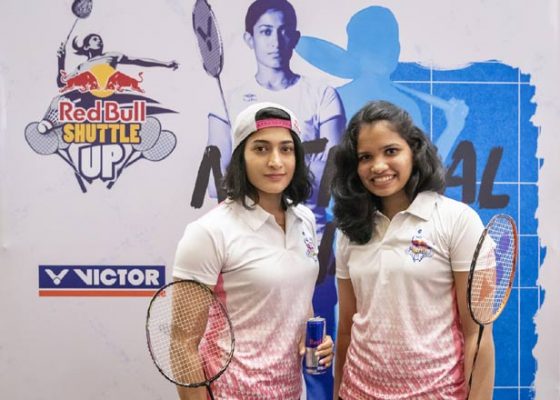
Ashwini Ponnappa (left) and Sikki Reddy, India’s top women’s doubles players
The Red Bulls Shuttle Up is a start up to encourage girls to take up doubles
Hyderabad:
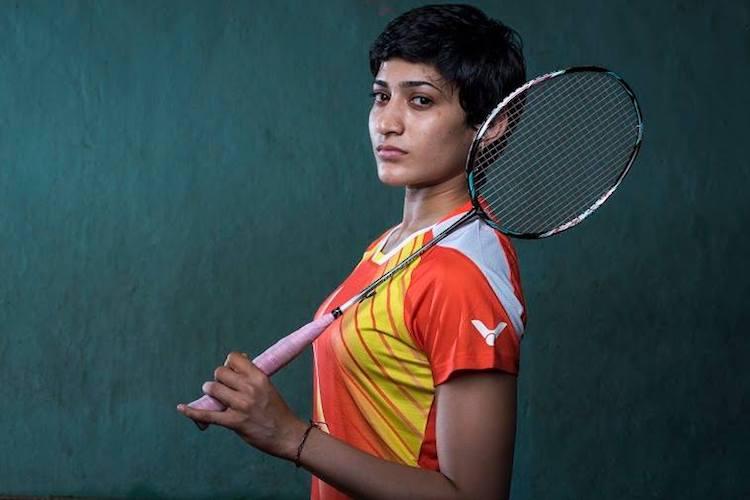
Seasoned Ashwini Ponnappa, who combined beautifully with the indomitable Jwala Gutta by winning the Commonwealth Games gold and World Championship bronze, is on a mission. She is making an earnest attempt, through Red Bull’s Shuttle Up, to promote women’s doubles in a big way in the country.
The 30-year-old doesn’t mince words by saying that the women’s doubles is not getting the due in the country although it is a lot better than what it was a couple of years ago.
“There is exposure, better training facilities and a lot of youngsters are taking to doubles now. There are also a couple of coaches for doubles. However, I feel the women’s doubles is not getting the due. We don’t have women’s doubles in Premier Badminton League (PBL). It is quite sad and disappointing. Something needs to be done as regards to women’s doubles. The Red Bulls Shuttle Up is a start up to encourage girls to take up doubles. It is giving them a platform to play and hopefully it will help the growth of women’s doubles in the future. I would have loved to play with the youngsters but I got injured and I can’t play. When you have this kind of tournaments, one can see the rise of women’s doubles in the country,’’ said Ashwini at the Shuttle Up tournament finals.
She said she was very fortunate to have someone like Jwala as her doubles partner. “My style and Jwala’s game worked. It clicked from the word go. I became Jwala’s partner when I was young and I was very keen on putting up a good show. She was an experienced player and had done well in the senior circuit. Jwala and I had the advantage of experience and youth. My power from the back and Jwala’s net play proved successful. It was a wonderful combination. Now a lot of girls have taken up the doubles but they need to be guided. We have to work hard to bring out successful doubles players.’’
According to Ashwini, women’s doubles in international competition has grown phenomenally. “It is lot different now. Like when I played with Jwala, I could smash from the back and Jwala used to do brilliant job at the net. Right now, most of the Japanese have a very good attack as well a strong defence. They play at an incredible speed. We need to do a lot of work in this aspect. It is not about tossing and tapping. We can get away here but not in international circuit. There is a mixture of attack and defence. Women’s doubles has one of the longest matches in the world. Fitness has gone to another level. That is the critical point in women’s doubles. We need to work in right direction and that is important.’’
She added that she and Sikki Reddy had had some good matches this year. “But unfortunately these matches were not converted into wins. We had some tough first round matches. It is sad we lost to some close matches. Our choice of tournaments could have been better in this Olympic year. Hopefully next year, we will have better planning. Most importantly, we should be injury free.’’
The doubles expert was all praise for Satwiksairaj Rankireddy and Chirag Shetty. “It is one pair that has clicked beautifully. They understand each other perfectly. Satwik is a stronger player and Chirag is very good in creating openings for him. Their game style and goals are very good. The self-belief has helped them a lot. They have challenged and beaten most of the top players. We need more and more Satwiks and Chirags for the good of doubles in the country.’’
source: http://www.telanganatoday.com / Telangana Today / Home> Sport> Badminton / by N Jagannath Das / December 09th, 2019
An excerpt from She Dared: Women in Indian sport, a book on the stories of leading women in Indian sport by Abhishek Dubey and Sanjeeb Mukherjea.
The women of the family and society form the fulcrum of many of the rituals related to the weddings in Kodagu (Coorg).The conducive ecosystem for the growth and development of the girl child manifests itself in the personas of the two Ashwinis who hail from this region – Ashwini Nachappa, in the closing decades of twentieth century India, and Ashwini Ponnappa in the opening decades of twenty-first century India.
As Ashwini Nachappa says, ‘The name “Ashwini” means “a female horse”.’ The two mares from Coorg have been brand ambassadors of Indian sports in terms of talent, strength, articulation and finesse. If Ashwini Nachappa galloped to success in athletics, Ashwini Ponnappa has been the stable and consistent force in the Indian badminton story. The two Ashwinis spread across generations give us the trailer of what the daughters of the country can achieve if they get a congenial environment for their growth. We have been through the pages of the sporting journey of India’s Florence Griffith Joyner or Flo-Jo, i.e. Ashwini Nachappa. It’s the turn of Ashwini Ponnappa now.
Born on 18 September 1989 in Coorg, Karnataka, Ashwini Ponnappa has sports flowing in her genes. ‘My dad M.A. Ponnappa was a hockey player. We have uncles who were hockey players and relatives who were into athletics and cricket. So, yes, we do belong to a sporty family. This has helped in my career as well. Dad was pretty fit and helped me with my physical fitness during tournaments, and in the off season when we didn’t have any training. Mum helped me with my diet and made sure that I ate right. More importantly, she helped me in keeping calm. The most important aspect is that they were with me always, irrespective of what happened in the match, and encouraged me to follow my dream of playing badminton and doing really well,’ says Ashwini.
Sports teaches us many things in life. And this is what one expects from parents who understand the meaning of sports. But did she take up sports as she happened to be from a sports family? ‘More than the sports family itself, I was a hyperactive child, and to keep me busy, my parents put me into sports. One thing followed another. Both my parents were working, and to keep me engaged, they put me in badminton. As is common amongst many of the players, I began with enjoying the game and playing with my parents. Thus, it all started as fun with badminton. Then I started attending coaching sessions. Actually, right next to Dad’s bank, there was a single badminton court which also had a coach. So it was convenient, as Dad used to drop me off there and then pick me up. After this, as this became part of my routine, Dad and mom started taking turns to pick me up and drop me off.’ Ashwini takes us down memory lane. This picking up and dropping off continued in the coming years with a new set ofchallenges. Professional sports demands frequent travel. In the case of a girl child, this becomes critical. For Ashwini Ponnappa, it was more challenging than usual—especially with both of her parents working. Her father used to travel with her for most of the tournaments, as her mother was at home looking after her younger brother who had asthma.
Among other things, what sports teaches us in life is the ability to take both victory and defeat in stride and move ahead. This lesson of sports, if learnt well, helps the best of the sportspersons not to take or put undue pressure. When a sportsperson is able to reach this zone, they perform their best.
Ashwini Ponnappa says, ‘There was no pressure as such from my parents to take up badminton. Most of us start as singles players and it was the same in my case. Gradually, I started moving up through the different age categories. I was runners- up in under-10, but the champion in under-13. Actually, it was from there that things started picking up for me. The state championships was followed by the nationals. I still remember that when I actually beat my partner, there was a change in the way I approached my game.’
Professional sports demand that one peaks as one starts entering the prime of one’s youth. This means forgoing many things that look like a sacrifice in the eyes of others. But for those who take up sports as their passion and a way of life, these are not sacrifices, but the means to achieve their end. Ashwini Ponnappa says, ‘I saw the best of both the worlds—school life and badminton. I was fortunate to have very good teachers in school. It was in the later stages i.e., when studies started getting serious in class VIII, that I started paying all my attention to badminton. And the fact that I was just an average student and more inclined towards badminton made my decision of taking up sports easier.’ And then she goes on to elaborate this further when she says, ‘I do remember my prelims happened when I was busy with my nationals. I fared badly in my prelims, but my teachers were very confident that I would do well in my board exams. They would say, “Don’t worry, you will do well.” My parents also did not put any pressure on me. It was during this time that I put in a lot of effort in my studies and I felt really happy when I did well.’ Ashwini does understand the significance of easing off the pressure during this crucial phase.
She says, ‘I had no pressure. I have seen my peers struggling to get permission to go for tournaments. But contrary to this, I easily used to get my leaves and had the liberty to leave the class early for my training sessions. For instance, my school closed at 3:30 pm, but I was allowed to leave at 2:30 pm. so that I could get an hour extra for my practice.’ Sports teaches us to be multitaskers in the formative years of our life. ‘At a young age, you learn how to juggle between your studies and sports, and I think this toughens you,’ she says. What was the regimen that gave her the initial rigorous training in multitasking?
‘My daily routine then was quite different because I had to manage both, my school, and then my college, along with training. Luckily, I had wonderful principals both in school and college. I was given permission to take off early from college to train. So my daily routine was waking up and starting my day with physical fitness exercises at the ground at around 6 am, then rush home to get ready for school which started at 8:30 am ‘Then I would leave school at around 2:30 pm for practice, even though school got over at 3:30 pm. I would finish practice and head back home at around 6:30 pm. So my entire day was filled with training sessions and practice, along with resting and eating,’ says Ashwini. If youngsters try multitasking as a routine early in life, it helps them in so many other aspects later on in life. One aspect follows another and eventually a beautifully-crafted success story emerges.
Excerpted with permission from She Dared: Women in Indian Sport published by Rupa Publications India. The book is available on Amazon for Rs 242 only.
source: http://www.thenewsminute.com / The News Minute / Home> Book Excerpt / by Abhishek Dubey and Sanjeeb Mukherjea / November 26th, 2019
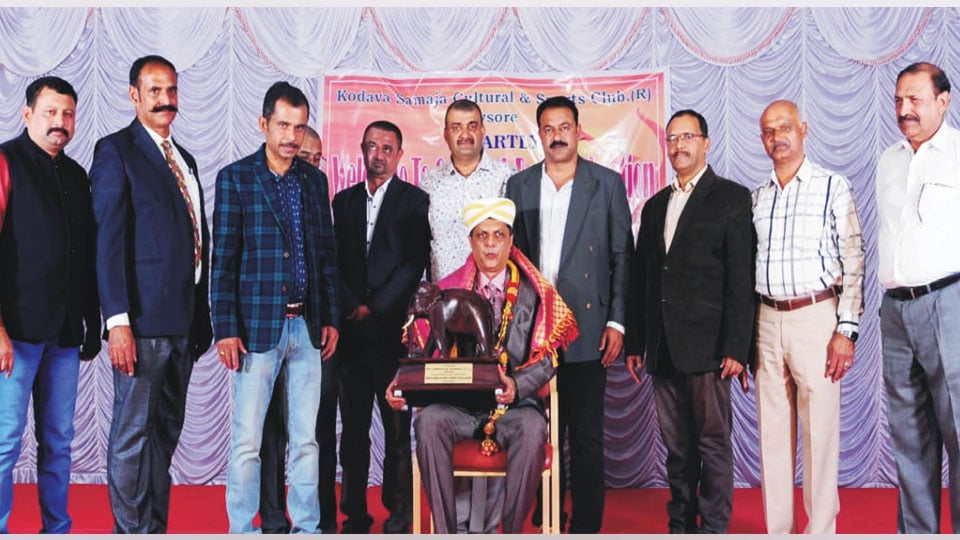
Kodava Samaja Cultural and Sports Club, Vijayanagar, felicitated city advocate Jammada M. Aiyanna recently during the Cultural Day function of the Club.
He is seen with (from left) Nagachettira S. Uthappa – Committee Member, Machimada P. Nanaiah – President, Kuttimada D. Muthappa – Vice-President, Mechanda S. Bopanna – Committee Member (partially seen), Aramanamada M. Ponnanna – Committee Member, Kannambira N. Kushalappa – Hon. Secretary, Iychanda Ashwath Chengappa – Treasurer, Meederira K. Prakash – Joint Secretary, Alemada K. Nanjappa – Committee Member and Chemira B. Chengappa – Committee Member.
source: http://www.starofmysore.com / Star of Mysore / Home> PhotoNews / November 27th, 2019
Sri Kavery Kodava Association, Mysore East, has organised its annual get-together function on Nov. 24 at 10 am in the premises of Kodagu Model School in Vidyashankar Layout, Sathagalli here.
Mukkatira T. Nanaiah, President of Kodava Samaja, Bengaluru, will be the chief guest. Kekada M. Belliappa, President of Kodava Samaja, Mysuru, will be the special invitee.
Koppira Ponnappa, President of the Association, will preside.
Sports and cultural programmes will be the highlight of the programme.
Scholarships will be distributed to children of Association members who are achievers in their respective field.
source: http://www.starofmysore.com / Star of Mysore / Home> In Briefs / November 21st, 2019
Codava National Council (CNC), the apex body of the Kodava tribe (original residents of Kodagu) has intensified their demand for a separate Kodava land having jurisdiction of two taluks Madikeri and Virajpet and parts of Somwarpet.
“We are being socially, economically and politically exterminated systematically by well connected political parties. The names of our villages and our festivals are being wiped off, distorted and forgotten. Our contribution to the country’s armed forces is being deliberately wiped under the mat by the people in power,” Codava National Council (CNC) President N U Nachappa Codava told reporters in Mangaluru on Thursday.
“We want our own administration on the lines of the hill council in the North East. An autonomous administrative unit. After the abrogation of Article 370 and subsequent rearrangement of Jammu and Kashmir state by the central government, our hopes of getting administrative autonomy has brightened, Nachappa said, adding the CNC will release a charter of 12 demands on the Kodava National Day planned on November 24 in Madikeri.
“The main objective behind the celebrations of the annual Codava National Day programme by CNC is to rejuvenate our geo-political aspirations in the quest for autonomy,” he added.
source: http://www.deccanherald.com / Deccan Herald / Home> State> Mangaluru / by DHNS, Mangaluru / November 21st, 2019
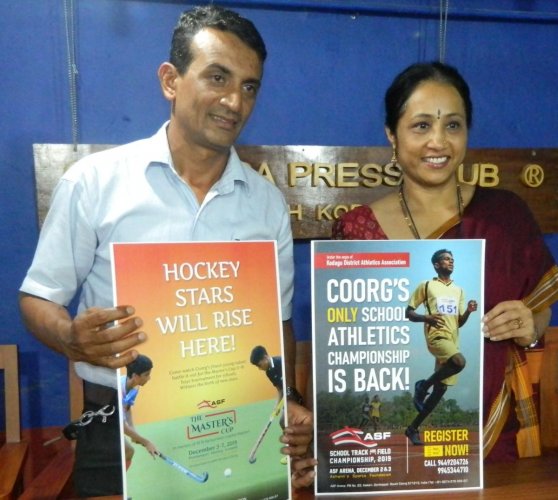
Former athlete and Ashwini Sports Foundation Director Ashwini Nachappa (right) releases the banner of the district-level track and field championship and Karumbaiah Memorial Masters’ Cup in Madikeri on Tuesday.
Ashwini Sports Foundation, Karumbaiah Academy for Learning and Sports (KALS) and Kodagu Athletic Association will jointly organise a district-level track and field championship event for boys and girls at KALS ground in Kaikeri on December 2 and 3, said Ashwini Sports Foundation Director Ashwini Nachappa.
Launching the banner of the Championship and Masters’ Cup, she said that boys and girls between 12 and 18 can take part. Race, shotput, long jump, discus throw, high jump and relay events will be held under various age categories.
Stressing on the need for the budding sportspersons to have an experience on tracks in the primary level, she said that Ashwini Sports Foundation will encourage budding talents by providing training.
DDPI P S Machado has been supporting the foundation, added Ashwini Nachappa.
She further said that Karumbaiah Memorial Masters’ Cup will be held for hockey, in the grounds of Karnataka Public School in Ponnampet, on December 5 and 7.
Eight invited teams will take part in the school level tournament, she added.
Trainer Chethan was present. For more details, contact: 08274 279456-57.
source: http://www.deccanherald.com / Deccan Herald / Home> State> Mangaluru / by DHNS, Ponnampet / November 21st, 2019
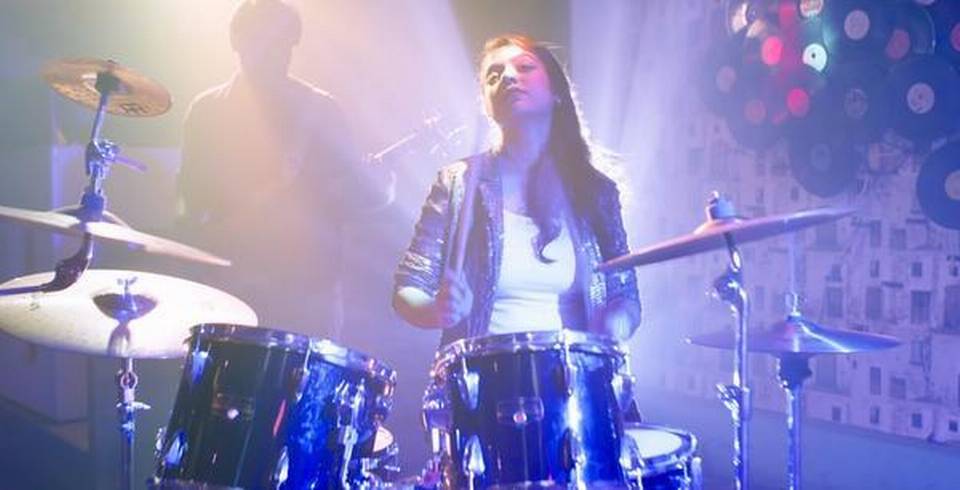
The actor, fresh from her ‘Bigil’ success plays the unusual role of a drummer in this to-be-released Telugu romantic flick
The teaser of Chusi Chudangane featuring producer Raj Kandukuri’s son Siva and Varsha Bollamma as the lead pair, has given rise to speculation that it could be a rip off of the Hindi film Wake Up Sid. Varsha is quick to deny, “Not at all. The overall look might have given people that feeling, but it story isn’t that. There is another heroine played by Malvika Sateeshan,” she says.
Varsha may be new to Telugu audience but she has had two Tamil hits, 96 and Bigil (Whistle in Telugu). The producers of Chusi Chudangane saw her in 96 and offered her the film. She reveals that her role in Chusi Chudangane is of a drummer, something she has never attempted before, and she thoroughly enjoyed playing the part. She adds, “Once I began playing the drums, I noticed the instrument gives a lot of freedom and there is power to it. I am part of a music troupe and the music director as well. It is not a sweet role though, am a little bold. The director was sceptical because he thought I have an innocent face but once the workshop started, they were happy.”
Varsha was a part of school plays, but when she auditioned for dramatics at college, she wasn’t selected. That left her heart broken. She recalls, “I remember imitating Aamir Khan and people cheering me. People who were selected didn’t get that kind of applause; that happened when I was in the XII Std.”
The vivacious Coorgi girl always wanted to be an actor. Her friend tagged her onto a FB page of a casting agency and she was immediately called for an audition and got selected for a Tamil film. In Whistle she plays a traditional Brahmin girl who puts her passion for football on the backburner and resigns herself to being a homemaker. After the film released, lot of people messaged her that they could connect with her character. Even boys texted that their mother went through the same situation and they will make sure their wife won’t have to go through it again.
Talk about the irony of working with Vijay in Whistle and another Vijay (Sethupati) in 96 in the initial stages of her career, she quips, “I don’t know which Vijay is in line next! When you work with them, you know why they are superstars. Even after they are reaching the level they are in, their consistent dedication inspires you.”
With her flair for languages, Varsha finds it easy to straddle fim industries in the south. She is currently working in a film featuring Anand Deverakonda as the hero. The director Vinod is a newcomer and was initially trying to find a Telugu speaking girl since he was planning to make the film in sync sound. Finally he roped in Varsha but got her part dubbed. “I grasp things quite well, the role calls for a Guntur dialect and I dubbed for it. But sync sound is tough; if my expressions came out well, modulation wouldn’t be good. Five to six takes for each shot is not a good thing, so I’m glad it didn’t happen. Even when I was dubbing for it, I felt it was entering an exam hall. Getting back all those emotions, the feel you had while performing is tough. But the end result is satisfying.”
source: http://www.thehindu.com / The Hindu / Home> Entertainment> Movies / by Y. Sunita Chowdhary / November 19th, 2019
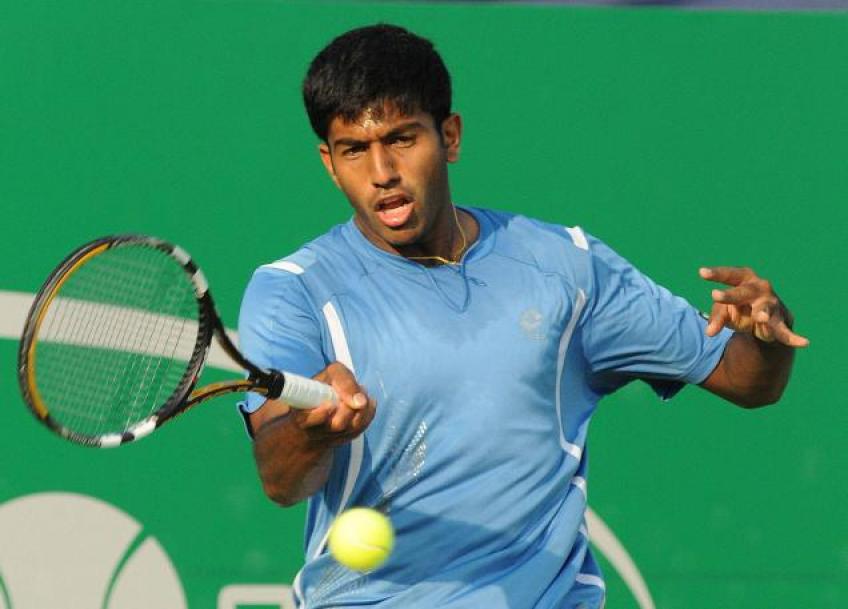
Indian tennis ace Rohan Bopanna says that he has no plans to retire just yet as he wants his daughter to watch him play tennis. In an interview to The Bridge, the 39-year-old Bopanna says, “I want my daughter to watch me play, you know.
If I retire now, how will she be able to do that? I really want to play as much as possible so she can actually accompany me and be there in the stands, watching me play. I hope to play as much as I can”. Bopanna, who recently announced that he would not play the India Pakistan Davis Cup tie due to an injury, says that playing with the youngsters at his academy also motivates him to continue playing.
“Not only that, since I have started my academy in Bengaluru, I think I have inspired a lot of youngsters. When I go to the academy, I’m able to say that I’m still playing and I can give them a lot of feedback… I think that makes a big difference.
I don’t see any reason to stop at the moment.” The Indian ace continues to add that having a family has helped him and does not distract him from his game. “I’ve been a professional for many, many years and the experience comes into play.
When I’m getting on the court, I know what the priorities are. I focus on my tennis right there and that’s how I go about it. Even my wife knows that at this point, my main focus when I’m playing is going out there and giving my best irrespective of what is happening elsewhere.
Those couple of hours that I am on the court, I’m 100% focused on my game and I’m committed to doing what I do best. With technology improving these days, it’s easier to keep in touch with your closed ones from anywhere in the world.
So that, also, definitely help”. Bopanna is currently ranked No. 38 in the world and has won 1 title on the ATP circuit this season, with a 28-26 record on the tour.
source: http://www.tennisworldusa.org / Tennis World / Home> News> Tennis News> Indian Tennis / by Prakash / November 21st, 2019
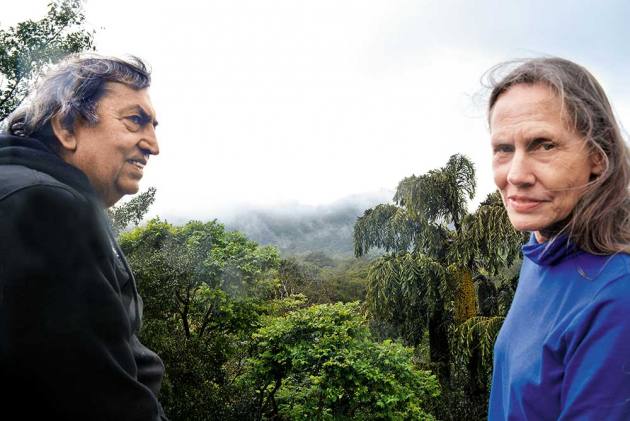
Foresters Anil and Pamela Malhotra have found peace among the coffee plantations of Coorg. Embracing nature has been their passion.
PHOTOGRAPH BY AJAY SUKUMARAN
Around four in the evening, after a late lunch, Pamela Gale Malhotra is standing at a bay window of her living room looking out at a picture-perfect landscape—a gushing stream in a rain-soaked forest with the abutting Brahmagiri hills framing the backdrop. It was about 25 years ago that she first stumbled onto this view. At the time, she was out scouting for a site for their home and had been hurrying up a hill trying to escape the rain and leeches when it struck her speechless.
The place is now more wooded than it was in 1995 when Pamela, 67, and husband Anil Malhotra, 78, built their home in south Coorg—in a coffee estate that had been listed. How they got here is quite a story, told amidst a primordial symphony—the burble of the stream and the call of the crickets.
Their first port of call in India was in the Himalayas in Uttarkashi along the Assi Ganga, where they stayed for nearly a decade before deciding to move south. After scouting through a few states, they finally found what they were looking for at the Brahmagiri foothills in Theralu—a remote plantation where they could raise a forest, as bizarre as it sounded to the folks around back then.
It might still sound like a nutty proposition, until you drive past the gates of the Save Animals Initiative (SAI) Sanctuary. Suddenly, you are in a thicket with a narrow driveway that meanders some distance to a garage and beyond that the dark peach walls of the Malhotra home. Around you is a 300-acre native rainforest through which the elephant and tiger freely saunter.
___________________________________________
“When you are away from Nature you aren’t thinking clearly…This is our passion.”
___________________________________________
Every morning, in more hospitable weather, Pamela and Anil set forth into this grove—their walks take an hour-and-a-half usually unless she’s checking on the dozen or so camera traps dotting the landscape, replacing batteries, swapping memory cards or switching locations. Over the years, Pamela has collected a mountain of data—otter, porcupine, leopard, sambhar, all kinds of species on video. Since it’s a wilderness—whatever remained of the coffee plants became humus for the trees—the couple merely follow the paths the elephants have cleared.
“We’ve set up this private model,” Anil tells Outlook. “We want other Indians who can afford it, we need even those who can’t, to join together to build this.”
The hills get covered up and the rain comes down. It’s been bucketing down all through the south-west monsoon this year, casting a gloomy outlook for coffee growers in Coorg. “When we came here, it was normal to have 350 inches of rain a year. Even if it was buckets of it, we had this,” says Pamela, pointing to the woods. “This is what the forest canopy is for. It’s like using an umbrella with pores in it, it’s going to break it up and slow it down.” But over the decades, Coorg’s forest cover has been dwindling. “The coffee plant is useless when it comes to retaining moisture…they have extremely small, shallow roots. We’ve warned people again and again, “don’t cut down your big native trees.””
The Malhotras put together their 300-acre sanctuary piece by piece, starting 1991, first by purchasing a 55-acre coffee estate. “Patches were cleared for coffee. So what we did was to fill up the patches with native trees,” says Anil. They planted jackfruit, Nandi, Rosewood, Matti and hundreds of fruit trees. “And, of course, the native trees come out way on top in absorbing carbon,” adds Pamela, pointing to sequestration studies which show that SAI Sanctuary acts as a carbon sink, helping the neighbourhood as well as providing a haven for the wildlife moving between the Brahmagiri reserve forests and Nagarahole national park, an hour away by road.
Down by the stream, a snake slithers away as we approach the water. Most days, the couple crosses over onto two rocks on a small island to meditate. “We were sitting on these rocks once and a matriarch elephant came up,” says Anil. It didn’t sound pleased, he recalls. “We kept sitting and mentally saying we have come in peace. They may not speak English but they know vibrations. She started eating the bamboo and then 8-10 members of the family came. They surrounded us for 45 minutes. It was such a beautiful experience.” Frequently, local people and the forest department bring them injured animals—dogs, cats, parakeets—which find a ready home.
Anil says it is possible for others to do what they did—buy land and restore forests—even if it’s difficult. “It can be done. People tell us “we haven’t made the money you made in America”. We bought at the right time. I can’t afford it today.”
Pamela and Anil met in the US in the early 1970s at her hometown, Red Bank, New Jersey, where he ran an Indian restaurant. She worked at an all-night cafe at Asbury Park, where a young Bruce Springsteen (then playing in a band called Steel Mill) would drop in to play sometimes during breaks from the music club upstairs.
“But Anil and I were on complete opposite sides of the political spectrum then,” she laughs. “I’ve always described it as fire and petrol…explosive encounters.” Mostly over the Nixon presidency and the anti-war movement. Soon after, she went back to college to study political science—the breaking-out of her conservative mindset of ‘materialistic Americana’ happened then. He sold up and followed her to Colorado, where they stayed for a few years, she working as a sales rep in a pharma company and he with a mortgage firm. The commissions he got were reinvested in real estate in Colorado and then in a forested patch in Hawaii, which they fell in love with on their honeymoon. The couple moved to India in 1986 to visit Anil’s ailing father and eventually settled in Uttarkashi where they wanted to recreate their wooded Hawaii home. The land ceiling regulations prompted the decision to look at plantation land in the south.
“I could have continued the real estate and all that in America, but what is the point of life then. I can’t take it after me,” says Anil. “I’d rather drink pure water and breathe fresh air than breathe carbon dioxide and be ill half the time and give all my money to doctors and hospitals.” Adds Pamela: “Being in Nature helps us physically. Kids today are being hot-wired by not having time out in Nature to play.”
Pamela, who received the Nari Shakti awards for her efforts in afforestation in 2016, has given numerous presentations across the country—including a recent one at the Apple facility in Cupertino while on her first visit to the US in 20 years—to raise awareness. She’s currently working on an autobiography titled From the Heart of Nature, slated for publication next year. “When you are away from Nature you aren’t thinking clearly,” says Anil. “Grow fruit trees, grow organic food…the demand far outstrips supply. We have planted thousands of native fruit trees now. Last year, we distributed thousands of saplings at schools and colleges telling them this is the future.”
The Malhotras, like successful permaculturalists, are mostly self-sufficient for most of the year. They rely on roof-top solar panels, installed in 1997—a year after the house was built. The patch next to the house is an organic food garden where most of their vegetables and salads come from. Pamela prefers cooking on biogas.
“Everything comes out of our pockets, except approximately two per cent in the form of donations if we are lucky,” says Pamela. Eco-tourism—they have four rooms for guests—helps meet expenses. “This is our passion, our life. So we have to keep things going. But there are things we’d love to do, like Payment for Ecosystem Services. We’d like to sponsor more organic farming,” says Pamela. “I cannot tell you how frustrating it has been trying to raise money for any of these programmes.”
The rain lets up for a bit, but the clouds hang low. Pamela and Anil climb up a wet, metal ladder to the rooftop for a sweeping view of their sanctuary. Pamela recalls a dream she once woke up with, years earlier. “I had seen a house on a small hill, overlooking a pond with the river flowing past in the middle of a wooded valley with white-capped mountains all the way around and a lot of wildlife. This was that view…those mountains are white-capped from the mist.” This was before they bought this place in Coorg. “I thought we’d find that in the Himalayas. But it wasn’t in the Himalayas, it was here. So, you never know.”
By Ajay Sukumaran in Coorg
source: http://www.outlookindia.com / Outlook / Home> Magazine> National> Cover Stories / by Ajay Sukumaran / November 21st, 2019
WELCOME. If you like what you see "SUBSCRIBE via EMAIL" to receive FREE regular UPDATES.
Read More »