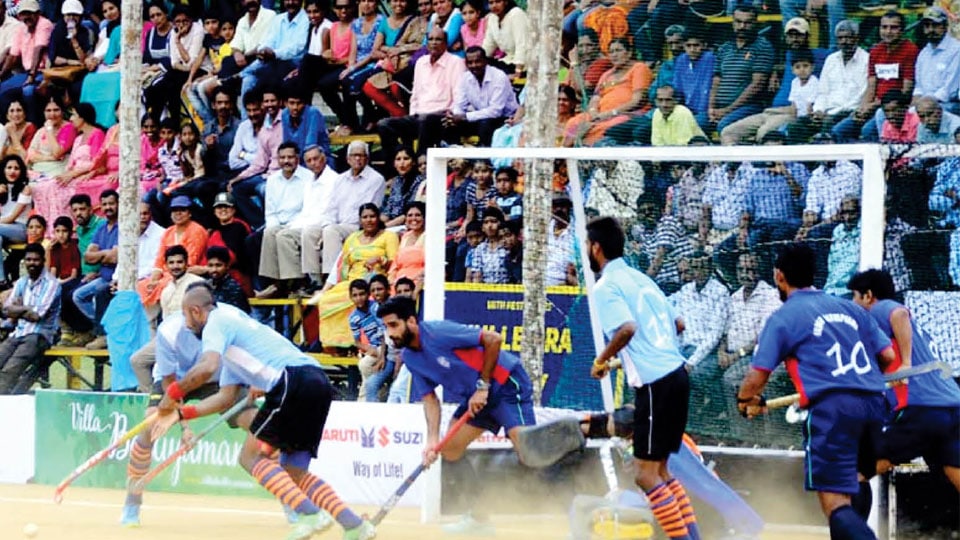
The 22nd Kulletira Hockey Festival, a popular event of Kodava families, was inaugurated yesterday at General K.S. Thimayya Stadium here.
Speaking as the chief guest, Additional Advocate General A.S. Ponnanna expressed apprehension over the gradual decrease in Kodava population in Kodagu district and other places. He appreciated Kodava families coming together and organising the hockey festival every year.
Inaugurating the festival, former Olympian and Hockey Academy CEO M.P. Ganesh hailed Kodagu district for providing over 25 hockey players to the nation in the past but regretted that not a single Kodava was a member of the Indian Hockey team now.
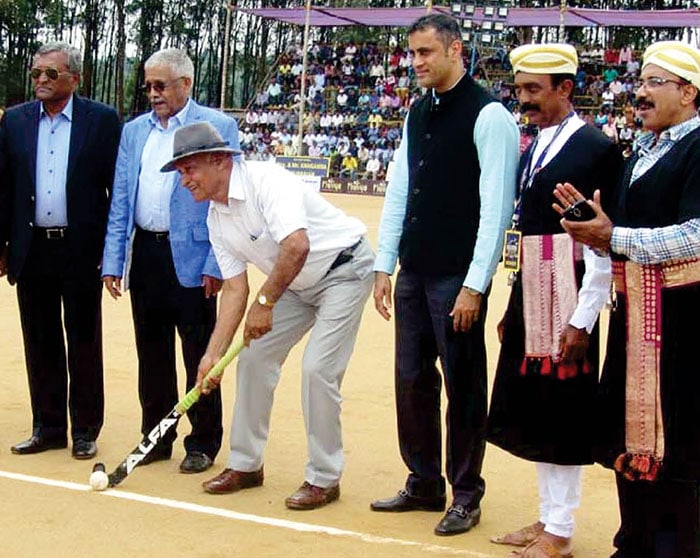
Kodagu Hockey Vice-President K. Nanaiah pushing the ball with a stick to mark the inauguration of the first match as chief guests former Olympian Mollera P. Ganesh, Additional Advocate General Ajjikuttira S. Ponnanna and others look on.
Kodagu Hockey Organisation Vice-President K. Nanaiah, Kulletira Hockey Festival Chairman Shambu Mandappa and Aruna Beba spoke on the occasion.
A book titled ‘Padebeera Kulleti Ponnanna’ written by I. Ramesh Uthappa was released by the dignitaries
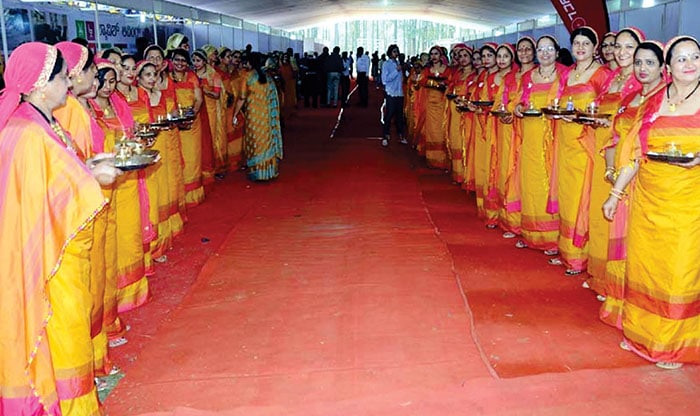
MELANGE OF COLOURS: The women-folk of Kulletira family, attired in their traditional best and holding ‘thaliyathakki bolcha,’ to receive the dignitaries yesterday.
The invitees were welcomed with traditional Kodava volaga and thaliyathakki bolcha.
The first match between Kodagu International XI and India Olympian XI was inaugurated by K. Nanaiah by pushing the ball with a hockey stick. India Olympian XI won the match with a score of 1-0. A short spell of rain played the spoil-sport.
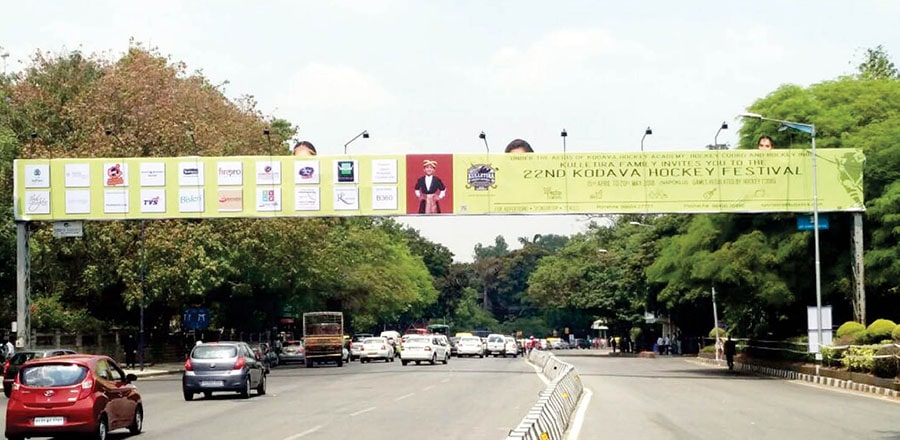
KODAGU CALLING: Picture shows a large hoarding of Kulletira Cup Hockey Festival displayed on M.G. Road in Bengaluru to beckon the hockey-buffs.
source: http://www.starofmysore.com / Star of Mysore / Home> News / April 2018
The area has a charming location but is populated mainly by low-income earners which could be one reason for the low voting percentage.
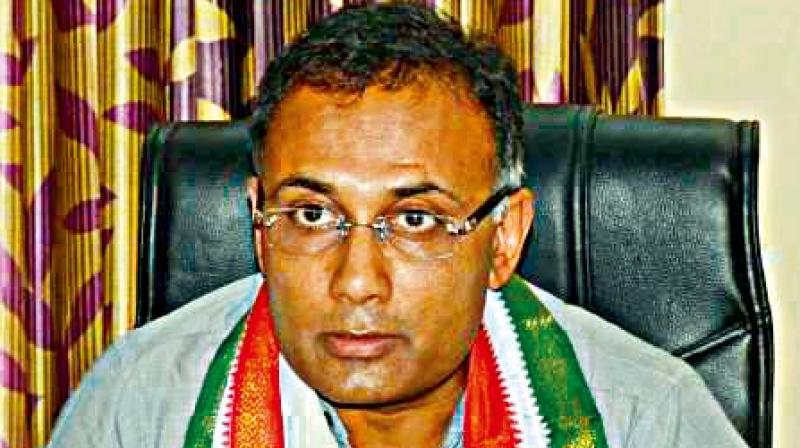
Dinesh Gundurao
Bengaluru:
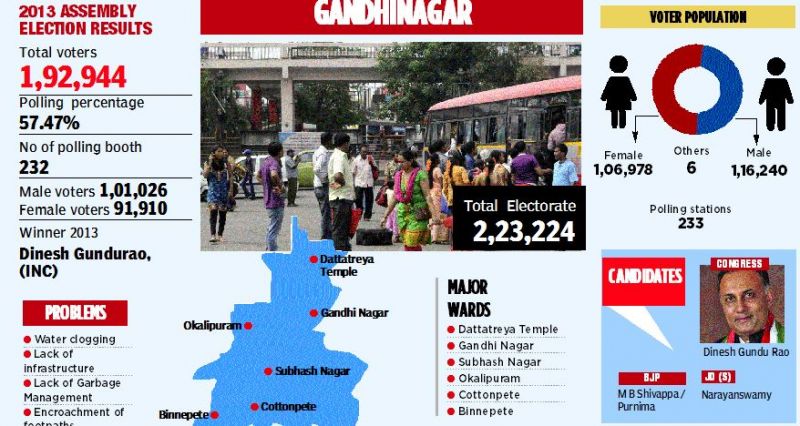
Gandhinagar constituency in the heart of Bengaluru houses the Majestic area, the transport hub of the capital city where the BMTC and KSRTC bus stations besides the City Central Railway Station, now known as Krantikari Sangolli Rayanna (KSR) Railway Station are located.
The constituency is also home to several theatres some of which have closed down and the offices of several film distributors and has become synonymous with the Kannada movie industry. Not to forget the bustling commercial centre which Gandhinagar has become over the decades.
The area has a charming location but is populated mainly by low-income earners which could be one reason for the low voting percentage. In the 2013 Assembly polls, the turnout was a mere 40%, below the Bengaluru Urban district average of 57%.
The constituency has a diverse economy and is considered a melting pot of cultures with a heavy floating population who rely on marketing merchandise at the popular markets in the Majestic area. Gandhinagar also has its historic landmarks-it has the 83-year-old Janatha Bazaar building on Kempe Gowda Road, which was inaugurated by the Yuvaraja of Mysuru way back in 1935.
Former minister and KPCC working president, Dinesh Gundurao, son of former CM late Gundurao, is a popular figure here and has represented the constituency four successive times. In 2004, Gundu Rao defeated JD(S) candidate Nagaraj by a margin of 28,268 votes and followed it up by winning the seat in 2008 beating the BJP candidate P.C. Mohan by a margin of 6,966 votes. He repeated his success in 2013 winning the seat by 22,607 votes. Going by the indications emerging from the constituency, it could be a cakewalk again for Mr Rao, considering his popularity among voters.
A major vote bank are the slums of Okalipuram and Subhash Nagar while other areas like Binnypet and Dattatreya Temple locality are mostly commercial hubs and non-residential areas. Of the six BBMP wards, five are represented by Congress and one by the BJP.
Crying for attention
Though know as a high profile constituency represented by the son of a former CM, Gandhinagar has been crying for attention with serious problems like traffic congestion, garbage management, footpath encroachment and water clogging remaining unattended to.
Most of the footpaths and subways in the Majestic locality have been encroached by street vendors forcing commuters to walk on the roads risking their lives. Water logging is another major problem in the constituency. Vathsala, a resident from Pipeline Road said, “Our houses are flooded with water whenever it rains in the area. Despite complaining about this several times, no official has cared to address the problem.”
A few residents, especially motorists are not happy with the slow progress of the Oklipuram underpass construction. “The work was started five years back and is still under progress. There is too much dust from construction activity and hardly any precautionary measures have been taken near these sites,” said Raghu, a resident of Oklipuram. However some residents said that despite the problems, they did not have any difficulty in reaching out to their MLA. Shashank, a resident of Subashnagar said, “We have no problem in meeting our MLA any time. He is pretty accessible and always responds positively to our problems and demands.”
So irrespective of the Modi wave if it still exists or anti-incumbency, the Congress is all set to retain Gandhinagar. The BJP and JD(S) are yet to announce their candidates and they would need extraordinarily strong leaders to face up to Mr Gundu Rao and come up with a win considering the confidence voters have in him.
source: http://www.deccanchronicle.com / Deccan Chronicle / Home> Nation> Politics / by Abhilash Mariswamy / Deccan Chronicle / April 18th, 2018
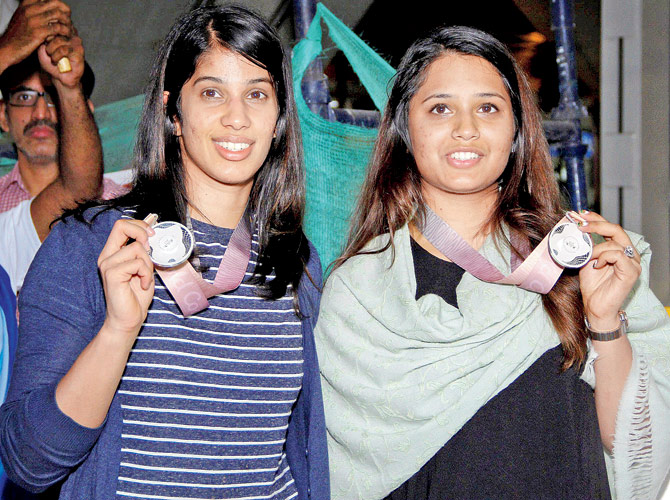
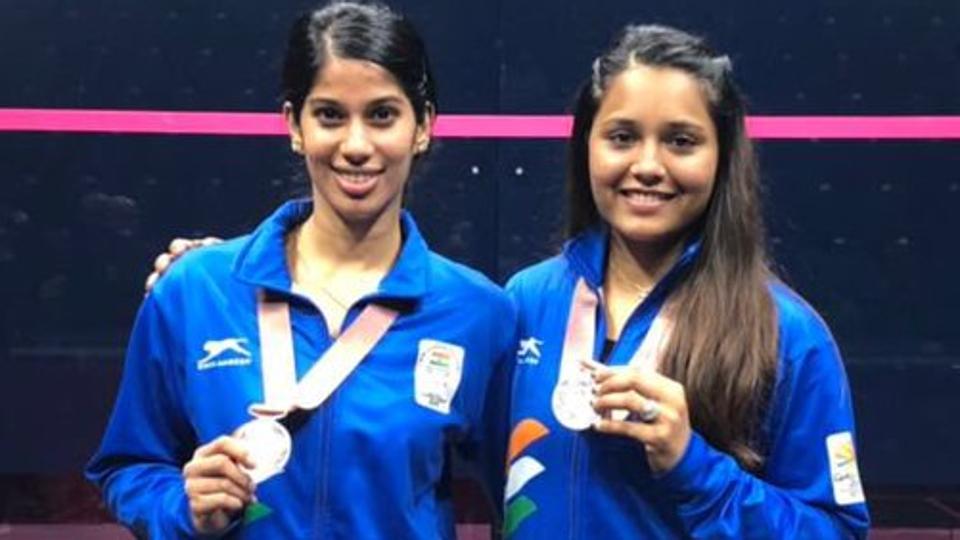
Chinappa and Pallikal had to settle for a silver in the women’s doubles competition India squash stars Joshna Chinappa (left) and Dipika Pallikal with their CWG silver medals at Chennai airport on Monday. Pic/PTI
India’s leading squash players, Joshna Chinappa and Dipika Pallikal, returned to a warm welcome here late last night after winning silver medals at the Commonwealth Games in Gold Coast.
Chinappa and Pallikal had to settle for a silver in the women’s doubles competition. Pallikal also won a historic silver in the mixed doubles with Saurav Ghosal. As defending champions, the thought of the past glory did come to the mind, said Chinappa, who had won a gold medal in the Glasgow Games in 2014 alongside Pallikal.
“Four years since, much has happened in squash. We were there on the podium then and the goal was not to miss that moment again. To that extent it was satisfactory finish,” she said. “We are encouraged to work harder for next big challenge, the Asian Games in August,” she added.
This story has been sourced from a third party syndicated feed, agencies. Mid-day accepts no responsibility or liability for its dependability, trustworthiness, reliability and data of the text. Mid-day management/mid-day.com reserves the sole right to alter, delete or remove (without notice) the content in its absolute discretion for any reason whatsoever
source: http://www.mid-day.com / mid-day.com / Home> Sports News> Other Sports News / PTI / April 18th, 2018
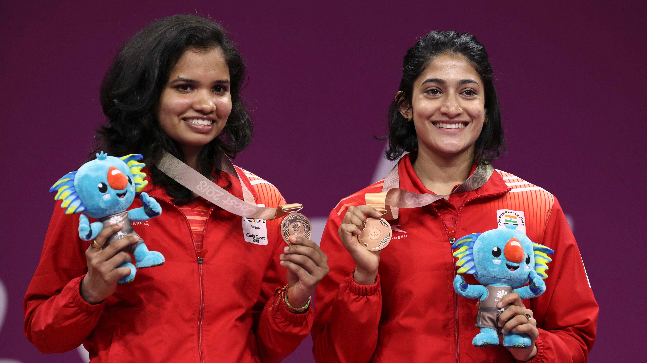
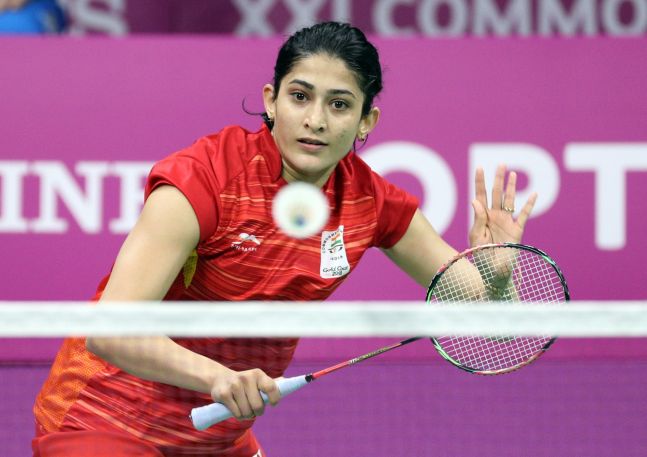
Ashwini Ponnappa (right) won her third Commonwealth Games medal as she bagged a Bronze in women’s doubles with N Sikki Reddy in Gold Coast. (Photo: Reuters)
India completed their best-ever medal in badminton at the Commonwealth Games (CWG) on Sunday with a total of the six medals, including two Gold, three Silver and a Bronze.
India not only won a Gold and two Silver in the singles events but scooped a gold medal in the Mixed Team event, a Silver in men’s doubles and a Bronze in the women’s doubles.
The reason for India to win double the number of badminton medals this year than the last two CWG is the success of doubles.
On Sunday, after the Games officially got over, Pullela Gopichand said that he felt “this tournament belongs to Ashwini (Ponappa).”
Ashwini Ponnappa is a name well known in India. She has been India’s top doubles players for quite a lot of years now but it is truly now that her name has begun to be highlighted well.
During the Mixed Team event final against Malaysia, Ashwini played the first match of the tie, the mixed doubles, with Satwiksairaj Rankireddy. Satwik, who is only 17 years old, is already one of the best doubles players in the country and world No.21 in men’s doubles along with Chirag Shetty. However, on April 9, 2017, it was Ashwini who led the pair to a stunning win against Rio Olympics silver-medallist Peng Soon Chan and Liu Ying Goh.
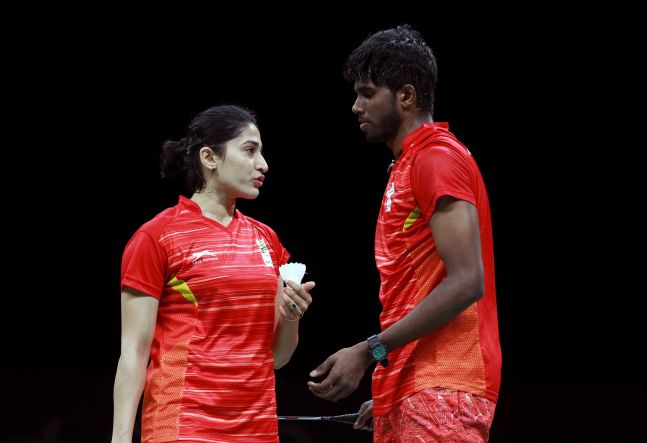
Ashwini Ponnappa was constantly chatting with Satwik, guiding him, during their mixed doubles match in the Mixed Team event final. (Photo: Reuters)
In the first game of the mixed doubles, the Indian pair completely dominated the Malaysian pair but Chan and Goh soon found their way through Ashwini and Satwik and took over from the second game.
In the decider, Chan and Goh were leading 12-7 at one point but the Indian pair then won a point to make it 8-12. From there as Ashwini led the way with her serve, India won seven straight points to go up 15-12.
Therafter, Chan and Goh could win only three more points before Ashwini and Satwik took the match away.
Ashwini in that mixed doubles victory was a sight to behold. Such was her brilliance that even the commentators were in awe of her skills and intelligence.
One could see in those final few moments, the determination and belief in her eyes and her strokes, she knew they could win it. Even as the Malaysians played it around, Ashwini knew exactly where the shuttles would come, she would leap up front and go for the kill.
Satwik supported her ably. Ashwini was constantly chatting with Satwik, guiding him, discussing their strategies, leading the team and it showed. Satwik’s control at the back of the court enabled Ashwini to absolutely intimidate the opponents at the net. Ashwini’s sharpness and booming smashes, along with Satwik’s jump smash, eventually took them home.
It was that unexpected mixed doubles victory that pegged the defending champions Malaysia behind. It gave Kidambi Srikanth to come forth and play his game.
Like Gopichand said, “The win in the team championship was very critical to put the team 1-0 up and give the confidence to Srikanth to beat Lee Chong Wei.” And Srikanth dominated the legend Chong Wei in some style.
Satwik and Chirag, thereafter, missed the chance to seal the win in men’s doubles and India’s Golden Girl Saina Nehwal came next and sealed the deal, giving India their first-ever mixed team Gold at CWG. (India Open: Indian doubles stars show spark, five pairs in quarters)
Ashwini, along with N Sikki Reddy, went on to win a bronze medal in women’s doubles and missed a mixed doubles Bronze by a whisker.
Consider this, on April 14, Ashwini played a total of four matches. Four gruelling badminton matches and still managed to scoop a Bronze in women’s doubles.
ASHWINI’S ROLE IN GUIDING THE YOUNGSTERS IN INDIAN DOUBLES
Ashwini’s importance in this badminton setup is not limited to the medals she brings home. Her stature has gone beyond that.
She plays in two different categories with two youngsters — a 17-year-old Satwik and a 24-year-old Sikki. She is the one who is making them better players.
Satwik is one of the most successful stories to come out of Premier Badminton League (PBL), where he plays along Olympic medallist Pia Zebadiah for Hyderabad Hunters. He came into prominence playing alongside Zabadiah but the immense growth the youngster has shown in the past year and a half, is down to the experience he is gaining from Ashwini.
Ashwini is a leader on the court. She teaches Satwik the mental aspect of the game and that helps him when he plays with Chirag in men’s doubles. (BWF rankings: Satwiksairaj-Chirag Shetty break into world top 20 for first time)
In fact, Ashwini is almost transmitting her leadership quality into Sikki. Sikki, who also plays mixed doubles with Pranaav Jerry Chopra, shows those leadership qualities alongside Pranaav.
Ashwini has achieved a great deal over the years. A women’s doubles Gold with Jwala Gutta in 2010 CWG started a long success story. Even then, perhaps the success did not get its due recognition. Thereafter, came a Silver in women’s doubles with Jwala at 2014 Glasgow Commonwealth Games, a Bronze in women’s doubles at the 2011 World Championships and many more. Yet, those achievements hardly created a stir in the sporting spectrum.
Doubles badminton needs to be given its due credit. In Australia, while Saina Nehwal, PV Sindhu and Kidambi Srikanth held sway at the individual events, the doubles players quietly took home two medals. Consequently, India was the most dominant nation in badminton during the Gold Coast events.
At the age of 28, Ashwini has a great deal of experience and many more years of play where she can achieve more glory and impart far more knowledge.
Even as the success story of Indian badminton at CWG 2018 was largely attributed to the credentials of the singles, it were truly the doubles players who stamped their name uniquely in Australia.
Among a host of Indian badminton stars in Gold Coast, Ashwini perhaps shone the brightest.
source: http://www.indiatoday.in / India Today / Home> News> Sports / by Abreshmina S. Quadri / New Delhi – April 16th, 2018
Dipika Pallikal and Joshna Chinappa settle for silver in women’s doubles squash final at the 2018 Commonwealth Games.
Dipika Pallikal and Joshna Chinappa lost 9-11, 8-11 in the final of women’s doubles squash at the 2018 Commonwealth Games.(Twitter)
Defending Champions Dipika Pallikal and Joshna Chinappa settle for silver after losing their women’s doubles final match to the New Zealand pair of Joelle King and Amanda Landers-Murphy at the Commonwealth Games 2018 on Sunday.
Pallikal and Chinappa lost the final in straight games 9-11, 8-11 in just over 20 minutes.
Coming into the final the Indian pair had lost just three games in their six matches but lost both of their games in the final to win silver.
Dipika was understandably unhappy with the contentious calls.
“There were some shocking calls as usual, those calls changed the match. They need to be looked at. If they don’t, then the game doesn’t grow,” she said.
“It’s sad to see, the players and game are growing, but the officials they’re not growing at all. It’s harsh for us players,” the player from Chennai added.
Joshna too was disappointed with not winning the gold but found some consolation in the silver.
“It’s great that we could be in the finals, we had a great chance to win. The New Zealanders played really well, we had a few bad calls. It’s disappointing, but it happens, that’s sport. We still managed to get a silver four years later,” she added.
This is India’s and Dipika Pallikal’s second medal in squash at the Games after winning the silver in mixed doubles on Saturday.
source: http://www.hindustantimes.com / Hindustan Times / Home> Sports> Other Sports / by HT Correspondent, Hindustan Times, Gold Coast / April 15th, 2018
Hearing Health & Technology Matters (HHTM), an organization bridging the knowledge gaps in treating hearing loss, is proud to celebrate its 7 year anniversary. The HHTM website is a resource for people who share the belief that Hearing Health & Technology Matters!
The editor’s at HHTM strive to provide timely information and lively insights to everyone who cares about hearing loss.
“Being a member of the HHTM writing team for the past 7 years and to see its growth has been exciting. People with hearing loss tell me that learning more about hearing and the view from the professional side has helped them deal better with their personal hearing loss,” said Gael Hannan, editor of the Better Hearing Consumer.
“Hearing Health & Technology Matters has filled a long-needed gap in the hearing healthcare industry; a series of reasoned and thoughtful blogs touching on underlying causes of issues without being constrained by any one ‘party line’,” said Dr. Marshall Chasin, an expert on music and hearing issues and editor of Hear the Music.
CELEBRATING HHTM MILESTONES:
Over the past 12 months, HHTM has exceeded 1 million unique pageviews. Since January 2018, the site has already witnessed greater than 20% growth in visits compared to 2017.
January 2018: Brian Taylor, AuD, was named Editor-In-Chief of HHTM and Amyn Amlani, PhD, was welcomed as new section editor of Hearing Economics.
March 2018: HHTM underwent a significant brand refresh. The website undertook major updates, including a new company logo. This update significantly enhanced the overall performance of the site and user experience.
March 2018: HHTM launched new section, Innovations in Hearing Healthcare, and welcomed new editor, Bopanna B. Ballachanda, PhD.
March 2018: HHTM’s Jane Madell, PhD, editor of Hearing and Kids, and Emmy and Peabody Award-winning director, producer, writer and cinematographer Irene Taylor Brodsky, premiered their documentary The Listening Project on March 9th at the American Cochlear Implant Alliance’s (ACIA) annual scientific meeting in Washington, DC.
“I take great pride in my role of Editor In Chief of the Hearing News Watch at HHTM. We strive to be an independent source of accurate and timely information. Like all credible journalists, our top priority is to inform our readers, who are combination of hearing healthcare professionals and lay-people, with unbiased reporting and thoughtful opinions about topics related to hearing healthcare,” said Dr. Brian Taylor, Editor In Chief.
HHTM articles and reporting have been cited and republished frequently over the last several years by authoritative sources inside and outside the hearing industry, including HHTM news reports cited in the influential “PCAST” report from the Obama Whitehouse in the fall of 2015.
“When I was first invited to work on the blogs, I hardly knew what a blog was… and I am not too sure many of our authors knew either. I had probably been to a blog but did not really know the term for it. It has really been hard work – but lots of fun – to be part of a blog that has gone from zero hits to millions of hits over the past 7 years. I must say, however, that the dedication of our initial investment team, our web site administrator and our authors that spent hours and hours of their time putting together blogs for our site once per week has allowed it to get to where it is today,” said Dr. Robert Traynor, editor of Hearing International.
The editors of Hearing Health & Technology Matters regularly add fresh content, including the latest industry news, so be sure to visit the website regularly for new articles. To view a full list of editors, visit: hearinghealthmatters.org/about-hearing-health-matters.
source: http://www.prweb.com / PR Web / Home> News Center / Tucson, Arizona – April 12th, 2018
Robin Uthappa’s long association with Indian T20 League 2018 has reached a new landmark. The right-handed batsman is playing his 150th match. He achieved this feat as Kolkata took on Bangalore at Eden Gardens. Uthappa has played for franchises like Mumbai, Bangalore, the now defunct Pune franchise owned by Sahara and Kolkata. He has been associated with Kolkata franchise since 2014.
From 149 matches, Uthappa has 3,735 runs at an impressive strike-rate of 131.79. He also has 22 half-centuries to his name. He is sixth highest run-getter in the history of Indian T20 League. His Kolkata captain Dinesh Karthik will be playing his 153th Indian T20 League match. Virat Kohli will also be playing his 150th Indian T20 League match. Interestingly, all his matches have come for Bangalore.
Suresh Raina, Rohit Sharma and MS Dhoni have played more match than Kohli, Uthappa and Karthik.
source: http://www.cricketcountry.com / Cricket Country / Home> Series> Indian Premier League 2018> News / by CricketCountry Staff / April 08th, 2018
With coffee running in the blood lines of the family the Mother Mirra Group has owned coffee plantations for four generations.
Sundar Subramaniam, executive director of Mother Mirra Group of companies releasing their company product in Coimbatore. (Photo: DC)
Coimbatore:
His family is introduced as the ‘first Asians’ to own a plantation in Asia. Ironically, it took several years and four generations of entrepreneurs of the ‘Mother Mirra Group of Companies’ to foray into retail coffee market.
Speaking to DC, Mr. Sundar Subramaniam executive director of group said, “way back in the 1930s, my great grandfather Mr. PPR. Subramanian Chettiar owned and managed estates in Malaysia at a time when only British and Scots owned coffee plantations. Since then on, my family is in the business of supplying coffee powder and roasted beans from our estates in Coorg to different parts of India. Entering into the domestic filter coffee market is a dream come true for my father Mr. S. Subramanian, who is a third generation entrepreneur of our family.”
With Mirras Coffee the company has entered the domestic filter coffee market. Two options of coffee powder were launched in Coimbatore recently. Mirras Premium blend is a combination of 85 per cent coffee and 15 per cent chicory while the Mirras Gold variant is a combination of 53 per cent coffee and 47 per cent chicory.
Available in 200 grams sachets, for a cost that is affordable, the traditional filter coffee tastes just like home-made coffee, sticking to the tag line of the product ‘idhu namma veetu kaapi’.
The product is available across big and small stores and supermarkets across the city. The firm has a strong dealership network in Tamil Nadu and Puducherry. “We have partnered with 350 dealers across both the regions. In a year’s time we are hopeful of capturing 3.50 per cent to 4 per cent of the filter coffee market,” Mr. Sundar Subramaniam said.
The company already has a strong market hold in the wholesale filter coffee market segment with regular consignments of their coffee powder delivered across India. Karnataka and Tamil Nadu is where the company does thriving business. The coffee is customized for their wholesale clients.
With coffee running in the blood lines of the family the Mother Mirra Group has owned coffee plantations for four generations.
It is home where three generations of employees have worked and it has to its credit more than seven decades of experience of growing and producing coffee powder. At the product launch in the textile city, one-year-old master Shiv Ram Alagappan, the founders’ grandson, gracefully received the first packet of coffee.
source: http://www.deccanchronicle.com / Deccan Chronicle / Home> Nation> In Other News / by Lakshmi L Lund, Deccan Chronicle / April 08th, 2018
The actress will play a sportswoman in her next film with Vijay Devarakonda.
The latest we hear is that Rashmika will be seen in the role of a sportswoman in the entertainer.
Rashmika Mandanna’s debut vehicle Chalo is a runaway hit in Tollywood. Ever since, she has been the cynosure of all eyes with filmmakers making a beeline to cast her. Her next film is opposite Vijay Devarakonda under director Bharat Kamma.
The latest we hear is that Rashmika will be seen in the role of a sportswoman in the entertainer. Apparently, the actress loved her part and the way it unfolds.
For someone who has done girl next door roles, this role of a sportswoman comes in complete contrast to what she has played earlier and will also take the audience by surprise.
A source says, “The actress is known to spring surprises by trying new roles. Perhaps, the role appeals to the youth a lot and that’s what excited her and prompted her to take up the project immediately.” The film will go on floors in June.
source: http://www.deccanchronicle.com / Deccan Chronicle / Home> Entertainment> Tollywood / by Sashidhar Adivi, Deccan Chronicle / April 01st, 2018
Vice Admiral A R Karve offers tribute after unveiling the war memorial at Sunnyside in Madikeri on Saturday.
A war memorial, built in memory of all martyrs from Kodagu who laid down their lives, on Sunnyside premises the abode of late General K S Thimayya was unveiled on Saturday by Vice Admiral A R Karve.
The government has planned to develop Sunnyside as a museum, and the work is in progress. The war memorial has been built next to the museum. A war tank has been placed in the memorial.
Later, the district administration and the Kannada and Culture Department observed the 112th birth anniversary of General K S Thimayya.
‘Pride of the nation’
Speaking on the occasion, Vice Admiral A R Karve said the people of Kodagu are known for their valour. He called upon the youth from the district to join armed forces. “Field Marshal K M Cariappa and General K S Thimayya are pride for the entire nation. Youth should come forward to serve the nation,” he said.
“Gen Thimayya was known for war tactics. He served as General from 1957 to 1961,” he said.
Forum member Major (retd) B A Nanjappa said, “Gen Thimayya was a sports lover. In spite of difficulties, he led the country to victory in the war.”
K C Subbaiah, who is the president of the Cariappa, Thimayya Forum, hoped that Field Marshal Cariappa will be bestowed with the Bharat Ratna at the earliest.
Deputy Commissioner P I Sreevidya, Superintendent of Police P Rajendra Prasad, Zilla Panchayat CEO Prashanth Kumat Mishra, Air Marshal (retd) K C Cariappa and others were present on the occasion.
source: http://www.deccanherald.com / Deccan Herald / Home> District / DH News Service, Madikeri / March 31st, 2018
WELCOME. If you like what you see "SUBSCRIBE via EMAIL" to receive FREE regular UPDATES.
Read More »