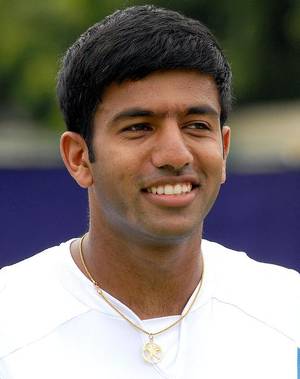
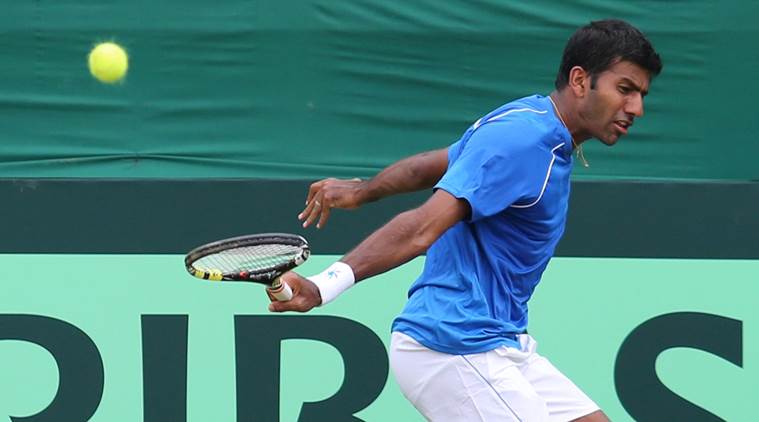
Rohan Bopanna and Jeevan Nedunchezhiyan will lead the Indian challenge alongside Leander Paes and Brazil’s Andre Sa in the doubles category of the upcoming Aircel Chennai Open set to begin here on January 2.
Paes and Sa are seeded third, and Bopanna and Jeevan, seventh.
Bopanna and Jeevan reached the quarterfinals of the Chengdu Open in China early this year.
Purav Raja and Divij Sharan have teamed up as the other Indian entry for the category.
Jonathan Erlich (Israel) and Scott Lipsky (USA) is the top seeded pair.
Player field (doubles) (read as names, team ranking):
Jonathan Erlich (Isr) & Scott Lipsky (USA) (99); Guillermo Duran (Arg) & Andres Molteni (Arg) (111); Leander Paes (Ind) & Andre Sa (Bra) (112); Nicholas Monroe (USA) & Artem Sitak (NZ) (114); Wesley Koolhof (Ned) & Matwe Middelkoop (Ned) (117); Andre Begemann (Ger) & Yen-Hsun Lu (TPE) (126); Rohan Bopanna (Ind) & Jeevan Nedunchezhiyan (Ind) (128); Purav Raja (Ind) & Divij Sharan (Ind) (128); Steve Darcis (Bel) & Benoit Paire (Fra) (133); Johan Brunstrom (Swe) & Andreas Siljestrom (Swe) (136). — Sports Reporter
source: http://www.thehindu.com / The Hindu / Home> Sports> Tennis / by Sports Reporter / December 20th, 2016
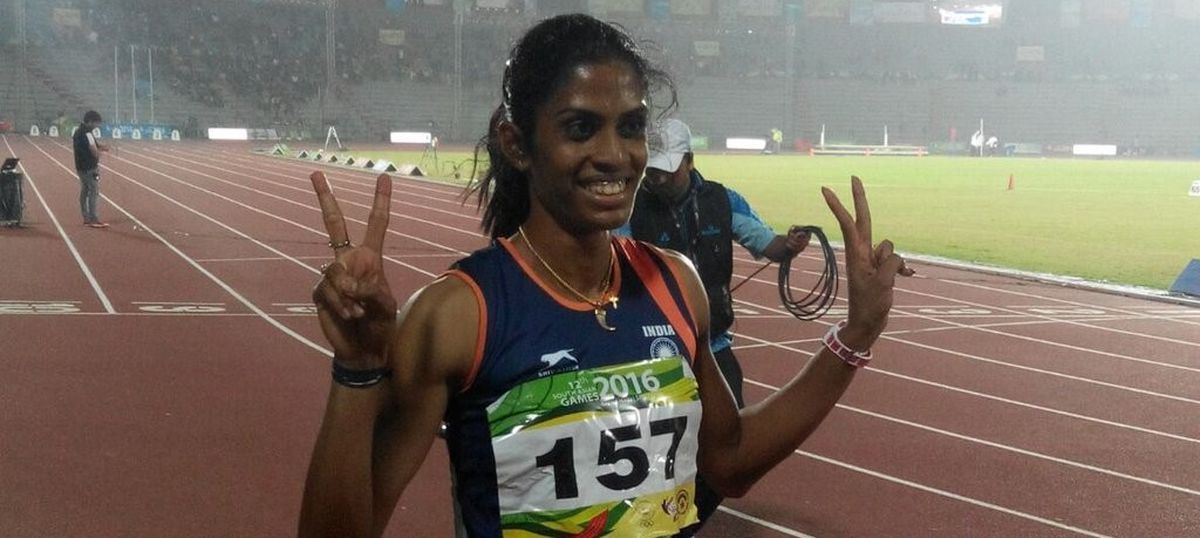
The country’s fastest woman over a distance of 400 metres suffered a debilitating injury in 2012 but came back strongly and won the Arjuna Award in 2015.
Image credit: Twitter
“At Beijing I was just a reserve and at Rio I was a senior member of the team. In between, eight years have passed but nothing, absolutely nothing has changed,” says the 26-year old Machettira Raju Poovamma, an athlete not known to mince her words.
The athlete, living in Mangalore for the last 25 years, has been India’s fastest woman over a quarter-mile or 400 metres for the last three years and was a part of the 4×400 metres relay team that finished 13th at Rio 2016.
Scroll.in spoke to Poovamma on the sides of the GoSports Foundation’s annual awards function in Bengaluru. Poovamma, sponsored by the Foundation since 2015 was recognised as the ‘Most Consistent Performer’ for her contributions to Indian athletics over the years.
“They lift you up, then bring you crashing down”
Some readers may remember that Poovamma, who was a reserve for the women’s 4×400 metres relay team in Beijing was India’s youngest athlete at the Olympic Games in 2008.
She was expected to be a shoo-in for the London 2012 team, but as Poovamma found out, things don’t always go to plan. A month before the trials for the Olympics were to be conducted, the sprinter suffered a horrendous injury which kept her out for almost 10 months and made her forego what was almost a guaranteed spot on the team for a second successive Olympics.
As we sit in the well-lit lobby of the ITC Windsor, Poovamma sporting a blue blazer is almost choking as she forces the words out, “Those times were really dark. I want to erase those memories.”
But as I found out, Poovamma’s problem is an age-old one and not something unfamiliar in the Indian sports scene. We identify the talent after they’ve set the sporting scene alight, not before, mind you, hype them up to atmospheric levels and then turn on them when their performance levels go down or missing. Clearly, standing with our athletes in troubled times is something we still have to learn.
Undergoing weight training in the gym, Poovamma ruptured the L4-L5 vertebrae disc in her spine. The lumbar spine (or the lower back) consisting of the L1-L5 vertebrae helps in supporting the upper body and allowing motion in multiple directions. Degeneration of the L4-L5 disc can result in possible leg pain and/or severe back pain.
During that time, Poovamma says that the same journos who praised her for her achievements in the span leading up to London turned on her. She says, “I read newspaper reports saying that I had gone missing, questioning why I was not performing at any meet. These people, the same ones that lifted me, had brought me crashing down.”
Post this revelation, I ask Poovamma the only logical question that comes to my mind, “Didn’t anyone check with you?” to which her answer is a resounding no. “It was very difficult for me to even go to the washroom but no one bothered checking with me,” says Poovamma as her expression turns expectedly sombre.
A happy ending
Her injury is a recurring one, and she has had to go through rehabilitation therapy several times post recovery. She seems happier with the Bengaluru-based not-for-profit’s involvement, “When you undergo an injury like that, you want some help, some support. Their (the Foundation’s) backing has given me a moral boost,” lending further credence to the theory that private organisations like GoSports, Olympic Gold Quest, JSW Sports and Anglian Medal Quest are filling important gaps in India’s sporting infrastructure.
A self-proclaimed fan of Jamaican sprinter Sanya Richards-Ross, Poovamma says she took up the 400 metres “for fun.” Born to a contractor at the Mangalore airport and a homemaker, she says she took up the 100 and the 200 metres after which she tried her hand out at the 400 metres.
Her mother, M R Jaji, is a lucky charm according to the sprinter. “Since 2005, I can’t recall a single domestic meet that she has missed. They (parents) are old but they do their utmost best to motivate me,” says Poovamma of her family’s involvement.
As she goes up to collect her award, Poovamma doesn’t shy away when asked about her journey as she reiterates, “I’ve been around for eight years but the diet, the schedule, the way of training as prescribed by our sporting authorities, nothing has changed.”
The Rio debacle is still on her mind as she recollects, “Prior to the Olympics, everyone was training individually with their personal coaches. We came together a week prior to the Games. In these events (relay), you need coordination, especially for the baton pass. A fraction of a second can make a difference.”
The authorities, she insists, have done nothing to change the approach to athletics in India, “In the West, each athlete has his or her personal diet and training regime designed for them. Here, they spend their time in the run up to the Olympics predicting the number of medals. I can only be satisfied in the fact that I gave my best on the day.”
And give her best, she did. After returning from injury in April 2013, Poovamma won the relay gold and silver in the individual 400 metres at the Asian Championships held at Pune, also notching up her personal best of 51.75 seconds at Lucknow the same year.
Her finest moment came the following year at the Asian Games in Incheon, South Korea where India won the 4×400 m relay gold as she won the individual bronze. Poovamma is currently ranked second in the 400 m category in Asia as she sets her sights on the upcoming World Championships to be held in London in August 2017.
But for Povamma, her greatest achievement is not that she has scaled the heights to reach the top of her sport in the country but the fact that she has seen the depths and has climbed back up again.
We welcome your comments at letters@scroll.in.
source: http://www.thefield.scroll.in / Scroll.in / Home> The Field> Sports news and scores> World Athletics / by Arka Bhattacharya / December 17th, 2016
Manyepanda Madaiah Chengappa recently took over as the Chairman of Karnataka Planters Association (KPA). Karnataka accounts for more than 70% of the coffee production in India.
According to United Planters Association of Southern India (Upasi), Karnataka’s post-monsoon estimated coffee production for 2015-16 was 253,340 tonnes, with the all-India number standing at 350,000 tonnes. KPA has about 700 members as of date.
In an interview with Furquan Moharkan of DH, Chengappa says that his aim as the chairman is to make domestic demand for the cup of coffee transform from an elitist drink to a common man’s drink.
What are the challenges that coffee plantation sector faces today?
Climate change has increased, apart from pests and diseases impacting the coffee crop productivity. The Arabica coffee crop yield has reduced from 1,200 kgs, to 600 kgs per hectare, while Robusta coffee has decreased from 2,000 kgs, to 1,400 kgs per hectare, over the last decade. For instance, this year, Kodagu has 300 mm less rainfall over the previous year, and Chikkamagaluru has also suffered a similar fate, which affects the standing coffee crop and development of new shoots in coffee plants for the coming season.
Labour wage constitutes over 60% of the total cost of coffee cultivation. The annual wage increase was below 6% till 2007-08. From 2008-09, the increase was very steep. Against 2007-08’s wage of Rs 79 per day, the current wage is at Rs 263 — an increase of 232% or an annual average increase of 15%. This could be the highest percentage increase for any industry in Karnataka. Also the statutory and welfare costs for the labour, which are over and above the wages and benefits, works out to an additional 50% of the wages. This is an additional financial burden for both corporate and proprietary planters.
However, the sale price for coffee at the farm gate hovers around Rs 2,800 to Rs 3,500 for a 50-kg bag, while the labour and fertiliser costs have spiralled disproportionately. The need to invest more funds for R&D to develop better quality coffee plants that are high-yielding and pest-resistant is another challenge.
What are your priorities after taking over as Chairman of the KPA?
Primarily, my major objective is to make domestic demand for the cup of coffee transform from an elitist drink to a common man’s drink. I would seek the Coffee Board’s assistance to establish coffee kiosks at public places like government offices, bus and railway stations, airports, shopping malls and educational institutions. This would make the demand for coffee explode in the country. Towards this objective, it would be necessary to jointly pursue vegetative clonal and tissue culture propagation of coffee, with United Planters Association of South India (Upasi) and Central Coffee Research Institute, Balehonnur, Karnataka. Also, to push for the import of pest and disease-resistant high-yielding coffee plant material. Identify biological viable and effective methods to treat effluents.
Also, request the state government and its Department of Agriculture to allocate Rs 1.9 crore in the state budget to fund the Upasi-KPA coffee research project. To establish soil and leaf analysis laboratories at Chettalli, Kodagu district and Chikkamagaluru district for the convenience of small and large growers.
A lady planters sub-committee has been constituted to promote community outreach programmes and showcase their achievements in cultivation of coffee, plantation nurseries, local marketing initiatives at national and international levels, home stays and plantation cafes for income augmentation.
What is the impact of the GST regime on the coffee plantation sector?
GST does not affect the coffee grower directly, as being agriculturists, they come under zero tax brackets. GST is applicable only after curing at the roasting and powdering stage, when the value-addition takes place, and the coffee can be consumed as a cup of coffee. According to Rule 7B (1) of Income Tax Act — “Income derived from the sale of coffee grown and cured by the seller in India shall be computed as if it were income derived from business, and 25% of such income shall be deemed to be income liable for tax.” This I-T Rule needs to be amended to tax coffee only at the stage of roasting and powdering that would enable the grower to sell coffee, which is plantation-specific, directly to the local and global markets.
Do you think that the import of pepper from Sri Lanka could affect domestic trade?
Import of poor quality pepper is killing the Indian pepper market. A regulatory price mechanism is necessary, whereby the price of pepper imported should be about 5% lower than the Cochin pepper auction price of equal quality of the day. Also, quality parameters of the imported pepper should be strictly monitored by a suitable government agency.
Your comments on the degradation of forests and environment pollution that have a bearing on the plantations in Karnataka.
The National Forest Policy is under amendment and a high-powered committee has been instituted for the purpose. The KPA and Upasi have jointly made a representation to the Union Ministry of Environment and Forests. Also the elephant menace in Kodagu district has assumed dangerous proportions due lack of proper fodder and vegetation in the game sanctuaries. Plantation crops, fruit trees and human beings are being trampled upon and destroyed. Therefore, the translocation of elephants appears to be the only solution, as all other forms of deterrents and barriers have proved ineffective.
While tourism has phenomenally raised the socio-economic level of people in the plantation districts, it should not lead to environmental pollution. Therefore, it is necessary to promote eco-tourism in the plantation districts of the state. Also, aggressively ban all types of pollutants, plastics, discharge of sewage and chemical effluents into the rivers. People need to be aware of waste segregation, its recycling and proper disposal through the media platforms to promote eco-tourism.
source: http://www.deccanherald.com / Deccan Herald / Home> Supplements> Economy & Business / by Furquan Moharkan / DHNS – December 12th, 2016
Ashwini Ponnappa and N Sikki Reddy went down to top-seeded Russian combination of Olga Morozova and Anastasia Chervyakov 21-16 21-11.
Ashwini Ponnappa and N Sikki Reddy had comfortably beaten England’s Lauren Smith and Sophie Brown 21-16 21-18 in the semis.
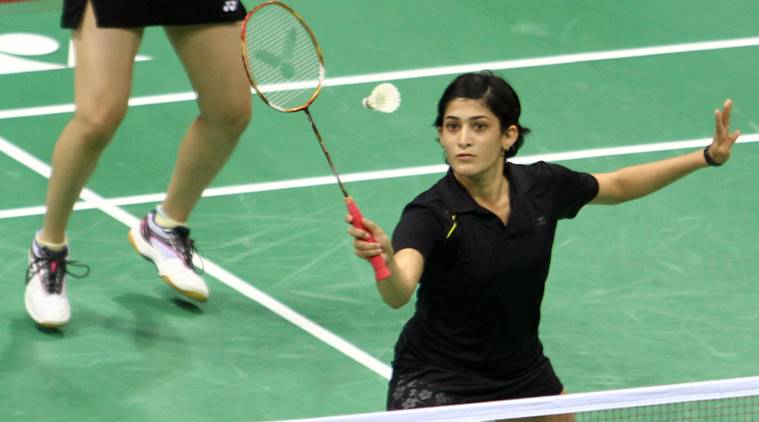
India’s women’s doubles pair of Ashwini Ponnappa and N Sikki Reddy finished runners-up at the Welsh International Challenge badminton tournament after losing in straight games in the final.
The unseeded Indian duo went down to top-seeded Russian combination of Olga Morozova and Anastasia Chervyakov 21-16 21-11 in a contest that lasted just 37 minutes.
Earlier, Ashwini and Sikki had comfortably beaten England’s Lauren Smith and Sophie Brown 21-16 21-18 in their semifinal match. The Indians took 39 minutes to get the better of the English team.
Meanwhile, the men’s doubles combo of Jishnu Sanyal and Shivam Sharma lost in the semifinals against Liao Kuan Hao and Lu Chia Pin of Chinese Taipei.
The third-seeded Chinese Taipei pair needed half-an-hour to make it to the finals by beating sixth seeded Indians 21-17 21-15.
Indians bowed out in the semifinals of the mixed doubles event also as second seeded N Sikki Reddy and Pranaav Jerry Chopra lost to Malaysians Goh Soon Huat and Shevon Jemie Lai 16-21 14-21 in 39 minutes.
source: http://www.indianexpress.com / Indian Express / Home> Sports> Badminton / by PTI / Cardiff – December 04th, 2016
“Nineteen years ago, I was one of the first columnists in Bangalore Times. I cut a wide swathe with that column, and BT was like a fresh breeze blowing through the city.
It chronicled the emergent Page 3 society and made Sandalwood the glamorous entity it is today.
Wherever I am in the country, I get to read The Times of India, but always miss reading Bangalore Times.
Happy anniversary BT, more power to you!” – Prasad Bidapa, style guru
source: http://www.timesofindia.indiatimes.com / The Times of India / News> Chennai News> Bangalore News / TNN / December 05th, 2016
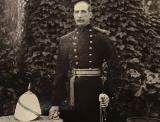
Coorg, as the British called Kodagu, was annexed by the East India Company in 1834, after dethroning the last Raja of Coorg, Veerarajendra. Coorg was administered as a separate province under a commissioner who was also in charge of Mysore. A British officer designated as superintendent was stationed in Madikeri and reported to the commissioner posted in Bangalore.
In March 1865, William Hobart Kerr, the superintendent of Coorg, fell ill and had to go on sick leave.
In his place, a young army officer, Captain Robert Andrews Cole, was appointed as the superintendent. Captain Robert was instantly attracted to the place, the climate, people and the invigorating environment. His duties involved meeting local people in remote villages, checking and updating land records, known as jamabandhi, which certified ownership and simplified revenue collection.
For fluent conversations…
Captain Cole was born in Madras in 1835, to an army doctor, Major General Robert Cole Sr. Having been educated in Madras, he was conversant with Tamil and Telugu. He had familiarised himself with Kannada on being posted in Bangalore. One of the problems Captain Cole encountered in Coorg was communicating with the Coorgis who spoke a dialect, which had many common words with Kannada, Tamil and other South Indian languages.
Surprisingly, according to Captain Cole, the Kodavas who lived in remote villages could not understand Kannada. This prompted him to learn the Kodava language so that he could effectively communicate with the people. Captain Cole soon started learning Kodava language. His knowledge of other South Indian languages helped. He began documenting the words, grammar and pronunciation. In order to help him communicate, he made extensive tables — known as Travel Talk — translating English sentences to Kannada (Canarese), Telugu, Tamil and Kodava language.
However, by October the same year, William Kerr returned, and assumed charge as the superintendent of Coorg. Captain Robert, who had taken a liking for Coorg, went back rather reluctantly to his posting in Bangalore. However, he continued his work on Kodava language. He learnt Kannada script for better conveyance of ‘peculiarities of pronunciation’, and started using this to transliterate Kodava language.
Captain Robert once again took charge from William Kerr, as superintendent of Coorg, in February 1866. He was happy to be back in this mountainous land and had come to enjoy the bracing weather. He particularly enjoyed his outings during the monsoon. This can be evidently seen in his book, Elementary Grammar of the Coorg Language, where he writes, “The thunderstorms during this season are often magnificent. The war of the elements is carried on here in a grander style than in the low country. Banks and mountains of clouds move against each other with the order of armies. The sound of heavy cannon is heard from a distance, solitary discharges of the electric fluid shoot through the gloom.”
Captain Cole served as the superintendent until December 1869. During this period, he compiled a comprehensive book on Kodava language. In 1867, with ample support from Lewin Bentham Bowring, who was the commissioner of Mysore and Coorg, he published his 136-page-book, Elementary Grammar of the Coorg Language. This was printed at the Wesleyan Mission Press. The book also contains a fragment of English-Coorg dictionary.
Captain Cole endeared himself to the people of Coorg. He also wrote another book titled A Manual of Coorg Civil Law. In appreciation of his contributions, an emerging town at the time was named after him as — Colepet. However, over the years, Colepet got merged with present day Ammathi. On promotion as a Major, he was appointed superintendent, Inam Settlement, Mysore. As a Colonel, he was with the Madras Staff Corps. He rose to the rank of Major General by the time he retired and returned to England.
He died in 1907. Major General Robert Andrews Cole ranks amongst other Europeans, who contributed to South Indian languages, such as Rev Hermann Mogling and Rev Ferdinand Kittel.
source: http://www.deccanherald.com / Deccan Herald / Home> Supplements> Spectrum / by C.P.Belliappa / July 26th, 2016
Rohan Bopanna, India’s doubles tennis specialist, is keen to put behind last year’s reverses and focus on achieving big things in 2017.
Rohan Bopanna said the singles rubbers against New Zealand hold key in Davis Cup Asia/Oceania Group 1. (Source: Express File)
India’s doubles tennis specialist Rohan Bopanna said he is keen to put behind last year’s reverses and focus on achieving big things in 2017.
“There is no point in discussing negative matter (on his recent twitter spat with Leander Paes). We should focus on achieving big things in 2017,” Bopanna told reporters after announcement of EduSports and Rohan Bopanna Tennis Academy tieup.
Drawing inspiration from Prime Minister Narendra Modi to perform better in coming season, Bopanna said, “Look at Modi, he has taken a bold step by enforcing demonetisation. He has shown us the way forward,” he added.
Asked about his new partner Pablo Cuevas, Bopanna said he would join the Argentinean as per his singles schedule.
“Cuevas’ priority is definitely singles. I will play as per his schedule. Wherever Cuevas wants to play in the singles section, I will join him and we will compete in doubles,” he said.
Bopanna had recently split with Florin Mergea. The 36-year-old will participate in Australian Open in Melbourne, but not before he would start the season at Chennai Open in January and then Apia International in Sydney.
Replying to a query, Bopanna said the singles rubbers against New Zealand hold key in Davis Cup Asia/Oceania Group 1 first-round tie.
“To qualify to the world group, we need two good singles players because out of the five points, four comes from singles,” he said. “I am hopeful Saketh Myneni, Yuki (Bhambri) and Ram (Ramkumar Ramanathan) can beat the top guys now,” he added.
source: http://www.indianexpress.com / Indian Express / Home> Sports> Tennis / by PTI / Bengaluru – November 22nd, 2016
Tennis doubles player Rohan Bopanna today said that wheelchair tennis was already a big sport in the world, which is reflected in top players like Roger Federer and Novak Djokovic sharing the same locker-rooms with top wheelchair players.
“Roger Federer, Djokovic and top wheelchair players – all of them share the same locker-rooms. There is no difference between wheelchair tennis players and the straight players,” he said.
“That’s where it shows, how big the sport already is, and million and millions of people are already watching it and supporting it,” he added.
Bopanna said holding the All India Tennis Association ranking wheelchair tennis tournament shows interest in this sport.
“Holding the wheelchair tennis tournament is a fantastic initiative and big step, which shows the interest people have in it,” he said.
Asked what sort of support he would give to promote wheelchair tennis, Bopanna said he would share details of wheelchair tournaments held in different parts of the world.
“I am always with them, no matter what support they need. As I am travelling a lot, it will be easier for me to share the details which will be of great help for improving the sport in India,” he said.
Earlier, Bopanna announced India’s first AITA ranking Wheelchair Tennis Tournament – tabebuia – which will be played from December 2 to 4 at Karnataka State Lawn Tennis Association.
The cash prize is Rs 2.5 lakh and the organisers have raised Rs 14 lakh from various sources including the corporate and individual donors, Sunil Jain, Founder Trustee of Astha, a part of Wheelchair Tennis, said.
As many as 40 wheelchair tennis players will participate in the tournament, he said.
Jain said the organisers would love to hold an International Tennis Federation tournament with the cooperation of AITA and KSLTA.
BDN PDS PDS
source: http://www.timesofindia.indiatimes.com / The Times of India / News> Sports> Tennis> Top Stories / PTI / November 29th, 2016
Havaldar Manesh also saw action during the Kargil conflict.
Manesh, a young National Security Guard (NSG) commando, was incapacitated in the 26/11 attack in Mumbai. But he has no regrets. He has lost control over the right portion of his body and uses a crutch to walk. “I have the satisfaction of having served my motherland,” the young and handsome former soldier told The Hindu. He was conferred the Shaurya Chakra for his act of bravery.
During an interview on the sidelines of the unveiling of the statue of Major Mangerira Muthanna here on Thursday, Havaldar Manesh recalled the horror of 26/11. He was part of the 250 NSG commandos airlifted from Delhi to fight the Pakistani attackers and positioned at Nariman Point, one of the spots targeted by the terrorists.
“I killed two of them,” he said proudly. While proceeding further, a terrorist lobbed a hand grenade, which landed on his helmet and exploded, blowing it to smithereens. He does not remember what happened afterwards, but he was shifted to a hospital by a rescue team. Three splinters of the grenade entered his head. “I still have one inside my skull,” he said. Doctors saved his life after a highly complicated surgery. “I was in coma for two months,” Havaldar Manesh said.
His heroics are not just limited to 26/11. He saw action in the Kargil conflict while serving with the 27 Madras Regiment and took a bullet in the hip. He was in hospital for two months, but it took him almost a year to fully recover. Later, he joined the NSG in Delhi and underwent rigorous training for six months before being drafted into service.
He recounts his Kodagu connection where his parents, Mukundan and Saraswati, lived in Jodubeeti near Ponnampet for several years. He is their third son. However, he now lives in Kannur in Kerala.
Havaldar Manesh killed two terrorists during the 26/11 Mumbai attack
source: http://www.thehindu.com / The Hindu / Home> National / by Jeevan Chinnappa / Madikeri – December 11th, 2010
Glamour queen of Indian sports Ashwini Nachappa to tie knot with Datta Karumbaiah, a 32-year-old coffee planter and timber merchant from Coorg whom she met two years ago.
The glamour queen of Indian sports has decided to switch tracks. Ashwini Nachappa, the sprinter, who attracted attention with her figure-hugging Flo-Jo-like one-leggers, is getting married this October.
The 27-year-old athlete, who has been dabbling in films recently, will be sprinting into the world of matrimony with Datta Karumbaiah, a 32-year-old coffee planter and timber merchant from Coorg whom she met two years ago.
Marriage won’t really change things much for Ashwini: she will continue to work for Vijaya Bank though she will call it a day as far as her career in Telugu films is concerned.