Karnataka Sangha Qatar in cooperation with Indian cultural Center hosted Indian Community.
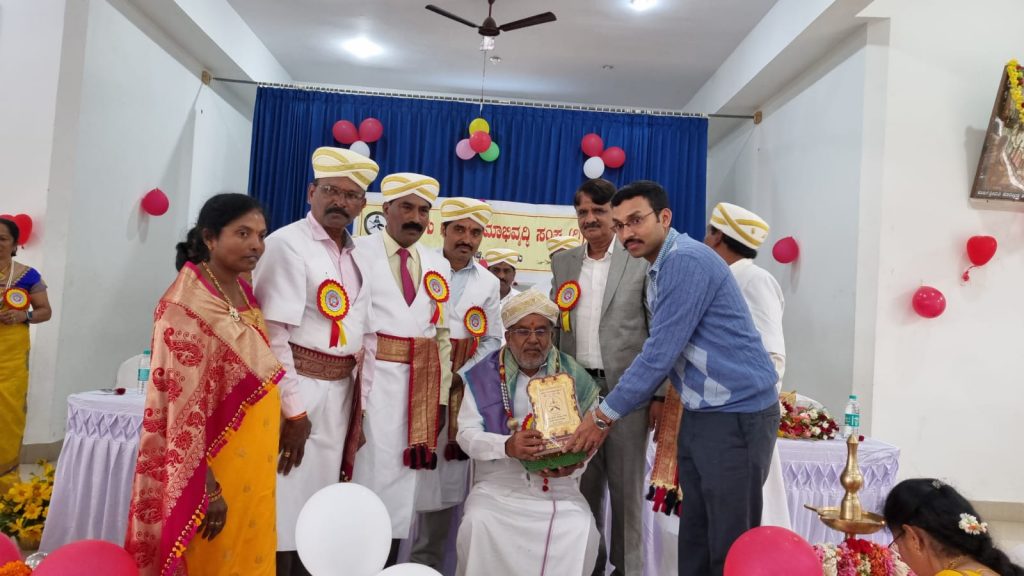
Welcome reception to V S Vinay, ex Indian Hockey team player and current Hockey Karnataka Sr team coach and felicitated on December 6 at Ashok Hall Auditorium of Indian Cultural Centre.
Dignitaries present during this event was president of Indian Cultural Center P N Baburajan, vice president of Indian Cultural Center Subramanaya Hebbgelu.
The platform to this felicitation was created by Indian Cultural Centre to Honour the dignitaries visiting State of Qatar during the FIFA 2022 event.
Mahesh Gowda president – Karnataka Sangha Qatar welcomed the gathering and thanked V S Vinay for giving time for the reception and expressed confidence that under his mentorship many players will get trained and join Indian Hockey team and play for the country, also mentioned it is a proud moment that V S Vinay hails from Coorg district of Karnataka and which is know for producing world class players and won many medals for India.
Mahesh Gowda also thanked Indian cultural organisations for their invite and all Associated Organisations for felicitating the guest.
P N Baburajan in his address briefed the dignitary about Indian Cultural Center and how ICC is involved in the FIFA celebrations.
V S Vinaya thanked Karnataka Sangha and Indian Cultural Centre for felicitating him and people for there time to meet him, also motivated the parents to put their children in any sports and also briefed how their children get all the training facilities from the federation if they are really doing well in the sport.
The programme emcee was done by KSQ member Nithi Ramesh.
source: http://www.daijiworld.com / Daijiworld.com / Home> Middle East / by Media Release / December 10th, 2022
Mysuru Kodava Samaja celebrated Puthari-2022, the harvest festival of Kodagu, in traditional fervour and gaiety at the Samaja premises in Vijayanagar here last evening.
Hundreds of members of the Samaja, wearing Kodava attire, attended the celebrations. Kodava men and women presented traditional dances on the occasion which won the applause of all those present.
In the previous years, the festival used to be celebrated at Sree Cauvery School premises in Kuvempunagar. But this year the celebrations were held in the Samaja premises itself and arrangements were made to distribute kadh (new paddy crop) to all the members by the Samaja volunteers.
Picture shows Kodava men performing a traditional dance.
The festival marks bringing home the new paddy crop from the fields, a symbolic welcome to Goddess Lakshmi. Before harvesting, the members chanted slogans ‘Poli Poli Deva’.
As part of the tradition, after the paddy sheaves are brought home, a unique pudding thambittu is prepared out of ripe banana, coconut, jaggery, sesame, cardamom, ghee and roasted boiled rice flour. Some grains of newly harvested paddy are used to prepare the dishes at home.
Office-bearers and Management Committee Members of Kodava Samaja, Mysuru;
President Mechanda M. Shashi Ponnappa; Vice-President Malachira M. Ponnappa; Hon. Secretary Mukkatira B. Jeevan; Joint Secretary Appanderanda Tara Somaiah; Hon. Treasurer Machimada P. Nanaiah; former Presidents and a large number of community people, young and old, were present.
source: http://www.starofmysore.com / Star of Mysore / Home> News / December 08th, 2022
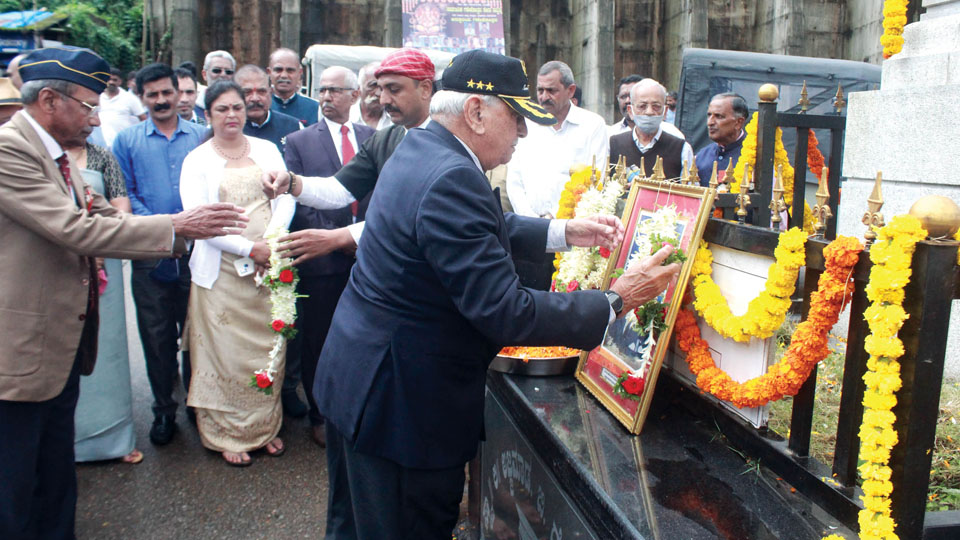
The Armed Forces Flag Day was observed in Madikeri in Kodagu on Wednesday. | Photo Credit: Special Arrangement
The Kodagu district administration and Department of Sainik Welfare and Resettlement observed the Armed Forces Flag Day at General Thimmaiah Memorial Bhavan in Madikeri on Wednesday.
Lieutenant Colonel (Retd) Mahaveer Chakra P.S. Ganapathy, Deputy Commissioner B.C. Satish, Superintendent of Police Capt M.A. Aiyappa, Air Marshal (Retd) Cariappa, Lieutenant Colonel Chacko, Kodagu Zilla Panchayat CEO S. Akash and other dignitaries were present on the occasion.
Every year, December 7 is observed as Armed Forces Flag Day throughout the country to honour martyrs and men in uniform, who valiantly fought and continue to fight on the country’s borders.
source: http://www.thehindu.com / The Hindu / Home> News> India> Karnataka / by The Hindu Bureau / December 07th, 2022
From 2000, Cheshire Homes India Coorg has been helping children & adults with intellectual disabilities.
Chairperson Gita Chengappa
Madikeri :
‘Save Soil’, ‘Swachh Bharat’, ‘Atmanirbhar…’ are not just grand slogans here. They are constants that motivate the functioning of Cheshire Homes India Coorg (CHIC), in Pollibetta of Kodagu district. An institution for the specially-abled, it caters to the needs of children and adults with intellectual disabilities – a majority of whom are from economically weak backgrounds.
Started in the year 2000, the centre has helped shape the lives of people with special abilities by providing special education and vocational training for free. Students are provided sustainable education and are involved not just in readying themselves to face a not-so-inclusive society but are also taught to lead a sustainable, eco-friendly life. Apart from special education, vocational training involves recycling plastic, clothes, paper and manufacturing eco-friendly value-added products.
“The institution is run under the umbrella of Cheshire National Council, but we are an autonomous body. The institution supports the strengthening of the National Council so that we have a stronger body for disability in India,” explained Gita Chengappa, chairperson of the institution.
The centre receives support from the state government. “The state releases Rs 19 lakh annually and supports us. However, on an average, the institution requires Rs 40 lakh to Rs 50 lakh, which is raised through various donors. The institution caters mostly to people from very poor economic backgrounds,” added Gita.
Community acceptance While most special schools are residential, CHIC is a day care centre. Each day, five school vans (hired on rent) leave the institution in five different directions. Designated pick-up spots have been drawn up and students are brought to these spots by their parents, where they are picked up and dropped back after school. “We spend over Rs 13 lakh for the van facility annually. Yet, we don’t want to make this a residential institution. We want the community, parents and society to be responsible for children with special abilities,” she opined.
The institution started off with just six students with special abilities. During the initial period, the institution involved itself in Community Based Rehabilitation (CBR) and travelled the length and breadth of Virajpet taluk. “We went door to door, looking for children with special abilities and convinced parents not to keep these children hidden but to admit them to the institution. It was then run in a small building in Pollibetta,” she recalled.
vice-chairperson Punita amaswamy and honorary secretrary Asha Subbaiah
The CBR programme was continued for eight years, and the institution currently operates in a spacious location with improved facilities, with 68 specially-abled students who are diagnosed with intellectual disabilities.
“After Covid-19, the number of students dwindled as many fell sick. But we continued to cater to their needs and are still providing them the required medication,” she said. The institution helps them avail of government schemes for the specially-abled. During the pandemic, the institution supported their families with provisions and monetary help.
Driving force The centre has six special educators. Shivraj, a specialist in visual impairment and mental retardation, heads the team as headmaster. Apart from the special educators, the centre has appointed vocational trainers. “The students are being skilled under different campaigns. While an inclusive society is still a distant dream, we are helping to skill them to earn a living within the boundaries of our institution,” she explained.
Single-use plastics, used papers and newspapers, used clothes and other recyclable plastic waste are turned into value-added products. Children with even severe impairment are involved in vocational activity which can help shape a sustainable, eco-friendly society. Used plastics are cut into pieces and woven (with help from a few women) into aesthetic mats. Used papers are cut into small pieces and processed into eco-friendly reusable paper, which is turned into paper bags and other items, and decorated with indigenous paintings.
From coasters to pillow covers, the talents of the specially-abled not just earn them a good living but help raise funds for the institution. The centre also has a ‘Jumble Sale Room’ where used clothes and other used items are stored and later sold. “We try unique methods to raise funds and build the institution,” explained Gita. The centre has a handloom unit operated by women from economically weak backgrounds, who are paid for their work. They also raise funds through handloom sales.Having addressed the needs of specially-abled people across Virajpet taluk, the institution is slowly expanding to the borders of Somwarpet taluk.
SPECIAL TOUCH
Institution equipped to support needs of specially-abled, has ‘tactile paving’ that helps guide the visually impaired
Toilets fabricated to meet the needs of specially-abled
Institution has full-time physiotherapist and psychiatrist
Helps recycle and upcycle plastic and paper waste, provides means of sustainable earnings to
the specially-abled
Centre has a ‘care unit’ where people with severe intellectual disabilities are cared for and nurtured
Projects of Central government are implemented to empower the specially-abled
source: http://www.newindianexpress.com / The New Indian Express / Home> Good News / by Prajna GR, Express News Service / December 04th, 2022
These microbial mats in a Lake Huron sinkhole have finger-like protrusions caused by a buildup of methane gas in small pockets beneath them. Image: Thunder Bay Marine Sanctuary
By Daniel Schoenherr
Special microbial mat systems in Alpena, Michigan, are helping scientists search for extraterrestrial life.
“It’s so different, and feels otherworldly,” said Stephanie Gandulla, a diver with the National Oceanic and Atmospheric Administration’s Thunder Bay Marine Sanctuary. She has sampled the mats near the sinkholes on the lake’s bottom.
You may have seen a microbial mat before — the green algae on wet rocks at the beach is an example.
Algae’s green color comes from chlorophyll — a substance that uses sunlight to turn carbon dioxide into energy. Carbon dioxide and oxygen support most of life on Earth.
But under special conditions, like those at three sinkholes just 2½ miles east of Alpena, primitive forms of microbes called cyanobacteria can survive without either of them.
These are white, not green, and they get energy from chemicals in the water.
“They are everywhere, but they are incredibly hard to find,” said Bopaiah Biddanda, a biologist with Grand Valley State University’s Annis Water Research Institute, who has been studying them for 20 years.
Such mats are normally found in ocean waters over 32,000 feet deep, but they can be found only 80 feet below the surface of what is known as Lake Huron’s Middle Island Sinkhole.
The sinkhole’s biologically extreme environment can help simulate sample collection in extraterrestrial worlds where life is based on similar chemicals. A new study by Biddanda models scenarios where robots could analyze material beneath the water of other planets. It’s based on the work in Lake Huron.
The study focuses on two methods: suction devices for soft mats and coring devices for hard mats.
Click on the photo below to watch a video about these mats:
The sinkholes near Alpena provide sulfuric, oxygenless groundwater that creates the conditions needed for the mats to grow. Filaments of cyanobacteria drift together, creating a wispy white-purple flow.
“It almost looks like a mirage,” Gandulla said.
It could be a long time before the experience from sinkholes in Lake Huron will be used to explore the potential of life on planets elsewhere, but Biddanda’s exploration is yielding other finds now.
Recently, for example, his team found an explanation for the mats’ mysterious ability to change colors overnight.
The purple and white cyanobacteria travel upwards to capture energy from the top of the mat, according to the study. During the day, microbes with color capture the small amount of sunlight reaching the seafloor with chlorophyll.
As the sun sets, the white microbes move to the surface of the mat to absorb chemicals in the sulfuric water for their energy. This continuous, vertical shift in microbes causes patches of the mat to change between purple and white in a daily cycle.
The microbial mats thrive off a special soup of chemicals in the groundwater, but changes in land use could disrupt it in the future.
The Thunder Bay sanctuary is constantly combating such threats to coastal ecosystems such as the one near Alpena.
“Development might choke off the water supply,” Biddanda said.
The marine sanctuary offers educational programs and tours to K-12 students and operates a welcome center year-round.
“We work together to protect it as a community,” Gandulla said.
Scientists hope to sample the oceans of Europa, a moon of Jupiter, for microbes with robots pioneered in Lake Huron. Image: NASA
The characteristics of Middle Island Sinkhole’s cyanobacteria could hold the key to much more than planetary exploration. They could lead to advances in other scientific fields, such as evolutionary biology and medicine.
“We have a library of pharmaceutical value here,” Biddanda said “This could help us down the road.”
And, he noted that they look cool: “There is something fascinating and mesmerizing about these colorful mats.”
Despite the hype and glamour that surrounds other sports, especially cricket, hockey holds a special place in the hearts of the people of Kodagu. The Family Hockey Tournament remains a popular event and there are several talented youngsters who emerge in these matches. Many such players from rural areas learn their craft on natural surfaces. Since all major tournaments are now conducted on synthetic surfaces and youngsters from the more affluent countries begin their hockey journeys by playing on such grounds, it confers a great advantage to players from these countries.
Fascinated by the interest and passion for hockey in Kodagu and not missing any Family Tournaments in his home district, Dr. Kuppanda Tilak Ponappa draws examples from other sports and presents the argument in this article that hockey players should be able to adapt to different surfaces including natural ones. Perhaps, such a move will ‘level the playing field’ and enable our once great subcontinental teams to compete with the very best in the world. — Ed
The early days
To people of the Indian subcontinent, hockey refers to ‘Field hockey,’ and is distinct from ‘Ice hockey’ that super-fast, ultra-violent sport played in the frigid northern latitudes.
Field hockey was introduced to India by the British during the colonial era. Indians soon took to the game and were quickly dominating the English teams, and indeed, everyone else. Indian players were famous for their skilful dribbling, clever passing, body swerves and general artistry.
India remained the pre-eminent team in the world for many decades. In the Summer Olympics, India was dominant between 1928 and 1956, winning gold in Amsterdam, Los Angeles, Berlin, London, Helsinki and Melbourne. Another Indian gold medal in Tokyo (1964) was sandwiched between the two Pakistani triumphs of 1960 and 1968.
Cracks in the pre-eminence of subcontinental hockey became evident in the 1970s. During this period, the victory in the World Cup final over Pakistan in 1975 proved to be a high point for India. By the time the Moscow Olympics rolled around in 1980, India was no longer a dominant force. That year, although India did win its eighth (and last) Olympic gold medal in hockey, it perhaps lacks the lustre of the previous seven golds, as many of the best teams of that era boycotted the tournament for political reasons.
The partition of India and the creation of Pakistan saw the two neighbours play each other in many an epic battle, featuring their exciting style of hockey. Pakistan produced numerous excellent teams that won three Olympic golds, three silvers and two bronze medals from 1956 through 1992; in addition, our neighbours have won the prestigious World Cup four times having last triumphed in 1994. Sadly, neither of these teams rules the sport any longer.
In the past, there was something about a hockey victory by India, especially during the colonial era and soon after Independence, that gave the sporting public a great sense of pride. But things change, and many factors have resulted in a host of European teams as well as Australia, New Zealand and Argentina being major powers in the sport.
A sketch of hockey in Kodagu by Dr. Tilak Ponappa’s wife Patricia Taylor.
Why do teams from the Indian subcontinent no longer dominate hockey?
All sports evolve over time. Technologically advanced countries probably analysed the all-conquering Asian hockey teams and developed means to counter them. Gradually, the Europeans and Australians began to catch up to the subcontinental teams and eventually surpass them.
Furthermore, numerous changes were implemented in the rules of hockey. Some of these were ostensibly to speed up the game and make it more visually appealing to television audiences; although the end result may have been detrimental to the Indians and Pakistanis. A major change was the switch from natural to synthetic surfaces that were inaccessible to many players in these countries.
I suggest that, at least in India and other developing countries, there would be much to be gained by returning to the natural surfaces where the game was first played and rose to popularity. In order to emphasise this issue, perhaps we can look at the way some other sports are conducted.
A case in point would be ‘lawn’ tennis where the surfaces vary depending on the tournament. Two of the major championships, the Australian Open and the US Open, are now played on synthetic courts. Wimbledon, on the other hand, is played on grass; whereas the French Open is conducted on clay.
Many giants of the sport have had limited success in adapting to courts that were relatively unfamiliar to them. For instance, the American stars, Jimmy Connors and Pete Sampras were unable to conquer the red clay of Roland-Garros at singles, although they had great success at the other major tournaments. A Wimbledon title eluded Ivan Lendl, though he won multiple major tournaments on surfaces other than grass.
All sports change over time. Modern-day tennis players use racquets with large sweet spots and are able to generate incredible pace and topspin. However, the introduction of these enormous racquets means that we seldom see the kind of finesse and ‘touch’ exhibited by the brilliant John McEnroe, our own Ramesh Krishnan or his father Ramanathan Krishnan.
While considering cricket, especially the exacting Test match version, there is little question that the playing surface has a great effect on performance. In fact, much of Test cricket’s charm results from the pitch’s characteristics. The nature of the soil, the amount of grass on the surface and the methods used in the preparation of the pitch, all contribute to the ebb and flow of the game and its ‘glorious uncertainties’.
Consequently, the ability to adapt to the initial state of the surface, as well as its changing nature over a five day Test match is vital to a cricketer’s success.
There is an abundance of sporting talent in the little district of Coorg (Kodagu) in Karnataka.
The hardy people of these hills have excelled in various athletic endeavours, but the sport that seems to be closest to their hearts is hockey.
The annual ‘Hockey Festival’ in Kodagu is a significant event in the local calendar. Hundreds of Kodava families participate in the tournament wherein the skills of many talented rural players are on display. Although the fields may be grass or gravel, the matches are often riveting, indicating that a synthetic surface is not imperative for the sport to be exciting.
Despite the all-pervasive presence of cricket in the media, and the general impression that interest in hockey is on the wane, it is encouraging to note that there remains isolated pockets in India, including Kodagu, Punjab and Odisha, where hockey still holds a special place in the hearts of sports enthusiasts.
Dr. Tilak Ponappa
Conclusion
India was once a great hockey playing nation. However, for various reasons, it has been many decades since teams from the Indian subcontinent have dominated the sport. Since the inaugural World Cup in 1971, India’s best result in the competition was achieved way back in 1975, when they were crowned champions. Unfortunately, replicating this early success in the prestigious tournament has proved to be elusive.
The bronze medal in the 2020 Tokyo Olympics was a significant achievement considering the country’s previous Olympic medal at hockey was earned in the boycott-marred, truncated Moscow Olympic competition of 1980. Although the silver medal in the recently conducted Commonwealth Games of 2022 is a creditable achievement for our men’s team, losing 0-7 to the mighty Australians illustrates the gulf that needs to be bridged before we can get back to the very top of the sport. As the country develops on all fronts, one looks forward to more progress in the sport and hopes that appropriate steps are taken for the team to reach the summit again. Perhaps making a pitch for putting the ‘field’ back in hockey will be one such measure.
How can we attract more youngsters to hockey?
1. Allow the use of different playing surfaces
A talented young hockey player in rural India may not have access to artificial turf. The skills needed to succeed on a natural surface are different from those required for synthetic surfaces. By the time the player is proficient enough to be selected for a training facility with access to artificial surfaces, new skills will have to be learned and old ones unlearned, putting the youngster at a disadvantage.
The use of artificial turf, often coloured blue, was thought to facilitate television viewing. Today, however, multiple, high-quality cameras would likely capture the nuances of the sport regardless of the playing surface. Perhaps it is time to play major international hockey tournaments on either natural or synthetic surfaces, depending on convenience.
The teams that can adapt to different types of surfaces will be more successful as in the case of a tennis player who is able to win all four major tournaments and earn the coveted Grand Slam, or a cricket team that wins at home and abroad.
2. Reduce the chance for injury and the need for protective equipment
While playing hockey on uneven surfaces and indeed on any surface, perhaps we can take a step back for reasons of player safety and ensure that the ball remains on the pitch, or not more than a few inches above the ground, except when ‘scooped’. Strong enforcement of the old rule of ‘sticks,’ whereby a hockey stick may not be raised above shoulder level when taking a shot, would also reduce the likelihood of injury.
3. Encourage the scoring of more field goals
Modifying rules to enable the scoring of more field goals and reducing the emphasis on ‘corners’ may well make the game more exciting. To this end, perhaps doing away with frightening drag flicks that could seriously maim defenders would be useful. Again, such measures will also reduce the necessity for expensive protective gear that may not be easily available or affordable to poorer countries. Although not related to this argument, reinstating the unique ‘bully’ to start the game would restore some old-world charm.
4. Look after the interests of hockey players in the developing world
As in most walks of life, money matters. Compared to many developing countries and indeed several other nations that are considered “advanced,” India has become relatively wealthy after shrugging off the colonial yoke. Thanks to shrewd marketing and administrative strategies, the Board of Control for Cricket in India (BCCI) has harnessed the passion of our enormous population for cricket.
Consequently, the BCCI is flush with funds and does not have to kowtow to the cricket boards of other countries. If our hockey administrators were as influential as the BCCI, changes proposed by the world body that may prove to be detrimental to the sport in our country could be opposed.
Also, popularising hockey with the country’s youths would be an important step forward. Promising young players need to feel a passion for the sport, pride in the country’s past success and perhaps view hockey as being just as glamorous as cricket.
5. Identify talent early
A scientific approach to identifying and grooming promising players is essential. In the highly competitive world of American football, players are constantly evaluated for parameters pertinent to that sport. Very often, but not always, elite athletes end up being exceptional football players. Conversely, some of the greatest professional players have not necessarily been the best athletes. Apart from being conversant with modern techniques, our hockey coaches must pick players who are not only sufficiently athletic but also have the temperament to succeed at the highest level. Excellence must be rewarded.
Dr. Tilak Ponappa is a planter based in Kodagu. Previously, he used to conduct scientific research in the area of plant biology. He is also the author of the novels, ‘Joy in Coorg’ and ‘The Cougar.’ The author is grateful to Dr. Ashok Menon for his valuable suggestions. Dr. Tilak Ponappa can be reached via email: tponappa@yahoo.com
source: http://www.starofmysore.com / Star of Mysore / Home> Feature Articles> Sports / by Dr Tilak Ponappa / November 28th, 2022
Codava National Council (CNC), which is aspiring for Codavaland Geo-Political Autonomy and ST tag for Kodava tribalism, celebrated its 26th AnnualCodava (Kodava) New Year Day Edmyar-1 as per Kodava tribal almanac by ritualistic ploughing of paddy fields.
CNC President N. U. Nachappa offered prayers to Guru-Karonas at Koopadira clan and reverential prayers to Mother Earth, Sun, Moon before two bullocks named Karianna – Kulla, ploughed a few rounds in the wetlands of Koopadira clan.
To herald the unbreakable bondage of Kodava tribal world with mother soil to entire universe, CNC is determined to showcase and display the age-old folkloric cultural traits and genus of Kodava tribal ancestry. In other words, all these ancient festivities enriched the civilisation of Kodava martial tribe.
CNC also prayed for the well-being of all the people of this world that is reeling under the pandemic COVID-19. Koopadira Sabu, Koopadira Mohan Muthanna, Lt. Col. Parvathi, Kompulira Myna Purandara and Koopadira Pranam participated in the celebrations.
Due to Corona pandemic, CNC’s Annual Edmyar-1 evening’s torchlight (pombolak) procession at Gonikoppal, is not being celebrated today. Speaking on the occasion, Nachappa said, “All Codava folkloric festivities and rituals mirror the agro-pastoral commitment, hunting skills and warrior hood of Codava tribal folk from time immemorial which depicts that we are above the tenets of caste and religion who are living in the rustic hills, mountainous terrain in the midst of rivers and rivulets.”
“We are happy that the Founding Father of the Constitution of India, Dr. B. R. Ambedkar’s birthday coincides with Codava New Year. We are ever grateful to Dr. Ambedkar for his yeomen contribution of accommodating space for expressing grievances of micro-minority tribes like Codava tribe,” he observed.
source: http://www.starofmysore.com / Star of Mysore / Home> Covid-19> News / April 14th, 2020
As the son of an Indian naval officer, Bidanda Bopaya was born in Pune, has lived all over the Indian coastline, and was sent to a boarding school in Ooty at a young age. His wife, Louella, daughter of an Indian air force officer, is a psychologist in private practice.
The Bidandas moved to Pittsburgh in 1987 after graduate work at Penn State and have raised two children in the Burgh. Their daughter, Maya is pursuing a PhD in finance & economics after an early career on Wall Street, and their son Rahul is an engineering graduate from Pitt. The Bidandas live in Fox Chapel.
Bopaya, a professor of engineering at the University of Pittsburgh and President of the Institute of Industrial & Systems Engineers, has authored/edited 13 books in the subjects of his specialization. Here is Bopaya in his contemporary dress and also in the traditional Kodava attire.
Editor’s note:
My early childhood was in Madikeri (earlier name Mercara) in Kodagu District, earlier known as Coorg (population: over 500,000 people) in Karnataka State. Madikeri is the headquarters for Kodagu and the home of the Kodavas, a small, accomplished, and colorful community in the Indian social tapestry. Kodavas are ~20% of the population of Kodagu District, and have contributed disproportionately to India’s armed forces, sports teams, and other professions including as India’s first female ambassador, India’s first PhD in sports medicine, the founder of the National Institute of Sports in Patiala, and of course, India’s first Commander-In-Chief (Gen. Kodendera Subbayya Thimmayya), and India‘s first Field Marshal Kodendera Madappa Cariappa.
Location of Coorg District and Madikeri town in Karnataka.
After sixty years, I chanced to drive through Madikeri. I had a vague memory of Omkareshwara Devasthana, a Shiva Temple there. Since it was the only temple I knew in my childhood, it made no impact then. When the driver showed me the temple from a mile away from the hills, I told him it looks like a mosque. His reply: was saar, iduve devasthana. (No sir, this IS the temple.) Stunned at the unique architecture for a Hindu temple with a typical Islamic dome including the four minarets, I stood in silence in front of the temple absorbing the ambience.
Then during the Patrika fundraising, I saw one Bidanda Bopaya as one of the on-line contributors. From the name, I recognized he is a Kodava (known earlier as Coorgis). I contacted him with my Madikeri roots, and one thing led to another in our exchanges, which finally culminated with Mr. Bopaya writing this article for the Patrika. – Kollengode S Venkataraman
The Omkareshwara Temple is a picturesque and unique place of worship in Madikeri, the heart of a salubrious and verdant hill station in Karnataka. Our family spent summers in Kodagu, and the place remained a well-kept secret because of the absence of a railhead. Now, it is a weekend getaway to Bangalore IT techies arriving in hordes.
Steep hills studded with vibrant homes surround the temple. Legend has it that the Raja of Kodagu, Lingarajendra II, built the temple repenting for some terrible act he committed. He was advised to build a Shiva temple that would awe people, as long as the sun and the moon are around! He commissioned the temple, consecrating it in 1820, with a Shivalinga brought from Kashi enshrined at the temple’s sanctum.
Omkareshwara Devasthana with its dome and four minarets
Omkareshwara Devasthana is the only known example of a Shiva temple for that matter, any Hindu temple built like a mosque with four turrets (or minarets) at each corner and a dome at the center. The rationale for this one-of-a-kind architectural style (Islamic with a Gothic touch) for a Hindu temple is not precisely known even though the temple is only 200 years old, given the frosty relations between the Kodavas and Muslims, thanks to Tipu Sultan (1750-1799), who repeatedly invaded and unsuccessfully tried to take control of the region. Search the web under Tipu Sultan and Kodavas to get multiple perspectives of this complicated relationship.
Given today’s strife-ridden global situation among all religions, it is inspiring that one Hindu temple integrated multiple styles of architecture into its place of worship two centuries ago. As children, we played hide-and-seek with our extended family around the temple.
The Rajaâ’s tomb located nearby, built in 1809, also has an Islamic architecture. My great-great-grandfather Bidanda Bopu was the Commander-in-Chief of the Kodagu Rajaâ’s army and is buried next to the Raja. Growing up, our family often celebrated festivals and visited the tomb to pay respects to our ancestors.
The Kodavas are proud people and maintain unusual traditions. Kodagu is often called the land of generals, beautiful belles, coffee, cardamom, pepper and honey, all because of its hilly terrain and suitable weather, honey, large number of military leaders, and charming and gracious women! Some interesting features of Kodavas
1)Are Kodavas Hindus? While Kodavas are governed by the Hindu laws, they are technically not Hindus, with the absence of a caste system; Kodavas are ancestor- and nature-worshippers. Most festivals are centered around agrarian and martial themes and traditions. However, many Kodavas have now adopted a Hindu lifestyle and traditions.
KODAVA FESTIVALS: Kodavas are rooted to their land as farmers and agriculturists. No wonder, all Kodava festivals are around farming.
2) Kailpodhu: After the paddy fields are transplanted in early September, Kodavas worship their weapons and tools, after cleaning and decorating them. This is followed by festivities (shooting competitions, athletic prowess, while feasting on spicy food and copious alcoholic beverages). Kodavas have the right to bear firearms and weapons without license.
3) Kaveri Sankramana: The river Kaveri originates in Kodagu District in a small natural spring in Bhagamandala, close to Madikeri. In mid-October, at a specified time, the sacred River Kaveri ” yes, for Kodavas in particular, and for all Kannadigas, Kaveri is sacred ” renews with new divine springs gushing towards a larger body of water. This is the birthplace of the river. People take dips in this holy water. Goddess Kaveri is then worshipped in Kodava homes with youngsters touching the feet of elders for blessings. Kaveri is perhaps the most common name for girls among Kodavas. This is the only meatless festival among Kodavas!
Kodavas in the field during the the Puttari Harvest festival
4)Puttari (meaning New Rice), is the traditional harvest festival, celebrated in early December when people gather in their traditional family home (ainamane) nicely decorated with farm motifs. Like Onam, Pongal, Lohri, Baishakhi, Bihu, and of course, Thanksgiving here, special culinary items are prepared. An important part of this festival is the matriarch of the family leading others into the fields for a symbolic first harvesting of rice paddies.
In addition to these, individual villages have temples that celebrate colorful festivals, including walks thru hot beds of coals. The best way to experience these is to be with Kodavas in their home during the season.
Pattaya, a traditional granary decorated for the Puttari harvest festival.
5)Is there a Kodava cuisine? Yes, of course. Kodava cuisine is replete with unique and fiery dishes including Pandhi Kari (pork curry cooked in a special vinegar), Baimble-Kari (bamboo shoot curry), mango paji (mango chutney), kuru kari (kidney beans, green beans, in a coconut gravy), akki rotti (rice chapattis) and the list goes on!!
7)Interesting fact: No priests at Kodava weddings. Family elders lead all the religious rites, with a frenzy of Kodava dancing, pandhi curry, libations, and ceremonies steeped in family traditions.
Drs. Palecanda and Nirmal Chengappa, longtime Pittsburgh residents, in traditional Kodava dress and jewelry at the wedding of their daughter Kaveri.
Websites offer a ton of information on tourism-related questions on Kodagu — places of interest, cuisines, lodging, what to do, how to reach, the best time to visit. One website is: www.coorgtourisminfo.com
source: http://www.pittsburghpatrika.com / The Pittsburgh Patrika / Home / by Bidanda Bopaya, Fox Chapel, PA / October 2022 issue
“Utharkand, Telangana, Haryana, Himachal Pradesh have become separate states after a long fight. Why should Kodagu not get an autonomous council?,” he questioned.
Madikeri :
“I will fight for your (Kodagu) separate existence within Karnataka state but with an autonomous council,” declared former minister and economist Subramanian Swamy in Kodagu. He was addressing the gathering at the 32nd Codava National Day celebration in Madikeri on Saturday. The event was hosted by Codava National Council (CNC).
Subramanian Swamy in his speech assured CNC about the organization’s goal of achieving geo-political autonomy through a legal battle. “Great injustice has been done to you (Kodagu/Kodavas). But keep fighting,” he added. He assured to file a petition in the Supreme Court shortly to get Geo political autonomy status to Kodagu. He stated that he will seek support from his legal advisor Satya Sabarwal. “Utharkand, Telangana, Haryana, Himachal Pradesh have become separate states after a long fight. Why should Kodagu not get an autonomous council?,” he questioned. He assured that Kodagu will be an independent council by November next year.
Meanwhile, speaking with the media Swamy said, “The former minister Chidambaram has faced serious charges in many cases followed by Rahul Gandhi in the young India case. Prisons wait for them.”
He commented on the Modi regime and spoke, “I am not opposing Modi. But his policy of appeasing China is opposed by me. He should not allow the Chinese to occupy our territory. India should fight back. I also oppose some of the wrong economic policies of the present government. No one in BJP has the guts to question the wrong policies except me. Even the PM has failed to declare Ram Setu as a heritage spot despite several appeals by me.”
Virat Hindusthan Sangam national secretary Jagadish Shetty, Supreme Court advocate Satya Agarwal and CNC president NU Nachappa also spoke. Several resolutions including the demand for ST tag for the Kodavas were passed during the session.
source: http://www.newindianexpress.com / The New Indian Express / Home> States> Karnataka / by Express News Service / November 26th, 2022