Category Archives: Famous Personalities of Kodagu / Coorg

Food Friday | The best-kept secrets of Kodava cuisine

The iconic Pandicurry is the most emblematic and popular food people identify from Coorg. But the kadi (good food) and kudi (liquor) of the Kodava region in Karnataka are as wide and wild as they could get.
Food Friday | The best-kept secrets of Kodava cuisine
The Kodava Cuisine

“Pandicurry please!”

The allure of the tangy-spicy curry keeps calling me back to Coorg, every time. Of course, I am a lover of coffee too but if I were baring my heart to you, I would tell you that pork takes precedence every time I visit the Scotland of South India. No other style of pork has made such an impact, not even the sorpotel!

Let’s agree that the iconic Pandicurry is the most emblematic and popular food people identify from Coorg. But the kadi (good food) and kudi (liquor) of the Kodava region in Karnataka are as wide and wild as they could get. From wild mangoes and mushrooms to tender bamboo shoots, the food here is full of organic ingredients that establish its supremacy over other cuisines emerging from the state.

Food Friday  The bestkept secrets of Kodava cuisine
Wild Mushrooms

In this context, it’s important to mention that Coorg was in fact a state itself, landlocked and rich with biodiversity that attracted foreign attention almost immediately when the British came to India. Ruled as a kingdom established originally by the Nayakas, the state was self-sufficient and housed a clan-based community of warrior tribes. It was the hunted boar, that actually led to the pandi curry’s foundation.

For centuries Coorg was quite inaccessible, a landlocked region. It explains the heavy reliance on locally sourced ingredients. On a recent visit to the Evolve Back Coorg which sits pretty in a 300-acre coffee plantation and traces the traditions of the valley efficiently, I found peppercorn growing carelessly creeping around jackfruit, silver oak and mango trees among the robusta coffee the estate produces.

Food Friday  The bestkept secrets of Kodava cuisine
Robusta Coffee

For the uninitiated, Coorg is also the rice bowl of Karnataka, it grows in abundance here thanks to plenty of rains and rich soil composition. Upon finding The variety of rice items alone is quite humbling at The Granary, the main restaurant at Evolve Back so I had to turn to a specialist who could explain better. Sudhansu Sekhar Jena, the senior sous chef helps me out – “Kadambuttu, Thaliya Puttu, Paaputtu, Noolputtu, Koovale Puttu and various seasonal pickles are signature dishes of Coorg cuisine, just to name a few,” he explained.

While small dumplings of steamed broken rice make the KadambuttuNoolputtu is a fine lump of pressed rice noodles and what makes Paputtu stand out is the addition of coconut milk and a dash of shredded coconut which is steamed together with rice. With this newly acquired knowledge, I settled for lunch with paputtus and a delicious koli curry (chicken curry).

Food Friday  The bestkept secrets of Kodava cuisine

Sudhansu Sekhar Jena , Senior Sous Chef – F&B Production, Evolve Back Coorg, shares the recipe of Paputtu and also tells the detials of the dish.Paputtu is generally known as palputtu ( pal means milk and puttu is steamed rice cakes). It’s made of akki thari (coarse ground rice rava), grated coconut, salt and water. It’s steamed in a special kind of steamer called sekala and goes very well with non-veg curries.

Ingredients:

2 cups thari or coarse rice rava
1 – 1 1/2 cups fresh grated coconut
2 cups whole milk / light coconut milk
2 cups water
1 tsp cardamom powder
Salt to taste
Oil to grease

METHOD:


Wash the rice thari and soak for 1/2 an hour in the 2 cups of water. Add the milk, cardamom and salt and mix well. Squeeze the freshly grated coconut to extract a little milk and add it all to the mixture. Grease the plates with little oil. Pour the prepared mixture into the greased plates till two-thirds full to allow room for the thari to expand. Divide equally between plates and steam for 25-30 minutes or until done. The puttu should look firm, with no soggy bits in the centre. Cover the plates with a clean tea cloth and allow the puttu to cool a little before cutting them into pieces.

JENJI MASALA (Mud crab curry)

Ingredients Unit Quantity
Crab ( Jenji) Grams. 1000
Garlic Chop Grams. 50
Ginger Julienne Grams. 20
Mustard Seeds Grams. 10
Onion Slice Grams. 250
Ginger Paste Grams. 25
Garlic Paste Grams. 25
Tomato Slice Grams. 200
Green Chilly Slit Nos. 15
Coriander powder Grams. 75
Chilly Powder Grams. 60
Turmeric Powder Grams. 5
Salt Grams. To Taste
Oil Ml 200
Coconut Paste 1 whole
Curry Leaves Grams. 50
Red Chilli Whole No. 3-4

Procedure:


Clean & wash Crabs, add salt, and turmeric powder, and keep aside. In a vessel heat oil, add chopped garlic, mustard seeds, ginger julienne, slit green chilli, and curry leaves. Then add onion slice and fry till light brown, add sliced tomato and all Masala powder, salt and little water and sauté till oil comes up. Now add coconut paste & simmer gently, cooking till coconut paste is well cooked. Then add Crabs and salt, and bring to Cooked. When Crabs are tender, remove them from the fire, add temper and serve.

For tempering:

Heat a little oil and add mustard seed, curry leaves, and red chilli whole. when mustard seed crackles pour into the Crabs Masala. Serve hot.

Monsoon brings even more joy for the tribe that used to be reliant on hunting-gathering in forms of mud crabs and fresh fish from the opulent rivers running through the forests of Kodagu. Mahseer, rohu, tilapia, katla, giant gourami are some of the fish which can be caught in river Cauvery, India’s fourth largest and the lifeline to this side of the peninsula.

Anjali Ganapathy, a Chef who calls herself an armchair ethnographist, has been tracing and presenting Coorg cuisine at her estate home, after running a successful catering service in Bengaluru for years. I reach out to her for more information and trivia.

“Traditionally we were hunters”, Ganapathy affirms.

“Our farms and forests had no boundaries and weaponry such as firearms and machetes were a part of every household. They were used for protection as well as hunting to provide for the family,” she tells me. It was the norm.

Meat from wild boar, venison and wild fowl came from the forests according to Ganapathy and though fast disappearing, mud crabs, river and paddy-field fish can still be found in a Coorg home kitchen, she informs. Bush meat has been replaced by commercially available chicken, mutton and pork.

I wanted to taste the Kaad Maange curry (wild mango curry) but Sudhansu informed me that the season just got over. Ruefully I decide that it’s never too late to plan another visit to Coorg. So I head to the Sidapur Coffee & Culture Museum to sharpen my coffee knowledge instead, since it is housed within the property. Welcoming a group of excited guests, Jenny starts her session with a smile and a question – “How many of you know the difference between Arabica and Robusta?

Food Friday  The bestkept secrets of Kodava cuisine

Assisted by a very skilled Barista, we embark on an aromatic journey of coffee produced in the estate, presented in a variety of concoctions including the famous Moroccan Nous-Nous (half and half) edition and Vietnamese Cold Coffee (with condensed milk to sweeten it). The beauty of a great coffee is not the design you see, but the firmness of the froth that doesn’t allow a spoon to dip, Jenny informed us with a demonstration. After six shots of coffee, I am convinced that I shall never have instant coffee again.

I still don’t know what makes the curry of the pandicurry, so I head back to Peppercorn, the specialty restaurant by the lake at Evolve Back to sit down with the sous chef.

What follows is a deep dive into the organic ingredients that make Kodava cuisine a secret.

A unique souring ingredient, Kachampuli, (Coorg’s version of a Balsamic/black vinegar) is extracted from the ripe fruits of the Garcinia Gummi Gutta tree, commonly known as Brindle berry or Malabar tamarind. The fruits are usually placed in baskets over large vessels to allow the juice to gently drip down (over a few days) as the fruit gradually becomes pulp through natural fermentation. The extract is then reduced over a woodfire to make the vinegar like black smokey sour liquid.

“It is typically used towards the end of the cooking process in many Kodava dishes (including the Pandi curry) and accentuates the flavours of the meat and the colour of the dish,” shared Jena.

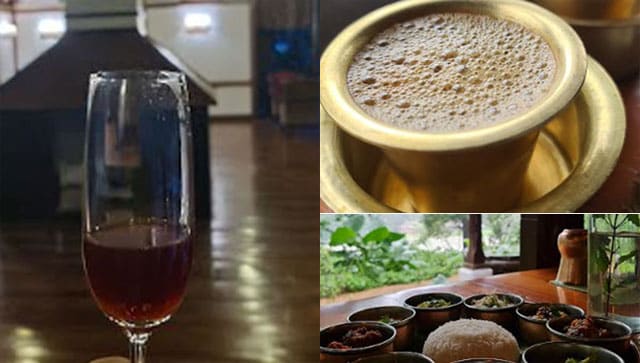
Enriched with this information, I wander into the reading room where the resort serves free coffee all day long. Looking over the rice fields being pattered with relentless rain, my mind wanders to the visual of an Ainmane, the Kodava-style clan house. I can almost smell the Baale Nuruk (a fritter made with rice flour and ripe bananas) in the kitchen in my virtual visit when my thoughts are interrupted by a gentleman dressed in khakis. I take him to be a naturalist at the resort. Sweetly he offers a glass of ‘Coffee Wine’, a dark amber-coloured liquid kept at the coffee counter. Intrigued, I take a sip and instantly, a wave of delight hits my throat. It smells of coffee and leaves the aftertaste of pepper, a unique combination indeed.

Food Friday  The bestkept secrets of Kodava cuisine
Coffee Wine

“Pigout has helped me achieve a deeper understanding of how the cuisine took shape, its evolution and a study of how to preserve and as well as prepare for what could possibly be the future holds for a micro cuisine, that is rooted in a wild landscape”, shared Ganapathy.

She has been running Pigout Coorg Kitchen from her family home (also an AirBnB) since the pandemic. “Your best bet at trying fresh ingredients with homegrown produce would be in someone’s home,” she chimes.

On my last day in Coorg, walking around the pool villa with a glass of Chukku Kaapi (also known as Bella Kaapi – coffee made with jaggery and ginger extract) I made a vow to come back to this wild land of delectable fares, soon enough.

source: http://www.firstpost.com / FirstPost. / Home> Arts & Culture / by Chandreyi B / August 12th, 2022

Write spirit

This journalist-turned-author talks about his new book Round and About with PT Bopanna, and his journey as an author.

Bengaluru :

Taking a leap of faith and moving to Mumbai 40 years ago, without a job or a plan worked out for PT Bopanna, veteran journalist and author of books such as Dateline Coorg and Are Kodavas (Coorgis) Hindus?. Growing up, Bopanna had no idea that he would become a journalist, and moved to Mumbai from Kodagu in search of better prospects. “I never thought I’d become a journalist, I never had a flair for writing. But when I was in college, I realised that journalists had the power to change the world, that’s what made me want to become a journalist,” he says.

forward to today, Bopanna’s newest book, Round and About with PT Bopanna, is a compilation of lighthearted articles written by the author. What’s special about this book is that Bopanna is able to tap a lighter, more humorous vein in this book, which he hasn’t been able to do in his other projects. The title of the book was inspired by the daily column, ‘Round and About,’ by Behram “Busybee” Contractor, a humour journalist. When Bopanna understood that journalism was his calling, he enrolled in a journalism course at Bhavan’s College in Mumbai. “Even though I wasn’t great at writing when I was younger, I always enjoyed reading the newspaper and books.

I was intrigued by ideas such as Marxism and rationalism,” says Bopanna. Since he also saw the rise of the Dravida Munnetra Kazhagam (DMK), he was also influenced by Periyar EV Ramaswamy Niacker’s ideas, who started the DMK. When Bopanna went back to Kodagu, he started working as a part-time correspondent for a newspaper, he was past the age of 30, which points to the fact that one is never too old to follow their passion. Bopanna was working at another newspaper when he started reading the astrological columns.

“I didn’t believe in astrology, but it did pique my interest. Once, the astrology section said that if I were to start a website, it would do well. After I read that, I compiled some of the information I was putting in my columns, and started my website coorgtourism. info.com in 2005, and after that, there was no looking back,” says Bopanna. However, the traffic on his website wasn’t as much as Bopanna wanted it to be. So he thought, “Why don’t I download all this material and bring it out in the form of a printed book?” This is how Bopanna’s career as an author started, with the release of his first book, Discover Coorg.

Writer C P Belliappa came up with the title of the book, and also wrote the foreword. Most of Bopanna’s books are about Kodagu, his home, and he writes about the rich cultural and political history of the region. “My book, Are Kodavas Hindus? was inspired by sociologist M N Srinivas’ work, who went to Oxford for his PhD and wrote his thesis on religion and society in Coorg,” Bopanna says of his journey as an author. Hence, what started as a dream to change the world, was fulfilled by an astrological prediction. Bopanna says a journalist’s profession can be a quite disappointing, however, the key is to ‘wait for the good tidings to come.’

source: http://www.newindianexpress.com / The New Indian Express / Home> Cities> Bengaluru / by Fia Majumdar, Express News Service / August 10th, 2022

Rudresh Mahanthappa’s Hero Trio Will Make NYC Debut In August

Saxophonist Rudresh Mahanthappa’s Hero Trio will make their NYC Debut this August to celebrate Charlie Parker’s Birthday at Smoke Jazz.

Located at the junction of 106th and Broadway (aka Duke Ellington Boulevard), Smoke Jazz Club is one of New York City’s premier live music venues. Renowned for offering top-notch programming of accessible, timeless jazz featuring legendary performers, modern masters, and rising stars, Smoke stands apart with its candlelit dining room, stellar acoustics, and classic American cuisine.

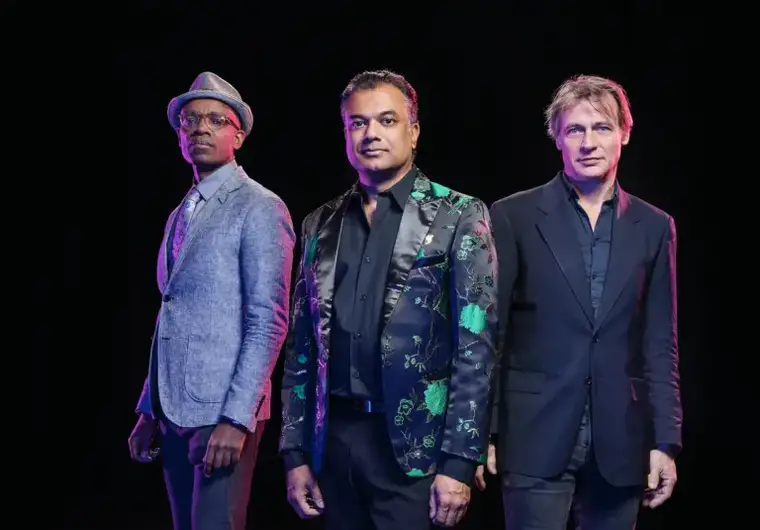
Rudresh Mahanthappa’s Hero Trio also includes bassist Harish Raghavan and drummer Rudy Royston. Their performance will set on Thursday and Sunday at 7 and 9 p.m., and on Friday and Saturday at 7, 9 and 10:30 p.m.

Hero Trio earned high praise for its eclectic 2020 self-titled debut and the 2022 follow-up Animal Crossing.  Animal Crossing is a digital-only EP featuring four new songs, each an unlikely addition to the canon of jazz standards which is also the titular theme from the wildly popular video game.

At Smoke, Mahanthappa will explore Parker’s compositions, classic standards, and modern covers with the Raghavan and Royston. “The idea behind Hero Trio was to turn the idea of playing a set of standards on its ear and freshen up the idea,” the saxophonist explains.

Rudresh Mahanthappa is widely known as one of the premier voices in jazz of the 21st century as well known for his exellent alto saxphone performances. He has been recognized by multiple jazz magazines including DownBeat Magazine, Jazz Journalists’ Association,and  JazzTimes Magazine. He has also received the Guggenheim Fellowship and the Doris Duke Performing Artist Award, and is currently the Anthony H. P. Lee ’79 Director of Jazz at Princeton University.

For information visit https://www.smokejazz.com/calendar/.

source: http://www.nysmusic.com / NYS Music / Home> Blues-Jazz> NYC Metro> Upcoming Shows / by Savanna Tong / August 07th, 2022

Gulshan Devaiah talks about his role in the series ‘Shiksha Mandal’

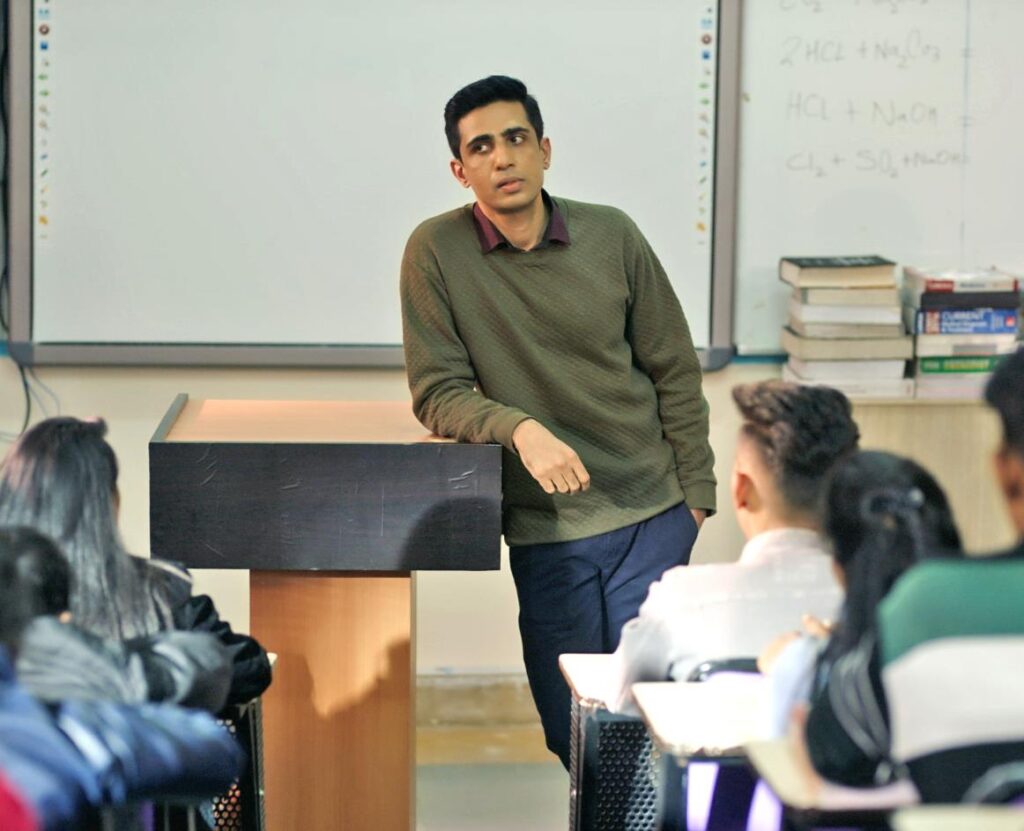
MX Player recently launched the first look of its upcoming original series, Shiksha Mandal. The show is a hard-hitting narrative inspired by true events that revolve around incidents in the educational system of India. The lead actor, Gulshan Devaiah, shares, “They say teaching is the most noble of all professions and having been a teacher myself, for a brief period in my life, I truly believe in that.”

He adds, “The story of Shiksha Mandal is about an education scam that brings to light the motives of certain unscrupulous people and their network of scoundrels, who conjure up scams for their personal profits and ruin the life of many talented, honest and hardworking students of this nation. It’s no exaggeration to say that many such scams have been happening around us and we may have even heard of one in the news recently.”

Mincing no words in encouraging people to take responsibility to avoid such incidents that destroy the fabric of society, Gulshan says, “If the young students are the future of India, then we are its present and must take the responsibility of creating an education system that operates on merit and is free of any corruption. Education can be a business, but it cannot be a corrupt business.”

source: http://www.tribuneindia.com / The Tribune / Home> Lifestyle / August 08th, 2022

Sandooka: Virtual Museum Of Kodava Heritage & Culture

Call to help preserve memories of a vanishing people

While modernisation has opened many opportunities for the well-qualified, it has also distanced the young from their heritage and culture.  This is even more accentuated amongst Kodavas living outside Kodagu. There is a need to establish a platform where young Kodavas could learn and keep in touch with the community’s heritage, cultural practices, folklore, music, dance, festivals and history, says Mrs. Codanda Rathi Vinay Jha, IAS (Retd.) and Chair, India Foundation for the Arts (IFA), who has initiated establishing a Virtual Museum of Kodava Heritage & Culture named ‘Sandooka,’ a treasure trove of information. —Ed

Kodavas are a micro-minority community in India, who live in Kodagu (Coorg) in Karnataka State. It is estimated that there are about 1,50,000 ethnic Kodavas within and outside Kodagu. 

Kodavas, by virtue of living quite isolated in a densely wooded hilly terrain on the Western Ghats of India since time immemorial, have developed their own unique culture, physical attributes, cuisine, language, attire, religious rituals and practices. 

Over the centuries, Kodavas adapted themselves to the harsh weather conditions, dangers from wild animals and the inhospitable terrain of Kodagu and transformed the land to an idyllic haven it is today.  With the passage of time, they toiled literally with bare hands to cultivate paddy in the valleys.

With the forests providing bountiful supply of wild game, they became expert hunters initially with bows and arrows, and later with firearms which enabled them to emerge as a warrior race.  They transformed the fertile land and were able to grow enough paddy that they could export to neighbouring areas. 

The interactions with immediate neighbours in present day Kerala, Mysuru and Mangaluru, influenced the Kodava language, places of worship, construction of their dwellings and some of the religious practices as well.  However, Kodavas still retain their fundamental philosophy of ancestor and nature worship.  They come under the broad umbrella of Hinduism.

Kodagu was ruled by Kodava Nayakas or Palegars who were basically warlords.  The Haleri dynasty established their rule in Kodagu after cleverly replacing the hopelessly divided Nayakas during the early part of the 17th century.  The Haleri Rajas ruled for over two centuries until the British takeover of the administration in 1834 after deposing the last Raja.  During the rule of the Haleri Rajas and later the British, Kodavas remained the prominent community very much involved in the administration.

During the British rule, education was introduced and this brought about quantum changes in the lifestyle of the Kodavas.  Kodavas found several employment opportunities.  Introduction and scientific cultivation of coffee and spices vastly improved the economy of the region.  Kodava culture and ethos found expression in the writings by the British, European and Kodava authors. 

By the time India got her independence, many Kodavas held important and high-level offices in sectors such as the Defence Forces, Administration, Revenue Department, Forest Department, Police, in the field of Education, Engineering and Medicine. 

Kodavas have several distinctive elements in their social, cultural and religious practices.  One of them is the deferential status given to women. There is no dowry system in the community.  Centuries ago, widow remarriage was permitted. This enlightened attitude is now reflected in well-educated Kodava women shining in a variety of fields.

After India’s independence many Kodavas ventured out of Kodagu seeking better opportunities in education, employment, business and sports.  Kodavas are now spread all over the globe.  The last three decades has seen a large number of Kodavas migrating outside the country. There is now a sizable number of Kodava diaspora in the US, Canada, UK and Australia.  In many cases, there are a couple of generation of Kodavas born and brought up outside Kodagu and outside India as well. 

While modernisation has opened many opportunities for the well-qualified, it has also distanced the young from their heritage and culture.  This is even more accentuated amongst Kodavas living outside Kodagu.  There is a need to establish a platform where young Kodavas could learn and keep in touch with the community’s heritage, cultural practices, folklore, music, dance, festivals and history. 

It is with this aim in mind that Mrs. Codanda Rathi Vinay Jha, IAS (Retd.), as Chair, India Foundation for the Arts (IFA), initiated establishing a Virtual Museum of Kodava Heritage & Culture (VMKHC).  This project is evocatively named — Sandooka — a treasure trove of information.  IFA has successfully supported several path-breaking projects in the field of  art and culture. 

Sandooka will be a living museum that will be interactive and open to receiving relevant new materials from the public.  People, especially the future generations of Kodavas, will have an easily accessible platform to gather details of their heritage.  Weblinks will also be given to some of the websites dealing with Kodava culture.  It is hoped that this treasure trove of information will be of immense help to those who wish to carry out further research on Kodavas. VMKHC will cover the following aspects of Kodagu and Kodavas:

1. Customs and Rituals  

2. Cuisine

3. Architecture                 

4. Clothes and Jewellery

5. Art & Craft                    

6. Landscape

7. Literature and Folklore

8. Community Histories

9. Festivals

The project is generously funded with a Corporate Social Responsibility (CSR) grant from Recaero India Pvt. Ltd., which is a pioneer in the field of aerospace engineering and is headed by Vinay Jha, IAS (Retd).  A highly professional team has been forged to deal with every aspect of the project.   The team comprises:

Lina Vincent – Project Head; Upasana Nattoji Roy – Designer (Switch Studio); Saurav Roy – Designer (Switch Studio) and Mookanda Nitin Kushalappa – Researcher.

IFA office-bearers are: Arundhati Ghosh (Executive Director) and Darshana Davé (Project Co-ordinator); Advisory Group: Rathi Vinay Jha, C.P. Belliappa and Hemanth Sathyanarayana.

Sandooka invites submission of Kodava artefacts, rare photographs, antiques including jewellery (photos) and anecdotes of yore.  All accepted materials will be given due recognition and credits. Sharing your valuable knowledge and collections will enrich the contents of Sandooka.

For details of submission of materials, please visit: www.sandookamuseum.org

source: http://www.starofmysore.com / Star of Mysore / Home> Feature Articles / by C.P. Belliappa / August 01st, 2022

‘Get acquainted with Kodava tradition’

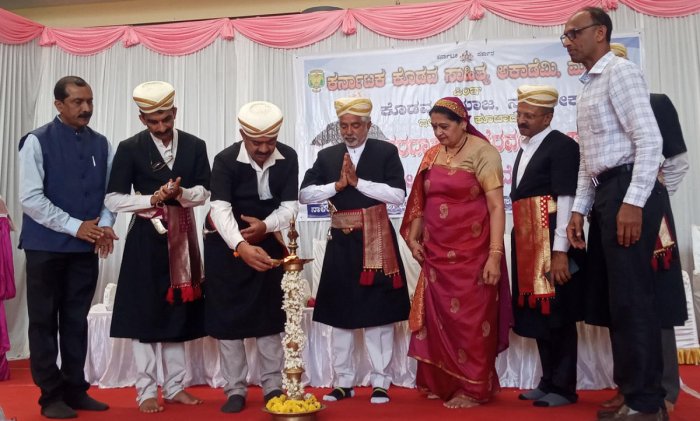
Kodava Education Society Joint Secretary Chiriyapanda Raja Nanjappa inaugurates ‘Kodavame Padipu’ programme at CIT PU College in Ponnampet on Wednesday. Karnataka Kodava Sahitya Academy Chairperson Dr Parvathi Appaiah, Academy member Dr Mullengada Revathi

People are busy in agricultural activities during the month of Kakkada and also it keeps raining during the month. Hence, our ancestors imposed restrictions on holding auspicious programmes during Kakkada month, opined Kodava Sahitya Academy member Dr Mullengada Revathi Poovaiah.

Speaking during ‘Kodavame Padipu’ programme, organised by Karnataka Kodava Sahitya Academy, at Coorg Institute of Technology (CIT) in Ponnampet on Wednesday, she said that the youth should understand the reasons behind the religious rituals. “Our elders gave a lot of importance to indigenous food and used them during the rainy season. They planned their food according to the seasons,” Revathi added.

Inaugurating the programme, Kodava Education Society Joint Secretary Chiriyapanda Raja Nanjappa said it is believed that the Kodava tribe was present during the origination of River Cauvery and called upon the present generation to get acquainted with the local tradition and culture.

He further said, “The Jamma land is not government land. It is inherited by Kodavas from generations. Also, the gun is used for religious rituals in Kodava culture. However, our ancestors did not use a gun for fighting. Gun rights of Kodavas should be preserved, he added.

During the programme, the resource persons spoke on the importance of ‘Kakkada Padinett’, ‘Kakkada Tingalra Pudume’, ‘Kodava Namme’ and ‘Kodava Takk’.

Karnataka Kodava Sahitya Academy Chairperson Dr Ammatanda Parvathi Appaiah, member Padinjaranda Prabhukumar, CIT PU College Principal Dr Sannuvanda Rohini Thimmaiah, Thookbolak Kala Sahitya Vedike convener Madhosh Poovaiah and others were present.

Students of CIT PU College watched the programme online.

source: http://www.deccanherald.com / Deccan Herald / Home> State> Karnataka Districts / DHNS, Kodagu / August 14th, 2020

‘Nadi Utsava to create awareness on protection of rivers’

DC calls upon various organisations to help make the festival a success.

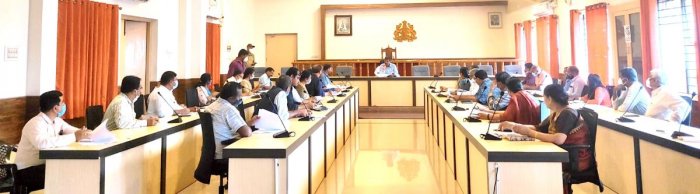
Deputy Commissioner Dr B C Sateesha chairs a preparatory meeting on Nadi Utsava at his office in Madikeri on Monday. DH Photo

Nadi Utsava will be held as a part of the 75th anniversary of Indian Independence in the district, said Deputy Commissioner Dr B C Sateesha.

The festival is directed towards spreading awareness on the protection of rivers, river banks and cleanliness, he said.

He was speaking during a preparatory meeting held at his office in Madikeri on Monday.

The deputy commissioner called upon various organisations to join hands with the district administration in making the Utsava successful.

Kaveri Neeravari Nigama Ltd engineer Nagesh said that the Nadi Utsava will be held on December 17 and 18.

The inaugural function will be held in Talakaveri on December 17 afternoon and the programme will be held in Kushalnagar on December 18.

A motorbike rally will be held from Talakaveri to Bhagamandala to create awareness about cleanliness. Later, a programme directed towards creating awareness on the protection of rivers will be held at Triveni Sangama.

Also, a cleanliness camp and Deepotsava are planned as a part of Nadi Utsava, he added.

Nagesh further said that a formal stage function will be held on December 18. The Nadi Utsava Jagruthi rally will be taken out from the Kaveri statue to the Ayyappa Swamy Temple.

Kaveri Nadi Jagruthi Vedike president Chandramohan said that the organisations in 23 Gram Panchayat limits and a Town Panchayat limit in Bhagamandala to Shirangala should take part in the Nadi Utsava. Information should be provided to the organisation by the administration.

Leader Monti Ganesh requested the organisers to ensure precautionary measures against Covid-19.

Kannada Sahitya Parishat district president M P Keshava Kamath called upon the youth to take part in the Utsava in large numbers.

Kodagu Gowda Samaja Federation president Surthale Somanna said that importance should be given to the cleanliness campaign in the Gram Panchayats in the Kaveri river basin.

All people should come together for the good cause of protecting the Kaveri river, he added.

During the meeting, it was decided to form sub-committees of Nadi Utsava.

Karnataka Kodava Sahitya Academy chairperson Ammatanda Parvathi Appaiah, Karnataka Arebhashe Cultural and Literary Academy chairman Lakshminarayana Kajegadde, leaders M B Devaiah and Talakaveri-Bhagamandala temple executive officer Krishnappa were present, among others.

source: http://www.deccanherald.com / Deccan Herald / Home> State> Mangaluru / by DHNS, Madikeri / December 06th, 2021

New Team For Igguthappa Kodava Assn

A group photo of the new office-bearers of Sri Igguthappa  Kodava  Association, Vivekananda Nagar, Mysuru. President: Moodera P. Belliappa, Vice-President: Nellamakkada Kaverappa, Joint Secretary: Porangada Somaiah,  Hon. Secretary / Treasurer: Anjanda Kumari; Committee Members: Saddumudira Kalappa, Chottangada Belliappa, Kuttetira Suresh, Appachettolanda Beena Erappa, Chottekalapanda Prema Uthaiah and Kademada Harish Poovaiah.

source: http://www.starofmysore.com / Star of Mysore / Home> Photo News / March 16th, 2017

‘Appacha Kavi’s residence should be developed as memorial’

Kodava Samaja, Napoklu, president Appachettolanda Manu Muttappa inaugurates the 153rd birth anniversary celebrations of Appacha Kavi, organised at Appacha Kavi auditorium in Kodava Samaja, Napoklu.

The Ainmane, traditional house of Haradasa Appacha Kavi, the first poet of Kodagu, should be developed into a memorial, said Appachettolanda Manu Muttappa, president of Napoklu Kodava Samaja.

He was speaking during the 153rd birth anniversary celebrations of Appacha Kavi, organised by Karnataka Kodava Sahitya Academy and Napoklu Kodava Samaja, at Appacha Kavi auditorium, on Tuesday.

Manu Muttappa said that along with the residences of great poets and writers, their native places should also be developed.

“There is a need to introduce Appacha Kavi’s works to the present generation. Appacha Kavi had great knowledge of Kannada and Sanskrit. An education officer called Raghunatha Raya inspired Appacha Kavi to create literary works in the Kodava language, he said.

Speaking on Appacha Kavi, Rangayana, Mysuru, director Addanda Cariappa said that Appacha Kavi should be awarded the ‘Karnataka Ratna’ award.

Karnataka Kodava Sahitya Academy chairperson Dr Ammatanda Parvathi Appaiah, Academy registrar Ajjikuttira Girish, Appaneravanda Ainmane Development Committee president Appaneravanda Chummi Devaiah, Appaneravanda Ramu and Dr Manoj were present.

‘Ummattat’ and other cultural programmes were held on the occasion.

Folklore scholar Bottolanda Kashi Achaiah sang songs composed by Appacha Kavi.

source: http://www.deccanherald.com / Deccan Herald / Home> State> Mangaluru / by DHNS, Napoklu / September 21st, 2022

Gulshan Devaiah to star in ‘Duranga’ based on Korean show ‘Flower of Evil’

Mumbai:

Bollywood actor Gulshan Devaiah is all set to star in the upcoming romantic thriller OTT series ‘Duranga’ along with actress Drashti Dhami. The series is an official adaptation of the Korean show named ‘Flower of Evil’ and has been directed by Pradeep Sarkar and Aijaz Khan.

The series chronicles the love story of Sammit (played by Gulshan Devaiah) and Ira (played by Drashti Dhami), that unfolds in three different timelines. Hiding a twisted past, Sammit maintains the facade of a perfect husband to his Inspector wife – Ira. With a series of twists and turns, Ira begins investigating multiple gory copycat murders by the suspected accomplice of a psychopathic serial killer Bala, twenty years after his suicide.

‘Duranga’ has been produced by Goldie Behl and Shradha Singh and will soon bow down on OTT platform ZEE5.

Talking about the series, Goldie, producer at Rose Audio Visuals, said in a statement: “At Rose Audio Visuals we have always been committed to producing quality, out of the box content which is also entertaining. ‘Duranga’ is a step forward in that direction.”

“It is a special subject because it explores the concept of marriage but through a unique twisted lens, something you have never seen before. The unusual pairing of Drashti Dhami and Gulshan Devaiah has worked very well for us. Their characters in the show come from very varied, distinct backgrounds and they both have divulged completely into it.”

The 9-episode series also stars Rajesh Khattar, Divya Sheth, Zakir Hussain, Barkha Bisht, Abhijit Khandkekar and Hera Mishra in prominent roles.

As the case unfolds, it leads Drashti’s character to some shocking revelations about her husband. The story will show how the protagonists wade through constant problems, despite which, they stand tall.

“‘Duranga’ primarily deals with the subject of how well you know your partner and then explores the story further. We may believe that we know our partner really well, but do we really? That’s what Duranga will explore and answer. Very excited to present the show and we hope the audience totally resonates with it the way we did,” Goldie further mentioned.

–IANS

source: http://www.newsroomodisha.com / Newsroom Odisha / Home> Entertainment / by Newsroom Odhisha / July 25th, 2022