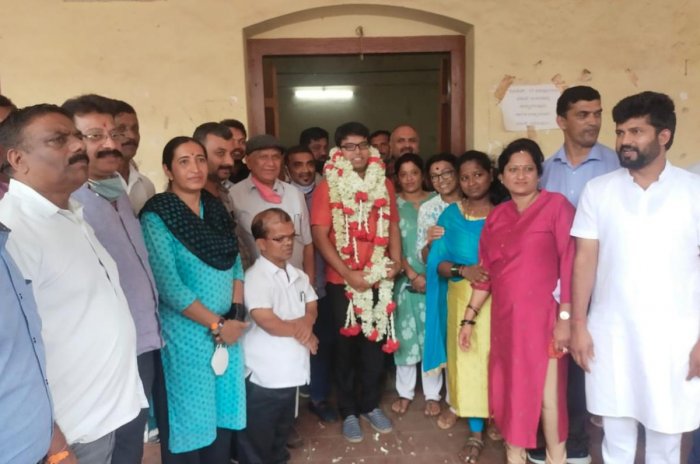
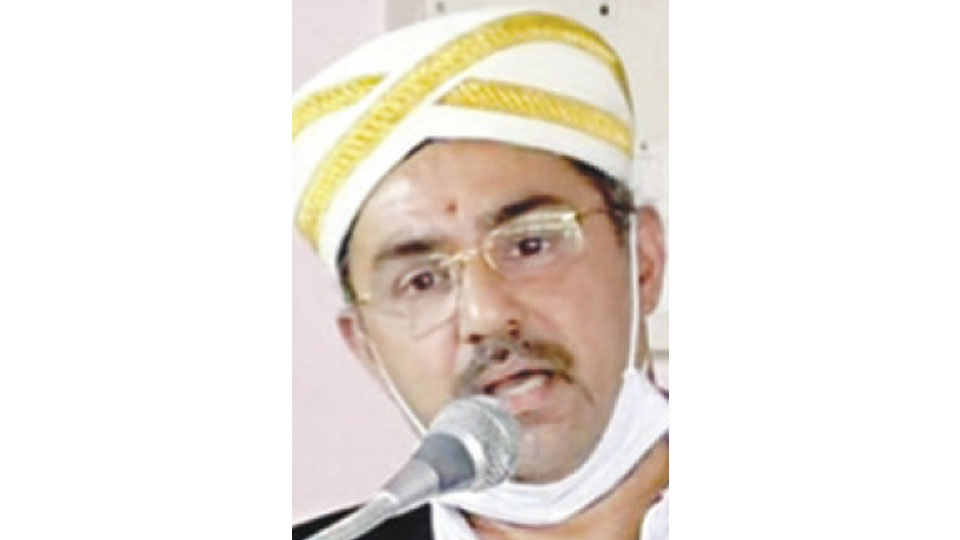
Vinank Kuttappa who was elected as the vice president of Virajpet Town Panchayat was greeted by MP Pratap Simha, MLA K G Bopaiah and other BJP members of the panchayat
Vinank Kuttappa from the BJP has been elected as the vice president of Virajpet Town Panchayat.
In the elections held on Friday, Vinank secured 10 votes, while his close contender from the Congress, Muhammed Rafi, got eight votes.
There are 18 elected members in the Town Panchayat. All eight members from the BJP, MP Pratap Simha and MLA K G Bopaiah voted for Vinank.
Six Congress members, one JD(S) member and an independent member voted for Rafi. Two independent candidates stayed neutral.
Tahsildar R Yoganand was the returning officer.
The seat occupied by former vice president of the Town Panchayat, Harshavardhan, was vacant, owing to his demise.
source: http://www.deccanherald.com / Deccan Herald / Home> State> Mangaluru / by DHNS, Virajpet / October 29th, 2021
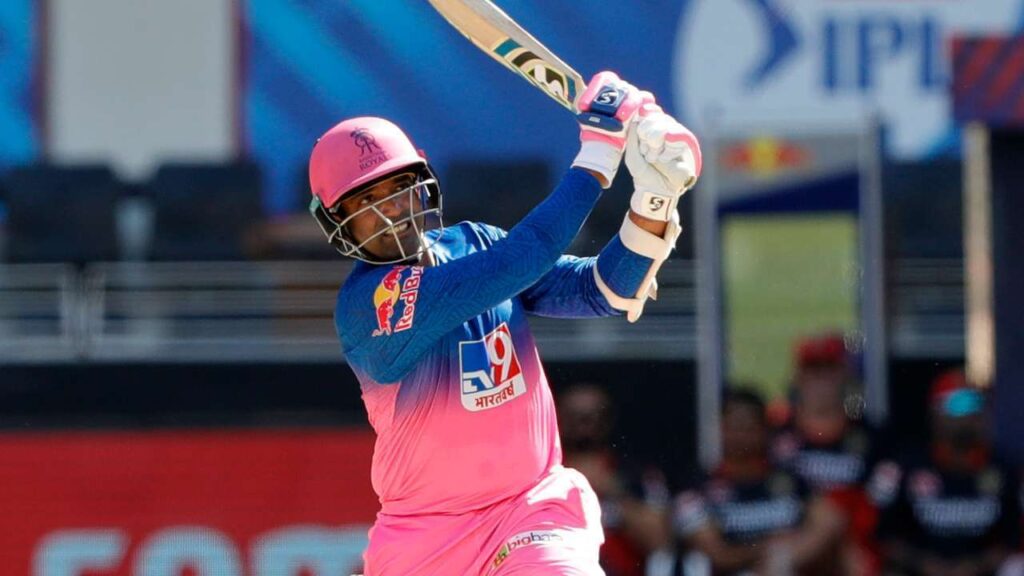
Robin Uthappa, the former India batsman has opened up on what goes through the mind of a cricketer during an Indian Premier League (IPL) auction, where a player’s value becomes about how much somebody is willing to spend on you.
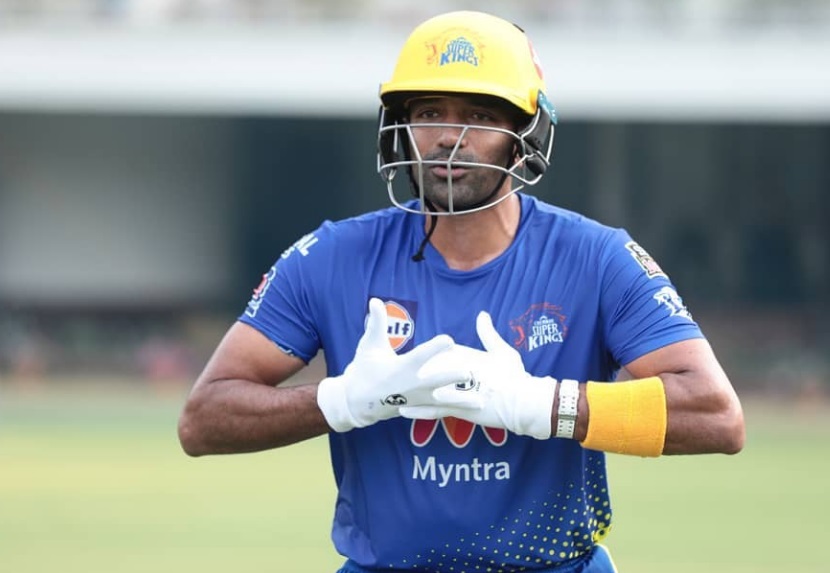
During the recent IPL mega auction, defending champions Chennai Super Kings re-signed Robin Uthappa for his base price of Rs 2 crore. The explosive batsman had chipped in with valuable innings in last season’s playoffs after being given a chance late in CSK’s campaign in the UAE following Suresh Raina’s poor form.
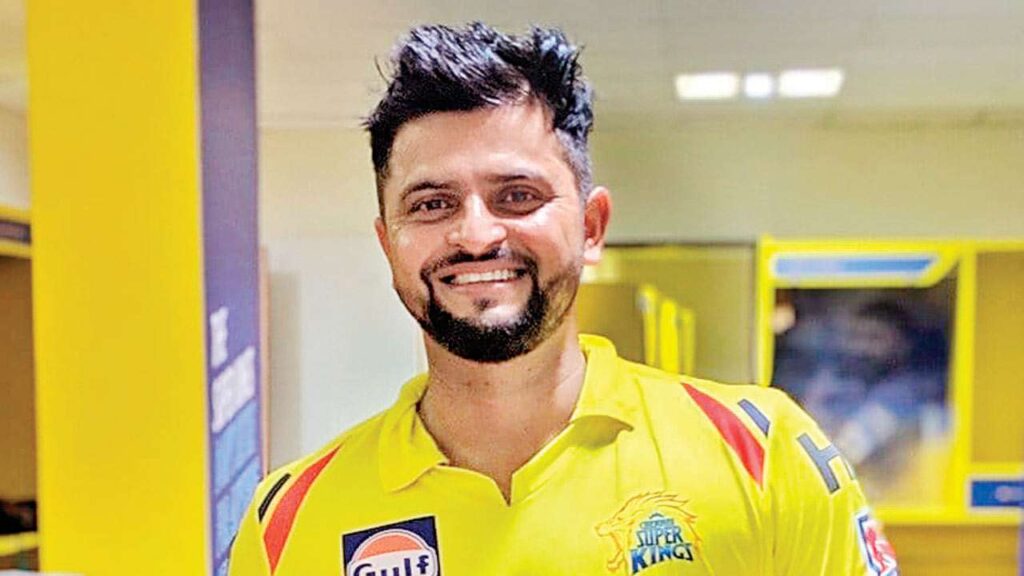
Suresh Raina (Image Credit: Twitter)
Robin Uthappa Opines That It’s Not A Most Pleasing Feeling To See IPL Auctions And Wants A More Respectful Draft System Instead
Robin Uthappa vitally scored 63 off 44 balls during the first Qualifier followed by a knock of 31 off 15 in the final to beat Kolkata Knight Riders. While Robin Uthappa admitted that he and his family had hoped that he would go back to CSK, the 36-year-old candidly spoke of how vulnerable a player can be while watching their name come up at an IPL auction.
“Playing for a team like CSK was something I desired, it was one of my only prayers: let’s get back to CSK. My family, even my son, prayed for that, which is special for me. I’m happy to be back in a place where there’s a sense of security and a sense of respect,” Uthappa, who played 46 ODIs and 13 T20Is for India between 2006 and 2015, said.
Robin Uthappa opened up about his own fight with depression, battling suicidal thoughts and wanting to quit cricket at the height of his career. As elated as he was to have found a spot in CSK’s roster, Robin Uthappa advocated for the IPL to shift to a draft system rather than the auctions.
“The auction feels like an examination which you have written a long time ago, and you’re just awaiting the results. You feel like cattle (commodity), to be honest,” he said.
“It’s not the most pleasing feeling, and I think that’s the thing about cricket, especially in India… everything about you is there for the world to consume and then judge and express their opinions about it. Having an opinion about performances is one thing, but having an opinion on how much you get sold for is quite something else.”
“You can’t imagine what the guys who don’t get sold go through. My heart goes out to guys who have been there for a long time and then miss out and don’t get picked. It can be defeating sometimes.
“Suddenly your value as a cricketer becomes about how much somebody is willing to spend on you. I really hope for the sake of the sanity of everybody that this goes into a draft system where it is more respectful.”
________________________________________________
The consistently proven match-winner, Robin Uthappa, was traded to Chennai Super Kings by the Rajasthan Royals ahead of IPL 2021 Player Auction. He had joined the Rajasthan Royals ahead of the 2020 season and played 12 games for them. Earlier, he was one of KKR’s stars in the title-winning efforts in 2012 and 2014.
Robin Uthappa Owes Being Part Of Chennai Super Kings And He Wants To Finish His Carrier With CSK
Ahead of the IPL 2022, which begins in just over a month’s time, Robin Uthappa is geared up for another successful season with four-time winners CSK, hoping to end his playing career with them.
______________________________________________
The expectation is to contribute to the success of the team,” he said. ” I love being a part of the team. I love the hard work that’s involved in it. I have this new lease wherein I want to play as much as I physically can. God-willing to finish my career with a team like CSK. “
______________________________________________
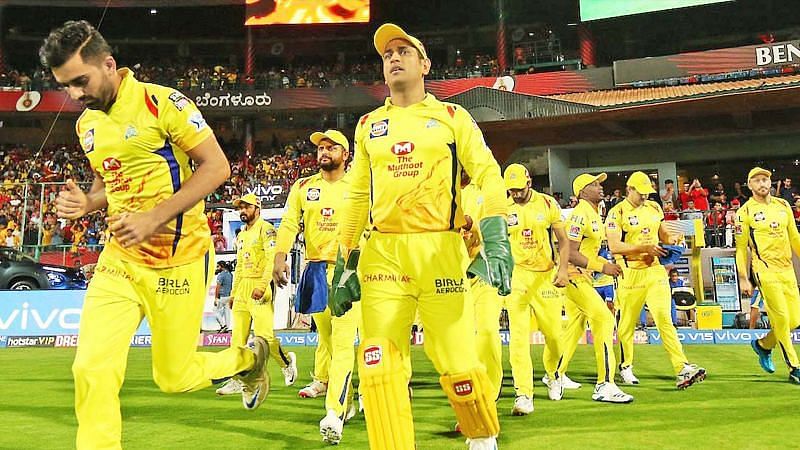
Chennai Super Kings (Image Credit: Twitter)
Apart from Deepak Chahar (14 crores), Ambati Rayudu (6.75 crores) and Dwayne Bravo (4.4 crores) were CSK’s most prized picks at the auction. Shivam Dube (4 crores) and Chris Jordan (3.6 crores) were the only other players that cost them more than two crores. Chennai Super Kings bought 21 players during IPL 2022 auction.
Out of 14 seasons, the franchise CSK has played 12 as they were banned in 2016 and 2017. The team has won the trophy four times in IPL 2010, IPL 2011, IPL 2018, and IPL 2021. The franchise has also reached the playoffs 11 times out of 12 seasons.
source: http://www.sportzwiki.com / SportZWiki / Home> Cricket> IPL 2022> News / by Nirmalya Banerjee / February 22nd, 2022
The actor gets candid about playing a homosexual character in the recently released film and working with Taapsee Pannu in Blurr.
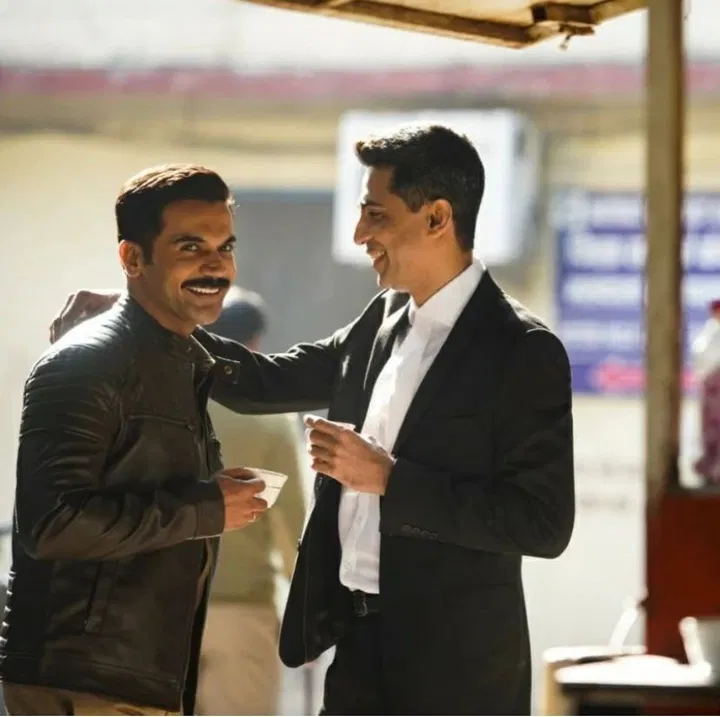
Gulshan Devaiah plays RajKummar Rao’s love interest in Harshavardhan Kulkarni’s latest directorial venture Badhaai Do. The film is being lapped up for its fresh portrayal of romance between people from the LQBTQ+ community. In an exclusive chat with the Free Press Journal, Gulshan opens up about his role in the film and more.
When asked about his first reaction to romancing RajKummar Rao, he shares, “I thought it was a good idea. I have tremendous respect for Raj, and I am also his fan. From a movie trivia point of view, I thought it was a cool idea for Harshavardhan’s previous leading man to romance his current one.”
When probed if he was apprehensive about playing a gay role and how he approached the character, he reveals, “I had no apprehension whatsoever. I read the nine pages worth of screen time, spoke with Harsh to understand his perspective and decided this was a very good idea. There was an element of surprise from the story point of view as well that I liked. My perspective was to, in the given time, have an accurate interpretation of the writing and to serve the sensibilities of the director.”
Badhaai Do was marketed as a family entertainer at the backdrop of the wedding. Gulshan feels such films can play a role in changing the mindset of people. “Cinema is a soft power, so yes, I would like to believe that it has its impact on society. It helps them understand things better without shoving it down their throats or cancelling them (like on social media). However, one should be careful not to overestimate or underestimate the power of cinema,” he avers.
source: http://www.freepressjourmal.in / The Free Press Journal / Home> Entertainment / by Rohit Bhatnagar / February 19th, 2022
Gulshan Devaiah, who recently played the love interest of Rajkummar Rao in the movie Badhaai Do, tells CE why he picked a role with a short screen time.
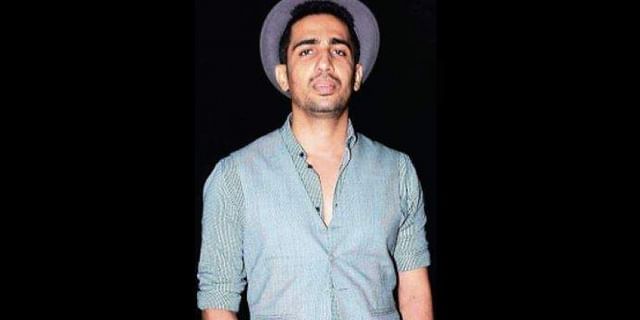
Bollywood actor Gulshan Devaiah ( File Photo)
Bengaluru :
Gulshan Devaiah’s part in the movie Badhaai Do was not just a pleasant surprise for his fans, but also brought in more substance to the movie. Devaiah, who romances Rajkummar Rao, the male lead in the movie, says Rao is a wonderful actor and romancing him was easy. “His wife had visited the set in Dehradun and she said, ‘You guys share such wonderful chemistry’,” says Devaiah, who plays a character by the name Guru Narayan.
His association with Harshavardhan Kulkarni, director of the movie, goes back to Hunterr, which was Kulkarni’s first movie as director. When Badhaai Do came about, they thought Devaiah was a great choice to play a part.
“I think they waited for the right time to call me. He said there is a small part and asked me if I would be interested to come for a shoot for 2-3 days. It comes towards the end of the movie but it is a very crucial part,” says Devaiah.
Though he is very clear about not doing cameos, he made an exception for this particular movie. “Sometimes, some things really seem like a good idea. I am not really a cameo sort of guy, I like full-fledged parts. I trust Harsh as he’s my friend and I want to support him as well,” says Devaiah, adding that the team wanted his part to be a surprise. He had even requested an uncredited part but “the team was too embarrassed about it”.
Most of Devaiah’s scenes are with Rao, who he “likes and respects” as an actor. “It was a wonderful opportunity to reunite with all of them. I had last worked with him in Shaitan, where he had a small part,” says Devaiah. The actor is also seen sharing screen space with Sheeba Chaddha, who plays Rao’s mother in the film.
Guru Narayan is basking in the glory of the success of the film, which has appealed to the LGBTQ community who find him relatable. “I didnt think of the fact that he was gay, I just knew that he was in love. Guru Narayan is a person who is comfortable with who he is. All the LGBTQ community wants is equal treatment,” says Devaiah, who is yet to watch the movie.
While the actor is keener on playing full-length roles, he says it depends on numerous factors. “You have to have some sense and curate your career after a certain point. In the beginning, you just hope you work on good projects, but after a point, you need to have some sort of idea about what you want to do or what you don’t want to do. In my case I have figured the latter,” says Devaiah, whose next film is a project with Zoya Akhtar, the story of which is written by Reema Kagti, and stars Sonakshi Sinha.
source: http://www.newindianexpress.com / The New Indian Express / Home> Entertainment> Hindi / by Monaika Monalisa, Express News Service / February 21st, 2022
Kallichanda Nishan Nanaiah’s movie ‘Alpha Beta Gamma’ revolves around three people who are stuck in a flat during the Covid lockdown.
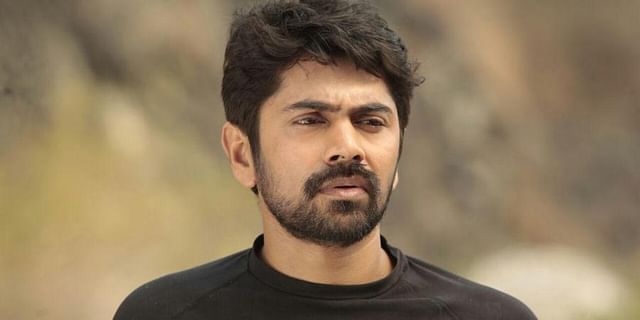
Nishan Nanaiah
Madikeri :
Kallichanda Nishan Nanaiah, a native of Kodagu, is now basking in fame through the short film ‘Alpha Beta Gamma’. The acclaimed movie, shot during the time of the Covid pandemic, is now being screened at the Berlin Film Festival.
Nishan is a pass out of the Film and Television Institute of India in Pune and he started his acting career with Cycle Kick directed by Shashi Sudigala.
Following this successful debut, Nishan set foot in the mainstream film industry and has so far acted in 25 movies in Hindi, Bengali, and Malayalam.
“I grew up watching commercial movies and I did my film course in Pune. Following this, I moved to Mumbai and have acted with noted names in the film industry. ‘Alpha Beta Gamma’ is close to my heart as this movie revolves around three people who are stuck in a flat during the Covid lockdown. The life equations change and it narrates a unique situation faced during the pandemic,” said Nishan. The movie, shot during the time of the pandemic, is a low-budget movie that has high content, he adds.
The movie witnessed its premier launch at the International Film Festival in Goa. Following acclaimed reviews, the movie was among the 25 other short films that were selected by the Indian Panorama. “Further, nine films out of the 25 were selected to be featured at the Berlin Film Festival and the movie is now being screened to the European audience,” he added. Nishan is the son of Kallichanda Prasad and late Padma Prasad – natives of South Kodagu.
source: http://www.newindianexpress.com / The New Indian Express / Home> Good News / by Express News Service / February 21st, 2022
IGP (Southern Range) Pravin Madhukar Pawar given additional charge as KPA Director
Mysore/Mysuru:
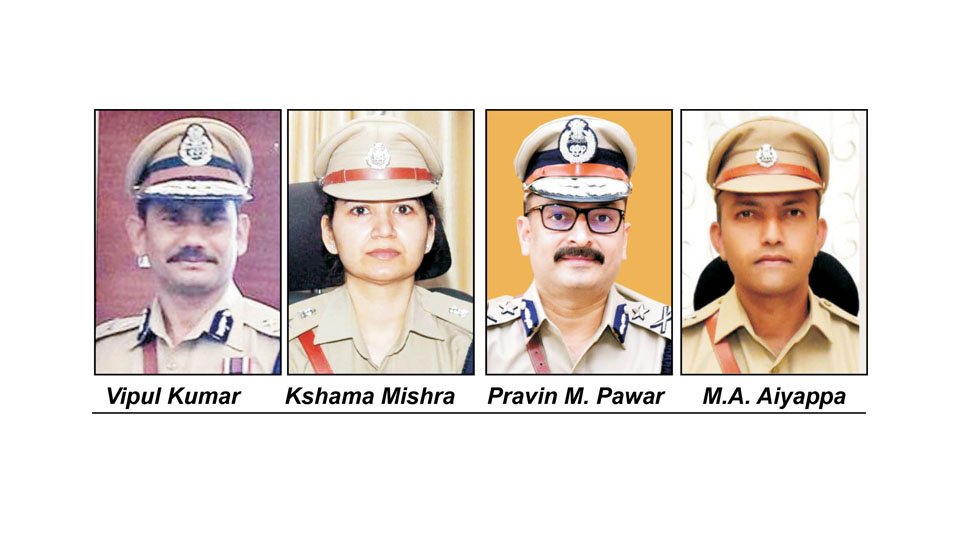
The State Government on Wednesday transferred Karnataka Police Academy (KPA) Director Vipul Kumar and posted him as the IGP of Internal Security Wing. IGP (Southern Range) Pravin Madhukar Pawar has been given additional charge as KPA Director.
Kodagu Superintendent of Police (SP) Kshama Mishra has been transferred without posting and Karnataka Power Corporation Limited (Vigilance) SP Malachira A. Aiyappa, a 2017 batch IPS Officer, has been posted to her place.
source: http://www.starofmysore.com / Star of Mysore / Home> News / February 18th, 2022
CNC says vested interests conspiring to include many others in Coorg by race classification
Mysore/Mysuru:
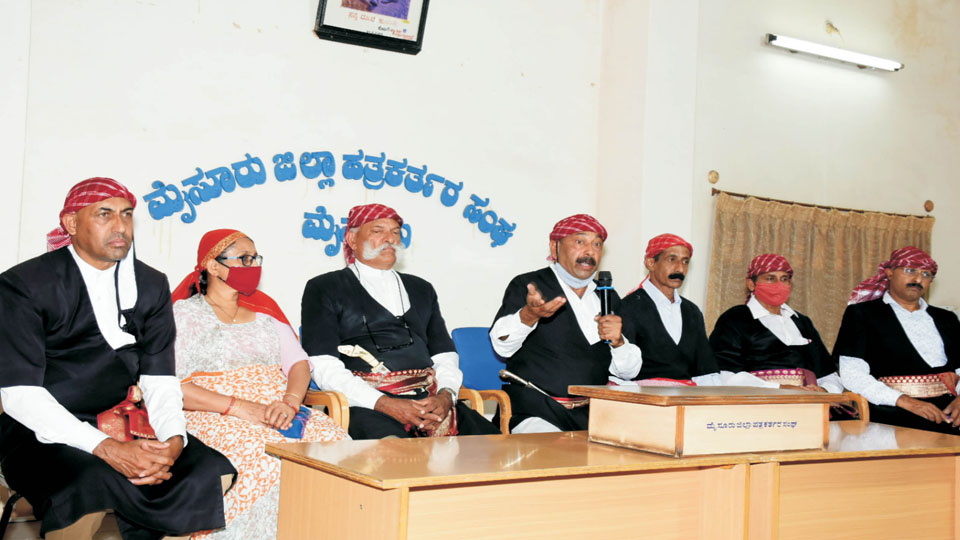
A gun is an integral part of Kodava culture, used in many rituals including birth, death and festivals and the Karnataka High Court has already upheld the Arms Act exemption granted to every person of Coorg by race Coorg (Kodagu district). As such, a law must be made to ensure that the rights of Kodavas over guns continue, demanded Codava National Council (CNC) President Nandineravanda U. Nachappa.
Addressing a press conference at Pathrakarthara Bhavan in the city yesterday, he said that all those who are settled in Kodagu are not Kodavas and attempts are being made by vested interests to portray a few communities as Coorgs (Kodavas by race). Attempts are being made at the highest official and political level to include many other communities in Coorgs by race classification for the sake of votes, he said.
“These vested interests who have settled in Kodagu — who are very different from the unique Kodava community — are systematically attempting to snatch away the exclusive rights of Kodavas by diluting the community itself and by demanding rights over guns. Kodava rights over guns are being questioned in the Court of law and the Courts have repeatedly upheld the Kodava community rights,” he noted.
The Kodava community has a long history with guns, and their culture is intrinsically linked with firearms. There are festivals in which gunshots are fired in the air, and a gun salute is performed when a child is born or a person dies. Firearms are an integral part of any Kodava festival, he said.
The British in recognition of their martial traditions granted the community a special privilege to own firearms without a licence in 1861. The exemption was then issued by the Union Government in 1963 under the provisions of the Indian Arms Act, 1959.
The Centre had issued a notification exempting every person of (the) Coorg race and every Jamma land tenure holder in Coorg from the Indian Arms Act. There was no curb on the privilege even after Coorg, which was a separate State earlier, merged with Karnataka, he said.
“This exemption has been questioned in Courts by vested interests and the Courts have repeatedly ruled in favour of Kodava community. As such, this exemption must be safeguarded with a law to protect the interests of the community. Like the Sikhs have been granted to possess the Kripan, Kodavas must be granted rights to possess a gun,” he demanded.
Other CNC leaders Kaliyanda Prakash, Lieutenant Colonel (Retd.) Balladichanda M. Parvathi, Chambanda Janath Kumar and Apparanda Poovanna were present.
source: http://www.starofmysore.com / Star of Mysore / Home> News / February 17th, 2022
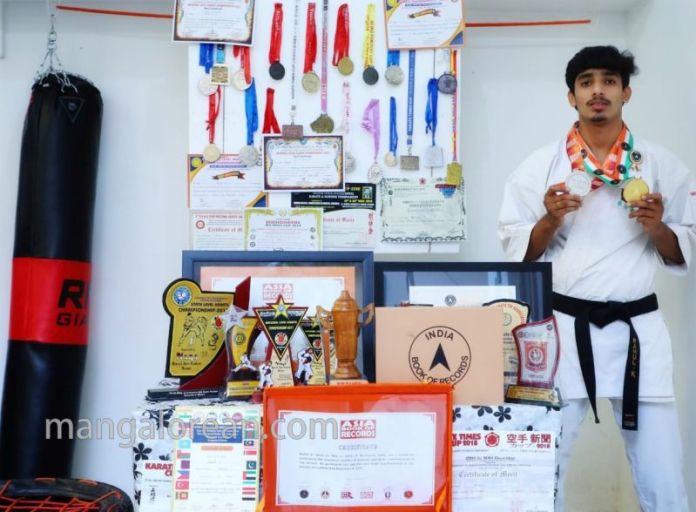
He is the new ‘Bruce Lee’ of this tiny Kodagu district which has contributed thousands of warriors, sports personalities to the nation. Keeping its tradition of shining in various fields, a youth has added another feather in the cap of this hilly district by gaining entry into the Asian Book of Records with his karate skills in January 2022, after being entered into the India Book of Records in December 2021. Meet young and dynamic martial arts lad 20-years-old K Rahul, hailing from Virajpet in Madikeri/Kodagu district, who achieved a new feat with a record-making 262 punches and 262 kicks in One Minute in karate. In view of the Covid pandemic, the achievement was recorded online.
Rahul is the first person from the Kodagu district to create such a record. Earlier, Rahul had secured a place in the India Book of Records. The karate tournament in which participants from 18 countries participated, was organised jointly by Dynamic Shotokan Karate Du Association, World Union of Martial Arts Association, World Karate Alliance and Evolution of Karate, in December 2021. Rahul who was very fond of karate since childhood, started practising the art when he was just twelve years old. “A lot of hard work and perseverance for a decade was behind my achievement. I owe my success to my parents who encouraged and supported me in this sport. Everyone has innate talents and they should make good use of them through practising”. said Rahul.
Apart from gaining entry into the Asia Book of Records, Rahul has won many medals at State and national level championships. He won first place in Kata and Kumite division in 2016 in the Karate championship organised by Karate Tues UECHI RYU DO India of Kerala. He strove many years to gain entry into the India Book of Records, where he was issued an identity card, certificate and medal to Rahul. Rahul was trained by karate expert H R Shivappa. In September 2021, he won a gold medal in an international online karate championship competition organised by the World Union of Martial Arts Federation, World Karate Alliance, following which he aimed to gain entry into the Asia Book of Records- and succeeded.
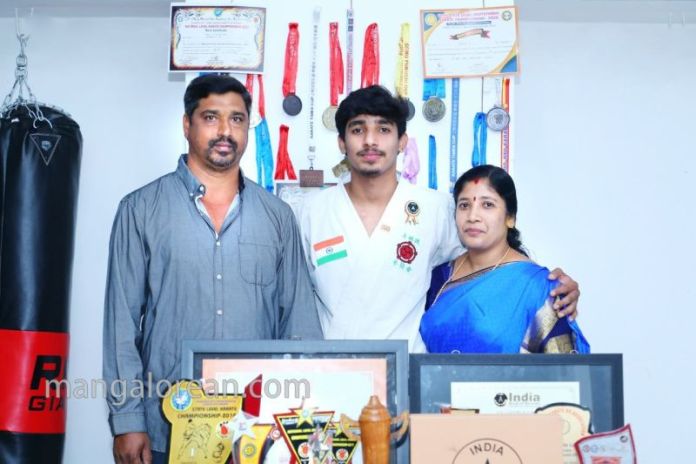
K Rahul seen with his Parents
Speaking to Team Mangalorean, Rahul said, “Karate is not merely a martial art for self-defence, but offers a lot to sportspersons to achieve. Kodagu, the smallest district in the State, has contributed hundreds of sports talents to the country.
Many talented sportspersons have proved their mettle in international and national level sports competitions. Following in the footsteps of all these Kodagu athletes, I was really keen on Martial arts and Athletics. I was so dedicated to karate that at my first Karate tournament in Karate Times Cup 2016, I secured 1st position in Individual Kumite and Kata. Since then I reached greater heights in this Art, winning top places in various Karate tournaments”.
Born to Kumar, who runs a metal shop in Virajpet, and Varalakshmi, a homemaker, Rahul attended St Anne’s Composite High School and is currently enrolled in a pre-university BA programme at Mangalore University.
He enrolled himself in UECHI RYU Karate school at the age of 12. In 2017, he won third place in Karate Times Cup; In 2017, Karate tournament organized by Naga Martial Arts Academy (R) Mysore SHORIJINI-RYU, he won 3rd position and in Kumite 2nd position; he won 2nd position in Kumite in 2018 Karate Times Cup; First place in SEIKO FUKUCHI CUP-2018 SOUTH INDIA in Individual Kata and Kumite; In 2019, in the Karate Times Cup at Kannur he gained 3rd position in Individual Kata and 2nd Position in Team Kata.
In 2019, got 1st place in the BODHIDHARMA JKS INDIA CUP 2K19 WORLD in Kata; In the 5th O.K.A.A OPEN KARATE CHAMPIONSHIP 2019 in Kata, he bagged 3rd Place; In 4th O.K.A.A OPEN KARATE CHAMPIONSHIP 2019 in Kata, he got the 2nd place; In the STATE LEVEL OPEN E-KATA CHAMPIONSHIP-2020 Above 18 years Black Belt, he secured 1st place; the 15TH STATE LEVEL INVITATIONAL KARATE CHAMPIONSHIP Below 70kg Black Belt fetched him the 2nd place and in Above 16 years Black Belt, the 2nd place.
No doubt that Rahul is the new hope for Karate among youth as he has won a series of prizes and his passion for Karate was inspired and supported by his parents in winning many laurels and awards consistently so far. It’s time for other youth to follow in his footsteps and take up Karate or any other sports, and make it big.
Anything or any achievement can happen over Coffee! No doubt the rich bold Coffee of Virajpet/Madikeri consumed by this Kodagu lad has shown some big results in Karate. Team Mangalorean congratulates K Rahul on his superb achievement, and we wish him all the luck in his future Karate talents, so he could enter the Guinness Book of World Records. You Go Boy!
source: http://www.mangalorean.com / Mangalorean / Home> Mangalorean News> Local News / by Alfie Dsouza, Team Mangalorean / February 15th, 2022
Dr. Mechira Subhash Nanaiah of Murnad has been unanimously elected as the President of Kodagu Moolanivaasigala Samvidhanika Hakku Samrakshana Samithi, a Committee that has come into existence for the protection of Constitutional Rights of Kodagu original inhabitants.
Nanaiah’s election was announced at a meeting of Kodagu Gowda Samajagala Okkoota held at Madikeri on Sunday, which was attended by representatives of various Kodava communities.
The meeting also elected Kodagu Gowda Samajagala Okkoota President Soortale Somanna as the Hon. President of the Samithi.
This apart, senior advocate Padinjharanda G. Ayyappa, who is the President of Kodagu Heggade Samaja, Kodava Muslim Association (KMA) President Duddiyanda H. Soofi, Kodagu Airy Samaja President Babbira Saraswathi and Savita Samaja leader Vedapanda Kiran as the Vice-Presidents of the Samithi.
The meeting also resolved to include representatives of all original inhabitant communities in the Samithi and to evolve plans for launching a movement for reddressal of issues.
source: http://www.starofmysore.com / Star of Mysore / Home> News / Februrary 04th, 2022
The drive on clearing of encroachments at Keere stream which was started in full spirit has remained stagnant for the past two months.
After clearing the encroachment of the bypass road drain, the taluk administration had assured of clearing the encroachment in the Keere stream which is situated in the heart of the town. The sudden stoppage of the operation has given room for speculation.
Two months ago, the encroachment of the bypass road drain was cleared with police security. The structures were razed mercilessly.
The citizens of the town expected a similar operation with the clearing of encroachment in the Keere stream.
However, the expectations were not met as the operation was stalled all of a sudden.
Excavating machines are gathering rust in the banks of the Keere stream for the last two months, it is alleged.
Residents alleged that most of the people among those who have encroached on the Keere stream belong to the ruling party and are influential. Therefore, the officials of the taluk administration have kept silent.
The operation of clearing of encroachments was initiated by Ponnampet taluk in-charge Tahsildar Yogananda. Now, Ponnampet has got a full-time Tahsildar. However, the operation has been stalled now.
“If the encroachments in Keere stream are not cleared, a protest will be staged against the taluk administration,” residents Gangadhar, Purushottam, Fayaz and Ahmed said.
Tahsildar Prashanth said that regarding the clearing of encroachments, the High Court had given time before starting the clearing operation in the Keere stream. The time has lapsed and the operation will be started soon.
Taluk Akrama Sakrama Samiti president K B Girish Ganapathy said that the government land which had been encroached in the town should be cleared as per the law. The taluk administration should take immediate action.
Kaveri Jalamoola Samrakshana Horata Vedike, Gonikoppa, president Pulinjana Poovaiah said that the compound of a private school had encroached on the Keere stream. There were other structures that had been built after encroaching the stream. The encroachments had resulted in flooding of residential areas in the rainy season. Therefore, the encroachments should be cleared.
source: http://www.deccanherald.com / Deccan Herald / Home> State> Mangaluru / by DHNS, Gonikoppa / February 14th, 2022
WELCOME. If you like what you see "SUBSCRIBE via EMAIL" to receive FREE regular UPDATES.
Read More »