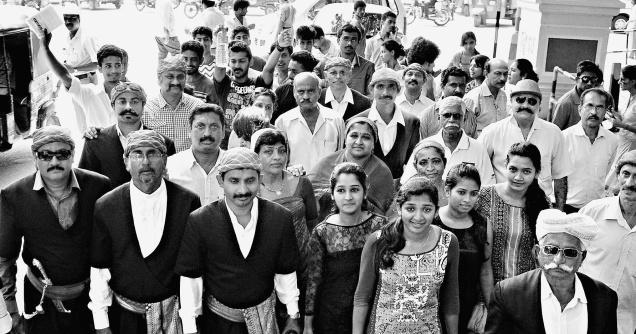
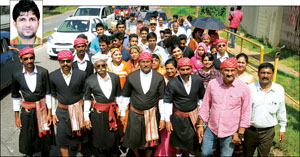
The Kodava Sahitya Academy and Arebhashe Samskriti Mathu Sahitya Academy will urge the Ministry of Home Affairs to continue the exemption to possess firearms under Section 3 and 4 of the Indian Arms Act.
At a meeting convened on Wednesday, to collect public opinion on the issue, the Kodava Sahitya Academy president B S Thammaiah said that a delegation under the leadership of MP Prathap Simha would be taken to Delhi to impress upon the Home Ministry.
“The public should give their opinion on exemption to possess firearms in writing. All the written opinions will be compiled and submitted to the Central government,” he said.
Arebhashe Samskriti Haagu Sahitya Academy President Kolyada Girish said, “There are several burning issues in Kodagu. Now, the issue of exemption to possess firearms has appeared. We are not ready to lose the exemption given to us.”
Napoklu Kodava Samaja President Uthappa demanded, “Exemption to possess firearms by every person of Coorg race and every Jamma holder should be continued.”
P J Ayyappa said the circular issued by the British rules mentions the term ‘Coorg race.’ There is a need to define the term ‘race’ to make the officials and the government understand, he insisted.
Kudukuli Bharath said, “All the traditional dwellers of Kodagu come under Coorg by race. I had availed exemption to possess firearms way back in 1976.
“The exemption is not restricted to Kodavas alone. It is related to all the traditional dwellers of Kodagu. We have to protect our rights.”
Kodagu Gowda Vidya Sangha member and Advocate Dayanand concurred, “The exemption to possess firearms has been given to ‘gallant people of Coorg’, according to a circular issued by the British Commissioner Cubbon in 1861. The circular does not mention one community alone.
“The ‘Coorg race’ is not restricted to one caste or creed alone. The circular on Coorg race has been misunderstood by the officials. The exemption enjoyed by the traditional dwellers of Kodagu prior to 1976 should be continued.”
Codava Makkada Coota President Bolajjeera Ayyappa said, “Coorg, by race, is only Kodava community. There is no need to create confusion in this regard.”
List of communities
Kodava Bhashikara Sangha District President Sara Changappa said, “When K G Bopaiah was the Speaker of the Assembly, the State government had submitted a list of communities that come under ‘Coorg by race’ to the Kodagu deputy commissioner. The list includes all the traditional dwellers of Kodagu.”
Advocate Yaladaalu Manoj Bopaiah said, “The exemption given by the British regime is continued by the Central government through a circular. The exemption is not a legislation passed in the Parliament. In case the government feels that the exemption will create discrimination among communities, then it will be withdrawn. The right is not bestowed on a particular community. Instead, it is given to the residents of a geographical area. There is a need to convince the government that the exemption has been availed by the Codavas, Arebhashe Gowdas and other community members in the district.”
Legislators K G Bopaiah and Appachu Ranjan should impress upon the Home Ministry through Union Minister for Law Sadananda Gowda, he said and added, “As we do not have time, we have to act swiftly.
source: http://www.deccanherald.com / Deccan Herald / Home> District / DHNS, Madideri – October 15th, 2015
In her few years as an actress, Harshika Poonacha has been a part of Kannada, Kodava and Konkani films and won a state award for her work in Thamasu. Now, with a Telugu film in the offing and with her currently shooting for an untitled multi-lingual thriller, she is set to make her Tamil debut too. Harshika tells us about the challenges the film industry has put forth before she could make headway.
Is branching out of the Kannada film industry to work on films in other languages the only way for a south actress to make a mark today? I don’t think actresses here can be blamed if they work towards making a mark elsewhere. We move out because, at times, filmmakers here fail to see the potential in local, Kannadiga actresses. See the number of films that are being made here each year — most of them have heroines from various other states. This, even when there are so many talented local actresses right here. I have often heard people say that heroines from here are not on par with, say, heroines from Bollywood or other south industries. They say we don’t look glamourous enough or are not bold enough. But that is not true. Actresses here can transform to play any role and I am not speaking for myself when I say that. Take a look at the many actresses from here that have gone on to make a mark in other languages. It is unfortunate that makers tend to notice potential only when an actress has ventured out and proven herself.
Tell us about the multi-lingual thriller you are shooting for… I have been shooting right through the nights for this film at a huge house on the outskirts of Bengaluru for the last one month. It is a thriller, directed by Venugopal,which is being made in four south languages simultaneously. So the cast for all are on the set together as we are required to shoot our scenes one after the other. While it is being made in Kannada too, I am not part of the Kannada version. This will mark my Tamil debut instead, in which I star opposite Mahat Raghavendra.
Do you find yourself facing language issues when it comes to such projects? Going to a school where you have friends who speak so many different languages is a huge advantage. I can speak most south Indian language fluently. While I dub for all my Kannada films, it is up to the director to decide if my Tamil is fluent enough for me to dub. Though, dubbing for your own films does give you an advantage, in terms of portraying your character to the fullest, as well as when you are being considered for State awards. There are not many actresses in the Kannada film industry who can dub for themselves. I am part of three Kannada films that are being shot in the coming year, and I will, of course, dub for all these films myself.
source: http://www.timesofindia.indiatimes.com / The Times of India / Home> Entertainment> Kannada> Movies / by Kavya Christopher, TNN / October 11th, 2015
What do pretty words do? A lyrical line, a clever turn of phrase, a poetic piece of prose in a book, a page, a passage: what it does is that it gives you a line to note down in a journal of favourite such lines from there and elsewhere. What these words and phrases do is make you remark privately on the poetry in the writer’s prose, applaud her imagination in stringing smart metaphors together, the sorts that make you pause your reading and say ‘ah’. But there is something like too much of a good thing. We have known that for long. And it is this too much of a good thing that threatens to tarnish the gleam in Sarita Mandanna’s Good Hope Road.
Mandanna is a good writer, undoubtedly. Some of her metaphors are very well thought of indeed. “…petrol-over-water colours”, “the sheen of a fin upstream” and suchlike draw a picturesque scene in the readers’ minds, like something at the edges of a detailed postcard. They lend themselves delightfully to a reading aloud, the lyricism as pleasing to the ears as to the mind that recreates every scene in a story as you go along. But the pitfall—and I imagine it is a hard one to avoid falling into—is that the story itself gets clouded by the pretty décor that is sprinkled on every page like sparkly confetti. Which is too often the case with Good Hope Road.
The story’s scope is ambitious and is spread over many decades and a couple of generations, spanning the First World War and ending just at the beginning of the Second. The narrative goes back and forth, shifting between the years and stories and incidents, jerky in some places, but mostly retaining a decent pace. There is Major James Stonebridge, a Yankee from New England, and Obadaiah Nelson, a Louisiana native, who find themselves at the warfront in Paris. Idealistic, brave, loyal and hungry for adventure, as most young men were, they form a deep, and unlikely, friendship. A decade and half later, Stonebridge is a recluse, back home, but lost somewhere still in France’s old war zones. A mirror that he is content to stare into stares back at him an image of a man broken and burdened by a war that changed his generation and the histories of many nations. His anger, his moods are most felt by his son Jim, whose first understanding of his father’s life comes when pretty and privileged Madeleine enters their lives. She won’t let the Major stew in his black mood, drawing him slowly out of his shell.
Then there is the Bonus March that is sweeping the nation… a reference uncannily, similar to the protests sweeping this nation, for pensions and dues. Mandanna picks up on a little known protest by veterans demanding that the US government give them the bonuses due to them and explores poignantly the way nations ignore their returning soldiers. It is in that sense a story of every nation that has ever been at war. While young men are sent off to the front with fanfare and hailed as heroes, or martyrs, the ones that return are often ignored. Their assimilation into a society that has never seen bombs or been in trenches is an exercise undertaken only reluctantly, half-heartedly, if at all. The book addresses this theme with sensitivity, highlighting the trauma, the depression and lack of a sense of purpose that plagues war heroes. It is not limb or life alone that is affected, but the hidden scars that run dark and deep that Mandanna seeks to shine a torch on. And for all the gloss, the book does do that rather well.
Her attention to detail makes for fascinating reading as well. Skimming over the technical details of war strategies, Mandanna cuts right through to the lives of the soldiers, strangers thrown together by patriotism, adventure or something else. Their camaraderie, the little sharing of a song or a letter, small conversations, these are places where the book offers lovely insight into the human-ness of those that fight a nation’s wars.
source: http://www.newindianexpress.com / The New Indian Express / Home> LifeStyle> Books / by Deepa Bhasthi / October 10th, 2015
Prelude: In 1965, Pak under Field Marshal Ayub Khan having acquired modern aircrafts, tanks and other armament from USA, as a member of SEATO, planned to wrest J&K from India militarily. They imagined that the Indian Armed Forces were a demoralised lot after the drubbing we got from China in 1962 and political leadership had gone weak after Nehru’s death. Pakistan thought that it was a historic opportunity for them to use force against India to attain their objective.
Pak started off with a diversionary attack in Rann of Kutch and followed it up with ‘Op Gibralter’ to infiltrate a large force, led by officers into Kashmir Valley to disrupt communication, cause panic and take over the administration. Both these were not only defeated by Indian Armed Forces but they captured strategic Haji Pir Pass which was used by them for infiltration. Undaunted, they on 1st Sept. 1965, launched ‘Op Grand Slam’ with two major offensives along Chamb – Jurian and in Punjab along R. Beas to cut off J&K from the rest of India.
Mobilisation and Concentration
India lost no time in declaring Emergency and countering with ‘Op Riddle.’ My Battalion (Bn), 5 MARATHA LI had arrived in Baroda (Vadadora) a few days earlier after a long tenure in North East and was in the process of settling down, when at night on 1st Sept., we got orders to mobilise and move to Ahmedabad for further orders. As we were short of transport, we requisitioned some civil vehicles and moved out before the people of Baroda woke up.
At Ahmedabad, the GOC of 11 Inf Div. Maj. Gen. Naveen Rawlly, MC told us that our 30 Inf Bde was to carry out an offensive into Sind as a diversionary attack, in order to attract Pak reserve Division in W. Punjab and that we should move post-haste to our Concentration Area between Barmer and Gadra Road (Rajasthan). Thanks to the patriotism of the way side civil petrol stations, who supplied fuel to us merely by accepting written receipts, we were able to move non-stop and reach our destination the very next day — a distance of about 400 km; but we had to wait two more days for other units of the Bde to fetch up and prepare for the battles ahead. With just 7 years service, I was the senior most Coy Commander (C Coy) in my Bn and was the only officer in the Bde, trained in commando operations. Much was expected of me and I was confident of living up to the expectations.
Offensive commences
On 6th Sept., Brig Buppy Guha gave his orders for the capture of Gadra City, a medium sized town 5 kms inside Sind by the Bde. As per the intelligence provided by Muslim smugglers operating in the area, only Pak Rangers were operating against us and there were no regular Army in the area. The attack was to be launched next morning and my Coy was to infiltrate behind the enemy as a preliminary operation and establish a block behind Gadra City, before the attack.
My Coy was the first to cross the Sind border soon after sun set. We moved in single file with myself in front with compass in hand for navigation. We moved fast for about 14 kms to find a suitable place and by 4 am, I selected a place on track Gadra City — Kokrapara which was their nearest Railway Station close to the border. At dawn, I heard firing in Gadra City signifying that our Bde attack had started as planned. The escaping enemy could use any route in the open desert; but luckily 7 Pak soldiers walked into our ambush, unaware of our presence. We could have killed them; but they capitulated without any resistance. They were regular soldiers from Baluch Regiment and they had been in that area training in desert warfare for quite some time. This was contrary to the earlier information given by the smugglers, who were obviously pro-Pak. These were the first batch of PsOW captured by our Bde, who gave us valuable information. We treated them humanely as per Geneva Convention.
Advance towards Kokrapara and Air Attack
After the capture of Gadra City by the Bde, my Bn linked up with me and we were ordered to advance towards Kokrapara. As the track was unfit for heavy vehicles, we took only few 1 tonners to carry essential ammunition and water. As we were advancing, our column was attacked by two Pak Sabre 86 aircrafts due to which one our ammunition vehicle was blown up. From then on till the end of the war these aircrafts kept attacking us with impunity as our own IAF could not spare a single aircraft to our Sector!
By last light we reached a village called Sakarbu, with a biggish sand dune feature next to it where we firmed in. Next day, except my Coy, the rest of the Bn was withdrawn to Gadra City for its defence. Seeing us, the poor villagers of Sakarbu wanted to flee but I advised them that we were not a threat to their safety and they could lock up their houses, take their valuables and in an organised manner go towards Pak leaving behind few guards. I assured them that we had come there to meet the aggression of the Pak Army on our sacred land and we have no enmity but only goodwill towards them. I can never forget their expression of gratitude and their blessings “Kuda ap sab ko bala kare” (May God bless you all).
Aborted raid on Dali
A day later, my Coy too was pulled back to Gadra City to carry out a raid on Dali, which was a known enemy position in the interior. I was allotted trained camels from Rajasthan Armed Constabulary (RAC later converted into BSF) to carry 3 inch mortars and MMGs with ammunition and water. We moved cross-country away from the track to avoid air attacks. Enemy aircrafts did overfly, but could not notice us as our camels just sat down and froze like well-trained soldiers! This was my first experience with camels — they could move on the desert in the scorching heat without water for days. When we were in the striking distance of Dali and planning the raid at night, I had an urgent message to call off the raid and rush back to Gadra City to deal with a serious situation !
Clearing of Pak Road Block at Khadin
When I returned to Gadra City, I was told that an enemy motorised column was successful in entering Indian territory and capturing a RAC Post at Khadin which was half-way between Gadra Road, our nearest Indian Railway Station and Munabao, where the old defunct Railway line entered Pak territory. They had effectively cut off 3 GUARDS and B Coy from my Bn which were operating in Munabao. A squadron-less two troops of tanks from Skinners Horse (Sherman Tanks) under Maj. Chopra was to join us, to clear the enemy block at Khadin. We moved piggy back on the tanks. It was agreed between us that when we contact the enemy, we would jump off from the tanks, move on a flank to assault, while the tanks would take hull down position to give us covering fire. Unfortunately, four of the tanks got bogged down in the sand and we had to march on foot.
Only late in the evening, we contacted the enemy, who fired their mortars, 106 RCL (Anti tank) and MMGs at us from a high ground astride the track behind the Khadin village. A few thatched huts in the village were burning due to Pak fire and in the dark their tracer bullets were flying all over our heads. It was a spectacular sight to behold as though we were witnessing a Diwali extravaganza, even though the situation was grim with one of my jawan lying wounded due to the shelling. Due to darkness, the three tanks which managed to reach the area were useless, as they did not have night fighting capability. However, their mere presence could have scared the enemy.
We carried out aggressive patrolling on the flanks at night due to which the enemy got panicky and fled in the cover of darkness with their vehicles. Their vehicles had balloon tyres to move on the desert unlike ours. My company occupied the post without opposition by midnight. In the morning, Maj. Chopra without my knowledge, informed the Brigade from his wireless set that we had succeeded in clearing the road block and he was getting back to retrieve his tanks.
As for me, we had not yet accomplished the mission fully as the enemy had withdrawn only up to Sakarbu height, which was previously held by us and directing artillery fire on us. We had to evict them from there to ensure that route to Munabao was safe. So, I requested my Bn to send me mortars and MMGs for attack on them next night and myself took a small patrol towards Sakarbu using sand dunes as cover, to plan attack. Strangely, I saw and heard them scooting from there too during mid-day. After ensuring the position was abandoned by them, I used my initiative, in the absence of communication failure with the Bde, to handover Khadin Post to RAC personnel who were in hiding not far away during Pak occupation and had rejoined us after it was recaptured by us.
Thereafter, I moved my Company to occupy Sakarbu, which was tactically more important for us. The route to Munabao was thus opened and it was now safer. Next day, the Bde sent a coy of 1 Garh Rif to relieve my Coy at Sakarbu and was called back to Gadra City. I thought it was to give us time to rest and recoup but alas it was not to be!
My last Mission: When I reached Gadra City, our new Bde Cdr, Brig. Summanwar complimented me for my Coy’s action at Khadin and Sakarbu but said that he had sent composite force with 17 MADRAS, a part of my Bn under my CO and a Coy of 1 Garh Rifs, inland towards Dali to capture more areas. They had captured Jasse ke Par, Dali and Pirani ki Par; but as there was a complete breakdown of communication with them, he was anxious to know about the situation on that front. He, therefore, wanted me to take a strong patrol mounted on 1 ton vehicles with mors and MMGs to bring back correct information, so that he could plan further operation.
I had Capt. Sardesai from my Bn to assist me as my second in command. It took the whole night to get the ASC vehicles and patrol ready. We could set out only in the morning with me in the lead vehicle and Capt. Desai in the last. We had to move dispersed due to the threat of air attack. As I was nearing Dali, I could hear a lot of firing there which made me move faster than the speed of my convoy behind. From a higher ground, I descended on a flatter area which was being overlooked by a high sand dune short of Dali.
On the skyline I noticed some figures. I saw through my binoculars to find that they were wearing Khaki uniform — they were unmistakably Pakistanis! The best I could do was to halt my convoy at higher ground left behind and take up a defence. So, I instructed the driver to reverse the vehicle and I got down to have a better look at the enemy. Just then, they fired artillery at us and unfortunately one shell fragment hit my right leg and it started bleeding. Nk Shinde, who was with me while helping me back into the vehicle, saw an enemy jeep mounted with 106 RCL less than 70 yds away and he fired at it with his rifle. The enemy crew, obviously scared, reversed into a depression, fortunately never to raise their heads again.
As I got back into my vehicle, we saw another enemy MMG mounted jeep trying to encircle us from a flank; but we managed to escape by driving fast back to the higher ground, where Capt. Sardesai was waiting for me. Fortunately, my wound was not life-threatening. While my wound was being bandaged to stop the bleeding, I could discuss the situation with Capt. Sardesai. We decided to deploy the patrol into a defensive position. I planned to get back to Gadra City to personally brief the Bde Cdr and attend to my wound.
After thanking Nk Shinde (without whose help, unmindful of his own safety, I would not have been alive today!) and dictating a situation report to be sent to the Bde, I left for Gadra City and reached there at night. Brig. Summanwar personally met me in the vehicle. After explaining what had happened, I recommended that a stronger reinforcement should be sent to help our beleaguered force at Dali and beyond. He discussed this with the Div. Cdr. and instructed 2IC of my Bn, Col. Sable to take the balance of my Bn with additional troops to stabilise the situation. It was nice of the Bde Cdr to take personal interest to arrange a hot dinner for me and evacuate me in an ambulance.
Cease Fire and After
While being evacuated, I was informed that night on 23rd Sept., India had declared unilateral cease fire. After two weeks of hospitalisation at Ahmedabad MH to tend to my wound, I was given a month’s sick leave to go home to Madikeri, where my parents were anxiously waiting for me. However, with the permission of my father, who had served in Burma as an Army Doctor during World War II, I voluntarily got back to my Bn at Gadra City, 15 days before my leave was to expire.
Taking advantage of the unilateral declaration of cease fire, Pak wilfully had tried to grab some unoccupied area of ours in Rajasthan, which led to skirmishes and casualties on both sides. By the time I returned, the situation had stabilised. Our Bde had achieved its objective, against heavy odds by capturing large area in Sind, which came in handy during the negotiation which followed after Tashkent Agreement. My CO, Col. Rattan Singh was designated to attend a flag meeting with Pak to finalise the plan for vacating the captured areas by us. He took me with him and he was pleasantly surprised to find that his counterpart, the Pak Col. was an old course-mate of his at the Indian Military Academy, Dehradun! After recognising, they hugged each other and the meeting ended amicably!
By a coincidence, my Coy which was to enter first into Pak territory was also the last to vacate it. In this senseless war, where there were no winners or losers, the loss of Lt. Ronald Serrao, our Intelligence Officer, who was killed at Dali after the Cease Fire and our gallant JCOs and men, was too overwhelming.
After the war, my Bn moved to Jodhpur where our Bde became a part of newly raised 12 Inf Div, which was to specialise in Desert Warfare. Under the new GOC, Maj. Gen. Satinder Singh, we trained hard and developed concepts peculiar to desert warfare, which paid us handsome dividends during the 1971 War with Pak.
Conclusion
In this war, we learnt how not to wage a war! My Bde was launched into battle poorly equipped and trained in desert warfare without any air support. Battalions are meant to fight as a homogeneous whole; but we were frequently split into coys and pls columns and mixed up with other bns deep into the desert without administrative backing. This was a major flaw in the conduct of war at Bde level. Yet, we achieved more than what was expected of us.
In sum, the 1965 War, which Pak imposed on us ended in a stalemate but taught secular India never to trust our religiously indoctrinated neighbour. In 1971, we did better mainly because of the powerful personality of our then Army Chief, Field Marshal SHFJ Manekshaw, who had a direct access to the Prime Minister bypassing bureaucrats in the Ministry of Defence but emerging India can no longer depend upon such personalities. We should take institutional measures backed by appropriate allotment of finances to safeguard our internal and external security.
It is high time that the unbroken legacies set by our first Prime Minister, to appoint Defence Ministers who lack basic knowledge of Military, have a Ministry of Defence wholly staffed by bureaucrats who enjoy all authority without responsibility and not integrating the three Services, namely, the Army, the Navy and the Air Force under one Chief of Defence Staff to fight future wars should be ended. I do sincerely hope that our politicians and influential sections of our people, who as a rule never send their sons into the Armed Forces, realise their responsibility towards the Nation and take positive steps.
Jai Hind.
source: http://www.starofmysore.com / Star of Mysore / Home> Feature Articles / Saturday – October 10th, 2015
Decides to submit memorandum to the Centre to retain the status.
A resolution was passed to submit a memorandum to the Centre, seeking to maintain the existing status on firearm rights enjoyed by Kodavas and Jamma land holders at the zilla panchayat general meeting convened by Zilla Panchayat president Chodumada Sharine Subbaiah at Old Fort Hall in Madikeri on Thursday.
Raising the issue, member Shanteyanda Ravi Kushalappa said that the Kodavas and Jamma land holders have been using rifles from generations. But, an appeal filed in the court, against the exemption rights has hurt the sentiments of people, she said.
Zilla Pancahayat president said that a report will be submitted to the Union Home Ministry, seeking the retention.
ZP former president B Shivappa said, the ration cards are being cancelled in many villages in Somvarpet expressing discontent over the move.
World Food Day
Sharine Subbaiah said that all department officials strive towards the meaningful observation of ‘World Food Day’ and towards creating awareness against the wastage of food, especially in the hostels in the districts.
Member Kaddi Sundar pointed out that the roofs of anganwadi buildings in Moornadu are leaking and demanded that the buildings A child has succumbed to death recently , due to a road accident and road widening is the need of the hour in the area, he said.
Zilla Pancahyat vice president Beena Bollamma said that the protective walls along Madikeri-Bhagamandala road are on the verge of collapse and directed the Public Works Department officials to take immediate measures, in the wake of upcoming Tula Sankramana at Talacauvery.
DCF Yedakundulu said that the government has released Rs 5.5 crore towards the control of wild elephant menace and elephant trenches have been dug and solar fences have been erected in the reserve forest.
The meet decided to form three teams in three taluks to inspect the afforestation work by the Forest Department. Meanwhile, Kodandera Bond Ganapathy urged the Forest Department to provide the names of the locations where saplings have been planted.
The DCF replied that the information will be provided according to the New Forest Act.
Bond Ganapathu also told the members to provide information on the work of drinking water projects worth Rs 25 lakh in each ZP limits. The list of works should be submitted by the respective zilla panchayat members, towards the action plan.
Members Biddanda Usha Devamma, Indira, Babbira Saraswathi, M S Venkatesh, Boppanda Bollamma Nanaiah, Venkappa Poojary, Geeta and Mani Nanjappa were present.
source: http://www.deccanherald.com / Deccan Herald / Home> District / Madikeri – DHNS, October 09th, 2015
Raj Chengappa, Group Editorial Director of India Today was today elected the President of Editors Guild of India while chief editor of online daily ‘The Citizen’, Seema Mustafa was elected as the treasurer.
Prakash Dube, Group Editor, Dainik Bhaskar was elected as the General Secretary.
The new office bearers were elected at the general body meeting today, a statement by the Guild said.
source: http://www.ptinews.com / Press Trust of India / Home> National / New Delhi – September 26th, 2015
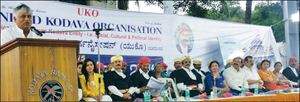
Mandya MP C.S. Puttaraju is seen addressing the gathering at the valedictory of ‘Jabhoomi Baalo-2015’ padayatra at Kodava Samaja in Bengaluru yesterday.
Bengaluru :
Rajya Sabha member from Bengaluru, Kupendra Reddy, has promised Rs. 10 lakh for conservation of Kodagu mandhs and revival of paddy cultivation across Kodagu district, said Mandya MP C.S. Puttaraju at the valedictory of ‘Jabhoomi Baalo-2015’ padayatra at Kodava Samaja in Vasanthnagar here yesterday.
Puttaraju said that he was authorised to announce this by MP Kupendra Reddy, who is currently in USA, on his behalf.
Stating that Reddy has announced Rs. 10 lakh for UKO’s cause as the first instalment, Puttaraju said Reddy has promised more funds for UKO’s various plans.
Stating that the people of Mandya were always indebted to river Cauvery, which originates in Kodagu, Puttaraju assured of extending all support for the protection of Kodava land, culture and its environment.
UKO Convenor Kokkalemada Manju Chinnappa, in his address, said that the funds provided by Kupendra Reddy will be utilised for conservation of Kodagu mandhs and other programmes. He also said that Puttaraju has handed over Rs. 10 lakh grant to UKO as the first instalment as promised by Reddy.
Karnataka State Handicrafts Development Corporation Chairperson Shantheyanda Veena Achaiah, former MLC Cheppudira Arun Machaiah, Kodagu District Congress President Biddatanda T. Pradeep, former Kodagu District BJP President Machimada M. Ravindra, Federation of Kodava Samajas President Mallengada Dada Belliappa, Bengaluru Kodava Samaja President Mandeda Ravi Uthappa, Vice-President Mukkatira Vani Nanaiah, Secretary Chennapanda Subbaiah, actress Prajwal Poovaiah, Madikeri Kodava Samaja President Moovera Shambu Pemmaiah, Ponnampet Kodava Samaja Secretary Chottekmada Rajiv Bopaiah, Kodava Sahitya Academy President Biddatanda S. Thammaiah, UKO office-bearers and others were present.
source: http://www.starofmysore.com / Star of Mysore / Home> Generla News / Monday – October 05th, 2015
Manju Chinnappa and team began walking from Talacauvery to Bengaluru to stress need to save the district’s ecosystem.
This farmer has been walking for 11 days to take his fight against environment degradation in Kodagu district. Manju Chinnappa, 37, started his padayatra from Talacauvery on September 18. Chinnappa, a native of Hudikeri, started the movement after severe drought that affected Virajpete this year. A Bcom graduate, Chinnappa says, “Even from my early days, I wanted to work towards the preservation of the culture and tradition of my motherland. Over the years, the district has seen several atrocities on land, deforestation and cultural aggression. The main aim of this walkathon is to bring to the attention of the social and economic problems that Kodagu district faces today. I hope it motivates people to preserve the culture and sanctity of the native people.”
Chinnappa has managed to cover close to 25 kms everyday and en route he is celebrated by the people of that particular village who walk with him for a few kilometres to express their support. On Monday, he reached Mysuru. He also gives awareness talks on how to keep the heritage of the district alive.
A founder of the United Kodava Organisation that was formed in 2011 to focus on preserving the environment and heritage of the place, he says, “We know merely submitting a resolution to the state government might not bring much change. We wanted to make a noise through this padayatra to get the attention of as many people as possible. We hope to reach Bengaluru by October 4 and we want to submit a memorandum to the chief minister regarding our demands.” His plan is to cover a distance of 414 km considering he has taken a route inside Kodagu within the villages to spread his message. After reaching Bengaluru, the final leg will start at 9 am from Jnanabharathi campus (Bangalore University) where the local Kodava population will join him in the walk up to 20 kms that will culminate at the Kodava Samaja in Vasantha Nagar. The local Kodavas will come in their traditional dress to show their support to Chinnappa.
Chinnappa says, “In the name of tourism, several trees are being removed which has harmed the people living in that region. Our main resolution is to put pressure on authorities to stop the conversion of wetland not only in Kodagu but across the state. Many infrastructure plans by the state government have destroyed the ecology of the district completely and we want to draw everybody’s attention to this.”
The Kodava community in the city is all set to welcome Chinnappa. They have also started a Facebook page to update the information of padayatra from time to time.
Members of United Kodava Organisation taking out a padayatra from Talacauvery to Bengaluru, passed through Mysuru on Monday.— PHOTO: M.A. SRIRAM
The Talacauvery to Bengaluru padayatra launched by the United Kodava Organisation (UKO) reached Mysuru on Sunday.
The participants stayed overnight at the Kodava Samaja at Vijayanagar in the city, before resuming their journey towards Bengaluru on Monday. The purpose of the walk is to to draw the attention of State and Union Government to their demands for development of Kodagu and Kodavas
UKO convener Kokkalamada Manju Chinnappa said the 17-day-long padayatra, which began from Talacauvery on September 18, will reach Bengaluru on October 4, after covering 414 km.
The UKO has sought a law to check conversion of agricultural land into non-agricultural purposes, subsidy of Rs. 10,000 per acre for growing paddy, stopping forced eviction of small coffee growers and dropping the Union government’s proposal to allow Foreign Direct Investment (FDI) in coffee cultivation.
The participants, who are scheduled to stay overnight at Baburayana Koppal near Srirarangapatna on Monday night, will pass through Mandya, Maddur, Channapatna and Ramanagaram before reaching Bengaluru
source: http://www.thehindu.com / The Hindu / Home> National> Karnataka / by Special Correspondent / Mysuru – September 29th, 2015
‘Jabhoomi Baalo-2015’ Talacauvery-Bengaluru padayatra leaves city
Mysuru :
“Kodavas should also get the same status and facilities accorded to Parsi community,” opined Mysuru-Kodagu MP Pratap Simha.
He was speaking at a programme organised at Kodava Samaja in Vijayanagar first stage here to mark the arrival of ‘Jabhoomi Baalo-2015’ Talacauvery-Bengaluru padayatra in the city yesterday.
Noting that the Parsi community, a minority community having less population, is playing a key role in the country’s economy and industrial sector, the MP said that many Parsi achievers such as renowned scientist Dr. Homi Jehangir Bhabha and senior advocate Fali S.Nariman have brought honour to the country.
“The Union Government, taking note of the dwindling number of Parsis, has come up with ‘Jiyo Parsi’ campaign for the survival of the community. Likewise, the Government should come forward to save the Kodava community, which has given two Generals, 28 Lieutenant Generals, 5 Hockey Captains and other greats in different fields,” he said and added that he would urge the Union Government to extend the status and facilities accorded to Parsi community to the Kodava community as well.
Noting that Kodagu is a distinct district known for its rich forest cover, culture and geographical features, he said that Kodava culture, land and language was a unique one and the government should take appropriate measures for preserving this.
The MP also stressed for unity among Kodavas to get all due government facilities.
United Kodava Organisation (UKO) Convenor Kokkalemada Manju Chinnappa, in his address, said that the Talacauvery-Bengaluru padayatra, which was launched at Talacauvery on Sept. 18, has been undertaken to draw the attention of State and Union Governments towards their 18-point charter of demands aimed at development of Kodagu district and survival of Kodava race.
The demands include: Bringing a new law on the Kerala-model to check conversion of agricultural land into non-agricultural purposes; Subsidy of Rs. 10,000 per acre for growing paddy; Suitable amendment for replacing Paisari with ‘Takkamaye’ in Section 6 of revenue land schedule; Stop forced eviction of small coffee growers; Drop the Union government’s move to facilitate Foreign Direct Investment (FDI) in coffee cultivation and Legalisation (Sakrama) of lands encroached for growing coffee.
As the padayatra reached Hinkal junction on Hunsur road yesterday, the office-bearers of Mysuru Kodava Samaja joined it and marched along with UKO members to Kodava Samaja in Vijayanagar I Stage where a stage programme was held later.
The padayatra team, which stayed overnight at the Samaja, resumed its march this morning. The team will stay for the night at Baburayana Koppalu in Srirangapatna taluk on Mysuru-Benglauru road. The padayatra will culminate in Bengaluru on Oct.4.
Karnataka Pradesh Hotel Owners Association President M. Rajendra, Mysuru Kodava Samaja President Moovera K.Kuttappa, Vice-President Balyamanda M. Nanaiah, Hon. Secretary Mandira P. Kalaiah, former President Mechanda M. Karumbaiah, former Secretary Kekada M. Belliappa and others were present.
Ponjanda Lovely Appaiah compered the programme.
MLC rues vanishing of Kodava race: MLC G. Madhusudan has regretted the dwindling number of Kodavas in their homeland, which gave hundreds of great warriors to the country.
He was speaking at a programme organised at Kodava Samaja in Vijayanagar here yesterday, marking the arrival of ‘Jabhoomi Baalo-2015’ padayatra to the city.
Appealing the Kodavas not to undergo family planning for the sake of survival of patriotic fervour in the country, Madhusudan expressed concern over the increasing tribe of selfish and anti-development families.
Stating that the migration of Kodava families to cities has resulted in Kodavas losing touch with their rich culture, the MLC called upon all Kodavas to stay in their homeland and strive for enriching the Kodava culture besides reviving the spirit of patriotism.
Noting that Kodagu district geographically resembles Shivalinga figure, the MLC said Kodagu is covered by rich forests and receives heavy rainfall.
Pointing out that Kodagu is the birth place of Cauvery river, which flows through Mandya, Mysuru, Chamarajanagar districts and Tamil Nadu before joining the sea, the MLC said that the river is the lifeline for crores of people. He called upon the expatriate Kodava families to return to Kodagu and strive for Kodagu to regain its past glory.
He also declared that he would extend full support for the ongoing agitation to demand development of Kodagu district and assured that he would raise issues concerning Kodagu district in the Legislative Council.
source: http://www.starofmysore.com / Star of Mysore / Home> General News / September 28th, 2015
WELCOME. If you like what you see "SUBSCRIBE via EMAIL" to receive FREE regular UPDATES.
Read More »