Category Archives: Famous Personalities of Kodagu / Coorg

New Light on Kodavas of Kodagu – 1, 2 & 3

Review of Kaveri Ponnapa’s book “The Vanishing Kodavas”
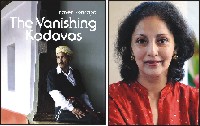
KaveriPonappaKF26sept2015

Title : The Vanishing Kodavas / Author : Kaveri Ponnapa / Pages : 360 / Price : Rs. 7,500 / Publisher: Eminence Designs Pvt. Ltd. [Order from www.thevanishingkodavas.com]

New Light on Kodavas of Kodagu – 1

People are interested in history because they want to know their roots; they want to know who they are; they want to know their progenitor. And with their physical features, colour and gait being different from their immediate neighbours, they want to know the why and how of it. The desire to know their ancestry becomes even more strong if their customs, costumes, culture, cuisine, language, songs of oral tradition and even Gods are different from those of others. The question arises if they could be of the land where they have been living from time immemorial or did they come from another part of this country or from another country traversing thousands of miles by land or sea due to historical reasons? War, pestilence or famine?

The Kodavas of Kodagu district in Karnataka belong to this class of unique people who want to know. Hence, there is an abiding interest among the successive generations of Kodavas, even scholars, to know their ancestry, history of their land of hills and valleys with thick rain forests, criss-crossing rivers and streams, having very high rainfall for over four months in a year. They are the high-landers and hardy people — physically strong and daring at any task and in war.

In retrospect, I myself being the son of that clan and soil, it can be said that these Kodavas lived on this land from the dim past to this day fighting all the time for survival with the nature and wild animals like tigers, elephants and vermins that destroyed their paddy fields and other crops; fighting the local chieftains of their own clans and the invaders from the neighbouring kingdoms till the geographical unity and political stability was attained when Kodagu (with Sulya and Puttur) became a kingdom under the Haleri Dynasty from 1600 to 1834 — 234 years.

In between, there was an interregnum when Hyder Ali and his son Tipu Sultan ruled Kodagu uneasily, under constant armed resistance from Kodava chieftains, for 11 years from 1780 to 1791 when Madikeri was renamed as Zaferabad.

In a classic example of the saying, “My enemy’s enemy is my friend,” the Kodagu Rajahs cultivated British of the East India Company, who were engaged in fighting Tipu Sultan, a sworn enemy of Kodagu Rajahs. So Tipu’s enemy, the British, became the friend of Kodagu Rajahs. But alas, in a tragic play of history, the British were able to de-throne and deport Chikkaveera Rajendra Wodeyar in 1834 after being betrayed by the Rajah’s trusted Dewans Cheppudira Ponnappa and Apparanda Bopu. Despite the Rajah’s army successfully resisting the British at the other two fronts, at the Eastern stockade it was a meek, humiliating surrender by Dewan Apparanda Bopu with a party of 400 Kodavas at the present Kushalnagar to Col. Frazer (hence Kushalnagar was known as Frazer Town).

The Dewan then “led the British troops back to Madikeri where the Union Jack was hoisted on 6th April 1834. The last battle for Kodagu was a sad betrayal,” writes Kaveri Ponnapa in her magnum opus of a book on Kodagu and Kodavas titled “The Vanishing Kodavas,” the book under review.

However, let me submit a caveat here. The records indicate the young King Chikkaveera Rajendra was more into outdoor activity, ironically with visiting Englishmen, of hunting and camping leaving the matters of State in the hands of trusted and able Kodava Dewans and also a Dewan from his own caste Kunta Basava, an evil genius no doubt, and another Muslim Dewan, probably to neutralise the power of Kodava Dewans mentioned above. When the relation between the Rajah and the East India Company got strained on the question of extradition of fugitives and the Kodava Dewans realised the end result of an inevitable war, they counselled the King to negotiate peace. But, the King was adamant. The Kodava Dewans, in the circumstances, decided that ‘discretion was better part of the valour.’ The British had already defeated a more powerful Tipu Sultan than the Kodagu King and as for weapons of war, the Britishers had cannons which the Kodagu Rajah did not have. If only Chikkaveera Rajendra had negotiated peace, he could have continued in the throne like the Mysuru dynasty under the suzerainty of the British Company.

Curiously, a large number of scholars and people, who have read the history of Kodagu written by many, are fed with information that shows the Haleri Kings, specially Doddaveera Rajah, Linga Rajah and the last Rajah, Chikkaveera Rajendra Wodeyar in poor light, as tyrants and mentally deranged towards the end of each one’s rule.

The history of Kodagu commissioned by Doddaveera Rajah in 1807 known as “Rajendranama” and another by Linga Rajah known as “Hukumnama,” the land laws of 1812, can be verified to find out its veracity and the good administration delivered by these rulers. The secret, if the word can be used, of the Haleri Rajahs ruling Kodagu for so long, 234 years, is no doubt because they never interfered with the land holdings of Kodavas, their customs, culture and, in short, Kodavas’ way of life. And Kodavas in return served their Kings loyally till the ‘betrayal,’ for self-preservation of Kodagu and Kodavas, came in 1834.

The proof of the Haleri Kings being good rulers is in the representation made to the British Government on 13th April 1834, just 7 days after the surrender, signed by 400 senior officials of Rajah’s Government, expressing their entire satisfaction with the Rajah’s rule and with grief requesting that the Rajah be allowed to remain in Kodagu.

Kaveri Ponnapa writes, “Despite the fact that he had an infant son, Prince Chitra Shekara, when he was conducted out of his kingdom, no attempt was made by the British to restore Haleri rule by placing a Regent over Kodagu, as had been done in some States, including nearby Mysore.” One would wish the author had given more information on Prince Chitra Shekara. Pray whatever happened to him? Interestingly, the Rajah begot more children in exile — in captivity at Varanasi ! To jest, what else could he have done with nothing else to do !

This book by Kaveri Ponnapa, based on 15 years of research, nearly 200 visits to Ainemanes (ancestral houses), historical locations, sacred places and interviews with elders in Kodagu, debunks many tendentious works on history and culture of Kodavas. The wealth of information, not so much on political history but on other aspects of Kodava life and culture, contained in the book The Vanishing Kodavas astonished me no end.

The book is a treasure trove of many informations hitherto presented in a distorted manner or suppressed from us to justify British occupation of Kodagu. I am reminded of a great Nigerian proverb which says that until the lions have their own historians, the history of the hunt will always glorify the hunter. Let it be.

It is, therefore, necessary for us to question the description of Chikkaveera Rajendra as a bad King in the eponymous novel by Masti Venkatesha Iyengar. No wonder there were protests and criticisms when Masti Venkatesha Iyengar was given Jnanpith Award for this book and when an attempt was made to produce a film-based on the book. ______________________________________

New light on Kodavas of Kodagu – 2

The book, The Vanishing Kodavas, however, does not answer the fundamental question: If not the natives of the land, where did the Kodavas come from? Many have ventured to address this question without any answer, leaving us in a sea of absurd speculations. One had tried to trace Kodavas’ origin to Rajasthan and parts of North India by drawing similarities between names of some clans there to the family (Okka) names of Kodavas. They also link the similarity in the distinct individual Kodava names like Muddappa, Muthappa, Machiah, Ponnappa, Somaiah, etc.

Some have speculated that a breakaway army unit of Alexander-the-Great had trekked to Kodagu from North India looking for a safe haven. Some others speculate Arab descent finding strong similarities between the Arab cultures and social life and that of Kodavas — the headgears (red-check vastra, head scarf) worn while at work and on special occasions, the ornate gold or silver dagger held by the sash (chale) tied around the waist, the white one-piece knee-length upper garment etc., complete with other artifacts.

Yet, some researchers on the origin of Kodavas opine Kodavas are Scythians, Eurasian nomads who landed in Kodagu. A 1398 Kannada dictionary says Kodavas are Mlenchas come from outside the country. Others have told us that Kodavas are Kurds, a hill-tribe of Arabia come here after a long journey by the sea, landing in Malabar coast of Kerala, then making an arduous journey to a safe hilly place inhabited sparsely by the local tribals — Kodagu. Well, if this is so, I doubt, the name Kodagu could not have been derived from the Tamil word ‘Kodimalenad’ — Hill Forest Land, an eponymous name as speculated in the book under review.

Extending this kind of speculation a bit further to Kurds, one can say the name Kodagu might have come after these Kurds (pronounced Koords) occupied this land, suggesting it is the land of Kurds which name, in its corrupt form or with minor distortion in pronunciation, must have become Kodagu the land of Kurds, Kodavas. The English called Kodava as Coorg and in early Church records it is Kurg.

To add to the confusion, of late, we have a Greek come to Kodagu making similar speculation — Mr. Antonios Vasileiadis. He says the customs of the people of Kodagu bear a striking resemblance to those of Ancient Greece. Can we connect this to the earlier speculation of Kodavas being the breakaway warriors of Alexander’s Army? 300 BC!

The book also does not address two other important questions. One, the origin of Kodava language which is a dialect and the other, the origin of the name of each okka clan or family — like Ajjikuttira, Apparanda, Biddanda, Chowrira, Kambiranda, Nadikeriyanda etc. And so far, no one has answered these enigmatic questions including that of our origin. I guess these questions will remain riddles wrapped in mystery inside an enigma even as Kodavas may vanish in the next 100 or so years from their ancient land Kodagu, perhaps, leaving behind their land, language, okka names, personal names, traditional dress, customs etc., in short, the treasure chest of their hoary past. Thereafter, they can be seen or heard only in the digital library or in books like “The Vanishing Kodavas.” Which is why, this book is a wonderful Collector’s Item, specially for Kodavas.

Is the title of the book prophetic? Time alone can say! UNESCO has already sounded the warning saying Kodava language is among the disappearing languages of the world. If so the people who speak the language may also disappear lost in a diaspora. And even as one reflects on the dismal future of this unique race under the sun, one will wonder how was it that these Kodavas whose number is 2.3 lakh (with 1.5 lakh living in Kodagu) survived for centuries as an ethnic people, practising a distinctive life found nowhere else in India or in the world. In a sense, it is providential that Kodavas survived so long in Kodagu in the absence of a religious or temporal head from their own blood-line to hold the flock together and bind them under a singular culture common to all Kodavas.

The book bears the stamp of not only the scholarship of the author, the love of labour of a patriotic Kodavathi but also the tremendous research and leg-work that have gone into its making. It has between its 360 pages, 12 chapters devoted to specific subjects, 300 colour and sepia photographs of superb quality and of archival value, most helpful guide to a reader of this kind of a researched book. The glossary of Kodava words is exhaustive and descriptive to leave no doubt in the mind of a serious reader about the import of those Kodava words and names; the select bibliography authenticates what is researched and will help those who wish to write on Kodavas and Kodagu in future.

Kaveri Ponnapa is beholden to so many who co-operated and helped her in writing this book. A grateful author recognises each one of them and also okkas acknowledging their help — proof of her deep sense of gratitude. I am sure in the next edition some more names will appear should she learn there are omissions! Index to a book of this kind can never be understated but here it is done with such meticulous care one is left wondering at the hard work by the team that put the book through production. Photo credits too are there which is as it should be.

I must mention here the depth and sweep of her work of extraordinary research with just one example. It is about least of an item used by Kodavas to deserve a research. It is about a ceremonial walking stick, made of black wood, known as gejje thand, a waist high staff. Her research finds out that it is made from the male kari mara (botanical name Diospyros ebenum) decorated with strips of beaten silver and tiny bells. She writes in detail about its significance and power as spirit medium and more. I guess Kaveri Ponnapa does not seem to have left a single stone unturned in her research that concerned Kodava life and culture.

At one point she mentions of the precepts delivered by an elder at the time of solemnising the marriage. Readers would wish a sample text of it was published. May be the next edition will find a place for it.

_________________________________________

New light on Kodavas of Kodagu – 3

For those Kodavas, who have been opposing the Jamma tenure of land holding in Kodagu, an act which is self-defeating in the context of the need to keep their land for themselves and thereby their identity as a unique people, here is some food for thought from the book:

“Since time immemorial the ownership of land has been the foundation of Kodava identity, and the thakkas and Haleri Rajahs, in their wisdom, made the Jamma lands inalienable, with reason.”

Lewis Rice, writing in 1878, summed it up best, his words proving to be prophetic in today’s Kodagu: Hence the Coorgs who hold lands on Jamma tenure are prohibited from alienating them, a restriction which was in force in the time of Rajahs, and which is absolutely necessary in order to prevent all the land in the province from gradually falling under the ownership of settlers from the low country. And should the ownership of the soil, which rightly belongs to them as a nation, pass away from the Coorgs… the independence and self-respect of a fine race will be sacrificed…

No wonder Britishers did not interfere with the land holdings in Kodagu. British did not also interfere with the law prohibiting slaughter of cattle and sale of beef that existed during the rule of Haleri Rajahs in Kodagu. I am one of the irrelevant majority of Jamma holding Kodavas, Gowdas, Mapillahs and others in Kodagu who agree with Rice and his warning.

The beginning of the end of Kodagu and Kodavas was when Kodavas felt betrayed by their elected leaders. The book says, Cheppudira M. Poonacha, the then Chief Minister of Kodagu, a Kodava himself, went down in Kodava history as the man responsible for the merger of Kodagu with Karnataka in 1956.

The fate of Kodagu and Kodavas was hermetically sealed by this unholy, sinister merger once and for all accelerating the ‘vanishing’ of Kodavas and Kodagu. According to Kaveri Ponnapa, this political move of merger “cost them (Kodavas) their independence, wrested the control of their land from their hands, severely depleted the natural resources and eroded the Kodava identity.”

Now, after Kodava political leaders gave away Kodagu on a platter to Karnataka for their own selfish political ambitions, the Kodavas and Jamma land owners became victims of the new Land Revenue Act of Karnataka that is often used to keep them under constant threat of eviction from their land — Jamma, Bane, Paisari. Kodagu’s development suffered under Karnataka. The Revenue Department practically rubbished the land records under all pervasive corruption and favouritism. The roads were neglected. For example, Hunsur-Gonikoppa road had remained unmotorable for six years. Many private bus operators stopped service and car owners avoided this road. The high-tension power-line was drawn across Kodagu forests, paddy fields and coffee estates despite objections and agitations. There are more trees in coffee estates today than in the forests. The latest threat to their land holding comes from the UNESCO plan to declare major parts of Kodagu as Eco-Sensitive Zone and the controversial Dr. Kasturi Rangan report that will adversely impact 55 villages. That probably will be the last nail to the Kodagu coffin.

A feeble effort is being made to overcome these dangers by Codava National Council (CNC), led by Nandineravanda Uthappa Nachappa demanding creation of a Kodava Autonomous Region, but there seems to be little hope as Kodavas are divided among themselves.

Now, before I vanish from these columns, a few words about the author Kaveri Ponnapa whom I had the privilege of meeting along with her husband Kambeeranda Naresh Ponnapa, a big-time software industrialist in Bengaluru, at their house of unique architecture in Whitefield. There was very little about her in the book which says that she studied English Literature at Lady Shri Ram College, Delhi and took a Master’s Degree in Social Anthropology in London. Like nature, she wants to remain half-revealed. Let us respect her sentiment but let me reveal that she is the daughter of Lt. Gen. B.C. Nanda, now settled in Kodagu.

The book is too heavy to handle. It is more like a Coffee-Table Book in its style of page layout. The font size needs to be increased. Such small type is harsh on eyes. It is best to have this book in two volumes with photographs compatible only to the text, not to please individuals who might have assisted the author. The next edition needs to take these changes, nay the challenge, seriously to make it reader-friendly. Should the expensive art paper be of that thickness merely adding to the weight of the book?

And finally, my most sincere thanks to Kaveri Ponnapa for giving us this pictorial book which will preserve for posterity the religious, social practices and agricultural activities, with keepsake photographs of Kodavas who are likely to join the ranks of Lost Tribes of the world.

e-mail: kbg@starofmysore.com

source : http://www.starofmysore.com / Star of Mysore / Home> Abracadabra…..Abracadabra / by K.B.Ganapathy / September 26th, 2015
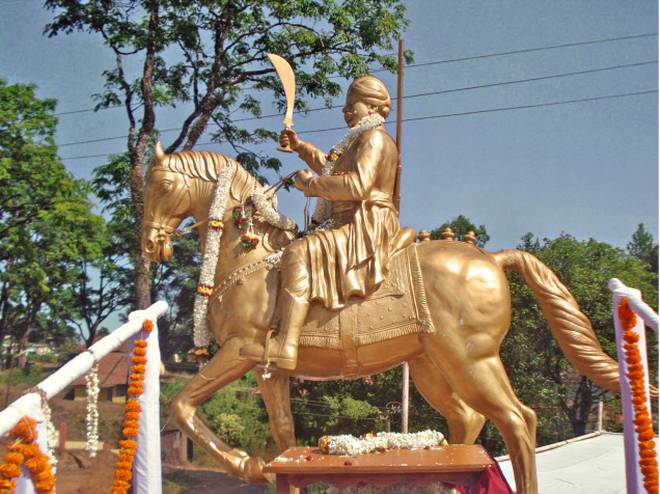
A memorial in honour of Appaiah Gowda

The bronze statue of freedom fighter Guddemane Appaiah Gowda, which was unveiled in Madikeri on Monday.

He was hanged by the British in Madikeri on October 31, 1837

Chief Minister D.V. Sadananda Gowda said on Monday that his government would take steps to initiate the process of development in Kodagu, a land known for its warriors, freedom fighters and natural landscape.

He was addressing a gathering at the Gandhi Maidan here after unveiling a bronze statue of Guddemane Appaiah Gowda at Field Marshal K.M. Cariappa Circle.

Appaiah Gowda was a freedom fighter, who was hanged by the British on charges of sedition on the fort premises here on October 31, 1837.

Mr. Sadananda Gowda’s wife Dotty hailed from Guddemane family. She was also present.

The Chief Minister said that he had taken nearly six months to visit Kodagu as he was being pressured by Madikeri MLA M.P. Appachu Ranjan and Speaker of the Legislative Assembly K.G. Bopaiah to take steps to solve the vexed Jamma Bane issue in Kodagu before the visit.

Responding to the demands made by Mr. Ranjan and M.C. Nanaiah, MLC, Mr. Gowda said that he would take steps to include a proposal to set up a medical college in Kodagu in the next budget.

A sum of Rs. 322 crore had been spent on various development projects such as roads, bridges, and buildings in Kodagu in the past few years. A sum of Rs. 115 crore would be sanctioned to the district in 2011-12, he said.

On considering Mr. Ranjan for inclusion in the next Cabinet expansion, Mr. Gowda said how could he deny it when he himself was the Chief Minister and he was versed with the requirements of Kodagu. All 122 MLAs from the BJP were capable of becoming Ministers, but it was not possible owing to restrictions.

Mr. Gowda, who conducted a progress review meeting involving officers of various departments at the Sudarshan Guesthouse, took exception to the tardy progress in the execution of projects under the Mahatma Gandhi National Rural Employment Guarantee Act (MGNREGA) in Kodagu. He instructed the officials to speed up work on the projects.

Of the 3,850 projects planned under the scheme in Kodagu, only 508 had been completed, according to officials.

Expressing dissatisfaction over the implementation of drinking water projects in the district, Mr. Gowda directed the officials to complete them in a month.

Of the 235 projects, only 22 had been completed in the current year, the officials stated.

Of the Rs. 8.5 crore earmarked for drinking water schemes in Kodagu in the current year, only Rs. 3.75 crore had been spent. Mr. Gowda announced that he would take the issue of lack of progress in the execution of projects in six departments seriously.

Mr. Gowda and Air Marshal K.C. Cariappa (retd.), son of Field Marshal K.M. Cariappa, paid respects to Field Marshal Cariappa’s statue.

source: http://www.thehindu.com / The Hindu / Home> National> Karnataka / by Jeevan Chinnappa / Madikeri – January 03rd, 2012 (updated July 25th, 2016)

KARBONN SMART KPL: Uthappa powers Bijapur Bulls to victory

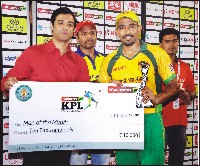
Star of Mysore Managing Editor Vikram Muthanna is seen presenting the Man of the Match award to Robin Uthappa.

Mysuru :

A blitzkrieg by left-hander J. Suchith, who hammered the fastest 50 of KPL, a 15-ball 54 for Mysuru Warriors, was not enough to stop the Bijapur Bulls from bulldozing their way to a convincing seven-wicket win over Mysuru Warriors in the Karbonn Smart KPL 2015 at the SDNR Wadiyar Grounds here yesterday.

Suchith’s blazing knock, studded with three fours and six towering sixes, matched Yusuf Pathan’s 15-ball 50 for Kolkata Knight Riders against Sunrisers Hyderabad in the IPL 2014 season.

Chasing a target of 167 set by Warriors, Bijapur Bulls were well served by Robin Uthappa (49 n.o, 34 b, 3×4, 2×6) and opener Rajoo Bhatkal (40, 21b, 6×4, 1×6).

The Bulls were cruising along the chase all through with the openers putting on 66 for the first wicket. Then Uthappa took over and in the company of Sunil Raju (23) and M. Nidesh (24 n.o.,) guided the team towards victory. The wins also puts Bijpaur Bulls on top of the table with 11 points from five wins and one washed out contest.

Robin Uthappa was awarded the Man of the Match.

Earlier, Suchith’s knock and new skipper, CM Gautam’s 58 were the highlights of the Mysuru Warriors innings, who became virtually the first team in the league to face bowing out of competition. Taking first strike, the Warriors batsmen showed positives in their approach. There were small and useful partnerships up the order. But unable to step on the run-rate meant the team would finish with a total of a little too few.

But Suchith plundered the last two overs scoring 23 from the 19th and the last five balls of the 20th over, Abhimanyu Mithun was hammered for 24 runs which took the team to 167 from 120 in 18th over.

Seven-wicket win for Bellary Tuskers

In an earlier tie, skipper Bharat Chipli and Amit Vemra batted well to guide Bellary Tuskers register a seven wicket win over Belagavi Panthers.

A match-winning third wicket partnership off 111-runs in 84 balls between skipper Bharat Chipli 63 (54b, 3x4s, 3x6s) and southpaw Amit Verma 52 n.o. (48b, 4x4s, 2x6s), helped Bellary Tuskers to defeat Belagavi Panthers by a seven wicket margin.

Earlier, Belagavi Panthers batting first, began confidently with their openers Abhisek Reddy 35 (34b, 4x4s) and Stalin Hoover 23 (15b, 5x4s) adding 46-runs for the opening wicket in 5.3 overs, but after the fall of Stalin, wickets fell at regular intervals and Belagavi Panthers ended up scoring 136 for seven in 20 overs. R. Jonathan (20) and wicket-keeper bat G.S.Chiranjeevi (20) were the other contributors. Prasanna Patil impressed for Bellary Tuskers with three for 20.

In reply, Bellary Tuskers scored 137 for three in 19.2 overs. After a shaky start (21 for two in 4.2 overs), Bharat Chipli and Amit Verma pulled them out of the woods and helped their team cruise to a comfortable seven wicket win.

After five games, Bellary Tuskers have secured six points are placed third in the points table, while Belagavi Panthers having qualified with nine points from five games are in the second position.

The Scores Mysuru Warriors 167 for five in 20 overs (C.M. Gautham 58, J. Suchith 54 n.o., A. Mithun two for 35) lost to Bijapur Bulls 171 for three in 19.4 overs (Robin Uthappa 49 n.o., Rajoo Bhatkal 40, R.Samarth 34).

Belagavi Panthers 136 for seven in 20 overs (Abhishek Reddy 35, Stalin Hoover 23, G.S. Chiranjeevi 20, R. Jonathan 20, Prasanna Patil three for 20) lost to Bellary Tuskers 137 for three in 19.2 overs (Bharat Chipli 63, Amit Verma 52 n.o, H.S. Sharath two for 23).

source: http://www.starofmysore.com / Star of Mysore / Home> Sports News / Tuesday – September 15th, 2015

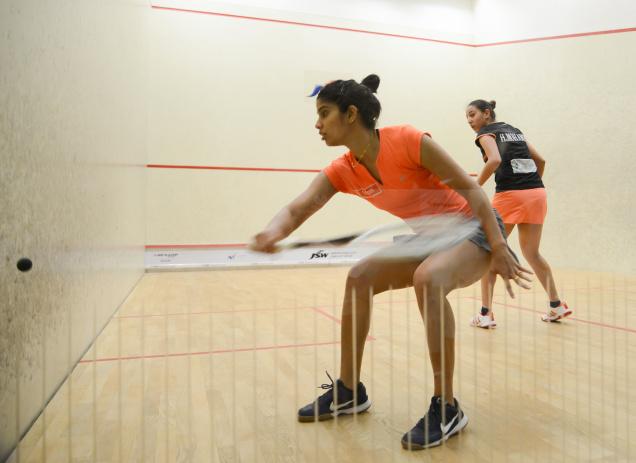
Joshna battles past Habiba for title

FIGHTING TITLE: Joshna Chinappa faced down a physically aggressive Habiba Mohammed to clinch the women's crown.
FIGHTING TITLE: Joshna Chinappa faced down a physically aggressive Habiba Mohammed to clinch the women’s crown.

England’s Adrian Waller makes it a no-contest against Mahesh Mangaonkar

Joshna Chinappa smashed her way past Habiba Mohammed 11-8, 11-9, 11-6 to lift the women’s title while England’s Adrian Waller backed his reputation as the men’s top seed at the NSCI Open, a $15,000 PSA event here on Sunday. Waller’s controlled play carved out a 3-1 victory over Mumbai lad Mahesh Mangaonkar.

Joshna, seeded third and facing the top-seeded Egyptian, kept her composure even after she got hurt in bizarre circumstances. With the first game in her pocket and up 3-1 in the second, Joshna’s face come in contact with Habiba’s racquet hand on the latter’s follow-through. The Indian crumpled on court holding the side of her face, went out for medical assistance and returned to the court more alert and determined to slog for victory.

The contest between the aggressive Egyptian, ranked 19th, against the experienced Indian, ranked 28th and working the angles, kept the chair umpire busy due to frequent body checks. Habiba was warned twice, first after the follow-through into the face, then for coaching assistance in game three.

Joshna, relieved to have pulled through in the face of ferocity, said: “On the circuit, she is known to be aggressive. The trick is to play your game without thinking too much about it. I went for my shots and left it to the umpire to take charge of the match.”

Wincing from memory of that blow, she added: “Habiba has a powerful follow-through and I almost walked into it. I almost felt like getting punched in the face, luckily I could return to the court after treatment. My victory had to do with experience. I have been on the tour more than her.”

Talking about squash rivalry getting physical on court, the champion said: “I have been involved in physical finals before, but girls play clean and fair. I enjoy those contests, matches are hard but you know rivals play fair. Unlike her they do not try to block so much. I tried not to get in her way.”

In the men’s final Mahesh clawed back in the third game, 14-12, after being kept at bay in the first two by his left-handed opponent. Waller then cut out the errors in the fourth to pick up the title.

“I could not convert openings into points, he did not allow me to fight back. Adrian showed what a huge talent he is,” said the third-seeded Indian later.

The results: Final: Women: Joshana Chinappa bt Habiba Mohammed (Egy) 11-8, 11-9, 11-6.

Men: Adrian Waller (Eng) bt Mahesh Mangaonkar (Ind) 11-9, 11-2, 12-14, 11-6.

source: http://www.thehindu.com / The Hindu / Home> Sport> Other Sports / by Special Correspondent / Mumbai – September 07th, 2015

Annual Kail-Poldh get-together held at Kodava Samaja

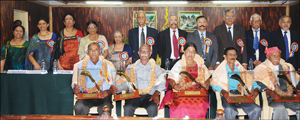
The senior members of Kodava Samaja, Mysuru (sitting from left): Machura N. Kaveriappa, Napanda U. Aiyappa, Kakamada Ganga Chengappa, Bottolanda M. Ponnanna and Ponjanda S. Arjuna, who were felicitated with a shawl, garland and memento at the annual get-together held at Field Marshal K.M. Cariappa Community Hall in city yesterday, are seen with (standing from left) Ponjanda Lovely Appaiah (Hon. Secretary, Sree Kaveri Kodagu Mahila Sangha); Thambanda Neena Devaiah (Jt. Secretary, Kodava Samaja); Balyamanda Sarasu Nanaiah (President, Sree Kaveri Kodagu Mahila Sangha); Chembanda Nanjamma (President, Kodagu Sahakara Sangha); Mechanda Mithra Karumbaiah; Mechanda M. Karumbaiah (President, Kodava Samaja); chief guest Kambeyanda C. Biddappa (retired Senior Vice-President, ITC); Moovera K. Kuttappa (Vice-President, Kodava Samaja); Kekada M. Belliappa (Hon. Secretary, Kodava Samaja); Kuppanda P. Subbaiah (Treasurer, Kodava Samaja) and Prof. Kambeyanda C. Belliappa (Chairman, Sree Cauvery Educational Institution)

Mysuru :

The annual Kail-Poldh get-together was celebrated at Field Marshal K.M. Cariappa Community Hall in Vijayanagar 1st stage here yesterday under the auspices of Kodava Samaja, Mysuru.

The day-long programme began with Ayyalapanda Pattu Pemmaiah performing Ayudha Puja to the traditional weapons of Kodavas. Kail-Poldh festival is celebrated in Kodagu during the end of the paddy sowing. Kail means weapon or armoury and Poldh means worship. The festival also signifies the day that men should prepare to guard their crop. Hence, on the Kail-Poldh day, the weapons are taken out of the puja room, cleaned and puja is offered.

Kambeyanda C. Biddappa, retired Senior Vice-President, ITC Ltd., who was the chief guest, felicitated eminent Kodavas and senior members of the Samaja in recognition of their service to the Samaja and the society.

Speaking on the occasion, K.C. Biddappa said that higher education was the most important enabler for all-round development of a community. He then said it was unfortunate that while Kodava students in urban areas are doing well academically their rural counterparts are lagging behind and needed help.

“These rural poor Kodava students need support from the community, and organisations like Kodava Samaja, Coorg Education Fund and Deena Bandhu Charitable Trust should help poor Kodava students without making merit the only criteria,” he added.

Stating that in most of the district head quarters every community has hostels to help their poor students to study with free boarding, lodging and financial support, he rued that there was not a single Kodava hostel any where. “If only we were to have Kodava hostels in Madikeri , Mysuru and Bengaluru, a lot of poor Kodava students would have benefited and progressed,” he opined.

Referring to the dwindling population of the community in Kodagu, he said Kodavas are losing relevance in their own homeland and that the Government does not bother because Kodavas are not a vote-bank.

Stating that Kodava population in Kodagu is just between 80,000 and 90,000, he said to become relevant Kodavas needed to take the support of all the moolanivasis of Kodagu like Peggade, Iri, Amma Kodava and other original inhabitants.

“We should all unite and take up our cause under one umbrella to create a sustainable and significant vote-bank, then only the Government will respond to our demands,” he said.

Biddappa reiterated that Kodavas must be united and said if Kodavas have to survive then they should focus on higher education and support poor Kodava students.

The senior members, who were felicitated by the Samaja are: Napanda U. Aiyappa, an exserviceman; Machura N. Kaveriappa, also an exserviceman; Bottolanda M. Ponnanna, who runs a private business; Ponjanda S. Arjuna, retired Circle Inspector and recipient of Chief Minister’s and President’s Medal and Kakamada Ganga Chengappa, who runs Swastha, a school for specially-abled children in Sunticoppa, Kodagu and recipient of Rajiv Gandhi Manav Seva Award for service to special kids. The above achievers were introduced by Mandira P. Kalaiah, Ammatanda Madhu Medappa, Machanda S. Muthappa, Thambanda Neena Devaiah and Kekada M. Belliappa respectively.

Replying to felicitations, the senior members, who are actively involved in the Samaja activities, called upon the Samaja, area-wise Kodava Associations and the community members to preserve and promote the unique Kodava art, culture and tradition by encouraging the Kodava youth to come forward and pursue the same.

On the occasion, various scholarships instituted by the Samaja members were presented to meritorious Kodava students (from 7th std. to Post-Graduation) and achievers in sports.

Kattera A. Kariappa, former President of Kodava Samaja and President of Deena Bandhu Charitable Trust, Mysuru, who also spoke, sought the support of the Samaja members to the Trust, which has been helping poor and needy Kodava students in their studies.

Earlier, Keethiyanda Kavya Kuttappa, Ketolira Bhavani and Appanderanda Thara rendered the invocation. Samaja President Mechanda M. Karumbaiah welcomed and presided. Treasurer Kuppanda P. Subbaiah read the names of the deceased members after which a minute’s silence was observed as a mark of respect to the departed souls.

Ponnachanda S. Bheemaiah read the names of the scholarship awardees.

Vice-President Moovera K. Kuttappa introduced the chief guest.

Ponjanda Lovely Appaiah compered and proposed a vote of thanks.

Hundreds of Kodavas attended the day-long get-together which concluded with sports and games for the members and their children in the afternoon session.

source: http://www.starofmysore.com / Star of Mysore / Home> General News / Monday – September 07th, 2015

Robin Uthappa rides Bijapur Bulls to victory

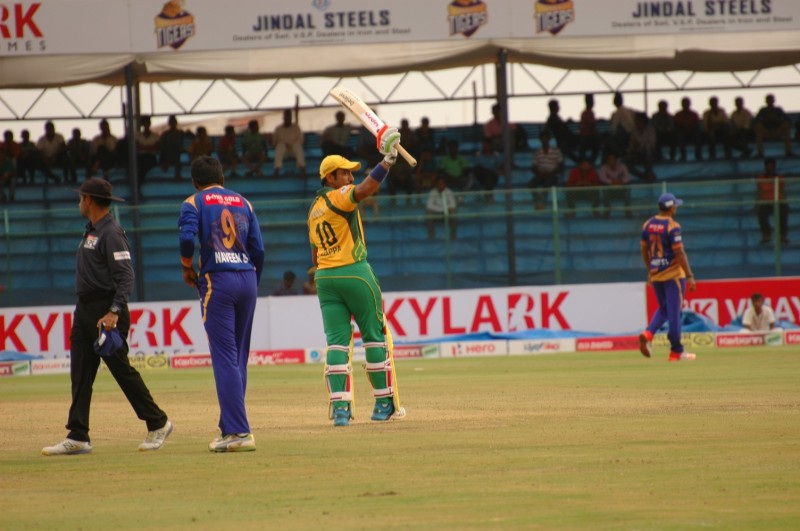
Robin Uthappa raises his bat towards his team dug-out after completing his half century

Hubballi :

Robin Uthappa came to the party in style hammering an unbeaten 45-ball 73 to steer Bijapur Bulls to a convincing seven wickets victory over Hubli Tigers in the Karbonn Smart KPL 2015 here on Sunday.

The India opener who came in at the fall of the first wicket was circumspect to start with before opening his shoulders to send the Hubli players on a leather retrieving spree. He slammed six fours and four sixes during his tenure at the wicket and in the company of skipper B Akhil (24 n.o.) knit together 64 runs for the unbroken fourth wicket.

Uthappa found his rhythm early and his confidence grew and he began middling the ball. Once he changed gears, the home team bowlers were not their own self and wilted under his slaughter.

Earlier a 58-ball identical 73 by Hubli opener KB Pawan enabled Hubli post a decent 152 after being invited to bat.

Hubli began well with Taha and Pawan negotiating the Bulls’ attack with confidence. But the departure of Taha saw the Hubli batsmen who followed struggle and none seemed to be able to give Pawan the support at the other end.

Even as Pawan went about accumulating runs, wickets fell at regular intervals at the other end and finally the total of 152 proved to be insufficient to defend for the bowlers.

Uthappa collected a cheque for rupees ten thousand for his efforts which fetched him the as the Man of the Match award.

Speaking about his performance, Uthappa said, “It was a good game. It was an important toss to win and I think we bowled pretty well and contained them to a manageable total. The wicket actually got better as the game progressed and I knew that if I just played my role it would be an easy target to chase.”

SCOREBOARD
Hubli Tigers:
Mohammad Taha c A Somanna b R Bhatkal 22; KB Pawan st Uthappa b Appanna 73 (58b, 3 x 4, 4 x 6); Abhinav Manohar st Uthappa b Appanna 15; Kunal Kapoor c Mithun b Vyshak Vijay Kumar 15; Sreenath Aravind c M Nidesh b Appanna 9; Kranti Kumar (not out) 10; Nithin Bhile c A Somanna b Cariappa 0; Chetan Wilias (not out) 4. Extras: (w-2, lb-2) 4.
Total: (For six wickets, 20 overs) 152

Fall of wickets:
1-28 (Taha); 2-68 (Manohar); 3-102 (Kapoor); 4-125 (Aravind); 6-145 (Pawan); 7-145 (Bhille).

Bowling: Abhimanyu Mithun 4-0-32-0; Vyshak Vijay Kumar 3-0-23-1; Rajoo Bhatkal 3-0-24-1; KP Appanna 4-0-29-2; B Akhil 2-0-12-0; KC Cariappa 4-0-30-2.

Biapur Bulls:
R Samarth (run out) 20 (14b, 3 x4); Rajoo Bhatkal c SL Akshay b B Naveen 13; Robin Uthappa (not out) 73 (45b, 6 x 4, 4 x 6); Deepak Chougle c N Bhille b D Negi 17; B Akhil (not out) 24 (19b, 1 x 4, 1 x 6). Extras: (w-4, bn-2) 6.

Total: (For three wickets, 17.-01 overs) 153.

Fall of wickets: 1-16 (Bhatkal); 2-56 (Samarth); 3-89 (Chougle).
Bowling: Kranti Kumar 2-0-14-0; B Naveen 4-0-36-1; SL Akshay 3-0-45-0; Sreenath Aravind 3-0-14-0; Chetan Williams 2-0-15-0; D Negi 3-0-29-1.
Toss: Won by Hubli Tigers; opted to field
Result: Bijapur Bulls won by seven wickets.

source: http://www.sportskeeda.com/

Funding remains a problem: Joshna Chinappa

Reigning CWG champ says life hasn’t changed much despite historic gold in Glasgow

Despite creating history by winning India’s first Commonwealth Games gold medal in women’s doubles squash last year, struggles still continue to be a part of Joshna Chinappa’s life.

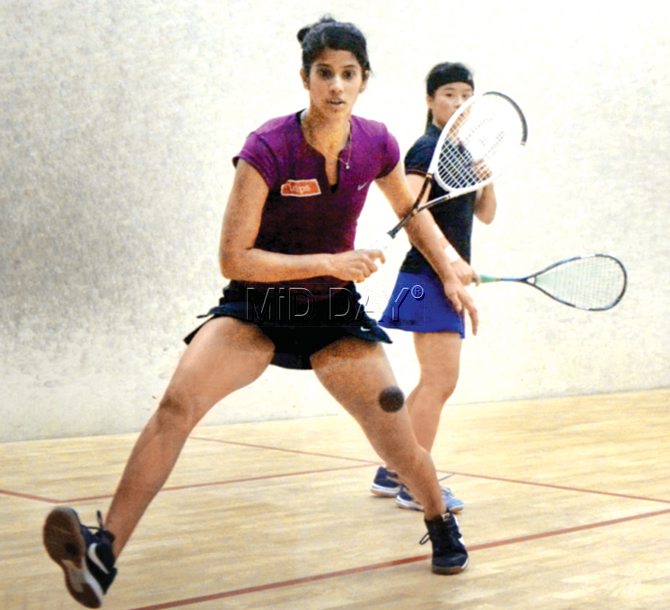
India’s Joshna Chinappa returns to Hong Kong’s Lee Ka in the women’s singles quarter-finals of the JSW Indian Squash Circuit at NSCI, Worli yesterday. Pic/ Pradeep Dhivar

In the CWG final, the fifth-seed pair of Chinappa and Dipika Pallikal had beaten the top-seeded English pair of Jenny Duncalf and Laura Massaro 11-6, 11-8 in Glasgow.

Yesterday, Chinappa spoke to mid-day on the sidelines of the JSW Indian Squash Circuit event at the National Sports Club of India, Worli.

“I don’t think my life has changed after winning the CWG gold as my struggles still continue. Despite being the No 2 player in the country, funding remains a problem. If you look at a sport like badminton, for example, the system helps players travel abroad for tournaments alongwith their coaches. In squash though we have to pay for everything. The only change that has come post the Asiad and CWG medals is that the government has started providing top squash players some funding.

In our country funding comes easily only if an athlete plays an Olympic sport. But there are players from sporting disciplines like squash and cue sports, who have represented India and achieved a lot, but it’s not good enough to merit funding equal to those who represent play Olympic sports,” said the 28-year-old, who entered the semis of the JSW meet yesterday with a 11-5, 11-7, 9-11, 11-2 win over Hong Kong’s Lee Ka.

source: http://www.mid-day.com / Mid-Day / Home> Mumbai News> National> Columnist / Sports News> Other Sports News / by Sundari Iyer / September 05th, 2015

Roller-Coaster drive aroung Bengaluru for a week – 4

Kodava Federation and Kodava Heritage Centre

1) M.N. Belliappa 2) M.C. Nanaiah 3) K.C. Cariappa

[Continued from August 22]

For a good friend, one would make a journey of a thousand miles and my visit to Bengaluru too was such a journey. A 50th wedding anniversary followed, a day later, by a wedding.

For the couple blessed with 50 years of married life, I wrote in the Visitor’s Book: “50 years of togetherness with understanding and the bliss that comes with it. Great. Here is wishing another 50+ years of wedded glory. — From friends of Dr. Sanmathi and Dr. Nitya.”

This was at Tamarind Tree Resort on the outskirts of Bengaluru on Kanakapura Road. The wedding too was on the same road at a Kalyan Mantap with a mythological name ‘Panchavati Pavilion,’ so far away, roads so bad. A friend asked me at the wedding, ‘Hey, couldn’t they find any other place in such a big Bengaluru?’ I merely grinned, still striving to overcome the tension that gripped us while driving at night to this place. Suffice to say it was a great wedding of the kind only few could afford or organise or spend. Apparently, an exclusive place, far away from the madding crowd, was needed for the wedding to be an extravaganza !

The following day, I found time to meet another friend at the other end of Bengaluru — Vasanthanagar. Mallengada N. Belliappa, Dada to his friends and family. A swashbuckling young Kodava entrepreneur since 1960s in Bengaluru, now a matured senior with commendable record of social service to the people where he lives and to the Kodava community in Bengaluru. A talkative person, he is also a doer bursting at the seams with energy even at this age.

A great philanthropist, every good cause will have him respond instantly and positively. It was under his initiative the first Coorg Public School (1996) at Gonikoppa, Kodagu, was set up, which has become a much sought after residential school. It was again under his initiative that Coorg Institute of Technology (an engineering college), again a first for Kodagu, was established in Ponnampet, South Kodagu (1999).

However, my interest was in the Federation of Kodava Samajas that was set up, again under his initiative, in the year 2000 at Balugodu, off Telllicherry (Thalassery) Road, 3 kms from Virajpet, Kodagu. As one occupied 24X7 as a coffee planter and a builder of many years in Bengaluru and now in Mysuru, Belliappa indeed has a vision for the good of Kodagu and its people. “For Kodagu to be saved from the present exploitation of its land and environment, all the original inhabitants of Kodagu of the days of the Rajas must come together and fight. Specially the prosperous communities — Kodavas and Kodagu Gowdas. The Britishers, known for their divide and rule policy, divided these two communities in 1937 at the time of Amar Sulya rebellion against the British occupation,” says Belliappa. I agree. He smiles and hopes this ‘coming together’ will happen for the greater good of both the communities and Kodagu as a unique geographic area tucked away under the shadow of Western Ghats with rain forests.

I go back to his pet project ‘Federation of Kodava Samajas’ and he goes off at a tangent telling, nay, re-telling the initial trials and tribulations in getting the land, the support extended by the former Minister M.C. Nanaiah etc. The then Chief Minister of Karnataka B.S. Yeddyurappa and the present Chief Minister Siddharamaiah have both generously given substantial amount of money that enabled the Federation to construct the buildings. He regretted that donations from the Member-Samajas and individual donors were not encouraging considering the size and scope of the project.

Belliappa then narrated an incident where a sum of about Rs. 94 lakh that was sanctioned to the Federation by the Union Ministry of Tourism with the help of the then Tourism Secretary, Rathi Vinay Jha, IAS (now retired). I am told that she is the sister of the famous Kodava of Codanda family, late C.G. Somiah, Comptroller and Auditor General of India (CAG). Here is how the Federation lost that grant as told to me by Belliappa.

It appears, Rathi Vinay Jha had come to Virajpet, Kodagu, to inspect the land of the Federation at Balugodu before releasing the grant. After the visit, she stayed overnight as a guest in the house of her relative, a retired high-ranking Army Officer. Well, the next news Belliappa heard was that the grant was diverted to a new entity, conceived by the host Army Officer, called ‘Kodava Heritage Centre’ to be set up in the District Head Quarters Madikeri where it will have maximum exposure, including from tourists, unlike at the Federation site away at the border of Kerala State near Virajpet.

Personally, I thought there was some sense in the idea though Belliappa may not agree. In fact, when the idea of a Federation was first mooted I had told Belliappa that it must be at Madikeri. However, I was told there was no land available in Madikeri, hence Balugodu was chosen.

In retrospect, I wonder, how come the District authorities, who could not find land for the Federation near or around Madikeri, could now find 5 acres of land at K. Badaga village near Madikeri for the Kodava Heritage Centre? Now I learn that the Centre will get another 10.68 acres of land as well. Well, where there is a political and bureaucratic will, there is a way. Where Belliappa and his friends failed, the high-ranking Army Officer, all by himself, succeeded.

M.C. Nanaiah, then MLC, Appachu Ranjan, then (now also) MLA and Air Marshal K.C. Cariappa (retd.), who are members of this Kodava Heritage Centre, should do some introspection on the issue of the Federation not being able to get the land for its establishment in and around Madikeri. Great iconic institutions have always born first in the minds of visionary leaders. Did these leaders lack that kind of vision for locating an important institution of Kodavas like the Federation in right place? I do not know.

Here I must salute Air Marshal K.C. Cariappa (son of Field Marshal K.M. Cariappa) for speaking out on the issue like shooting straight from the hips, as they say. At the meeting held on 24.6.2010 in the Deputy Commissioner’s Office, Madikeri, to discuss about the Kodava Heritage Centre with the DC in the chair, there were members and officials numbering 15 as per the minutes of the meeting. It was only Air Marshal K.C. Cariappa, who had the gumption and honesty to ask, “As I know, a plan is afoot to construct a Kodava Heritage Centre at Balugodu by the Federation of Kodava Samajas and, therefore, what is the purpose of constructing another separate Kodava Heritage Centre in Madikeri? Is it required?”

Surprisingly, M.C. Nanaiah parried the question like a typical politician saying, ‘Since this project is financed by the Central aid, it is not wise to make any change in the project (location).’ I learn, M.C. Nanaiah knew that this Central aid was originally meant for Balugodu project of Kodava Heritage Centre. If so, why did he not support Air Marshal K.C. Cariappa? Of course, Rathi Vinay Jha’s reasoning was sound and sensible when she said that for such a project Madikeri, the District Head Quarters was the ideal location as it would get maximum exposure. It was the very reason why I was asking Belliappa to bide the time to start the project till land is available in or near Madikeri.

How I wish the Federation got this 5+10 acres of land near Medikeri in the year 2000 so that every iconic Kodava-centric project like the Kodava Heritage Centre, Library, Hall of Fame, Kodava War Room, etc., could be located in one place.

Be that as it may, so far the PWD has been given Rs. 153.54 lakh for the construction of this building and Rs. 9.38 lakh is lying without being spent. The total cost has been revised to Rs. 2.68 crore from the original estimate of Rs. 1.45 crore. The Central Tourism Department has released another Rs. 1 crore on 16.2.2015 to the account of the DC. Now, money is no constraint for completing the project, it is the will to complete.

I am left wondering how some good projects lose proper direction because of indifference or ego on the part of the decision-makers as in this case.

Finally, an effort should be made by all concerned to bring this Kodava Heritage Centre, Madikeri, under the umbrella of the Federation of Kodava Samajas. May be, it is possible, if Rathi Vinay Jha co-operates. After all, the ship is greater than the crew! Did you get me Steve?

e-mail: kbg@starofmysore.com

source: http://www.starofmysore.com / Star of Mysore / Home> Abracadabra….Abracadabra / by K.B. Ganapathy /Saturday – September 05th, 2015

Forgotten heroes

The world has a dark fascination about war and particularly the Second World War. The last of the war action may have ended in 1945, but our imagination never seems to stop wondering about the large scale hostilities and the repercussions that wars have come to represent.

HeroesKF31aug2015

Every new book or movie about the Second World War opens us to some aspect of that war not known to people.

Raghu Karnad’s book, Farthest Field – An Indian Story of the Second World War, is what the title suggests and much more. It not only takes us through a journey of three men lost to war, but talks about India’s role in the Second World War and throws in snatches from the country’s nationalist movement that ran concurrently with the war.

Death, we have often believed, has an element of finality. But Karnad says people have two deaths. The first death occurs when they die, and the second when all those who remember them also die. Beautifully put.

The second death is the farthest field from which no one returns, says Karnad, and so the name of his book.

But war, says Karnad, brings the two deaths close, because it “chooses young people most deliberately to die”. A life barely lived, most of these young people lost in wars often end up as photographs.

And it was photographs of three young men that stood on table tops in his grandmother’s house that prompted him to prise open a history unknown not only to him, but to a whole generation of Indians.

These youngsters who stood in the photographs — Bobby Mugaseth, Manek Dadabhoy and Ganny or Kodandera Ganapathy — had their lives intertwined with each other through marriage and through their involvement in World War II. Bobby’s sisters had married Ganny and Manek. Ganny was Karnad’s maternal grandfather, while Manek and Bobby his grand-uncles (his mother’s uncles). Bobby’s sister Nugs (the author’s grandmother) was married to Ganny.

The book opens in Calicut, at the residence of Mugaseths, and follows the personal stories of these three men, a story recreated by the author with the help of research, conversations, chronicles and his own creative mind’s eye.

In the process of recreating the story that started unfolding 80 years ago, Karnad also had to understand the role of Indian Army in the Second World War and the country’s own nationalist movement that was playing out at the same time.

India’s broader role in the Second World War is that it had the largest volunteer army fighting the war for the British Empire. As per Karnad’s estimates, more than two million men and women served in it.

“As a part of the British Empire, India had won its war. Then, ceasing to be a part of the Empire, it won its independence,” says Karnad in his book. To a large extent, one was born of the other and yet India’s part in the world war is absent from its own history, he says.

Bobby’s journey took him to Roorkee training camp and then to Iraq and later to the Burmese frontier to defend India against Japanese forces. Bobby’s life was hell during the last few months with death staring at him daily, but he died of a shot from his own revolver. The gun went off in error was the explanation given. The truth was that nobody would know what caused that death. That was 1944.

By the time Bobby was gone, his brothers-in-law Manek and Ganny were already lost to war. Manek joined the Indian Air Force as a fighter pilot and died in 1943 when he crashed into a mountainside in Manipur. Ganny became an army doctor in North-West Frontier and died in 1942 of bronchitis, at the frontier. “The farthest field is not just a conceit about Bobby’s death but one that applies to all those Indians who were lost to the Second World War,” says Karnad in his afterword to the book.

Undoubtedly, Farthest Field opens up India’s forgotten role in the Second World War and at the same time helps the reader to refurbish memories about the war itself and the events unfolding at home in the country that led to its independence from Britain. The author’s brilliance is evident in the fact that the reader is not only transported to that era, but helps to stay connected with the book until the end.

Delving into the effortless storytelling ability of the book, one can fathom the kind of work the author has put in to bring out this book, probably prompting readers to say that Karnad is a writer to watch out for in the years to come.

source: http://www.deccanherald.com / Deccan Herald / Home> Supplements> Sunday Herald Books / by Latha Venkatraman / August 30th, 2015

Shubra Aiyappa at a cocktail party at Sheraton Grand in Bengaluru

Bengaluru’s swish set got to check out interesting fashion over canapes and special concoctions at a cocktail party organized by Jyotiee Balani, beverage enthusiast and food writer co-hosted by Sheraton Grand Bangalore Hotel at Brigade Gateway at their lounge Durbar.

ShubraKF31aug2015

Spotted at the event were actresses Shubra Aiyappa and Tina Ponnappa, along with some of the party regulars.

source: http://www.timesofindia.indiatimes.com / The Times of India / News Home> Entertainment> Kannada / TNN / August 03rd, 2015