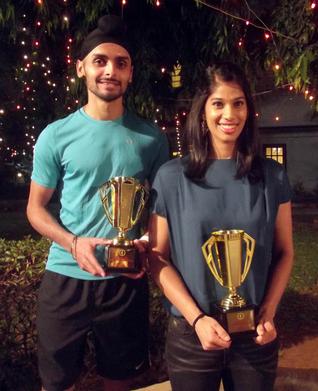
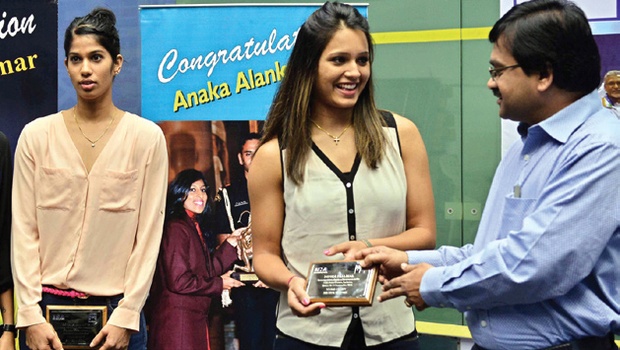
Harinderpal Singh Sandhu dethroned Saurav Ghosal while Joshna Chinappa pocketed her 13th title, beating Sachika Ingale to take the titles.
Harinderpal Singh Sandhu ushered in a change of guard, dethroning Saurav Ghosal in the final to clinch his first title at the senior National squash championships.
“If it had to be anybody to beat me, I am happy it is him,” remarked the latter after losing the men’s final in 74 minutes. Harinderpal won in five sets, 11-2, 11-9, 9-11, 8-11, 11-9.
Two sets up, Harinder found himself at the receiving end when Saurav got into the groove to wrest the third and fourth and take the title clash into the decider. “I committed a schoolboy error,” he said. “Saurav does not allow you to get back after such mistakes,” he said.
Winning the decider against the champion demanded mental preparation. “I was ready to grab the chance. It is about restricting my thinking to within four walls of the court and shutting out anything happening outside.”
Harinder led 9-0 in the first, 4-0 in the second, and did not allow the loss of next two sets to disrupt concentration in the decider.
The newly-crowned champion flew out on Saturday night for the Asian Beach Games at Phuket, along with Kush Kumar for company.
Joshna Chinappa pocketed her 13th title, blasting past Sachika Ingale 11-3, 11-3, 11-6 in just 22 minutes.
Commenting on the competitors, Chinappa said: “Playing the pro circuit is the only way forward for these young girls, instead of playing the junior circuit.”
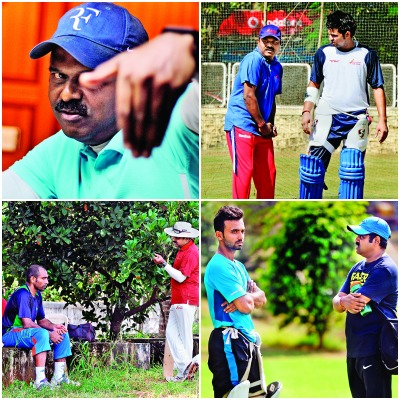
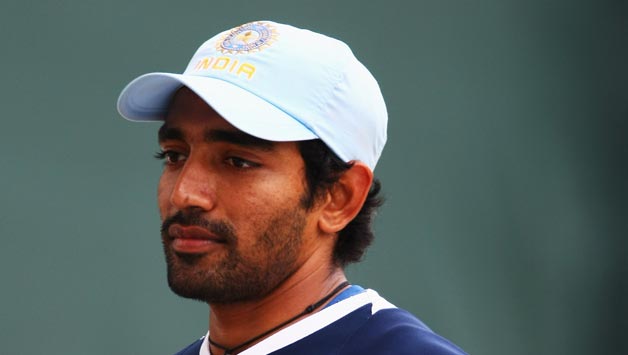
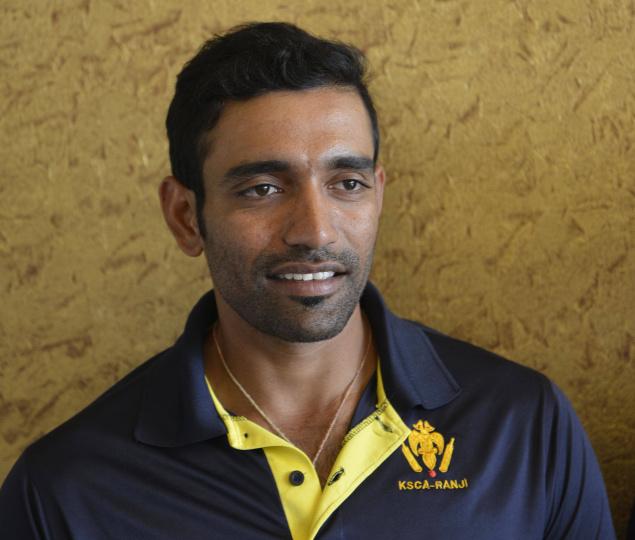
Suresh Raina, Ajinkya Rahane and Robin Uthappa have all ironed out the creases in their batting and mental make-up by lending their ears to coach Pravin Amre and following his guidelines Salman Ansari DNA
What is common between Uthappa, Rahane and Raina? They all went to Pravin Amre to get their act together. Derek Abraham talks to former Test player from Mumbai to find out what makes him the most sought after batting coach in India today
Like any true-blue Kodava, he is known to live life king size. Hailing from Coorg, the picturesque south Karnataka district which uber-rich coffee planters call home, Robin Uthappa is as cool as they come.
Supremely talented and fiercely proud, his bravado with the bat is more exciting than assuring. That said, the right-hander is often accused of being laid-back. Perhaps, his not-so-impressive returns in 41 ODI appearances, spread over over eight years, are to blame.
Somewhere at the back of his mind, Pravin Amre harboured similar thoughts. During the 2012 IPL season, he conveyed the same to Uthappa. “You are not working hard enough. You must come out of your comfort zone,” Amre, then assistant coach of the now-defunct Pune Warriors India, told the team’s superstar player. Taken aback, Uthappa retorted, “How can you say that? I know I am working very hard.” Amre’s reply was even blunter. “Whenever you decide to work harder, give me a shout,” he said.
The IPL was over before anyone knew it and Uthappa went on a holiday. “One day, I got a call from Spain. It was Robin. He admitted he wasn’t putting in the hard yards,” Amre recalls. He promptly told Uthappa to enjoy his trip.
A month later, Uthappa touched down in Mumbai. His first meeting with Amre turned was an eye-opener. “I told him was to shed 16 kg off his upper body,” Amre says. How did Uthappa go about it? “I am just a batting coach. So his fitness isn’t my concern. He has a team of dieticians and trainers. All I wanted was a fitter, hungrier Robin,” Amre says.
Three months after that ‘top-heavy’ conversation, Uthappa returned in top shape. The ensuing two-year period saw the 28-year-old force his way back into the ODI side after six years, excel for Karnataka on the domestic circuit and play a key role in the fortunes of Kolkata Knight Riders. Nowadays, when the selectors sit down to pick a side, Uthappa features in their discussion.
Uthappa may be the first, but he is not the only one seeking Amre’s help. Simply put, the 46-year-old Mumbaikar, who happens to be from the stable of a certain Ramakant Achrekar, is the country’s most sought-after batting consultant today. Technically sound, knowledgeable, practical, approachable and a great manager of men, Amre also counts Ajinkya Rahane, Suresh Raina, Naman Ojha, Dinesh Karthik among his wards.
Player to coach: the journey
So when did he get bitten by the coaching bug? “Nothing was planned. It happened by default,” Amre says in a tête-à-tête at the iconic Shivaji Park Gymkhana in Mumbai.
The former India batsman happens to be the president of the club that produced him and 20 other Test cricketers. As we sit down in the swanky conference room on the first floor, Amre, sporting a slick Roger Federer cap and training gear, points to a framed picture of Shivaji Park. “It was taken in the 1950s,” he says. “This is where we are sitting,” he points to the black and white photo, probably shot from a chopper. A few hundred metres away, at the Bengal Club, he runs Amre Coaching Clinic where 30-odd Under-14 boys ply their trade.
“Not many know that I played provincial cricket for Boland, South Africa,” Amre says. Incidentally, he had played the first of his 11 Tests in that country. His debut, in Durban, was memorable to say the least. “That 103 I scored against Allan Donald, Brett Schultz, Brian McMillan, Meyrick Pringle and Omar Henry in 1992 was the highlight of my career,” he adds. Predictably, Amre fell in love with the country. “Not only did I play domestic cricket there, but I also cleared the coaching and umpires exam,” he reveals. “Despite years of isolation, the South Africans showed us what they were made of. This fascinated me. And that’s why I decided to understand their cricket structure.”
When Amre returned home in 2001, he was in for a rude shock. The BCCI categorically told him that it doesn’t “recognise” the South African system. “So I had to do undergo the Level II coaching programme all over again (Test players are exempt from giving the Level I exam). And when it was time to appear for the Level III exam, the Mumbai Cricket Association told me I couldn’t represent them as Chandrakant Pandit and Lalchand Rajput had taken the slots. So, I requested Brijesh Patel, head of the National Cricket Academy, to consider me. Thankfully, he agreed,” Amre says. And so, in 2002, Amre and some others like Rajput, Pandit, Venkatesh Prasad and Robin Singh passed the exam with flying colours. “I had never studied so hard in college. The curriculum was vast, but I did my best,” Amre says.
Amre then started an academy at Shivaji Park Gymkhana. “I trained players like Siddhesh Lad, Kevin Almeida, Shardul Thakur, Harmeet Singh and Gaurav Jathar. A few years later, the MCA asked me to if I wanted to coach the Ranji Trophy team. I agreed.” The period from 2006-07 to 2010-11 saw Amre guide Mumbai to three Ranji Trophy triumphs.
Amre, who never wanted to become a coach because he was “short-tempered”, doesn’t know how it all fell into place. Perhaps, Achrekar was an inspiration. “Achrekar Sir is a very strong, a very different personality. I can never be like him. He is a father figure to his players. He is just too great,” Amre concedes.
Why does he say so? “Listen to this incident. Everyone knows Sir has five daughters. He also fathered a son. But the poor infant died the same evening he was born. The next day, Sir was about 30 minutes late to practice,” Amre recalls. “Then, he went about his business. To him, cricket is paramount. Your personal life is secondary. As a father, I know what Sir must have gone through. And believe me, I heard this story from my Shivaji Park seniors many years later.”
For someone who tallied less than 1,000 runs in international cricket, Amre agrees he could have done a lot more as a batsman. “That’s why I feel happy when a player I coach scores a hundred. Look, when I was a player, my God was my godfather. I had a first-class average of 87 when I first played for India. But things didn’t turn out they way I would have liked them to.”
Team coach to personal coach
After spending five years with the Mumbai team, Amre went on a long break. “It got monotonous,” he says. “As someone who had coached Mumbai with great success, I could have gone to another state. But I decided to stay put in Mumbai. I knew I had to reinvent myself as a coach.”
Amre did just that. For starters, he collected as many videos as he could and watched them, one by one. “Don Bradman, Garfield Sobers, Graeme Pollock, Barry Richards, Viv Richards, Sunil Gavaskar, Sachin Tendulkar… I watched them all,” Amre says. So what was the underlying theme? “What I understood is that all great batsmen have something in common. Their stance, back-lift and approach may be different, but the moment they prepare to face the ball, they somehow get in line. In other words, they offer the full face of the bat to every delivery. That’s why they are great.”
As Amre delved deeper and deeper, he realised that a coach’s job was more than just giving throwdowns and finalising the playing XI. “One must find the root cause (of a problem or defect). A coach must be like a doctor,” he says. Asked why decided to play ‘doctor’ to Uthappa, Amre comes up with a straightforward answer. “I thought he was not justifying his talent.”
Amre spent three years watching videos, studying bio-mechanics, reading and devising papers and presentations. “There are three aspects to a players’ game: physical shape, mental shape and skills. Most players have two boxes ticked. A coach’s job is to ensure a player gets everything right,” Amre says
When Amre decided to take up Project Uthappa, he changed “everything” from the batsman’s stance and grip to back-lift and head position. And he also cautioned his ward that, initially, his performances would suffer. “Are you ready to go down and then up,” Amre told Uthappa. He was referring to the career graph that would witness a dip after so many fundamental changes. “Sir, I have tried everything. This is it. Now, I want you to take me to the next level,” Uthappa conceded.
Soon, Amre went about his business of “dismantling” Uthappa the batsman. “His grip was bottom-handed and locked. I asked him to ‘unlock it’ so that he could hit the ball straighter,” Amre says. “I then worked on his stance, footwork, shoulder position, head position. In short, I changed him from head to toe. It was course correction all the way through.”
How receptive was Uthappa? “Look, this is a science. The results are showing only now. Ever since we started working, people critcised me for ruining him. But Robin knew of the ‘down and up’ we had spoken of. He was quietly confident. Today, he is batting better than ever before.”
Amre says he has made Uthappa bat in different cities, on all types of wickets and against all kinds of bowlers. “One has to have cricketing smartness. You can’t play all your shots on every wicket. You may be technically sound, but you have also got to be smart,” he says.
Helping Rahane
Amre knows Rahane since this Under-17 days. It is during Amre’s time that Rahane scored 1,000-plus runs season after season. “Do you remember his Test debut?,” Amre asks. For the record, Rahane earned his maiden Test cap against Australia in New Delhi last year. India won the series 4-0, but Rahane had a forgettable outing. “He was all over the place. He got hit on the head before a rash shot cost him his wicket. It didn’t take the media too long to brand him a failure. They conveniently forgot that he had a first-class average of nearly 70 then.”
Soon, Amre took Rahane under his wings. “I had to help him with his technique. He was getting out to the incoming ball. On some occasions, he was getting caught behind. Today, he is one of the best batsmen in India,” Amre says proudly. “I remember taking him to Sachin’s place. The master told him to target the next five years. Once you play for five years, you can think of playing for 10 years. And automatically, you will have 10,000 runs under your belt.”
Rahane, who has never missed a practice session in all these years, spent 19 Tests on the bench before making his debut. “You have no idea of the number of people, including IPL franchise officials, who told me that Rahane is not ‘international material’,” Amre says. Guess they must be feeling silly now.
“If your technique is strong, nobody can stop you from scoring runs in all formats. People used to tell Ajinkya that he must bat like Virat Kohli. But I told him that God has made you like this for a reason. You can’t be Virat. So, be Ajinkya. Be the one who can bat in any situation. Today, he is just that,” Amre says.
During the World Twenty20 earlier this year, Amre employed a few baseball techniques to help Rahane hit the ball longer, harder. “It’s all about bio-mechanics. Tennis, baseball, cricket and a number of sports follow similar principles like hand-eye coordination, focus. Baseball players use their core muscles — abdomen and back — to generate power. I made some adjustments to his back-lift and he started hitting the ball better,” Amre says.
Ojha, Raina and Karthik
Amre has coached Ojha and Raina at Air India. Of late, Ojha has been dealing in double hundreds at the India ‘A’ level. Again, that is Amre at work.
“I never tell a player I want to work with him. I wait for the player to approach me. But one day, I told Naman there was a problem in his game. But he never bothered to check with me. A couple of years later, he came back,” Amre says.
When Ojha approached him, Amre put him through the same grind and made him a better player. “There wasn’t much wrong with Naman’s game. His technique was good; so was his mindset. He came across as a simple boy who was very committed, hardworking,” Amre says. Did the wicketkeeper in Ojha ever bemoan the presence of that chap called Dhoni? “I told him not to think of any competition. Just do your thing and your chance will come,” Amre told him. But for how long? “I gave him the example of Michael Hussey. And I told him that the Test cap is worth waiting for.”
So what is it that works for Amre? “The fact that I got a hundred on debut in Durban gets me respect. I guess the players believe in me. After all, there must be something in my technique and my template that seems right. There are several others who are more knowledgeable than me, but I have something called experience,” Amre says. “Whenever I get time, I discuss cricket with Sachin. Whenever I have a doubt, I call him. Like I said, I have taken Ajinkya and even Robin to him.”
Amre holds Raina in high regard. “Let’s go back to the 2011 World Cup. Yusuf Pathan was picked ahead of Raina. It was only after the group-stage matches that the team turned to Raina. Naturally, he was very low. I told him to wait for his chance,” Amre says. For the record, Gary Kirsten, the former India coach, maintains that Raina won India the World Cup with his brilliant displays against Australia and Pakistan.
Over the years, Raina has drawn flak for throwing away his chances in the Test arena. That he has a problem with the short ball is common knowledge. “But why don’t you also say that he is the second-best finisher in Team India?” Amre retorts. “Look at the way he is batting now. Do you remember how he played in the ODI series in England this year?”
Coaching, Amre says, is all about having faith in each other. “I have to be accountable. If my player fails, then it’s my failure too. People will blame me for ruining someone’s career. I know what I am doing. All my wards have got their basics right. I can happily say that.”
Not surprisingly, Amre is open to coaching India some day. “Why not?” he says.
This following episode throws light on the emphasis Amre puts on mental strength. Abhay Poyarekar, a retired customs officer and Amre’s relative, raided huge quantities of RDX at the Mumbai port in 1993. The underworld troubled him for eight years. He was provided with ‘Z’ security and won the President’s medal for bravery. “That RDX was meant to destroy Mumbai during Ganeshotsav. I took Ajinkya and Robin to this man. To me, he is a real hero. He explained how the dons harassed him and attacked his family for years together,” Amre says. Till date, Rahane gets goose bumps thinking of Poyarekar and his heroism. Cricket, after all, is just a game.
AMRE’S WARDS
Robin Uthappa
They got together two years ago. Amre changed everything in Uthappa’s game — grip, stance, head and shoulder positions, back-lift. The results are showing. Amre flies to watch him to every part of the country. During the off-season, Uthappa rents grounds by the hour in Mumbai or Bangalore. Amre joins him here too
Ajinkya Rahane
The two have known each other for over 10 years. Amre honed Rahane’s technique during his time as Mumbai coach. Now, he has helped his ward go to the ‘next’ level. He has even contributed to Rahane’s mental toughness
Naman Ojha
Ojha, Amre says, is a very hardworking lad. What he lacked was confidence. Amre gave him the example of Michael Hussey, who scored more than 10,000 runs before earning a Test cap.
Suresh Raina
Amre came to Raina’s rescue when he was feeling low during the 2011 World Cup. Yusuf Pathan was picked ahead of him. Amre told Raina to wait for his chance. Raina came good in the quarters and semis. Today, he is the second-best finisher in Team India
Dinesh Karthik
Amre took Karthik under his wings only recently. A talented wicketkeeper-batsman, Karthik approached Amre after he saw the positive impact he has had on the above players
source: http://www.dnaindia.com / DNA / Home> Sport / by Derek Abraham / Place: Mumbai, Agency: DNA / Sunday – November 09th, 2014
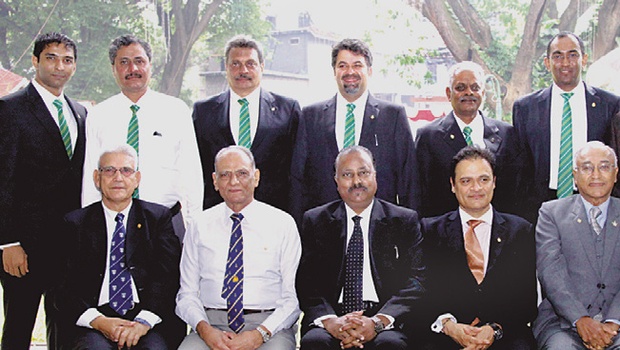
Aditya Sondhi (standing fourth from left) with other ‘Old boys’ of Bishop Cotton School
Bengaluru :
An annual lecture series in memory of General K S Thimayya enters its tenth year on November 22.
‘Old Boys’ of Bishop Cotton School started the lectures to commemorate the memory of General Kodandera Subayya Thimayya, also an alumni of the school. In an exclusive Aditya Sondhi interview with the City Express, managing trustee recounts the decade-long journey.
What inspired you to start this lecture series?
When Col Lalit Rai addressed a small group of us on his experiences in Kargil (where he won a Vir Chakra), it struck me that Bishop Cotton had an alumni that had so much to share. The lecture series was started in the memory of Gen Thimayya, one of our most towering old boys and one of India’s greatest generals. This would not only showcase the depth of the alumni, but also improve the quality of interaction among the participants and inspire the younger listeners to greatness.
Did any of you know Gen Thimayya personally?
Most trustees were born only after the General had passed on. But one trustee, Jairaj Daniel, remembers his father leaving him in the care of the General while he attended meetings of the board of governors at the school. Gen Thimayya had no reservations about spending the next hour or so chatting with the four-year-old! Another trustee, C N Kumar, fondly remembers him visiting the school as Chief of the Army Staff and the patron of the Old Cottonians’ Association. ‘Timmy’ was regarded as a ‘Soldier’s General.’ He was always close to his men, witty and jovial in tough situations, and fearless in thought and execution.
In the ZoJi la sector, he personally implemented the movement of tanks to hitherto unseen heights. His brand of leadership is to be treasured.
Is Bengaluru a good place to hold strategic affairs lectures?
Indeed, for the critical mass of retired military and government officers coupled with the Bengalurean hunger for intellectual stimulation.
However, I must clarify that our lectures go beyond strategic affairs and span art, science, social service and entrepreneurship.
Over the past 10 years, what difficulties have you encountered in organising these lectures?
This endeavour is run by seven friends, six of whom are large-hearted and spirited. Expectedly, with such ‘start-ups’, funding and logistics are always a challenge. Initially, we also found it challenging to convey our intent behind the lectures.
Fortunately, our patrons took to the lectures early enough to convince us that the effort was not in vain and needed to be sustained. Special thanks are due to the school, the family of the General and the armed forces veterans for their unstinting support.
Which lectures sparked the most intense discussions?
By far, Col Rai’s talk on Kargil in 2007 evoked the strongest feelings among the audience, with an intense and moving account of the valour of his troops. Dr Ajit Varki’s talk on experiments in glyco-biology, Phil Wollen’s talk on ahimsa and the vegan movement, and G K Pillai’s talk on internal security were very robustly received by the guests.
Give us an overview of how the lectures could shape up in the next 10 years. Any long-term vision?
The trustees aim to invite younger speakers and those with more eclectic life experiences. We also hope the lectures become more of a Bengaluru calendar-event and attract wider participation.
source: http://www.newindianexpress.com / The New Indian Express / Home> Cities> Bangalore / by Saloni Mital / November 12th, 2014
DJ and MTV VJ Nikhil Chinappa recently invited Jay Sean to India, specially to work on the new mix under his company Submerge Music. Chinappa and Jay are working on remixing the track “Aashiq Mizaaj” from Lisa Haydon, Akshay Kumar-starrer film “The Shaukeens.”
The original track “Ashiq Mizaj” has been composed by Hard Kaur and sung by Aman Trikha. Nikhil, who is a fan of Kaur’s work wanted to remix the number ever since he heard it for the first time.
We hear that he picked Jay Sean because of the unique spin he adds to desi tracks. He wants it to be a tribute to the singer.
Apparently, Jay too has loved the song so much that he has been listening to it on loop. He even called her up to congratulate her on track.
Chinappa plans to add his own twist to the track, and hopes that Hard Kaur will love it. Let’s see whether the remix ups the energy of the original song.
source: http://www.indiawest.com / India West / Home> News> Entertainment / by Suparna Thombare, India West Staff / November 06th, 2014
Madikeri MLA Mandepanda P. Appachu Ranjan celebrated his eldest son Dr. Mandepanda Vikram Poovaiah’s wedding with Vietnamese scientist Kim at a ceremony held at Laguna Beach, California recently.
Appachu Ranjan’s son, who is settled in USA and works as a Principal Chip Designer, got married in traditional Kodava wedding style.
The ceremony was attended by the MLA’s wife Shyla, his second son Dr. Cariappa, daughter Ksheera and about 30 family members along with some relatives of the bride.
source: http://www.starofmysore.com / Star of Mysore / Home>General News / Friday, November 07th, 2014
Success at home for youngster as overnight leader Abhishek Jha falters in final round
Abhishek Jha suffered a severe bout of final-round nerves while a tenacious S Chikkarangappa scripted a sensational fightback to emerge champion in the inaugural Take Solutions India Masters here on Saturday.
Leading by a whopping six shots overnight, Jha appeared completely beset by stage fright as he reserved his worst for the last, carding a disastrous three-over 75 to end runner-up in painful fashion in front of his home crowd at the Eagleton Golf Resort.
The crowd, whose loyalties were divided all day with two homegrown boys slugging it out for supremacy in the Asian Development Tour event, had plenty to cheer about as well with Chikkarangappa carding a brilliant five-under 67 to total 270 and score an out-of-nowhere two-shot victory.
“I won my first junior and amateur titles here but I’ve always come short in a pro tournament,” said a delighted Chikkarangappa, watched by his parents, after pocketing $12,250 (approx Rs 7.5 lakh). “To finally get a pro win at your home course is something amazing. I could not sleep until 2.30 in the morning because of the injury I suffered in the third round. But all that pain has vanished with this victory that I’d been dreaming of.”
Although just 21 and six years younger to Jha, Chikkarangappa is miles ahead of his practice partner and friend in terms of top-level experience and that was what proved to be the difference in the end. While Chikkarangappa conjured all his experience in rising to the challenge, Jha, playing as a final-round leader for the first time in four years, was totally overwhelmed by the occasion, his game collapsing amidst the tension he brought upon himself.
Things started to unfold as early as in the third hole itself when Chikkarangappa nailed a 25-footer birdie and Jha three-putted as the lead was cut short to four. That poor putt seemed to have an immediate bearing as Jha found the woods on the par-5 fourth hole, from where he could only bogey at best.
Chikkarangappa then birdied the eighth hole, draining a 10-footer as he turned in just two strokes behind Jha. Both birdied the 10th before Jha dropped a shot again on the 12th, the par-putt agonisingly lipping out. Chikkarangappa brought himself level with Jha on the 15th after pulling off a stunning 35-foot birdie putt.
That scorcher appeared to knock the stuffing out of Jha, who picked up a double bogey on the 16th. He drove the ball next to a banyan tree, hit it to the greenside rough with his second attempt before duffing it on the third. He then chipped way over the pin, two-putting from there as Chikkarangappa, aware the title was just handed over to him on a platter, coolly parred to take a two-shot lead.
Chikkarangappa birdied the penultimate hole and although Jha too matched his friend, it was way too late as the former completed a brilliant win.
“I wish I could play the final round again,” said a disappointed Jha. “I just suffered from final round blues. It’s been a four years, since I played as leader and I just didn’t know how to pace myself. I just did everything wrong. It’s a big lesson for me.”
Squash stars Dipika Pallikal (centre) and Joshna Chinappa (left) being felicitated by the federation in Chennai on Friday | P JAWAHAR
Chennai :
Injuries are not always career stalling, though it’s an aberration than rule. While many eventually concede to the overwhelming reality that their career would never be revived, some just pick themselves and return recalibrated.
There wouldn’t be a better example in Indian sport than Sachin Tendulkar, who in his career that spanned a remarkable quarter century defied intermittent spells of career-threatening injuries. Joshna Chinappa is no Tendulkar, whichever sporting yardstick you measure them with, but like the master she has turned a career-threatening injury into a springboard to rediscovering herself.
It was in mid 2012 that she sprained her ankle midway through a match. She was stretchered off, and the doctors confirmed her worst nightmare that she wouldn’t be able to play the game she had given her heart, body and soul. An anterior cruciate ligament seemed to have laid her path out of the game.
The World No 21 returned to India heartbroken. “A lot of doctors, even in the US, told me that I won’t be able to play squash again. I couldn’t even think of it. All my dreams, aspiration and hopes seemed over. I didn’t know quite what to do and I used to cry a lot every day. It was the toughest phase of my life,” she said.
But misery, sometimes, has the strange power to embolden you, and Joshna decided to fire-fight the cruel destiny. “I was 26 and I knew it was now or never. If I don’t recover now, I may never play squash again. I didn’t want to regret later in life. So I decided to give one last shot. The knee was operated and the rehabilitation began,” she recounted.
Suddenly, life, despite the screeching pain on her ankle, turned more pleasant. And a chance meeting with former national champion Ritwik Bhattacharya turned her life around. “I was doing my rehab in Mumbai when I bumped into Ritwik and his wife. I told them about my situation. They infused the belief that I could come back stronger. To convince me, they had to counsel, cajole and event taunt me.”
Gradually, life limped back to normalcy. “It took me almost 10 months to get back on to the court. But I didn’t hurry my return. It was like starting the career all over again and gradually my movements became more fluent. The confidence was back. But in the first six months, I kept losing. But I was just happy to be back on the court,” she reflected.
In hindsight, the injury proved career-defining. “Now I feel it’s the best thing to have happened to me. Maybe, it gave me a much-needed break. It made me value my life and career all the more,” she said.
Maybe, it’s this newfound positivity that has revitalised her game. Subsequently, she went on to script history with Dipika Pallikal in the Commonwealth Games, besides the team silver in Asian Games and achieving her career-high ranking of 19 in April.
Joshna’s story can motivate injury-plagued athletes, but it comes with a statutory warning: only for those strong in mind.
source: http://www.newindianexpress.com / The New Indian Express / Home> Sport / by Sandeep G. / November 01st, 2014
Nishan Nanaiah in a promotion still of Badlapur Boys / by Special Arrangement
Actor Nishan Nanaiah talks to about his upcoming Hindi flick Badlapur Boys.
“We have gone to six cities in a week and another 10 have to be covered over the next two weeks. I don’t know how I am going to make it,” Nishan Nanaiah says with a chuckle over the phone. The back-breaking trips are for promoting his new Hindi movie, Badlapur Boys, slated to be released on November 7.
“In the Hindi industry, when you sign up for a movie, along with shooting dates, you also have to give dates for promotions,” he adds.
Badlapur Boys is a remake of Susindran’s hit Tamil flick Vennila Kabaddi Kuzhu, which tells the story of a group of kabaddi players in rural Tamil Nadu, who have never won a game but triumph in the end under the guidance of an astute coach. However, the Hindi version has been tweaked to a great extent even as kabaddi remains the core factor.
Nishan says. “My character, Vijay has to tackle certain personal issues and has a goal that he dreams to attain through kabaddi,” he says. The movie, shot in Mammana village near Jaipur, is directed by debutant Shailendra Varma, who wrote Salman Khan’s Veer and has done television shows as well.
Badlapur Boys is Nishan’s third Hindi film after Cycle Kick, directed by Subhash Ghai, which “came and went unnoticed” and David.
According to him, there couldn’t have been a better time for Badlapur Boys to be released, since the game of kabaddi has touched new heights, thanks to the recently concluded Pro Kabaddi League and India’s golden run at the Asian Games. “The best part about the movie is that what you see on screen is the real game. Except for a handful of actors, the rest of the players you see in the film are actual kabaddi players. When you do a sports film, you have to look authentic on screen. Our director was very particular about this and all of us practised hard before shooting the game sequences. I enjoyed sweating it out, having played the sportsperson in real and reel lives. I was a state-level tennis player before entering films. I acted as a football player in Cycle Kick and now in Badlapur Boys, I am playing kabaddi,” he says.
With just days left for the release of the movie, he can’t hide his nervousness. He is worried about how the audience would accept a sports movie with many new faces. “If a movie with newcomers becomes a hit, many similar movies are made and released. But the moment one such movie flops, a dozen other films with newcomers that are in various production stages get shelved. It is a huge risk but we have done our best,” he says.
Meanwhile, he is doing another Hindi movie, Chai Shai Biscuit, a satire on arranged marriages, directed by debutant Himanshu Bhatnagar. An untitled Malayalam movie is also in the pipeline.
Before signing off, this alumnus of the Film and Television Institute of India admits that he is not happy with the way his career is shaping up in Malayalam cinema. “I am doing my best, but I am not flooded with roles. Perhaps, being a non-Malayali (he hails from Coorg, Karnataka) is a problem. As far as I know, I have never been the first choice for many of the roles I did. Nevertheless, I hope things will change. After all, I have worked with some of the best directors, a bonanza I never expected,” he says.
Badlapur Boys has Saranya Mohan, Pooja Gupta and Annu Kapoor in the cast.
source: http://www.thehindu.com / The Hindu / Home> Features> Friday Review / by Athira M / Thiruvananthapuram – October 30th, 2014
Robin Uthappa, on Wednesday completed his 100th First-Class match. The final of the Duleep Trophy against Central Zone is Uthappa’s 100th match. In his previous 99 matches, Uthappa has scored 6,484 runs at an average of 40.52. Uthappa had made his First-Class debut in the 2002-03 season.
Uthappa has been a prolific run-scorer in domestic cricket. He was the pillar of Karnataka’s successful campaign in Ranji Trophy 2013-14. He was also instrumental in the Irani Trophy and Vijay Hazare Trophy wins.
Uthappa played for Kolkata Knight Riders in the Indian Premier League this season and was once again played sparkling knocks to help the team bag KKR’s title. He is an aggressive batsman and has often opened the batting.
source: http://www.cricketcountry.com / Cricket Country / Home> News / by Cricket Country Staff / October 29th, 2014
“At the end of the day, it’s your own game and you know what works for you,” Robin Uthappa said. File photo: K. Bhagya Prakash / The Hindu
Putting value on his wicket has been the compelling factor in Robin Uthappa evolving as a batsman.
The South Zone stroke player presented a confident countenance ahead of the Duleep Trophy final against Central Zone to be held here from October 29.
“I have evolved as a batsman. I have realised there is no point in tweaking the process too much.
“One has to stay true to one’s skills. I have learnt from my seniors,” said Uthappa.
He elaborated, “I don’t throw my wicket away now and don’t like getting out even in the nets. I understand my technique better after making some adjustments. My head is still and that is important.”
Keen to regain his spot in the India team, Uthappa said he was keen to keep wickets too.
“I am serious about my wicketkeeping.
“I like to do the job whenever the team needs me to.”
He gives credit to personal coach Pravin Amre for the change in his cricket.
“He made me realise my responsibility and I understand the importance of staying at the wicket and contributing,” said Uthappa.
source: http://www.thehindu.com / The Hindu / Home> Sport> Cricket / by Special Correspondent / New Delhi – October 27th, 2014
WELCOME. If you like what you see "SUBSCRIBE via EMAIL" to receive FREE regular UPDATES.
Read More »