Category Archives: Famous Personalities of Kodagu / Coorg

Revathi launches Rajiv Menon’s book

Actor and director Revathi launched author Rajiv G Menon’s book ‘Thundergod: The Ascendance of Indra’ in Mumbai recently.

VJ Nikhil Chinappa and actor Purab Kohli were seen in a scintillating conversation with author regarding his popular fiction book at Aurus, Juhu.
Gul Panag, Aditi Rao Hydari, Sandhya Mridul, Cyrus Sahukar, Shonali Nagrani and many more were seen enjoying the launch.

Before setting out on a writing career, Rajiv G. Menon was an actor, occasional screenwriter, traveler and beach bum. A voracious reader since childhood, he was fascinated by stories and characters from Indian, Greek and Norse Mythology. Thundergod was born as a result of that fascination.

source: http://www.articles.timesofindia.indiatimes.com / Home> Entertainment> Regional / TNN, October 26th, 2012

Joshna Chinappa wins Penang Open squash title

Penang (Malaysia):

India’s top squash player Joshna Chinappa claimed the IJM Land Penang Open after defeating top seed and local favourite Siti Munirah Jusoh in straight games on Sunday.

(This was Chinappa’s seventh…)
Chinappa defeated her Malaysian opponent 11-9, 11-7, 11-1 in a 34-minute battle between the two top seeds at the Nicol David International Squash Centre. Both had dropped just one game en route to the final.

This was Chinappa’s seventh WSA World Tour title. It was the Indian who kept up her dominant form in the final, winning the first game narrowly.

Jusoh’s resilience waned as the match progressed and the gap in the score was more pronounced in the second game. The Malaysian could not keep pace with the Indian and could claim just one point from the third game.

Chinappa gained a walkover in her first round tie after Pakistani qualifier Zahab Khan withdrew injured.

The Indian later battled from a game down against number six seed Karman Siu to face another Hong Kong player in number three seed Carmen Lee in the semifinals.

source: http://www.articles.timesofindia.indiatimes.com / Home> Sports> More Sports /by PTI / October 28th, 2012

DOC CREATES AWARENESS ON WILDLIFE CARDS


Mysore, Oct.7
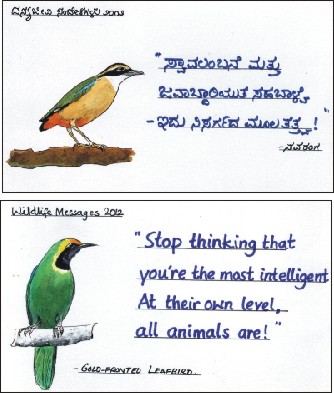
People who love environment, find a way to preserve it and also create awareness among the laymen on conserving it. Many take out rallies, conduct environment-related programmes, plant saplings and adopt animals. However, a family physician of Virajpet, Kodagu district, has found a unique way of bringing nature closer to mankind — he sends free hand-painted postcards containing wildlife messages to public as part of Wildlife Week.

An avid birder and nature lover, Dr. S.V. Narasimhan has been sending such postcards since 28 years. Author of ‘Feathered Jewels of Coorg,’ a fieldguide to 310 species of birds found in Kodagu, he has been spreading wildlife conservation messages through his unique hand-painted wildlife message cards.

This year, his message is ‘Life on Earth – a Large Extended Family.’ Till now, he has made 56,590 cards with 1,270 this year. About 8,340 people have received his cards all these years.

His Special Wildlife Messenger of this year is the Indian Pitta (Pitta brachyura), a medium-sized, stubby-tailed bird that is mostly seen on the floor of forests or under dense undergrowth, foraging on insects in leaf litter and often more easily detected by their calls. Indian Pittas breed mainly in the Himalayan foothills from northern Pakistan in the west and possibly up to Sikkim in the east. They also breed in the hills of central India and in the northern Western Ghats. They migrate to all parts of peninsular India and Sri Lanka in winter. Their seasonal movements are associated with the monsoon rains. For more such wildlife cards, visit http://drsvnarasimhan.blogspot.com

source: http://www.StarofMysore.com / General News / October 07th, 2012

Laxman, Ashwini to save our SOUL!

Former test cricketer VVS Laxman and World Badminton women’s doubles bronze medallist, Olympian Ashwini Ponnappa are joining hands with Save Our Urban Lakes (SOUL) to campaign along the Bon Cheruvu, also known as Hasmathpet Lake in Secunderabad.

The initiative aims at calling for follow-up action from the various governement departments on the recommendations made by former Ranga Reddy District Collector Seshadri to save the said lake from pollution, drainage and encroachment.
The effort seeks to draw attention to violation of laws by the many residential constructions that are taking place within the prohibited limits/radius of water bodies.

A message in support of the walk, sent by Dr RK Pachauri, who as Chairman of the Intergovernmental Panel on Climate Change (IPCC) shared the 2007 Nobel Peace Prize with former US President Al Gore, will be read out at a media conference post the walk. A message sent by Dr PM Bhargava, Padma Bhushan and one of the most distinguished scientists of the country, will also be read out. He was the former vice chairman of National Knowledge Mission and former and founder Director of CCMB, Hyderabad.

The walk will begin today at 2 pm in front of Nilgiris Super Market, located near Mansarovar Heights Phases I, II and III in Thirmulgherry.

source: http://www.ibnlive.in.com / Home> Latest News / The New Indian Express, Express News Service / Hyderabad, October 10th, 2012

Nidhi Subbaiah: The rising star

Nidhi Subbaiah is all set to singe B-town. Filmfare chats up the South siren

I used to be a sailor. I was really good at that sport. Considering I come from Coorg, Karnataka, I represented the state at the international level and won two gold medals. I did want to take it up professionally. But after hearing my parents and elders out, I realised there wasn’t much money in that sport. In India, only tennis, badminton and cricket can earn you money. Sadly, sailing doesn’t. So I had to give it up. Now I prefer to keep it as my hobby.

In the second year of engineering in Bangalore, I started modelling. I also did a couple of advertisements and then came the downpour of movie offers from the South Indian film industry. I got offers from the Mumbai, Kannada, Tamil and Telugu industries. And since I just wanted to break free from my engineering course, I grabbed the opportunity.

It’s been three years since I began working in South cinema. I have seven films to my credit today. My first two films were average hits but my fourth film (Pancharangi) was a super hit. From then onwards, things started getting brighter. Whilst working on my seventh film, I signed Oh My God! It’s a movie that’s against idol worship. I believe in that too. I signed it because I wanted to test the waters in the Hindi film industry. And after that immediately Ajab Gazabb Love happened.

It was so much fun doing Ajab Gazabb Love. I remember we had to go to Italy to shoot three songs. I even sneaked some time out to shop at the flea markets. And I sailed in Italy as well! Now you can imagine how big a deal that was for me!

I don’t see the South as a stepping stone to the Hindi film industry. I’d still like to have a healthy balance between the two industries. When I was working in the South, I never thought I’d be doing a Bollywood movie. So yes, signing my first Hindi film is something eventful. Bollywood has worldwide recognition.
Neither does success give me a high nor failure a low. I don’t let it affect me, these things never last forever. People praise me, I say thank you and move on. I’m critical of my own work.I don’t think I take things too seriously, maybe that helps me.

Frankly, there’s so much more to life than acting. I grew up in Coorg with a lot of books around me. My parents have imbibed reading as a definitive hobby. Maybe that’s what ticked the writer in me. I’m a blogger and have also written short stories. Eventually, I want to write a book and maybe even a script. (Laughs) But I also want to sail around the world. Besides, my dad has wanted me to be a singer since I was two. I sing too. I also sang at the audio release of Ajab Gazabb Love. But I’d love to be like the legendary Suraiya, who acted and also sang in her movies.

I don’t want my friends and family to treat me like an actress. Once when I got back home my dad asked me to wash the car. I shouted, “How dare you! I’m an actress now!” All he said was, “Oh okay, go wash the car now and take the dog out for a walk too.” But this is exactly how I’d like it to be.

I’m crazy about Kajol. I used to watch all her films first day, first show back then. Usually, teenagers my age had pictures of heroes on their bedside and framed on the walls but I had Kajol’s posters in my room. So doing a film with her would be like a dream come true!

Also, there are so many good-looking and talented girls out there, I better buck up!

source: http://www.Filmfare.com / Home> Interviews / by Karishma Loynmoon , Multimedia Executive / October 08th, 2012

Art review


It rained ideas

The ample series of performances by mostly young local artists at Gallery Rasa on September 27 was another contribution from the well-guided enthusiasm and organisational skills of Smitha Cariappa, who has by now virtually institutionalised her efforts under the title of Live Art Lab being a part of BAR1 activities.

One has to congratulate her not just for practising performance since a time when it had only a slight presence in the country and none in the city, but also for encouraging and involving others, especially art students and young artists. At the moment as things are still beginning to take shape, one is bound to appreciate the fact that several people from within the circle, even many who otherwise engage with different media, are fascinated by the manifold potential of performance, while understanding that a degree of chaos, chance and mistakes belongs to the process, although some words of caution may not be out of place.

Although it did not start the event, Cariappa’s piece veritably introduced it in a gracefully simple and poetic manner, encapsulating her role as a creative but neutral and open-ended stimulant towards new ideas of the participants by using the metaphor of archaic rain-induction magic.

One could see the work of Deepak D L as complementary here with its humorous-serious combination of objectivity and randomness that admitted uncertainty whether performance has to mean something. Allowed so the freedom of individual interpretation, the present writer would like to stress the spectator’s primary need for sensation pointing to associations that becomes enhanced by its being incorporated in the live person of the performing artist. For this to happen during an actual contact of the viewer with the performer, the artist’s looks, gestures and behaviour along with the significant accessories and background have to be quickly recognisable at least in general terms, even if complexities of thought are to be considered carefully later. Without that, arbitrary or arcane symbolism risks turning into intellectual puzzles which tends to distract the audience from the mood as well as to confuse the reading of intended content. The varied sequence of performances had examples of both extreme options and in-between stages.

Perhaps the best one, anchoring in sheer sensation but thoughtful, which also formed another overture for the day, was by Aishwarya Sultana. Ingeniously using the large window outside and inside the hall, she cleaned it, wrote on it with water, erased it and tried looking within, indeed letting one viscerally yet subtly intuit the perceptual aspirations behind art-making and witnessing art.

Suresh Kumar G was equally inventive and topical in his use of the window in the interior and the noisy traffic on the road considering two, not entirely opposite sides of the observer and observation along with the two sides of screening oneself off and being exposed. The pieces by Dimple Shah, Mangala and Justine Williams dealing with rather diverse issues of anonymity versus fame, identity and truthfulness oscillated between authenticity of concerns or engagement with spectacular visuals and a confusing metaphorical language which troubled in particular with Shah’s effort being partly excellent.

The most layered in his not quite recognisable symbolism was Prakash L. At the other spectrum of message – simplicity and visual or aural primacy – were Anjana Kothamachu, Vasudev and Raghu Wodayar. They knotted fabric of dream by the first kind of illustrating a poem, the second somewhat formalistically tracing link lines between the body, dance and art, the last in a plain yet evocative way, conjuring a noisy crowd of self-centred mobile phone addicts.

Yearly gamut

The ninth annual show with 45 Indian artists 2012 at Galerie Sara Arakkal (August 25 to September 15) was a display very similar to what comes up there as a sort of yearly review of the institution’s steady repertoire while accommodating some slight changes.

The general profile continued with its emphasis on the traditional genres of painting and a few sculptures and a sporadic presence of once innovative photography-based and other complex media. It continued the preference for pleasant and often predictable styles as well, even though on the whole the level improved, thanks to a lesser number of very old-fashioned and amateurish idioms whereas comparatively progressive and ambitious artists could be noticed more often. With some all-India seniors from the always admirable K G Subramanian to Lalitha Lajmi and Achuthan Kudallur, to Yusuf Arakkal and S G Vasudev locally, the gamut included several middling styles together with some interesting contributions by mid-career artists (Rm Palaniappan, C F John) and especially younger ones from around here, like Ravikumar Kashi, Udaya Vir Singh, Manush C J, Gopinath S and Alok Johri.

source: http://www.DeccanHerald.com / Home> Supplements> Art Review / by Marta Jakimowicz / DHNS, October 07th, 2012

Sarita Mandanna’s debut novel ‘Tiger Hills’ shatters conventions

The refreshing wisdom that love may not conquer all

By Judy Wertheimer

How often does it happen that you’re hundreds of pages into a novel and you think you know what you’re reading, when, with the turn of a page, it becomes something else?

With Sarita Mandanna’s debut novel, “Tiger Hills,” I thought I was reading a first-rate historical romance, a cut above most stories of its ilk. But ultimately, the author surprised me by deftly defying the conventions of romance. She illuminated not the wildly palpitating heart, but rather the disappointed, unforgiving heart, battle-scarred and broken

In the end, “Tiger Hills” is about forgiveness, or rather, the failure to forgive. Who gets hurt by that failure to forgive, and how does that failure mark the generations that follow? Also, too, it’s a study of choices. Time and again, the author paints a person at a crossroads, to where it comes to feel almost as if there are two stories: one that lives on the page but also a phantom story that exists off the page, where the reader carries an awareness of all that might have been had different choices been made.

The story begins in the late 1800s in Coorg, a small principality in India tucked into the mountains along the country’s southern coast. Politically, it’s an interesting time in India, which had come under British rule, with Englishmen and women coming over to make their homes and livelihoods on large coffee estates, bringing wealth and Western culture and mixing with the locals. The author, whose family has been in Coorg for centuries, brings to life the local customs and traditions, but shows us, too, the impact of that influx of new money and new ways, for better and for worse, that came from the West.

We meet our heroine, Devi, on the day she is born and follow her nearly the length of her days, watching her life play out on a lush, panoramic stage thick with humid, jungle-scented air. As a child, she comes to be raised alongside an academically gifted young boy named Devanna who her family takes in and loves as one of its own.

She is beautiful, he is brainy, and it doesn’t give a whole lot away to say that he falls in love with her. She is 10 years old, however, when she meets the famed hunter, Machu, 10 years her senior, and declares to her mother, “Mark my words, Avvaiah. I will marry Machu.”

• • •

Well, maybe, maybe not. Certainly, it strains credibility when, nine years later, she’s still saying she will marry Machu, declining one marriage proposal after another in her quest for the still-unmarried hunter whom she hasn’t talked to once in all those years.

But it’s a choice that you make as a reader, that choice to buy in, that willful suspension of disbelief for which I opted because “Tiger Hills” is a good story. It moves and moves and moves. Things keep happening, and there’s a lot to be said for that — for the pleasure of a fast-paced, well written, multigenerational saga that brings to life a slice of India at a moment in time. So while the novel does have that “plotted” feel at times — certain things happen because they need to happen to propel the story forward.

One thing that distinguishes this novel from others with which it might, wrongly, be lumped together, is that it doesn’t for a moment suggest that love conquers all. In fact, it’s a little more cerebral than that, suggesting your brain conquers all.
That happiness happens in your head, that it’s a choice that you make, regardless of whatever setbacks and disappointments line your personal landscape. Encountering Devi at a point when she feels utterly beaten up by life, a kinswoman explains, “One has to live, not run away from one’s problems. One has to fight for happiness. It isn’t easy for a woman, I am the first to agree with that. But where is the sense in throwing everything away? One must fight.”
However that might sound out of context, it works on the page; it resonates because it’s true. Life can disappoint. Things get hard, and don’t necessarily work out the way we wanted. What do you do when that happens? And how do the choices you make affect the people in your life?

Sarita Mandanna has written a fine story that treats these questions with the respect they deserve. This while also crafting a story that manages to offer the reader that particular rush of pleasure you get from diving headlong into a whole other world and allowing yourself, in the end, to be swept away.


A CONVERSATION WITH SARITA MANDANNA


The following interview was recorded over Skype on September 18 , 2012. Parts have been edited for clarity
.
Judy Wertheimer: Where am I catching you? Are you in Toronto?
Sarita Mandanna: Right now, I’m in Toronto. I still tend to split my time between New York and Toronto, but I’m in Toronto right now.
JW: I understand that you got your MBA in the U.S. and you got the Indian equivalent of an MBA in India.
SM: Yes.
JW: And then you went on to work as investment banker in India, Hong Kong, and New York.
SM: Yes.
JW: And you managed to write this book while you continued to work.
SM: Yes. [laughs]
JW: It sounds like Devi inherited your work ethic. Are you and Devi alike in some ways?
SM: In the composite, I would hope not … but I think whenever you create something, there are always bits and pieces of you that get embedded in the character that you create. In that respect, I’m sure there are some similarities. I mean, we’re both really stubborn, for one, we’re both pretty hard-headed for another. And then, yes, maybe there is a certain tenacity that I would say holds true for a lot of the women in my family, and Devi is very much modeled on a lot of those women.

In particular, I would say, if Devi were to resemble any actual person, I think she would most closely resemble my great-grandmother. That lady died well before I was born, but stories of her percolate through the family and she was quite a character, a very, very strong person, widowed very early with six young children, the youngest of whom was not even a year old. And she managed her property, the estate, singlehandedly, and made sure all the children were educated. There are stories of her-she was not quite five feet tall-and there are stories of her roaming the fields all alone early in the morning with just a dagger in her hand. So, beware, man or beast, who dared approach her. Those were the stories that I had in mind, and a lot of Devi’s strength definitely draws from those sources.

JW: With so much else going on in your life, why was it important to you to carve out the time to write this novel?
SM: I started writing Tiger Hills about seven years ago, and even a month before then, or maybe six months before then, if you had told me that I’d be sitting here talking to you about a published novel, nobody would have been more surprised than I would have been. It just kind of crept up on me. I was always an avid reader when I was younger, and I’d write these nonsensical poems that a lot of us do, ‘the sun’ rhyming with ‘fun’ … but I never thought that I would write, especially in a professional way … I thought once I retired, I might write something, but purely for personal pleasure.
And I was in New York and I’d just gotten back from a really grueling day at work. It was just one of those weeks when everything was going wrong. I had a very difficult deal and the team was having a lot of difficulties, and the hours were really long and I came back home and it was close to 11 p.m. and I remember just longing to do something different, something creative and apart from Excel spreadsheets and number crunching.

And I remember wanting to bake a cake and that was just too long [laughs], so I literally opened up my laptop and I began to write without any conscious thought of what I was doing. And it was just one of those moments-it sounds so cliche, but absolutely true-when you’re so absorbed in what you’re doing that you completely lose track of the time. And I looked up and it was about three, three and a half hours later, and I realized that I’d been writing this fictional story. And I came back home the next day and I continued writing it. And I enjoyed the process so much that I kept doing this. And [after a] period of about four or five months, I had a collection of short stories. It was then that I said that maybe, since I enjoy it so much, maybe it’s worth a shot to show it around to a couple of people and see if there was any merit to it …

So I showed it to a couple of people, and they said, “There’s good news and there’s bad news. The good news is that you can write. The bad news is, it’s hard to get a collection of short stories published, a debut collection. Why don’t you write a novel?” And at that point, I remember balking at the prospect and saying I’m not trained and I don’t have an MFA. I’d been a math and finance geek all along and I had no idea how to start. To my mind, writing a short story was somewhat more manageable because you have a certain plot line in your head and you just have to get from point A to point B. At least, for me, it seemed a more finite, manageable project. But a novel, I had no idea how to start it. And then someone said the only way you’re going to know if you can do it is if you try. And that seemed to make sense to me … I think it helped being naive in some ways about the process, because if I had known now how difficult the process would have been, I don’t know that I would have started it. But at that point, I just said, “Sure, let me just try.”

And that’s literally how I started and once I started, the story came about in a very organic fashion. I just had a couple of scenes in my head, but it was a process of knitting them together. And as I was writing, I would discover more about the characters. And the process was just so-it was a difficult time. I was very sleep-deprived, but it was so innately satisfying to do that and to create these characters and tell their story, that I knew that, no matter what, whether it was published or not, I had to write the story and get it done.

JW: So you continued to come home and do your writing after working all day?
SM: Yeah, pretty much. I mean, it took me five years to write Tiger Hills and I was pretty much writing in a vacuum. It wasn’t like I had a publishing contract waiting for me. I had no idea if the book would get published or not. And I told myself, let me just write the story that I want to write and let me just write it to the best of my ability. Let me do the best that I can. And I would come home and my hours were pretty long for the most part, Wall Street’s hours, and my typical schedule would be to start writing about 11 at night and then carry on till about two or three in the morning … and then sleep for a couple of hours and then go back to work. And then every weekend, when I wasn’t at the office, I was home working on the book … I remember a friend asking me, she said, “It’s not possible for someone to be so busy all the time … What’s going on? We haven’t seen you in months.” And I’d be like, “No, I’m just really busy.”

JW: So you kept it a secret that you were working on this?
SM: Yes. A huge secret.
JW: Wow! Why?
SM: By nature, I am a very private person, and it was an undertaking that was so dear to my heart and it was so important to me that I got it done … There were a few very close friends who knew I was working on something. My mom was my Rock of Gibraltar through the entire process. She was the one who would read the chapters as [they were] coming through and give me her comments. So she was very much clued into the entire writing of the book. My close family-again, my sister, my husband, my dad-they did know that I was working on it. But the day-to-day progress of it, that I kept to myself. And then at work as well no one really knew I was doing this. I just wanted to keep my personal, you know, the creative side of things and the professional side of things totally separate.

JW: I’m impressed that you were able to share your work with your mom as you went along. That says a lot about your relationship with your mom.
SM: Judy, I am so lucky with my mom, I mean, with my family in general, knock on wood, but my mom is just the sweetest, gentlest soul, but a very, very strong person, as well. She was the one really who really instilled this whole desire to write in me because she loves to read, as well. I remember growing up, my sister and I were always surrounded by books. We literally had trunks of books under the bed, stuffed with books, books, books, everywhere. And it was mom that really encouraged us to read and start that habit. And she’s also a very natural storyteller. She’s a doctor by profession, and I remember, growing up, she’d come back and dinnertime was a sacred ritual at home. And when we’d be sitting around the table, we would all [go] through our day. And for the most part, I’d have a couple of sentences to contribute. And mom would start talking about her day, and it would be the most mundane thing, but the way she would say it was so interesting that all of us would just kind of rattle through our stuff just so we could get to her and listen to her speak. But I think some of that-her storytelling ability-may be genetically passed on and that kind of got instilled in the book, as well.

JW: To me, Tiger Hills felt like a historical romance novel. That’s what I felt like I was reading until-I don’t want to ruin the surprise, but until one surprising event when it clearly became something else. I was wondering if that was your intention all along, or did the characters surprise you and lead you in a different direction?
SM: … The theme that I wanted to explore was what happens when your love story or your life doesn’t quite go the way you planned it? Where do you go after that point? And if you look at all the characters in Tiger Hills, all of them are inherently flawed, no matter how nobly intentioned they are, and I wanted to explore-once you make a certain mistake in your life or if you are the victim of a gross injustice, where do you go from there? Do you continue to harbor the grudge because that’s a way of remembering who you were before then? When is the right time to let go of the past and look to new avenues of happiness in the future? That was a central theme in the book, the power of choice. And it’s a core philosophy as well, in that no matter what happens to you, if you live long enough, at one point or another you are going to be facing a situation not of your creating, a situation very unfair to you and a situation over which you have very little control. But I think no matter how stringent the circumstances, more often than not, we do retain a choice in terms of how to react to our circumstance. And that’s what I wanted to explore. And Devi, in particular, takes a certain path where she’s so wedded to the past and she’s so wedded to what might have been … that’s what I wanted to explore-the cost of holding on unduly to the past.

JW: You grew up in Coorg?
SM: I grew up in India, but my dad was in the army so we traveled a great deal around the country, a typical Defense Services lifestyle. But my family, my parents, they live in India now. They live in Coorg now, and every summer it was a family ritual to go back to one of the grandparents’ estates there and have all of the uncles, aunts, cousins, everybody come down. So that was the foundation with which I grew up. And all those memories of Coorg and running around the coffee estates and the lakes. That part of the world is so dear to me. I mean, I have traveled and lived in a number of different places, but that part of the world still has such a pull on me that when I started to write the book, I knew that even though I knew the story would evolve as I wrote it, I wanted the setting to be Coorg.

JW: Is Coorg today similar to the Coorg you depicted?
SM: In a lot of ways, actually, we’re fortunate in that it is still very, very similar. When I was researching the book, the physical landscape was easy to talk about because it is very little altered. The estates are still run the same way as they were 150 years ago. We still have a lot of jungles and the woods and the waterfalls. All of that still exists. Things are modernized, obviously. Modernity has come into Coorg, and it’s rapidly becoming a mainstream tourist destination in India, but that comes with a mixed bag of things. On the one hand, it’s great. There’s a lot of new tourism revenue coming into the region, which is good. But the flipside of the coin is, you do have a lot more litter in public places and it’s so very crowded.

And the town, called Madikeri, which I remember, growing up it was one of those quintessential small towns where you’d be driving on the road and you’d see somebody else coming up the other way and it would definitely be somebody you knew, so you would stop your car in the middle of the road and have this long conversation, [then] drive on. And now that’s out of the question. I mean, there are actually traffic jams in Madikeri. So some things have changed, but it’s still incredibly beautiful… . The greenery, the hills, all of that is still very much the same.

JW: One of the things that I like that you did was that you showed the effect of people’s choices on the generations that followed.
SM: I don’t think parents realize the impact they have on their children. I think very often, particularly in older times, children weren’t always allowed to grow to the people that they were meant to be. There was so much familial expectation put on them in terms of who they were supposed to be. There was a lot of baggage that they were born with and had to deal with through their lives. And that’s something that I did want to explore.

Devi’s relationship with both her sons, her projections of the life that she wanted-she projects so much of that onto Appu, in particular, that he is never really allowed to blossom into the person who he might have been. He’s always ‘the tiger killer’s son.’ The burden of all her expectations are placed on this one boy, and he just grows up spoiled and not of very sound character. On the other hand, the other son [Devanna] who’s just … It’s not an easy situation, but the boy is an innocent and he never quite fathoms, until later on, just why the mother never quite connects with him … . There’s no physical abuse, but at the same time it’s very different than her relationship or her feelings with [Appu]. And that changed [Devanna], as well. He’s always in search of that maternal approval, and he, as well, doesn’t quite grow into the person he could have been.

JW: Do you have another book in the works?
SM: I do. It’s a very different setting, but again it will be similar to Tiger Hills in that it explores family ties and some of the emotional [connections] that we make during the course of our years. So it’s still in progress, but we’ll see what happens with that one.

JW: Are you still working in banking?
SM: I’m not. I’m on a sabbatical right now, but looking to get back to work. The writing is absolutely fabulous, but it would be good to be getting a steady paycheck every month, too. [laughter]

Judy Wertheimer is a writer living in Squirrel Hill (wertheimer.jb@gmail.com).

Read more: http://www.post-gazette.com/ Pittsburg post-gazette / by Judy Wertheimer / October 07th, 2012

Let’s dance

Deejay-VJ Nikhil Chinappa is ready to welcome Swedish House Mafia to Bengaluru and Delhi on November 18 and 19. He chats with Ritika Arora about other line-ups, including a music fest at The Park happening today and the Sunburn Festival on October 26 and 27

We caught him at the launch of MTV Fragrances in Delhi. It seems VJ-deejay Nikhil Chinappa is having a tough time, juggling between events in Delhi and Mumbai. But he appeared in a happy-go-lucky kind of mood. He stated, “I love my job.” I’m also investing in brands and properties. It’s fun.” It’s the first time that MTV has collaborated with global fragrances. “I feel that given the kind of weather we have, one should use right fragrance. It also reflects one’s persona.” Nikhil is part of The Park Hotel’s one-day Electronic Dance Music Fest — Twilight. It’s on today.

Deejay Pearl and Ma Faiza would be there too. The three will play a blend of Bollywood and Western mixes. “A similar fest happened in Bengaluru some time back and was a success,” said Nikhil. He added, “The EDM scene is fantastic. It’s preferred over other genres at nightclubs.”

Nikhil informed that he was in talks with Swedish House Mafia, an electronic dance music trio consisting three house disc jockeys and producers Axwell, Steve Angello and Sebastian Ingrosso.

“They were keen on coming here. First they will play in Bengaluru and hopefully be here the next day. We expect at least 20,000 people, and have been getting emails from abroad. People from Los Angeles, Malaysia, Singapore and South Africa want to come down. It’ll be a big event. They will play music non-stop for six hours. We have tie ups with radio channels and one can listen live.”

The Sunburn Festival also begins in October. It’s happening for the first time in Noida.

“There’s so much happening,” he sighed and added, “We have a good line-up. Over 150 artistes will be here from all parts of the world.” Nikhil feels India is ready to organise such large scale events. “Last year FI happened. Several renowned Deejays and artists keep coming to India because they like it here. We have technically sound infrastructure and good venues. It’s good to know the music culture is growing. And at a rapid pace.”

source: http://www.dailypioneer.com / Home> Vivacity / Saturday, September 29th, 2012

A tale of resistance & rewards

Heritage:

Three years after the British took over Kodagu, a rebellion against the rulers erupted in the region. Among the rebels was Guddemane Appayya. C P Belliappa charts the chronology of events immediately after the rebellion was quelled.

In 1837, three years after the British take-over of Kodagu, a rebellion erupted against the colonisers. This uprising is popularly known as ‘Amara Sulya da Katakai’. The primary reason for this revolt by some of the peasants in Sulya was their objection to the British collecting land tax in currency instead of in kind as was the practice during the reign of the rajas. There was also a rather mysterious individual named Kalyanaswamy who proclaimed himself a descendant of the Haleri rajas and claimed the throne of Kodagu.

The rebellious peasants rallied round him. Guddemane Appayya took command of the rebels. The entire uprising was not well organised and there was a great deal of confusion. However, it soon spread to Puttur and then right up to Mangalore, where some of the establishments of the East India Company were ransacked. Emboldened by their success, the rebels made a bid to attack Madikeri, the capital of Kodagu.

Three years of British administration had brought peace and stability in Kodagu and a majority of the people did not want this disturbed. Compared to the misrule of Chikka Veerarajendra, the administration was streamlined and there was equitable law. People-friendly policies were implemented in various fields. The alarmed British enlisted the support of Kodavas to quell the rebellion. The two dewans, Apparanda Bopanna and Chepudira Ponnappa, mustered the Kodavas, and within days the insurgency was put down. The British did not want any repetition of such revolts against their rule. Harsh punishments were meted out to those who took part in the rebellion. Amongst those executed were Kalyanaswamy and Guddemane Appayya.

After this operation was completed, a large amount of booty was collected from the rebels. The British offered the spoils of war to the Kodavas for having helped them. To the surprise of the British, Kodavas rejected sharing the war booty.

Awards for quelling rebellion

At the time, Colonel Mark Cubbon who was posted in Bangalore was also the Commissioner of Kodagu and Captain Le Hardy was the superintendent. It was Colonel Mark Cubbon who recommended to the then governor-general Lord Auckland that the gallant Kodavas should be suitably recognised for their distinguished service in quelling the rebellion. On Mark Cubbon’s recommendation, the following awards were presented: gold medals with gold chains worth Rs 400 to the two dewans, 12 gold medals with chains worth Rs 200 to subedhars and principal chiefs, 20 gold medals without chains for parpatigars and others of equal rank, 10 gold medals worth Rs 50 for peasants who supported the British, 200 silver medals worth Rs 10 for lower ranks and peasants.

Several bronze and copper medals were presented to the foot-soldiers. All these medals were two inches in diameter. They were cast in the same moulding with a Kodava warrior on the obverse and a trophy of Kodava arms on the reverse. Weights of the gold medals were adjusted by varying the thickness.

In addition, there were grants of land, Pegu ponies, fowling pieces (guns), shawls, clothes, turbans, etc.

But there was a 70-year-old subedhar named Monnaiah (spelt Moonien by the British) who rejected all that the British offered. He was crestfallen, because during the operation, he had lost his prized sword which was a gift from Dodda Veerarajendra. He wanted nothing other than replacement of the sword!

Mark Cubbon immediately acted on this request and had an exact replica made and presented to the subedhar. I wonder if this sword exists somewhere in one of the Kodava homes. Likewise, none of the gold and silver medallions are with any of the Kodava families.

However, I have one of the bronze medals, which was very kindly gifted to me by A Franklin, an avid art collector in Bangalore.

Franklin is also the proud owner of the autographed Bible that Queen Victoria presented to her god daughter Princess Victoria Gowramma of Coorg in 1852.

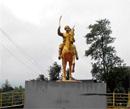
History has nevertheless come full circle. Recently an imposing statue of Guddemane Appayya on horse-back has been installed at the entrance to Madikeri town. He is recognised as one of the earliest freedom fighters.

source: http://www.DeccanHerald.com / Home> Supplements> Spectrum> Heritage / October 01st, 2012

Govt will release Rs 50L for Madikeri Dasara

Madikeri:

A delegation led by the Dasara committee president and the city municipal committee president H M Nandakumar and minister Appachu Ranjan met chief minister Jagadish Shettar, who has promised Rs 50 lakh for this year too, just as last year.

A demand for an increase in funds was not sanctioned due to the present drought condition in the state. The Dasha Mantapa Samithi conducted a meeting at Madikeri and elected Kundurumotte committee representative T P Rajendra as the new president for the Dasha Mantapa Samithi this year.

The president will be responsible for presenting the views of the Samithi before the Dasara committee, appointing judges for deciding the best mantaps and also carrying out other traditional works. A new logo was released by the Dasha Mantapa Samithi.

The Dasara committee has accepted to release Rs 1.75 lakh to each Mantapa Samithi, subject to the condition that the representatives do not misbehave themselves during the distribution of prizes for best performances.

Nandakumar, the Dasara committee president, has strictly communicated this message to all the mantap representatives. Every year, the losing Mantapa Samithis have expressed their ire by not accepting the consolation prize and by raising slogans against the main Dasara committee even though the judges are selected by the Mantapa committees and the main Dasara committee has nothing do with it.

source: http://www.articles.timesofindia.indiatimes.com / Home> City> Mangalore / TNN, September 23rd, 2012