Category Archives: Famous Personalities of Kodagu / Coorg

Field Marshal K M Cariappa – an Officer and a Gentleman

By Richard Lasrado [ Published Date: January 29, 2012 ]

As I keep recalling the great personality I had met a few times, esp., for an interview as a budding journalist way back in 1974, the picture gets etched in the mind, deeper and deeper.

The Grand Old Man of Kodagu (then Coorg), Kodandera Madappa Cariappa (January 28 1899 – May 15, 1993), then a retired General, who was an epitome of discipline, punctuality and promptness, had graciously consented to my request to be interviewed for an Indian journal.

He, as independent India’s first and until then only Commander-in-chief, had retired in early 1952. He was made an honorary Field Marshal only later, as late as in 1986, during prime minister Rajiv Gandhi’s tenure.

A couple of kilometres down the serpentine road from Mercara, now Madikeri, to Siddapur stands the palatial ‘Roshanara’, the residence of the great man.

My nervousness was showing. Being a cub journalist, I was to meet a great warrior of world status and a hero of the world wars, who had been honoured by presidents, kings and heads of states.

Led into his drawing room by an attendant, I was awe-struck by the splendid display of military trophies, mementoes and souvenirs.
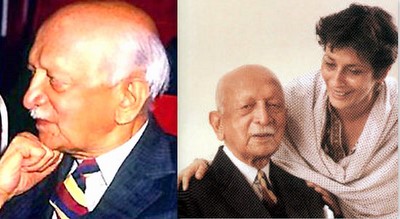
Field Marshal with his daughter Nalini
Two minutes after the appointed time, the broad-shouldered, six-foot-plus celebrity with peach-pink complexion appeared on the scene. As said already, it was not the first time that I had seen or heard him. But his simplicity and friendly nature were absolutely heart-warming and disarming at the same time. To cap it all, when the General repeatedly apologized for the two-minute delay with folded hands, I was rendered totally speechless and blank, for a moment making me forget the questions I had long planned to shoot.

Our meeting was scheduled to last just about an hour. But as the clock ticked away, the General seemed to be interested and asked to go on.

Reminiscing about that interview I had almost forty years ago invariably necessitates the quoting of some words of his, which, over the years have proved prophetic.

The following excerpts from the interview may provide an insight into his personality and thinking. They should be appraised only in the light of circumstances that prevailed in India in the early 1970s. Those among the readers who may have closely followed the India’s developments since 1970 may find his words quite fascinating.

******************

On the prospects of a military government in India and if such a measure would cure the country of all its ills and ailments.

The moment I mention a military rule, I am misunderstood. I would say, military rule can never take over India. One, we are a huge country and are beyond the control of a military machine. Two, we have too many diversities to keep us together. Three, when our defence resources are engaged at the borders, they may not be equipped to rule the country.

It makes me sad to see the inroads of foreign ‘isms’ into our body politic and havoc they have wrought. But democracy is deep down in our blood. Yet, under the present conditions, an indefinite President’s rule all over the country would do us a lot of good. Only such areas as may be unruly can be given in the hands of the army. Only after restoration of normalcy can elections be held.

The President can draw on the best talent in the country and form a cabinet of intellectuals and run the affairs of hte state more efficiently.
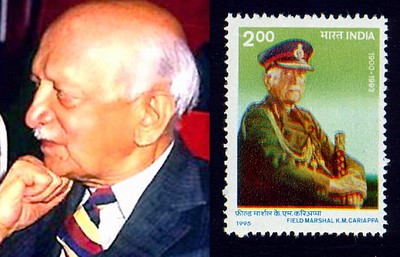
Commemorative stamp issued in his honour

On Jayaprakash Narayan’s movement against corruption in Bihar and elsewhere.

It is comforting to know there is a clean and upright person like JP to show us the way. But the public opinion is not strong enough in our country. People might curse the leader and the government. But in private the same persons run after politicians for licences, permits and favours.

Matters have come to such a dangerous pass that corruption is almost being regards as a way of life. Today’s students might call the politicians corrupt, while they indulge in copying and toehr malpractices themselves. It is just like a pot calling the kettle black.

On the future of the opposition parties and if the newly-formed Bharatiya Lok Dal (BLS) would be a mess or a Messiah?

A steam-roller of the ruling party anywhere poses a great danger to democracy. Presence of a plethora of political parties aggravates the situation.

All along, I have been advising all opposition parties to sink all their ideologies and come together on four major issues – 1. Defence of the country, 2. Foreign policy, 3. A realistic economy and 4. Internal security.

I can only say that the formation of BLD is a healthy democratic development, but how how far it is going to be a success, only the future can tell.

On the future of sports and games in India – he was a spin bowler, and a tennis and hockey player himself.

Sports is in our blood. Yet our achievements are not up to the mark. The main reason is the lack of practice as well as the grace to accept defeat. Dedicate practice is a must.

On India’s dismal failure in the field of hockey in spite of having a staggering line-up of talent.

There could be many reasons. But I would like to blame it on the lack of practice in the first place. Matters have been made worse by the ubiquitous ‘politics’. I did my best to keep this menace at bay during my tenure as three years as chairman of the All India Council of Sports (AICS), but it was in vain.

**************

I had two more issues that I wanted to broach with him. With much diffidence and hesitation, I took courage to ask him. First was about a little-known and little-publicized episode between him and Mahatma Gandhi. There was a brief pause.

Obviously, many had hesitated to put this question to him. He said, ‘Your way of asking such questions reminds of Melville de Mellow of All India Radio, who was here to meet me a few days ago.’ I was lost for words as my jaw dropped.

Then he handed me the Mahatma’s biography by Prarelal, who has devoted a whole chapter to this particur incident. The General felt that I would be better off with a third-person account than his own version.

Soon after the Indian independence, Cariappa had thundered at a metting in London that in the then-prevailing circumstances, the concept of Ahimsa (non-violence) was not going to be any help to India and a powerful army alone could make it one of the strongest nations in the world.

Gandhi was indignant at this candid outburst and shot back a rejoinder in his journal, ‘Harijan’, saying that even Generals greater than Cariappa would admit that they had no right to talk on non-violence. The concept of non-violence alone could eliminate the causes and chances of wars, wrote the Mahatma.

The General wanted to clarify matter with the Father of the Nation. They did not know each other personally and so he sought an audience. In December 1947, in full military attire, he visited Gandhi in Delhi.

It was a day of silence for the Mahatma., who was spinning his celebrated charkha. The General left his shoes behind, entered the room and saluted Gandhi. He told him that he had come to seek his blessings. Declining the chair offered by Gandhi, he preferred to squat next to him.

Bapu broke his silence and asked Cariappa if he had read the article in ‘Harijan’. Cariappa answered in the affirmative and humbly said that he felt honoured by Gandhi’s reference to his speech, all the more because he had commented on someone who he had never met before.

Then he went on to clarify that the soldiers’ community was the one that bore the brunt on many counts. They too believed in non-violence. If at all thre was a community opposed to wars, it is the soldiers’ community, he said.

Cariappa continued as Gandhi heard him with rapt attention: Soldiers did not like wars, not so much for the dangers and risks they were fraught with, but because they were aware of the futility of war in solving disputes and problems of the world. If at all soldiers fought wars, they did it as a mandate of the people. If people did not want wars, they should tell their governments so; it that didn’t work, they should change their governments. Gandhi looked impressed with the stream of thought and said he needed time to think it over.

Two days later, they met again and conferred on the same subject. On January 18, 1948 they met yet again in Birla Bhavan, Delhi. The General had come to bid good-bye on his wasy to Jammu-Kashmir action mission and seek his blessings. The Mahatma expressed the hope that the problem would be solved by peaceful and non-violent means, and asked Cariappa to report to him about his mission thereafter. The General said he would certainly do so.

By a strange quirk of fate, on January 30, 1948, the General returned to Delhi with the sole purpose of meeting the Mahatma, only to pay his last respects to the latter’s mortal remains at Raj Ghat.

====

The second question was also sensitive. I could sense a tinge of sadness and bitterness when he replied to my query. It was about the only only political shot he took by contesting a southern Mumbai – then Bombay – Lok Sabha constituency sometime in 1971.

I enquired of him as to why he had to contest from there and earn a needless tag of being a Shiv Sena candidate, although he was being supported by seven different parties, including the Bharatiya Jan Sangh and the Swatantra party. Instead, he could have contested from south Mangalore constituency which included his own home district of Kodagu, I said.

He replied: ‘ When I contested, my manifesto was simple and plain – giving priority to people’s basic needs of food, clothing and shelter and education, strongly opposing luxury life, control over pompous offices, conference and foreign tours, instilling a national feeling in everyone instead of narrow parochial and linguistic atttitude.’

I decided to contest in certain circumstances. At 71 then, I had no ambition or craving for power. One day, Congress (O) leader former railway minister Poonacha called me up and said the his party’s high command had chosen him to be their candidate. All opposition parties were to lend me their support. Hence I had to consent, he said. I thought to myself, just like General de Gaulle reached the top with military experience behind him, that I could raise my voice in the parliament at least for ex-Servicemen and thought this could give me a suitable opportunity to fight for them.

I told Poonacha, ‘ I am an VOP – very ordinary person. I do not have the resources to fight the election.’ He told me not to worry, assuring that all the parties would take care of it. However, a few days later, Poonacha called again to tell me that the party had instead chosen himself instead of me. Anyway, I said it was OK.

Another few days later, I received a telegram from the Swatantra party leaders informing me that 6 or 7 parties had chosen me as their joint candidate from southeast Bombay constituency. Shiv Sena happened to be one of them. I had a formidable Congress candidate like A G Kulkarni against me. Yet the mood was so upbeat that my victory was thought to be easy. There was even a talk going around that in the likely coalition government in Delhi, my name was thought to be the right one for the defence portfolio.

Yet I lost. Former president V V Giri once met me after the election and enquired why I lost when the chances were bright. Without mincing words, I told him, ‘One of your own central leaders came down and started saying that Cariappa was a Kannadiga and a southerner should not win in Maharashtra’ and such other narrow-minded words. There were twelve horses in the race. Jan Sangh and a few others let me down in the middle. Jan Sangh termed me pro-Muslim since I refused to attend the Vishwa Hindu Parishat programmes. Bombay Kannadigas alienated me saying that I was a Shiv Sena candidate. I called all representatives and tried to clear the misunderstanding in the presence of a Swamiji from Udupi, but it was of no avail. I fell a victim to adverse propaganda.’ Giri seemed to agree with in full.

*************************

Cariappa was a no-nonsense, no-compromise personality. There have been cases of chiefs of service staff, as they approached retirement, having tried to appease the centres of power with an eye on plum posts like those of ambassadors, governors and the like. Many retired officers have taken up adminstrative posts in corporate houses. But this intrepid fighter stood above all that. He kept on raising his voice against misrule, corruption and political chicanery.

During his tenure as India’s high commissioner to Australia and New Zealand between 1953-55, an off-the-cuff remark against the racial policy of the Australian government is said to have created a diplomatic row, which created a rumpus in the Indian parliament seeking his recall. But he stood his ground, without any fear.

His differences of opinion with the Nehru-Krishna Menon combine was a matter of an open secret. During Indira Gandhi’s rule, once he had advocated handing over of disturbed areas to the military. Politicians sought his arrest on charges of giving a call for military rule. They even demanded withdrawal of his pension.

Those were the days when a late prime minister used to blame the ubiquitous ‘foreign hand’ or the ‘CIA’ for most of the problems in the country. Cariappa did not hesitate to ridicule it saying that a day would come when the prime minister’s chest pain would be blamed on the CIA.

Naturally, he had earned the displeasure of the ruling classes. No wonder, he was not recognized until late in his life. Gen Sam Manekshaw was upgraded as Field Marshal soon after the Bangladesh war victory in 1971.

The very fact that a man like General Cariappa, who had served the Indian army for a good 33 years, was made an honorary Field Marshal 33 years after his retirement during Rajiv Gandhi’s tenure as PM, speaks of the vagaries and systemic malaise that plague our country.

Field Marshal Cariappa always said he was an Indian first, and a Kodava or Kannadiga only next. He played a major role in getting the names Mercara and Coorg changed back to their ethnic forms as Madikeri and Kodagu. He also had fought against the Kambadakada dam project which would have gobbled up thousands of acres of fertile land of Kodagu.

His residence ‘Roshanara’ and a lifesize statue at a circle on the way to Mysore stand majestically in his memory. A college in his hometown has been re-named after him.

When the messenger of death came calling in a Bangalore hospital in 1993, for sure, he mght have struggled to take away this giant, the fearless soldier who may have said good-bye to this world with sadness. Because the India of his dreams is still a long distance away.

If power lay in the hands of patriots and upright Indians like Field Marshal Cariappa, it would have been a different picture. Maybe his dream may come true some distant day, but, alas, there cannot be another Cariappa.

source: http://www.Mangalorean.com / by Richard Lasrado / January 29th, 2012

Freestyle Fitness: Bandra’s New Sports Clinic

Match Point

If the Nadal-Djokovic final made you want to up your stamina (and girlfriend standards), we suggest you rally around Freestyle Fitness. This week-old endurance training centre and ‘sports clinic’ in Bandra aims at getting you one step closer to your favourite sportstar, quite literally, with squash champion Joshna Chinappa training right next to you. There’s also members like Neha Dhupia , thrown in for the glam quotient.

Lunging With The Stars

While they have a gym where you can go about your usual exercise routine, Freestyle Fitness specialises in making personal training regimes followed by athletes accessible to you. So this means your agenda could include physiotherapy along with sports conditioning and rehabilitation. They have Crossfit ceiling bars used for a complete functional workout under the guidance of a certified trainer (Rs 6,000 a month in groups of four) and a sandpit for joggers with weak knees. The coolest bit is that they even integrate squash and tennis games into your schedule to break the monotony that comes with most gym workouts. For this, Freestyle Fitness has tied up with clubs around Bandra – Khar Gym, Bandra Gym and Otter’s Club – where they can book a court for you even if you’re not a member. Net profit, indeed!

Expect to find expert trainers here like Egypt’s ex national fitness coach, a nice upgrade from the Mr India hopefuls carelessly dictating their personal exercise routines, the kind you see in many gyms around the city. Sign up and Freestyle Fitness will conduct a thorough past and present fitness analysis on the basis of which they’ll chalk out the most effective game plan for you. They even conduct boot camps with members at Mahalaxmi Race Course, Jogger’s Park and nearby beaches to regularly test and check improved fitness levels.

Juiced Up

Coming soon: Yum smoothies and juices from Fellas Café. They’ve even tied up with sports nutrition brand Neulife for protein shakes. No Whey!

Getting there: Freestyle Fitness, 301, Silver Pearl, Waterfield Road, opposite China Gate, Bandra (W), call 31924779, Rs 6,000 a month for Crossfit training and Rs 4,000 a month for gym membership.

source: http://www.bpbweekend.com / brown paper bag / Tuesday, January 31st, 2011

‘Ko Ko Koli Kothi Village Belle Harshika ‘Balle Balle’

The chirpy heroine of Kannada cinema who gives a lovely performance in any given role and wins like how got distinction in her Engineering studies Harshika Poonacha has given a sensible performance in ‘Ko Ko’ movie. As a village belle Harshika giving her mind to ‘Kitty Bhava’ in the film was so inspiring to director R Chandru and he kept a song for the actress for her talent in abundance.

It is a short and sweet role ‘Ganga’ in KKKK remains in the mind of Kannada audience for Harshika Poonacha. When Kitty decides to take up his IPS and not marriage with Ganga, it is Ganga who throws a challenge and says she will marry in front of Kitty when he comes back to the village. So when Kitty returns to village in the second half of KKKK there is some electrifying moments. All is under the impression that Kitty and Ganga get married. But screenplay of the film that is captivating in the film says something else. Ganga hot tempered marries the boy looked for her in front of Kitty and that is a suspense for Cauvery (Priyamani). There is of course all round of applause for Harshika Poonacha in the media reviews too.

Happy and content in Kannada filmdom Harshika Poonacha armed with Engineering degree made her beginning in arch lights from ‘PUC’ Kannada cinema. She was really at the first years of Engineering when she accepted PUC Kannada cinema. Jugari, Thamassu, Jackie, Murali Meets Meera got released. The films to release are Crazy Loka, Adwaitha, Beet, Mavalli, Hubballi Hudagaru and Parie for Harshika Poonacha.

In coming four years as the lone daughter of my parents I would take up more interesting roles and settle down for marriage.

Harshika Poonacha is also in to social service activities. She is a member of Lions Club and ambassador of Yuva Global.

From Ko Ko Koli Kothi I got very good name. I am told I look very innocent and beautiful. I am also a performer is the encouraging appreciations I have received says Harshika Poonacha.

source: http://www.SuperGoodMovies.com/ Kannada Movie News> Talent> News / January 21st, 2012

Army day greeting

Imphal: January 14:

On the occasion of Army Day 2012, Lt Gen Dalbir Singh, AVSM, VSM, GOC 3 corps, conveys his greetings and best wishes to all ranks of the Army. The Army Day which is schedule on 15 of January every year in recognition of Lieutenant General (later Field Marshal) K.M. Cariappa becoming the first Indian commander-in-chief in 1949.

GOC 3 Corps, in his message, brought out that all ranks of Army should feel proud of being a soldier of this great and glorious Indian Army. The released also said that “all ranks of spear corps have been working together with the local civil administration and the people of the land to bring in greater growth and prosperity in Northeastern region.

GOC 3 Corps also expressed his appreciation to the dedicated efforts of each soldier towards this noble cause.

The released further said that Army has been a source of inspiration and has contributed to society’s development in a number of ways. Army’s efforts to undertake infrastructure developmental projects, to motivate school children, to recruit Jawans, to conduct vocational training, to provide medical & veterinary services at remote locations and to encourage women empowerment has made significant difference in the overall growth of the region. The General also added, “We salute the brave soldiers who have made the supreme sacrifice in the performance of their duty”.

source: http://www.kanglaonline.com / by Imphal Free Press / January 14, 2012

Indian Army: Poised to safeguard the nation and uphold democratic norms

New Delhi, Jan.14 (ANI):

In India, the month of January witnesses two things in ample measure – the biting cold and a spirit of nationalism. National fervor is whipped up by the Republic Day celebrations with parades and revelries generating tremendous enthusiasm.

Yet another ode to nationalism is the Army Day celebrations held across the Nation on January, 15. It was on this historic day in 1949 that the Indian Army divested the control of the British with General (later Field Marshal) K. M. Cariappa taking over as the first Commander-in-Chief of the Indian Army from Sir Francis Butcher.

A number of parades, memorial lectures, equipment displays, investiture ceremonies organised by the Army on this day elicit tremendous response from the general public.

The Army Day is also a time to audit the achievements of the Army in the year gone by. The pace for this very sensitive exercise is set, in no small measure, by the traditional press conference of the Chief of Army Staff (COAS). This year, the press conference by General VK Singh, COAS, was held at the majestic Manekshaw Stadium on January, 12. Many issues of relevance came up during the press conference.

In the year gone by, the Army continued with its operational engagement in such pockets of the Nation where inimical forces are not desisting from spreading the cult of terrorism. 65 brave soldiers of the Army made the supreme sacrifice while upholding the safety and integrity of the Nation in 2011. These included 11 officers, 06 Junior Commissioned Officers and 45 brave soldiers.

Due to relentless anti terrorist operations by the Army, the year gone by was the most peaceful in the Kashmir Valley since 1990. Jammu province witnessed 74 per cent decline and the Kashmir Valley witnessed a 33 per cent decline in terror violence as compared to 2010.

Terrorism related violence in 2011 dropped to an all time low of around 190 incidents. Beyond internal security, the Army also upheld its tradition of being the first to respond to natural calamities. It made a sterling effort to restore the situation in earthquake afflicted Sikkim and also some flood affected regions of the country.

Operationally, the Army made quantum progress in critical aspect of modernisation and transformation designed to make the force more lethal, mobile and network centric.

Some new structures were put to test and validation. A primary validation initiative was Exercise Sudarshan Shakti which culminated in mid December, 2011. The exercise was witnessed by none other than the President of India, Pratibha Patil. It successfully validated a number of new concepts that were earlier on the drawing board.

The fighting capability of the Army was enhanced during the year by better surveillance, improved night fighting capability, air defence capability and human resource development. The Army is now better poised for tactical decision making and deeper strikes.

The Army rendered significant assistance in preparing Police and Para-military Forces (PMF) in tackling internal strife. About 33000 police and paramilitary personnel were trained for counter Naxal operations.

Advisories were given when sought and footprint in the region was improved by an increase in recruitment. However, the army desisted from getting directly involved in counter Naxal operations since it would weaken its bond with the people and negatively impact its preparedness for its primary task of defending the country’s borders against external aggression.

The environment in the neighbourhood continued to pose a challenge to India’s security. Even though Pakistan remained instable, its internal problems did not lead to a letdown in support to cross border terrorism.

The army remained ready for all eventualities; it constantly monitored the border and had complete information about the 42 camps in Pakistan occupied Kashmir which facilitate infiltration.

The circumstances dictated enhanced vigil in Jammu and Kashmir and also the continuance of enabling legislations like the Armed Forces Special Powers Act which provide protection to the soldiers performing extraordinary duties under extraordinary circumstances.

The line of actual control with the Chinese did generate issues of perceptions but confidence building measures remained in place even as necessary steps to build up defence capability in the form of force accretion and improvement of infrastructure were put into motion.

The army attempted to reach out to other countries in India’s extended neighbourhood through the medium of joint exercises and exchange of ideas on tackling terrorism and insurgencies.

The army also continued with its sizeable contribution to the United Nation (UN) peace efforts with more than 7000 personnel deployed in UN missions abroad.

The internal health of the Indian Army was addressed by emphasis on the core value systems which form the bedrock of its culture. A clear message was sent out that rank and power will not come in the way of punishing those who indulge in misdemeanours and acts of impropriety.

The army’s thrust towards sports and adventure was encouraged and the result was as many as 112 medals in the National Games. Five army sportsmen have already been selected to represent the country in the London Olympics.

The Indian nation is going through some testing times. The Indian Army is prepared for all eventualities and for effectively performing its responsibilities towards the nation.

The people of India see the Indian soldier as the epitome of all that is the best in the country due to his demonstrated qualities of courage, self sacrifice, integrity, strength of character and commitment to the cause of the nation.

It is the bounden duty of the nation to ensure that the blood spilled by the soldier as also his contribution to the national cause does not go waste. To ensure the same all out efforts should be made to maintain him at a highest pedestal professionally, socially and psychologically. By Jaibans Singh (ANI)

source: http://www.newstrackindia.com / ANI / New Delhi / Saturday, January 14th, 2012

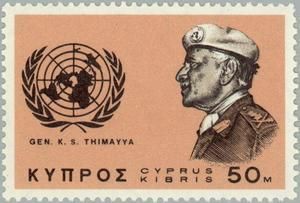
Commemorative Issue – General Thimayya

General Kodandera Subayya Thimayya was born in Madikeri, the district town of Kodagu (also known as Coorg), Karnataka, India. He was a graduate of the Royal Indian Military College in Dehra Dun. He served in the Indian Army from many posts.

He became Chief of Army Staff of the Indian Army in 1957. He was also awarded the Distinguised Service Order. After the Korean War, he headed an United Nations unit dealing with the repatriation of prisoners of war. After his retirement from the Indian Army, he was appointed as the Commander of UN Forces in Cyprus (UNFICYP) in July 1964.

While in Cyprus, he died of a heart attack, in 1965. The Republic of Cyprus, in addition to this stamp issue, honored him by renaming an avenue of the city of Larnaca after him.

Commemorative Issue General Thimayya

Cyprus
Date of Issue: 06 June 1966 /4/1966
Technical Information
Quantity: 292329
Designer: A. Tassos

source: http://www.philatelism.com
http://www.philatelism.com/details.php?issueid=24

Award for P.M. Belliappa


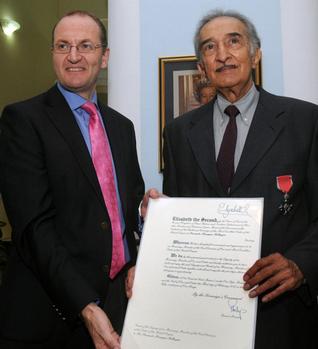
British Deputy High Commissioner in southern India Mike Nitharvrianakis presents the Most Excellent Order of the British Empire citation and medal to the president of ABS P.M.Belliappa in Chennai on Monday. Photo: K Pichumani
Recognising his contribution towards improving the Indo-U.K. relationship, the British High Commission presented the Most Excellent Order of the British Empire (MBE) badge to P.M. Belliappa, president of the Association of British Scholars at a function here on Monday.

Mike Nitharvrianakis, British Deputy High Commissioner in southern India, said that the award is to recognise Mr. Belliappa’s services to environmental protection and for promoting Indo-U.K. alumni relations through the ABS. Calling the award as a “very, very rare honour”, Mr. Nitharvrianakis said “Indians who study abroad always try to give something back to the country where they spent their academic life. Mr.Belliappa is a prime example.”

Terming the occasion as a moment of great joy and pride, Kartar Singh, Deputy Director, British Council, said that Mr. Belliappa is a true ambassador of Indo-U.K. relationship. “This award celebrates his human spirit,” he said. Reflecting on his life and career, Mr.Belliappa said “I have had three careers, running almost in parallel – civil service, my years as an international environmental consultant and the ABS. In all of them, I’ve achieved a measure of success. But the results were achieved only due to a collective endeavour.”

source: http://www.thehindu.com / News> Cities> Chennai / by Staff Reporter / April 12th, 2011

Coorg person of the year

Bangalore:

Pemanda Monappa Belliappa, a retired IAS officer from Tamil Nadu, has been voted as the Coorg person of the year by the website www.coorgtourisminfo.com, a new portal of Coorg. This comes on the heels of another honour: He was decorated with the title of the ‘Most Excellent Order of the Member of the British Empire (MBE) bestowed on him in 2011 by the Queen of England for his contribution towards improving the Indo-UK relationship in his capacity as the president of the Association of British Scholars (ABS).

Speaking to City Express, Belliappa said, “I am grateful to have been selected for this honour. I would like to dedicate this award to my parents. It is a tribute to their identity.” Despite having settled in Chennai, Tamil Nadu for many years and having developed his own identity” his ties to Coorg was through his parents. “I have lived outside Coorg all my life. I have evolved in my own way. However, my parents were full-blooded Coorgis,” he said.

Belliappa established the ‘Pemanda Monappa Scholarship’ in Cambridge University in the memory of his late father, Pemanda Monappa, former Karnataka Inspector General of Police. This scholarship will enable one student from the Southern states of India to pursue a post-graduation course in England.

In spite of his upbringing outside Coorg, he has retained his connections to the place and his family there. “After my father died, I inherited land in Coorg. Since I no longer live there, I did not know what to do with the land. After consulting my mother on the course of action, I distributed the land among close relatives. I do travel to Coorg every year and hope to come there soon,” he said.

His ties with Coorg and its culture still hold strong as he fondly speaks of Hockey and Coorg. “Though I play tennis, I understand that hockey is an integral part of the Kodava Community and the families come together to play the game annually. It is a great way to bring together the community and families,” said this former captain of Madras
University tennis team.

In his 35-year-long service, he has occupied important posts such as District Collector, head of the National Hydro Electric Corporation of India and the Chairman and Managing Director for Rural Electrification Corporation of India.

He was also the leader and member of several Indian delegations like the ESCAP, UNIDO, World Bank among other leading international institutions. He served as the Chairman of International Workshop on ‘Clean Technologies’ organised by the Regional Institute of Environmental Technology (RIET) Singapore, a European Union sponsored institution working on sustainable technology.

source: http://www.ExpressBuzz.com / Home> Cities> Bangalore / Expess News Service / January 05th, 2012

Retired IAS Officer P.M. Belliappa is ‘Coorg Person Of The Year’

Mysore, Jan. 2:
P.M. Belliappa, a retired IAS officer of Tamil Nadu, who was decorated early this year with the Most Excellent Order of the ‘Member of the British Empire’ (MBE) by the Queen of England is the ‘Coorg Person of the Year 2011.’

Pemanda Monappa Belliappa was given the MBE award for his contribution towards improving the Indo-UK relationship, especially in his capacity as President of the Association of British Sch-olars (ABS), over many years.

Belliappa was selected ‘Coorg Person of the Year’ in a poll conducted among the members of www.coorgtourisminfo.com, a news portal of Kodagu (Coorg).

Presenting the MBE award, Mike Nitharvrianakis, British Deputy High Commissioner in Southern India, had said that the award was in recognition of Belliappa’s services to environmental protection and for promoting Indo-UK alumni relations.

Belliappa, in his 35-year-long service in the IAS, had occupied important posts, starting as District Collector and also held the posts of head of the National Hydro Electric Corporation of India and the Chairman and Managing Director of the Rural Electrification Corporation of India.

He was leader and member of several Indian delegations to ESCAP, UNIDO, World Bank and other leading international institutions. He served as Chairman of International Workshop on “Clean Technologies” orga-nised by the Regional Institute of Environmental Technology (RIET) Singapore, a European Union sponsored institution.

He established the ‘Pemanda Monappa Scholarship’ in perpetuity, in Cambridge University in the name of his late father, Pemanda Monappa, former Karnataka Inspector General of Police, which will enable one student from the southern States of India to pursue a Masters course.

Belliappa has Masters degrees in both Economics and English, and also a law degree. He was a Research Fellow at the Centre for South Asian Studies, Cambridge University and also obtained a Diploma in Development Administration from Manchester University, United Kingdom.

Among the others who were nominated for this year’s ‘Coorg Person of the Year 2011,’ include M.C. Nanaiah, MLC, N.U. Nachappa of the Codava National Council (CNC), Ashwini Ponnappa, badminton champion and Sarita Mandanna, author.

The past winners of the ‘Coorg Person of the Year’ are Dr. Ka-very Nambisan, novelist, 2005; Dr Boverianda Nanjamma Chinnappa, researcher, 2006; Robin Uthappa, cricketer, 2007; Dr. Moodera Jagadeesh Sub-baiah , scientist, 2008; Air Marshal K.C. Cariappa, Retd., environmentalist, 2009; Tennis player Rohan Bopanna, 2010.

The news portal www.coorg tourisminfo.com has been promoted by senior journalist and author P.T. Bopanna.

source: http://www.StarofMysore.com / General News / January 02nd, 2012

It got boring: Biddu

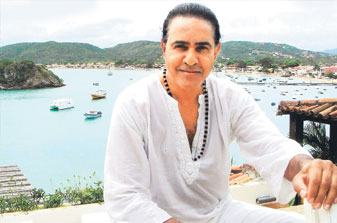
At 67, dressed in his PJs and a pair of sequinned loafers, Biddu continues to exude the charisma of an ’80s pop star. No surprise for someone who’s spent over five decades of his life making some of Indian pop music’s most memorable tunes.

Biddu

Shuttling between Mumbai, Goa, London and Spain, Biddu
has charted out a yearly travel calendar that takes him to “happy, sunny places”. “At this age, I want to avoid the cold and snow. It’s a nomadic life, but whether I’m at Marbela or Mumbai, my people know me well enough to know that I like a masala dosa or two fried eggs for breakfast.”

The Disco Deewane singer is in the city to promote his debut novel, Curse of the Godman, which he penned three years ago. Coming a year after his autobiography Made In India, which captures the singer-songwriter-producer’s journey from Bangalore to Kolkata to London, ask him if writing is his new calling and he says, “I wanted to write this novel for a long time now. But my publishers said they would only publish it if I wrote my autobiography. So I sold myself to the devil.”

He recalls, “Four years ago, it struck me that I didn’t want to do music anymore. I wanted to open a restaurant or write a book— but the story of my novel hit me sooner.”

Curse Of The Godman, a mix of “adventure, mysticism, romance and murder” is set in 1950s India and is the story of a tea plantation in Darjeeling, terrorised by a tiger. And like his prolific years as a singer, the new writer too isn’t leaving any page unturned, literally. Ahead of its launch, he reveals that he’s already finished writing his second book: “It’s set in Mumbai and deals with the sexual awakening of a young boy.”

For a man who delivered some of the biggest hits in his heyday, and still rakes in royalties, was it difficult to change career lanes? “It got boring. I’ve done this for over 50 years now. So the day I decided I had had enough, I went and gave away all my music equipment. My wife thought I had gone mad.”

For now, Biddu is content living life on his own terms. “A regular day in my life involves long walks on the beach, yoga, lunches with friends and a little bit of writing, At this age, there’s little to complain.”

Biddu’s musical highlights

Curse of the Godman is out on HarperCollins for R 299. It will be launched at Crossword Bookstore, Kemps Corner on January 13.

He won the Grammy for Kung Fu Fighting, in the best selling single category.

Till date, he has sold 38 million records.

He produced Disco Deewane which sold 60 million records worldwide.

Biddu produced music for Qurbani, with songs like Aap Jaisa Koi.

He became the pioneer of Indi-pop with his pop album Disco Deewane and Alisha Chinai’s Made In India.

Till date, royalties from Kung Fu Fighting get him anywhere between 60,000 pounds-70,000 pounds a year.

He received a Lifetime Achievement Award from Rolling Stone Magazine.

source: http://www.HindustanTimes.com / ENTERTAINMENT > Music / by Megha Mahindru / Hindustan Times, Mumbai / December 29th, 2011