Category Archives: Famous Personalities of Kodagu / Coorg

The healthy choice

Some simple steps that can help provide 
affordable, quality health care anywhere in India
By Dr Kavery Nambisan
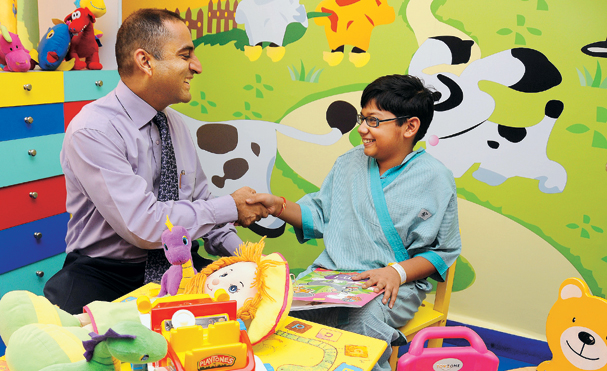
Healing bond: Dr Anupam Sibal with a patient at Indraprastha Apollo Hospitals, Delhi. Among the essential qualities of a doctor is the ability to empathise / Photo: Arvind Jain

Medical care in our country is like a patchwork quilt: a few small segments sewn with lovely silk while the rest are frayed and falling apart. Millions of Indians are deprived of basic medical facilities because they are too expensive. Well-to-do Indians have the right to be healthy. The rest simply suffer or die. We like to boast about the richness of our culture and about the billionaires who figure prominently in the news but when it comes to human development, we are paupers.
The imbalance in health care, the dreadful state of most government hospitals and the exorbitant fees charged by private doctors are common knowledge. How shall we redress these?

Like several of my colleagues, I have spent most of my surgical career working in rural areas, in south and north India. In many such places, being the only qualified surgeon, I had to handle all types of cases. Rural folk are hard-pressed for money and cannot spend too much on any illness. My experience and that of my colleagues shows that quality medical care that is affordable can be given anywhere in India (or any other country) by following a few essential steps.

As medical students we spend five and a half years learning the art and science of medicine. But we are not sensitised to the unique nature of a profession that has to deal with pain and suffering all the time. Mere moral lectures will not do. One way to sensitise young minds is by introducing humanities into the medical curriculum as is being done in many countries. It will help produce more rounded personalities, better equipped to take on the high-pressure job of a doctor while retaining human values.

For a young doctor, there are riches to be had from working with an experienced senior, especially in a hospital where the resources are not plentiful. He will learn to adapt and innovate, use his clinical judgment and will not be easily tempted to do too many investigative procedures like blood tests, X-rays and scans. He will be an all-round doctor rather than one with narrow experience. We certainly need specialists and super-specialists for the treatment of certain problems but for the majority of ailments, an efficient MBBS doctor is all you need. He can learn multiple skills by working with a senior who is willing to pass on his experience and knowledge.

A surgeon working in a small town or village should be able to do a hernia repair, mend a broken forearm, manage prostate trouble or do a caesarean section. He should be able to handle common medical problems like chest infections, skin allergies, diabetes, angina and high blood pressure. A multi-skilled doctor can handle 85-90 per cent of all patients walking in or wheeled into the hospital.
Doctors must have the ability to empathise. This quality can be developed by any doctor who is able to put herself in the patient’s place. She is then more likely to come up with the right mode of treatment.

A part of this process is telling the patient why he fell ill, explaining the disease and teaching ways of preventing future problems. This is an essential part of a doctor’s job but is totally neglected for two reasons: patients never ask questions like “What caused this illness?”, “What exactly is diabetes/blood pressure/eczema?” or “How do I protect myself in future?” Most of us prefer to fall sick and then be cured after suffering the pain and agony. This is silly, because learning how to prevent future problems is far better for health. Instead we are grateful when the doctor gives a few minutes of her precious time to prescribe medicines.

We doctors like to think that we have too much to do and little time to talk to patients. By readjusting our priorities and the way we work, it can be done. The rewards are tremendous, for both patient and doctor.
Small, well-run hospitals are much more efficient than large ones. It may make good business sense to have 1,000- and 2,000-bed mega-centres with hundreds of doctors and thousands of paramedics, and the main objective of making a profit. This usually results in diminished quality of care. The ideal in-patient capacity for a rural or a small-town hospital is 60 beds. In a city, it could go up to 100 or, because of multiple speciality departments, 200. In such hospitals, the doctors, nurses and other staff get to know each other. They meet and talk every day, not just as medical professionals but also as ordinary human beings. This makes it easier for them to work as a team and it boosts their morale. They are less stressed and more caring. For the patient, a well-managed small hospital with efficient doctors and staff is a real boon.

A good hospital will say ‘no’ to unnecessary gadgets. A hospital should have only those machines which are in regular use, with the exception of certain life-saving emergency equipment which are essential. Before any new purchase is made, its usefulness and running expenditure must be carefully looked into. Some hospitals buy equipment the way a fashion-crazy youngster blindly follows the latest style, without stopping to consider if it will suit her. The running expenses for rarely used equipment will be very high, and patients will be made to go through needless investigations in order to recover the money.
Most illnesses require fairly simple treatment and very little in the form of investigations and tests. An efficient doctor and nurse can do far more than any gadget. In many peripheral hospitals, seriously ill patients (like those who have suffered a heart attack or undergone major surgery) are being cared for perfectly well by giving intensive nursing care without the use of a multitude of gadgets. When more sophisticated methods are absolutely essential, such patients can be referred to a higher, multi-speciality centre. This will be psychologically better for the patient, and the medical bills will be a fraction of what one would pay in a fully-equipped ICU.

Choices such as these—of keeping the treatment simple and effective at all times—have to be made by those who run small hospitals. Any patient who cannot be treated without sophisticated gadgetry and/or by super-specialists should be referred to the appropriate centre at the earliest. In the vast majority of cases, this is not necessary.
For a doctor (or nurse or any hospital staff), there is no greater joy than that of seeing a patient cured and happy before going home. If more doctors can come together with this purpose in mind, we can do much more for the health of our nation than by blindly applying our knowledge. The knowledge is very important. But without genuine caring, it is at best cosmetic. And from experience, I know that a good living can be honestly made without chasing money.

Can doctors fulfil the real needs of patients? We need to make the right choices. The rest is simple.

Nambisan is a surgeon and novelist. Her most recent novel, The Story That Must Not Be Told, is shortlisted for the DSC South Asian Literary Prize.

source: http://www.week.manoramaonline.com / Cover Story / THE WEEK / Saturday, November 19th, 2011

You never know what the future holds

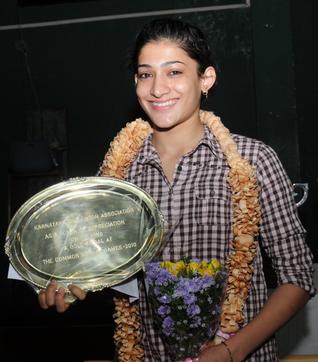
Says model Dayana Erappa, who bagged the title of ˜Miss Photogenicâ™ at the ˜Miss India 2011™ pageant

Like many young girls, even Dayana Erappa, a Bangalore model, dreamt of taking part in the ‘Miss India’ pageant.

Her grooming started when she entered college and her principal saw the potential she had in the glamour world. Before she knew it, Dayana was on her way to take part in the ‘Miss India 2011’ pageant. She even won the title of ‘Miss Photogenic’ at the pageant.

Speaking to Metrolife during the ‘Beyu Fashion Show’ held recently, the model expressed how she would have loved to bag the crown. “Not winning the contest was a little disappointing. But I am happy about the ‘Miss Photogenic’ title. At the end of the day, it’s the experience that counts. For a young girl like me, it was a huge thing to work with some of the biggest names in the industry,” she says.

The grooming and expert advice she picked up from the pageant are things that she applies during her work. At the same time, Dayana says that there is no denying the heavy competition that surrounds her. “It’s all about how each one perceives it. There are so many newcomers entering the modelling industry every year but if we start worrying about that, it will kill the fun part of the job. I feel we, as models, must stick to giving our best, that is to show the hard work of the designers in the best way possible,” adds Dayana, who dreams of walking the ramp for Roberto Cavalli.

Apart from modelling, Dayana is also interested in acting. So getting into the film industry is definitely a part of her agenda. Ask her who she would like to be cast opposite and she gives a list of names. “But I would love to act with Suriya and Vikram.

They are my all-time favourites. I do plan to act but not right now. My concentration is on modelling. But you never know what the future holds,” she signs off.

source: http://www.deccanherald.com / by Megha Shenoy / Home> Supplements> Metrolife> Beauty Speak / Friday, November 18th, 2011

CM inaugurated Centenary Celebration of Kodava samaja

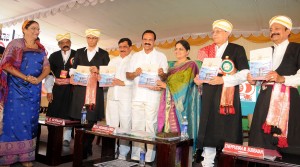
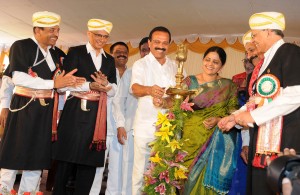
Chief Minister D V Sadananda gowda inaugurated Centenary Celebration of Kodava samaja. Speaker KG Bopayya, High Court Judge Bopanna, M C Nanayya MLC, Dati Sadananda Gowda seen in Picture.

Chief Minister D V Sadanada Gowda inagurated Centenary Celebration of Kodavasamaja.Speaker K G Bopayya, High Court Judge Bopanna, M C Nanayya MLC, Dati Sadananda Gowda seen in Picture

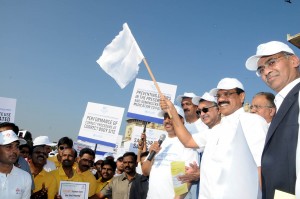
Chief Minister D V Sadananda Gowda Flaged off of Marathon Run by Quality Control in Health Management. Rajiv Gandhi University of Medical Sciences Vice Chancellor Dr Sheeprakash seen in Picture

Chief Minister D V Sadanada Gowda Released Smarana Sanchike for Centenary Celebration of Kodavasamaja.Speaker K G Bopayya,High Court Judge Bopanna,M C Nanayya MLC,Dati Sadananda Gowda seen in Picture

source: http://www.sandanandagowda.com / Sunday, November 13th, 2011

Bopanna & Qureshi win

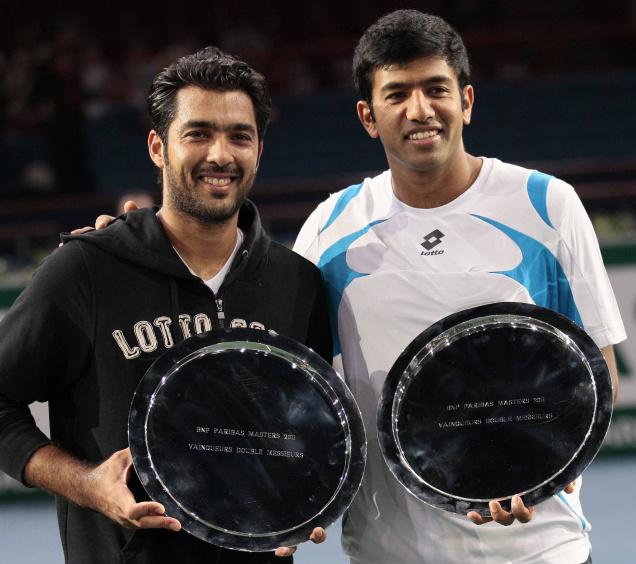
A LANDMARK WIN: The triumph in Paris is Asiam Qureshi’s and Rohan Bopanna’s first Masters title. AFP
PARIS, November 13th, 2011
Maiden Paris Masters for Roger Federer

Rohan Bopanna and Aisam-ul-Haq Qureshi won their first ever ATP Masters tournament beating Julien Benneteau and Nicolas Mahut 6-2, 6-4 in the final here on Sunday.

The seventh-seeded pair took just 65 minutes to see off the French wildcards and pocket its third title of the season. Bopanna and Qureshi had won the Gerry Weber Open at Halle and the Stockholm Open before this event.

Bopanna and Qureshi broke in the third and fifth games to open up a 4-1 lead.

They were twice 0-30 on serve, but held on to close the set out.

Benneteau and Mahut, who had shocked top seeds Mike and Bob Bryan en route the final, gave a better account of themselves in the second set.

At 4-4, Mahut’s double-fault offered Bopanna and Qureshi a break point, which they gratefully accepted.

They then served the match out in the next game despite a few anxious moments.

One-sided final

Meanwhile, Roger Federer won the singles title for the first time here by defeating Frenchman Jo-Wilfried Tsonga 6-1, 7-6(3) in a one-sided final.

It was the Swiss star’s third tournament win of the year after Doha in January and his Basel hometown event last week.

It was also his 18th Masters title win, second only to Rafael Nadal who has won 19 times, and the 69th title of his career.

“This is the realisation of a dream for me and it’s been so long that I have been waiting for it,” said Federer, after receiving the Paris Masters trophy from French basketball star Tony Parker.

“Honestly, I am surprised myself at just how well I am playing.”

The win makes Federer just the second player after Andre Agassi to win both the French Open at Roland Garros, which he took in 2009, and the Paris Bercy title.

The results: Final: Roger Federer bt Jo-Wilfried Tsonga 6-1, 7-6(3).

Semifinals: Jo Wilfried Tsonga bt John Isner 3-6, 7-6(1), 7-6(3).

Doubles: Final: Rohan Bopanna & Aisam-ul-Haq Qureshi bt Julien Benneteau & Nicolas Mahut 6-2, 6-4.

source: http://www.thehindu.com / AGENICES / AFP/ Sports> Tennis/ November 1th, 2011

1971 Bangladesh Liberation War memoirs

When the Pak envoy was on the mule trail

The declassified 1971 war papers narrate a curious story of the Pakistani ambassador to Argentina fetching up an hour-and-a-half late for his farewell dinner. B K Sanyal, then India’s ambassador to Argentina, in a 1969 note to New Delhi found this amiss but said the Pak ambassador had not acted irresponsibly. “In my view, the ambassador did not act irresponsibly, but went away with a brigadier to visit mule breeders who are chiefly located in the Cordoba and Pampas areas.”

Before the 1971 war, Pakistan bought mules from Argentina to beef up its logistics capability in Kashmir. The Pak ambassador’s conduct triggered a chain of communications. K Sankaran Nair, then joint director, R&AW, wrote on Septemer 24, 1969, to C B Muthamma, joint secretary (Americas): “The Pakistani army has raised four mountain regiments and are likely to raise four more. These have mountain guns carried on artillery mules over hilly terrain. Eight mountain regiments would require 3,000 mules. The regiments are meant for use in PoK.”

How US responded to the signs of war

The 1971 war papers document how the US mission in India packed off confidential documents to secure places during the conflict, asked its banks to be ready to close accounts of American citizens and discussed the possibility of the war being a long affair.

A letter written at the peak of the Indo-Pak war by the then IB chief gives an insight into the mindset of the US mission in India during the 1971 war. “Sensitive documents with various US missions in India have been sealed under instructions from the US government. Thereafter, the documents are to be sent partly to Colombo and partly to Kuala Lumpur,” Atma Jayaram, director IB wrote on December 13, 1971.

Jayaram wrote that the “First City National Bank and the Bank of America in Madras were contacted by officials of the local US consulate and advised that they should prepare to close the accounts of American nationals and arrange for their transfer to places (presumably outside India) at a short notice.”

source: http://www.articles.timesofindia.indiatimes.com / by Josy Joseph / TNN / November 06th, 2011

Bopanna, Advani named `Global Shapers`

Bangalore:
Davis cupper Rohan Bopanna and ace cueist Pankaj Advani have been inducted into the `Global Shapers`, an exclusive community of exceptional youth in their 20s, established by the World Economic Forum (WEF).

Although Bopanna is 31, an exception has been made in his case, it was clarified. Advani, 27, has seven World titles to his credit.

According to the release, the community comprises of a selected band of exceptional youth from across the world, possessing unique qualities and extraordinary achievements that set them apart from the mainstream.

Representing all walks of life, these individuals are highly committed to developing their leadership potential towards serving society and adhere to the highest standards of moral and intellectual integrity, it added.

“We are becoming increasingly aware that solutions to our global challenges must purposefully engage youth, at all levels — locally, regionally, nationally and globally. This generation has the passion, dynamism and entrepreneurial spirit to shape the future,” Professor Klaus Schwab, WEF Chairman said.

IANS

source: http://www.zeenews.india.com / by IANS / Tuesday, Nov 01st, 2011

Chikka grabs Western India Golf title

MUMBAI:

Seenappa Chikkarangappa, the reigning National champion completed a comprehensive 11-shot win over fellow Bangalore player, Khalin Joshi in the LIC – Western India golf championships at the BPGC on Friday.

Chikka, who was having a less than satisfactory last few weeks, carded a five-under 65, and totaled a whopping 20-under 260. Khalin shot one-under 69 in the final round and finished at 271, 11 shots behind the winner.

Completing a 1-2-3 for Bangalore golfers was Udayan Mane (68), who added another good finish to his recent win on the IGU circuit. Mane totaled 274.

Chikka’s win fetched him 50 points towards the IGU order of Merit, while Joshi took 40. Dominic Foos (65, 279) and Angad Cheema (73, 279) tied for fourth at 279 and the sixth place was taken by Manav Das (71, 280).

source: http://www.articles.timesofindia.indiatimes.com / by TNN / November 05th, 2011

What is the need for post-party party and why you are not invited?

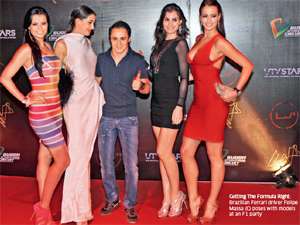
How do you know that a trend has caught on? It’s when the lowest common denominator, namely us, starts following it. Recently, a friend had an after party for her birthday party which incidentally was at Delhi’s swanky nightclub The Love Hotel at Ai, owned by the man who probably single-handedly fanned the after-party culture in the capital, AD Singh. It was Singh’s and actor Arjun Rampal’s co-owned nightclub brand Lap, Rampal’s Chasing Ganesha along with Jaypee Sports International ( JPSI) that powered the F1 after parties, which took five months to plan. “Large sporting events have visitors from all over the world and good after parties offer a chance for everyone to let their hair down,” Singh explains the raison d’etre of after parties.


If F1 put India on the world map, the after parties showed that Indians can throw a mean party. Even Lady Gaga went a little gaga, tweeting her pic with Rampal and pal SRK. And everyone from Bollywood glam to fashion biggies to society majors walked the red carpet to the F1 after party. “It’s a status symbol to be part of the after-party guest list. While the event is open to everyone who can buy the tickets, the after party is an exclusive privilege. And that’s what makes them coveted,” says Harmeet Bajaj, director of Smokehouse Room, a new nightclub in Delhi by Impresario – a group where Bajaj partners with Shiv Karan Singh and Riyaz Amlaani.

Gatecrashers are always a big problem at such events. “One gentleman pretended he was Mark Weber (the F1 driver) to get in,” Singh says. The after-party culture started with fashion weeks. The fash frat has always been known for it’s proclivity to partying and when it became a business event, the need was felt for a forum to let their hair down. Bajaj says: “The week has a very formal format where you sit on benches and watch show after show. Designers felt the need to socialise informally.” And after party was born. Soon, IPL started its ‘infamous’ after-match parties and now every sport and society event has one, even wedding receptions.

The Guest List
Who’s invited is the single-most important factor about an after party. Bangalore-based image consultant and fashion choreographer Prasad Bidapa who managed the after-match parties – all 30 of them – for IPL4 along with DNA Networks, says the after-party culture feeds on the “we are a children few” mentality referring to the feeling of privilege it brings to be part of the A list. “It creates a feeling of endless excitement too,” he comments.

But most after-match parties during IPL drew a lot of flak for not giving time for the cricketers to rest. In fact, even MS Dhoni had commented that too many “after parties are taking a toll on our energy levels”. While South African cheerleader Gabriella Pasqualotto has another story about the energy levels. In her tell-all blog on behind the scenes at the IPL the 22-year-old had said that: “The music pumps, the drinks flow and the cricketers come and go… But the real fun happens in the VIP rooms where the players and night owls can cause scandal!” After parties by very nature are more risque.

“If sport meets glamour sparks will fly unless you grew up in a convent,” says Bidapa. But not only sparks but even liquor -and the best one at that – flies off the shelf. “An after party has to have the best of decor, food and definitely liquor to live up to its guest list,” says Utkarsh Bansal of P3party.com and organiser of a many farmhouse and private after parties in Delhi. Bansal has seen a literal 100% surge in the demand for an after party from the friendly BYOB (Bring Your Own Booze) get togethers to the real heavyweight parties that require a velvet rope at the entrance. The high demands he has
noticed are for liquor, decor and now foreign hostesses.

We Like to Party

The unwritten rule for IPL parties is that the top stars need to show up. Reportedly, sponsors demand that stars turn up at least for a photo op and they do oblige. For smaller players of IPL, it’s a platform to network – after all, they also know that they won’t be getting an in into this world post the season. “After parties are the best networking platform there is. It’s the right mix of people – from fashion to films to bureaucrats and industrialists,” says Bajaj, enough contacts to fill your Rolodex.

The entertainment quotient at an after party is fairly minimal – maybe a ten-minute fashion show or a stand-up comedy routine. “It’s the whole feeling of living vicariously that this culture feeds on, it’s the same way I would read a piece on Maureen Wadia’s house,” Bidapa says and adds that an after party is now planned as a part of the whole event. It’s a media-created event which feeds the Page 3 and growing number of news and lifestyle TV. Bajaj says people have a guest list that’s divided into A lists, B lists and C lists. And everyone wants to be in the first one.

source: http://www.economictimes.indiatimes.com / by Nupur Amarnath / ET Bureau / Nov 06th, 2011

Smashing serves

Despite star players giving it a miss, the Karnataka Badminton league holds promise


Ashwini Ponnappa

Ashwini Ponnappa commanded a price. The Commonwealth Games gold medallist (in the women’s doubles alongside Jwala Gutta) has star value and provided the glamour quotient to the inaugural edition of the Karnataka Badminton League (KBL). She fetched a whopping Rs 2.5 lakh for her appearance in the first week of the league, which runs from November 5 to 19.

“She has a star value and will keep the rest of the team motivated. That is why we bid for her,” says Vishal Vincent Tony of the Aratt Fighters, the franchisee that successfully bid for Ashwini. “Her presence in the team, even if it is only going to be for the league stages (Ashwini leaves for the Hong Kong Super Series on November 12) should do wonders to the morale of youngsters in the team. She is only participating in the mixed doubles category. We have also bagged Jacqueline Rose Kunnath, who commanded the second highest bid of Rs 1.06 lakh to play the women’s singles, there is no reason why we cannot do well,” says Vincent.

Beside the two women stars, Rohan Castellino was picked to provide the thrust in the men’s singles.

If Aratt Fighters spent huge sums on women players, franchisees such as Fly Power Warriors and Li Ning Lions did not invest on big names and instead opted for a balanced team. “This being the inaugural year, there was a lot of apprehension and uncertainty. We chose a couple of young guns to deliver for us and hopefully they will,” says Choudhary, a member of the Fly Power Warriors, for whom Rajas Jawalkar and Sindhu Bharadwaj will lead the singles challenge in the men’s and women’s categories respectively.

P. Kumar of Kumar Sports, owner of the Li Ning Lions, said: “Li Ning is the leading shuttle-cock manufacturer in China and is making its presence felt in the Indian market. This league could provide the perfect platform. We are happy with the team.”

Agarwal and Bhandari joined hands to form the AB Chargers and picked the top ranked men’s singles player, Mohit Kamath, alongside women’s player Mahima Aggarwal and doubles specialist Vineeth Manuel. “There were some hiccups but overall, I am quite satisfied,” says Bhandari after the players auction that lasted nearly six hours.

With Aditya Prakash and Prakash Jolly going to White Peacock and K2 Smashers respectively, one felt the Hennur Banaswadi Cosmopolitan Club (HB Challengers) were the ones to lose out, with just Rishiket Yeligar and B.S. Phalgun leading the challenge in the men’s singles. But Srinivasan (Secretary) and Krishna Kumar (coach), who once formed a strong doubles combination with George Thomas in the ’90s, felt the players would deliver. “We win some and lose some. It is a learning curve for us. We will be better equipped next time,” says Manjesh, who represented the K2 Smashers.

“There were too many caps,” was the general feeling and the phenomena resulted in active players like Poorvisha Ram and Ruth Misha going unsold. On the flip side were the withdrawal of the eighth team, Team Victor, from the fray and some internationally renowned names like Aravind Bhat and Anup Sridhar giving the league a miss for varied reasons.

source: http://www.thehindu.com / MetroPlus> Life & Style / by Avinash Nair / November 02nd, 2011

It’s all about Honey … HONEY!

Caption:

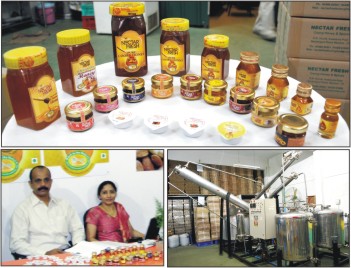
1) Some of the honey, jams and sauces produced by Nectar Fresh. 2) Chayaa Nanjappa with business partner Rajappa at Ahaar expo in Chennai. 3) The entire processing unit consisting of a container to feed honey to the settling unit.

They say ‘fruit of hard work is sweet’ and in this case it is metaphorically and literally sweet. Shall we call this a success story of a lone lady who made it big in the small scale industries sector or the growth of a brand which has today become one of the leading names in the field of honey? It is difficult to describe one without the other as this is the story of a lady who started a honey brand from scratch which has grown to great heights over the years. In this Weekend Star Supplement, SOM introduces its readers to this lady who says ‘If I could make it, then any other lady can

’ A flavour for every season

History:

Nectar Fresh was launched by Chayaa Nanjappa in 2007 at Bangalore and was backed by Khadi and Village Industries Board. Born on June 20, 1971 at Kodagu, Chayaa says, “I had a gut feeling and wanted to do something connected with my hometown. That instant I knew I wanted to start honey manufacturing and wanted to name it as Nectar Fresh.”

“The plant was doing well in Bangalore but due to some circumstances we had to relocate to Mysore in 2010.

Initially people said that Mysore is a small town and is not feasible for such businesses. But for me Mysore has been a lucky mascot. Most of the major deals were struck after we shifted here,” she says.

The plant was relocated to Kadakola near Mandakalli Airport when Chayaa partnered with Rajappa of MyStore.

Speaking about Nectar Fresh, Chayaa says, “We are one among the top 5 honey manufactures in India and are the only ones who are manufacturing different varieties of honey. Usually the Khadi and Village Board products are not considered as product for the high end markets. But today we have replaced international brands in hospitality sector under the Board. We have used their logo in our brand because it is the Board which has supported us. Also, there is a notion that business is only for the elite class who come from the same background or have the educational qualification for it. But we have proved this wrong. Anyone can do it if they have the survival instinct. Today we employ around 50 persons all over the country and around 20 in our Mysore plant.”

Chayaa, a PG Diploma holder in Mass Communication, underwent specialised training at Central Bee Research and Training Institute, Pune. She is also a member of the National Bee Board and is the first lady to have a honey processing plant in the country.

Process

The company has its mobile vans placed near the fields across India. Hence they are the only producers of a variety of honey in the country. They are also the first brand to launch honey blisters.

“Every month we have different varieties of honey according to the flowering season. This month it is acacia, clover and Himalayan honey,” says Chayaa, adding that lychee honey has the greatest demand.

Although Nectar Fresh has a wide network, it’s manufacturing unit is only at Mysore. The unit produces around 1,000 tonnes a day and is planning to increase it to 4,000 tonnes by procuring more equipment.

Processing plant: First, the honey is loaded into the container. This honey undergoes around 30 microns of filtration. It later undergoes moisture reduction and then again 2 microns of filtration. It is then cooled and sent to settling tanks. This will later be filled in containers and packed.

The brand has also started dealing with jams and sauces to help sick women groups. It aims to provide them with the technical knowhow and quality assurance and in turn market their produce thereby giving them a channel to avoid middlemen.

The processed honey is tested for quality at Pristine Laboratories, Bangalore and also at the units’s in-house laboratory.

Varieties

Nectar Fresh is known for its varieties in honey which include Coorg honey, rapeseed/mustard, eucalyptus, lychee, sunflower, Himalayan, acacia, clover, south Indian etc.

Market and export

Nectar Fresh today exports its produce to the Middle East, Malaysia and Australia. They will be looking forward to capture the US and European markets very soon.

The brand has replaced top international brands in India and today has a monopoly with the five star hotels.

“Previously we were not keen on our own private labeling and would supply in bulk and to the hospitality sector. But now we are entering the retail market also. We are the major suppliers to the Honey Society and are vendors for DFRL in city. Apart from this, ITC, Kerala Ayurveda, Taj group of hotels, Apollo etc., bottle their products here,” says Chayaa.

Mission beyond market

With an aim to be a leader in their business in India, Nectar Fresh is also seeing to offer its service beyond market. Apart from helping women with jams and sauces, they have empowered the locals around Kadakola region by providing them training and employment. They are also backing tribals by sourcing honey from the Sirsi belt.

The company is also associated with various charitable organisations helping girl child and Chayaa herself is a member of many women organisations in the country.

Competition

When asked about their major competitors in the market, Chayaa said “We have replaced many international brands including Australia’s Beerenberg Farm. In India, our major competitors are Kashmir Apiaries and Kejriwal Enterprises.”

Future

The company will soon be launching honey pouches with an aim to make honey available to even the lowest section of the society. The pouches are being prepared with the help of CFTRI. They will also be launching premixes of coffee and tea. The mix, which comes with milk, sugar and coffee/tea powder, can be prepared by just adding to a cup of water. With this the company plans to rule the Indian market and introduce Mysore and Kodagu to international customers.

Work hard and believe in yourself

I am not a feminist. But I support those women who work hard to stand on their feet. Most of the time, laws favouring women are abused and the most genuine cases do not have the privilege to use it. Hence, through our brand we intend to empower such women.

“Believe in yourself and have that never-let-go attitude. The success you achieve through this will give you a lot of self-respect rather than finding easy ways of making money.

“I have faced many hardships while coming this far. As a single woman, it was initially difficult for me to survive in this field. But that did not discourage me. With help from Corporation Bank, the government and of course from my business partner, now sky is the limit for Nectar Fresh. If I was able to achieve so much, then any woman can.”

source: http://www.starofmysore.com / Feature Articles / October 29th, 2011