Category Archives: About Kodagu / Coorg

K.J. George is new district minister for Kodagu

Madikeri :

Home Minister K.J. George has been appointed as the In-Charge for Kodagu district by CM Siddharamaiah with immediate affect.

He is to take over from PWD Minister Dr. H.C. Mahadevappa, who also is the District In-Charge Minister for Hassan.

Kodagu District Congress President B.T. Pradeep has welcomed the change while district BJP spokesperson Manu Muthappa has flayed it saying it would not bring in any change in the district. He opined that since the new District in-Charge Minister holds the Home portfolio, he must bring in a sea change in the Police Department to strengthen the administration.

Manu Muthappa also said that the previous District Minister Dr. Mahadevappa had not shown any interest in the development of Kodagu.

source: http://www.starofmysore.com / Star of Mysore / Home> General News / January 18th, 2014

The roots of Kannada in Kodagu…

The coffee land is all set to witness the 80th Kannada literary meet scheduled to begin on January 7, after a long gap of 32 years. Earlier, Madikeri has witnessed two literary meets – the 18th literary meet in 1932 under the leadership of D V Gundappa and the 54th literary meet in 1982 under the leadership of Dr Shambha Joshi.

Interestingly, despite being one of the smallest districts in Karnataka, it has a wide variety of culture as well as languages that include Kodava, Arebashe Gowda and Malayalam, yet the region has managed to retain the flavour of State language.

If one goes down the pages of history, the little district with unique weather and culture has contributed immensely for the development of Kannada language. The Ganga – Kongwala – Hoysala and Haleri dynasties, perhaps laid the strong foundation for Kannada through inscriptions way back in the 9th century. In the 10th century, Nagaverma had created ‘Chandombudi’ and ‘Punyashrava,’ according to the reference available at ‘Kodagu Sahithya – Sanskrithi Darshana,’ published by Kodagu District Kannada Sahithya Parishat.

During the Chengalva dynasty, the third Mangarasa had published ‘Jayanrupa Kavya’ and ‘Samyukta Kaumudi’ (1508), while his cousin Nanjunda had written ‘Kumara Ramana Kathe.’

There are documents to prove that the first epic ‘Rama Vijaya Kavya’ was written by Devappa, a Jain poet in 1540. Similarly, Dodda Veera Rajendra, who ruled Kodagu between 1789 and 1809, has the credit of documenting history titled ‘Rajendra Name’ in Kannada. The II Linga Rajendra, who ruled Kodagu between 1810 and 1820 had written a book pertaining to land in Kodagu entitled ‘Lingarajana Shisthu.’

The 19th century

The leading name of 19th century pertaining to literature is that of Panje Mangesh Rao, who served as a teacher in Kodagu in 1920s. He had penned poems pertaining to Hutthari festivities among other literary works. In fact, he was the president of All India Kannada literary meet held in Raichur in 1934.

Haradasa Appacchha Kavi, popularly known as the Adi Kavi of Kodagu had penned many plays including ‘Savithri,’ ‘Yayathi,’ ‘Kaveri’ and ‘Subramanya’ in Kodava language. The same were translated to Kannada language by Dr I M Muttanna, who also hailed from Kodagu.

Kodagina Gowramma

The first woman story writer in Kannada literary field, Gowramma, hailed from Kodagu and she is known as ‘Kodagina Gowramma.’ Born in Madikeri in 1912, she did her early schooling in Madikeri and married to B T Gopalakrishna in 1928.

From 1931, she wrote a number of articles and stories in the name of ‘Mrs G T G Krishna’. Most of her stories were based on the theme of women’s problems. However, she passed away in 1940 when she was just 28 years old. When Mahathma Gandiji arrived at Kodagu, she had invited Gandhiji to her home and she had donated her jewellery for the cause of freedom.

Bharathisutha

A teacher by profession, ‘Bharathisutha’ was the pen name of S R Narayana Rao. Based on the life story of Kodagu ruler Siribai Dodda Veerappa, he had written ‘Huliya Haalina Mevu,’ which was later made into a film by the same name.

His other stories too have been made into films and they include ‘Girikanye,’ ‘Edakallu Guddada Mele’ and ‘Bayalu Daari’ among others. His work on ‘Solle Haraduva Rogagalu’ (Diseases transmitted by mosquitoes) and ‘Giliyu Panjaradolilla’ (The parrot is not in the cage) earned him Central government award and Karnataka Sahithya Academy award respectively.

Kittel’s footsteps

Rev Fr Ferdinand Kittel, who contributed immensely to the field of Kannada literature has left indelible marks in Kodagu, prominent among them include the Kannada – English dictionary.

A German missionary, who served in Kodagu church (presently knownn as Shanthi church) between 1871 and 1876, was the first parish priest of the church. Rev Kittel started learning Kannada after going around the coffee land, says the present parish priest of the church.
DH News Servcie

source: http://www.deccanherald.com / Deccan Herald / Home> District / by Srikanth Kallammanavar, Madikeri / DHNS / January 05th, 2014

DC’s letter on Kodava firearm licence kicks up a row

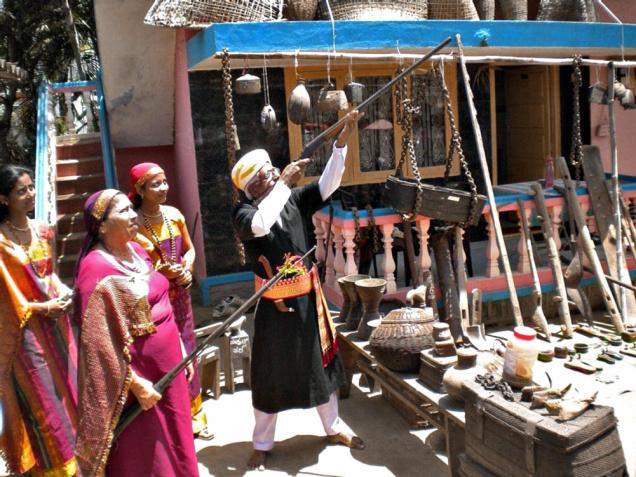
Guns are part of the Kodava culture and they are used during auspicious occasions.—Photo: Nanda Kumar / The Hindu

Clarification sought on granting exemption certificates to Kodavas and ‘Jamma’ holders

The clarification sought by the Kodagu Deputy Commissioner from the State government on granting exemption certificates (ECs) to the ‘Coorg by race’ (Kodava) people and ‘Jamma’ (land tenure) holders to keep weapons without licence, a privilege existing since the days of the British, has caused anxiety among the people here.

In his letter on September 20, Deputy Commissioner Anurag Tewari asked the Home Department whether the Jamma holders should necessarily be Kodavas (Coorgs) or otherwise. He asked whether ECs could be granted to Kodava people even if they were not Jamma holders, and non-Kodavas, who are Jamma holders. It was also asked whether EC holders could purchase weapons from outside Karnataka in such cases.

CLAIMS

Kodavas are eligible for EC, as per concessions under Sections 3 and 4 of the Indian Arms Act of 1959, even if they are not Jamma holders, says T.C. Thammaiah, a former tahsildar. “ECs were issued to Kodavas and non-Kodavas, who were Jamma holders. There is also no mention about the extent of land a Jamma holder should possess to qualify for ECs,” he says. After the letter sent by the DC, many people have been forced to wait for long to get ECs.

Kodavas worship fire arms during festivals, they are used to fire shots in the air to herald the birth of baby boys, and some use it during house warming too.

Weapons provide security to people who live in remote villages and can act a deterrence to ward off activities of Naxalites.

The new documents sought by the district administration included original Jama Bandhi (land record) pertaining to 1918, Kodava caste certificate, Election Photo Identity Card bearing address in Kodagu, and ration cards, which were not necessary, Mr. Thammaiah argues, quoting lawyers in Madikeri.

A revenue transfer certificate would confirm whether the person seeking EC is a Kodava or the land held by him is Jamma.

The Madikeri Kodava Samaja has threatened non-cooperation for the All India Kannada Sahitya Sammelan scheduled to be held in Madikeri from January 7 to 9 if the obstacles in issuing ECs were not removed.

The Akhila Kodava Samaja, a representative body of the Kodavas, wants the rights continued. The Codava National Council, headed by N.U. Nachappa, too has demanded unhindered continuation of the privilege.

However, Mr. Tewari told The Hindu that the administration did not want to harass people, but the intention was to devise an alternative way to regulate the likely misuse of weapons.

The government of India had raised the issue some time ago, he said. “We have not stopped issuing ECs to the people,” Mr. Tewari confirmed.

Asked why the applicants were being told to produce Jama bandhi copies of 1918, he said some officials dealing with it had sought them to verify the claims of the applications as additional proof and it was not mandatory.

Efforts were on to computerise and keep a directory of licensed weapons and EC holders in the district, Mr. Tewari said. “The people of Kodagu should get the benefit,” he added.

source: http://www.thehindu.com / The Hindu / Home> News> National> Karnataka / by K. Jeevan Chinnappa / Madikeri – December 03rd, 2013

Ancient microcontinent discovered in Coorg block

MicroContinentKF16nov2013
A team of scientists from four research institutions have reported the discovery of an ancient microcontinent in India.

Based on extensive investigations in the Coorg block comprising parts of Kerala and Karnataka, the scientists have confirmed the existence of a 3.1 billion-year-old exotic microcontinent that could have broken off from Madagascar or Africa and drifted across the ocean to get wedged into the Indian landmass.

Based on the geological formations that characterise the block, the researchers assume that it could have been part of the earliest ‘Ur’ supercontinent formed through microcontinent amalgamation.

The age data of the rock samples collected by the researchers showed that the peak of continental building in the exotic Coorg block occurred around 3.1 billion years ago. The studies indicated that the crust building might have also involved partial recycling of basement rocks as old as 3.8 billion years.

The team comprising M. Santosh from India, now working at the China University of Geosciences, Beijing, Q.Y. Yang from the same university, E. Shaji from the Department of Geology, University of Kerala, T. Tsunogae from Tsukuba University, Japan, and Ram Mohan and M. Satyanarayanan from the National Geophysical Research Institute, Hyderabad, has published the discovery in Gondwana Research, an international journal on earth science with particular focus on the origin and evolution of continents.

According to the paper, the Coorg block, a continental fragment sandwiched between the Dharwar craton (a craton is a piece of a continent that has been stable for over a billion years) in the North and several younger crustal blocks to the South, is composed dominantly of a suite of arc magmatic rocks.

“Considering the age of the rocks from the periphery of the Coorg block, the microcontinent could have got wedged with peninsular India around 1.2 billion years back in time,” says Dr. Santosh, the lead author.

“This exotic microcontinent could have come from any of the cores of the earliest supercontinent Ur. The possible sources are Madagascar or Africa.”

The study revealed that the Coorg block was unaffected by major tectonothermal (geological episodes that shape rock formations) events in the rest of southern India.

The team relied on Uranium-Lead dating and Lutetium-Hafnium analyses of zircons separated from the different rock types. They also carried out petrological and mineralogical studies and geochemical analyses of the rocks.

The study is significant in understanding the supercontinent cycle, the amalgamation of continents into large land masses and their disruption.

“The Early Earth was dominated by island arcs in an oceanic realm analogous to the modern Pacific region. The formation and collision of arcs gave rise to the birth of microcontinents,” explains Dr. Shaji.

The landmass arrangement on earth today is the culmination of a long history of continental movement. The Indian subcontinent is believed to be one among the several landmasses that emerged from the break up of the Gondwana supercontinent about 180 million years ago. The Coorg block covers an area of over 3,000 sq km and includes the whole of Kasaragod district in Kerala and parts of Kodagu district in Karnataka.

source: http://www.thehindu.com / The Hindu / Home> News> National> Kerala / by T. Nandakumar / Thiruvanathapuram – November 12th, 2013

Coorg: A Green Escape in Karnataka

If you find Ooty, Kodaikanal or Munnar a bit too touristy and crowded a destination in southern India, Coorg is that perfect holiday spot in Karnataka that is sure to please toddlers, youth and the old alike.
CoorgKF16nov2013
Not that this hill station needs to be chosen for a sojourn by eliminating other similar destinations in the vicinity. Just a three-hour drive from Mysore, 150 km away, Coorg district on its own has much to offer, beyond its coffee, cardamom, pepper and beetelnut estates.

There is much to see, admire and soak in at this hill station, which the locals call Kodagu, on the slopes of the Western Ghats, what with some pristine trekking trails, picnic spots, waterfalls, wildlife, woods, forests, valleys and some mouth-watering cuisine. Situated at a height of 1,525 metres, Madikeri or Mercara is the capital of Coorg, with a nice bazaar, quaint houses with red-roofs and liberal use of teakwood reapers for doors and furniture, so common among homes and clubhouses in Indian hill stations.

It may come as a surprise to some that Coorg has one of the largest settlements of Buddhists in India, just about 30 km away from Madikeri, with their own Namdroling Monastery built in 1963, which the locals call the Golden Temple. Once you enter the monastery, you feel transported into some other world in the Orient, packed as it is with some 5,000 monks in bright yellow and red robes, with some soothing Buddhist chants, smell of incense and breathtaking sights of pagodas.

After seeing those large golden statues of the Buddha and Tara, the intricate murals and Tangkha paintings, don’t forget to taste some authentic Tibetan food here, especially the delectable momos and the subtle thugkpa, their noodle soup. One is told it is the largest teaching centre of Nyingmapa – a major lineage of Tibetan Buddhism in the world – and the present Dalai Lama gave its shorter name, as opposed to Thegchog Namdrol Shedrub Dargyeling that this mesmerising place was called originally.

Before dwelling further, where to stay is a question that is bound to crop up. While there are plenty of hotels and resorts, including the Orange County, that can even set you back by as much as Rs.25,000 per day, it is best to opt for a home stay. There are some 35 of them in and around Medikeri in a range of Rs.1,000 to Rs.5,000 per day where one gets not just to retire but also taste authentic Coorgi food and take some refreshing strolls on their plantations that grow coffee and other cash crops.

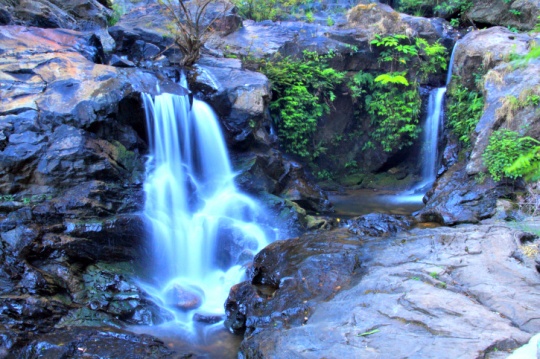
As far as the season goes, October to March — like most places in India — are the best months. The weather is pleasant with that welcome nip in the air. But Coorg during monsoons can be equally mesmerising and enchanting. There are also plenty of places one can go to. There is Abbey Falls, not far, where one has to make his or her way through some dense woods, dotted with coffee bushes, trees and creepers, to suddenly find a cascading gush of water.

Then about 80 km away is the Iruppu Falls, right next to the Rajiv Gandhi National Park, also called Nagarhole, which is famous for its elephants, with a lot of other game and some 50 species of birds. Children, especially, are certain to enjoy a visit to Dubare Forest, around an hour and a half from Medikeri. A ferry there takes you across to an elephant camp where one can see the pachyderms being bathed and fed, after which they are ready for a joy ride.

Talacauvery, around an hour away, is the source of the river Cauvery, with a temple to pay homage to this main source of water for some parts of Karnataka and Tamil Nadu. Not far is Bhagamandala, the confluence of three rivers: Cauvery, Kanika, and Sujyothi.

Another must-see is Tadiyendamol, which is the tallest peak in Kodagu and gives a breathtaking view of the entire Coorg, apart from the distant Arabian Sea. There is also the Naalkunaadu Palace built by Kodagu king Dodda Raja Veerendra in 1792. After all this exploring, a bungalow at the plantation is perhaps the best place to retire. Toddlers can chase butterflies, and a hammock and freshly brewed coffee are sure to be at hand!

How far: Around 150 km from Mysore and 260 km from Bangalore

How to reach: By bus or car from Mysore. Closest airport is in Bangalore; the airport in Coimbatore in neighbouring Tamil Nadu is another alternative.

Cost: Around 35-40 home stays in Coorg ranging Rs.1,000 to Rs.5,000 per day.

source: http://www.indiatimes.com / India Times / Home> Lifestyle> Travel / November 11th, 2013

Kodavas board special train to Delhi for rally on Nov. 1

KodavaDelhiKF04nov2013Mysore :

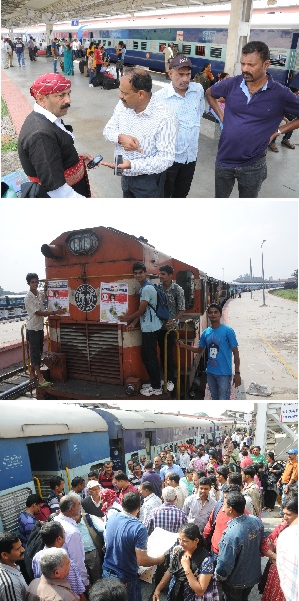
With the objective of seeking autonomous status for Kodagu district, nearly 2,000 persons of the Kodava community boarded a special train this morning to participate in the Delhi Chalo rally, to be staged from the Ram Leela Maidan to the Parliament House on Nov. 1.

The special train, called Codava National Council (CNC) Express, left the City Railway Station at 11.10 am, with 20 coaches, including a pantry car and store-room. The store room coach was stacked with water bottles, groceries for the entire journey of seven days, LPG cylinders, cooking and serving utensils, vegetables and other materials. A team of 70 cooks and their helpers also accompanied the rallyists.

The rallyists started arriving at the railway station since 8 am itself in their private cars and rented vehicles including buses and tempos.

Posters about the demands of CNC were pasted on the coaches along with the coach numbers which were allotted area-wise to participants coming from various towns and villages in Kodagu. People of all ages, including women and children were seen enthusiastically boarding the train.

CNC President N.U. Nachappa, speaking to SOM, reiterated that the CNC’s demand was not for a separate State but for declaring the hill district as an autonomous region.

One of the CNC members said that though sight-seeing in Delhi was not important in their agenda, they will make a brief halt at Jaipur and are expected to return to Mysore on Nov. 4.

source: http://www.starofmysore.com / Star of Mysore / Home> General News / October 29th, 2013

Coorg and the reorganisation of States

When it was a Part C State, the government in Coorg was a mobile administration going to the people anticipating their needs

The discourse on the imminent birth of Telangana brings back memories of the glorious career of Coorg, now Kodagu district, as India’s tiniest state. The flashback is both sad and inspiring.

Not many are aware of the challenge the Lilliputian Part C State of Coorg had thrown to the advocates of big States by proving, beyond any doubt, that small States can thrive on their own. Every day in Coorg, the government’s dispensation was an engagement with people and was indeed a mobile administration going to the people, anticipating their needs.

For no fault of it, Coorg was snuffed out of existence. Recommendations of the States Reorganisation (Fazl Ali) Commission led to Coorg, then known as the Switzerland of South India, merging with the Mysore state, a backyard district of the new State in 1956.

Since then, heroic campaigns were launched by N.U. Nachappa, leader of the Codava National Council, who unsuccessfully knocked at the doors of the Union government demanding the restoration of the independent status of Coorg.

Telangana could be a ray of hope for Nachappa and his never say die compatriots to pick up the thread and join the race.

The movement for a unified Kannada land had stretched over nearly a century.

A Rs. 15,000-crore plan, based on the D.M. Najundappa Committee report on regional imbalances relating to the Hyderabad Karnataka region is also on the anvil. Similarly, the Bombay Karnataka region had smouldered under incensed grouse of neglect.

This piece does not attempt at lobbying for the rebirth of Coorg as an independent State. All that is intended is an essay in looking at things in their proper perspective. The virtues of the experience of Coorg as a civilised, modern, and democratic entity stand out in dire contrast to the sordid record of the titans of contemporary times.

Now, the anatomy of the dwarf — the birth place of the Cauvery which sprouts in Brahmagiri in Talacauvery, Coorg, with Mercara as its capital — was a marvel of 60×40 mile geographical dimensions.

Its population at the time was 1,30,000. It had affinities, for long, with the neighbouring Kannada land ambience. It had its own language without a script. So, Kannada was the mainstay which qualified its merger with Mysore. Before it bloomed into a Part C State alongside of Himachal and others, it had stints of royalty and direct British suzerainty.

It was the land of coffee, accounting for almost the whole national production, orange, honey, the best specimen of teak and other woods of commercial value spanning its ever green forest wealth, fed and supported by an unfailing south-west monsoon.

The land of Field Marshal K.M. Cariappa and General Thimmaya composed of sons of the soil, together with immigrants, Coorgs are a proud race influenced by westernisation.

This pride built into their psyche a strong sense of identity which they were keen on protecting and it found expression in the birth of the Takkadi party.

In the early 20th Century, the shadow of movement for unification of Karnataka had been cast on an unwilling Coorg.

The Takkadi party with a veteran Gandhian in Pandyanda Belliappa, was a dominant political force and voice of Coorg with its anti-merger plank. It lost the first Assembly elections in 1952 to C.M. Poonacha of the Congress, equipped to shoulder the responsibility of steering the fortunes of the first Part C State.

The Assembly had a strength of 24 members and the Cabinet consisted of just two members. While the Chief Minister was C.M. Poonacha, (who also held the finance portfolio), the other was Home Minister, Kuttur Mallappa. The head of State was the Chief Commissioner, Colonel Dayasingh Bedi. As the governor’s equivalent, Colonel Bedi was presiding over the meetings of the Cabinet.

The new democratic dispensation was a kind of a second liberation for Coorg. All through the Poonacha regime, the relationship between the government and the people was exemplary and cordial.

Because of its tiny size, people from the farthest tip in the South Kutta, near the Karntaka-Tamil Nadu-Kerala tri-junction, could reach the capital at midday, finish their call on the administration and go back to their home early in the evening.

There was no corruption. Neither was there beggary and no mosquitoes and malaria, the curse of Malnad of which Coorg was part. Literacy was almost cent per cent which was far higher than the national average.

Despite the fact that Coorgs enjoyed the licence to bear arms, surprisingly nobody talked of gun-related offences and crime.

On the other hand, the gun was the harbinger of new life as gun shots were fired at the birth of a baby as there were gunshots to mark bereavements.

Does one believe that weddings, though gala affairs, were a co-operative venture with the invitees contributing their share of the expenses of wed locks.

Financial viability

Talking about financial viability of the tiny State, agricultural income tax, covering the whole gamut of agrarian activity, including forest produce, formed the mainstay of the budget supplemented by traditional Central aid.

(The writer is a veteran journalist.)

source: http://www.thehindu.com / The Hindu / Home> News> National> Karnataka / by C.M. Ramachandra / October 20th, 2013
Encroachers volunteer to vacate forestlands in Kodagu dist

There is good news for the Forest department, which is striving to clear encroached forestlands. Villagers, who had encroached upon Subraya sacred grove, in Korangala village, near Bhagamandala, have voluntarily decided to vacate the land and have submitted a letter of consent in this regard.

On survey number 106, behind Subramanya temple, in Korangala, there is sacred grove of 59.34 acres. Six persons, who had encroached upon 8.70 acres of land, have decided to vacate it voluntarily.
N S Bojappa (two acres), N J Somanna (1.5 acres) N N Kalappa (1.50 acres), J S Subraya (two acres), B N Lokanath (1.5 acres) and N N Jnanashekar (0.20 acre) have handed over the land to the Forest department. In a meeting held in front of Nangaru Ainmane, the villagers handed over a letter of consent to ACF C Shashi. Following the development, T B Somappa (0.50 acre) and K D Seetha (two acres), who had encroached upon Ayyappa sacred grove at Sannapulikotu, have also decided to vacate the land.
Speaking to Deccan Herald, J S Subraya said, “Our ancestors had encroached upon the sacred grove land, knowingly or unknowingly, and we were cultivating coffee and cardamom. The forest officials brought the issue to our notice. So, we decided to vacate the land and help conserve forests.”

There are approximately 13,371 acres of sacred grove lands in Kodagu district. Some of them have been encroached upon by local farmers. There is no exact statistics on the encroachment.

However, we can identify the encroached land, said Shashi. “We are trying to convince the villagers to vacate the land on their own. Basavanna Devara Bana Samithi had issued notices to farmers, through its lawyer, urging them to vacate the encroached land at Valnoor-Thyagathur Basavanna Sacred Grove.

Now, we have written letters to all sacred grove committees, seeking details and have asked them to vacate encroachers. If the encroachers fail to vacate voluntarily, we have to do it legally,” he said.

source: http://www.deccanherald.com / Deccan Herald / Home> District / by Srikanth Kallammanavar, Madikeri / DHNS / October 24th, 2013

Readiscover : Stories from a sacred land

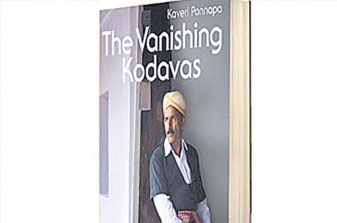
A fascinating picture of the people of Coorg, their origins, history, myths and traditions. The Vanishing Kodavas
By Kaveri Ponappa
Eminence Designs Pvt Ltd
Rs. 7500 PP360

The Vanishing Kodavas

Where the Coorgs came from, the enigma of their customs, social traditions, laws and dress are questions that have been debated ad infinitum. The Vanishing Kodavas by Kaveri Ponnapa is a work that not only answers these questions but also sheds light on the events that fashioned the people’s traditions and made them unique.
To do this, Ponnapa uses official records, correspondence, colonial accounts, the recorded history of the Rajahs of Kodagu or Coorg and the oral histories of the Kodava people themselves. The hauntingly beautiful backdrop of the wild, beautiful hills with their gurgling streams, dense forests, and abundant wildlife and flora serves as a canvas for stories about a people who made the hills of Coorg their home, and who, through their violent history, managed to preserve their ancient social customs, dress and way of life.

Replete with 300 colour plates, the book, which took Ponnapa 15 years to research, contains a wealth of information. Chapters tell stories of bygone eras, of myth and legends, of the tragic history of the people, of songs composed by warriors for whom routine violence was a way of life and of marriage rituals that were not only esoteric but also created to save a clan from extinction.

The reader is taken to a land that became almost sacred to its people — evident in the small, open-air shrines and large tracts set aside for worship – and into the heart of festivals dedicated to forest deities where trance and possession figure and oracles link the people to both their ancestors and their gods.

This is a book about a people who named the trees, shrubs, creepers and medicinal herbs, a people who created a rich oral tradition for themselves, worshipped their ancestors before all gods and danced before the spirits of the forest, and for whom upholding personal honour and that of one’s ancestry at all costs was the Kodava code.

Until recently the only source material for most contemporary accounts of Kodagu history were official manuals and gazetteer accounts. These were authored by missionaries and official historians of the East India Company and almost completely distorted the history of the Kodavas and obliterated the memory of the loyalty and affection the people felt for their kings.

The Vanishing Kodavas seeks to correct this image. It explores the unique role the tiny kingdom, ruled by Lingayat Rajahs, supported by a Council of Kodava Chieftains, played in the rise of the East India Company in southern India and focuses on a fast disappearing culture.

In The Vanishing Kodavas Ponnapa has created a volume of work that the reader will read, put away and revisit another day. Few writers can boast of making their work relevant to a general readership as well as to those for whom it will serve as a base for further academic studies.

Nalini Menon is a senior journalist

source: http://www.hindustantimes.com / Hindustan Times / Home> Books> Readiscover /by Nalini Menon, Hindustan Times / October 12th, 2013

The lost glory of a missing tribe

The land of Kodagu or Coorg — the source of the river Cauvery — with its lush hills, forest streams and plentiful wildlife and flora has been home to the Kodavas, as well as a number of forest-dwelling tribes, since time immemorial.

Over the centuries, the hills hid the tiny region from the eyes of the world, offering the people the freedom to roam the dense forests they loved and respected as their home.
A student of social anthropology from the School of Oriental and African Studies, London, Kaveri Ponnapa spent 15 years researching The Vanishing Kodavas — crisscrossing the length and breadth of Kodagu, attending village festivals, participating in ceremonies propitiating ancestors, harvest festivals, marriages, deaths and ceremonies where the spirits of the ancestors speak through oracles. What struck her most poignantly was that with each passing year, there were fewer dancers, fewer singers and the voices of change were even more strident.
BookKF29sept2013
Her book, The Vanishing Kodavas, thus seeks to capture the spirit of a people and the motivations that shaped their traditions — the events that fashioned them and made them unique. The book is full of information — stories, myths and legends, the tragic history of the people, the poetic songs composed by rough warriors to whom routine violence was a way of life. As Ponnapa explains, “In a country as large as this one, small cultures tend to be overlooked or ‘lost’ quite easily. The Kodavas, one of the smallest groups, have contributed significantly to the country in many fields… There are many such small cultures like this one across the world that just add to the richness of human diversity…”

The book also explores the unique role the tiny kingdom of Kodagu, ruled by Lingayat rajas, supported by a council of Kodava chieftains, played in the rise of the East India Company in southern India. Until recently, these official manuals and gazetteers’ accounts, authored by missionaries and official historians of the East India Company written with an eye on official censorship, were the only source-books for most contemporary accounts of Kodagu’s history. They projected a completely distorted picture of the rajas of Kodagu portraying them as bloodthirsty tyrants, almost obliterating all memory of the loyalty and affection the people of Kodagu demonstrated time and again for their kings, over more than two centuries of their co-existence that survived only in the folk history of the land.

Using official records, correspondence, colonial accounts, the recorded history of the rajas of Kodagu and the oral histories of the Kodava people themselves and combining this with some 300 spectacular photographs, Ponnapa has created a rich and engrossing account of one of the most enigmatic people who have fascinated generations of scholars, administrators and anthropologists.

The easy narrative style of the book makes it accessible to a wide readership and the serious research that has gone into the writing makes it an important reference work on a fast disappearing culture and a base for further academic studies.

Ashwin Coelho is a social anthropologist

source: http://www.asianage.com / The Asian Age / Home> Books / by Ashwin Coelho /
September 22nd, 2013