Category Archives: About Kodagu / Coorg

CMC wards restructured in Madikeri

After the exercise, the number of wards comes down to 23 from 31
Following the High Court’s direction to restructure the wards under Madikeri CMC limits, the CMC has taken measures to restructure the wards, based on the population of 2001 census.

There were 31 wards in Madikeri. Now, it has been reduced to 23. The CMC has already invited objections for the restructuring.

The new wards are:

Ward No 1 — Block No 14 (Dairy farm, Rifle range, Subrahmanya Nagara, DAR quarters, road behind FMC College, Vidya Nagara Housing Board)

Ward No 2 — block No 1 (Mahadevepete Main Road, Muthappa Temple Road, Kodandarama temple Road)

Ward No 3 — Block No 2, 3 and 24 (Ganapathy Street, Mahadevapete, Dasavala Road).

Ward No 4 — Block No 3 (partially)(Block 6) (Dasavala road, Ganapathy street)

Ward No 5 — Block No 5, 4 (Mahadevapete, Makangalli, Kanakadasa Road and Hill Road).

Ward No 6 — Block No 7, 4 (partially) (Ranipete, Mahadevapete, Hill Road)

Ward No 7— Block No 10, 7 (partially), 8, 9, 14 (Ranipete, Convent Road, Mallikarjuna Nagara).

Ward No 8 — Block No 8 (partially), 25, (Ranipete, Mallikarjuna Nagara).

Ward No 9 — Block No 9(partially), 14 (partially), 8 (partially) (College Road, Bhagavathi Nagara, ITI, Housing Board).

Ward No 10 — Block No 11, 12, 13 (College Road, Appacchu Kavi road, Pension lane, Shastri Nagara).

Ward No 11 — Block No 12 (partially), 11 (partially), 13 (partially), (Gowlibeedi main road).

Ward No 12 — Block No 14 (partially), Indiranagara, Chamundeshwara Nagara and new layouts.

Ward No 13 — Block No 14 (partially) (Jyothi Nagara, new layouts, Police quarters and Remand Home).

Ward No 14 — Block No 15, 14 (partially), (Rajaseat Road, Mangalore Road, Brahmanara Beedi, Chamaraja Villa Road).

Ward No 15 — Block No 16 (Mangaladevi Nagara, General Thimmaiah Road, Mission Compound, Moornadu Road).

Ward No 16 — Block No 17, 18 (Moornadu Road right side, Mangalore road left side, Mysore Road and G T Road).

Ward No 17 — Block No (partially), 17 (partially). 19 (Mysore road, Ukkuda, Old Siddapura Road and PWD quarters).

Ward No 18 — Block No 18 (partially), 17 (partially), (Mysore Road, Sudarshana Circle, Putani Nagara and Jayanagara).

Ward No 19 — Block No 20, 21, 22, 13 (Chaingate road, Junior College Road).
Ward No 20 — Block No (partially), (Dasavala Road, Kannandabane and Somwarpet road).

Ward No 21 — Block No 23 (partially), (Forest quarters, Somwarpet road, Kannandabane, Pumphouse and Housing Board).

Ward No 22 — Block No 24 (partially), (Muthappa temple road, behind Gaddige, Thyagaraja Colony).

Ward No 23 — Block No 24 (partially), (Behind Gaddige, Azad Nagar, Ukkuda Road and Rajarajeshwari Nagara).

History

Madikeri TMC was upgraded to CMC in 2007. After the upgradation, the number of wards were increased to 31. Questioning the increase in wards, P P Chami had filed a writ petition in the High Court, on March 24, 2008. During the proceedings, the court directed the state government to suspend the order on 31 wards. As the elected representatives were elected for 31 wards, the court had directed to maintain status quo and asked the government to restructure wards for the next election

source: http://www.DeccanHerald.com / Home> District / Madikeri, DHNS / December 02nd, 2012
Heaps of broken images

HERITAGE
Mookonda Kushalappa visits Moribetta in Kodagu and discovers that the hilltop has numerous megalithic structures. It is thought that these were more of commemorative value, built in remembrance of the dead.

In the north of Kodagu district, on the way from Madikeri towards Hassan is Moribetta, the ‘hill of the Maurya’. Local people are, however, not very familiar with that name. They know well the name of a sacred lake and a temple near the same hill, both dedicated to Goddess Honnamma.

As one approaches the place, one can spot two huge granite hills touching the sky. The bigger one is Gavibetta, while the smaller one is Moribetta. Green foliage surrounds the serene place. Coffee and other plantations make up the agrarian areas. The road leads one towards the large lake that lies between the two hills. This lake happens to be the largest one in the district. It is called Honnammana Kere, the lake of Honnamma. On the right side of the road are a couple of temples; the larger one is newly built and painted while the smaller one is in ruins. In fact, the older one is hardly distinguishable from the rocky background.

The ancient temple is built of stone blocks. Amidst these blocks which are overgrown with plants is an open doorway which is not quite discernable. In the darkness within is a stone nandi, the bull that carries Shiva, and a linga. The more modern temple is the temple of the goddess in front of the lake. Both the lake and this temple are named after the local goddess, Honnamma.

The lake temple
Legend has it that Honnamma was the youngest among an influential man’s daughters-in-law. When the father-in-law told his daughters-in-law that one of them had to sacrifice her life for the common good, it was only the youngest, Honnamma, who complied. She jumped into the lake and drowned. Ever since, the lake has never gone dry. It is after her death that she was revered as goddess Honnamma, the golden deity.
On the occasion of Gowri habba, a day before Ganesh Chaturthi, the place has throngs of people. As part of the festival, a bagina or an offering is made to the goddess. This is left afloat on the lake.

During this annual temple festival, pilgrims trek up Moribetta until they reach a spot marked by a flag near its summit. The lesser-known name of the village is Doddamalte. Gavibetta has a few caves and a stairway that leads to the summit. Villagers refrain from speaking much about the ‘other hill’, Moribetta, because of talk about it being an ancient site for human sacrifices.

Shrouded in mystery
Mystery shrouds the Moribetta hill. There are numerous megaliths, although in disarray, on the hilltop. There are 50 short dolmens or portholes on the granite hill. Each of them is an arrangement of four upright flat stones with a capstone and the eastern wall has a circular porthole. These granite slab dolmens stand around four or five feet high and the circular portholes are a little more than a foot in diameter.

While some are intact, others have been broken down. Many of these dolmens have been dismantled and destroyed by treasure hunters, grave diggers, stone cutters or neighbouring farmers. Some of them have taller orthostats (large stones standing upright) beside them. Interspersed between them are cairns or piles of stones.

No human remains were found in the portholes. Broken stone circles can also be found on the granite hilltop.

These structures on Moribetta didn’t hold any remains of the dead nor were they habitable. They were like miniature houses, but these abodes were too small to live in. They contained miniature utensils and goods. Some claimed that a pygmy race lived in them. In a 19th-century published article titled ‘Rude stone monuments in all countries’, Fergusson was mesmerised by these ‘miniature toys’ of Moribetta but doesn’t give an explanation for their size.

However, as no human remains were found in the place, it is thought that these were more of commemorative value, built in remembrance of the dead. To reduce expenses, all these that were built for the dead would have been made on a miniature scale, as they were not used for practical living purposes. Historians like B L Rice, Mackenzie, Rob Cole and K K Subbayya have already explored the hill extensively. Some locals call the structures on Moribetta Kodava Kote, ‘fort of the Kodavas’.

Epic connection
These cromlechs were associated with the Pandavas, the demigod heroes of the Mahabharatha. Locals called them ‘Pandava Pare’ as well, in the past. The same name is used for large stones that were used to lay steps that led to temples and large country houses in Kodagu. Now, however, it’s a forgotten place visited only during the annual temple feast of Honnamma on Gowri festival, a day before Ganesh Chaturthi.
Six miles from Somwarpet is another place called Morikallu, also known locally as ‘Pandava Bande’. This is a small granite hillock with six dolmens, of which four were well preserved and surrounded by paddy fields. Stone circles surround all these dolmens. The shrine of Male Sartavu, another Kodava temple, has six stones; they are said to have been dedicated to the five Pandava brothers and their wife Draupadi.

In South India, anything ancient or unknown would be quickly attributed to Brahma (Brahmagiri, the ‘hill of Brahma’ or Brahmadesam, the ‘country of Brahma’), the mythical Pandavas (places called ‘Pandava Pare’ or ‘Pandava Bande’) or the historical Mauryas (Moribetta ‘hill of the Maurya’ or Morikallu, ‘rock of the Maurya’).

According to Rob Cole’s book, Kodavas have an ancient belief that the Pandavas were the original owners of the earth who rented out land to agriculturists. On Bisu Changrandi (Vishu), also called Edmyaar 1, the new year of the Kodava calendar, Kodavas start farming their lands without fail. This is because they believed that if they don’t, then the Pandavas would come down from their celestial abode to reclaim their lands.

In his 1870-book ‘Gazetteer of Coorg’, Richter speaks of this picturesque tank, Honnammana kere, which is three miles from Somwarpet, but doesn’t mention its name. He talks of a version of the legend associated with the place. Malla Shetty of Yelusavirashime was the father-in-law who vowed to build this tank.

Sacrifice

But after its construction, there was still no water. It was suggested that animals be offered in sacrifice to appease the gods but to no avail. Goddess Ganga appeared in front of the merchant and asked him for a sacrifice. So he approached his daughter-in-law Akkony whose husband was away. Akkony took leave of her child and parents and entered the tank to drown in the rising water.

Her parents and husband got upset upon hearing this. Richter also writes about a stone inscription found in the place. It reads in Kannada, “King Andany has ordered this tank to be built on Tuesday the tenth day of the month of Phalguna in the year Parthiva.

“This was written by Venkadasya Mallia Bomarsia at the time of Basawalinga Deva Raja Vodea”.
Lately this stone inscription has been cemented on the ground in front of the new Honnamma temple.

King Andany mentioned here must have been a local ruler while the person mentioned at the end must have been the Lingayat (Basawalinga) Raja Devappa (Deva Raja Wodeyar, 1770-1774) of the Haleri dynasty

source: http://www.DeccanHerald.com / Home> Supplements> Spectrum by Mookonda Kushalappa / November 26th, 2012

Jamma Baane comes under forest : Governor

‘It is not a revenue land’

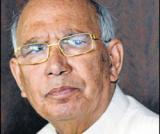
Governor H R Bharadwaj has opined that Jamma Baane land comes under forest limits in Kodagu district.

Speaking to Deccan Herald, during his private visit in Madikeri on Monday, he said that Jamma Baane land comes under forest. “People were given the right to use the land. However, it is not a revenue land,” he said.

The Assembly had passed Karnataka Land Revenue (Amendment) Act, with regard to Jamma Baane. However, the Governor had not given assent to the Act.

“As Jamma Baane comes under forest limits, I had sent the Act to the Central government for approval.”

Kodagu district is surrounded by Western Ghats, which is known for its flora and fauna. It is one of the hotspots of the world. There is a need conserve the bio diversity, he said.

Kodagu is a tourists paradise. Several tourists visit the district to enjoy the beauty of nature. There is a need to promote eco-friendly tourism, without harming the nature.

‘Provide facilities’

The Governor said that the government can solve the problems related to Maoists by responding to the needs of the people.

“There is a need to provide basic facilities in the villages. The villagers should be provided with better health care and education. To check the eviction of the forest dwellers, Forest Rights Act has been implemented. MGNREGS and others schemes of the government should be implemented effectively.

Intervention

The Governor said that he has been watching closely into the political development in the State. “I will intervene, if there was any constitutional crisis in the State.

The development is internal issue of the BJP. I can not intervene now,” he said and added “the government should function as per the constitution.”

Deputy Commissioner Dr N V Prasad, SP Manjunath Annigeri, Additional DC N Shivashankar, CMC Commissioner N M Shashikumar and others were present.

source: http://www.DeccanHerald.com / Home> District / Madikeri, DHNS / November 13th, 2012

Tribals empowered to collect minor forest produces: Rameshwar Oraon


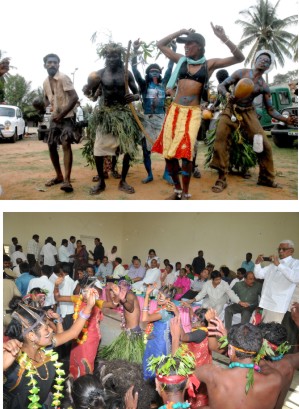
Rameshwar Oraon, Chairperson, National Commission for Scheduled Tribes, addressing tribals at Dr. B.R. Ambedkar Bhavan in Hunsur yesterday, accompanied by other members of the Commission. Pictures centre and right show the tribal dances performed to welcome the Central team.

Mysore, Nov. 9 (RK&RNN)
Tribal people have every right to collect and sell Minor Forest Produces (MFP) and no one could interfere with this, observed Rameshwar Oraon, Chairperson, National Commission for Scheduled Tribes.

Addressing members of the tribal community at Dr. B.R. Ambedkar Bhavan in Hunsur after visiting several Haadis in H.D. Kote taluk of Mysore district yesterday, he said the Union Government was taking steps to fix a minimum price for the MFP to avoid exploitation from middle men.

He also added that The Scheduled Tribes and Other Traditional Forest Dwellers (Recognition of Forest Rights) Act, 2006 made all tribal people living in the forest eligible for title deeds of their lands and urged Adivasis to take benefits due to them.

He also elicited the opinion of tribal people and others who participated in the meeting on whether they were getting the benefits given by the Centre.

Stating that the tribals would be given compensation four times higher than the existing value of the land if the same was acquired for any government purpose, Oraon added that the Centre was planning to bring legislation in this regard.

Many of those present complained that they were denied benefits like schools, angan-wadi centres, drinking water and ration under the Public Distribution System (PDS) to which Oraon replied that he would take up the issue with the State Chief Secretary at a meeting scheduled to be held today and added that he would also discuss it with Deputy Commissioner and CEO of Mysore Zilla Panchayat.

Food security to tribals

It is reported that Rameshwar Oraon has directed the District Administration to provide food security to tribals and adivasis living in the periphery of forests through Fair Price shops and also urged the District Administration to provide them alternative land for agriculture.

Stressing for education to tri-bal children at Ashraya Schools from first to seventh standards, Oraon instructed ADGP Chikkanur to withdraw false cases filed against tribals and also called for making arrangements for selling of products manufactured by tribals through Lamp Societies at good prices.

He directed early completion of probe into the missing cases of Jiyamballi Raju and Hunsekoppa Bheemasena besides ensuring avoidance of harassment of tribals by forest officials.

A traditional welcome was accorded to the visiting team by tribals who performed folk dan-ces following which Prasanna, Convenor of South India Cell for Human Rights Education and Monitoring (SICHREM) and Vaddaragudi Chikkanna gave a presentation of problems being faced by tribals.

The team consisting of Rameshwar Oraon, Commission members Kamala Kumari, B.L. Meena, Jt. Secretary Aditya Mishra, Dy. Director K.D.Bansar, SC/ST Regional Office (Bhopal) Asst. Director R.K.Dubey and others who arrived from Bangalore in the morning drove straight to Morarji Desai School Hostel in Hunsur for an inspection.

Dy. Commissioner P.S. Vastrad, ZP CEO Dr. Ajai Nagabhushan, SP R.Dileep, MLAs Chikkanna and Manjunath, Asst. Commissioners, Tahasil dars and other officials provided necessary information to the team.

source: http://www.StarofMysore.com / Home> General News / November 09th, 2012

‘Privilege to Kodavas’

President of the Codava National Council N.U. Nachappa said on Monday that the exemption certificate to hold firearms in place of licences was a privilege given to the Kodava people by the Centre. No one could interfere with it, Mr. Nachappa said addressing a gathering at Kakkabe in Madikeri taluk.

The CNC was organising awareness programmes on the right of Kodava people to hold weapons without licence ever since the Forest Department issued a circular making permission from them necessary to possess firearms.

source: http:/ww.TheHindu.com / Home> National> Karnataka / by Special Correspondent / Mysore, October 09th, 2012

Tribals will not be evicted from sacred groves: Minister

‘Hobli-level janasamparka meeting likely to be extended to State’

Hundreds of people thronged to the Janasamparka meeting held at Kutta Kodava Samaja on Saturday, seeking solution for their various problems.

The people found solution to the problems related to delay in distribution of ration cards, Sandhya suraksha yojana, pension for senior citizens, honorarium for widow and so on.
Speaking after inaugurating, District-in-Charge Minister M P Appachu Ranjan said that the government wants to reach out the programmes to the beneficiaries.

The Minister said that ‘sacred groves will be conserved. There was a need to provide basic facilities. In the name of conserving sacred groves, tribals will not be evicted.”
Deputy Chief Minister K S Eshwarappa is planning to extend the model hobli-level janasamparka meeting to the entire state.

“Janasamparka is nothing but taking the government to the people,” he said.
Assembly Speaker K G Bopaiah flayed the forest department officials for preventing the forest dwellers of Devamacchi forest from offering pooja in the temples.

The Forest Rights Act provides an opportunity for the forest dwellers to lead a comfortable life. Pseudo environmentalists are responsible for fire in Nagarahole reserve forest.

By propagating false rumours, they are engaged in getting funds from foreign countries. “Forest is house for the forest dwellers. They will not engage in setting fire on the forest. The forest has been conserved by the dwellers and not by the pseudo environmentalists.”

Various schemes were distributed among 3,440 beneficiaries on the occasion. This includes Sandhya Suraksha scheme, pension for widow and physically challenged, natural calamity relief fund, Bhagyalakshmi bond, fodder kit, ration cards, nutrition food for the tribals, financial assistance for the students, housing schemes and so on.

Cheques were distributed to 1,796 families under natural calamity relief fund.
Zilla Panchayat Vice-President H M Kaveri, Additional DC Dr N Shivashankar, SP Manjunath Annigeri, ZP CEO K B Anjanappa and others were present.

source: http://www.DeccanHerald.com / Home> District / DH News Service / Madikeri, September 30th, 2012

A tale of resistance & rewards

Heritage:

Three years after the British took over Kodagu, a rebellion against the rulers erupted in the region. Among the rebels was Guddemane Appayya. C P Belliappa charts the chronology of events immediately after the rebellion was quelled.

In 1837, three years after the British take-over of Kodagu, a rebellion erupted against the colonisers. This uprising is popularly known as ‘Amara Sulya da Katakai’. The primary reason for this revolt by some of the peasants in Sulya was their objection to the British collecting land tax in currency instead of in kind as was the practice during the reign of the rajas. There was also a rather mysterious individual named Kalyanaswamy who proclaimed himself a descendant of the Haleri rajas and claimed the throne of Kodagu.

The rebellious peasants rallied round him. Guddemane Appayya took command of the rebels. The entire uprising was not well organised and there was a great deal of confusion. However, it soon spread to Puttur and then right up to Mangalore, where some of the establishments of the East India Company were ransacked. Emboldened by their success, the rebels made a bid to attack Madikeri, the capital of Kodagu.

Three years of British administration had brought peace and stability in Kodagu and a majority of the people did not want this disturbed. Compared to the misrule of Chikka Veerarajendra, the administration was streamlined and there was equitable law. People-friendly policies were implemented in various fields. The alarmed British enlisted the support of Kodavas to quell the rebellion. The two dewans, Apparanda Bopanna and Chepudira Ponnappa, mustered the Kodavas, and within days the insurgency was put down. The British did not want any repetition of such revolts against their rule. Harsh punishments were meted out to those who took part in the rebellion. Amongst those executed were Kalyanaswamy and Guddemane Appayya.

After this operation was completed, a large amount of booty was collected from the rebels. The British offered the spoils of war to the Kodavas for having helped them. To the surprise of the British, Kodavas rejected sharing the war booty.

Awards for quelling rebellion

At the time, Colonel Mark Cubbon who was posted in Bangalore was also the Commissioner of Kodagu and Captain Le Hardy was the superintendent. It was Colonel Mark Cubbon who recommended to the then governor-general Lord Auckland that the gallant Kodavas should be suitably recognised for their distinguished service in quelling the rebellion. On Mark Cubbon’s recommendation, the following awards were presented: gold medals with gold chains worth Rs 400 to the two dewans, 12 gold medals with chains worth Rs 200 to subedhars and principal chiefs, 20 gold medals without chains for parpatigars and others of equal rank, 10 gold medals worth Rs 50 for peasants who supported the British, 200 silver medals worth Rs 10 for lower ranks and peasants.

Several bronze and copper medals were presented to the foot-soldiers. All these medals were two inches in diameter. They were cast in the same moulding with a Kodava warrior on the obverse and a trophy of Kodava arms on the reverse. Weights of the gold medals were adjusted by varying the thickness.

In addition, there were grants of land, Pegu ponies, fowling pieces (guns), shawls, clothes, turbans, etc.

But there was a 70-year-old subedhar named Monnaiah (spelt Moonien by the British) who rejected all that the British offered. He was crestfallen, because during the operation, he had lost his prized sword which was a gift from Dodda Veerarajendra. He wanted nothing other than replacement of the sword!

Mark Cubbon immediately acted on this request and had an exact replica made and presented to the subedhar. I wonder if this sword exists somewhere in one of the Kodava homes. Likewise, none of the gold and silver medallions are with any of the Kodava families.

However, I have one of the bronze medals, which was very kindly gifted to me by A Franklin, an avid art collector in Bangalore.

Franklin is also the proud owner of the autographed Bible that Queen Victoria presented to her god daughter Princess Victoria Gowramma of Coorg in 1852.

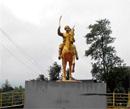
History has nevertheless come full circle. Recently an imposing statue of Guddemane Appayya on horse-back has been installed at the entrance to Madikeri town. He is recognised as one of the earliest freedom fighters.

source: http://www.DeccanHerald.com / Home> Supplements> Spectrum> Heritage / October 01st, 2012

Women & Guns

Mysore, Sept. 8:

The Week magazine dated September 16, 2012, has a surprise for Kodavas particularly as it carries on its cover the gun-toting, trigger-happy Kodava woman who lives in city, Mrs. Tiny Biddapa.

The 66-year-old Kodavathi, Madrira Tiny Biddapa, is also featured on the inside-spread of the magazine with her 12-bore gun resting on her shoulder inside her coconut-garden in the outskirts of the city adjacent to the Police Layout in Mysore East.

The article says that many women see guns as a force equaliser in this unfair world, well, dominated by men of lust and greed.—KBG

source: http://www.StarofMysore.com / General News / September 08th, 2012

Serving the Kodava cause


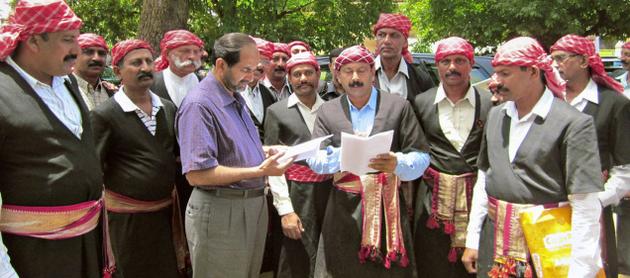
File photos of (left) CNC members led by N.U. Nachappa presenting a memorandum to the Kodagu district administration representative and (right) Kodavas staging a protest to highlight their demands.— / Photos: Nanda kumar, Sampath Kumar G.P./ The Hindu

Will the two-decade-old struggle of the Codava National Council (CNC), demanding an autonomous Kodava homeland, succeed? This is a debatable point. The CNC led by its president, Nandineravanda U. Nachappa, initially was demanding a separate Statehood, but later scaled it down to seek an autonomous homeland. Mr. Nachappa has been able to keep the organisation alive and make its presence felt, both at the State and the national level, by organising protests, demonstrations and other conspicuous events.

The main demand of the CNC is a full-fledged Kodava Autonomous Region, encompassing the 45 ancient traditional ‘naads’ (‘nad’ is a group of villages), on a par with the Darjeeling Gorkhaland Territorial Administration.

Mr. Nachappa says that the Central Government must accord ethno-linguistic tribal minority status to the Kodavas under the Constitution and extend reservation facilities in the fields of education, economic and employment. It should also ensure Constitutional special guarantee for the land tenures and customary personal laws of the Kodavas without any interference, on the lines of Jammu and Kashmir and Northeast States of India under Articles 370 and 371 of the Constitution.

The Government must facilitate the CNC to establish a Central University to propagate “Kodavalogy” on the lines of North-Eastern Hill University, Aligarh Muslim University and Banaras Hindu University, Mr. Nachappa demands. Kodava language must be included in the VIII Schedule to the Constitution and implemented as one of the three administrative languages in Kodagu.

The exemption under the Indian Arms Act to hold firearms to the ‘Kodava by race’ people should continue without any hindrance, Mr. Nachappa argues. In the same manner, the land rights being enjoyed by the Kodava people, thanks to privileges such as ‘Jamma’, must stay, he demands.

The CNC opposes the Dilip Singh Bhuria report submitted to the Centre that wanted Virajpet taluk to be declared as a Scheduled Area for the benefit of tribal people who live in that taluk. Mr. Nachappa argues that it would adversely affect the Kodava people, whose roots could be traced to Virajpet taluk and parts of Madikeri taluk.

Submitting memoranda

Memoranda are being submitted to the State and the Central Governments time and again by the CNC to further its cause. The Central and the State Government authorities too have been acknowledging them. But, there are many who look at its struggle sceptically. The movement lacked political support and the backing of the entire populace of Kodagu, they say. They also term it as an unpopular movement which does not cover populace other than a group of Kodava people in the district. But Mr. Nachappa maintains a hard stand, stating that cause of the struggle was important and it was achievable irrespective of numbers or backing by the majority.

He says that the struggle was totally peaceful and well within the bounds of the Constitutional framework. The CNC had also forged alliances with 13 other like-minded organisations across the country to achieve its goals in the past, including the Darjeeling Gorkha Hill Council and the Jharkhand Mukti Morcha.

The CNC claims credit for a series of development works that were initiated in Kodagu in the last one-and-a-half decades, including roads and bridges, plus release of special grants. It also says that the credit for the proposed move of the State Government to write to the Centre recommending establishment of a Central University in Kodagu, should go to the organisation.

Guests

Mr. Nachappa’s effort to rope in the support of political leaders and heads of other organisations is worth a mention here. During the previous Annual Day celebrations of the CNC in Madikeri, the AICC general secretary, Oscar Fernandes, Additional Advocate-General of Haryana and Supreme Court advocate, Brijesh Kalappa, and Karnataka High Court advocate, M.T. Nanaiah, were the guests. Gorkha leader Dawa Pakhrin, JMM leader Shibu Soren, and intellectuals Balveer Arora and T.K. Oommen, among others, have been guests in the past.

Mr. Nachappa has reiterated the demand of the CNC to establish the proposed Central University at the ‘Kodava Kund’ (Kodava Hill), a location identified by the CNC near Kakkabe.

The CNC delegations have submitted memoranda to the State Governors and met the Chief Ministers of Karnataka several times in the past.

Census

The CNC has been appealing to the Kodagu Deputy Commissioner to direct the caste census enumerators to enlist the Kodava people separately under the columns of the ‘Kodava’ caste, and not as ‘Kodagaru’ or ‘Kodaga’ or ‘Coorgi’ in the census sheets. This move would enable the minority Kodava people to assert their identity and uphold the dignity of the community whose people had been serving the nation admirably well in various fields, it felt. Some success was achieved in this regard in Kodagu.

To bolster its base, the CNC has been organising ‘Ain Mane’ (ancestral home) programmes in select Kodava families since a few years. It has been coming up with ‘human chain’ programmes in the entire district, mainly targeting the areas dominated by the Kodava populace.

Other causes

The CNC, apart from taking up the causes of the Kodava people, has also been observing World Indigenous Peoples Day, World Minorities Day, and ‘Black Day’ on November 1, coinciding with Kannada Rajyotsava.

Mr. Nachappa argues that ‘Kannada Nadu’ could not be complete without the creation of an autonomous homeland within the State of Karnataka.

Mr. Nachappa, who has not groomed a deputy so far in his nearly two-decade existence, has preferred to change the nomenclatures of his organisation several times. What appeared to be a broad-based organisation encompassing a few other communities as well in the beginning has come to patronise only Kodavas in the recent times. The ‘Kodagu Praja Vedike’ which took birth only to counter the CNC has now fizzled out.

Mr. Nachappa hopes that the Kodava Autonomous Region would become a reality along with Telangana.

Jeevan Chinnappa

A full-fledged Kodava Autonomous Region, a Central University to propagate ‘Kodavalogy’, special land rights… the CNC has a whole list of demands

source: http://www.TheHindu.com / Home> Features> District Plus / by Jeevan Chinnappa / September 08th, 2012

Natural cave unearthed

The forest officials have recently unearthed a natural cave inisde the thick forest, in Kodagu district.

The cave is situated near Anderson stream inside thick forest at Vatekoli, which is 15 kms from Virajpet- Makutta road. The cave is 60 metre long and two metres in height. According to forest department officials, they have heard the sound of water inside the cave. “If there is water inside the cave, then it would be giving shelter to water creatures like fish, crab and so on. Realising the decrease in oxygen inside the cave, the officials did not make an attempt to move further inside the cave.”

The bats will welcome anyone who enters the cave. Normally, snakes live in and around those areas where bats live, say officials. Kodagu Circle Chief Conservator of Forest Deekshith said that the cave must have been formed by the flow of water through limestone and similar rocks. Water seeps into the pores and cracks of rocks and soil and bubbles beneath the earth above. Such caves are called as Solution caves.

The soil in the cave is a mixture of white and grey colour and is soft. The roof of the cave is strong. “We could not see the cave fully. The cave will provide an opportunity for the geologists to make a study. I will inform the State government on the discovery of a cave. If the government sends an expert, we will get more details on the cave,” said an official. It is said that the forest guards had discovered it a year ago. However, they had not informed it to the higher authorities. After taking charge, Deekshith visited the spot. In fact, he has marked the route to the cave through GPS.

source: http://www.DeccanHerald.com / Home> District / DHNS, Madikeri, August 08th, 2012