Category Archives: About Kodagu / Coorg

Cauvery: include Betta Kurubas in ST list

‘A ZP resolution should be submitted to the government’
Vice-president of the Kodagu Zilla Panchayat H.M. Cauvery said on Monday that the State government must include Betta Kurubas in the list of Scheduled Tribes to enable them to get benefits due to the community.

She made this point at the monthly KDP meeting held at the Old Assembly Hall in Madikeri presided over by president of the zilla panchayat Ravi Kushalappa, according to a press release.

A resolution should be passed in the meeting and submitted to the government, Ms. Cauvery said.

Chief Executive Officer of the zilla panchayat N. Krishnappa said that the State government had constituted a commission to take up a comprehensive study of SC and ST communities in the State. It would be good if the proposal (to consider Betta Kurubas as ST) was submitted to the commission.

Kodagu Social Welfare Officer Rajesh Gowda said that his department had written to the State government to consider Betta Kurbas as a Scheduled Tribe. He would remind the government of it again. Mr. Krishnappa asked the social welfare officer and the Integrated Tribal Development Project (ITDP) officer to take steps to assess the socio-economic status of SC and ST communities in Kodagu and the extent of government benefits that reached them.

Deputy secretary of the zilla panchayat S.Y. Basavarajappa said that Rs. 18.92 crore had been spent under MGNREGA scheme in Kodagu and Rs. 1.27 crore had to be spent. Mr. Krishnappa said a proposal seeking Rs. 9 crore had been submitted to the government in the current year of which Rs. 1 crore had been released. Funds were being provided based on the requirements of gram panchayats, Mr. Krishnappa said.

He said 52 drinking water projects were energised in the district recently, and asked the Executive Engineer of Chamundeshwari Electricity Supply Corporation (CESC) to complete 18 such projects by March-end.

Mr. Kushalappa asked CESC to follow up the work on Rajiv Gandhi Grameen Vidyudeekaran Yojna providing electricity to BPL households in the district and ensure that it was completed by March-end.

source: http://www.TheHindu.com / National> Karnataka / By Staff Correspondent / Mysore, March 13th, 2012

AINMANE: Preserve it for Posterity

Ainmane, the house of the elders in Kodagu, has given an opportunity for the families to live without any discrimination. Men and women were considered equal. If a girl whose married life was not happy and if she had a serious problem in her husband’s place, she had a right to leave her in-laws’ house and live at Ainmane as long as she lived. Obviously, Ainmane protected women by providing a shelter with affection.
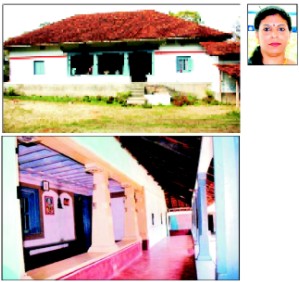
The pressures of 21st century’s globalisation and urbanisation has made people of Kodagu re-think about their cultural heritage and rich tradition. Today, one can see this healthy growth in their thoughts too with each ‘Vokka’ trying to protect their Ainmane — more as a prestige issue for every family to have their Ainmane renovated, re-built and protected. With some hope towards a prosperous life, let’s preserve our Ainmanes for posterity.

One finds Kodavas’lifestyle unique. Its recorded history dates back to 18th century. The people here live in a hilly region amidst heavy rain, cold and wild animals. Hence they have their own lifestyle and culture that is unique in its nature.

Kodagu people lead their lives in houses that stand apart in architecture. The house that is remarkable in its structure and a place of unique bonding, that ancestral house is called Ainmane. Ainmane has always stood as a mirror reflecting the Kodava culture, life, family practices, worships and festivals according to seasons.

Kodava culture enjoyed joint family system in the past. It is because of Ainmane that Kodava families have a family name. According to the names, the families of Vokka or Vamsha is identified. Under one Vokka, there are many family units. Many Vokkas have more than 500 units. All these families put together has one Ainmane. The family also has its own ornaments, weapons, implements used for agriculture, the gift from the kings who ruled Kodagu etc. These are treasured items that are collected and preserved.

Based on this, Ainmane is not only a living place for families but it acts like a museum of the community that helps to enhance the cultural heritage of Kodavas.

The relationship between Kodagu and Kerala seems to be closely knit since ages. Ainmane stands as a proof to it. Comparing to the house of Nayars of Kerala (that is called as Taravad) and the Ainmane, we can see many similarities. The influence of Malayalam on Kodava language cannot to be ignored. Similarities can be found between the two languages. The festivals, a few rituals, ceremonies performed and some celebrations have a strong Malayalam impact. It is clearly identified that Ainmane has played a significant role and has provided enough room to have a good relationship between Kodagu and Malayalam province. More important is the structure and architecture of Ainmane that is a living example to recognise the relationship from the past between Kodagu and Kerala.

The Kings who ruled Kodagu built their Palaces in the same style of Taravad houses. Towards the North of Kodagu in a place called ‘Yavakapadi,’ king Doddaveera Rajendra, who ruled Kodagu, built a Palace in Nalaknadu village in 1792. Architecture of this Palace resembles Ainmanes of Kodavas. This clearly shows that architecture of Ainmane has been influenced from Kerala and hence instilled the same kind of style to their Palaces.

Likewise, the Palaces that exhibit their majestic nature seem to be unique, like that of Ainmane that which is a link to depict the history of Kodavas of Kodagu. The pivot of joint families was the Ainmane where in the past era, people of different age groups lived together. The centre was always full of life. But today, because of modernisation, the Ainmane is only an epitome depicting Kodava cultural heritage.

Modern education and urbanisation has opened a new lifestyle for Kodavas. Herein they look down upon their own culture and hence the existence of Ainmane has become obsolete. Higher education has made many to take up urban residence. Therefore, elders of the family are the only people who are living in Ainmane; but after their death, Ainmane is sort of abandoned and edge towards dilapidated condition, without any family living there. In a few circumstances, there are modern style houses coming up. Members of the families live in these modern houses near to Ainmane, which is kept locked. They open it at dawn and at dusk to light the traditional lamp at the Nellakki Baade inside it.

As families become financially stable, they try to migrate to the cities either selling their property or asking somebody to look after it. Such families have abandoned Ainmane and hence, most of them are in a neglected state. Growth in economic conditions and the family planning followed by Kodava families has resulted in one or two children in a family. Moreover, the children are brought up in cities. Education is provided there and hence they get employed in the cities itself. The above reasons have led Kodava families to leave their native. All family members have a right on Ainmane, but their lack of interest and their dislike towards rural lifestyle have prevented them to give a serious thought on their ancestral house.

The house of elders has given an opportunity for the families to live without any discrimination. Men and women were considered equal. If a girl whose married life was not happy and if she had problem in her husband’s place, she had a right to live at her parents’ Ainmane. Obviously, Ainmane protected women by providing them shelter and respect.

The pressures of 21st century globalisation and urbanisation has made people of Kodagu re-think about their cultural heritage and rich tradition. Today, one can see this healthy growth in their thoughts too with each Vokka trying to protect their Ainmane — more as a prestige issue for every family to have their Ainmane renovated, rebuilt and protected. With some hope towards a prosperous life, let’s preserve our Ainmanes for posterity.

Significance of Ainmane

Ainmane is not only a part of the culture of Kodavas, but also of Kodava dialect speaking communities. Though Ainmanes of all sects are similar, they are also called Balyagattumane, gurukarana mane, gurumane etc.

Rev. G. Richter writes in the Gazetteer of Coorg (1870) that Ainmane usually is near paddy fields. Ainmane would be one-storied and square shaped, with an attic. Though east-facing houses are preferred, more emphasis was on houses facing paddy fields. A typical Ainmane will have two doors at the entrance. Entering inside, Nadu mane is found. Living rooms in this square-sha-ped house have small doors and usually no windows.

Ainmane has an open roof space in the middle, so that rain water is collected within and excess water is drained out. The house consists of two doors to go to backyard. Front portion of the house is a canopied open hall called as Kaiyale. It consists of a 2-feet high seater of thick wooden plank which is used as a bench, called Aimara. Daughters-in-law of the house are not allowed to sit on Aimara whereas married daughters of the house can sit on it. Elders of the family usually sit here to exchange cordialities, discuss various issues and take important decisions.

Two massive wooden poles adorn the entrance. The central Nadubaade would consist of three wooden poles. The first pole is called as Kannikamba — it supports the whole roof of Ainmane. The kannikamba is as significant as the thook bolcha (hanging lamp) lit everyday at the Nellakki Baade (prayer room).

During ceremonies, family members would seek blessings by touching the base of kannika-mba and then the feet of elders. Images of sun, moon, flowers etc. adorn Kannikamba and main doors, signifying that Kodavas were nature worshippers.

An integral part of Ainmane is Kaimada — an important structure built in memory of the founder of that family or Vokka. It is a prayer place which is used during happy or sad ceremonies.

At Ainmane, the prime position is given to karona, the head of that particular family. Unique feature about Kodava culture is that men and women share same kind of respect, status and position.

Earlier, families of a Vokka lived together at Ainmane. Later, a few families left Ainmane to live independently and improve their property. The result was joint families gave way to nuclear families. New houses are built in modern architecture. But during festivals and other occasions, Vokka members gather at Ainmane and partake in the ceremonies and feast, symbolising unity.

source: http://www.StarofMysore.com / Feature Articles / March 04th, 2012
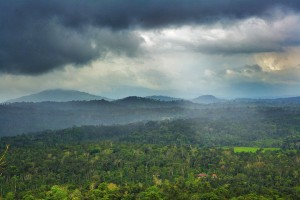
Coorg – The Kashmir of Karnataka & Scotland of India


Coorg the modern name for Kodagu is a unique and beautiful hill station in the Western Ghats of Karnataka. Coorg is a small district covered with dense forests and picturesque valleys and enchanting waterfalls. This is one of the closest experiences one can have with Mother Nature. Coorg is a famous tourist destination for both Indian and international tourists. This quaint and scenic hill station is commonly known as the Kashmir of Karnataka & the Scotland of India.

Coorg is the largest producer of coffee in India. It is recognized for its vast and magnificent coffee tree plantations all over India. It is said that the fragrance of coffee fills the air of Coorg . The gorgeous plantations are spread over the slopes of the hilly regions. Besides, coffee plantations Coorg and its cities are famous for spices like cardamom and pepper. Apart from buying coffee, lot of tourists buy the best and natural honey manufactured in Coorg as its souvenir.

Do you love animals and wildlife? Coorg has many wildlife sanctuaries and national parks and is known to be prosperous in wildlife.

It is recommended that wildlife lovers must visit Coorg to explore and experience the adventurous elephant safaris organized by national parks. One can also, catch a glance of wild bears, deer’s, tigers and many interesting and charming birds. It is said that there are hundreds of different species of birds found in the paradise – Coorg.

Tourists can take part in adventurous sports like river rafting, trekking, and angling. Coorg is the best place to listen to your adventurous spirit and enjoy yourself to the fullest. There are many places to visit including the Abbey Falls, Raja Seat, Nisargadhama and the Tibet Monastery are the main attractions. One can also, visit wildlife sanctuaries like Brahmagiri Wildlife Sanctuary, Rajiv Gandhi National Park and Pushpagiri Wildlife Sanctuary. There are many historic and divine places including temples of Lord Shiva & Lord Vishnu –Omkareshwara which make the marvelous district heavenly.

Coorg has very pleasant summers and winters. However, it is recommended that tourists must avoid the monsoon season from May to October. A two to three day trip is good enough to experience the beautiful scenery of the captivating and serene Coorg.

Coorg homestay is the finest option for accommodation adding to the splendid experience. Coorg accommodation includes all types of housing which are available within one’s favorable budget. Coorg cottages are another great option to relax and unwind oneself and feel close to nature. Cottages in Coorg are known the best to experience the calm and mystical blue skies and mountains. Bird chirping sounds and unpolluted fresh air unlike big cities rejuvenates one’s body & mind. The resort in coorg has beautifully furnished cottages for both couples and families. Coorg also, has many hotel options near the capital.

Coorg is known to be the ‘Heaven on Earth’ and a numinous paradise which one must visit to explore its lush green mountains, enthralling waterfalls, wildlife & rich culture.

source: http://www.ZaraHutke.in / Home> Blog / February 23rd, 2012

Coorg, a green escape in Karnataka

If you find Ooty, Kodaikanal or Munnar a bit too touristy and crowded a destination in southern India, Coorg is that perfect holiday spot in Karnataka that is sure to please toddlers, youth and the old alike.

Not that this hill station needs to be chosen for a sojourn by eliminating other similar destinations in the vicinity. Just a three-hour drive from Mysore, 150 km away, Coorg district on its own has much to offer, beyond its coffee, cardamom, pepper and beetelnut estates.

There is much to see, admire and soak in at this hill station, which the locals call Kodagu, on the slopes of the Western Ghats, what with some pristine trekking trails, picnic spots, waterfalls, wildlife, woods, forests, valleys and some mouth-watering cuisine.

Situated at a height of 1,525 metres, Madikeri or Mercara is the capital of Coorg, with a nice bazaar, quaint houses with red-roofs and liberal use of teakwood reapers for doors and furniture, so common among homes and clubhouses in Indian hill stations.

It may come as a surprise to some that Coorg has one of the largest settlements of Buddhists in India, just about 30 km away from Madikeri, with their own Namdroling Monastery built in 1963, which the locals call the Golden Temple.

Once you enter the monastery, you feel transported into some other world in the Orient, packed as it is with some 5,000 monks in bright yellow and red robes, with some soothing Buddhist chants, smell of incense and breathtaking sights of pagodas.

After seeing those large golden statues of the Buddha and Tara, the intricate murals and Tangkha paintings, don’t forget to taste some authentic Tibetan food here, especially the delectable momos and the subtle thugkpa, their noodle soup.

One is told it is the largest teaching centre of Nyingmapa – a major lineage of Tibetan Buddhism in the world – and the present Dalai Lama gave its shorter name, as opposed to Thegchog Namdrol Shedrub Dargyeling that this mesmerising place was called originally.

Before dwelling further, where to stay is a question that is bound to crop up. While there are plenty of hotels and resorts, including the Orange County, that can even set you back by as much as Rs.25,000 per day, it is best to opt for a home stay.

There are some 35 of them in and around Medikeri in a range of Rs.1,000 to Rs.5,000 per day where one gets not just to retire but also taste authentic Coorgi food and take some refreshing strolls on their plantations that grow coffee and other cash crops.

As far as the season goes, October to March — like most places in India — are the best months. The weather is pleasant with that welcome nip in the air. But Coorg during monsoons can be equally mesmerising and enchanting.

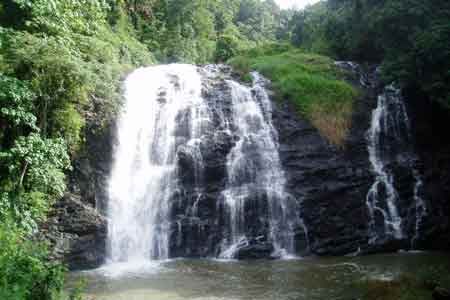
There are also plenty of places one can go to. There is Abbey Falls, not far, where one has to make his or her way through some dense woods, dotted with coffee bushes, trees and creepers, to suddenly find a cascading gush of water.

Abbey falls, among the many in Coorg, with cascading water
Then about 80 km away is the Iruppu Falls, right next to the Rajiv Gandhi National Park, also called Nagarhole, which is famous for its elephants, with a lot of other game and some 50 species of birds.

Children, especially, are certain to enjoy a visit to Dubare Forest, around an hour and a half from Medikeri. A ferry there takes you across to an elephant camp where one can see the pachyderms being bathed and fed, after which they are ready for a joy ride.

Talacauvery, around an hour away, is the source of the river Cauvery, with a temple to pay homage to this main source of water for some parts of Karnataka and Tamil Nadu. Not far is Bhagamandala, the confluence of three rivers: Cauvery, Kanika, and Sujyothi.

Another must-see is Tadiyendamol, which is the tallest peak in Kodagu and gives a breathtaking view of the entire Coorg, apart from the distant Arabian Sea. There is also the Naalkunaadu Palace built by Kodagu king Dodda Raja Veerendra in 1792.

After all this exploring, a bungalow at the plantation is perhaps the best place to retire. Toddlers can chase butterflies, and a hammock and freshly brewed coffee are sure to be at hand!

How far: Around 150 km from Mysore and 260 km from Bangalore

How to reach: By bus or car from Mysore. Closest airport is in Bangalore; the airport in Coimbatore in neighbouring Tamil Nadu is another alternative.

Cost: Around 35-40 home stays in Coorg ranging Rs.1,000 to Rs.5,000 per day

source: http://www.articles.timesofindia.indiatimes.com / Home> Collections> Coffee / Life & Style> Travel / by IANS / February 21st, 2012

At the summit of faith

Temple history

Kodagu’s Paadi Igguthappa temple became a prominent place of worship during King Lingarajendra’s reign. The temple, located atop a hill in a forested area in Kakkabe, has been in existence since 1153, writes C P Belliappa

Goddess Cauvery and Lord Paadi Igguthappa are the two presiding deities of Kodagu. If legends are to be believed, Igguthappa temple located atop a hill in a forested area in Kakkabe, in the southern part of Kodagu, has been in existence since 1153 AD. Legend also has it that Igguthappa is one of the seven divine siblings who chose Kodagu as his abode.
The temple became a prominent place of worship during Lingarajendra’s reign. Legend has it that in 1811, Lingarajendra came to the densely forested area surrounding the temple to hunt for elephants. Lingarajendra’s main source of income, besides taxes collected from his subjects, used to be cardamom and ivory. Every pod of cardamom grown and every tusk extracted from an elephant had to be surrendered to the raja at a price fixed by him!

Lingarajendra was camping at the nearby Nalknad palace and had instructed his dewan Apparanda Bopu to organise the hunt. Dewan Bopu arranged for machaans to be built on trees and had hunting dogs and drum-beaters to herd the elephants. On the appointed day Lingarajendra and Bopu sat on a machaan armed with powerful guns especially designed to shoot elephants.
In spite of all the drum-beating and dogs barking, not a single elephant was to be seen. The raja started getting restless and directed his ire at Bopu. Lingarajendra’s nasty temper was well-known and Dewan Bopu who was a devotee of Igguthappa started silently praying for some divine intervention. Suddenly a huge pachyderm with mammoth tusks appeared silently from the nearby bushes.
The elephant looked up at the machaan where Lingarajendra and Bopu were seated and started scratching itself on the tree trunk. The raja and dewan froze and were too petrified to shoot the beast. The action of the elephant shook the large tree so violently that they were about to fall off from their perch. This time around, Dewan Bopu prayed loudly to Lord Igguthappa to save him and the raja. Lingarajendra too joined Bopu in prayer. Suddenly the behemoth stopped, once again looked up, and gently sauntered away into the forest.

Lingarajendra, a Lingayat, was a worshipper of Shiva and had not visited Igguthappa temple which was dedicated to Vishnu. He made an exception and asked Bopu to immediately take him to the temple. It was a modest shrine. The head-priest welcomed the raja and advised him to perform various poojas including tulabhara (donation of grains equivalent to the weight of the devotee), to thank Igguthappa for saving his life.

After all these rituals, Lingarajendra asked the priest if he could do anything for the temple. The priest was quick to request for a punarnirmana (renovation) of the temple.

Lingarajendra immediately agreed and the temple was renovated and the approach improved. He also made grants of wet-lands in the vicinity, the income from which continues to be used for the upkeep of the temple. When the reconstruction was completed, he visited the temple again. At the temple, he had a sack full of silver coins brought. Lingarajendra dipped both his hands and scooped out three heaps of silver coins. He then ordered Dewan Bopu, who was present, to get an idol of an elephant made out of the coins. The coins weighed about three kilograms.

Silver elephant

The best silver-smiths from Mangalore were commissioned to craft an idol of an elephant. On the back of the idol is inscribed in halagannada (old Kannada), the year in which it was dedicated to Igguthappa for favours granted to Lingarajendra. This exquisite silver elephant is used daily in the poojas performed at the temple.

In 1835, the year after Lingarajendra’s son Chikka Veerarajendra was deposed by the British, Dewan Apparanda Bopu took it on himself to renovate the temple. The structure was reconstructed and was fitted with tiles replacing the earlier thatched roof. The temple once again went through reconstruction in 2008. Descendants of Apparanda Bopu along with other devotees have provided silver cladding for the entrance door.

Paadi Igguthappa is an important deity for the people of Kodagu. He is considered a provider of bounty and one who fulfills his devotee’s wishes. Iggu means grain and thappa means give.

Puthari, the harvest festival in Kodagu, is normally celebrated 90 days after Onam. Every year, paddy is first harvested in fields belonging to Lord Igguthappa. People of Kodagu celebrate the festival the following day. On a daily basis, those who visit the temple are served a simple but scrumptious lunch.

source: http://www.DeccanHerald.com / Home> Supplements> SPECTRUM/ February 07th, 2012

Indian Republic is incomplete, says CNC

Members of the Codava National Council (CNC) demanding an autonomous Kodava homeland comprising 45 erstwhile ‘nads’ (nad is a group of villages) on Thursday, staged a satyagraha at the Deputy Commissioner’s office in Madikeri and presented a memorandum to the Kodagu Additional Deputy Commissioner pressing for their demands.

The Indian Republic was “incomplete” without positively addressing the concerns of the Kodava people in Kodagu for creation of an autonomous homeland for the Kodavas, N.U. Nachappa, president of the CNC, who led the satyagraha, said. Granting ethno-linguistic tribal minority status to the Kodavas, ensuring Constitutional special guarantee to their customary laws, including Kodava language in the VIII Schedule of the Constitution, unhindered exemption under the Indian Arms Act to hold weapons, were some of the other demands.

Census

Mr. Nachappa appealed to the members of the Kodava community to ensure that the caste names in the caste census enumeration was entered as Kodava. Kodavas should see that the caste was not entered as ‘Codaga’ or ‘Coorgi’ or ‘Coorgs’ in the column meant for entering the name of the caste. The move would help the Kodavas to maintain their identity in future, Mr. Nachappa said.

The Prime Minister’s Office and the Chief Minister’s Office had acknowledged the memorandums submitted in this regard, Mr. Nachappa said.

The Assistant Registrar General, Government of India, attached to the Union Home Ministry, Pratibha Kumari, too had acknowledged the memorandum of the CNC on entering the caste, Mr. Nachappa added.

source: http://www.thehindu.com/National> Karnataka> Mysore / by Staff Correspondent / January 27th, 2012

Flower show in Madikeri today

Madikeri:

Former Rajya Sabha member F M Khan has organized a flower show for public view on his Balyantri estate at Boikeri near Madikeri. The exhibited will be held on Saturday and Sunday, with free entry.

Khan has been organizing the show every year since 1998.The garden has been named after Yousuf Ali Khan memorial. Over 1,000 varieties of flowers are grown here.

source: http://www.articles.timesofindia.indiatimes.com / Mysore> Home> Collections> Madikeri / TNN / January 21st, 2012

Participants applaud clean venue

Napoklu (KODAGU):
The eco-friendly measures taken up by the organizers of the Storm Music Festival has been appreciated by music lovers. The sprawling venue was free from litter. Dustbins were placed to prevent participants from littering the venue. A separate gallery was set up for drinkers and smokers.

A band member of Faridkot, I P Singh from Delhi, was glad that measures were taken to maintain the cleanliness of the place. “We should preserve nature. Without spoiling the beauty of nature, humans can do whatever they want. In the name of entertainment we cannot spoil the environment. The organizers have done a fantastic job by setting up dustbins,” he says.

A student of Mumbai Pratiti, who was on her first visit to Napoklu, was mesmerized by the greenery of Kodagu. “It’s a beautiful place to unwind. The organizers have planned the event meticulously. I hope the greenery remains the same even the after the event,” she added.

A Mumbai-based businessmen Ramachandran who was disappointed when the event was postponed last November, said: “The ambience was fantastic, we can sit wherever we want and chill out. I also hope we have more such events. I am impressed by the cleanliness of the area,” he added.

source: http://www.articles.timesofindia.indiatimes.com / Home> Collections> Music Lovers / TNN / January 21st, 2012

The Bearded Bandit of Coorg!

The Bearded Bandit of Coorg!

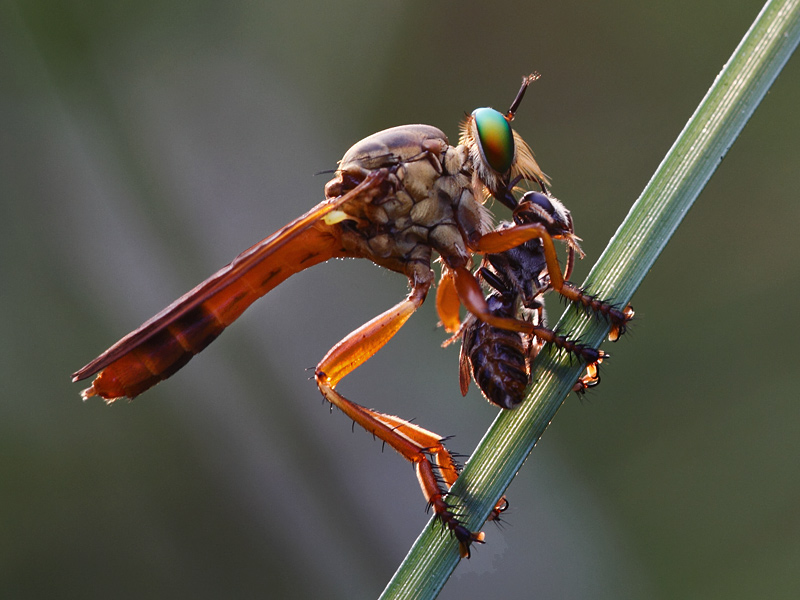
Robber Fly, Coorg / Photographed by: Samyak Kaninde
Being mugged is every traveller’s nightmare. Being mugged and then consumed as the main course in a mugger’s banquet, is the stuff that makes it to the horror movie hall of fame. But being killed and converted into a Smoothie to be slurped at leisure, takes the (dis)honours and is certainly not something you’d like on your resume. That, however, is exactly what happens to unwary air-travellers in Coorg if they don’t keep a lookout for the most feared bogeyman of the area – the Robber Fly. This bearded brigand perches quite innocuously on a twig, and when a beetle, dragonfly or wasp is spotted approaching incautiously, smacks his hirsute lips and takes off on a roundabout flight, before veering back suddenly and grabbing the unsuspecting insect, mid-flight, with his powerful legs. A short jab with his rapier-sharp beak injects venomous saliva that paralyses the prey while liquefying the body matter. From there on it’s a smooth return flight to the home perch, where the Robber proceeds to slurp up his Insect Smoothie. If he’s particularly peckish, and feels like a larger serving, the Robber Fly doesn’t balk at taking on prey much bigger than himself, trusting to his well-honed predatory skills and the power of his proboscis.

Talking of skill-sets, the predatory career of this successful bandit begins quite early: the larval baby brigand hides in the soil and in decaying wood, and learns the ropes by preying on the larvae, eggs and pupae of other insects around him. While this is bad news for some, a healthy Robber Fly population is good for humans, as it is our first line of defence against destructive and disease-carrying insects. Much like the legend of Robin Hood, the Robber of Coorg has shown that a bandit for some could well be a saviour for others.

We at Orange County have loved sharing this story with you, and shall bring you one every fortnight, as part of our Responsible Tourism Initiatives to raise awareness about the nature and culture of the environments we operate in.

source: http://www.lifescapes.org.in / LIFESCAPES by Orange County / Home> Lifescapes Gallery / January 11th, 2012

Landscape Garden at Madikeri Gaddige

Madikeri:

The Gaddige in the town here (mausoleums of the erstwhile rulers of Kodagu), which had been in the news for all the wrong reasons – vandals setting its main door on fire, encroachments, haven of illicit activities, etc – is finally being spruced up to attract tourists who are already making a beeline to Kodagu district.

The Madikeri Urban Development Authority (MUDA) has prepared a plan to develop four acres of land around the Gaddige into a landscape garden at a cost of Rs. 45 lakh, MUDA Chairman Shejil Krishnan told SOM yesterday. At present, 35 granite benches have been erected around the Gaddige area and a walkway has been created around the proposed garden, said Shejil, adding that after the famous Raja Seat, this will be the second botanical garden in the town. Ornamental plants have been planted, lawns have been laid and a lotus pond has also been created on the vacant land. The variety of ornamental plants have been brought from SNV Nursery in Rajamundry of Hyderabad. Landscaping for the garden is being done by Bangalore-based Green Stays Landscaping Company and the works are being supervised by the company’s Planning Officer M.S. Sudhir.

Plans are on the anvil to include a children’s play park too in the garden, said Shejil.

The land belonging to Gaddige has been fenced off and the main entrance has been renovated. Works are on to mount the stone statues of elephants on to concrete platforms.

Despite all these development works, it is an irony that the Department of Archaeology seems to be oblivious.

The Gaddige are protected monuments that come under the Karnataka Ancient & Historical Monuments & Archaeological Sites and Remains Act of 1961.

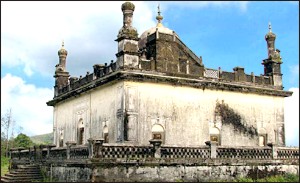
Gaddige has two identical square structures, which are the tombs of the kings and their queens. They are close to each other, built in Indo-sarcenic style. A small tomb by the side of these structures is of their Guru or royal priest Rudrappa. It was built in 1834.

source: http://www.StarofMysore.com / General News / January 09th, 2012