Category Archives: About Kodagu / Coorg

Record Tourism Influx Into Kodagu

Bangalore:

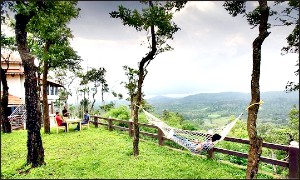
Kodagu district, aptly called the Kashmir of Karnataka and the Switzerland of India, is fast becoming a popular tourist destination with urbanites from various parts of the country making a beeline to this serene hill station surrounded by coffee plantations, where numerous resorts and home stays have mushroomed to cater to the needs of the tourists whose numbers swell during the holidays and weekends.

The pleasant weather, picturesque landscapes and fresh air are a luxury for many of the urban populace who simply look forward to relax in such serene atmosphere, away from the urban hustle-bustle, noise and air pollution.

According to sources in the Tourism Department, the number of tourists visiting Kodagu is higher than those visiting Munnar in Kerala, one of the most popular hill stations of South India. As per the statistics provided by the Karnataka and Kerala Tourism Departments, the number of tourists who visited Kodagu in 2010 was 5,94,467 (including 5,87,216 domestic and 7,251 foreign tourists), which is double that of Munnar which saw 2,45,438 tourists (including 19,690 foreign tourists). Up to Nov. 2011, Kodagu saw a quantitative leap with over 15 lakh visitors.

Tourism officials are thrilled by the prospects of developing Kodagu as a popular tourist destination. The hill district is situated at an elevation of 1,525 metres MSL.

Though the tourist footfall in Munnar has not gone down, the fact that the numbers have swelled significantly in Kodagu has given it the lead, said officials.

Situated at the confluence of three mountain streams –Muthirapuzha, Nallathanni and Kundala __ and placed about 1,600 metres above sea level, the hill station of Munnar once used to be the summer resort of the erstwhile British administration in south India. Marked by vast expanses of tea plantations, colonial bungalows and waterfalls, Munnar had so far been the ever-green favourite of tourists in sea-rch of a calm and quiet hill station.

source: http://www.StarofMysore.com / General News / January 09th, 2012
Picturesque Coorg to get rail connectivity

Coorg or Kodagu is in a dilemma today on whether to accept the new development in the region or not. For decades people from Coorg district of Karnataka demanding railway route for the region and at the same time some traditional populace protesting it as such a development can harm the serenity of the terrain. Kodagu district of Karnataka, a prominent tourist place does not have railway or air connectivity. This isolation of the region surrounded by mountains, forest, fields and waterfalls has worked as blessing in disguise.

But now railway department has proposed a train route from Mysore to Madikeri, the headquarters of the district, and the survey is already undergoing. Recently, Minister of State for Railways K.H. Muniyappa launched the first stage of the preliminary survey works on the route at Kushalnagar in Kodagu district. The work relating to the preliminary engineering-cum-traffic survey between Mysore-Kushalnagar-Madikeri will be completed in four months and the project would start in less than a year. According to K.H. Muniyappa, although the preliminary survey works were taken up from Mysore to Madikeri, the first phase of the project work would commence from Mysore to Kushalnagar. The project was expected to cost Rs. 600 crore.

M C Nanayya, Member of Legislative Council (MLC) and JD(S) leader from Coorg has a different opinion.
He said, “I am perfectly positive about extending railway line from Mysore to Kushalnagar. As this line goes through Belagola, Hunsur, Piriyapattana and Kushalnagar there is no threat to forest of private plantations. The route covers plains and government land and will not harm environment or farmers. But, I am against this railway line extending to Madikeri as the route goes through hilly terrain forest near Kushalnagar which is of 2800 ft height from sea level and Madikeri forest is 3900 ft height from sea level. The route is not necessary as this covers forest, hilly terrain and private coffee plantations and we can travel same distance by road in 40 minutes. As the route is environmental hazard and not eco friendly I will oppose such plan.”

Though, efforts were made to provide rail links to Kodagu during the tenure of the former Chief Minister late R. Gundu Rao who hailed from Kushalnagar but failed to fulfill the dream in his term. So, at last now the region is going to cheer up with new railway link.

“It is true that serenity of the region will be harmed, but any development we should accept. If railways come the travel will become cheaper. There are positive and negative points attached in it. Knowing such a type of development will harm the environment, it is difficult to accept,” Says Seetha Aiyanna, Vice president, Kodava Samaja, Bangalore.

But, Seetha Aiyanna and others residents of the region accept that protesting voices are becoming weak nowadays. Knowing the necessity of development everyone wants railway and air connectivity to this beautiful district.

source: http://www.TheSundayIndian.com / by N K Suprabha / Bangalore, January 07th, 2012

Kodava Samaja hits a century

The association grew into being a strong force named the Kodava Samaja with more than ten thousand people from the Kodava community becoming a part of it and celebrated its hundred years of existence here on Sunday.

A majority of the women wore sarees draped in the traditional Kodava way, while the younger generations wore jeans and t-shirts.

B A Muttanna, Deputy Commissioner of Police (Traffic) East, who spoke on the occasion said that the history of the community should not be oral alone.

Till now there is no library which can help the young generation learn about the Kodava community. The Samaj must set up a library in Bangalore where books on the history of the community must be made available.”

The Kodavas regard their female folks highly and that is a matter of pride.

M Boppaiah, member of the Samaj said even during marriages, Kodavas do not depend on any priests.

Instead, the older lady of the house performs the rituals. This is to symbolise that they are respected most.

With special Kodava meals served for lunch, people from the age of 10 to 80 were seen relishing what they miss in the urban environment.

“The food took me back to my village near Virajpet,” said P Muthanna, a retired government employee.

source: http://www.DeccanHerald.com / Home> City / DHNS / September 11th, 2011

Fest brings in glimpses of Kodava culture

Taluk-level Kodava Sanskritika Mela painted a festive mood in Kushalnagar on Tuesday.

Kushalnagar, Dec 6, DHNS:
Organised by Kushalnagar Kodava Samaja, the programme was inaugurated by Zilla Panchayat President Shantheyanda Ravi Kushalappa who thus threw open a platform to showcase Kodava culture and traditions.

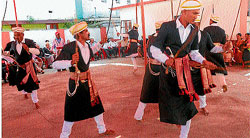
Kodavas dressed in their traditional attire presented a slice of Kodava folk culture by performing ‘Ummathat’, ‘Kolata’, ‘Bolakat’, ‘Kathi Aat’, ‘Valagathat’, ‘Pariyakali’ etc. The mela was not confined to youth. Even kids and elderly took part in the programme with equal zeal.

Inaugurating the event Ravi Kushalappa said that everyone should take up the responsibility of keeping their culture and traditions alive and passing it on to the next generation.

He said that the Kodavas should take this responsibility because Kodava culture and language is distinct from others.

“Number of Kodavas is declining in Kodagu. The Kodavas are migrating to cities to try their fortune. This in future will lead Kodava culture and language towards dangerous end,” he warned.

Kodava Sahithya Academy President Imudiyanda Rani Machaiah presiding over the programme said that Kalamela intends to protect the Kodava culture in its pristine form.

Kodava Sahithya Academy former president Bacharaniyanda P Appanna presided over the session. Kodava Samaja former president Cholanda A Muddappa presented paper on ‘Changing Kodava culture’ while Lecturer Ajjikuttira Sunita Girish presented paper on ‘Kodagu-background of Kodava folklore and history’

source: http://www.deccanherald.com / Home> District/ December 06th, 2011 / DHNS

Kodagu, Karnataka Tourism and Attractions

This page Kodagu Karnataka Tourism and Attractions gives the details about the Important tourist places in coorg bhagamandala, Harangi Backwaters, Madikeri sight seeing, Nagarhole National Park, Nisargadhama Tourist places and Nisargadhama tour and Talacauvery temple and sight seeing including weather and climate of Kodagu in Karnataka.

Kodagu Tour

The scenic splendor of the Western Ghats with undulating meadows and hills was called as Coorg or the Scotland of India. The region is famous for coffee estates and orange orchards plantation.

Tourist places Around Kodagu

Bhagamandala Tourism

Bhagamandala is a special place in Karnataka for the union of rivers. This place is situated at the distance of 38km from Medikeri. A small town to the west of medikeri , where the sacred river Cauvery and its tributary Kannike meet. This Sangam is considered sacred and draws many pilgrims and visitors. Near the confluence is the Bhagandeshwara Shivan temple which has a peculiar style of architecture similar to the temple of Kerala.

Harangi Backwaters

This place is situated at the distance of 30km from Hunsur. A pretty reservoir close to Kushalnagar recently constructed here attracts more visitors. Harangi Backwaters is an ideal picnic spot or for week end gate way. The highest point provides a breathtaking view of the vast water area below.

Madikeri Tourist Places

Madikeri the most beautiful hill station of Karnataka is located at the distance of 254km from Bangalore. Standing at a height of about 1524 metres elevation in rich green trap of the Western Ghats, Medikeri is rich scenes of enchanting loveliness. One can have a glimpse of the Arabian Sea from its peak. The 19th century fort has several old buildings, a temple and a chapel, some of which are mow converted as museums. Two lives- like elephants made out of mortar stand in their beautiful garden which presents an enchanting view of the valleys to Shiva with two sacred ponds on one side. On the outskirts are the massive strictures. A little away from Madikeri are two water falls which are situated in very picturesque surrounding. Abbey water falls and oruppu water falls enhance the beauty of Madikeri.

Nagarhole National Park

Nagarhole National Park the popular tourist spot of KarnatakaThis place is situated 42km from Hunsur. A famous wild life sanctuary very well maintained with excellent forest lodge. This place gives an opportunity to the visitors to see wild life of all kinds varying from majestic elephants to bison, deer and jackal moving about within their own natural setting. Jeep and elephant rides are available for jungle safari.
Nagarhole National Park timings: 9:00 am- 5:30 pm
Nagarhole National Park safari Timings: 10:00 am- 2:30 pm

Nisargadhama Tour

On the state highway, from Madikeri to Kushalnagar at a distance of 3km are few islets on the river Cauvery. The cluster of huts built of wood and bamboo, this resort blend with the thick forest around. It is a popular resort frequented by many tourists.
Nisargadhama Entry Fee: Entry Fee: Rs 10, Rs 5 for kids
Nisargadhama timings: 9:00 am- 5:30 pm

Talacauvery Karnataka Tour

This holy place of Karnataka is located at the distance of 40km from Medikeri. This is the birth place of the sacred river Cauvery, situated on the slopes of the Brahmagiri hills. The Tula Sankramana is regarded as the most auspicious day by the people of Kodagu for visiting this place. There is a small pond which is the source of the river. One can see the water gushing out at a prescribed moment known beforehand.
Talacauvery Temple: Omkareshwara temple, a popular pilgrim destination.
Talacauvery Temple timings: 6:00 am- 8:30 pm

source: http://www.karnatakaspider.com / Author: Kavitha / Posted November 29th, 2011

Madikeri Fort / Madikeri Palace

Madikeri Fort / Madikeri Palace

Madikeri Fort was first built as a mud fort by Mudduraja at the end of 17th century. He also built a palace inside the fort. It was eventually rebuilt in granite by Tipu Sultan who later named the site as Jaffarabad.

The Madikeri fort had witnessed several fierce battles. In 1700, Doddavira Rajendra took control of the fort. The Palace was renovated by Lingarajendra Wodeyar II in 1812-1814.

The fort encompasses a church which houses the state archaeological museum, and in 1812, when the British took over the territory the fort, the palace and its apartments were all transformed into district offices. Two magnificent mortar elephant figures can also be seen inside the fort. The palace features a stone formation of a tortoise, which has initials of King Vijayarajendra engraved on it.

The palace is built in gothic style, and the church inside is known as the St. Mark’s Church which has been converted into a museum with historical artifacts, along with a section dedicated to Field Marshal Cariappa. Besides museum, this fort also houses a district prison, the Kote Mahaganapathi Temple and the Mahatma Gandhi Public Library.

source: http://www.folksden.com / Karnataka

Talacauvery

About 48 kms from Madikeri, in the ranges of Kodanda, this spot is where the holy river Cauvery has her founts. The legend has it that Lopamudra, the daughter of Lord Brahma, the creator, was given in marriage to the mythical sage Agasthya, by her foster fathers, another mythical sage, Kabhir Muni. Sorrowed by the marriage, Lopamudra turned herself into water and sought asylum in the ‘Kunda’ or the mountain cauldron. It is believed by the faithful that she dwells in the ‘Kunda’ in which an amazing phenomenon occurs on the 17th of October every year without fail. The placid waters of the pond turn vibrant in the form of a bubbling spring on the day, bearing testimony to the belief. There is also a larger pool nearby in which a dip is considered sacred.

A flight of rock cut steps meanders up the sacred Brahmagiri Hill, on the top of which a beautiful temple is dedicated to Goddess Cauvery where the Goddess is worshipped with alacrity. This region also has puranic references. The ‘Pandava Brothers’ of the great epic ‘The Mahabharatha’ are said to have sojourned here. The hill offers a wonderful view of sylvan beauty.

source: http://www.folksden.com / November 28th, 2011

Kodavas of Coorg: Bold, beautiful and brainy

That its men are brave and the women beautiful is an oft-remarked blanket statement about Coorg. The British called it the Scotland of India when they fell in love with this cool nook in the Western Ghats and its warm people.

The Kodavas or Coorgis are an ethnic minority. But unlike other minority communities, the Kodavas are largely privileged. In fact, a pleasant colonial hangover stays with the people who enjoy a good life with evening drinks, golf, and hockey.

Although a Hindu community on paper, their language, customs, and traditions are distinct.“Easily one of the most martial cultures in the country, these are a people who ritually worship their guns and swords. Interestingly, till a few decades ago, the birth of a male child was marked with a gun shot, announcing to the world the arrival of a warrior,” writes Pattamada Sundar Muthanna in a coffee table book on Coorg tourism, brought out by journalist PT Bopanna.

Thanks to the outstanding contributions of this community to the country’s defence sector, Coorg is also called the Land of Generals.Field Marshal Kodandera ‘Kipper’ Madappa Cariappa, the first Indian Chief of Army Staff of the Indian Army, was a Kodava. General KS Thimmayya was another brave soldier, who led the army during crucial conflicts with China and brought laurels to his homeland in the hills.

“The people’s right to carry arms was originally granted by the Kodagu kings, who did not maintain a standing army, but called on the people to fight when an invasion threatened. This right was formalised by the British when they exempted the Coorgis from the Arms Act. Today the Coorgis and a few other communities have the right to own guns without having to go through the process of getting a licence,” said Muthanna.

Characteristically, Kodava weddings are not exempted from the martial element either. The bridegroom, wearing his smart traditional costume— the knee-length kupya (similar to the Scottish kilt )—would chop banana trees with their carved daggers called pichekathi and odi kathi, symbolically to portray the duels he fought for the bride. The pichekathis are a part of the groom’s wedding gear, stylishly tucked into the cotton cummerbunds that hold their wraparound cloaks together. The ceremonies are tribal in nature more than Hindu, and are devoid of any Brahminical rituals. There is no chanting of mantras and slokas, and family elders direct it.

Like the Scots, Kodavas too stress upon their clan lineage. Their surnames indicate their clan, and inter-clan marriage is forbidden. Another distinguishing characteristic of this community is the high status given to women. According to the Gazette of Coorg, compiled by G Richter, published in 1870, “Young persons under 16 years of age are not married in Coorg. Exceptions from this rule are very rare. It is to be hoped that the Coorgis will ever be preserved from the misery of child marriages.” Dowry is forbidden, and widow remarriage is encouraged. Probably owing to the cool climate and the secluded terrain, the Kodava community is known for its liberalised outlook to alcohol consumption.

“Alcohol is offered to gods and ancestors during ceremonies. Children who have come of age enjoy a drink or two with parents,” said Muthanna.

A main festival in the Kodava calendar is called Puthari. It is an annual fest to celebrate the first harvest of paddy. Under full moonlight, stalks of paddy are cut and joyous gunshots mark the occasion.

The Kodava language is a mix of its geographical neighbours with many surprises thrown in. Malayalam, Tulu, and Kannada influences can be easily spotted, but the language is also unique as its people.

source: http://www.anhourago.in / DNA www.dnaindia.com / Home> Bangalore> Report / by Malavika Velayankkal / Sunday, Nov 13th, 2011

‘Ekikarana’ movement: A timeline

The regions that make up for today’s Karnataka were under as many as 20 different administrative units with the princely state of Mysore, Nizam’s Hyderabad, the Bombay Presidency, the Madras Presidency and the territory of Kodagu being some of them.


* Under such circumstances, a need was felt among Kannadigas living in these various administrative units to form one state, which would unify all Kannada-speaking people in the various regions. This movement called the Ekikarana movement was led by litterateurs and thinkers.

* The Karnataka Vidyavardhaka Sangha was established in Dharwad in 1890. This was an important phase in the history of the unification movement. The Sangha was started by R H Deshpande who strove for the revival of Kannada in a region which was part of the Bombay Presidency where Marathi was the language of administration.

* It was later that the Kannada Sahitya Parishat (Bangalore) was set up (1915), which was another driving force in the unification movement.

* Alur Venkata Rao was the leading light of the unification movement. The publication of his Karnataka Gatha Vaibhava in 1912 gave a huge push in terms of a mass movement. He was known as the Kannada Kula Purohita or the ‘High priest of the Kannada family.’

* The States Reorganisation Commission was constituted by the Central government under the States Reorganisation Act and consisted of Hon. Fazal Ali, Kavalam Madhava Panikkar, and HN Kunzru.

* The recommendations of the Fazal Ali Committee was ratified by the Parliament, which meant that several disparate Kannada-speaking regions would now come under the Mysore State.
n The State was formed on November 1, 1956.

n It was on November 1, 1973, under Devaraj Urs as chief minister that the Mysore State was renamed as Karnataka.

source: http://www.deccanherald.com /by DHNS / Home> Supplements> Spectrum / Tuesday, November 01st, 2011