Category Archives: About Kodagu / Coorg

Coorg is serenity and beauty personified


When three women who have been friends for a decade decide to take their first trip together, we had to make it spectacular; and Coorg was the star of our spectacle.

We set off on a train to Bengaluru and on reaching the station, we unwittingly got into a ‘No English, no Hindi, only Kannada’ auto rickshaw to the Satellite Bus stand. From there, a super clean, very on time KSRTC bus took us to Kushalnagar, which is about 225 km from Bengaluru in four hours.

It was a fantastic drive on superb, pothole free roads. Kushalnagar is a bustling little town with warm and friendly people. There are many hotels which are quite close to the bus stop and also conveniently priced for us budget travellers.

Two places you should definitely visit from here are Bylekuppe and Dubare Forest reserve. Bylekuppe is a Tibetan settlement which houses a beautiful monas-tery. It is such a calming experience to see the monks dressed in maroon and yellow sit down to prayer in the large hall with the gleaming golden Buddhas.

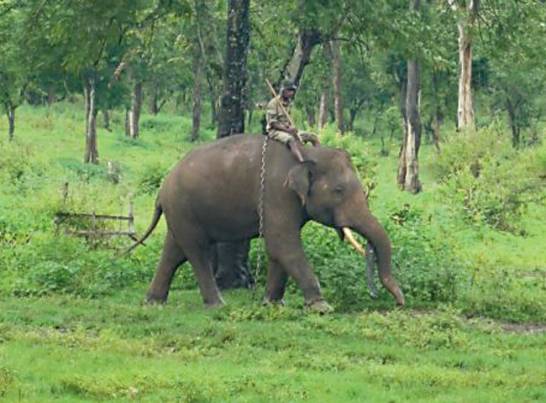
From there we went to Dubare, which was a paradise for the animal lover in me.The high point of the reserve is the elephant interaction programme. You can roll up your sleeves and get dirty as you bathe an elephant, while cavorting around in the Kaveri flowing at your feet and then feed them huge globes of food and finally as a reward for your hard work, get up on the Jumbos and experience the jungle as they see it. It’s a memory that will be etched in your heart forever.

The next day, still talking animatedly about the elephants, we boarded a bus to Madikeri. About 35 km away from Kushalnagar, it is a gentle climb up a hill. Once we got there we were joined by a fourth team member; the rain, who was our constant companion from then on! Undeterred, we whipped out our umbrellas, zipped on our raincoats and headed out to see the Abby falls.

The mighty Kaveri in all her fury, cascading down steep rocks, to become the glorious Abby falls. We could not take our eyes off her, and try as we might, we could not take a picture that did justice to her splendour.

There are many other to-dos in Madikeri that tourist guides will give you but I suggest you slow down, walk through the narrow winding streets of Madikeri, breathe in the fresh mountain air and
experience nature at her pristine best.

Writer is a travel enthusiast

source: http://www.deccanchronicle.com / by Dwithiya. R / Home> Channels> Lifestyle> Wanderlust / October 18th, 2011

In the Mountains and the Valley of Kodagu (Coorg)

Situated in Karnataka, the southern state of India amidst the massive Western Ghats of the Sahyadri Mountains is a picturesque region of Kodagu (Coorg is the angelical term for Kodagu). Coorg is famously known for its scenic marvel, especially since it’s a calm hilly region with the hues of green caused because of the vast stretches of trees and forest. The Kaveri River that flows through this district also adds more beauty to this place.

Coffee and Coorg

Coorg and CoffeeThe district of Coorg is one of the largest and the first Coffee producing districts in India and the Coffee from Coorg is suppose to be one of the richest in the world. Coffeea robusta is a commonly found variety of Coffee in Coorg. One of the other varieties of Coffee produced in this region is Coffeea Arabica. The Coffee plantations also cultivate crops like vanilla, black pepper, and Cardamom.

Coffee Planation in CoorgThe vast natural forests are a great source of forest reserve and thus making Coorg an apt region for cultivation of variety of crops.

Flora and Fauna

Coorg is gifted with a rich variety of flora and fauna. The three wildlife sanctuaries Brahmagiri Wildlife SanctuaryPushpagiri Wildlife Sanctuary,Talakaveri Wildlife Sanctuary, and one national park Nagarahole National Park have several species of animal like leopard, tigers, Asian Elephants, boars and deer.

Flora and Fauna - CoorgThe flora of the jungle is like none another, with trees like the thickly wooded bamboo, Iron wood, Indian Mahogany, Sandal wood, Ebony and much more the forests of Coorg are generously gifted.

Wildlife in CoorgIf luck favours you while driving through Nagarhole National Park you may sometime get to see wildlife like Chitals, Elephants, Bisons and Sambar.

Cultures and Traditions of the Coorgi’s

Kodava Pandi CurryThe people of Coorg have a distinctive culture much different from that of people from other parts of India. Known much for their hospitality and their love for weapons the people of Coorg are very welcoming and would be more than happy to have you around. If you are fortunate you could savour the famous delicacy of Coorg, Pork cooked in vinegar that has been extracted from wild berries.

The people of Coorg worship nature and their ancestors. They have high regards for the holy River Kaveri and consider it to be their mother and their provider.

A mother is also held at the highest regards in the Coorg community. A mothers blessing is considered of utmost importance and unlike other Hindu communities widows in the Coorg community can still participate in joyous events.

Coorgi’s also have a very distinctive way of dressing up. Men dress up in coats that hang down to their knees, paired with a turban or a white and red checked scarf. The saree that is worn by the women of Coorg is tucked in the back unlike the typical Indian way of tucking the pleats in the front.

Best place to Stay

If you are looking to enjoy the true beauty of coorg and to experience their culture first hand what better way than to opt to stay in a Homestay. Not only is Homestay one of the most economical way option of staying in Coorg it also comes with many added benefits. We offer you a variety of Homestay options in Coorg.

Eco HabitatOne of the best place to stay in Coorg is Eco Habitat, situated very close to river Kaveri. It’s a beautiful coconut farm intercropped with Vanilla & Cardamom. There is small dairy farm in Eco Habitat which takes care of all the dairy needs as well as bio gas for the kitchen.


Bird of Paradise


The Ahana Group stay In Coorg is a one of kind Estate stay amidst one of the numerous Coffee plantations in Coorg.

The Birds of Paradise is another Homestay option you cannot overlook. This seven acre estate will entice you with its scenic beauty and the gushing sound of Kaveri River that passes right through it With nothing but nature all around you this is a great place to unwind.

What To Do

Whether you are alone or with your friends, driving to the Raja Seat is one of the most relaxing and picturesque experience. The valley could be rebuffed with fog thus blocking your view in the winters but the distant mountains and the drizzle of the cold morning could be soothing and elating.

Irpu FallIrpu FallIrpu is a beautiful waterfall which makes it way from the Brahmagiri hills which is also the place where the Laxamana Teertha River originates.

TrekkingTrekking is one of the most popular forms of sport in Coorg. Coorg has extremely rugged land area thus making it a hotspot for trekkers who could trek to many summits and pave their way through dense jungles. Trekking is also a very dangerous sport hence it is highly recommended that you have done all your preparations well. The winters could bring the temperatures near the peak to freezing points hence it is advisable that you are well equipped, summers could also lead to heat strokes.

Abbi FallsAbbi waterfall located inside one of the private Coffee plantations is also one of the most visited tourist places in Coorg. It is not one of the most beautiful places in Coorg but you could give it a shot and see how it goes for you.

BhagamandalaBhagamandala and Talakaveri are places of great importance for the Coorgi’s. Bhagamandala literally translates to ‘the meeting point of 3 small rivers which gives birth to River Kaveri.

The Medikere Fort also attracts many tourists. Once made out of mud it was rebuilt by Tipu Sultan who used stone to construct the structure.

BylakuppeThe largest Tibetan settlement of Bylakuppe is located near Kushalnagar. There are numerous places to visit and see in Bylakuppe. Tibetan monasteries of great importance like Sera Je, Sera Mey and Namdroling Monastery are also located here. You could visit the monasteries and experience a totally difficult culture and witness the gold statues of Buddha which reflects the rich cultural heritage of Tibetans and earn yourself some good karma and peace of mind.

If fishing is your forte you could visit the Valnur Fishing Camp and experience the joy of angling for the grand Masheers. Make sure you have received a permit for fishing from the Coorg wildlife Society. Valnur is also a delight for bird watchers and bird aficionado.

Weather

Weather at CoorgThe best time to visit Coorg is in the between the months of September and March. The moderate temprarture of Coorg makes it a tourist hotspot for people from all around the world all year round. The winter time in Coorg could be a little chilly but it is still quite pleasant. The summer time heat makes it a welcoming place for tourists.

Weather - CoorgMonsoons make Coorg a scenic wonder since the greenery is at its peak and the waterfalls across the town are vivacious. Dress according to the season when you plan to visit, pack light cotton clothes for summer and some woollens for the winter.

Why Coorg

CoorgBlessed with cosmic stretches of mountains, abundant tropical forests and the greenery of the trees, the small hamlets scattered across the mountains and the sweet smell lingering from the coffee and cardamom plantations makes Coorg one the most opted vacation getaway across India. If you are looking to get away from the stressful life of the city and get some fresh air, experience the lush foliage and relax in one the most peaceful places then Coorg is the right place to sit back and relax and enjoy the joy of being amidst nature.

Getting to Coorg

CoorgThe nearest airport to Coorg is Mangalore which is nearly 136 kms away. You could also head to Coorg directly from Bangalore airport which is 260 kms away. The nearest railway station to Coorg is Mysore and Mangalore which approximately the same distance away. There are buses from major cities across Karnataka to Madikere which is the closest bus stop to Coorg.

If you want to be notified next time, subscribe to the RSS feed or say hello via Twitter @theotherhome. You can plan your dream holiday with us, visitThe Other Home.

(Photo Courtesy: Kislaya Dube, Anuj Kumar and Nayyar Azam)

source: http://www.en.paperblog.com / September 24th, 2011


Cauvery ‘Teertodbhava’ at 11.43 p.m. on October 17

The famous ‘teertodbhava’, emerging of the sacred or holy water from the tiny pond called ‘Brahmakundike’ at Talacauvery, foothills of the mighty Brahmagiri Hills in Kodagu, will occur at 11.43 p.m. on October 17 under the ‘Mithuna Lagna’.

Kodagu Deputy Commissioner N.V. Prasad said this at the preliminary teertodbhava meeting at the Old Assembly Hall in Madikeri on Tuesday. The puja rituals concerning the teertodbhava would start from September 28 at both Bhagamandala and Talacauvery with the patreyalli akki hakuvudu (filling rice in the vessel) at 8.45 a.m. on September 28, Aajna Muhurta on October 5 and Akshaya Patra on October 13.

Mr. Prasad gave a call to officials of all departments to take steps to ensure a successful teertodbhava. He instructed the Public Works Department engineers to repair the Madikeri-Bhagamandala-Talacauvery road a week ahead of the Cauvery jatra that ensued after the teertodbhava.

He said the officials of the Chamundeshwari Electricity Supply Corporation (CESC) should make arrangements to avoid power disruptions. The Talacauvery-Bhagamandala Temple Committee should keep diesel generators as stand-by to meet emergencies since the occurrence was in the night, Mr. Prasad said.

Sampath Kumar, Manager of the Temple Committee, said four generators would be kept ready to meet emergencies.

Mr. Prasad said the KSRTC Depot Manager Lachme Gowda should take steps to provide buses to the devotees visiting the temples on the teertodbhava day and on other jatra days. Mr. Gowda said 30 buses had been deployed during the last year’s teertodabhava and jatra, and the same number would be available this year as well.

Superintendent of Police Manjunath Annigeri said the police would regulate the movement of vehicles to and from Talacauvery in view of the lack of space for parking at Talacauvery. The Public Works Department should take steps to look into the parking problems, Mr. Annigeri said.

Mr. Prasad told the Department of Health officials to equip themselves with medicines, ambulance, and related facilities to attend to health needs during the occasion.

Additional Deputy Commissioner K.M. Chandre Gowda said this was a preliminary meeting and the Legislative Assembly Speaker and legislators would attend the next meeting to oversee the preparations. Every government department should cooperate to make the teertodbhava celebrations a success, Mr. Gowda said.

Seven sub-committees, including reception, transport, cultural, and publicity, were formed on the occasion.

Mr. Gowda asked the Assistant Director of the Department of Kannada and Culture to organise cultural programmes during teertodbhava at Talacauvery. The Karnataka Kodava Sahitya Academy president Iymudiyanda Rani Machaiah, Madikeri Deputy Conservator of Forests K.S. Anand, and Senior Assistant Commissioner M.R. Ravi, were present.

source: http://www.thehindu.com / by Staff Correspondent / National> Karnataka / Mysore, September 21st, 2011

Of loyalty & betrayal

Kodava King Lingarajendra was assisted by his trusted soldier Thathanda Subbayya on several hunting expeditions to please British officers. A famous painting, depicting the king offering Subbayya a gold bracelet, a gun and a sachet of gold coins, is still in the ancestral home of the Thathanda family, discovers C P Belliappa
Lingarajendra was not meant to be king. However, a series of lucky breaks landed him on the throne of Kodagu in 1811.

It was a combination of luck and chicanery that propelled him from being the timid younger brother of Dodda Veerarajendra to finally usurping the kingdom of Kodagu by cleverly dislodging the eleven-year-old daughter of his brother who had been named successor to the throne.

After the demise of Dodda Veerarajendra, Lingarajendra started asserting himself, and within a short time took complete control over his domain.

He was wise in maintaining good relationships with the powerful British who had established a strong presence in neighbouring Mysore after overthrowing Tipu Sultan.

One of the attractions Lingarajendra offered the British officers was organising elaborate hunting expeditions in the dense forests of Kodagu, which had abundant wildlife. As a protectorate of the British, there was no external threat to his kingdom. He diligently presented two elephants every year to the East India Company as a tribute.

Lingarajendra had a very loyal and trusted lieutenant in a young Kodava soldier called Thathanda Subbayya. Lingarajendra, though short in stature, was physically very tough. Also, he was very agile and athletic. He was an excellent horseman, a sharp shooter and an able archer. Subbayya was one of the few who could match him in marksmanship. This brought the two closer and Subbayya was Lingarajendra’s constant companion on every hunting trip of the raja.

Thathanda Subbayya rose rapidly in the court of Lingarajendra and was promoted to the post of kariakara which was equivalent to the position of an Army Commander. In a well-documented hunting trip of Colonel Welsh and Lieutenant Williamson in March 1811, it was Thathanda Subbayya who was in charge of all the arrangements for the elaborate shikari. Colonel Welsh who later became a General was extremely pleased with the sizeable booty of trophies he collected after the hunt. He promised all support for Lingarajendra and also requested the raja for another hunting adventure during October the same year.

After the departure of the guests, an immensely pleased Lingarajendra presented Subbayya with a gold bracelet, a gun and a sachet full of gold coins. He then announced a gift which was awarded only to very special subjects. It was to be painted in a portrait along with Lingarajendra.

This painting depicting a reverential Subbayya in front of Lingarajendra is still in existence at the ancestral home, or the aynmane of the Thathanda family in Kukloor village near Virajpet. When I visited the aynmane, the present residents allowed me to take a photograph of the painting which is placed in a recess of the wall next to the traditional hanging lamp known as thook bolucha. This is a sacred place in Kodava homes meant for offering regular obeisance to ancestors.

Taming the tiger
All the attention that kariakara Subbayya was receiving generated great envy amongst other members in the court of the raja. They felt threatened, and feared Subbayya would soon be promoted above some of the senior officers.

Few of his rivals waited for an opportunity to damage the reputation of Subbayya in the eyes of Lingarajendra. A few months later, Lingarajendra received an appeal from nearby villagers about a tiger that was terrorising the area and they wanted the raja to help them eliminate the beast.

Lingarajendra asked Subbayya to make all the arrangements and also set up a machaan (platform on a tree) for him to stalk the tiger. A live bait was tied in the vicinity to attract the big cat.

Subbayya who was an expert in setting up machaans immediately got on to the job and made all the necessary arrangements for the hunt. His foes took advantage of this event to discredit Subbayya. They surreptitiously sent their men to sabotage the machaan on which Lingarajendra was to camp overnight. The ropes used to tie the machaan were cut half-way to make it weak and unsafe.

Subbayya’s sacrifice
Lingarajendra got on to the machaan and Subbayya sat on another machaan set up atop another tree. A little after midnight, the tiger made its appearance where Lingarajendra sat waiting. There was no escape for the tiger with Lingarajendra’s accurate gunshot.

But, with the recoil of the powerful gun, Lingarajendra’s machaan gave way as the weakened ropes snapped. It was entirely the agility of the raja that enabled him to hold on to a branch and get down using the rope ladder.

Lingarajendra was furious and wanted Subbayya to be brought to him immediately. Subbayya who heard the gun shot got down from his machaan and was walking towards where Lingarajendra camped. He met the soldiers on the way who were looking for him. The soldiers narrated what had happened.

Subbayya who knew the raja’s explosive temper was sure he would be killed on sight. He told the soldiers that he would follow them. He then sat under a tree and shot himself in the chest with the gun that Lingarajendra had presented him months earlier.

When Lingarajendra learnt about Subbayya having taken his own life, he was most upset. He had complete faith in Subbayya and had no intentions of harming his loyal kariakara. He vowed to investigate the incident and punish the culprits.

Subbayya was still a bachelor and was planning to get married soon. He was a rising star among Kodavas at the time. Lingarajendra bitterly grieved Subbayya’s untimely demise. He built a memorial (in Lingayat style) in honour of his trusted kariakara in Kukloor village. This monument is well-maintained by the Thathanda family even to this day.

Lingarajendra ruled Kodagu for nine years. The economy of Kodagu improved during his tenure and there was no threat of war. For the battle-weary citizens of Kodagu, this period of peace came as a great reprieve.

Lingarajendra, however, turned despotic during the later part of his reign. His son and the last raja of Kodagu, Chikka Veerarajendra succeeded him in 1820. In 1834, the British dethroned the unpopular Chikka Veerarajendra and Kodagu came under the direct rule of the East India Company. Chikka Veerarajendra was ingloriously exiled to Benares.

source: www.deccanherald.com / History > / September 20th, 2011

Kannada version of ‘Rise and Fall of Coorg State’

“Coorg State: Udaya-Pathana”, Kannada version of journalist P.T. Bopanna’s book, “Rise and Fall of Coorg State”, dealing with the merger of the erstwhile Coorg (Kodagu) State with the then Mysore (Karnataka) State in 1956 has been released.

The English version of the book was published in 2009. B.K. Ganesh, a journalist, who also hails from Kodagu, has translated the book into Kannada, Mr. Bopanna said in a statement.

Commenting on the book published by the Press Club of Bangalore, Mr. Bopanna said when “Rise and Fall of the Coorg State” in English was first published, he was not sure how it would fare in the market.

There were reasons for his apprehension as he was publishing the book all by himself and no one had showed keenness in publishing it.

But to his surprise, the entire copies were sold out within two months of publication, mainly in Kodagu, he said. He felt the need for bringing out the Kannada edition of the book to reach out to the Kannada readers to make them understand the feelings of the people in Kodagu.

Even though Kannadigas were overjoyed by the integration of Kodagu with Karnataka, a large section of the people in Kodagu still felt that they would have been better off in the independent Coorg State, he said.

It was up to the policy-makers in Bangalore to try and remove the feeling of alienation by striving for the comprehensive development of Kodagu, he said.

Mr. Bopanna has authored four books, including “Discover Coorg”, the best-selling handbook on Kodagu which was translated into Kannada earlier. Mr. Bopanna also runs the website, www.coorgtourisminfo.com. The book is priced at Rs. 80 a copy.

source: http://www.theHindu.com / National>Karnataka> Mysore / September 17th, 2011 / by Staff Correspondent

Coorg – The Scotland of India

Coorg located on the Western Ghats around 180 miles from the hi-tech city of India Bangalore, in the state of Karnataka is admired for its enduring beauty. The recorded history of the area says that it was ruled by the Lingayat Rajhas who established their capital at Madikeri where they built a mud fort. The inhabitants of Coorg, Kodavas agitated the Mysore ruler Hyder Ali and Tipu Sultan in the course of random rebellions.

Eventually Tipu marched into Coorg with a large army in 1785 AD and overcome to their little kingdom. But just after four years, with the British assistance, Coorg take back their Kingdom and Raja Veerarajendra set about the task of reconstruction. Yet in 1834 AD, the British captured the Coorg and prosecuted the last Raja Chikkaveera Rajendra and expelled him. With its foggy mountains and opaque jungles, Coorg give the impression like a little corner of to the British and adopted a name as the Scotland of India.

The British left a legacy behind that is still an imperative source of national capital. The well laid coffee plantations by them in Coorg account for almost half of Karnataka’s coffee production and the state goes on with to be the major producer of coffee. Talakaveri, the origin of the River Kaveri is situated in the Brahmagiri hills of Coorg and this area is about 4,500 ft above the sea level. Hence, it is one of the scenic spot in Coorg. A temple and a big tank have been built near the kundike at Talakaveri; the pilgrims’ take bath in the tank prior to praying at the origin of the river.

There are two famous Hindu Temples dedicated to lord Shiva and lord Ganesha and both the temples are open to visitors. Coorg has many verdant hiking routes in the midst of forests and hills, and it’s better to visit in the months from October to February. Misty hills, lush forest, acres and acres of tea and coffee plantations, orange groves, undulating streets and breathtaking views are what make Coorg an unforgettable holiday destination. You can accompany cheap flights to India for exploring this marvelous destination that is definitely going to manage your travel budget in a way you will be able visit much more places of interest.

A breathtaking attraction of waterfalls known as abbey Falls is located at a distance of around four miles from Madikeri town, approaching this attraction is itself an excellent ride experience as the path that you drive on is very narrow with countless turns and twists, ups and downs with a ebullient mother nature greets you at each turn. This famous falls, situated on a private property, attracts a large number of tourists around the globe. There are other famous waterfalls to be explored such as Iruppu Waterfalls, Mallalli Waterfalls and the Chelavara Waterfalls. A nature lovers paradise Nisargadama, an ecological park, this romantic 64-acre island is reachable through a hanging bridge offering immense pleasure to all the Nature and Fun loving tourists to wander around the park. You can also visit various stunning attractions like Nagarahole, Dubare Forest, Harangi Dam, Chiklihole Reservoir, Omkareshwara Temple, Coffee Plantation Farm, Raja’s Seat and Madikeri Fort.

source: http://www.CheapFlightHouse.co.uk / admin> News> / August 28th, 2011


‘Muthina Male’ Coorg Rain on Screen

'Muthina Male' Coorg Rain on ScreenThe rainy season of Coorg district is very special and something lovely to watch. The five Coorgi friends Bhasker Raju, P Chandrasekhar Raju, KK Balaji, YS Satish and DM Vishwanath are up to give a cooling effect for Kannada audience from the first venture ‘Muthina Male’. Male – rain is referred to pearls in literature.

Priya Sagar has worked in the camps of directors Prem, Victory Vasu, Om Prakahs Rao, Kashinath and Dwarki. There is no special story but the presentation if the new thing he says. In the beginning and ending rain will be found on the silver screen.

Ragana a Coorgi is appearing in her second film. It is because the shooting will be held in Coorg Ragana alias Anusha Poo accepted this film. She has appeared in ‘Besuge’ Kannada film. it is a homely role says Ragana. Ragana comes to Coorg to give an invitation and there the ‘Pyaar’ factor evolves.

Vishwas of ‘Kalgejje’ is in his fifth film and this is his second film as solo hero. Priya Sagar as director has done good story, screenplay, dialogues and the team has the winning aspiration says Vishwas.

AT Ravish is Ravi Sharma from this film is trying his luck as music director. He has six songs for this film. Mohan is the cameraman of ‘MM’.

Chandrasekhara Raju on behalf of the producers said this is a new attempt said we want to present the feel of Coorg rain for the silver screen from this film.

source: http://www.supergoodmovies.com / Jun 27th, 2011

Cairns of Megalithic Era Found

UNEXPLORED:A view of the cairns at Doddamalte village in Kodagu.

UNEXPLORED:A view of the cairns at Doddamalte village in Kodagu.Legend has it that the relics at Doddamalte date back to the Mahabharata . ASI took up a survey of the area two years ago. Survey discovered rich deposits of granite

Madikeri:

Antique cairns that have been sighted in a few places in Kodagu have so far remained a mystery. One of the sites where a number of such structures are found is at Doddamalte village, close to the picnic spot of Honnammanakere,  in Somwarpet taluk of Kodagu district.

The Archaeological Survey of India (ASI), which had conducted a survey of the area a couple of years ago, had concluded them as megalithic burial monuments. These are called cairns. These cairns remain at the ground level or in some cases their tops crop out of the ground a little bit. They resemble a stone chamber about six or seven-foot long, three-and-a-half to four-foot wide and about four to five-foot in height. In some cases, granite pillars raised at four corners are surmounted by a granite slab.

These burial structures, which could date back to 2,500 to 3,000 years, (megalithic period) appear either as solitary structures or in groups or in columns at Doddamalte village. One could surely conclude that human civilisation thrived at that age in Kodagu. However, not much of an effort has gone into the mystery to ascertain what exactly those cairns contained, residents of Doddamalte, who call the spot as “Pandva Pare”, say.

There are two hillocks towards both ends of Honnammanakere, one of the popular picnic spots in Kodagu, near Somwarpet town. The hillock towards left of the Honnammanakere temple has these megalithic burial monuments.

Shivanand, a resident of Somwarpet, says the ASI did take up some kind of survey of the area two years ago, but nothing happened afterwards. The areas had rich deposits of granite. Quarrying took place in one portion of the hillock but it had now stopped, he told The Hindu.

Legend also has it that the Pandavas, celestial heroes of the yore, travelled the place and stayed at the spot by which the name Pandava Pare was derived.

According to another version, people who dug up the Honnammanakere did not get water. Water came in abundance only after human sacrifices were made. Those bodies were buried at Pandava Pare. Whichever theory is correct, the ASI has failed to protect these monuments, including fencing, leave alone ascertaining the facts.

The ASI had two circles in the State, one at Dharwad and another in Bangalore. These monuments came under the purview of the Mysore sub-circle of the ASI.

Similar sites were found at Bavali village in Madikeri taluk ( The Hindu reported it two years ago) and also in some places such as Kedamullur in Virajpet taluk.

According to information gathered here (from the Gazetteer of Coorg), one such cairn was first noticed in Kodagu in 1856 and several others were found near Virajpet in 1868 and also near Fraserpet (now Kushalnagar) later.

source: http://www.thehindu.com / by Jeevan Chinnappa / National / Karnataka / Apr 07th, 2010

A Tiger Wedding in Coorg, India

A Tiger Wedding in Coorg, India

The Illustrated London News,   Dateline: December 06th, 1873

A TIGER WEDDING IN COORG.
“The small province of Coorg, in Southern India, is situated among the mountains that separate Mysore from the Malabar coast to the west. Its late Rajah, being of cruel and treacherous misrule, was deposed in 1834, and the Coorgs, being put to the vote, unanimously desired to become complete subjects of the British Government. In 1852, the deposed Rajah visited England, accompanied by his daughter Gauramma, and paid his former enemies the compliment of seeking for her an English and Christian education. In June 30, 1852, she was baptized, the Queen herself standing sponsor, and giving her the name ‘Victoria.’ The Princess Victorian Gauramma, who was a constant visitor to her Majesty at Osborne and Windsor, eventually married an English officer of the name of Campbell. She died in 1864; her tyrant father lies buried in the Kensal-green Cemetery.
“A good description of Coorg will be found in ‘Eastern Experiences,’ by Mr. Lewin Bowring, late Resident or Governor of Mysore. The natives are distinguished for their fine appearance and warlike temper. They are skillful hunters, being trained for this from infancy; at the birth of a boy, the first thing done is to place a little bow and arrow in his hands, and to fire a gun outside the house, thus initiating his career as a huntsman and warrior.
“In the accompanying illustration there is abundance of music, feasting, torchlight, and dancers; and the owner of the mansion is brought in with triumph to graces the festival.
“A curious ceremony takes place when a tiger has been shot by a Coorg man. Tigers are not numerous in the country, and this ceremony has only occurred twice within the past four years. On the last occasion, March 9 of this year, the successful huntsman was Mr. Colovanda Carriapah, Head Sheristadar of the Mercara Talook. In this ceremony the man is wedded to the soul of the dead tiger.
“As shown in the Illustration, he is seated under a canopy in full warrior costume. On each side are placed his weapons and the household emblems of plenty, vessels of rice and milk, and burning lamps, analogous to the Masonic corn, wine and oil. So he sits, receiving the homage and congratulations of his relatives and friends. Each scatters a few grains of rice over his head, and gives him a sip of milk from a brass vessel resembling a teapot, and makes an offering in money, varying in value according to the means of the donor. The hero of the day is afterwards carried in triumph round the tiger, which is suspended to a high bamboo grame in the garden. The officers and ladies of the regiment stationed at Mercara, who reside in the late Rajah’s palace, were specially invited to attend.
“Mr. Carriapah is a native Coorg gentleman of high merit and distinction. He wears the gold Coorg medal, which was presented by the British Government to his father, for suppressing an insurrection in South Canara. Our correspondent would further testify to Mr. Carriapah’s unvarying support of English education among the Coorgs. A wealthy and influential man, he spares neither time nor money in this cause, and has, at his sole expense, erected schools for Coorg girls as well as boys, and has on several occasions received the thanks of the Government of India, as well as of the local Government of Mysore and Coorg.
“We are indebted to Captain Belford Cummins, of the Staff Corps at Mercara, for the sketch we have engraved.

source: http://www.harappa.com

Kodagu’s Charms

To say Kodagu is a tourist haven would be an understatement. The district has many interesting sights, from cascades, peaks to ancient temples and tombs, writes P T Bopanna
The scenic Kodagu (erstwhile Coorg) district is a tourist paradise for nature lovers. Kodagu is not the sort of place for the routine tourist, undertaking a ‘package tour’. It is for those who want to soak in nature. 

Kodagu shares one of its boundaries with Kerala. The landlocked district is not connected by train or air. The only way to reach this nature’s resort is to take a bus ride from Mysore, Mangalore or Hassan cities. Madikeri (known earlier as Mercara), the district headquarters of Kodagu, is 120 km from Mysore and 260 km from Bangalore.

Though Kodagu is dotted with several towns like Virajpet, Kushalnagar, Somvarpet, Gonikoppal and Pollibetta, only Madikeri and Kushalanagar to some extent, have good tourist facilities. There are not many clean budget hotels in Kodagu. Most tourists prefer to stay at ‘home stays’ spread across Kodagu, including at Madikeri. The home stays are mostly located away from the towns and housed in the midst of coffee plantations.

Home stays are a big draw

Home stays involve either sharing homes with the resident family or staying in independent bungalows. They offer an opportunity to enjoy the legendary hospitality of the Kodavas, the predominant community of Kodagu. There are an estimated 1,000 home stays in Kodagu, catering to various categories of tourists.

The tariff could range from around Rs 800 a couple per day to Rs 3,000, depending upon the facilities and location. Kodagu’s roads are a driver’s nightmare. Though the region has emerged as a major tourist destination, not much it seems, has been done to improve road connectivity and tourist infrastructure.

Madikeri is dotted with red-tiled bungalows and has an old world charm about it. Madikeri has several interesting tourist spots. The Raja’s Seat in Madikeri offers a breathtaking view of the towering hills and green valleys studded with paddy fields, and could be considered one of the most scenic spots in South India. Raja’s Seat attracts a lot of tourists and morning walkers. For the nature lover, the ideal time to visit the spot is in the morning when the first rays of the sun pierces through the mist covered valley. Madikeri Palace of the erstwhile Kodagu Rajas located inside the Fort, now houses the offices of the Deputy Commissioner. The brick and mortar structure was built in 1814.

The Omkareshwara temple in Madikeri was built by Lingarajendra II in 1820 in the Mohammedan style of architecture with a dome at the centre and four turrets at the four corners. The temple is akin to a Muslim dargah with a Linga installed near the entrance door.

Gaddige, or the tombs of kings Veerarajendra and Lingarajendra at Madikeri, is one of the important monuments of Kodagu. The hillock where the tombs are located is to the north of Madikeri and provides a commanding view of the town. The tombs are in the style of Mohammedan edifices with domes in the centre and turrets at the corners. Abbey Falls is a picnic spot eight km from Madikeri town, where water from the Madikeri stream gushes down from a height of 70 feet. It is a treat to watch the torrent of water in the monsoon season between July-October.

Talacauvery, the birthplace of the sacred river Cauvery, is located on the slopes of Brahmagiri Hill. Besides being a pilgrimage centre, Talacauvery is known for its natural beauty. On Tula Sankaramana day in the middle of October, thousands of pilgrims flock to the birthplace of the river to witness a sudden upsurge of water in a small pond, at a predetermined auspicious time. This gushing of water from the small pond is considered a miracle.

Bhagamandala is at the foothills of the Talcauvery. It is eight km downstream from Talacauvery and 39 km from Madikeri. Bhagamandala is at the confluence of the sacred rivers Cauvery and Kanike and legend has it that a third river Sujyothi, a subterranean stream, joins the two rivers here.

The Rajiv Gandhi National Park (Nagarahole) is one of the best maintained game parks in India. The Nagarahole (meaning snake river in Kannada) sanctuary derives its name from the serpentine river which flows through the park.

Irupu Falls, located 48 km from Virajpet on the way to Kutta from Gonikopppal, is both a picnic spot and a pilgrimage centre. The Falls is located in Kurchi village, not far from the Rajiv Gandhi National Park. A stream flowing down the Brahmagiri hill range plunges down 170 feet in two stages with a resounding roar into a rocky valley surrounded by dense forest.

Bylekuppe near Kushalanagar is one of the largest Tibetan settlements in South India. The settlement, set up in 1960, is dotted with several monasteries. Prominent among these are the Great Gompa of Sera Je and Sera Mey and the Namdroling monastery. The gold-coated Buddhist statues in the monastery are imposing and unique, reflecting the rich cultural heritage of the Tibetans. Tourists can shop for handicrafts, carpets, incense, sweaters, dress material and other accessories.

Cauvery Nisargadhama is a breathtakingly beautiful island off the state highway, two km from Kushalanagar town and 28 km from Madikeri. The 64-acre island, surrounded by the Cauvery river, can be accessed by walking across a hanging bridge.
Established in 1989, the picturesque picnic spot with lush foliage of thick bamboo groves, sandalwood and teak trees has lovely river-side cottages.  The Harangi dam, built across river Cauvery, is located eight km from Kushalanagar. Behind the dam is a vast reservoir. On the banks of the reservoir stands a temple of Basavanna. Dubare Elephant Training Camp, located 15 km from Kushalanagar, on the banks of the Cauvery river, is run by the Karnataka government-owned Jungle Lodges and Resorts Ltd. A visitor can spend hours simply watching and interacting with elephants, some of which have participated in the Mysore Dasara festivities.
Virajpet town, 32 km from Madikeri, is a taluk headquarters. The town, situated at the foot of a hill, is well connected by road to the coastal Kerala towns of Kannur and Tellicherry.

The Clock Tower is the most visible landmark in Virajpet, erected in 1914 to commemorate the Delhi Durbar of King George V. Another important landmark of Virajpet is St. Anne’s Church built in the Gothic style in 1868.

Tadiyandamol peak (1,745 meters) is the highest peak in Kodagu and poses an exciting challenge to seasoned trekkers. The peak is located in the south-eastern part of Kodagu and is 8 km from the town of Kakkabe which is 35 km from Madikeri. A steep serpentine path from the Nalaknad Palace, leads to the Tadiyandamol peak from where on a clear day, one can view the distant Arabian Sea.

Off the beaten track
But, if you are one of those who wants to take the path not trodden, then, you should probably be exploring Mandalpatti, Mallalli Falls or Honnamana Kere, for instance. The fog-covered awe-inspiring mountains around Mandalpatti, located 20 km from Madikeri, is perhaps the most unexplored region of Kodagu till recently. The presence of treacherous curves makes it risky to travel by road from Madikeri to Mandalpatti during the monsoon.

The forest department has constructed a watchtower atop the mountain which provides a magnificent view of the Pushpagiri mountain range.

The villagers assemble at the mand (village plains) during the annual Hutthari festival for staging sports events and other cultural activities. In recent years, Mandalpatti has emerged as a popular venue for film shooting because of the scenic location.
Mallalli Falls, located 25 km from Somvarpet, is one of the most beautiful water falls in Kodagu. The Kumaradhara river takes a plunge from over 200 feet, creating a spectacular sight. The Falls which lies in the foothills of the Pushpagiri hill ranges is situated in Bettadahalli Gram Panchayat in Somvarpet taluk.

The water falls into a gorge which is surrounded by steep lush green hillocks, making it an ideal place for trekking.

Honnamana Kere is perhaps the biggest lake in Kodagu, situated at Doddamalthe, six km from Somvarpet town, amidst beautiful hills and coffee plantations. During the Gowri festival, a special pooja is conducted and ‘Bagina’ is offered to goddess Honnamma. Newly wed couples visit the lake to make offerings. It is an ideal place for boating and fishing.


source: http://www.deccanherald.com/ by P T Bopanna /Supplements / Spectrum / Travel /