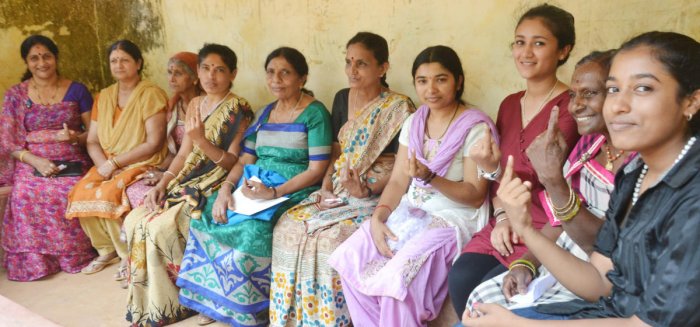
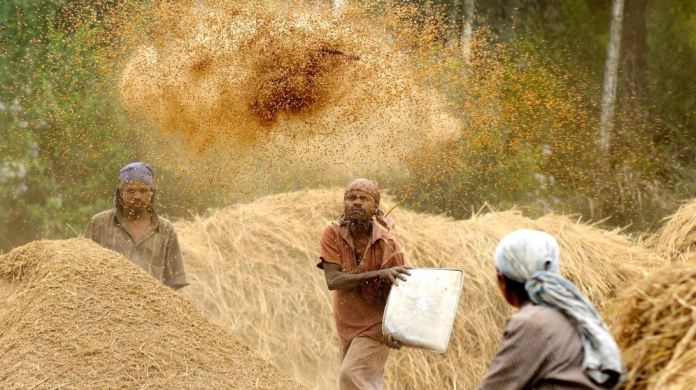
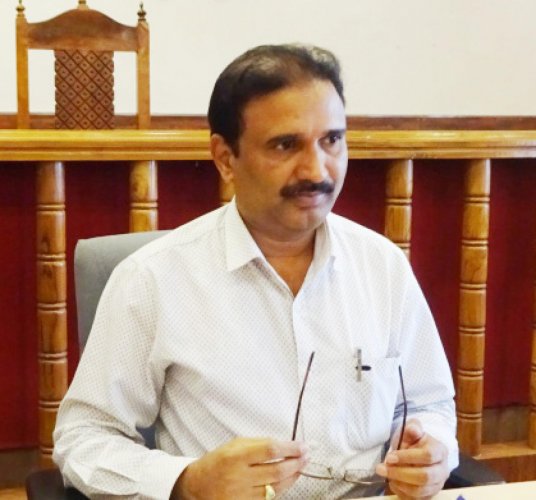
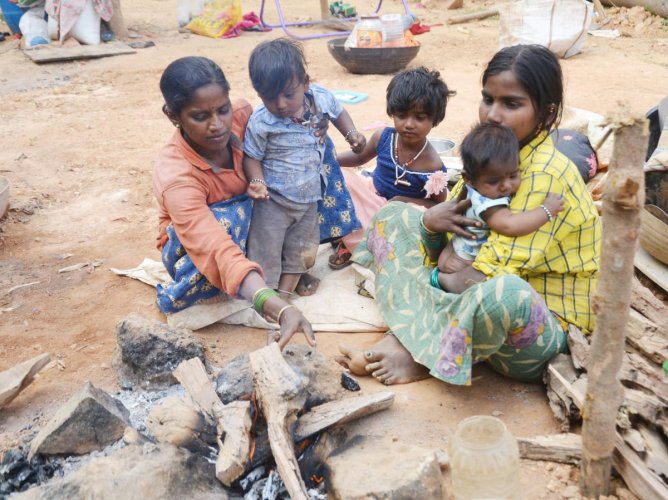
Women voters show inked fingers after casting their votes in the Maoist-infested Vanachalu polling booth in Madikeri taluk on Thursday. DH photo
The calculations about who will be elected from Kodagu-Mysuru Lok Sabha seat, which have started with the electoral fortunes of candidates being sealed in electronic voting machines (EVMs) after the election on Thursday, will continue till the votes are counted on May 23.
The calculations on who will win or lose is being done on the basis of votes cast at booth level. Owing to a tough competition between the BJP and the Congress-JD(S) coalition in the constituency, both the parties have gone out of their way to woo the voters.
A voter turnout of 68.82 percent was registered in Mysuru-Kodagu constituency. Kodagu district has recorded a voting of 74.67%. The voting percentage in the 2014 parliamentary elections in the district was 71.88. Thus, the voter turnout has witnessed an increase by 2.79% when compared to the previous election.
Out of 2,21,157 voters in Madikeri Legislative Assembly constituency, 1,69,725 people have cast their vote, registering a voting percentage of 76.74. Of the total 2,19,573 voters in Virajpet Assembly constituency, 1,59,387 people have exercised their franchise (72.58%).
In 2014, 1,55,682 out of 2,10,819 people had cast their vote in Madikeri Assembly constituency. The voting percentage was 73.84. In Virajpet, 1,45,752 out of 2,08,514 voters had exercised their franchise in 2014. The voting percentage was 69.90.
There is an increase of 21,397 voters this time, compared to 2014. As many as 27,678 additional votes have been cast in this election. The BJP candidate had obtained a lead of 32,000 votes during the previous Lok Sabha election.
The question on whether the margin will decrease or increase due to the coalition of JD(S) and Congress parties, will be known when the counting of votes begins.
Kudos to PWD voters
As many as 3,022 out of 3,076 PWD (persons with disabilities) voters have exercised their duty, drawing appreciation from all sides. The percentage of voting by the PWD is a whopping 98.24.
The good turnout of PWDs has been attributed to the free vehicle facility provided by the district administration.
source: http://www.deccanherald.com / Deccan Herald / Home> State> Mangaluru / by Adithya K A / DH News Service, Madikeri / April 20th, 2019
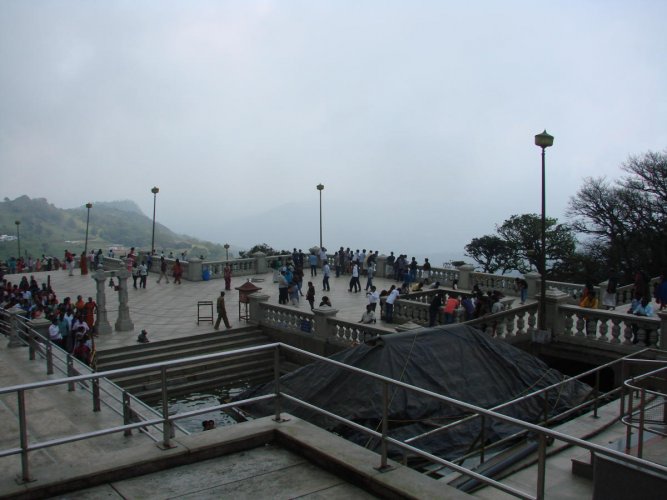
A lesser-known destination of Madikeri is Mandalpatti where sky-high hills are covered with magical mist. Sunrises and sunsets here are phenomenal, writes B V Prakash.
Mandalpatti
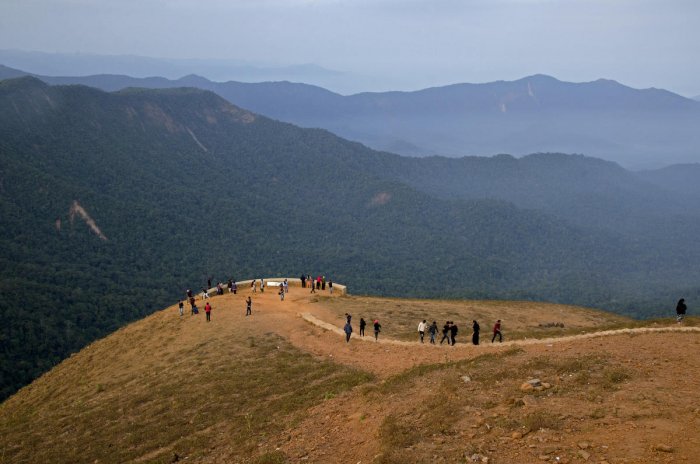
Often described as ‘Switzerland of India’, Coorg is a district known for its hilly terrain, dense forests, waterfalls and unique temples. There are at least half a dozen tourist spots like Bylakuppe Tibetan Monastery, Dubare Elephant Camp, Cauvery Nisargadhama, Abbey Falls and so on. But in recent times, a new charming destination is gaining popularity and is being listed as an important sight not to be missed. Mandalpatti Viewpoint, not far from Madikeri, is a thriving tourist attraction. Virtually little known for long, Mandalpatti shot to fame after the popular Kannada movie Gaalipata was filmed here. The place is also known as Mugilupete or ‘abode of clouds’, as it was named in the movie. Now, this spot has indeed become a star attraction for visitors.
Up, up & away
During our last visit to the town, we had earmarked an extra day to make it to Mandalpatti. Perched atop a range of rolling hills and deep valleys, Mandalpatti, at 4,050 ft, is the ultimate viewpoint offering a 360-degree view of the spectacular landscape. The highlight of the place is the blissful mood it gets into, particularly at sunrise and sunset. As such arriving in Madikeri by the night, we at once called up Harish, the jeep service provider, and fixed the programme for the next day. As per his suggestion, we would leave at 5 in the morning to be able to reach the spot, some 30 km away, in time. It was still dark and cold when the jeep arrived, we were on the way soon.
As had been informed beforehand, the road to Mandalpatti is anything but a ragged trail battered to the core. After the recent deluge, the huge landslides have left their scar and the driving is all the more backbreaking. Only jeeps and 4WDs can venture up this terrain. There are two approaches to Mandalpatti which lies to the north of Madikeri. We skipped the road via Abbey Falls having been to the place many a time. Also, the water would hardly be copious at this time of the year.
The other road passing through Makkanduru and Hattihole is slightly longer but better. Nevertheless, the journey shook us off from the sleepy mood. Reaching the parking lot, we quickly moved up the short trail to the hilltop duly paying the prescribed entry fees at the check-post. Hordes of people had already gathered and were scrambling up. At the summit, we were simply blown off our feet by the stupendous views that opened up all around. The popularity of the spot goes by the ethereal beauty the surroundings have with a sea of rolling hills and the white fluffy layers of mist like waves.
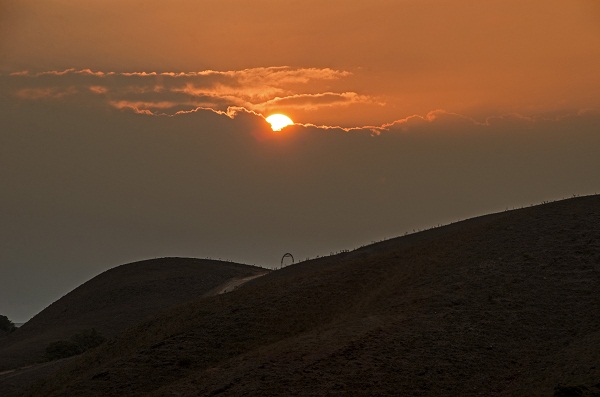
Sunrise at Mandalpatti.
Stunning beauty
The deep ravines that run down from the edge of the plateau are packed with seemingly impenetrable dense forests. In each direction, towering peaks soar with prominent ones like Kumara Parvatha or Pushpagiri, Kote Betta, Nishani Betta, etc. As the sun rose over the horizon, it was as if a huge light was lit over the whole valley. With the clouds painted with golden lines, it was truly an awesome sight. After a delightful experience of viewing breathtaking vistas and scrambling all over the place for a couple of hours, we made it back to Madikeri.
Nishani Motte
With half a day more at our convenience, we chose to climb the Nishani Motte Peak that loomed large in the northwest. Also called Nishani Betta, the 4,100-ft-high hill can be approached from different starting points each with its own difficulty level. The easiest route being from the town Gaalibeedu, 12 km away from Madikeri. We headed there in an auto. The driver was friendly and tried his best to leave us as near the foothills as he could, thereby reducing a third of the trekking distance which is 7 km to the peak. The initial path is a motorable road through coffee estates and a few houses. Soon, it was just the two of us with the trampling of the dry leaves being the only sound to be heard. At the top is a wide plateau with deep valleys to the east and west. As the sun went behind the distant hills, we retraced our steps.
Having visited a heavenly viewpoint and trekked up a beautiful peak, the experience was, for sure, pleasant and rejuvenating.
source: http://www.deccanherald.com / Deccan Herald / Home> Supplements> Travel / by B V Prakash / April 06th, 2019
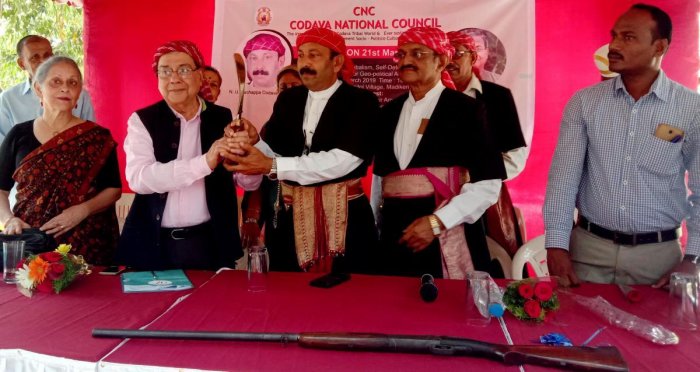
The Kodava community should be accorded tribal status in recognition of the unique customs of the Kodavas, Prof Balveer Arora, Political Science professor at the Jawaharlal Nehru University, New Delhi, has urged.
He was addressing the gathering at a seminar on the study of Kodava genealogy on account of the International Day for Elimination of Racial Discrimination organised on Thursday at the Capital Village Auditorium in Madikeri.
Prof Arora welcomed the move of the government to conduct a study of the genealogy of Kodavas. The study will facilitate the conservation of Kodava heritage, he stressed.
He observed that the culture and tradition of the Kodava community, had a close resemblance to those of tribals.
“The government should consider the demands submitted at regular intervals by the tribal population. The demands are just and should be implemented by the government,” he said and added, “Kodava population has been dwindling in the recent years due to sociopolitical reasons.”
He also stressed that it is necessary to preserve the community.
Codava National Council (CNC) president N U Nachappa said that the Karnataka State Tribal Research Institute (KSTRI) in Mysuru had been conducting a study of the genealogy of Kodavas for the last 72 years. He also urged the members of the Kodava community to extend full cooperation to the researchers from the Institute.
The Social Welfare Department has released grants to carry out the study, he added.
M T Nanaiah, president of the Kodava Samaja, Bengaluru, said that the Samaja will provide assistance to the survey. An awareness programme will be organised on the survey, he added. “Around one lakh members of the Kodava community reside in the district. There is a misconception that all Kodavas are affluent,” said Nanaiah. “The fact is that there are many Kodavas who are poor and have no access to government facilities,” he added. Dr Madhusudan of KSTRI and Kodava Samaja president K S Devaiah were present.
source: http://www.deccanherald.com / Deccan Herald / Home> State> Mangaluru / by Adithya K A / DH News Service / Madikeri – March 22nd, 2019
The Kodagu principality was ruled by the Haleri dynasty between 1600 and 1834.
During this time, a Havyaka family moved from Adamane in Shimoga to Palathadaka near Subrahmanya in Dakshina Kannada. Hence, they identify themselves as the Adamane Palathadaka (AP) family. Many AP family members were related to the officials who served under the Kodagu rulers.
A member of this generation, Dr A P Lalit Mohan, has their family tree.
The AP family claims their descent from Subbarasaya, who served as a karnika (treasurer) in Kodagu, as well as his brother Thimmarasaya. A number of Subbarasayas and Thimmarasayas can be found in the family tree.
Dr Mohan claims that two female members Mahadevamma, the wife of Dodda Vira Rajendra, and Gowramma, one of Chikka Vira Rajendra’s 13 queens, were born in the AP family.
Two missionaries, Hermann Friedrich Mögling in his Coorg Memoirs and Georg Richter in his Gazetteer Coorg narrated the story of the Rajas.
Linga Raja I died in 1780 while his three sons, Vira Raja, Appaji Raja and Linga Raja II, were still young. Hyder Ali became their guardian of the princes and took up the direct administration of Kodagu. He maintained that when they would come of age, the throne of Kodagu would be restored to them. In the meantime, he appointed Subbarasaya, from the AP family, as the amaldar of Kodagu.
In 1782, Kodagu rose in rebellion. The princes and their family members were moved to Gorur Fort in Hassan. After the death of Hyder Ali, his son, Tipu Sultan, succeeded as the ruler of Mysore. The Kodagu princely family was again moved to Periyapatna Fort. They were being held in confinement and were prevented from reaching their capital, Madikeri. Tipu marched through Kodagu in 1784. When Kodagu rebelled again, he returned.
Subbarasaya was succeeded as amaldar by his nephew Nagappayya. Nagappayya was charged with treason by Tipu Sultan and was condemned to death. He then fled to Wayanad and took asylum under Kote Raja in Kotangadi.
During 1788, two Kodagu leaders, Appaneravanda Achayya and Pattacheravanda Boluka, helped Vira Raja and his family escape. Most of the family members settled in Kurchi in Kodagu. From there, Vira Raja with Achayya, Boluka and his other men led a guerrilla war against Tipu Sultan.
Nostalgia
The Kote Raja sent bandits to Kurchi where they killed the family members, including Vira Raja’s first wife, looted the place and burnt it down. Despite this setback, by 1791, Vira Raja reclaimed Madikeri. In 1795, a new palace was built in Nalknad. Vira Raja had a daughter, Rajammaji, from his first marriage.
He desired to have a son. Hence, the following year, a mantapa (pavilion) was built in front of this palace where Vira Raja married Maha Devamma in a grand ceremony. Maha Devamma later came to be called as ‘Maha Deva Rani’. Vira Raja and Maha Deva Rani had four daughters: Devammaji, Muddammaji, Rajammaji and Mahadevammaji.
Remnant Kalyana Mantapa in front of Nalknad palace in Kodagu. Photo by author
Vira Raja had his will made before he died in 1809. Accordingly, Devammaji succeeded him to the throne. But two years later, her uncle Linga Raja forced her to abdicate the throne in his favour.
Linga Raja ruled from 1811 until his death in 1820. He got his four nieces married. Linga Raja’s son Chikka Vira Raja succeeded him. By 1826, Chikka Vira Raja got Muddammaji and her family members killed.
During the 1834 war between Kodagu and the British East India Company, Chikka Vira Raja surrendered to the British. After his exile, he went to London where he died in 1864. Karnika Thimmappayya, who was his brother-in-law, died in 1868.
source: http://www.deccanherald.com / Deccan Herald / Home> Spectrum> Spectrum Statesman / by Mookonda Kushalappa / March 10th, 2019
With addition of Kushalnagar and Ponnampet, the hill district will now have five taluks
Madikeri/ Mysuru:
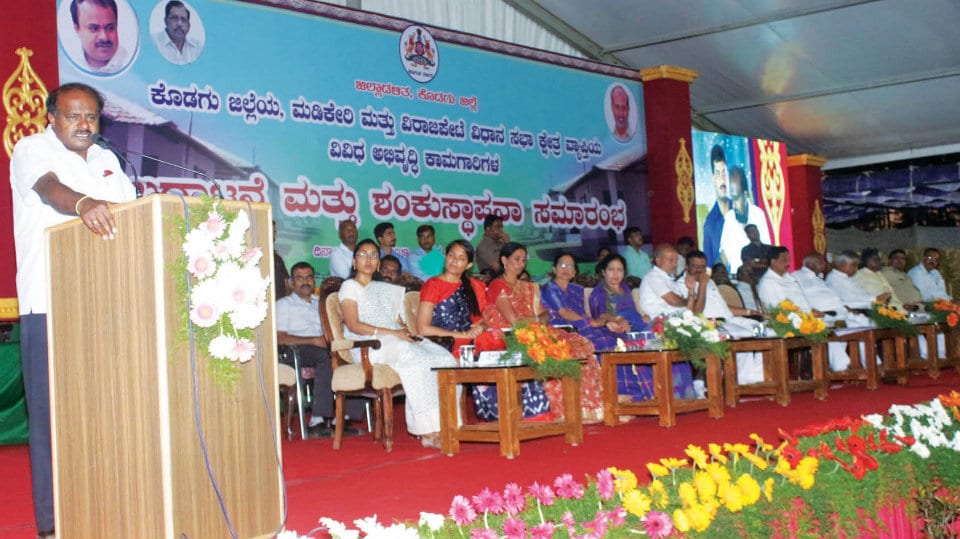
Chief Minister H.D. Kumaraswamy yesterday announced the formation of Kushalnagar and Ponnampet taluks in Kodagu following the Cabinet’s decision conceding the long-pending demand of the people of the hill district. The two new taluks carved out will be Cauvery Taluk from Kushalnagar and Ponnampet Taluk in the South.
With this, Kodagu will have five taluks, the other three being Madikeri, Virajpet and Somwarpet. The CM made this announcement at a programme organised for allotting houses to the displaced tribals of Diddahalli, at Basavanahalli, near Kushalnagar. He also launched a slew of development works at a cost of Rs. 2,146 crore.
House keys handed over to displaced tribals
A sum of Rs. 50 lakh would be released to each newly-formed taluk in the first stage for establishing basic infrastructure. On the occasion, the CM symbolically handed over keys of houses built for the displaced tribals of Diddahalli, who were evacuated from the Devamachi reserve forests.
Kumaraswamy said the people affected by last year’s floods and landslips need not worry as the government was committed to rehabilitating them. He directed the Deputy Commissioner to consult experts and explore precautionary steps to be taken in the wake partially collapsed hills before the onset of monsoon.
Kodagu District Minister S.R. Mahesh said the CM had visited Kodagu district six times since he assumed office and argued that the government was completely with the people of Kodagu.
Kodagu flood: Rs. 5 lakh to Manjula’s parents
On the occasion, the Chief Minister handed over a cheque for Rs. 5 lakh to the parents of Manjula, a student, who was feared dead in the landslips at Jodupala last year. MLAs K.G. Bopaiah, Appachu Ranjan and others were present.
About Ponnampet taluk
Ponnampet in South Kodagu is a main cultural centre in the district. Earlier, it was under the jurisdiction of Virajpet. Barring a Tahsildar’s office, all other taluk offices are situated at Ponnampet. The Court, Treasury, Taluk Panchayat Office, PWD Office, Offices of Social Welfare Department, Department of Backward Classes, Horticulture, Nada Kacheri and others are situated at Ponnampet.
Villagers from Balele, Nittoor, Karmadu, Kutta, Birunani, Parakatageri and Theralu had to travel 50-km to 60-km to reach taluk headquarters of Virajpet for any work. The proposed Ponnampet taluk will include Ponnampet Hobli, Balele, and Srimangala, Hudikeri Hobli, 21 Gram Panchayats and 49 villages. Ponnampet taluk will have 2,23,507 acres of geographical.
About Cauvery taluk
A new Cauvery Taluk will be carved out comprising Kushalnagar that was earlier under the Somwarpet Taluk. It was the dream of former Chief Minister late R. Gundu Rao to form Cauvery Taluk way back in 1993.
Kushalnagar has the offices of DySP, Circle Inspector, First Grade College, Polytechnic College, industrial layout at Kudlooru, Sports School at Koodige, DIET, Training Centre for Forest Officials, Offices of the Department of Agriculture, Sericulture and APMC. Recently, Court, Government Engineering College, Kodagu Sainik School, PG Centre of Mangalore University at Chikkaluvara and a Sub-Registrar’s Office was set up in Kushalnagar.
12 NEW TALUKS
1. Harohalli in Ramanagara
2. Cheluru in Chikkaballapura
3. Teradala in Bagalkot
4. Kalasa in Chikkamagalur
5. Ponnampet in Kodagu
6. Kushalnagar in Kodagu
7. Alamela in Vijayapura
8. Mulki in Dakshina Kannada
9. Ullal in Dakshina Kannada
10. Saligrama in Mysuru
11. Shantigrama in Hassan
12. Yaragatti in Belagavi
source: http://www.starofmysore.com / Star of Mysore / Home> News / March 02nd, 2019
The bust of Deewan Ponnappa and Basaveshwara Temple in the heart of Ponnampet.
The decades-old struggle demanding taluk status to Ponnampet has been fulfilled with the Cabinet meeting deciding to accord taluk status to Ponnampet.
The countdown has begun for Chief Minister H D Kumaraswamy to make an official announcement of Ponnampet and Kaveri taluks during his visit to Kodagu on Thursday.
Ponnampet in South Kodagu is a main cultural centre in the district. It was coming under the jurisdiction of Virajpet taluk so far. Barring a tahsildar’s office, all other taluk offices are situated at Ponnampet.
The court, treasury, taluk panchayat office, PWD office, offices of social welfare department, department of backward classes, horticulture, Nada Kacheri and others are situated at Ponnampet.
Villagers from Balele, Nittur, Karmadu, Kutta, Birunani, Parakatageri, Teralu had to travel 50-km to 60-km to reach taluk headquarters of Virajpet for any work.
Demanding taluk status to Ponnampet, former MLC C S Arun Machaiah, senior advocate Mathranda Appacchu, Bheemaiah, M T Cariappa, senior leaders like Pucchimada Harish Devaiah, A A Haji, M S Kushalappa had been fighting for the last 10 years. The demand for taluk status had gained momentum in the last two years.
The proposed Ponnampet taluk will include Ponnampet hobli, Balele, Srimangala, Hudikeri hobli, 21 Gram Panchayats and 49 villages.
According to the survey conducted by Horata Samithi, Ponnampet taluk will have 2,23,507 acres of geographical area including Devamacchi, Nagarahole and Brahmagiri forest.
The taluk will have more than 100 primary schools, 50 high schools, 15 PU Colleges, two polytechnic colleges, one ITI, one degree college and one post graduation centre.
Speaking to DH, Nagarika Horata Samithi member M S Kushalappa said, “The long-pending demand of the people of Ponnampet region has been fulfilled.”
source: http://www.deccanherald.com / Deccan Herald / Home> State> Mangaluru / by DH News Service, Gonikoppa / February 27th, 2019
In Michael Ondaatje’s Running in the Family, he stitches together an almost dreamlike journal that navigates a return to his origins in Sri Lanka, evocatively confronting the gnawing incompleteness in his cultural identity, along with the layer of dust settled over his ancestral line in Ceylon. Ondaatje’s imagery shimmers with tropical heat and the haze of memory, and the exciting semi-autobiographical account he’d crafted stuck with me. Reading about his hollow connection with home felt uncomfortably familiar, and although I’m in far greater proximity to my own native land of Kodagu, a cultural enigma still persists somewhere.
Kodagu (anglicised as Coorg), despite its indistinguishable and seamless borders, has always been recognised as an independent region in the country. The district hums a wild rhythm of lime groves and red squirrels and sweet cardamom, and has had an electric pull on tourists in recent years. However, we’ve been tucked away for decades, earning a certain cultural obscurity in our isolation and lack of political voice.
As Kodava writer Kaveri Ponnapa observes in her exhaustive book The Vanishing Kodavas, “These rustic mountain people, their extraordinary way of life, and the exhilarating beauty and mystery of their land have intrigued generations of writers, travelers, soldiers, and administrators. Where did they come from, these people acknowledged by everyone who encountered them, as puzzlingly different from all the people in the lands surrounding them, even from those with whom they had lived in close proximity for centuries?” I still think of Kodagu with a childlike wonder, each time I visit contains the magic of a first visit, but also with a little guilt – detachment is a symptom of living in the city, as well as ignoring how inextricably linked we are to our cultural identities and ancestors in every sense.
The Kodava community is a recognised microcosm of distinct social observances, but how my people actually came into being within the pitted hills of the Western Ghats remains an anthropological question mark. It’s a discussion that is bursting with rather muddled speculation, but little concrete information to rest on. In the vast universe of Hindu mythology, Kodagu was gifted its name from Lord Brahma, who created the river Kaveri that runs through the land. According to another legend from the Puranas (ancient texts), Kodagu was once called “Krodadesa”, a name which symbolised the land (“desa”) blessed by the Mother Goddess.
THE KODAVA COMMUNITY IS A RECOGNISED MICROCOSM OF DISTINCT SOCIAL OBSERVANCES, BUT HOW MY PEOPLE ACTUALLY CAME INTO BEING WITHIN THE PITTED HILLS OF THE WESTERN GHATS REMAINS AN ANTHROPOLOGICAL QUESTION-MARK.
Among many historical conclusions is that after Alexander the Great had invaded North India, many of his soldiers remained, married the native women, and settled down in the valleys of the Western Ghats, particularly the Kodagu region. Another theory by Abdul Gaffar Khan in his book Kodavaru Arabiyaru draws a connection between Kodavas and Arabs, based on the similarities of the patterns and styles of traditional clothing in both communities. Perhaps the strangest explanation floating around is that Kodavas descended from Mt. Caucasus, which belonged to the former USSR territory.
A foolproof historical point from which we can actually begin tracing Kodagu’s roots is its first recorded appearance in second century Tamil literature, where the district is dubbed “Kudakam” in reference to its western geographical location. Furthermore, Ponnapa rationalises the etymology of Kodagu: “Given the simplicity of the Kodava language, and the practical nature of the people, the name Kodagu is most likely rooted in the word ‘kodimalenad’, meaning the ‘hill country’, or ‘forested highland country’.”
Ponnapa also cautions her readers about the dangers of experiencing Kodagu’s rich and complex past through the many ‘problematic’ colonial accounts that exist as the few contemporary narrations of Kodagu and her people. According to Ponnapa, the British records of the rajahs that ruled over Kodagu paint a flawed and antagonising image of “tyrannical, bloodthirsty monarchs ruling over a dispirited, craven people.” It’s a reminder to consume information about people and places responsibly, since history is always written by the victors. Unfortunately, the physical sources that could potentially have captured the life and times of a bygone Kodagu are stained by the East India Company’s manipulative censorship and efforts of proselytisation.
I THINK THIS IS MOST ESSENTIAL IN UNDERSTANDING HOW THE KODAGU SOCIETY TREATED ITS WOMEN, AS THEY WERE PRESENTED WITH THE RIGHT TO CHOOSE, AND MANAGED TO PRESERVE A SENSE OF AUTONOMY FOR THEMSELVES.
Recognising the Kodavas’ singularity as a community is impossible without also recognising its strong matriarchal undertones. Kodagu women were and still are extraordinary in their commanding wisdom and hardiness. One would think they had steel stitched into their spines, as they balanced burdensome farm and menial work. Their ability to have carved out an individual role for themselves in a male-dominated society is striking, and some believe that Kodava society may have, at one point in time, been matrilineal in nature.
The physical and social environment of Kodagu generated certain selection pressures that pushed its people to embody a sense of bravery and strength, and as Ponnapa phrases it, “society endorsed a cult of heroism”. Men weren’t the only ones lionised for their fearlessness, as women were also held in high esteem.
In regard to matrimonial matters, women were considered marriageable at any age, and those who decided to remain bachelorettes could do so without any social disapproval. Most importantly, the tradition of dowry was non-existent during marriage. I think this is most essential in understanding how the Kodagu society treated its women, as they were presented with the right to choose, and managed to preserve a sense of autonomy for themselves. Moreover, Kodavas liberated themselves from the oppression of the caste system, and isolated themselves from the archaic Aryan varnsashram, or the Vedic system that divides society into natural groups. Instead of castes, Kodavas arranged themselves into family-based communities with units called okkas.
The rapid pace of globalisation has triggered the inevitable dwindling of Kodagu culture as people migrate into the cities in search of job and opportunity, but Ponnapa reminds us of the vulnerability of small ethnic groups and the urgency to safeguard cultural identities. Her painstaking research and commitment to telling our stories is a comforting reminder that even if Kodagu traditions and values are endangered, they can still be protected through little and big measures.
All photography credits: Sudeep Gurtu
source: http://www.feminisminindia.com / Feminism In India / Home> Magazine> Culture / by Anoushka Narendra / February 15th, 2019
Talakaveri in Coorg district is where the mighty River Kaveri takes birth. Chitra Ramaswamy traces its journey, all the while enjoying some scenic spots along the way… Talakaveri
The sky blushes a monochrome in blue tending to grey-black, with clouds that promise rain. Driving through the winding roads of Kodagu flanked by lush coffee estates and fields of spices, we bring our vehicle to a halt at Talakaveri, the birthplace of the sacred River Kaveri. We are as much awestruck by our surrounds as by the legends associated with the waterbody.
A river’s journey
Kaveri, the sacred, easterly-flowing river of peninsular India, commonly referred to as Dakshina Ganga, was born here in the Brahmagiri ranges of the Western Ghats, at an elevation of 1,341 m. However, Kaveri is not visible as a river at Brahmagiri. Rather, she originated as a gurgling spring that to date feeds a tank built on the hillside by the Kodavas of Kodugu. We witness devotees fill pots and bottles with the holy water from the tank, while others take a dip in it. Kaveri miraculously bubbles up every year at an auspicious moment in rebirth, on Tula Sankaramana day, which falls between October and November. Pilgrims in hundreds of thousands flock here to cleanse themselves during this time.
A temple to Goddess Kaveri, that is also dedicated to Shiva as Agasthyeswara, and Ganesha, overlooks the tank and attracts devotees in droves throughout the year. Talakaveri’s importance as a place of veneration gained greater importance since it is believed that Sage Agasthya was blessed here by Brahma, Vishnu and Ganesha as he sat meditating under the ashwaththa tree. Legend also has it that the saptarishis or the seven great sages who are extolled by the Vedas performed their yajna or ritual sacrifices at Brahmagiri Peak.
After offering prayers at the tank shrines, we ascend a flight of steps leading up to the summit of the mist-kissed Brahmagiri Hill, which offers stunning glimpses of the valley below. It is from here that the shimmering body of blue gleefully begins her downward journey, only to disappear underground. However, Kaveri resurfaces in a steep tumble at Bhagamandala, located at the foothills of Talakaveri where she swells with pride as she unites with River Kannike, and Sujyoti, a mythical river. The trio of rivers forms the much venerated ‘Triveni Sangam’. A dip at this confluence is believed to purge one from all evil and negative influences. Believers proceed to Talakaveri after taking a dip at the sangam and performing rituals for their ancestors.
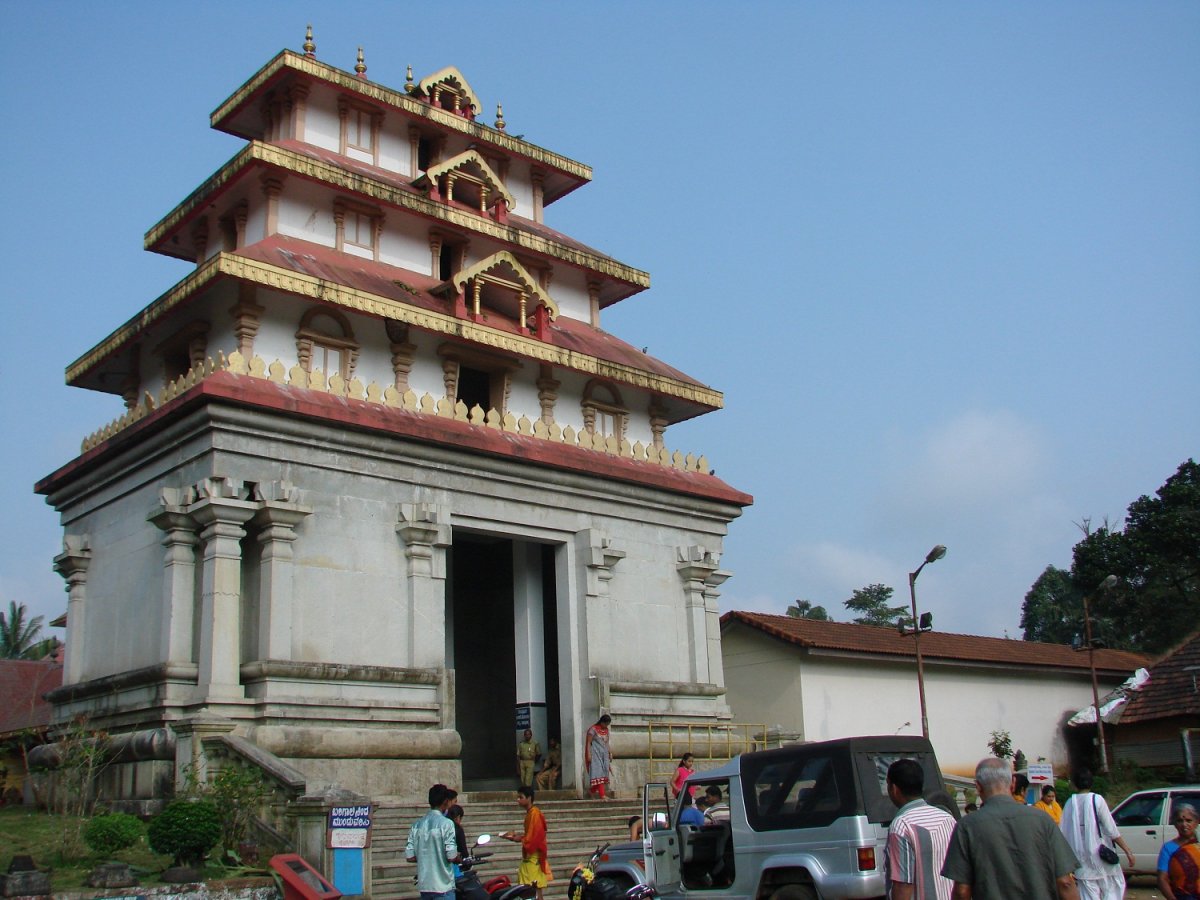
The entrance to Bhagamandala Temple
Our next halt then is Bhagamandala or Bhagandeshwara Kshetra which derives its name from the Bhagandeshwara Temple dedicated to Lord Shiva. Though the temple complex was built by the Cholas around the 11th century, it displays Kerala-style temple architecture with copper roofs that curve up at each corner, into rearing and hooded cobras. Shrines to Vishnu, Ganesha and Subramanya with rimmed brass doors dot the courtyard. Painted sculptures of the pantheon of Hindu deities, flora, fauna and men in battle adorn the ceilings.
An inscription in its premises refers to Bhagamandala as having been captured by Tipu Sultan in the 1780s. He renamed it as Afesalabad, and as a tribute to himself for the feat he had accomplished, Tipu placed the ‘Salam Kallu’, a stone on the way to Talakaveri. The stone bears testimony to the brutal bloodbaths that he caused. However, in 1790, in a fiercely fought battle, Dodda Veera Rajendra, the most famous of the Haleri rulers of Coorg, regained the territory. Further, he donated the stupika stupika and golden pinnacle of the temple’s cone-shaped shikhara.
Our Bhagamandala trip takes us to Karnataka’s only museum that exhibits objects related to bee-keeping. Bhagamandala is also home to Madhuvana, a bee-rearing and honey marketing centre.
Stuff of legends
A host of legends, most of which have their origins in the Puranas, are associated with Kaveri that has inspired several civilisations that have flourished on its banks. She is inextricably linked with Sage Agasthya, King Kavera and Lopamudra, a trio of puranic icons. The most popular tale associated with the river is that Lord Brahma sent his daughter Vishnumaya to earth as Lopamudra. He had twin objectives in doing so. One, to assist Lord Vishnu as the damsel Mohini, in his ploy to vanquish a demon. Secondly, to allow his daughter to fulfil her keen desire to serve humanity on earth. Brahma gave Lopamudra in adoption to King Kavera who meditated upon him to beget progeny.Pleased with the king’s worship, Brahma gave Lopamudra in adoption to him. As the king’s daughter, she was rechristened Kaveri, and she grew up to be a gorgeous maiden.
Sage Agasthya, who was meditating on Brahmagiri Hill, was entranced by the young Kaveri’s enchanting looks. He sought her hand in marriage. Kaveri accepted him, upon the condition that she would leave him for good if he left her alone for long, at any point in time. As fate would have it, Agasthya once became engrossed in a philosophical discussion and forgot his deal with Kaveri. She immediately left him, transfigured herself into a river, and began to flow in order to fulfil her own desire to serve mankind.
According to another popular myth, Sage Agasthya, by his yogic powers, turned Kaveri to water which he filled in his kamandalu or water pot, and kept it in his ashram. But on one occasion, when he entrusted the pot to his disciples and returned late from a debate, Kaveri used her divine powers to jump out of the kamandalu and emerge as a river to serve humanity. A variant of this version claims Lord Ganesha as having taken the form of a crow and toppling the water from the kamandalu.
Nalaknad Palace
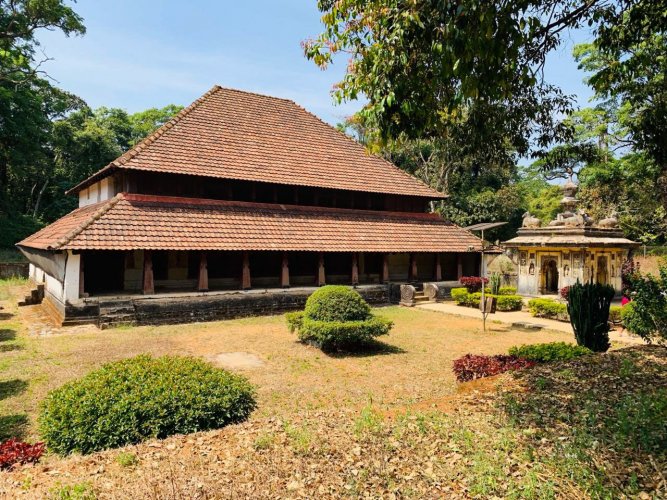
Having feasted our senses on the picturesque Talakaveri and Bhagamandala, we then explored the neighbourhood within a radius of 70 km. Igguthappa Temple, 26 km away, is one of them. After paying our obeisance to Igguthappa, the chief preceptor of the Kodavas, their god of rain and crops, we delight in the verdure surrounding Chelavara Falls, a natural waterfall formed by a tributary of the Kaveri, and Nalaknad Palace which is located at the foot of Tadiandamol, Kodagu’s highest peak. The edifice was built in 1792 by Dodda Veera Rajendra to celebrate his victory against Tipu. It is adorned with exquisite wall murals in various states of preservation. The twin-storeyed palace with a simple exterior has intricate wooden carvings, low conical roof, crested dome and pillared facade.
About 70 km from Bhagamandala, we visit the serene and breathtaking Nisargadhama, a 64-acre island surrounded by River Kaveri. A scenic spot accessed by a hanging bridge across the river, it is ensconced by foliaceous teak and sandalwood trees and bamboo groves. Uma Maheshwara Kshetra and Harangi Dam are our final halting spots on this explorative sojourn of Kodava land. Our hearts and minds fill with a sense of pride at belonging to the land of this holy river. In her 800-km-long long thrilling odyssey, Kaveri traipses amid varying landscapes of Karnataka, Kerala and Tamil Nadu, bounding over boulders, crisscrossing through clusters of expansive palm and paddy fields. She displays several shades of her whimsical nature on this jaunt — a young bride, serene and shy at once, a capricious and tempestuous prankster the next. The mirthful lass creates little and large waterways en route, joins forces with lesser streams, until she takes a final bow and loses herself in the fathomless depths of the Bay of Bengal.
source: http://www.deccanherald.com / Deccan Herald / Home> Supplements> Travel / by Chitra Ramasamy / February 09th, 2019
As per the newly released draft of the revised voters’ list, there are 4,34,256 voters in Kodagu district, said Additional Deputy Commissioner Shrinivas.
Addressing reporters at the DC’s office in Madikeri on Wednesday, he said that new 5,444 voters are enrolled this time. The names of 6,449 voters have been omitted from the list, for the reasons of death, change of place and repeated entries.
The draft of the voters’ list, containing the picture of the voters, has been published as per the directions issued by the Election Commission of India.
The voters must ensure that their names are mentioned in the revised voters’ list, said the additional DC. If not, the citizen may submit their application in Form-6, to booth level officers or to the taluk office. The deletion of the names of demised voters, change of location and removal of repeated entries can be requested under Form 7.
Shrinivas further said that an awareness programme on voting will be held for the sake of voters in the booth, taluk and district levels on January 25, on account of Voters’ Day.
The new voters will be distributed with voter’s identity cards on the occasion, he added.
This apart, the Election Commission has set up the helpline number 1950 in all districts, to clarify the doubts of people on the voting process. The helpline will be operational between 9 am and 9 pm on all the days.
In connection with the release of the draft of the revised voters’ list, a meeting was convened by the additional DC, with the representatives of political parties.
Leaders Sajil Krishna from BJP, Tennira Maina from Congress, Ajith Kumar from JD(S), Appanna and Shamaraj were present.
source: http://www.deccanherald.com / Deccan Herald / Home> State> Mangaluru / by Adithya K A / DH News Service, Mangaluru / January 16th, 2019
Children light a bonfire to beat the cold weather on Race Course Road in Madikeri on Thursday. DH Photo / Rangaswamy
Chilling cold air blowing across Kodagu district pushed temperatures way down to 10 degree Celsius in Madikeri on Thursday.
The cloudy weather experienced in the past three days ended up increasing the chill factor and sent daytime temperature down to 10-degree Celsius.
With the temperature falling so low, Kodagu is freezing at dawn and dusk. Residents are protecting themselves from the biting cold by lighting up fires in the hearth and wearing warm woollen clothing.
Elderly people preferred to stay indoors. Due to the harsh weather, the Raja Seat now witnesses a thin attendance of people on morning walks.
The number of tourists visiting Madikeri during the winter season also dipped. Tourist agencies have attributed the fall in the number of tourists to fear of natural calamities.
There is no respite from the frosty weather for those residing in the hilly ranges of Mandalpatti, Tadiyandamol, Talacauvery and Brahmagiri.
Indresh, a senior citizen recollected that harsher weather was experienced a decade ago in the district.
“The cold weather was coupled with mist which remained for the most part of the day,’ he recounted.
source: http://www.deccanherald.com / Deccan Herald / Home> State> Districts / by Adithya K A / DH News Service / Madikeri – December 20th, 2018
WELCOME. If you like what you see "SUBSCRIBE via EMAIL" to receive FREE regular UPDATES.
Read More »