Category Archives: About Kodagu / Coorg

Buried Under Landslides, Coorg’s Coffee Planters Peer Into Oblivion

Before the rains started, coffee planters in Coorg were talking of a good crop —the plants were well rested after a lean year and went through the process of blossoming and forming fruits. That settled, seasonal certainty is gone with the wind and merciless lashings of torrential rain.
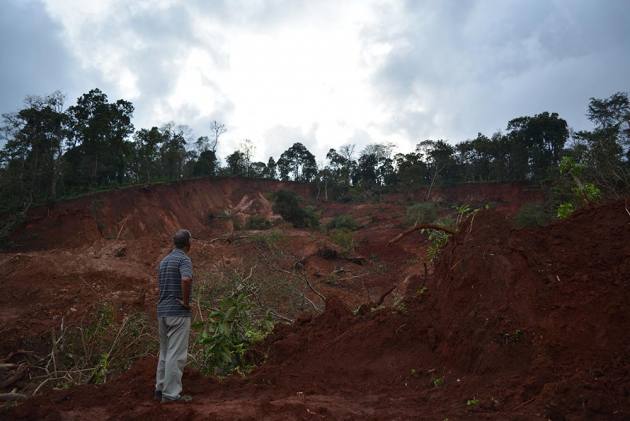
HELPLESS  /   A planter contemplates nature’s carnage where once existed a fecund patch / PHOTOGRAPH BY AJAY SUKUMARAN
HELPLESS / A planter contemplates nature’s carnage where once existed a fecund patch /
PHOTOGRAPH BY AJAY SUKUMARAN

A fully-done crossword puzzle is on the table next to Chitra Subbaiah who confesses that she could forego reading the newspaper, but not the crossword. We are in the cottage of a home-stay in Madapura, north Coorg, resplendent in the evening sun—the first day in two months that the rain has let up. It brings some rel­ief from fear. Chitra, nearing eighty, rec­ounts a painful experience with great fortitude. “You have to do some mental jugglery, you know. You can’t curse your fate.” She’s staying in a friend’s cottage because her home, in the neighbouring village of Hattihole, now lies beneath a pile of earth which slid down the hillside, burying everything she owned.

“Wiped out, totally. I don’t have one pin. There is nothing to say there was a house,” she tells Outlook. All she could reach out for in time were her spectacles, medicines and some gold the wor­kers from her coffee estate had ent­­r­­usted her with safekeeping. The workers’ quarters on her coffee estate too went down. Fortuna­tely, they had time to move out. She points to others in the same situation. “At least I can rent a house and stay. What about so many others, who have nothing,” she asks.

Before the rains started this year, coffee planters in Coorg were talking of a good crop—the plants were well rested after a lean year and went through the process of blossoming and forming fruits.
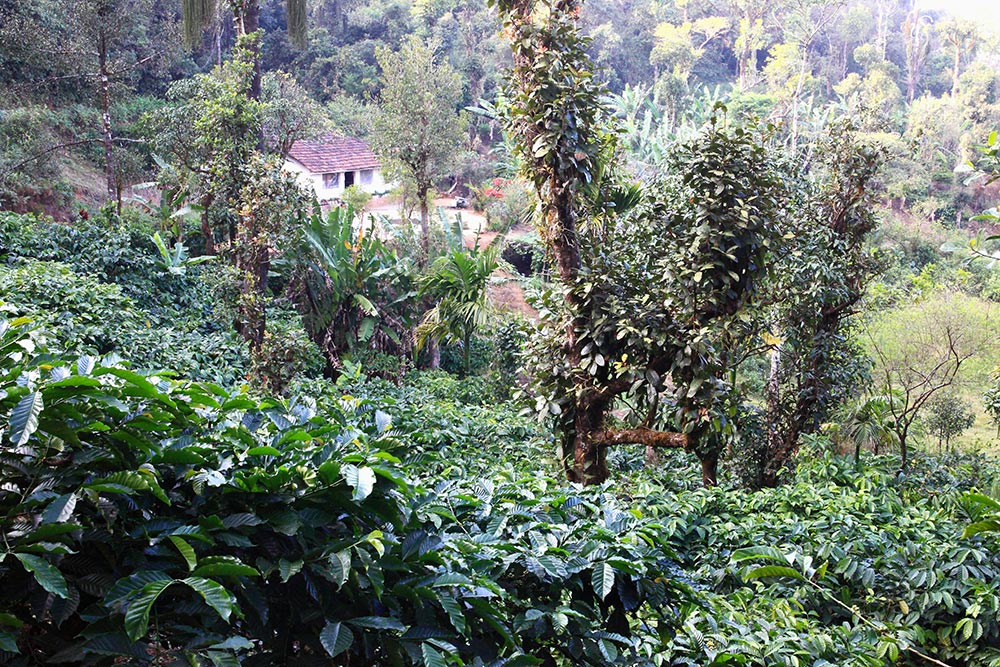
The scene at a typical Coorg coffee estate  / PHOTOGRAPH BY GETTY IMAGES
The scene at a typical Coorg coffee estate /
PHOTOGRAPH BY GETTY IMAGES

That settled, seasonal certainty is gone with the wind and merciless lashings of torrential rain. It rained heavily through July and August in this region of south Karnataka bordering Kerala. Then, in late August, came a series of punishing cascades of sodden earth. Now, there’s a trail of ruin in these charming hills, where landslides have swept off whole villages, re-arranged estates and shattered its economy. With immediate rescue measures tapering off, one question hangs limply in the air: where do you start picking up the pieces?

“I can’t plant anything now on my land, that’s for sure,” says K.U. Erappa, standing in his camouflage gumboots in a relief camp inside Madikeri’s old fort where, grouped with several families, he has been staying for days now. “All that’s left of my coffee plants are just stalks,” Erappa says. His ageing mother walks up to say, “We had a small house, but it was pretty.” Their grief is palpable. Erappa owned a few acres of coffee and paddy in Mukkodlu, one of the hardest-hit places in north Coorg, in the vicinity of district capital Madikeri. Much of Coorg is remote, away from the main-travelled roads. Like others, Era­ppa has been going back to salvage what he could. His three children, like most kids from his village, have been sent away to a temporary residential facility in a school in Ponnampet town at the southern end of the district. “We never dreamt Coorg would come to this,” says N. Bose Mandanna, a planter from Suntikoppa.

Right now, a full picture of the damage isn’t available, though it is being estimated. Planters like Mandanna reckon that at least 5,000-7,000 acres have been wiped off in the landslides. For the plants still standing, there’s the danger of wet feet and black rot—water-­logging at the base of the plant that strangulates it, cau­sing leaves to fall off. “When leaves are lost, next year’s crop is also lost,” says Man­danna. Coorg, with about one lakh hectares in cultivation, accounts for close to 40 per cent of India’s coffee production. The 2017-18 post-blossom estimate was 1,33,500 metric tonnes, most of which is exported, Italy being a top destination. To make matters worse, prices, say market watchers, have been at historic lows. Brazil is harvesting a good crop this year and so will Columbia and Vietnam.
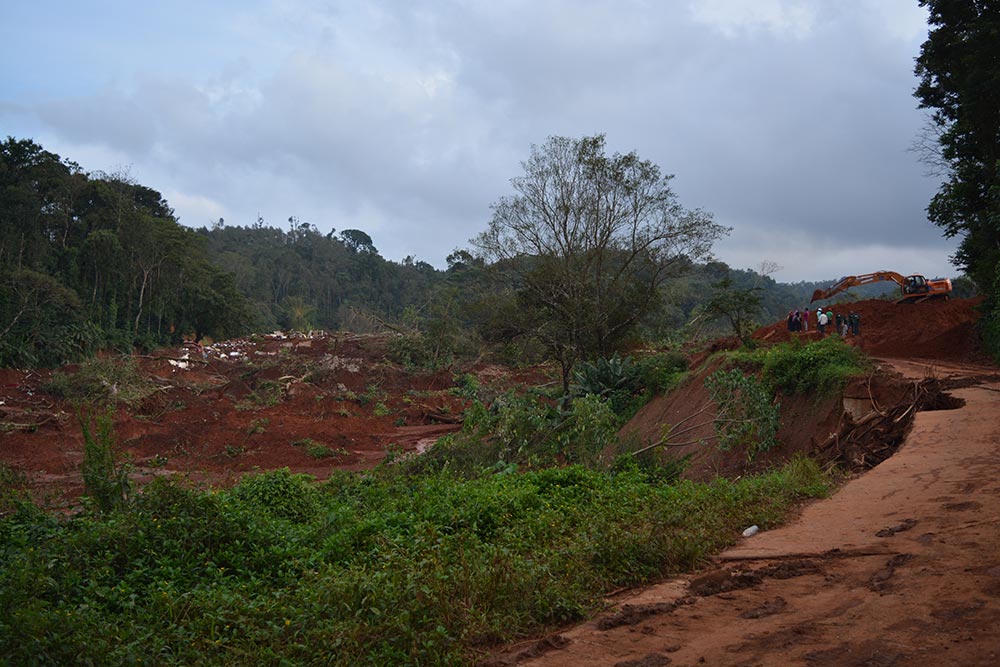
The desolation on the spot after the landslide / PHOTOGRAPH BY AJAY SUKUMARAN
The desolation on the spot after the landslide /
PHOTOGRAPH BY AJAY SUKUMARAN

“International prices have gone (down) to levels last seen in 2006. We are getting a lot less now, if you factor in the inflation,” says Ramesh Rajah, president of the Coffee Exporters Asso­ci­ation. Prices dep­end on the big three producers—Brazil, Columbia and Vietnam—which account for over 70 per cent of the global production. “Only if there are supply shocks in the big three will there be impact in international prices. India can lose one third or even half its production and the international market is not going to blink,” says Rajah.

In the mid-nineties, Coorg coffee saw a boom when prices rose because of a supply shortage in Brazil whose production, apart from being vulnerable to frost, was considered inefficient then. The boom years lasted a decade until trends began to reverse. Owing to hilly terrain, Coorg can’t mechanise the way Brazil did. So, it has been grappling with high labour costs. Nor can other crops be sown, as coffee plants need trees for shade. Many Kod­a­vas, as Coorg’s natives are called, conc­ede the difficulty in maintaining pla­­­­n­­tations. The symptoms, many say, have been showing—an ageing population, a you­nger generation that has been migrating to cities and bits of land being sold to meet expenses, the latter contributing to a soc­ial churn in the highlands. This devastating blow came on top of all this.

The future, many say, is bleak. First, the question of land lost, by no means an easy task, given the complexities that involve verifying claims, boundaries and so on. “Let the government acquire the property. See the record, set­tle them,” says planter Mittu Che­n­gappa, who’s also a Karnataka Congress general secretary. His suggestion, that the government acquire private land ravaged by landslides for afforestation so that owners can begin afresh elsewhere, has been voiced by many. Unlike neighbouring Chikmagalur—where coffee was first grown in India—there are more small growers in Coorg, many owning only a few acres.
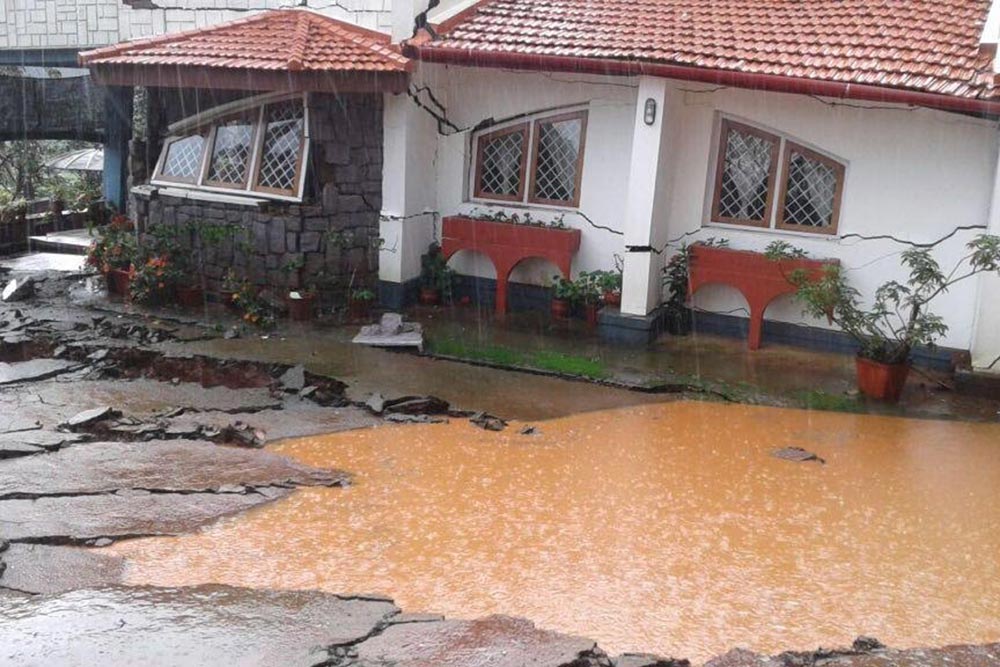
Chitra Subbaiah’s house in her estate in Hattihole village

Even for those who didn’t lose land, rep­lanting will be a big financial burden, says Rajah. Besides the upfront cost, it would mean a five-year wait for yields. “So, how will they sustain themselves for five years? What does he do about infrastructure within the farm, workers’ houses, his house?” asks Rajah. Coffee planters have always weathered difficult years, but the destruction this year is unprecedented. “Some years, the crop yield is sharply lower because of lack of rain or excess rain. But this is the first time we have act­ually seen this sort of damage where infrastructure is damaged. It’s going to be very difficult in the short term,” reckons Rajah. In the long term, he says, every producing country is bleeding, so things can be pulled back to a degree by increasing efficiency. Of course, primary rehabilitation remains a priority; the process of replanting will take place slowly.

“The other thing is the labourers are not coming back. We are still in a state of flux, a dilemma as to what’s going to happen. There are a lot of issues, it’s very fluid,” says Nanda Belliappa, a coffee grower from Hattihole who has to now walk half a kilometre inside his property to reach his house, as the road leading to it is blocked. The Hatti, a stream outside his gate—where once a Malayalam film was shot—has beached fallen tree trunks ashore. “The neighbours’ coffee plants and trees are on our road…it’s unbelievable,” says his wife Anitha. In villages in these parts, the conversations go from rain to earthqu­ake—many planters say they heard loud booms and felt tremors, but officials say no seismic event was captured.

Bose Mandanna too says he won’t be so pessimistic as to say that the coffee ind­ustry won’t claw back. But he’s doubtful about the prospects of a full recovery in North Coorg. “This area cannot come back in a hurry,” he says. Last weekend, as the evening drew on, Madikeri wore a deserted look—tourism has stalled and hotels are ordered not to take in travellers for some time. “Every night, there’s fear that the hill will come down on your head,” says Mandanna. The Kodava harvest festival Kailpodh, when they worship their guns, went by this week. Says Mandanna, “Nobody was interested in the festival. Coorg has become like a funeral parlour.”

source: http://www.outlook.com / Outlook / Home> The Magazine> Business / by Ajay Sukumaran / September 17th, 2018
Calamity in coffee country

Old-timers and environmentalists blame tourism for the devastating floods in Kodagu

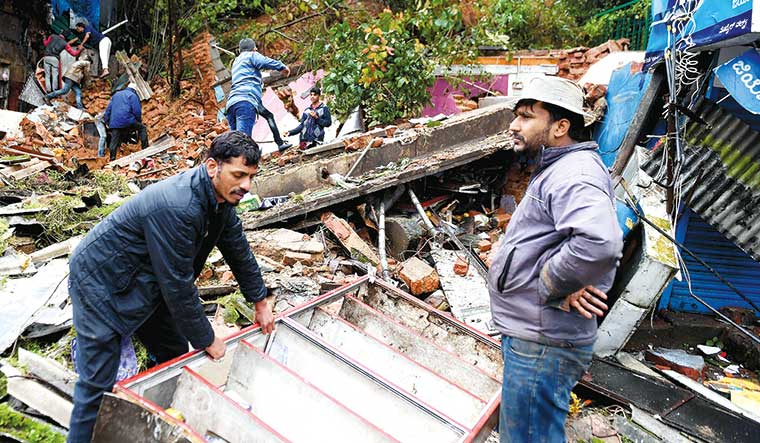
Shattered hopes: As many as 1,206 houses and 278 government buildings were damaged in the Kodagu floods | Bhanu Prakash Chandra

IF THE RAINS had not wreaked havoc in Kodagu, Karnataka’s coffee country would be preparing for ‘Kail Murta’, a festival in which the Kodavas worship their weapons. But, the district, which got battered by flash floods and landslides that took 12 lives and rendered more than 1,500 families homeless, is now left with just one weapon: resilience.

On the midnight of August 15, torrential rains started pounding Kodagu. The hills cracked up and tumbled down, and the rivers swallowed everything on their way—century-old houses, brand-new homestays, tiny tea shops, lush green paddy fields, vast stretches of coffee plantations, forests, livestock, bridges and vehicles. Incessant rains submerged low-lying areas in Kushalnagar, Somwarpet and Madikeri, pilgrimage centres like Talacauvery and Bhagamandala, and major bridges like Bethri, while landslides along the national highways turned those into death traps.

By the time the district administration launched rescue operations, the communication lines were cut off and most villages had become inaccessible. Heavy rains, tough terrain and scattered habitations made rescue operations a daunting task even for the armed forces and the National Disaster Response Force. Many people were hungry and exhausted when the rescue teams finally reached them.

Manu Madappa from Mukkodlu village said around 40 people took refuge in his homestay for three days. But with no help arriving, they decided to trek to Madikeri. “We covered a distance of 20km, walking in the rain on a muddied path, and made it to a relief camp in Madikeri,” he said.

As many as 51 relief centres have been opened across the district, sheltering 7,594 people as on August 22. NGOs have ensured an uninterrupted flow of relief material to these camps. The Kodava Samaj in Bengaluru and Mysuru are the nerve centres for organising relief material.

Local MP Pratap Simha, who was part of the rescue operations, said the devastation was unimaginable. “Incessant rains prevented airlifting of stranded people although three Army choppers were on standby. After I sent an SOS to Defence Minister Nirmala Sitharaman, the Army unit from Karwar was rushed in,” he said. “The relief centres are working well, and our next big challenge is rehabilitation. We will need huge cash donations to rebuild homes.” According to the Karnataka State Natural Disaster Monitoring Centre, 1,206 houses and 123 kilometres of roads have been damaged, 58 bridges and culverts have collapsed, 278 government buildings and 3,800 electric poles and transformers have been severely damaged.

Chief Minister H.D. Kumaraswamy, who conducted an aerial survey, said the infrastructure damage alone amounted to Rs 3,000 crore. “A team of engineers from the Border Roads Organisation and the Army engineering task force have been called in to clear roads and restore them,” said Kumaraswamy. “A team from the National Geophysical Research Institute, Hyderabad, is conducting geotechnical studies to ascertain the causes of landslides. We have deputed two IAS probationers to fasten the process of identifying the lands for rebuilding 2,000 temporary homes.” he said.

The government has promised Rs 3,800 per family, along with essential groceries as immediate relief. The chief minister has promised the affected people work under the National Rural Employment Guarantee Act and offered to issue provisional documents for those who have lost their Aadhaar and ration cards and title deeds. “Rs 5 lakh will be given to the family of the deceased. Special classes and books for children are also being planned,” said Kumaraswamy.

The rainfall was unprecedented, but old-timers and environmentalists said the alarming plight of Kodagu was the fallout of the booming tourism industry. G.S. Srinivas Reddy, director of the Karnataka State Natural Disaster Monitoring Centre, said Kodagu received 103 per cent more rainfall than normal this year.

U.M. Poovaiah, editor of Brahmagiri, a Kodava weekly, said he had never seen or heard of such devastation in the history of Kodagu. “This is the fallout of unregulated tourism that has razed down the hills to make roads to homestays. The riverbed has been encroached upon. Unplanned construction has pushed the district to the edge. The authorities are to blame for the influx of tourists and atrocities against nature in this once-pristine district. We want unlicensed homestays and construction activity to be stopped,” said Poovaiah.

The Coorg Wildlife Society, too, blamed the severe stress on Kodagu because of the change in land use and unbridled tourism. In a letter sent last May to Prime Minister Narendra Modi, the CWS wrote, “Kodagu provides almost 50 per cent of the total inflow into Cauvery, which is the lifeline of South India, and provides water to over 80 million people and 600 major industries across the region. The food, water and economic security of southern India hinges largely on Cauvery River. It is therefore in national interest to preserve the Kodagu landscape and protect its ecosystems.”

Colonel (retd) C.P. Muthanna, president of CWS and co-ordinator of the Save Kodagu and Cauvery campaign, said more than 2,800 acres of paddy fields, coffee plantations and highlands were converted to residential layouts, sites, commercial complexes and resorts between 2005 and 2015. “Kodagu’s fast-paced urbanisation will turn it into a slum,” said Muthanna. Earlier this year, he had urged the Karnataka government to regulate tourism in the region and demanded an audit of water and waste and sewage management in the resorts. “While Kodagu has a population of 5.5 lakh, the number of tourists goes up to 13 lakh,” he said.

A report by the Centre for Ecological Sciences, Indian Institute of Science, Bengaluru, said massive deforestation and monoculture plantations caused the landslides. “Trees hold the top soil and also absorb and regulate the flow of rainwater. But deforestation for construction of roads and power lines have resulted in soil erosion,” said T.V. Ramachandra of the centre. “If the government wants to avert disasters, it should not take up any mega projects.”

source: http://www.theweek.in / The Week / Home> The Week> Cover Story / by Prathima Nandakumar / September 02nd, 2018

A Professor Remembers His Days In Kodagu

ProfessorKodaguKF25jul2018

Voice of the Reader:

Sir,

Apropos the letter titled ‘A Mysurean’s tryst with Kodagu’ published in Star of Mysore dated July 11, I want to narrate my experience of staying in Kodagu from 1962 to 1966 being a former native of Hunsur.

In 1962, I was directed to a school in South Kodagu by my College Professor whom I happened to meet on Sayyaji Rao Road, Mysuru. Since Kodagu is adjacent to Hunsur, I thought, as a fresher, that I can go and work there and teach English to students.

When I landed at Balele in Kodagu, I was mesmerised by the beauty of nature around the school which was situated amidst a coffee plantation dotted by orange trees. There wasn’t any other building near the school except an asphalted road on which buses used to ply from Gonikoppal to Balele – four or five buses used to ply on this road every day. It was a rare sight for us to see the buses so clean and punctual. The crew of the bus was so co-operative and social, that the passengers used to feel that all of them were the members of the same family.

There was a valley near the school and down below, there was a stretch of land which belonged to the school just like a part of the coffee plantation around the school. It was used to cultivate paddy and rain water was the only source of irrigation. The valley was so beautiful that we used to stand at the rim and enjoy the beauty especially during rainy season and winter amidst thick mist. There was an old house at the rim of the valley and from there we used to enjoy the beauty of the rising sun over a cup of piping-hot Coorg coffee.

Boys playing hockey was a feast to the eyes at the school field which was close to the valley. But that side rim was covered by trees and other vegetation.

This year’s rainfall reminds me of the continuous rain in Kodagu for about five days which locked us up in the school building which was our residence too. We spent our days playing carom, chess, hearing radio. There was no electricity and tap water during that time. I have gone to that place many a time even after leaving that place about 52 years ago to recapitulate the memory.

– Dr. Hunsur S. Raghavendra Rao, Retired Professor, J.P. Nagar, 12.7.2018

You can also mail us your views, opinions, and stories to voice@starofmysore.com

source: http://www.starofmysore.com / Star of Mysore / Home> Voice of the Reader / July 15th, 2018

Voice of The Reader : A Mysurean’s Tryst With Kodagu

KodaguKF12jul2018

Sir,

I should consider it treason on my part if I don’t respond now to KBG’s Abracadabra titled “Will Kodagu, heaven on earth, cease to exist ?” (SOM dated June 23). Yes, I consider Kodagu my second homeland, if KBG calls Mysuru his homeland.

Ever since KBG advised me to go to Tadiyandamol in 1984 to enjoy a good trekking experience, my tryst with the land has been, probably, more significant than that of anybody else living outside Kodagu. During the first six years thereon (1984), one could find me wandering around seldom tread remotest and wildest paths of the district, along with my students. During 1990 and 1995 people could very regularly find me around Talacauvery, measuring rainfall and monitoring flows in small streams, including Cauvery and Kannike at their origin, and developing theories on ‘Pipeflow’ for my Ph.D.

Later, for about a decade, one could find my students working on data we collected from the region and me coming out with significant publications telling the world about the thrills of my work in the Western Ghats. Ever since I was awarded a Funded Project by ISRO in 2006, my association with Kodagu started expanding in multiples. Innumerable number of our (NIE) students started getting benefited from the project, and enjoyed working in the wet areas of the Watershed of Kumaradhara, which originates on the eastern slopes of Pushpagiri.

We instrumented streams, installed rain gauges and collected precious data. The project culminated in me setting up a very unique “Field Hydrological Laboratory” which now caters to teaching PG students of NIE practical Hydrology. The Annual Survey Camp for UG students was also being held for a few years in Garwale, exposing students to real-life problems.

Recently, I have got funds to the tune of Rs. 30 lakh from MoES, for continuing my work in Kodagu — this means I can work with freedom in the Ghats till my retirement from service at NIE. I hope, people will understand how formidable my emotional attachment with Kodagu is.

For this very reason, I oppose all forces working towards the fall of Kodagu. I assure you that my ‘alilu seve’ continues to be available for purposes that will do good to Kodagu. To add to my earlier write-ups, I now have a point to emphasise on.

During the over seven decades of independence and democratic rule in the country, very sadly, Kodagu has had the opportunity of sending only one of its own sons to the Parliament. People of Kodagu have cast votes 16 times and have seen their representative (C.M. Poonacha) becoming an MP only once. During the last four decades, which I have seen, no MP has ever done anything favourable to Kodagu, except for shedding crocodile tears. Hence, I strongly feel that the people of Kodagu take up the challenge of installing their own representative.

A true representative of the people is of utmost importance in shaping political decisions and a strong lobby which alone can bear fruits. No doubt that a long-lasting battle is required to achieve this goal.

– Prof. Yadupathi Putty, Krishnamurthypuram, 1.7.2018

You can also mail us your views, opinions, and stories to voice@starofmysore.com

source: http://www.starofmysore.com / Star of Mysore / Home> Voice of the Reader / July 11th, 2018

Karnataka: Now, permission from Forest Department necessary to enter Mandalpatti

The pleasures of visiting these popular spots were taken away due to the aggressive nature of locals who charged up to Rs. 1500 to ferry tourists to Mandalpatti.

Madikeri :

In order to curb exploitation of tourists by locals who were charging exorbitant charges to ferry them to Mandalpatti, the State Government has now made it mandatory for tourists to obtain permission from the forest department for entry to the Pushpagiri belt of Mandalpatti.

The pleasures of visiting these popular spots were taken away due to the aggressive nature of locals who charged up to Rs. 1500 to ferry tourists to Mandalpatti. While bus routes were drawn to this spot, it was not seen as a convenient option by many tourists who paid over Rs 1,500/- per jeep to reach Mandalpatti from nearly 14 kms away.

Be it one passenger or eight passengers, the charges per jeep remained the same.

This overcharging by locals had been brought to the notice of DC Sreevidya P I, who has laid down strict rules to control the menace.

A meeting was recently held by Sreevidya along with SP Rajendra Prasad who concluded that permissions need to be sought to enter the Pushpagiri belt of Mandalpatti. The DC has also ordered that the jeeps ferrying tourists will be brought under the scanner and Galibeedu village panchayat has been asked to install CCTV cameras at the premises.

No public or private vehicles will be allowed beyond the gates installed by the forest department at Mandalpatti; pedestrians and tourists could trek to the spot (after receiving permission) from the gate instead of travelling in vehicles.

The district administration has also drawn a maximum ferry charge of Rs 300/- per jeep and anyone demanding more money would not be allowed to function in the area.

The forest department is ordered to make sure that no plastic, liquour or other items are carried to the spot by the tourists. Offenders of these rules will be penalized by the Police Department’s Road Transport Authority.

source: http://www.newindianexpress.com / The New Indian Express / Home> States> Karnataka / by Express News Service / June 05th, 2018

Rampant land conversion in Kodagu leads to reduced flow of water in Cauvery

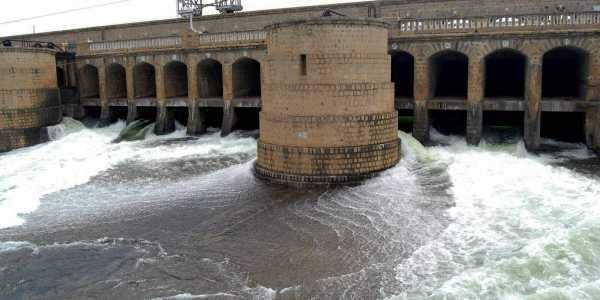
Kodagu district is the major watershed and catchment for the Cauvery and has witnessed rampant conversion of not just forest land but also wetlands and coffee plantations.

Water flowing from a dam across the Cauvery river. (File | EPS)

Bengaluru :

With 2,800 acres of land converted for commercial purposes in the last decade in Kodagu district, environmentalists decry the continuing change in land use and say it has decreased the annual flow of water in the Cauvery.

Kodagu district is the major watershed and catchment for the Cauvery and has witnessed rampant conversion of not just forest land but also wetlands and coffee plantations.

The statistics revealed by the district authorities are shocking as between 2005 and 2015, more than 2,800 acres of paddy field, coffee plantations and highlands were converted to residential layouts, sites, commercial complexes and resorts.

Col C P Muthanna, president, Coorg Wildlife Society said, “We have received this data from the district authorities as a reply to our RTI application. This is a matter of grave concern as the tiny district is the lifeline of not only south Karnataka but also Tamil Nadu. The river’s catchment areas have made way for buildings … the district has also been losing its tree cover to infrastructure projects, high tension power lines and railway lines.”

The Coorg Wildlife Society has met the district authorities in this regard and submitted a memorandum highlighting how large scale conversion of wetlands/highlands without even getting a NoC from the gram panchayats have taken off and legalised later by paying bribes. They have requested the authorities concerned to carry out a site inspection in the three taluks and a proper assessment on conversions. Col Muthanna adds, “The DC has tentatively agreed to our request. Further, we have requested for a study on carrying capacity of tourism in Kodagu that may finally result in policy measures for sustainable tourism.”

Environmental activist Sundar Muthanna, who has started an online petition ‘Stop the two railway tracks to Kodagu and Save Cauvery River’ and addressed it to PM and 14 others says, “Implementing the two railway lines will involve cutting of lakhs of trees in the catchment region. Kodagu has already lost 54,000 trees for a high tension power line to Kerala and now hundreds of fresh applications for conversions are pending with the department. Land conversion seems to be the government term for ‘ecological suicide’.”

Railways and highways are being planned to promote tourism and business. “When tree-holding agricultural land is converted for commercial purposes, the trees are cut for construction activities. In river catchment area, less trees is … simply put … less river. The Cauvery went completely dry in Kodagu in March this year … we don’t seem capable of understanding the many warnings that nature is giving us,” Muthanna says.

Environmentalists say a study done by researchers of Indian Institute of Science has already revealed the decreasing water flows to the Cauvery from the catchment areas of the district. Prof T V Ramachandra, head of Wetland and Energy Research Group, IISc headed this study — Modelling Hydrologic Regime of Lakshmanthirtha Watershed, River Cauvery. The study outlines how change in land use in Kodagu has decreased the flows into Cauvery. The assessment showed that out of five watersheds, four had high deficiency of water for over three months.

Kodagu DC was not available for her comments.

source: http://www.newindianexpress.com / The New Indian Express / Home> States> Karnataka / June 13th, 2018

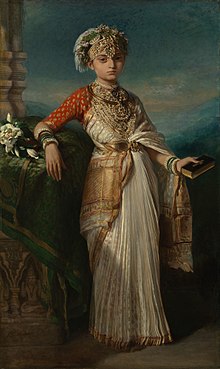
FRANZ XAVER WINTERHALTER (1805-73) Princess Gouramma (1841-1864) Signed and dated 1852

Princess Gouramma (1841-1864) Signed and dated 1852

Oil on canvas | 153.2 x 91.8 cm (support, canvas/panel/str external) | RCIN 403841

Durbar Corridor, Osborne House

PrincessGowrammaKF10jun2018

Description
Winterhalter was born in the Black Forest where he was encouraged to draw at school. In 1818 he went to Freiburg to study under Karl Ludwig Sch?ler and then moved to Munich in 1823, where he attended the Academy and studied under Josef Stieler, a fashionable portrait painter. Winterhalter was first brought to the attention of Queen Victoria by the Queen of the Belgians and subsequently painted numerous portraits at the English court from 1842 till his death.

Princess Gouramma (1841-64) was the daughter of the ex-Raja of Coorg. She was baptised in the Chapel at Buckingham Palace on 1 July 1852 and took the name ‘Victoria’, with Queen Victoria as her Sponsor. She had been considered a suitable bride for the Maharaja Duleep Singh whose portrait is also in the Royal Collection (RCIN 403843), but he declined to marry her. In 1860 she married Colonel John Campbell.

Here the Princess is depicted in Indian dress and rich jewellery, leaning on an Indian table. She is holding a Bible, an allusion to her conversion to Christianity.

Signed and dated: F Winterhalter / 1852.
Provenance
Painted for Queen Victoria

source: http://www.royalcollection.org.uk / Royal Collection Trust / Home> Collection> Explore The Collection

Going the Parsi way

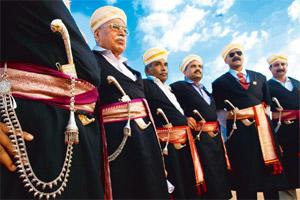
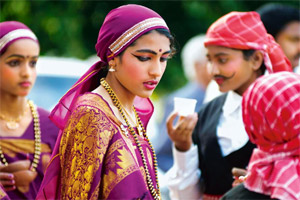
Parsis of the south: Scenes from the centenary celebrations of the Kodava Samaja Bangalore earlier this month. Photographs by Aniruddha Chowdhury/Mint.

Fair-skinned, educated and Westernized, they are the Parsis of the south. And their numbers too are declining— from 175,000 in 1992 to 125,000 in 2010 (Bureau of Economics and Statistics). Kodavas, or Coorgis, are concentrated in Coorg, Karnataka, which the British turned into a major district of coffee plantations. The land is also known for its mist-cloaked hills scented with honey, cardamom and oranges.

Kodavas are more numerous than India’s Parsis, Bahá’ís and Jews but that’s no solace. “We might vanish by 2030,” says Chepudira M. Thilak Subbaiah, president of the Kodava Samaja Bangalore that held its centenary celebrations in early November. “Young Kodavas are educated workaholics and don’t care about families. They don’t want more than one child.” According to Subbaiah, Bangalore has the largest population of Kodavas (35,000) after Coorg (70,000).

“The concern is not so much of losing at a numbers game,” says Sarita Mandanna, whose debut novel Tiger Hills was set in Coorg at the turn of the 20th century, “but the risk of losing an entire way of life, and the land as we once knew it.”

Kodavas are warrior-caste Hindus but their festivals and rituals are different. They have no priest, no holy fire and no dowry in weddings. They are great pork eaters. They worship Kaveri, the river that originates in Coorg. With a literacy rate estimated at 80%, their vocabulary is a mix of Persian, Sanskrit, Hindi, Kannada, Tamil and Telugu. Almost everyone has an estate—it could be 1 acre or 500 acres. Some say they migrated from the Kurd region in West Asia, others claim they are descendants of Alexander’s army. Traditionally a martial race, they have produced army icons like K.S. Thimayya and K.M. Cariappa. Other notable Kodavas are athlete Ashwini Nachappa and VJ Nikhil Chinappa.

Explaining the reason behind the dwindling numbers, the Bangalore-based author, Prof. P.S. Appaiah, says: “Until 1950, families had at least half a dozen children each. After the government introduced family planning, the Kodavas showed the most enthusiasm. General Cariappa himself would tell us not to go beyond two children. He said that we couldn’t afford to make India a jam-packed stadium.”

KodavathiJun052018

The Kodavas have been known for their well-knit joint families. “With better education and exposure, Kodavas are opting for smaller families, a trend that’s evident in most of educated India,” says Mandanna. “With land no longer jointly held within a family, but being parcelled into smaller acreages, it’s no longer viable to support a large brood of children.”

Young people are moving to cities like Bangalore, Mysore and Mumbai, where many have found their calling in the IT industry. “Many Kodavas are finding it hard to find suitable life partners within Kodavas, which forces them to marry non-Kodavas or stay as singles,” says Kishor Cariappa, moderator of KodaguCommunity.com, a site where people discuss topics ranging from marrying outside the community to Kodava cuisine.

A woman married to a Kodava is not considered a Kodavathi, but the children of the marriage are Kodavas. “Not so if a Kodava woman marries outside, in keeping with traditions observed in most of the country,” says Mandanna, whose sister married a Tamilian Brahmin. “Marrying within the community has its advantages in terms of a shared cultural background, but it is no guarantee of happiness, and I think a lot of the older Kodavas have come to recognize that.”

Despite the alarmists, there is no scare of extinction yet. “We are not going down like the Parsis,” says Mumbai-based art director Dipti Subramani, a Kodava who married outside her community. “I think we can maintain our present numbers.”

How can they be increased?

“We’re asking people to have more babies,” says Subbaiah. “Instead of criticizing young people marrying non-Kodavas, we must open our arms to people from other communities and not treat them as ‘outsiders’,” says Cariappa. However, some have other concerns. “If the Kodava population too goes up,” says Appaiah, “imagine what will be India’s fate.”

source: http://www.livemint.com / LiveMint / Home> Live / by Mayank Austen Soofi / November 25th, 2011

Codavas On A Mission To Nourish Cauvery Back To Health

Snapshot

Codavas are seeking living entity status for Cauvery – the lifeline of South Karnataka-Tamil Nadu.
______________________________________________________

As politicians try to gain political mileage out of the controversy over the sharing of Cauvery river water between Karnataka and Tamil Nadu, Codavas – the original inhabitants of Kodagu – have embarked on a novel journey. This could one day give Cauvery river, the lifeline of South Karnataka and Tamil Nadu, the ‘living entity status’ like Ganga, Yamuna and Narmada. It will be also on the lines of the special status that Whanganhi River of New Zealand, which is very dear to the original inhabitants Maori tribe, enjoys.

Called “Codavas separatists”, these inhabitants have been demanding a separate state since 1957. In fact, Kodagu enjoyed ‘C’ Grade statehood before Independence. Consecutive state governments in Karnataka have not protected the antiquity of Codavas and did nothing to give them special status despite being a miniscule minority in terms of population, allege the Codava National Council (CNC) activists.

Several times they had objected to the way river Cauvery is being abused and overexploited for socio-political and economic reasons. “We have been pointing out to the government that Cauvery river is not in her full health and we need to take corrective measures, but none of the governments did anything. Which is why we have organised a vehicular jatha, a convoy of vehicles with Codavas and Codavathis (women Codavas) from Talacauvery (birthplace) of Cauvery river to the last point of the river in Poompuhar in Tamil Nadu. This is an awareness campaign to let people know how the Cauvery is shrinking and how to nourish her back to her pristine beauty and girth,” said CNC president N U Nachappa.

River Cauvery is one among seven sacred (sapta nadi) rivers of the Vedic period and they are Ganga, Yamuna, Sindhu, Saraswati, Narmada, Godavari and Cauvery. Thankfully, other rivers are now under rejuvenation process with Prime Minister Narendra Modi pledging his full support to the rejuvenation and cleansing of Ganga. This has motivated the states like Haryana, Punjab, Gujarat, Andhra Pradesh, Goa and Maharashtra to take up rejuvenation of their rivers seriously.

However, Karnataka has not done anything to protect Cauvery river despite the river losing girth and inflow steadily. At many places, it is being polluted. “This apathy has hurt us, and after many failed appeals we have decided to kickstart a people’s movement to save Cauvery. She takes birth in our district and nourishes several lakhs of hectares of land and quenches the thirst of the crores of people. It becomes our responsibility to let the people know her condition. She nourishes our crops and has two southern rice bowls for India, one in Mandya in Karnataka another in Thanjavur, Tamil Nadu. She is the lifeline of the south,” says Nachappa.

There are already instances where the governments in Uttarakhand, Madhya Pradesh and even New Zealand are giving rivers a new lease of life by according “living entity” status. River Saraswati disappeared centuries ago and such a thing should not happen to Cauvery, say Codavas, who took part in the expedition.

The CNC has urged the governments of Karnataka and Tamil Nadu, the United Nations Organisation and the International Water Dispute Tribunal to accord special status to the Cauvery river. The five-day jatha to Poompuhar from Talacauvery also witnessed visits to temples of Tamil Nadu that are built along the course of the Cauvery river. “It was not just evoking the divine grace for the river’s welfare but we also talked and engaged with the local people on the importance at Salem, Rasipuram, Tiruchirapalli, Thanjavur and Myiladuthurai.”

As per the legends, great Sage Agastya had his seat of learning in Kodagu on the banks of Cauvery. Until 1956, Kodagu was politically a powerful C grade state of the Indian Union. Codavas consider the reorganisation of states under the State Re-organisation Act, 1956 a great geo-political catastrophe of the 20th century for them. Cauvery and Kodagu were synonymous with each other.

R Sridhar, a scholar on Cauvery in Bengaluru, analysed why Cauvery is losing girth. “In the name of development, we have reduced the value of our rivers, which is a general situation. In the Cauvery basin, we have killed many tributaries like Arkavathi and Kanva rivers. While Arkavathi was killed at its source in Bengaluru by drying the river and creating housing projects, Kanva river has been reduced to a rivulet, and most part of the year except in monsoons, it is dry. I remember the Tamil Nadu government making a case with the Supreme Court stating that the Cauvery river was contaminated with sewage and industrial effluents and chemicals. But I still think the Cauvery river gets an inflow of 740 thousand million cubic feet (TMC) water during a typical monsoon season. But the utilisation of river water has trebled in the last 20 years, which is why Cauvery has slendered down in girth. Check dams have been constructed in many districts along the Cauvery’s course in Karnataka and Tamil Nadu to store water, another reason for it to become slender. But it is never too late for taking up a drive like the CNC has taken up, which is laudable.”

However, things are presently fluid as the governments have demanded constitution of a Cauvery river water management board of which shape of things to come is not certain, Sridhar said.

President of the Delta Farmers Forum at Tiruchirapalli, Pandit Ramdas, hailed the expedition. “This is the first effort that has kindled hopes of better future for the river Cauvery and also to the users of her waters. I am sure the governments will take notice of it. Codavas are not only martial heroes but also die-hard conservationists of their heritage land, their efforts to conserve the river Cauvery was a heroic event just like their innumerable wars with invaders which they won”.

*Route Map of the Mission on Cauvery was Talacauvery in Kodagu – Mysore, Hogenakkal, Dharmapuri, Mettur Dam, Salem, Rasipuram, Namakkal, Paramathiveleur, Mohnaur, Tottiyam, Musiri, Mukkombu, Srirangam, Tiruchirapalli, Thanjavur, Ayyampettai, Papanasam, Kumbakonam, Mayiladuthurai, Sempanarkoil, Mudikandanallur, Melayur and Poomphar (Cauvery Pattinam) the final destination.

*Cauvery jatha as they called it was fascinated by the site where world’s first dam built over sand by the legendary Tamil emperor Karikala Cholan during 1st century AD. This grand Anekat, dam is built across river Cauvery Vennar at Kallanai and still stands.

*With this expedition the Codavas have begun a new people to people friendship with Tamil Nadu, while the politicos on both states choose to take the political route to the Cauvery water sharing and in the bargain foment and fuel inter-state unrest.

*What is living entity?

The concept of river being given the same rights and duties as a human being is new to India, the first to do was Equador in South America its constitution provided this right to many rivers within in its geographical area, recently New Zealand gave such rights to Whanganui River. The river will have all the rights and duties that a citizen has. The rivers endowed with such status will not be treated as property of the state or a nation but will have right to exist, persist, maintain and regenerate its vital cycles. The river will have its own identity and will get the same protection that the human beings get.

Raghuram hails from coastal Karnataka and writes on communal politics.

source: http://www.swarajyamag.com / Swarajya / Home> Ideas / by M Raghuram / June 03rd, 2018

Vanishing Kodavas: Some Facts

KodavaSymbolsKF30may2018

NOTE: Here we reproduce the letter titled ‘Vanishing Kodavas: Some facts’ for the reading pleasure of ‘Star of Mysore’ readers. —Ed

It’s Kodavas all the way!

Sir,

Though Kodavas belong to ethnic minority tribes of Kodagu, they were quick enough to adapt themselves to civilisation under British influence, when Kodagu, then known as Coorg, was a ‘C’ Class State under British rule.

With literacy and civilisation, they soon entered the mainstream of our national life emerging as a martial race and went on to occupy important positions in armed forces, sports and other walks of life.

The first Indian to become Commander-in-Chief of Indian Army was Field Marshal K.M. Cariappa (a Kodava), who succeeded the last British Army Chief Butcher.

The first Chief Commissioner (CC) of the erstwhile Coorg State after the exit of the last British CC Gordon was Dewan Bahadur Ketolira Chengappa (Kodava).

When Coorg (Kodagu) was merged with Karnataka and became a district, the post of the Chief Commissioner was re-designated as Dy. Commissioner and the first DC of the newly-formed Kodagu District was I.C. Subbiah (a Kodava).

Will not these achievements bear ample testimony to the calibre of Kodavas, with their minority status notwithstanding?

– V.R. Srinivasa Murthy, Brindavan Extension, 4.10.2015

source: http://www.starofmysore.com / Star of Mysore / Home> Voice of the Reader / May 28th, 2017