Category Archives: About Kodagu / Coorg

The Day War Was Declared On Coorg

CoorgWar01may112018

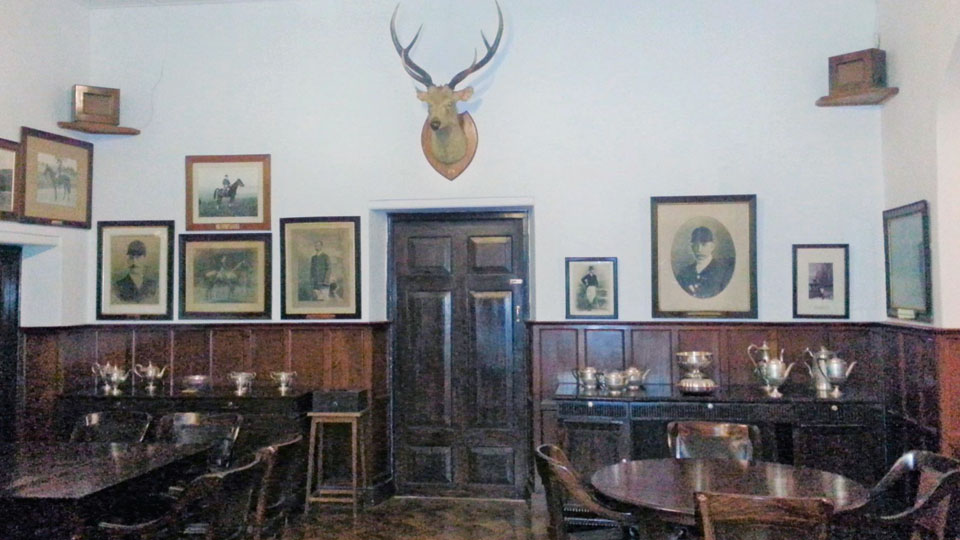
Courtesy our friends Pemmanda Jepu and Jemy Ganapathy, we spent four wonderful days at the Ooty Club, a place steeped in colonial history. The trophies, the silverware, the honour lists and the photographs of the ‘Masters of the Fox Hunt’ date back to early 1840s.

During our stay, I got an opportunity to read a well-documented book titled ‘Ootacamund – A History,’ written by Sir Frederick Price in 1908, which is otherwise kept in the safe locker. Only two copies of this book exist. I was particularly interested in the visit of Governor-General Lord Dalhousie to Ooty in 1856, few details of which I had gathered while writing about Victoria Gowramma. However, what I stumbled upon was even more interesting — Governor-General William Bentinck’s journey to Bangalore, Mysore and Ooty in 1834. This trip was primarily to coordinate the attack on the ‘problematic’ Raja of Coorg: Chikka Veerarajendra.

Chikka Veerarajendra and the East India Company were at loggerheads since 1830. Governor-General William Bentinck, who was more interested in reforming India than in annexing new territories, had to finally deal with the Raja of Coorg who had dared the British by keeping in custody one of their emissaries — Kullapalli Karunakaran Menon.
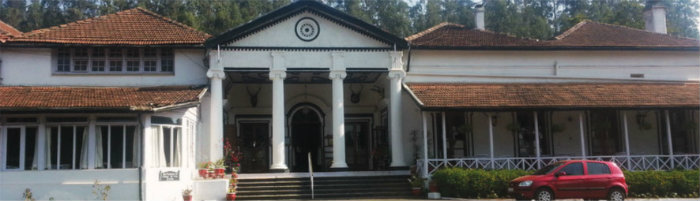
A frontal view of the Ooty Club, which was originally Sir William Rambold’s Large House.

Lord William Bentinck set out from Calcutta on 3rd February 1834 on board the Curacoa to Madras. Bentinck reached Madras on 15th February 1834 and journeyed to Bangalore via Vellore. Travel those days was by horse carriages, bullock carts, palanquins and on horseback, with frequent camping en route.

He wanted first-hand assessment of the situation in Coorg, and for this purpose, the Commander-in-Chief Sir Robert O’Callaghan was in attendance. Strategies on military action against Coorg were finalised in consultations with Sir Robert O’Callaghan while at Bangalore. The Governor-General also had administrative issues concerning Mysore to be discussed. The reason for him to visit Ooty for an extended stay was to improve his rather poor health.

Lord Bentinck stopped over in Mysore and was put-up at the precursor to the Rajendra Vilas Palace atop Chamundi Hill, which was originally built by Robert H. Cole who was the earlier British Resident at Mysore (1811-1827). Bentinck set out for Ooty and it was while camping at Gundlupet on 15th March 1834 that he officially declared war on Coorg. Col. James Stuart Fraser was in overall command. Coorg was encircled from three fronts. Chikka Veerarajendra surrendered on 10th April 1834 and Coorg was annexed by the East India Company. Incidentally, Coorg was the only province to be added to the John Company during William Bentinck’s tenure, for which he came under criticism back home in England.

Lord Bentinck’s entourage reached Ooty on 22nd March. At Ooty the only suitable accommodation for the Governor-General and his staff was ‘Sir William Rambold’s Large House.’ It was a grand hotel built in 1832 by an influential British entrepreneur named William Rambold. However, Rambold soon ran into financial difficulties. The hotel was frequently rented for extended periods of time by senior officers of the East India Company. It was in 1842 that ‘Rambold’s Large House’ became the Ootacamund Club, or the Ooty Club. During Lord Bentinck’s sojourn in Ooty, Lord Babington Macaulay arrived at the hill station on 25th June 1834. The Governor-General and Macaulay met each other for the first time at Rambold’s Large House. Macaulay chose a small cottage nearby where he lived for several months to draft the Indian Penal Code (IPC).

Governor-General Bentinck stayed on in Ooty till the end of September 1834. On his return journey he again passed through Mysore and reached Bangalore on 9th October. He sailed aboard the Curacao on 26th October from Madras and reached Calcutta on 14th November 1834.
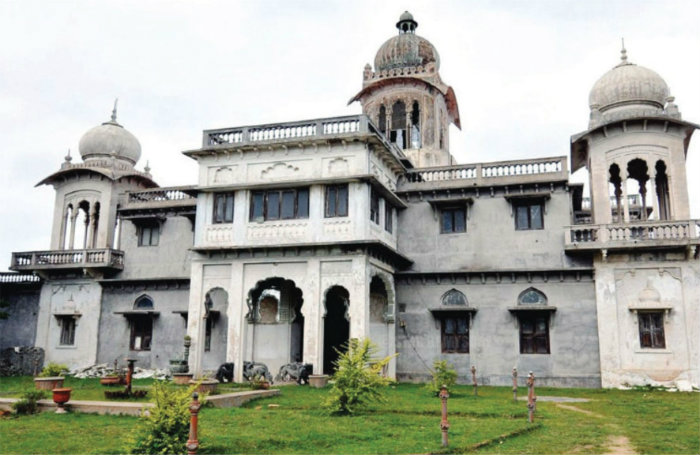
Rajendra Vilas Palace atop Chamundi Hill, Mysore.

I checked on Lord Dalhousie’s sojourn in Ooty from 7th March 1855 to 29th October 1855. Dalhousie’s visit was also for health reasons, and he was due to retire soon. However, he was not too comfortable in Ooty, and shifted to Kotagiri.

During Dalhousie’s stay in Nilgiris, one of his ADCs took permission to visit Coorg, where the ADC’s brother was a coffee planter. It was in 1852 that Dalhousie had reluctantly given permission to the ‘rascally Raja of Coorg’ to travel to England along with his daughter Gowramma.

The ADC, on his return, narrated an amusing incident to his boss. Coorg being a rather remote province, news from the outside world took time to percolate. Very often, wild rumours floated amongst the small but growing community of British planters and officers. One such rumour was that the British and their allies had lost the Crimean War, and that Queen Victoria and her family had fled to India! However, Dalhousie who had had a temporary telegraph line installed at Nilgiris had already received the news that the British and their allies had in fact wrested Sevastopol from the Russians.

On his journey back to Calcutta, Dalhousie stopped over in Bangalore during early November 1855, and was the guest of Sir Mark Cubbon. Dalhousie narrated the ‘Coorg rumour’ to the British officers, much to their amusement. After inspecting the troops, he formally announced the British victory at Sevastopol. Fast forward, 2014: Vladimir Putin has Crimea back in the Russian fold.

About the author: C. P. Belliappa, born in 1946, is a Chemical Engineer. Currently settled in Coorg, he is known for his writings on issues pertaining to Kodagu. Four of his books — Tale of A Tiger’s Tail & other Yarns from Coorg, Nuggets from Coorg History, Victoria Gowramma: The Lost Princess of Coorg, and Tongue of the Slip, have been published by Rupa Publications.

source: http://www.starofmysore.com / Star of Mysore / Home> Feature Articles / by C.P.Belliappa / March 2018

Coorg Diary

They say Coorgis were descendents of Alexander’s Great Greek army. Is that true? Find out more about Coorg and its aromatic society in Coorg Diary
_____________________________________

Alexander’s Army

Coorg has always fascinated me. How come this tiny area with such a small population has produced so many outstanding soldiers? Among the best known are Field Marshal Cariappa—independent India’s first army chief and also the first King’s Commissioned Officer decorated with the Order of the British Empire for “exemplary service during World War 11—and General Thimayya, an army chief as well, who famously clashed with then Defence Minister V.K. Krishna Menon. Former ladies’ national tennis champion Dechu Appiah, her musician brother, Biddu Appiah (composer of the international hit, “Kung Fu Fighting”) and famed architect Brinda Sommaiya also come to mind. And what of the Coorgis’ complexion, which is a few shades lighter than that of the people from surrounding regions? And the brown or grey eyes? Another mystery: What explains their unique customs, far removed from Hinduism? They worship their ancestors, not any Hindu gods, and don’t believe in reincarnation. One rather far-fetched theory is that the Coorgis were descendants of Alexander the Great’s Greek army. That would explain their fair features and martial tradition. But, then, Alexander only came into a part of present-day north India, far away from Coorg (though he did leave a general behind to form a kingdom). How could any descendants of that Greek army have travelled such a long distance?
___________________________________

ILLUSTRATION BY SAJITH KUMAR

All My Sons

I finally made it to Coorg (its modern name is Kodagu, and Coorgis are now Kodavas). As it happened, my hosts were the legendary Cariappa’s son, Nanda, and his wife, Meena. They live on the vast Cariappa estate in the heart of the Coorg capital, Madikeri (earlier Mercara). A short walk from their house on a mound surrounded by artistically placed stones and wild flowers is a simple black stone slab with the following engraved on it: “Field Marshal Kodandera Madappa Cariappa, 28 January 1899-15 May 1993”. This is the Samadhi where he was cremated. It still attracts his admirers from all over, many of them simple villagers who come to pay homage to perhaps their greatest son of our time. Nanda, who retired as an Air Marshal, was a fighter pilot in the 1965 Indo-Pak war. He was shot down near Amritsar on the last day of that war and captured by the Pakistanis. Gen Ayub Khan was then the President of Pakistan. He had served under Gen Cariappa and when Ayub realised his former boss’s son was their prisoner, in a gesture of friendship he offered to send him back to India, and, meanwhile, to treat him well. This prompted Cariappa to send his famous reply to Ayub Khan: “They (the Indian prisoners) are all my sons. Treat him just like them.” Nanda says he was initially kept in solitary confinement for a month, but otherwise treated well. Those were the honourable days. Ayub Khan’s son, Gauhar, even visited Nanda and gave him a tin of Capstan cigarettes and a P.G. Wodehouse book!

British Arms

Fanciful theories of Greek descent apart, the Coorgis—or Kodavas, if you will—have simply been traditional hunters, fond of their weapons. Then, when their independence was threatened, first by Hyder Ali, and then by his son, Tipu Sultan (who defeated them), they turned into fierce warriors. Tipu was extremely brutal with the Coorgis, forcibly converting many of them and transporting over 70,000 to Serangapatnam, while moving a large number of Muslims into Coorg, this affecting a demographic change in the region, which persists to this day. When the British took on Tipu, the Coorgis naturally sided with the British, helping them defeat Tipu. In gratitude, the British bestowed various favours on their Coorg allies, including the right to bear arms without licences, the only Indian community with that right, which continues even now.

Dense Aroma Society

Coorg is also synonymous with coffee, a well known fact. Somehow, the climate—not too hot, not too cold—the altitude—3,000 to 4,000 feet—and plenty of rainfall, are just right for coffee as well as a variety of spices, especially pepper. Mercara is dotted with shops selling coffee and spices. It also has a modest, charming museum in what used be a church built in the Roman Gothic style. There, a variety of arms are displayed, testifying to Coorg’s martial tradition. Considering the strong British presence of pre-Independence days, there had to be a golf course! There are two of them, both of 18 holes, as picturesque and challenging as you can get—steep slopes and plunging valleys. The mighty Cauvery river has its source just a couple of hours drive from Mercara, at Talacauvery, where a much frequented Hindu temple has sprung up. Coorg was once heavily forested, teeming with wild life. However, the timber mafia has been at its worst here, as in so many other parts of India, denuding the land of its precious trees. In some ways the Coorgis remind me of the Parsees. Both are small in number—the Parsees around 100,000, the Coorgis 170,000. Both have high literacy rates. Both tend to marry late, hence have low fertility, with declining numbers. Finally, both had a kind of mutual admiration society with the British—and still do!

(The writer is a well-known journalist)

source: http://www.outlookindia.com / Outlook Magazine / Home> The Magazine> Last Page / by Rahul Singh / June 12th, 2017

In the land of tigers and elephants, voters matter little

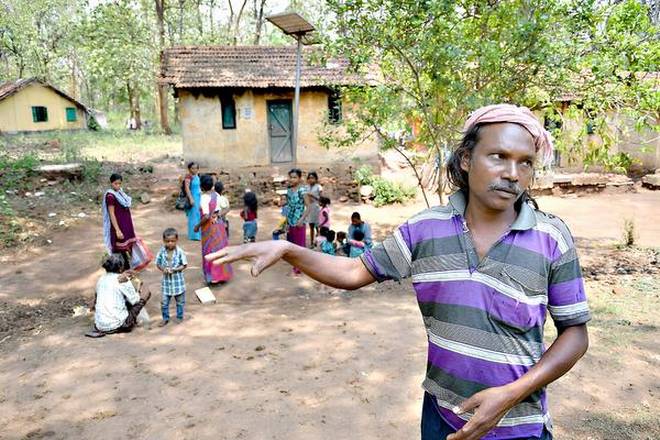
Neglected: A tribal hamlet at Kollangere in the Nagarahole National Park where no candidate has campaigned for votes.   | Photo Credit: M.A. SRIRAM
Neglected: A tribal hamlet at Kollangere in the Nagarahole National Park where no candidate has campaigned for votes. | Photo Credit: M.A. SRIRAM

Few candidates want to invest their time and resources to reach interiors of Nagarahole forests to seek votes from Jenu Kurubas.

The dense jungles of the Nagarahole National Park, 60 km from here, are an unlikely setting for the heat and dust of an election campaign.

The national park where nearly 90 tigers and 800 elephants roam free in their natural habitat is a no-go area for the general public, except for the guided safari. But there are about 1,250 Jenu Kurubas — an indigenous tribal community — still living in the national park and approaching them is inevitable during election times when every vote matters. But few candidates want to invest their time and resources to reach the forest interior, given the lack of easy access to the hamlets and the distance to be commuted.

Kolangere — a tribal hamlet of about 25 families — is a case in point. It is located about 20 km from the Veeranahosahalli checkpost gate at the entry of Nagarahole from the Hunsur side and around 35 km from Nanchi gate from the Kutta side.

The meandering potholed road is open only from 6 a.m. to 6 p.m. during which there is limited access to vehicles. There are 29 votes in this hamlet which falls under the Virajpet Assembly segment in Kodagu district. The nearest polling booth is at Moorkal, about 6 km by walk through the jungles, but there is a motorable road leading to it.

“No MLA has visited any of the tribal hamlet so far, but their representatives approach us for votes once in five years,” said Muthanna, a Jenu Kuruba.

The adivasis subsist on roots and minor forest produce. Though their needs are few, they work in coffee plantations in Kodagu to earn a living.

“All we seek is a settlement on the forest boundary along the elephant-proof trenches but our requests are rejected,” said Mr. Muthanna whose community has refused to relocate away from the forests.

Political awareness

It is the same scenario at Nagarahole, Nanachigadde Haadi, Gonigadde, Kolle Haadi, Tattekere or Kumbarkatte. But not withstanding the indifference of politicians, political awareness among the tribal people has increased over the years.

“Jenu Kurubas have traditionally supported the Congress. But the new generation has different views,” said Sanappa, head of the tribal community who relocated from the forests to Nagapura at Veeranahosahalli. Drinking water scarcity, lack of basic health care and educational facilities, and unemployment plague them even after relocation. The tribal people who volunteered to be relocated in 1998 were promised 5 acres of land as compensation, but 20 years on, it is yet to be fully implemented. “Yet there is no talk of boycott as we are hopeful that the government will act,” said Kalappa, a resident of Nagapura.

Survey under way

But a section of the adivasis of Nagapura whose patience is running out, launched an agitation on January 26, 2018, which lasted 75 days, forcing the authorities to take up a survey to demarcate the land. “We have now adopted a wait-and-watch policy on whether to boycott the polls or not in view of the ongoing survey,” said M.B. Prabhu, a tribal leader spearheading the agitation.

Tribals in Hunsur threaten poll boycott

Jenu Kuruba tribals from six hamlets in Hunsur have threatened to boycott the elections if their long-pending demands for proper rehabilitation and land allotment are not fulfilled.

The hamlets come under Hunsur Assembly constituency and banners announcing poll boycott have come up in some of them. There are about 300 families in these six hamlets and they account for at least 1,000 votes. The boycott threat indicates their frustration, according to Sreekant of Development Through Education, an NGO working for uplifting tribals. “Their language betrays their feelings and it is the successive governments that are to blame for the sad state of affairs as [the tribals] are left begging and pleading for basic amenities,” he said.

The hamlets that have called for election boycott include Hebbala, Neralakupe B. Haadi, Billanahosahalli and Chikkejejjur. Though the local authorities have been directed to prevail upon the tribals not to boycott the polls, DEED has sought the intervention of the Assistant Commissioner to end the impasse.

“He should visit the hamlets affected, understand the condition of these communities and list out the pending works for their comprehensive rehabilitation. Though most of the demands are outside his immediate purview, the Assistant Commission can make recommendations to improve their living conditions,” Mr. Sreekant said.

The demands include land allotment as part of the rehabilitation package that was promised to the tribals when they were shifted from Nagarahole and clearing land encroachment reported in 10 hamlets.

Tribal communities threatening to boycott elections is not something new, and they always end up exercising their franchise, according to DEED. But the larger message being sent out is the failure of the authorities to fulfil the promises made decades ago.

source: http://www.thehindu.com / The Hindu / Home> Elections> Karnataka 2018 / by R. Krishna Kumar / Mysuru – April 30th, 2018

When Kodagu had its own Assembly and Chief Minister

Coorg Assembly was constituted in 1924 and the only election was held in 1951

Though reduced to two Assembly segments after the 2008 delimitation, the hilly district of Kodagu from where the Cauvery takes its birth has a royal pedigree and boasted of its own Legislative Assembly to frame law for the local region and the people.

What is more, Coorg (as the district was then called), which was merged with Mysore State in 1956, also had its own Chief Minister to govern the province from 1952 to 1956.

The Legislative Assembly of Coorg was constituted in 1924 and the first and only election was held in 1951. The members represented 18 constituencies, which had 24 seats as six of the constituencies had to elect two members each.

The constituencies were Sanivarasanthe (2 seats), Somwarpet north and south, Fraserpet, Sunticoppa (2 seats), Mercara town, Murnad, Mercaranad, Srimangalanad (2 seats), Hudikeri, Berriathnad, Ponnampetnad (2 seats), Virajpet town, Virajpetnad (2 seats), Ammathinad, Siddapur (2 seats), Napoklunad, and Bhagamangalanad, according to the Election Commission of India data.

Of the national parties, only the Indian National Congress and the Communist Party of India were represented and 15 seats were won by the INC and Independents won 9 seats. While the 15 councillors represented the prevailing majority view that Coorg should merge with Mysore, the 9 Independents were against the merger. There were 60 candidates in fray and the number of voters was 1,38,440 of whom 87,947 exercised their franchise (63.53%).

PoonachaKF30apr2018

According to the district gazetteer published by the State government, the Indian Constitution recognised Coorg as a Part C State and thus it was entitled to posses a responsible government. This came into vogue in 1952 and the post of Chief Commissioner also continued and C.M. Poonacha, who was elected to the Coorg Legislative Assembly from Berriathnad, was the first and only Chief Minister of Kodagu.

When the State Reorganisation Commission recommended the merger of Coorg with the new Mysore State, Coorg became one of the districts on November 1, 1956 and Poonacha became a Minister in the S. Nijalingappa Cabinet.

He later became a Rajya Sabha member (in 1964) and was elected as MP from Mangalore Lok Sabha seat in 1969 (Kodagu was then attached to the Mangalore Lok Sabha constituency) and went on to hold different portfolios, including that of Minister of Railways.

C.P. Muthanna, son of Poonacha, recalled that there were hundreds of administrative entities, including princely States, at the time of Independence and they wanted to merge them into larger States to create a more cohesive administrative unit. “Since my father was the Chief Minister of Coorg at that time, there were many — keen on maintaining Coorg’s distinct identity — who imagine it was my father responsible for merging Coorg with Mysuru State.”

source: http://www.thehindu.com / The Hindu / Home> News> States> Karnataka / by R. Krishna Kumar / Mysuru – April 29th, 2018

Rahul smitten by Kodagu’s natural beauty

Congress president Rahul Gandhi has been smitten by the natural beauty of Kodagu’s landscape. “I have not seen such a beautiful place in India earlier,” Mr. Gandhi said before starting his speech at a Congress rally at Gonikoppal on Friday.

Before winding up his address, Mr. Gandhi again referred to the hilly district’s fascinating scenery and regretted that he was leaving such a beautiful place in a short period as he was on an election tour.

But, he promised that he would return soon and stay for one or two days and spend time with the people of Kodagu.

source: http://www.thehindu.com / The Hindu / Home> National> Karnataka / Gonikoppal (Kodagu District)- April 28th, 2018

A symbiotic bond with tribal communities

For 38-year-old S Thanaraj, a visit to study the impact on the lifestyle of Paliyar tribal community due to globalisation in 2006 was a life changing moment. He was impressed by how tribal communities embrace nature and live in forests complementing each other.

A native of Radhapuram in Tirunelveli, he shifted to Madurai to pursue law. Being a dalit, Thanaraj has witnessed caste discrimination at a very young age. He always stood against it and had the tendency of helping others since childhood. This came true after his formal education, when he turned an activist. The law graduate has worked in various areas like youth empowerment, environment and total prohibition by joining hands with various organisations including CESCI, Ekta Parishad and People’s Education for Action and Liberation.

Thanaraj became an Adivasi activist after he extensively worked with the Paliyars, educating them about the Forest Act which ensures their right over forest land. The Scheduled Tribes and Other Traditional Forest Dwellers Act passed in 2006 promises tribal rights over agriculture land which traditional belonged to them, accessing forest produces and right to protect and manage the forest, which had been denied for long.

“I went to educate them, but ended up learning so many things from them. Their life is an exemplary one in conserving forest, which needs to be learnt by all. I have taken these lessons to over 1.5 lakh school and college students so far,” Thanaraj said.

For instance, Adivasis do not kill pregnant animals for meat. When they collect roots, they plant more and they never cut living trees, they only use dead trees. They treat woman equally and encourage widow remarriage. There is no dowry system either, said Thanaraj.
While he worked for Paliyars till 2008, he expanded his horizon and started working for various communities like Kadar in Valparai and Anaimalai, Malasar in Amaravathi, Udumalaipettai and Anaimalai, Muduvan in the interior forests of Theni and Valparai forests and Mahamalasar from Anaimalai and Topslip.

Thanaraj’s has a strategy in empowering the Adivasi community. To create leaders among them, unite them to retrieve their rights over forest and defend themselves from exploitation, he along with the organisations he works for help Adivasis in various areas in the state by getting them housing facility and agricultural land. Only recently, Kadar tribe from 24 villages in and around Valparai in Coimbatore received 10 acres of land after several stages of protest.
Thanaraj has taken part in various national-wide protests carried out to ensure the rights of Adivasis. He has also organised many state-level protests demanding total prohibition. He has also extensively worked in the Tsunami rescue and rehabilitation throughout the TN coast. He also played active role in the protests against Sterlite and Koodankulam nuclear plant.

Thanaraj was lucky to get married to a like-minded person like K M Leelavathi, a daughter of a tribal leader from Coorg, in 2010. An MSW graduate, she too joined him in the work towards helping deprived communities. Recently, he joined the Centre for Justice and People and continues his work towards Adivasi empowerment.

source: http://www.timesofindia.indiatimes.com / The Times of India / Home> City News> Madurai News / TNN / April 11th, 2018

Cauvery: A time to pause

The role played by Kodagu, which has nourished and nurtured the Cauvery over time, needs to be recognised.

The Supreme Court of India has determined the manner in which the waters of the Cauvery river are to be shared among the beneficiary States. In its recent judgment on the long-pending issue, the court virtually pulled the proverbial rabbit out of the hat. The decision has received with muted acceptance, understandably, by all concerned, and some token opposition.

The Cauvery dispute has been a long-standing issue among the States, each one trying to tweak the 1924 Agreement forged during the British administration. Much water has flowed down the river since, and each State was trying to secure the best deal for itself.

A noteworthy aspect is that the matter has engaged some of the brightest minds, be it engineering, law, administration or politics, and the fortunes of many rose and fell at each turn of events. The din has for the present subsided. The bigger and immediate challenge now is to save the river to ensure lasting harmony and sustained development of the beneficiary States of Karnataka, Kerala, Puducherry and Tamil Nadu.

Amid all the arguments, the role played by Kodagu district in Karnataka, which has nourished, nurtured and nursed the river over time, has hardly been recognised or acknowledged.

Kodagu is part of the lower Western Ghats and at its highest point, is around 5,000 feet above sea level. Originally administered directly by the British from Madras, it became a Part ‘C’ State at the time of Independence, with its own legislature and Ministers. Subsequently, after the Reorganisation of States it became the smallest district, with a wealth of natural resources. It is in the Brahmagiri hills of Kodagu that the Cauvery rises and disappears, till it is seen again outside the boundaries of the district. The scenic beauty of the Brahmagiri range is a feast for any nature-lover. A mind-boggling phenomenon can be seen between October 14 to 17 every year unfailingly, when the Cauvery, which is nowhere to be seen, suddenly gushes forth from a spring and then swells into the river that bestows its bounty on millions of people along the way, till it reaches the Bay of Bengal in Thanjavur district of Tamil Nadu.

Kodagu has the largest acreage under coffee in the country, with one of the Tata companies owning approximately 40,000 acres. Trees of vintage growth, bamboo, pepper vines, spices, fruits and other agricultural produce make Kodagu a nature’s paradise. Kodagu hosts many species of wildlife, including the tiger, making it an attractive tourist destination.

Kodavas, the numerically small Hindu ethnic community, are different from neighbouring communities in their costume, language, and social practices. Suffice it to say that they have distinguished themselves in many fields and contributed to India significantly. This, however, is not about the Kodavas.

Journey to Tamil Nadu

Abundant green cover in Kodagu is of vital importance as this will ensure that the district receives sufficient rainfall to bring the river to life and flow in all its glory up to Tamil Nadu. Unlike Himalayan rivers, which are snow-fed, the Cauvery depends primarily on the Southwest monsoon. The river is impounded at the Krishnaraja Sagar dam, outside Mysore, conceived and constructed during the British period by the legendary engineer Sir M. Visvesvaraya. From here water is released, reaching Tamil Nadu, where it is stored in the Mettur Dam (Stanley Reservoir). Further release of water is dependent on the agricultural requirements of farmers downstream.

It would be facile to assume that the court decision has solved all problems and that the States concerned will live happily ever after. In a year when there is copious rainfall in Kodagu and the Cauvery is in spate, Karnataka releases water freely, making a virtue out of necessity. There is then no need for any water- sharing formula. It is only in years when rainfall in Kodagu and the catchment of the Cauvery is below par that the problem arises. This results in constant wrangling, and heated arguments between the States over the quantity of water released, the timing of the release and the manner of release, often resulting in violence. Matters get worse if the ‘deficit’ year happens to be an election year. This is the real issue and to date no satisfactory acceptable formula for sharing the distress has evolved, nor is a sound mechanism in place, for delivery in such situations.

It would be relevant to examine data for the decade 2007-2008 to 2017-2018 relating to release of water. Flows received from Karnataka were measured at the Mettur Reservoir up to 2012-13, and from 2013-14, at the Biligundlu gauging site maintained by the Central Water Commission. Against an annual 205 tmc ft (thousand million cubic feet) at Mettur, only 69.727 tmc ft was realised in 2012-13. At Biligundlu, against an annual figure of 192 tmc ft, the receipt in 2015-16 was 15.385 tmc ft. In 2016-17 the figure was 69.316 tmc ft and in 2017-18 it was 113.084 tmc ft. The statement shows that in the preceding decade there was deficit in four years. This is a matter of concern.

Reason for ‘deficit’

The main reason for deficit is reduced rainfall in the catchment area of the Cauvery in Kodagu district, mainly on account of loss of ‘green cover’. One needs to understand the reason for this loss. It is stated that construction of high tension power lines across Kodagu required felling of large number of mature trees, which reduced the ‘green cover’ substantially along the alignment. Perhaps that was the price to be paid for providing sustained power supply to areas beyond Kodagu. But who paid the price? The farmers in Karnataka and Tamil Nadu were the ones directly affected, along with all those areas that depend on assured water supply, such as Bengaluru which supports major industrial activity and large populations. In recognition of this need, the Supreme Court has specifically earmarked a certain quantity of water for Bengaluru.

Disturbing news

A matter of serious concern is news that certain infrastructure projects have been lined up for implementation in Kodagu. Two railway lines are planned: the Mysore-Kushalnagar-Madikeri (Makkandur) line and the Thalasssery-Kodagu-Mysore line. Four National Highways are planned. These are the Mysore-Kodlipet-Sunticoppa-Madikeri- Gonikoppal- Kutta-Mananthawadi; the Bangalore-Bantwal highway via Kushalnagar and Madikeri; Pannathur-Bhagamandala-Madikeri, and Mattanur-Gonikoppal- Thithimathi-Hunsur. This will connect the new Mattanur airport to Mysore and Bangalore at a cost of Rs. 1,000 crore. Additionally, existing roads are to be upgraded into four-lane highways.

These projects will undoubtedly result in the felling of a large number of trees, constant influx of persons transiting Kodagu without any concern or commitment for the local environment, increasing issues of waste disposal and management. Many other unacceptable activities will disturb the ethos of Kodagu and its natural environment.

The question to be asked is whether Kodagu, which is the major watershed and catchment for the Cauvery, requires these projects that are likely to cause more harm to the beneficiary States, while bringing only marginal and doubtful benefits. The ryots in the Thanjavur delta of Tamil Nadu that covers vast acreage, the farmers of Mandya in Karnataka, the drinking water supply needs of burgeoning cities such as Bengaluru and Chennai and many areas in the other States will be affected by any reduction in the flows of the Cauvery. There is no indication that the long-term impacts of these actions have been considered. No consultation with local communities appears to have been done. The impression at the ground level is that a very short-sighted view has been taken, and these projects have been mooted at the instance of local politicians as part of vote bank politics, in some cases backed by lobbies eager to monetise the natural wealth that will need to be extracted before implementation.

The way forward

It is clear that India needs to walk the ‘development path’. The right way is ‘sustainable development’, which does not appear to be the case in respect of the above-mentioned projects. The waters of the Cauvery have nourished downstream civilisations for centuries. It is the life blood of the States that now comprise the region. The time has come to save the river, bring back its glory as a provider and nourisher of humans, enabling them to live in peace, harmony, and rise to their full potential in every sphere of endeavour. There is no case for inter-State political one-upmanship or victory or loss for any group. The goal and cause are one…. save the Cauvery for the good of all, for all time to come, by taking a long-term view. Everyone needs to be on the same page.

The following steps need to be taken immediately.

1. Suspend all infrastructure projects, proposed or under implementation, for six months or a year. This short postponement will give time to study the issues necessary for saving the Cauvery.

2. Set up a competent neutral body to assess the real need for connectivity through Kodagu with contiguous areas and examine alternative options.

3. Identify the best option that will cause least damage to the environment and catchment of the Cauvery.

4. Having completed the above three tasks, arrange for a ‘carrying capacity study’ to be done by a credible professional body.

5. On the basis of the findings of this study, the implementation of projects should be supervised by an empowered body to be named the ‘Kodagu Sustainable Infrastructure Projects Board’, with the Deputy Commissioner of the district as Chairman, and the representatives of different agencies and local non-officials as members, to ensure timely implementation in accordance with project specifications.

6. Quarterly meetings of Chief Secretaries of the four States to be convened by the board to update them on the progress and the status of safeguards for the Cauvery.

The need of the hour is statesmanship, avoiding political short-sightedness. It should not become a case of winning the battle of sharing the Cauvery waters and losing the war of saving the river for posterity.

The author, who retired from the Indian Administrative Service, has written this as a concerned citizen. Email: sonnabel@gmail.com

source: http://www.thehindu.com / The Hindu / Home> Opinion> Open Page / by P.M. Belliappa / March 18th, 2018

A welcome retreat

RetreatKF14mar2018

The recent withdrawal of the amendment bill to the Karnataka Preservation of Trees Act, 1976 (KPT Act) by the government, which would have allowed indiscriminate cutting down of some 50 tree species, came about under pressure from green NGOs but is perfectly welcome. Farmers prefer growing hebbevu, eucalyptus, Casuarina, silver oak, Acacia auriculiformis, shivane, teak, sandal, etc.

The first four of the above species are already on the exemption list. The current proposal of the Forest department for inclusion in the exemption list includes Acacia auriculiformis, Kakke, Gulmohar, Peltoform, Raintree, Christmas tree, orange tree, Purple Bauhinia, mulberry, curry leaf, drumstick, Simaruba glauca, African tulip, tabebuia, Tecoma, Indian cork tree (Mellingtonia), etc.

Granting exemption on Gulmohar, Peltoform, Raintree, Purple Bauhinia, Tabebuia, Tecoma would lead to destruction of trees from urban areas. Thankfully, withdrawal of the exemption proposal does not hurt farmers as these are not their preferred species.

Acacia auriculiformis was the main species of forest plantations for more than three decades. Now, the planting is banned in some areas, yet its exemption may induce smuggling from older plantations. It is understood that the plantations are to be protected by the department, then why not include other species like teak, etc., on the exemption list?

When KPT Act was legislated in 1976, Casuarina and Hopea wightina were in the exemption list. Other species required permission. But, for nine districts, namely Chikkamagaluru, Chamrajnagar, Dakshin Kannada, Hassan, Kodagu, Mysuru, Shivamogga, Udupi, Uttar Kannada, felling permission is not needed for any species except sandalwood and rosewood.

Even in these districts, tree-owners had provision for domestic consumption. People were harassed in the districts by Revenue and Forest officers. In 1987, the Act was amended to include Coconut, Erythrina, Eucalyptus, Glyrecidia, Prosopis, Rubber, Sesbania and Silver oak in the exemption list.

There were difficulties in protecting exempted species in the forests, yet the amendment was not retracted. The red tape in the lower bureaucracy continued to harass tree-owners for several other species. By another amendment in 2015, the exemption list was extended to subabul, areca nut, coffee, guava, hebbevu, Ailenthus excelsa, lemon, Maeopsis eminni, mango, sapota, Dendracalamus stocksii, Burma bamboo, Yellow bamboo, Acacia mangium, Acacia hybrid, Balangi and Cashew.

Exemption for mango and Balangi posed a serious threat to forest conservation in the Western Ghat areas. Huge mango trees growing on water courses in the forests were illicitly cut away, sometimes with the connivance of the officers. Many varieties of mango disappeared.

The loss of these trees from water courses can deplete water flow in the tributaries of major rivers. The Karnataka High Court removed the exemption on mango trees. The exemption of other species did not bring any negative impact on the conservation of forests.

To popularise farm forestry, Karnataka took some interesting initiatives. Krishi Aranya Protsah Yojane (KAPY) was launched in 2011, where tree-growers were paid an incentive for successfully growing plants for three continuous years. The initiative has picked up well.

The recently published Forest Survey of India (FSI) report confirms that the state’s forest cover has gone up from 36,449 sqkm to 37,550 sqkm in two years. The cover in recorded forests, Revenue and Paisary lands has gone up by 359 sqkm. However, in private wooded areas, coffee estates, and coconut and areca nut gardens, it has increased by 742 sqkm, but the assessment has not separated the contributions of forests and horticultural plants. Tree groves below one hectare and strip plantations are also assessed by FSI, where tree-cover is found to have increased from 5,552 sqkm to 5,713 sqkm in the same period.

The assessment is based on satellite imagery of October 2016. Assuming that five years’ growth is necessary for a signature to be picked up in satellite imagery, the increase, if any, can be attributed to plantations raised prior to 2012, and not due to the impact of KAPY and exempting additional species from KTP Act.

Mixed findings

FSI has also brought out the district-wise status of forests. It is heartening to note that the tree-cover in all dry districts has gone up, and horticultural plantations have also contributed. The success of the forestry programme in dry districts can be attributed to the fact that these districts are not covered under KPT Act and the movement of growing trees has picked up well.

Further, there is a disturbing trend of forest cover in Malnad districts like Dakshina Kannada, Kodagu, Mysuru and Shivamogga having decreased. This is the negative impact of KPT Act, as some of the exempted species have been illicitly removed from forests. The forests in these districts must be preserved as these are the catchments of many important rivers. Kodagu is a hilly district extending over 4,102 sqkm, of which only 1,700 sqkm is recorded forests. The vegetation on private land is equally important in the catchment of Cauvery river. The KPT Act has played havoc there in the past. It is time to suspend felling of naturally-growing trees on private lands in Kodagu.

Forests are the ‘mothers’ of several rivers, and the KPT Act is important for conservation. At the same time, growing trees on private lands must be encouraged and authorities must be held accountable for any laxity in dealing with cases under KPT Act. Bureaucratic hurdles are man-made, which must be dealt with severely.

Prime Minister Modi’s vision is to double farmers’ incomes by 2022. Among other things, he has been talking about soil testing, easy availability of neem-coated urea to reduce costs and growing tree species on the periphery of farmlands as well as bee-keeping to boost incomes. We have been importing wood for quite some time for our domestic consumption. The only way to save the foreign exchange is to grow our wood requirement indigenously.

(The writer is a former Principal Chief Conservator of Forests, Karnataka)

source: http://www.deccanherald.com / Deccan Herald / Home> Main Article / by B.K. Singh / March 10th, 2018

Retain sanctity of traditional dance, experts urge Kodavas

Kodava Sahitya Academy makes suggestions on `Ummathat’

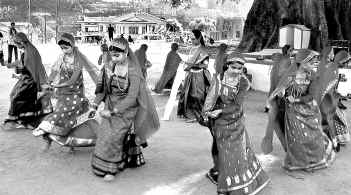
Traditional glory : Dancers performing a traditional dance of Kodagu.

Madikeri :

Kodavas have a unique culture and their folklore too is distinct from others. “Ummathat”, a special dance, a mixture of folklore with a dainty touch of medieval and modernity, performed by Kodava women, is a case in point.

Kodava women lag behind in variety of dances vis-a-vis men. Men attired in traditional costumes perform “Bolakkat”, “Peeliyat”, “Chowriyat”, “Kappeyat”, “Pareyakali”, “Kolatt”, and “Kombatt” whereas women dressed in colourful saris perform “Ummathat”.

There was a debate whether these dances should be performed in public or only at Kodava religious and cultural ceremonies.

The Karnataka Kodava Sahitya Academy, which had organised a seminar on “Ummathat” at Devanageri in Virajpet taluk recently, has come up with some suggestions concerning “Ummathat”. A decision was taken to maintain a uniform pattern of “Ummathat” in future.

Some of the suggestions are: Ummathat should not be performed in open or public functions or in front of the tableux as it loses sanctity. The dance shall be performed only in venerable places. Dancers shall remove footwear, wear traditional “bottu podiya” (a grand sari with rich brocade) while performing the dance.

The songs, an assortment of over 12 songs, sung in different tunes, will be retained without giving it a touch of modernity, was another decision taken at the seminar.

The “taleyatakki bolakk”, a brass plate containing a burning lamp sprinkled with rice, will replace the woman dressed up as Goddess Cauvery in the middle. The seminar arrived at a decision to formulate enough programmes in future to foster “Ummathat”.

Pace and rhythm

Akhila Kodava Samaja president Matanda C.Monnappa agrees with most of the suggestions that “Ummathat” must be nurtured. There ought to be a touch of modernity to go with it, he says. Increasing the pace of songs to match the rhythm will make it more attractive. At the same time, changes should not dilute the original nor affect the decorum of the dance. It should not portray women in poor light.

No one is sure of the origin of the songs or the nuances of “Ummathat”. Most people believe the songs were compiled by the late Haradasa Appacha Kavi several decades ago. Certain songs are contained in the book written by Kavishishya Haridasa Mukkatira S. Poovaiah. Late Puggera Karumbaiah, who was instrumental in reviving the “Ummathat” in the early Seventies, too had contributed to the dance form.

Origin of Ummathat

According to Puggera Aiyappa, a senior citizen from Devanageri, Ummathat was practised centuries ago though there are no records available to prove it. Mr. Monnappa says his 95-year-old mother (who passed away recently) used to sing “Ummathat” songs.

Other dances performed by men such as “Bolakkat” have religious sanctity. Bolakkat is offered to the deity unlike “Ummathat”, Mr. Monnappa said.

Similarly, dances such as “Peeliyat”, “Chowriyat” and “Kombatt” are performed at the religious places where the deities are worshipped. “Ummathat” and “Bolakkat” were performed in public in the past even in New Delhi. It had drawn criticism.

source: http://www.thehindu.com / The Hindu / Home> Karnataka> Madikeri / by Staff Correspondent / July 20th, 2005

‘Male habba’ showcases rich culture of Kodavas

MaleHabbaKF28feb2018

45 lakh released for Kodava Sahitya Academy: Appachu Ranjan

MLA dancing to the tune of music of Kodagu, Kodava Sahithya Academy President and ZP members engaged in retransplatation of seedlings, Taluk Panchayat members ploughing the field, running race with a dog, tug of war and marshy field race… These were the scenes at ‘Male habba’ organised by the Karnataka Kodava Sahithya Academy in the field of Mukkodlu Hotteyanda S Thimmaiah in Madikeri Taluk on Sunday.

The habba was inaugurated by MLA M P Appacchu Ranjan. Amidst the greenary of the nature, the villagers actively took part in ‘Male habba.’

Irrespective of caste, creed and age, all took part in the competitions. On a whole, it was reflecting the Kodava culture, tradition and agriculture activities.

MLA M P Appacchu Ranjan, Kodava Sahithya Academy President Rani Machaiah, ZP Member B C Neelamma, TP Member Napanda Ravi Kalappa and others were taken out in a traditional procession.

Speaking on the occasion, the MLA said that it was good to see that Male Habba is being organised by uniting all the villagers. “The tradition and culture of Kodavas should be passed on to the future generation and Male Habba will help in showcasing the rich culture of Kodavas.”

Race, dancing and having meals together was the speciality of the ‘Male habba.’

The MLA said a sum of Rs 45 lakh was released to Kodava Sahithya Academy. Public should join hands with the Academy in preserving the Kodava language, culture, tradition of the land.

Academy President Rani Machaiah said additional grants are being released to the Academy, which helps the Academy in organising several programmes. The Academy will bring out a CD to showcase the rich Kodava culture to the future generation.

source: http://www.deccanherald.com / Deccan Herald / Home> District / Madikeri – DHNS / August 08th, 2010