Category Archives: About Kodagu / Coorg

Karnataka halts Kerala in its tracks, saves Kodagu

CoorgKF28feb2018

Says it has not approved the Thalassery-Mysuru rail link

A burgeoning environment movement across Kodagu was put to halt — albeit breifly — by the state government on Wednesday.

Putting an end to the rising levels of anxiety among thousands of Kodavas and green activists, the state government clarified that it has not approved the controversial rail link connecting Thalassery (Kerala) with Mysuru (Karnataka) via Kodagu. Further, the state government clarified that it would not even allow preparation of detailed project report (DPAR) for the proposed rail link as the project would jeopardise the fragile ecosystem of the pristine Western Ghats.

Allaying the fears of thousands of people, RV Deshpande, Minister for Large and Medium Scale Industries and Infrastructure, told the state legislature that the government expressed its opposition for the project. Drawing the attention of the state government, BJP MLA from Virajpet KG Bopaiah alleged that both Karnataka and Kerala already met once and agreed to carry out survey for the proposed rail link amidst stiff opposition from the local population.

Deshpande acknowledged that a meeting between secretaries of Karnataka and Kerala did take place recently, however, the Karnataka government had not consented for the project. “Holding a meeting does not ensure our approval for the project. We have not consented for the rail link project. Further, the project is yet to be approved by the Railway Board and thereafter a formal request has to be made by the Kerala government. Only then, we will be able to take a decision,” Deshpande revealed.

Going further, Deshpande stated, “We already had discussion about the project at government level. Our forest department has not only expressed reservations but also opposed the project as it would jeopardise the green cover and affect elephant corridor through which the rail link passes. Hence, the state government in principle has not consented for the project.” According to Bopaiah, as per the Railway minister’s reply in the Lok Sabha in December 2017, a joint meeting between Kerala and Karnataka secretaries had resolved to take up survey along the route only if the Kerala government submits a proposal to Karnataka provided it does not cause disturbance to wildlife areas. Interestingly, the rail link spanning more than 200 km would pass through Wyanad of Kerala and enter Kodagu at Kutta to pass through thick forest regions like Balele-Nittor-Canoor and Thithimati to reach Mysuru.

Perturbed that the new railway line with a project cost of Rs 6,685 cr would result in clearing of about 40 per cent of Kodagu’s forest, Kodavas, including retired defence officials, planters, environmentalists and public had staged massive protest rallies recently at Kutta and Madikeri. Fighting against the projects that would spell doom over the fragile eco-system of Kodagu where the River Cauvery originates, people from Kodagu, Mysuru and Bengaluru had launched Save Kodagu and Cauvery campaign led by Coorg Wildlife Society. Col (Rtd) Muthanna had even accused Kerala political leaders, including Congress parliamentarian KC Venugopal, of misusing his office as the Congress in-charge in Karnataka by leading Kerala delegations to push for destructive projects cutting through Kodagu benefiting Kerala.

source: http://www.bangaloremirror.indiatimes.com / Bangalore Mirror / Home> News> States / by Niranjan Kaggere, Bangalore Mirror Bureau / February 08th, 2018

Winds of change hit Kodavas

The Kodavas were always a martial race with a pronounced colonial hangover (Agency Photo)

It’s an impressive roll call. Field Marshal K M Cariappa, Gen Thimmaiah, B C Nanda, M P Ganesh, Prasad Bidapa, Len Aiyappa….The Kodava community, from southwestern Karnataka, has always punched above its weight in Indian public life. Kodavas rose high in the Indian Army; they excelled at sport, particularly hockey and flourished in the coffee trade. But that was then. Today, the Kodavas are buffeted by the winds of change. Modernity and migration are taking their bewildering toll on a people that set great store by tradition.

This is the context of renewed demands for a separate Kodava autonomous region, which would give them a separate place of their own, in keeping with their claims of being vastly different from everyone else. For this would also accrue all the benefits that go with a distinct identity. The men are strikingly handsome and their women appealing winsome. Their customs and traditions too are quite different from those in the rest of the region,one being that an uncle usually marries his niece. For nearly two decades, the Codava National Council (CNC) has been fighting for autonomy and the issue is back on the agenda with regular dharnas and sporadic protests at the state legislature.

The Kodavas were always a martial race with a pronounced colonial hangover. Their loyalty to the British meant they found secure footing in the armed forces. Even though they had few officers and mainly made up the rank and file, the Army had a significant Kodava presence. No longer. Kodava recruitment at the Bangalore Army headquarters, which caters to Karnataka, Kerala, Mahe and Lakshadweep, fell steadily from 85 in 2001-02 to 28 in 2007-08. Today, the highest-ranking Kodava officer is a lieutenant-general and they have just a few major-generals.

The once-famous Coorg Regiment has suffered too. Twenty-five years ago, every Kodava family could proudly list several of its men in uniform. That’s history. Sons prefer to head for engineering colleges now or professions more lucrative than the Army, say recruitment officers.

It is the same with sport and the Kodava’s once-legendary skill on the hockey field. M P Ganesh, the first Kodava to captain the national team, heads a list that also features ace players such as M M Somaiah, B P Govinda, Len Aiyappa and Mandepanda Monappa. The community always enjoyed and excelled at traditional war games such as pareya-kali and shakti-kolu. This is why Ganesh, who started playing hockey late, was deemed a natural.

Army hockey teams, particularly those that played for the Madras Engineering Group, had several Kodavas. They were robust, used to walking to school several miles a day. And they had the right temperament for the game. But now, hardly any Kodavas play hockey, says Ganesh. “High coffee prices, other employment opportunities and a more sedentary lifestyle have led to a lack of interest in the game,” he says.

Today, the Kodava’s passion for hockey surfaces only during the annual tournament in Madikeri, the town in the Kodagu district that Kodavas regard as home. The tournament is hosted by one Kodava family or clan. Other families and clans play for pride and honour. Women are allowed to compete. National and state players are welcome but Ganesh says they are nothing like yesterday’s Kodava hockey stars. “Players should be picked up from here and coached,” he suggests. Eight Kodavas play in the Karnataka team today, but none in the national team. Len Aiyappa was the last to distinguish himself at the national level.

It is hardly different in the former Kodava mainstay, the coffee plantation. Once upon a time, almost every Kodava family owned a coffee estate, or part of it, ranging from a few acres to vast swathes of land. Coffee is cultivated on roughly 2.5 lakh acres in Kodagu, says M C Nanaiah, a member of the state legislative council, but the Kodavas no longer rule the roost.

Many Kodava families are selling off their ancestral homesteads and estates and migrating to Bangalore or Mysore. The trickle grew to a flood after coffee prices slumped a few years ago. Kodavas are also converting their palatial bungalows into home-hotels, burgeoning business ventures for sure but emblematic of their decision to swap a timeworn culture for modern commerce.

The winds of change are sweeping the little district, bearing the scent of the white coffee flowers. The Kodavas are hanging up their hockey sticks and Army boots. Many argue that it is all to the good for a community to change with the times, embracing newer professions such as IT and science. For the Kodavas, the change may be eagerly sought but bewildering.

deepa.bhasthi@timesgroup.com

source: http://www.timesofindia.indiatimes.com / The Times of India / News> India News / by Deepa Bhasthi / TNN / November 02nd, 2008

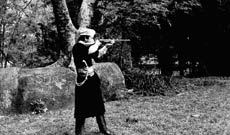
Kodavas: One of the few tribes in India allowed to possess a gun without a licence

A Kodavn takes aim: a shortage of bullets threatens his way of life

An acute shortage of cartridges is threatening the way of life of the Kodavas, a martial race living in Kodagu (Coorg) district in south-west Karnataka. The Kodavas are one of the few tribes in India allowed to possess a gun without a licence. Cartridges are sold like any other commodity in Janata bazaars, cooperative stores and by private traders throughout the district.

But every time a fresh consignment of cartridges is received by the 36 licenced ammunition dealers, long queues are formed in front of these shops. The cartridges are rationed and usually-one box is allotted per person. At least four private dealers have closed shop because of the shortage.

C.U. Kalappa, president of one of the Janata bazaars, told India today in Mercara: “We had indented for 20,000 cartridges but the Government supplied us only 5,000. Now there is such a big rush for them that quarrels are frequent.” Of course, there are no shoot-outs as bullets have become a scarce commodity. Of the district’s demand of two-and-a-half lakh cartridges, the Government was able to supply only 1.3 lakh last year.

Shortage of bullets had been reported in the past few years after the Government banned manufacture of ammunition by private dealers and made the Government ammunition factory at Kirki the sole supplier. But it is only now that the shortage is being felt acutely and has restricted certain rituals of the Kodavas for whom guns are as common as ploughs.

Exception: The Kodavas have been exempted from the Indian Arms Act right from the time it was introduced by the British in 1834. The British made an exception for this tribe in appreciation of their valiant support to them in their fight against Tipu Sultan. Of the 3.8 lakh people living in Kodagu, almost every family possesses a gun, some even ten. The only regulation is that the Kodavas should obtain an exemption certificate from the Government, which gives them the right to possess any gun without a licence. Borkar, the district superintendent of police said: “In the past five years 12,189 exemption certificates have been issued. We can roughly estimate that about 40,000 weapons are in the district.”

Kodagu is perched on the summit of the Western Ghats and its numerous hills are covered with thick forests. Panthers, tigers, wild boars, bisons and elephants abound in large numbers and the Kodavas are adept hunters. The 1973 Wild Life Preservation Act put an end to one of the important traditions of this tribe. But even now, clandestine hunting goes on.

Legend has it that in the good old days no Kodava was allowed to cultivate a handlebar moustache unless he had shot a tiger. Even as late as 1970 there were nine forests reserved specially for hunting and licences were issued to people who wanted to shoot tigers. Today most of the ancestral houses are decorated with stuffed bisons or boar heads and tiger skins.

The Kodavas are one of the few races in India who worship a god for sports and hunting called Sarthau. Every year a special festival called Kiel Poldu (worship of arms) is held in which Kodavas perform poojas for their guns and swords. Every festival is usually accompanied by a shooting competition in which three coconuts are placed and the men are expected to knock them down. The Kodava festive dress, a black robe with a white turban, is embellished with jewelled guns and swords.

The men usually carry an ornamental dagger and a sharp sword. According to tradition, whenever a male child is born two rounds of ammunition are fired in the air. When a male member dies, two rounds are fired simultaneously and if it is a female, only one round. During the death ceremony, every time a group of mourners pay homage to their dear departed, a round is fired.

Complaint: Because of the acute shortage of cartridges, these customs have to be curtailed drastically. The more affluent families still observe these customs with the full paraphernalia and usually buy the bullets in ‘black’ at double the controlled price. Said B.D. Ganapathy, a noted Kodava writer: “We don’t use the guns as indiscriminately as before because of the cartridge shortage. But it has not drastically affected our culture because we are still willing to buy cartridges from other sources. But I don’t know how long we can continue.”

Said K.N. Ponappa, vice-president of the Mercara Kodava Samaj: “Our major complaint is that our crops are systematically being destroyed by wild animals and we are helpless because of the Government Act banning shooting. The Government must modify these laws.”

The present law stipulates that if a wild animal is troubling a village then the forest officer should be called to shoot it. But one planter said: “Who can afford to wait till a government officer comes to shoot the animal?” Many planters kill the animal themselves and have a feast at dusk.

source: http://www.indiatoday.in / India Today / Home> News> Magazine> Coorg / by Raj Chengappa / November 20th, 2013

Tracing the roots of Kodava tribe

There is opposition to releasing the findings of research

Blood samples of 100 couples to be drawn for DNA tests Kodava tribe is said to be 2,000 years old Research team asked to be cautious while dealing with sensitive issues There is apprehension that research findings may divide the community

Virajpet (Kodagu Dt.) :

Kodagu Natural Sciences Society has launched a unique initiative to trace the origin of Kodavas by ascertaining the ancestry, customs, culture, language and a study of genealogy by the Kodagu Natural Sciences Research Society.

A research professor from Delhi University has drawn 150 blood samples of selected Kodava families for conducting the DNA test. This was revealed at a seminar organised by the Akhila Kodava Samaja here on Friday, attended by representatives of various Kodava Samaj units, prominent Kodavas and office-bearers of society. The significance of the research will be to carry out DNA tests on Kodavas to trace their origin and roots.

Society president Lt. Gen. B.C. Nanda said Kodavas inhabited Kodagu 2,000 years ago. The first recorded instance of Kodavas was found in 1174 AD during Hoysala dynasty in the State. Kodava was the only community that accepted the “gotra” system other than non-Muslim and non-Christian communities, he said.

Speaking in favour of tracing the origins of Kodavas, Gen. Nanda said modern scientific inputs gave ample opportunities to take up research work. Along with the DNA test, socio-cultural aspects, somatometry (physical measurements on various attributes) and demography should go hand-in-hand to corroborate the theory. The final report will be submitted to Akhila Kodava Samaja president Matanda.C. Monnappa.

Gen. Nanda said the pilot project started involving nine couples aged between 20 and 40. As many as 100 DNA samples will be drawn from Kodavas living in all parts of Kodagu. The outcome of the study will be kept confidential.

The former president of the Karnataka Kodava Sahitya Academy B.P. Appanna, who did not approve of the idea, said a report on the scientific study on Kodavas can turn out to be sensitive. The principal investigator of the study team is M.A. Abdul Kalam, Department of Anthropology, University of Madras, Chennai, and the project coordinator is Xavier Raj from the Social and Environmental Research Centre, Chennai. The cost estimated for carrying out the study is Rs. 11.80 lakhs.

source: http://www.thehindu.com / The Hindu / Home> National> Karnataka / by Jeevan Chinnappa / February 18th, 2006

‘Preserve the sanctity of Brahmagiri’

Coffee planter Manavattira Dore Somanna warned the district administration of locking up the entrance of Brahmagiri if the entry of public is not banned within a week.

He further added that the Brahmagiri, the birthplace of river Cauvery has been converted into an abode of illegal activities. “Tourists have been spoiling the sanctity of the place by littering it with garbage. This will affect the purity of river Cauvery.”

He said that the district administration should also ban the illegal shops near Talacauvery. Tourists should be banned from discarding the food leftovers at the Triveni Sangama in Bhagamandala. CCTV camera should be installed to monitor the activities of people. Additional staff should be deployed at the spiritual destination to perform the religious rituals smoothly. Also, the temple should conduct the ‘Ashtamangala Prashne’, he added.

Badumanda Muttappa, Padiyammanda Yogish Monnammaiah, Manavattira Papu Changappa and Manavattira Harish Biddappa were present in the press meet.

source: http://www.deccanherald.com / Deccan Herald / Home> District / DH News Service / Napoklu – January 01st, 2018

The roots of Kannada in Kodagu…

The coffee land is all set to witness the 80th Kannada literary meet scheduled to begin on January 7, after a long gap of 32 years. Earlier, Madikeri has witnessed two literary meets – the 18th literary meet in 1932 under the leadership of D V Gundappa and the 54th literary meet in 1982 under the leadership of Dr Shambha Joshi.

Interestingly, despite being one of the smallest districts in Karnataka, it has a wide variety of culture as well as languages that include Kodava, Arebashe Gowda and Malayalam, yet the region has managed to retain the flavour of State language.

If one goes down the pages of history, the little district with unique weather and culture has contributed immensely for the development of Kannada language. The Ganga – Kongwala – Hoysala and Haleri dynasties, perhaps laid the strong foundation for Kannada through inscriptions way back in the 9th century. In the 10th century, Nagaverma had created ‘Chandombudi’ and ‘Punyashrava,’ according to the reference available at ‘Kodagu Sahithya – Sanskrithi Darshana,’ published by Kodagu District Kannada Sahithya Parishat.

During the Chengalva dynasty, the third Mangarasa had published ‘Jayanrupa Kavya’ and ‘Samyukta Kaumudi’ (1508), while his cousin Nanjunda had written ‘Kumara Ramana Kathe.’

There are documents to prove that the first epic ‘Rama Vijaya Kavya’ was written by Devappa, a Jain poet in 1540. Similarly, Dodda Veera Rajendra, who ruled Kodagu between 1789 and 1809, has the credit of documenting history titled ‘Rajendra Name’ in Kannada. The II Linga Rajendra, who ruled Kodagu between 1810 and 1820 had written a book pertaining to land in Kodagu entitled ‘Lingarajana Shisthu.’

The 19th century

The leading name of 19th century pertaining to literature is that of Panje Mangesh Rao, who served as a teacher in Kodagu in 1920s. He had penned poems pertaining to Hutthari festivities among other literary works. In fact, he was the president of All India Kannada literary meet held in Raichur in 1934.

Haradasa Appacchha Kavi, popularly known as the Adi Kavi of Kodagu had penned many plays including ‘Savithri,’ ‘Yayathi,’ ‘Kaveri’ and ‘Subramanya’ in Kodava language. The same were translated to Kannada language by Dr I M Muttanna, who also hailed from Kodagu.

Kodagina Gowramma

The first woman story writer in Kannada literary field, Gowramma, hailed from Kodagu and she is known as ‘Kodagina Gowramma.’ Born in Madikeri in 1912, she did her early schooling in Madikeri and married to B T Gopalakrishna in 1928.

From 1931, she wrote a number of articles and stories in the name of ‘Mrs G T G Krishna’. Most of her stories were based on the theme of women’s problems. However, she passed away in 1940 when she was just 28 years old. When Mahathma Gandiji arrived at Kodagu, she had invited Gandhiji to her home and she had donated her jewellery for the cause of freedom.

Bharathisutha

A teacher by profession, ‘Bharathisutha’ was the pen name of S R Narayana Rao. Based on the life story of Kodagu ruler Siribai Dodda Veerappa, he had written ‘Huliya Haalina Mevu,’ which was later made into a film by the same name.

His other stories too have been made into films and they include ‘Girikanye,’ ‘Edakallu Guddada Mele’ and ‘Bayalu Daari’ among others. His work on ‘Solle Haraduva Rogagalu’ (Diseases transmitted by mosquitoes) and ‘Giliyu Panjaradolilla’ (The parrot is not in the cage) earned him Central government award and Karnataka Sahithya Academy award respectively.

Kittel’s footsteps

Rev Fr Ferdinand Kittel, who contributed immensely to the field of Kannada literature has left indelible marks in Kodagu, prominent among them include the Kannada – English dictionary.
A German missionary, who served in Kodagu church (presently knownn as Shanthi church) between 1871 and 1876, was the first parish priest of the church. Rev Kittel started learning Kannada after going around the coffee land, says the present parish priest of the church.

DH News Service

source: http://www.deccanherald.com / Deccan Herald / Home> District / by Srikanth Kallammanavar / Madikeri – DHNS, January 05th, 2014

Chikkaveerarajendra’s descendants visit Kodagu

Lakshmidevi is the great granddaughter of the king

Chikkaveerarajendra of the Haleri dynasty was last ruler of Kodagu

Akhila Bharata Veerashiava Mahasabha received the members of the ruler’s family

Madikeri:

Descendants of the last ruler of Kodagu, Chikkaveerarajendra of the Haleri dynasty, carrying memories of the glory their ancestors, arrived in the district on Sunday to a rousing reception accorded to them by the members of the Kodagu unit of the Akhila Bharata Veerashiava Mahasabha.

Family

Lakshmidevi, great granddaughter of the last ruler of Kodagu Chikkaveerarajendra, her sons, Praveen Sardesai and his brother Girish, wife of Dr. Sardesai, Anuradha and their two daughters, Deepti and Disha, arrived at the Anechowkur gate on the Kodagu-Mysore border on Sunday afternoon.

The president of the Akhila Bharata Veerashaiva Mahasabha, Kodagu unit, S.P. Mahadevappa and members of the mahasabha from various parts of the district welcomed the royal descendants.

Mr. Mahadevappa said that the British, after wresting power from Chikkaveerarajendra in 1834 and banning him from Kodagu, had prohibited the royal family members from entering Kodagu.

The members had not thought of venturing into the district till 1947. However, Lakshmidevi, paid a secret visit to Kodagu in 1974, thanks to a Minister, who was in the State Government at that time, he said.

Dr. Sardesai is a ENT specialist serving in Hyderabad and his brother is pursuing a business, he said. Dr. Sardesai had also visited Kodagu in 1986 as part of the bird watching team in 1986.

He is said to be a member of the Andhra Pradesh Bird Watchers’ Society. The royal family members were just here to reminisce the past and not to claim any property in the district, Mr. Mahadevappa clarified.

Felicitations

The members were taken to the Bamboo Club in Polibetta and later they went to a private resort in Kakkabe, near Napoklu.

On Monday, the family members were felicitated by Shantamallikarjuna Swamy of Arameri Kalancheri Math near Virajpet.

The members will be felicitated at the Gaddige located in Madapur on Tuesday, Mr. Mahadevappa said.

Lakshmidevi is the great granddaughter of Chikkaveerarajendra and granddaughter of Gangamma, one of the three daughters of Chikkaveerarajendra. Gangamma was married to a zamindar in Hyderabad. Veeramma, the other daughter was married to a prince in Madhya Pradesh and the other Muddamma was married to a former Prime Minister of Nepal, Mr. Mahadevappa said.

source: http://www.thehindu.com / The Hindu / Home> National> Karnataka / by Staff Correspondent / September 29th, 2009

Coorg connection

EXOTIC LINEAGE The Coorg royal descendents   | Photo Credit: PHOTO: SATISH H
EXOTIC LINEAGE The Coorg royal descendents | Photo Credit: PHOTO: SATISH H

It’s interesting to note how the descendents of Coorg royal family came to settle down in Bodhan

In a sub-continent that has been in existence for ages, it is no surprise that there is every possibility of us crossing paths with the descendents of some king or sultan who had reigned over some part of the Indian soil. Within the confines of this city, or more so a fairly small place called Bodhan in this State (Nizamabad district to be precise), we’d come across the direct descendents of the Coorg royalty — the Haleri clan that had held sway over the exotic tract of land for nearly 234 years. That they found their way to Bodhan is mind-blowing, for Coorg is nowhere in the horizon of Andhra Pradesh! But as Lakshmi Devi Sardesai and her son Ajay Rajendra Wadiyar point out, there is a third dimension to the riddle —the Benaras factor.

The jigsaw nature of Coorg history started unfolding no sooner than Lakshmi Devi began her crisp narration introducing herself as the great granddaughter of the last king of Coorg Chikka Veera Rajendra. The beautiful lady is grace personified, albeit a little frail. Says she, “to cut a long story short, the last rajah was arrested by the British (East India Company) and put in house arrest at a place of his choice and this happened to be Benaras.” The East India Company provided him with a privy purse which allowed him, his four sons and daughter Gowramma to live in comfort if not luxury. One of the sons was Lakshmi devi’s grandfather on the paternal side. Chikka Veera Rajendra along with his daughter went to Britain to plead for his case to no avail. His daughter was baptized there after the Queen of England who took a liking to the beautiful Gowramma but the Rajah refused to convert, it was reported. Heart-broken, he left his daughter along with the royal jewels in the care of a British royal couple and died quite suddenly in London. The mortal remains of his body buried in that country was later sent to Benaras to be immersed in the Ganga as per Hindu custom.

Now, where is the Bodhan link? Smiling, Lakshmi Devi shares the information for the Veera Shaiva sect, there was a mutt (Jangamvadi) in Kasi (Benaras) headed by a Panchacharya (seer). Congregation of all lingayat priests (Jangam) from across the length and breadth of the country at this mutt at least annually was not uncommon then and even now. It so happened that one Jangam from Bodhan Samsthan met Chikka Rajendra’s son at Benaras during one of his visits to the place. An alliance for the two daughters of the king was proposed to the Deshmukh of Bodhan. Both were without heirs and it was then that one of the sisters decided to call her brother’s son (nephew) to Bodhan to take care of the family and property. That’s how Linga Rajendra (third son of Veera Rajendra) came to settle down at Bodhan. The other three sons of the rajah were Veera Rajendra, Mudhu Rajendra and Chandrashekara Rajendra. Since Linga Rajendra at a young age his and my widowed grandmother called for her youngest brother-in-law to take care of the Samsthan at Bodhan.

It’s interesting to know that Lakshmi Devi’s second son was adopted by her father to take on the family name as there was no male progeny. The silverware, brassware embossed with the royal seal and gazette notifications are the only precious preserves now with the family while the original Madikeri (Markara) palace at Coorg has been housing the Collectorate now.

The erudite Lakhmi Devi, is personification of the three ‘Bs’ (beauty, brains and breed) not to talk of the Coorg secularism.

source: http://www.thehindu.com / The Hindu / Home> Features> MetroPlus / by Ranee Kumar / November 01st, 2008

River Cauvery safe in Karnataka, say experts

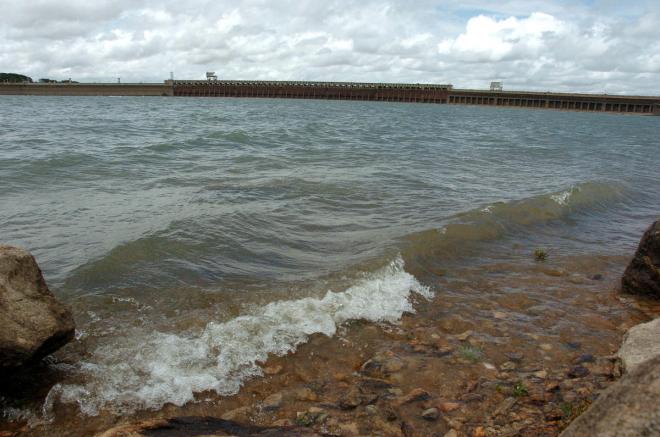
The backwater of the KRS dam. According to a KSPCB official, Cauvery river water in Karnataka falls under 'C' grade, which means it is safe for drinking after treatment. DH FILE PHOTO
The backwater of the KRS dam. According to a KSPCB official, Cauvery river water in Karnataka falls under ‘C’ grade, which means it is safe for drinking after treatment. DH FILE PHOTO

Environment experts claim that the report on River Cauvery published by Anna University, Tamil Nadu, may be partially true, but, the river water is safe for consumption in Karnataka.

S Srikantaswamy, professor in Environmental Science, University of Mysore (UoM), said, the pollution level at River Cauvery will be high during summer as water flow is less. The professor, who had conducted a study on River Cauvery two years back, said, “We cannot ignore the report, but, the pollution level in the river varies at different points in time.”

“It is true that the river, which has its origin at Talacauvery, in Kodagu district, receives wastewater from the starting point itself. The river flows amidst coffee plantations and the coffee pulped water is directly let into the river without any treatment. Similarly, the industries located along the river discharge wastewater (including toxic effluents) without treatment,” he said.

An official of the Karnataka State Pollution Control Board (KSPCB) said that he is unaware about the parameters of the study conducted by Anna University.

“The water in Karnataka comes under ‘C’ grade, which means it is safe for drinking after treatment. The report might be true as the river might be more polluted in TN,” he said.

In TN, a large number of small and medium textile dyeing industries, paper and sugar mills are located besides the river, and this could be the reason for high pollution levels. The pollution level during summer will be high as self-purification is low due to less volume of water flow, he said.

In Mysuru district, except sewage water in a few places, no industry releases wastewater into the river directly. The authorities monitor the quality of water every month at various places, commencing from Kodagu district up to the border of Karnataka, and the river water quality is good, he claimed.

Claiming that the River Cauvery in Karnataka is not polluted as much as River Ganga, he said, as per the physical appearance itself, the river is not much polluted.

source: http://www.deccanherald.com / Deccan Herald / Home> District / by Ranjith Kandya / Mysuru – DH News Service / December 25th, 2017

Support to be extended to CNC for autonomous status

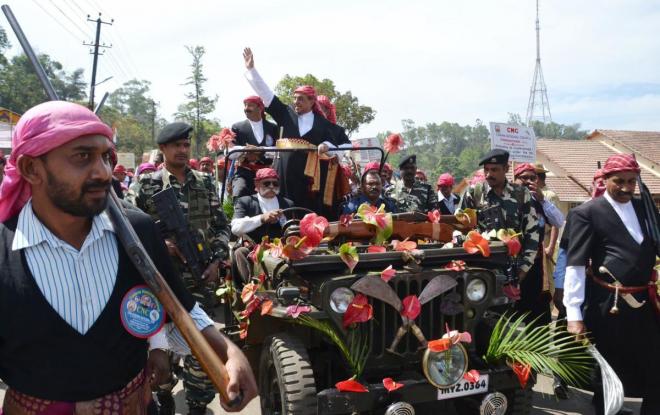
Rajya Sabha Member Subramanian Swamy was taken out in a procession during Codava National Council Day in Madikeri on Sunday.

Rajya Sabha member Subramanian Swamy promised to extend his support to the issue of autonomous and union territory status to the Kodava land and tribal status to Kodavas.

“The support that I had extended for Telangana will be extended to the Kodavas too,” he said.

He was speaking at the Codava National Council Day organised by Codava National Council here on Sunday.

“Owing to long struggle, Telangana was separated from Andhra Pradesh. Similar struggle was held in Uttarakhand. Kodagu will get autonomous status in future,” he predicted.

“Kodavas are not demanding a separate country like Pakistan. They are demanding constitutional rights. The demand for separate state or a union territory is not wrong,” Swamy said.

Black money
“Black money from different parts of the country is reaching Kodagu.

Those who are involved in corruption are purchasing properties in Kodagu district. Former Union minister P Chidambaram, even multinational companies own properties in Kodagu,” he said.

Stating that the BJP is not engaged in vote bank politics, he said that no Muslim candidate was fielded by the BJP in Uttar Pradesh. In spite of it, the BJP won the election, he pointed out.

“In the name of labourers, several illegal migrants have entered the district. They have availed of Aadhaar and ration card facilities as well,” he said.

CNC president N U Nachappa was present during the ceremony.

source: http://www.deccanherald.com / Deccan Herald / Home> District / DH News Service / Madikeri – November 26th, 2017