Category Archives: Amazing Feats

Charishma Kaliyanda: My mum in her own words

Charishma Kaliyanda, NSW MP for Liverpool, interviews her mother Bhanu Chottera, a former Indian Government architectural draughtsperson. 
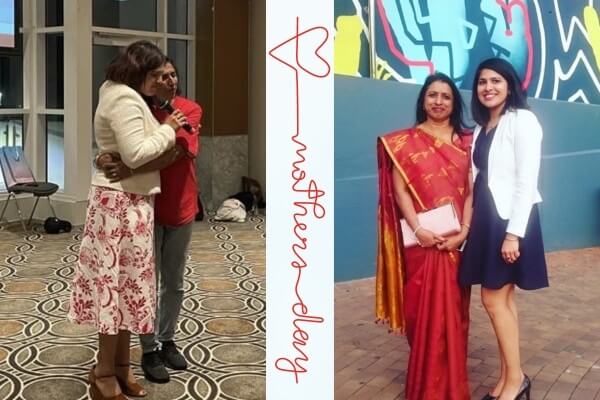
Our Mother’s Day series ‘My Mum in her own words’ pays tribute to our mothers, showcasing the intergenerational bond between mother and child. Here Charishma Kaliyanda, NSW MP for Liverpool, sits down with her mother Bhanu Chottera, a former Indian Government architectural draughtsperson. 

Charishma Kaliyanda: What are your strongest memories of your mum?

Bhanu Chottera: My mum, known as ‘Baby’ to all, was the example of someone who gave unconditional love, she treated all her 5 children equally – no difference between boys or girls. You could never tell when she was unhappy or concerned, she was always bubbly and charming.

She always had the answers to our problems – and never refused when any of us asked for help.

Charishma Kaliyanda: She sounds a lot like you, actually! So what’s something your mum or dad used to tell you growing up that later turned out to be true?

Bhanu Chottera: They always encouraged me to study and stand on my own feet, regardless of being a girl. Education is the one thing nobody can snatch away from you and will make sure you can put food on the table. Dad always said, regardless of the situation, don’t hide away from your problems and don’t be afraid to speak out.
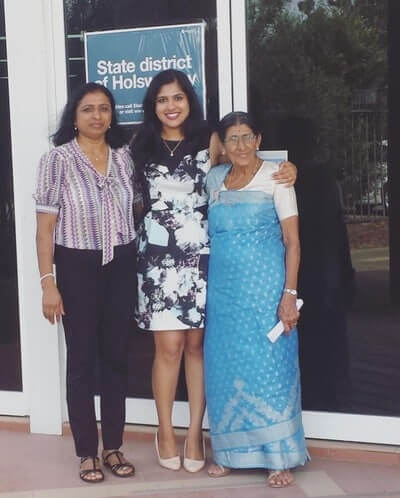
Charishma with her mother and grandmother (Source: Supplied)

Charishma Kaliyanda: How about Ammachi, what is the best advice your mum ever gave you?

Bhanu Chottera: Always be financially independent, and make sure you save some money as you never know when you’ll come across a rainy day when you need it!

Charishma Kaliyanda: That is definitely practical advice that we can all use. Tell me about the day I was born.

Bhanu Chottera: I felt blessed – but it was a lot of effort, because I was in labour for almost 22 hours with you!

I was so happy because I always wanted a girl. I grew up with two sisters so, in having a daughter, I knew I would always have someone to talk to, share experiences and develop a lifelong bond with.

The entire extended family was so pleased because my sister is the eldest and she was a role model for everyone else. You were also the first female grandchild on both sides of the family, and so your Thatha called you our ‘Lakshmi’.
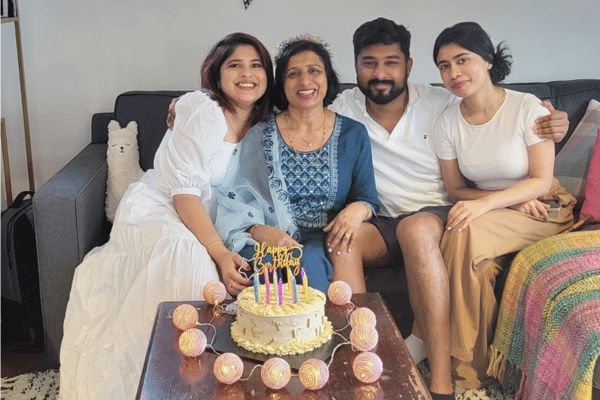
Celebrating mum’s 60th birthday (Source: Supplied)

Charishma Kaliyanda: That’s really cute, I didn’t know that. Tell me about the world events that have had the most impact on you?

Bhanu Chottera: The first event was the 2004 Tsunami in the Indian Ocean. I had never heard the word tsunami before and didn’t know what it was until I saw the devastation created that day – so many people died, there was so much destruction and across such a large area. It made me realise that things can change in the blink of an eye, anything can happen and life is short, precious and unpredictable. It made me really think about what I wanted from my life.

The other is COVID, of course. The whole period had a huge impact on me and reinforced that nothing belongs to you, so share what you have and show care to the people around you as much as you can.

Charishma Kaliyanda: Keeping those lessons in mind, what would you say are the best decisions you made in your life?

Bhanu Chottera: The first was keeping in mind my parents’ advice and getting an education because I got my dream job working for the Indian Government’s housing department as an architectural draughtsperson. I loved my work and my lifestyle and I made some amazing friends that I am still close with today.

The second was buying a home. After coming to Australia, starting a new life from scratch here, having a home of my own was a sign that I had some roots and could stand on my feet. It made me feel like I had achieved progress and independence, and I could nurture my family (and my own garden!).
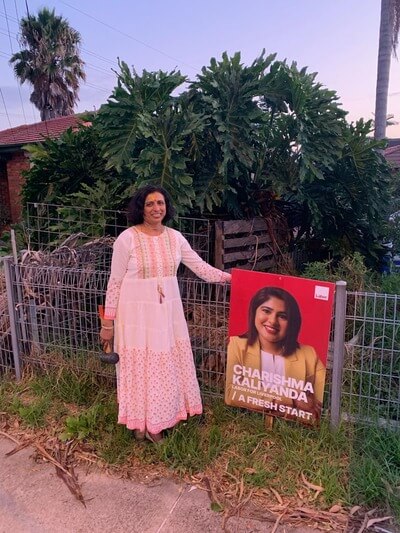
Mum on the campaign trail (Source: Supplied)

Charishma Kaliyanda: Speaking of gardens, that’s probably the biggest difference between us, you’re in your element surrounded by roses, mulch and manure and you still won’t let me forget how I accidentally killed your choko vine when I was 14! How did you feel when I told you I wanted to get into politics?

Bhanu Chottera: It was actually a shock. Coming from a different cultural background, I thought you might find it difficult to be accepted. I also saw the demands of working in politics in the media and thought it would be really challenging. At the same time, I remembered the advice I had gained from my dad, who served in the army for many years and had even fought in a World War and knew I should pass it onto my daughter. You come from a long line of fighters, so I knew you would be alright.

Charishma Kaliyanda: So how did you feel on election night when results came in that I had won? What went through your mind?

Bhanu Chottera: Which election? There have been a few!

Charishma Kaliyanda: Look, that’s a fair call.

Bhanu Chottera: The first one was a bit disappointing but I remember clearly thinking “there’s always next time, this is only the beginning”. We’ve been on a long journey, with 6 election nights in total! On election night last year though, I thought, “this is the right time”. I have seen you develop the skills and temperament to balance things and to be able to make the impact you want to on the things you are passionate about.
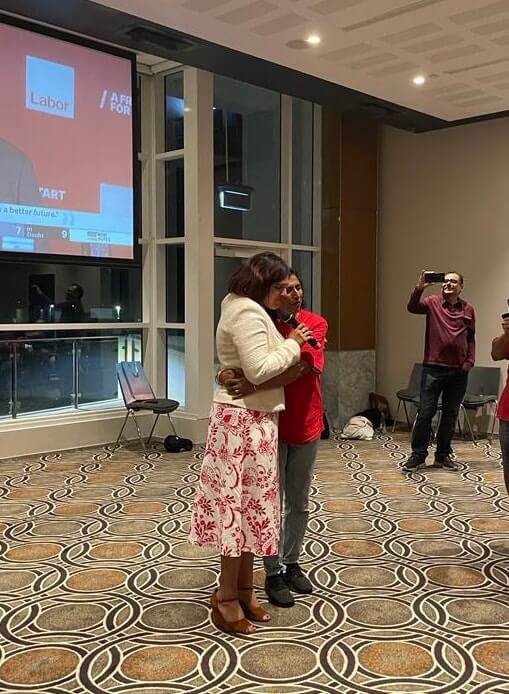
With mum on election night as results came in (Source: Supplied)

Charishma Kaliyanda: How about on the day I was sworn in at Parliament ?

Bhanu Chottera: That was one of the most exciting and memorable days of my life. I felt my daughter had achieved something I never thought possible. When we became Australian citizens, I remember we had the ceremony at the Liverpool Council chambers and when you were sworn in as the youngest councillor at Liverpool Council in 2016, I was blown away. To see you become a member of the NSW Parliament was a real validation of our decision to seek a new life in Australia because we wanted better opportunities for our children. You made us proud, and all the challenges and sacrifices worth it.

Charishma Kaliyanda: What do you worry about most now, regarding me?

Bhanu Chottera: Look, like every parent I always worry about your health, happiness and safety. I know the hours you work and the travel you do, as well as the stress and responsibility you take on. So I try and encourage you to maintain a healthy work/life balance.

Charishma Kaliyanda: If by encourage, you mean, nag with great affection, you’re spot on! So what about your own self, what are you looking forward to?

Bhanu Chottera: I want to stay healthy as possible so I can travel, starting with Cambodia! I try and eat well, meditate, exercise and stay connected with my friends. I really enjoy being involved with charities and community work because I like helping people and I know that people have been there to support me when I needed it, so I pay it forward.

Charishma Kaliyanda: What the one lesson you want me to take forward?

Bhanu Chottera: Always listen to people, but believe in yourself and act according to what your heart is telling you.

source: http://www.indianlink.com.au / Indian Link / Home> India in Australia / by Indian Link / May 09th, 2024

Minns names Charishma Kaliyanda as new digital and customer service parliamentary secretary, NSW Australia

Charishma Kaliyanda (second from right) is NSW’s new parliamentary secretary for customer service and digital government, emergency services and youth justice. (Photo: Facebook)

NSW Premier Chris Minns has appointed lower house member Charishma Kaliyanda as the state’s new parliamentary secretary for customer service and digital government, emergency services and youth justice, replacing Anthony D’Adam, who was sacked a month ago after labelling the state’s police commissioner a liar.

Elected to Parliament in 2023, Kaliyanda’s appointment comes as Minns and NSW Labor attempt to fend off growing criticism in several parts of Western Sydney that many local members simply don’t reflect the communities in their electorates or make it to junior ministries let alone cabinet.

While there are some high-profile exceptions like Treasurer Daniel Mookhey, Jihad Dib (Kaliyanda’s senior minister) and Industrial Relations Minister Sophie Cotsis, the composition of the first Minns ministry was notable for its Anglo-Celtic weighting.

Community diversity and preselection of state and federal candidates, especially from southwest and western Sydney, have become an increasing friction point across the Australian political spectrum, with Labor losing once safe seats like Fowler to local independent candidates like Dai Le after locals were sidelined for so-called captain’s picks like Kristina Keneally.

Fairfield, where Le whittled down Labor’s margins to just a couple of points as a Liberal state candidate, is somewhat of a case study in how and why migrant communities abandon major parties, with former Fairfield Labor mayor Frank Carbone also quitting his party to run for council on an independent ticket.

You can’t undo years of electoral neglect overnight, but you can make an effort to listen.

Indian diaspora is one of Australia’s fastest-growing migrant communities, now numbering close to 1 million, and the ties are strengthening.

Australia appointed its first consul-general in Bengaluru, Hilary McGeachy, in 2023, adding diplomatic muscle to the massive nation’s south, which includes the states of Karnataka and Telangana.

The capital of Karnataka is Bangalore (population 15 million), which positions itself, for better or for worse, as India’s Silicon Valley.

In an interview with Indian Link , a community publication founded in 1994, Kaliyanda says it “empowers and elevates the South Asian community in Australia, by telling their stories and unpacking their experiences in a nuanced and unbiased manner” reaffirmed her commitment to her community.

“I had thought deeply about what I will wear on my first day as an MP. I wore a blue sari from Karnataka, draped in the Kodava style, with a Waratah broach,” Kaliyanda told the community publication.

“I wanted to share that I will be bringing my whole self to this role and to the Parliament — my commitment to and love for my community in wearing the colours of NSW, and my pride in where I come from and the diversity of my community in wearing a sari specifically from where I was born and in the Kodava style.

“I did struggle with it because there wasn’t really a playbook for what to do and what was expected but I was encouraged to “be myself”, and so I wanted to share my authentic self with our broader community.”

Asked who gave her the best advice for the first time in the bear pit, Kaliyanda told IndianLink: “two Labor Party colleagues, Jihad Dib and Sophie Cotsis, who were very supportive and full of advice.”

“There’s a lot to learn, so take it slow and ask questions as much as you can, Jihad told me,” Kaliyanda said.

Take it slow? That just changed. Welcome to the ministry.

source: http://www.themandarin.com.au / The Mandarin / Home> Careers / by Julian Bajkowski (headline edited) / June 17th, 2024

Kodagu Woman At Mount Everest Base Camp

Madikeri:

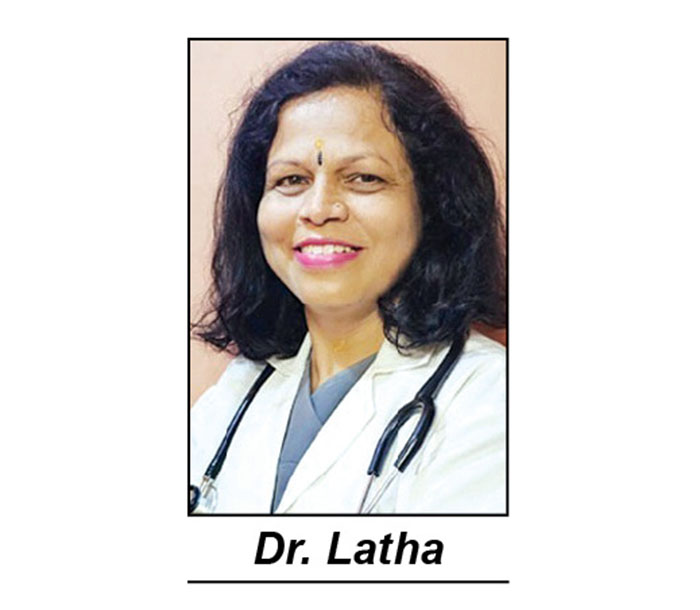
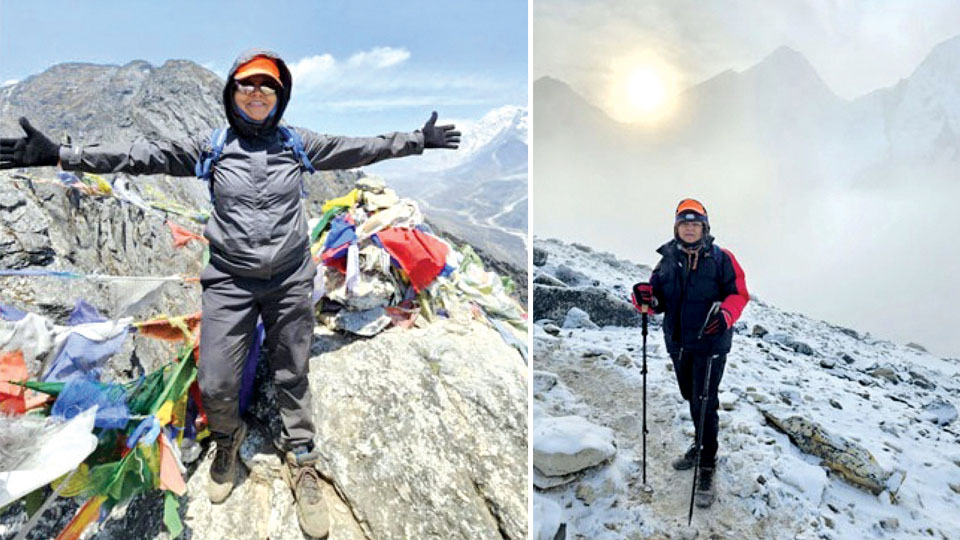
A woman from Kodagu has made history by reaching the Mount Everest Base Camp. Dr. Latha, a 57-yearold gynaecologist working in Bengaluru, participated in the trek to the Everest Kodagu woman at Mount Everest Base Camp Base Camp and successfully reached the first phase target of 18,514 feet.

Dr. Latha, a native of Badubanahalli near Alur Siddapura in Somwarpet Taluk, Kodagu, has brought great honour to her region through this remarkable achievement. She is the daughter of the late Mallappa.

With a keen interest in sports and trekking, Dr. Latha had a deep desire to conquer Mount Everest. She underwent rigorous training for six months with a Nepal-based company, running up to 10 kilometres daily and climbing small mountains to build stamina.

Dr. Latha was selected to climb the world’s highest peak during the April 28 to May 11 schedule, where several teams from India were participating. Among them, there were eight individuals aged between 30 and 40.

“Every day, we used to climb 10 to 15 kilometres and then rest. Only three members from our team, including me, could reach that Base Camp,” she said.

source: http://www.starofmysore.com / Star of Mysore / Home> Sports / June 01st, 2024

Club Mahindra Madikeri recognised as India’s ‘First Triple Net Zero’

The Indian Green Building Council (IGBC) recognised the resort, acknowledging the resort’s net zero energy, net zero water, and zero waste to landfill.

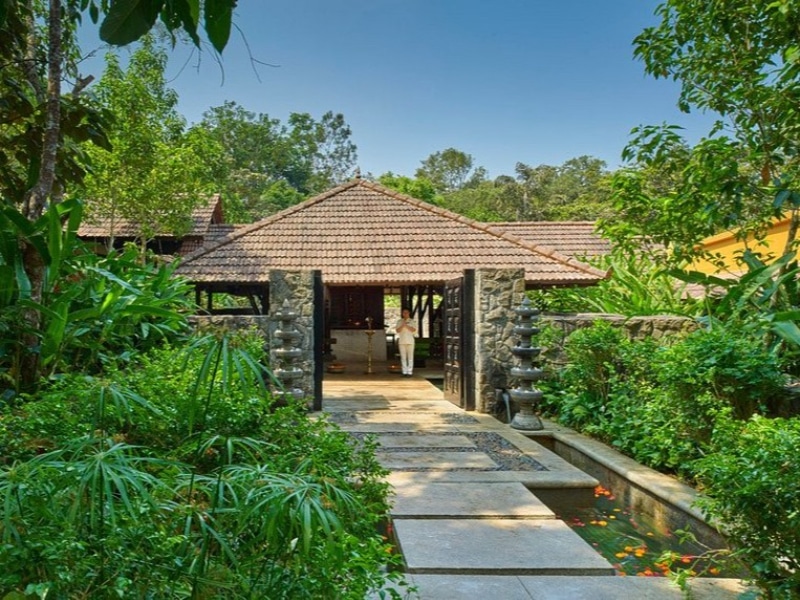
Club Mahindra Madikeri was recognised as India’s first triple net-zero-rated resort by the esteemed Indian Green Building Council. The triple net zero acknowledges net zero energy, net zero water, and zero waste to landfill. The rating sets a benchmark on par with international standards, thus making Club Mahindra Madikeri achieve a significant milestone in sustainable hospitality.

More about net zero certifications:

  • Net zero energy: This indicates the resort generates as much energy as it consumes. The resort makes optimum utilisation of solar energy and energy-efficient infrastructure, reducing its carbon footprint.
  • Net zero water: This is a remarkable achievement in water management. It promotes water conservation and security. Club Mahindra’s water conservation initiatives demonstrate its commitment to sustainable practices. Measures include rainwater harvesting, efficient irrigation systems, and water-saving fixtures.
  • Zero waste to landfill: TÜV SÜD certified the resort for net zero waste in FY23. Comprehensive waste management practices, including segregation at source, composting, recycling, and other measures, help Club Mahindra achieve this.

The resort nestled in the picturesque region of Coorg, Karnataka, is a beacon of luxury, comfort, and responsible tourism, thus contributing to preserving the planet. The resort blends seamlessly with its lush surroundings, supporting local plants and animals, covering a vast area of 126464.26 square metres, with buildings occupying just 22257.7 square metres. By incorporating dense vegetation, insulated roofs, and using local materials, the resort has reduced the surrounding temperature by approximately 3°C. The resort adopts several other energy-saving initiatives, such as motion sensor-controlled washrooms, regulated geysers, timer-controlled external lights, heat pumps, and BLDC fans, which have resulted in an impressive energy performance index of 74.4 kW per m² per year, surpassing the Bureau of Energy Efficiency’s benchmark of 313 kW per m² per year. Moreover, over 70% of the water is recycled and reused for operational purposes at the resort, further emphasising the resort’s commitment to sustainability.

Additionally, under the Mahindra Hariyali project, thousands of trees have been planted, enriching the region’s natural habitat and attracting diverse bird species. This initiative fosters a thriving ecosystem, enhancing the visitor experience with its biodiversity.

Julian Ayers, Chief Resort Officer of Mahindra Holidays and Resorts India Limited, said, “At Mahindra, we recognise the crucial importance of advocacy and partnerships in driving the swift shift towards a sustainable future. Our journey towards a greener future began in 2008. Since then, we’ve embraced a ‘Planet Positive’ approach to sustainability. We’re committed to making our operations eco-friendly, helping industries reduce their carbon footprint, and revitalising nature. Our unwavering commitment to habitat protection and biodiversity at Madikeri has earned us recognition and honour from the IGBC, reflecting our steadfast dedication. We embrace a global responsibility to safeguard diverse ecosystems and achieve carbon neutrality by 2040. As part of Mahindra Holidays’ sustainability journey, we’re committed to innovating and inspiring change within our operations and beyond.”

Mahindra Holidays is India’s first hospitality company to join the global campaign RE100 and EP100. To achieve its zero-energy goal, Club Mahindra implemented an 804-kW solar rooftop photovoltaic plant and solar carports in parking areas. In water conservation efforts, over 70% of water is recycled and reused, with natural streams diverted to a 380 kL capacity pond and 14 rainwater harvesting pits constructed within the resort premises. For zero waste, the resort utilises a bio-digester to convert food waste into biogas, reducing waste, and LPG costs.

With these remarkable achievements, Club Mahindra continues its steadfast journey towards sustainability and biodiversity conservation. By doing so, it provides its members with unparalleled access to some of the most breathtaking and exotic destinations both in India and across the globe.

source: http://www.hotelierindia.com / Hotelier India / Home> Operations / by Staff Writer – Hotelier India / June 07th, 2024

Cheppudira Arun Machaiah Appointed As Joint Chief Of Karate India Organisation (KIO)

Former MLC and International Karate expert from Kodagu, Cheppudira Arun Machaiah has been appointed as the new Joint Chairman of the Technical Commission of Karate India Organisation (KIO).

Director of World Shitorio Karate Council and President of All India Shitorio Karate Organisation, Arun is the first Kannadiga to achieve the highest post of KIO.

source/content: starofmysore.com (headline edited)

LS polls 2024: Kodagu records over 70% voter turnout

From nearly 6.30 am, voters started to queue outside their respective polling stations with much enthusiasm to practice their duty.

Voters from all sections of the society enthusiastically took part in the festival of democracy and cast their votes.Photo | EPS

Madikeri :

Smooth polling was recorded across Kodagu and the district recorded a voter turnout of 70.58% at 5pm.

Voters from all sections of the society enthusiastically took part in the festival of democracy and cast their votes. The district had special polling booths even as foresters guarded the booths located in wildlife conflict zones.

The minor glitches in EVMs were sorted out during the mock voting process held in all polling booths from 6 am to 7 am. From nearly 6.30 am, voters started to queue outside their respective polling stations with much enthusiasm to practice their duty.

A total of 23 special polling booths including Sakhi and Model booths were set up across the district. At Maldare, Nagarahole, Hebbale, Malambi, Heruru and CB Halli, tribal themed polling stations were set up to woo the increased population of tribes.

The tribes in large groups participated in the electoral process enthusiastically. The Sakhi polling stations were decked up in polling centers that had increased women voters even as Kodagu ADC Veena BN opted to vote from one of the Sakhi polling booths in Madikeri. Model polling centers with improved facilities also wooed the voters.

However, the officers on election duty at the interior village of Vanachal were made to suffer for some time due to the unavailability of drinking water.

Nevertheless, the voters of the center helped the officers and arranged for a drinking water facility. In Wildlife conflict zones including regions across Siddapura, Kushalnagar and Virajpet, a Range Forest Officer alongside a Rapid Response Team equipped with weapons were deployed to ensure the safety of the voters. Armed Forces from Gujarat guarded the naxal sensitive booths across the district including at Karike and Sampaje areas.

A tragic incident was, however, reported at a polling station in B Shettigeri of South Kodagu. Manohar (58), a traditional drummer who played the ‘chande’ instrument, died of a heart attack outside the polling station.

Sources confirmed that he waited in the queue and cast his vote. However, he collapsed outside the polling center after he suffered a heart attack and died.

MADIKERI: Smooth polling was recorded across Kodagu and the district recorded a voter turnout of 70.58% at 5pm.

Voters from all sections of the society enthusiastically took part in the festival of democracy and cast their votes. The district had special polling booths even as foresters guarded the booths located in wildlife conflict zones.

The minor glitches in EVMs were sorted out during the mock voting process held in all polling booths from 6 am to 7 am. From nearly 6.30 am, voters started to queue outside their respective polling stations with much enthusiasm to practice their duty.

A total of 23 special polling booths including Sakhi and Model booths were set up across the district. At Maldare, Nagarahole, Hebbale, Malambi, Heruru and CB Halli, tribal themed polling stations were set up to woo the increased population of tribes.

The tribes in large groups participated in the electoral process enthusiastically. The Sakhi polling stations were decked up in polling centers that had increased women voters even as Kodagu ADC Veena BN opted to vote from one of the Sakhi polling booths in Madikeri. Model polling centers with improved facilities also wooed the voters.

However, the officers on election duty at the interior village of Vanachal were made to suffer for some time due to the unavailability of drinking water.

Nevertheless, the voters of the center helped the officers and arranged for a drinking water facility. In Wildlife conflict zones including regions across Siddapura, Kushalnagar and Virajpet, a Range Forest Officer alongside a Rapid Response Team equipped with weapons were deployed to ensure the safety of the voters. Armed Forces from Gujarat guarded the naxal sensitive booths across the district including at Karike and Sampaje areas.

A tragic incident was, however, reported at a polling station in B Shettigeri of South Kodagu. Manohar (58), a traditional drummer who played the ‘chande’ instrument, died of a heart attack outside the polling station.

Sources confirmed that he waited in the queue and cast his vote. However, he collapsed outside the polling center after he suffered a heart attack and died.

Outside a polling centre in Madikeri, the officials forcefully shut down shops that were located within 200 meters from the St Michael School polling station. However, DC Venkat Raja intervened and withdrew the closing down order. He, however, cautioned the shopkeepers not to allow campaigning from political parties at the shops.

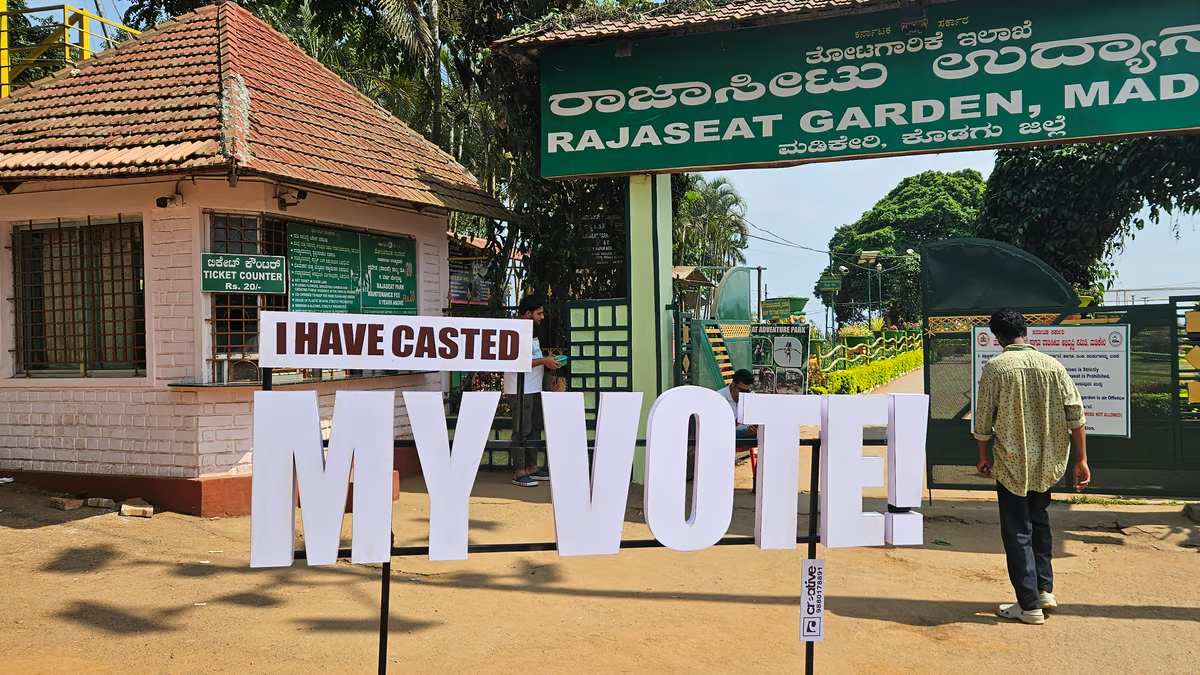
Venkat Raja, SP K Ramarajan and CEO Varnit Negi cast their votes at the taluk office in Madikeri and later visited the Raja Seat tourist spot to urge residents to go vote. While most of the tourist centers were open in the district, the Dubare Camp was shut for tourist visits as this was turned into a polling station for the tribal voters.

source: http://www.newindianexpress.com / The New Indian Express / Home> Karnataka / by Prajna GR / April 26th, 2024

Europe To Receive First EUDR-Ready Coffee Verified By Rainforest Alliance

India’s High Range Coffee Curing is poised to become the first farm verified by the Rainforest Alliance to ship EUDR–ready coffee beans to Europe later this month.

The coffee farm partnered with the Rainforest Alliance to meet the necessary compliance requirements of the regulation.

Established in 1995, High Range Coffee Curing is located in the Periyapatna and Kushalnagar Coorg districts, among 142 hectares of tropical forests, and is known for its quality beans.

The farm supplies coffee to leading global coffee brands, roasters and traders in India, including Nestle , Unilever, E-Com Commodities, Olam, Continental Coffee, Louis Dreyfus Company , Vidya Coffee and Allanasons.

EUDR-Ready Coffee

Zaidan M Saly, director of High Range Coffee Curing stated, “Implementing EUDR  [EU Deforestation Regulation] posed significant challenges for our team, but with the invaluable guidance from Rainforest Alliance representatives in our region, we overcame them and gained confidence in the process.

“Their expertise made the seemingly daunting task entirely feasible, facilitating a smooth and successful implementation, which now not only guarantees adherence to EUDR regulations but also sparked a revolution in our approach to traceability.”

Rainforest Alliance certification enables coffee and cocoa farmers to opt in for EUDR-aligned criteria.

This allows companies to source from these farms, track ingredients along their supply chains, and leverage farm data to demonstrate compliance with the regulation’s deforestation risk assessment and mitigation requirements by the deadline, at no additional cost.

‘Sustainable Practices’

Miguel Gamboa, coffee sector lead at the Rainforest Alliance stated, “The EUDR represents an important step forward to shift the global coffee sector towards more sustainable practices.

“Yet, many smallholder coffee farmers need support to align with the requirements, including traceability, deforestation risk mapping, local laws, and practical and technical guidance on key environmental practices.”

The Rainforest Alliance has urged the EU Commission not to dilute or delay the legislation or postpone its deadline in response to calls from some companies and governments.

It has also called on companies not to scale back purchases from smallholder coffee farmers, but rather support them in meeting the deadline of this legislation.

Gamboa added, “We are also piloting a deforestation risk assessment offering for companies buying non-certified coffee and cocoa, which we plan to roll out more widely later this year.

“With this offering, we aim to support more companies in their journey to compliance, but more importantly, to also reach non-certified farmers so their products can still be sold on the EU market.”

source: http://www.esmagazine.com / ESM, European Supermarket Magazine / Home> Supply Chain / by Dayeeta Das / May 06th, 2024

‘SOM’ Report On Kodagu-Born Vet Saving Leopard Wins Award

Madikeri:

Three journalists have been selected for the Annual Awards given by the Kodagu Press Club.

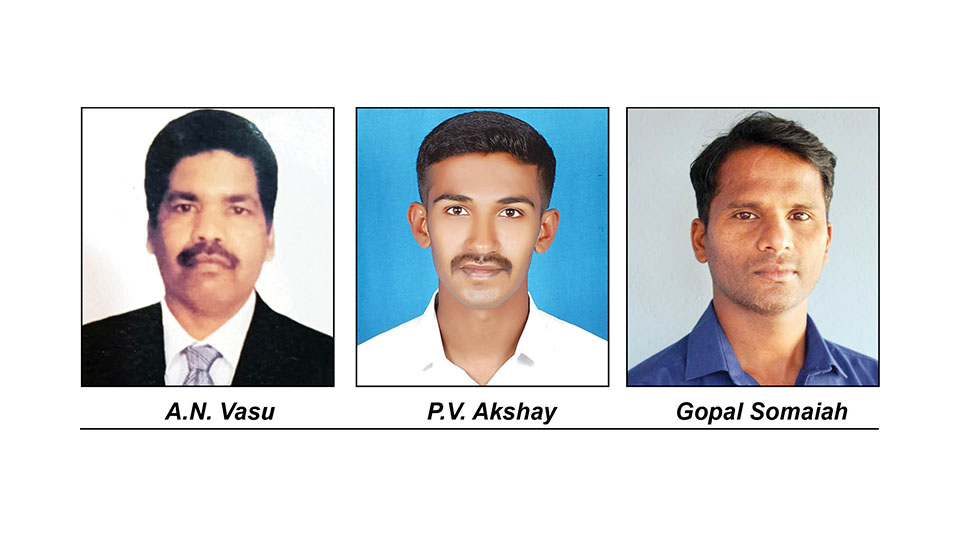
A.N. Vasu’s report titled ‘Yejentara Mosakke Baliyagi Videshadalli Silukida Mahile’ published in Shakthi Daily has been selected for Best Effective Report Award, instituted in memory of senior journalist  K.B. Mahantesh.

P.V. Akshay’s (AG) report in Star of Mysore (SOM) titled ‘Daredevil Act by Kodagu-born Vet Saves Leopard in Mangaluru’ has been selected for Best Humanitarian Report Award, instituted by Koovarkolli Indresh and family in memory of his father B.V. Chandrashekhar and mother Pushpalatha.

Imanda Gopal Somaiah’s report ‘Madikeriyalli Maragala Maaranahoma,’ telecast on TV9 Kannada, has been selected for Best Environmental Report Award, constituted by M.N. Chandramohan in memory of his father M. Narayana and mother N. Padmavathi.

Each of the three awards includes a cash prize of Rs. 5,000 and a plaque. The awards ceremony will take place in Madikeri on June 2 at 12 noon.

source: http://www.starofmysore.com / Star of Mysore / Home> News / May 29th, 2024

At 79, Padma Shri Ummathat Ki Rani is busy pushing for a Kodava ‘lipi’

Rani’s entire career has been dedicated to preserving and promoting the folk dance form, Ummathat, of the Kodava tradition.

Rani Machaiah (seated) was felicitated at a function in Madikeri on Thursday, 26 January. (Supplied)

The news came as mellifluous as the song that accompanies Ummathat, the traditional dance form of Kodagu.

Rani Machaiah — better known as Ummathat Ki Rani  — was at her home in Madikeri when she received the news of the nation honouring her with Padma Shri.

Congratulatory calls have been flooding her from relatives, friends, well-wishers, and most importantly, from her large number of students since Wednesday, 25 January.

“A train of thoughts crossed my mind,” the 79-year-old shared her experience with South First. “I have worked for around 50 years, promoting this traditional dance form.”

She has been leading Ummathat since 1984 and she had trained over 10,000 students.

Rani recalled taking her students to different states to showcase the dance form. “Ummathat is performed by a troupe of 20 — two will be singing and the other eighteen will dance to narrate a story,” she explained.

“This dance form is similar to the traditional ones of every other state,” she added.

Creating masters

Rani doesn’t dance anymore. But she still teaches students to master the art form. She had trained several batches of students.

Padma Shri Rani Machaiah. (Supplied)

“Once they get married, they leave and a new batch joins. Girls of any age can join the troupe,” Rani said.

Her students had performed in Lakshadweep, Goa, Chhattisgarh, Himachal Pradesh, Jammu and Kashmir, Haryana, Mizoram, Odisha, Punjab, Maharashtra, Madhya Pradesh, and several places across Karnataka.

“We get invitations from various places and institutions from all over the country and we perform our traditional Ummathat there,” Rani, who has dedicated herself to preserving and promoting the traditional dance form, said.

Rani was born in 1943 in Siddapura in the Kodagu district. Her husband, the late Machaiah, was an advocate, who passed away when she was 65.

Her son, Sathish Machaiah, 55, is a software engineer in Bengaluru. Rani’s daughter, Saritha Devaiah, is a homemaker in Kodagu. Her husband Devaiah owns a plantation.

When asked about her inspiration to take up Ummathat, Rani said it was personal interest.

Now, a lipi

Rani is the chairperson of Kaveri Kalavrunda Sangha, an organisation she founded. She is the recipient of the Rajyotsava Award and many other honours.

She was a former president of Karnataka Kodava Sahitya Academy and at present, she is encouraging groups of Kodavas working on designing a lipi — alphabet or script — for the Kodava language to preserve its literature since the language doesn’t have a lipi now (traditionally, Kodavas use the Thirke script, which is an abugida).

“It will look somewhat similar to Kannada and it will have phonetics and extra words that are used in the Kodava language in Kannada lipi,” Rani said.

source: http://www.thesouthfirst.com / South First / Home> States / by Bellie Thomas / January 27th, 2023

New species of spider discovered in Kodagu district

This is only the second documented occurrence of the Ligdus genus in 129 years, according to naturalists.

Ligdus garvale spider discovered in Kodagu district. | Photo Credit: special arrangement

A group of naturalists from Tamil Nadu and Karnataka recently discovered a new species of spider in Kodagu. They named it Ligdus garvale after the village where it was found. Garvale, a village in the Somwarpet taluk of Kodagu district, is where the spider was discovered.

This jumping spider is significant as it represents only the second documented occurrence of the Ligdus genus in 129 years, according to naturalists.

The research team includes John T.D. Caleb from the Department of Anatomy at Saveetha Medical College & Hospital in Chennai, A. Divyashree from Kuvempu University in Shankarghatta, A.P.C. Abhijith from Indraprastha Organic Farm in Mysuru, and Lohith Kumar from Montrose Golf Resort and Spa in Kodagu.

According to Ms. Divyashree, Ligdus garvale was found in Garvale village, which is surrounded by agroforestry. “Coffee plantations are prominent in the area, along with pepper and paddy fields where the Ligdus Garvale, a jumping spider, was found,” she added.

After the team of naturalists observed the spider and recorded their findings, they sent the specimen to Mr. Caleb for anatomical examination. “Ligdus garvale represents just the second recorded occurrence of the Ligdus genus in 129 years. The first, Ligdus chelifer, was documented in Myanmar in 1895,” Mr. Abhijith said.

Mr. Abhijith explained that the eight-legged creature was discovered beneath the leaf of a torch ginger plant in Garvale village in north Kodagu. “The Garvale jumping spider measures approximately 0.2 inches in length. It has eight legs, eight eyes, and a body covered with fine pale hairs. Only one male Garvale jumping spider was found, and the new species was named after the Garvale area where it was discovered. So far, this is the only area where it has been found,” he added.

source: http://www.thehindu.com / The Hindu / Home> News> India> Karnataka / by The Hindu Bureau, Bengaluru / May 24th, 2024