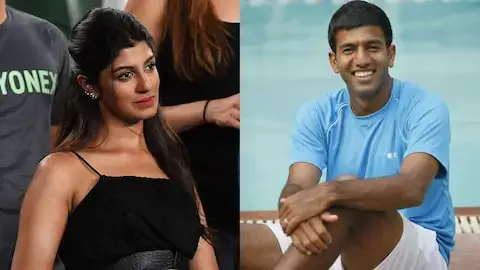
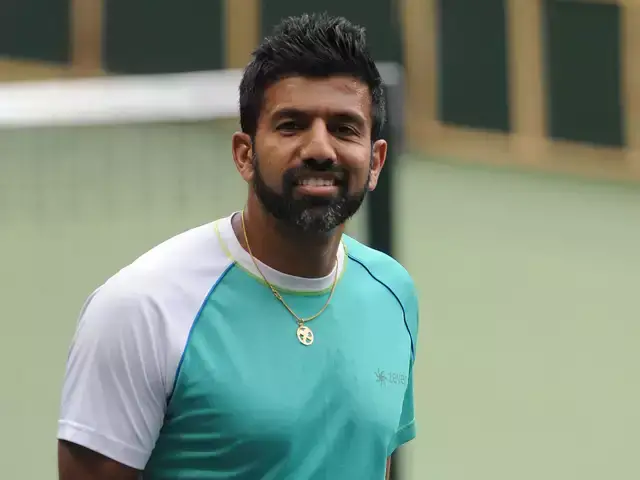
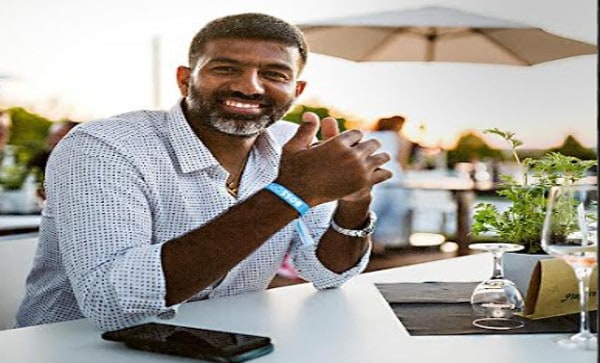
Here’s everything you need to know about the personal life and family of Rohan Bopanna and his wife Supriya Annaiah.
Rohan Bopannawas born in a middle-class family in Coorg, Karnataka. His father, M. G. Bopanna, works as a coffee planter, while his mother, Malika Bopanna, is a homemaker. He pursued his education at Sri Bhagawan Mahaveer Jain College, affiliated with Jain University in Bengaluru .
Both of his parents strongly support Rohan’s career. They reside in Coorg/Kodagu District, situated in the southern Indian state of Karnataka, approximately a six-hour drive from Bangalore. Additionally, Rohan has an elder sister who resides in Mumbai.
Supriya Annaiah and Rohan Bopanna
Bopanna tied the knot with Supriya Annaiah in 2012. Before the marriage, they dated for some time and married in a closed ceremony. Surpiya has a mutual friend whose cousin is Rohan. Supriya and Rohan met at a restaurant accidentally. Later, Rohan asked his cousin to introduce him to Supriya. And that’s how the couple started their journey together.
Supriya is a psychologist and media personality. She is also the director of the Rohan Bopanna Tennis Development Foundation, registered with the Indian Ministry of Corporate Affairs (MCA). Supriya Annaiah and Rohan Bopanna have a daughter named Tridha Bopanna.
Rohan Bopanna has had a legendary Tennis career
Rohan Bopanna achieved a career-high singles ranking of world No. 213, while he reached a career-high doubles ranking of world No. 3 on July 22, 2013. He has been a valued member of the Indian Davis Cup team since 2002. Bopanna has an impressive record, clinching victories in five Masters 1000 men’s doubles tournaments. These victories include the 2011 and 2012 Paris Masters, the 2015 Madrid Open, the 2017 Monte Carlo Masters, and, most notably, the 2023 Indian Wells Masters, where he made history as the oldest Masters 1000 champion.
Rohan Bopanna
Additionally, Bopanna was a finalist at the ATP World Tour Finals in both 2012 and 2015. Bopanna’s achievements extend to the Grand Slam stage as well, as he secured the 2017 French Open mixed-doubles title alongside Gabriela Dabrowski, making him the fourth Indian player to claim a Grand Slam title. Recognized globally for his campaign “Stop War Start Tennis”, Bopanna was awarded the renowned Arthur Ashe Humanitarian of the Year award in 2010.
source: http://www.mediareferee.com / Media Referee / Home> Tennis / b y Sabrik Dutta / September 02nd, 2023
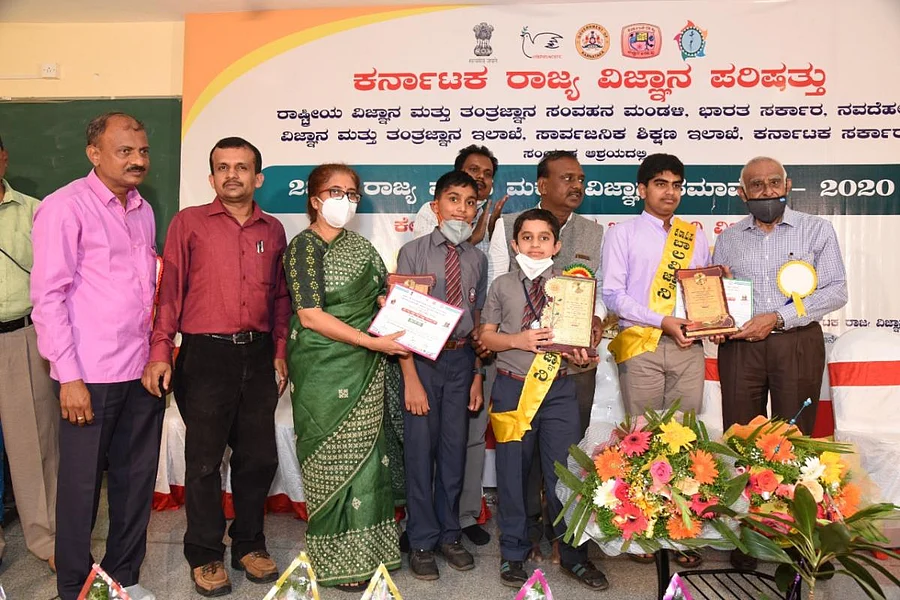
Two young scientists from Kodagu have been selected for the National Children’s Science Congress (NCSC).
National Council for Science and Technology Communication (NCSTC) and Rajya Vijnana Parishat had organised the 28th National Children’s Science Convention.
Owing to the Covid-19 pandemic, the convention was organised on virtual mode.
The selected students are C S Raghuvamshi and K K Mahin from Bharatiya Vidya Bhavan Kodagu Vidyalaya, said convention district coordinator G Sriharsha.
In the state-level junior-level competition held under the theme ‘science for sustainable living’, C S Raghuvamshi and team member N R Samanyu had presented a scientific paper on Shola forest in Kodagu. They prepared their study under the guidance of teacher M S Shruthi.
In the senior category, K K Mahin and team member Purab Ponnappa had prepared a scientific paper on ‘chemical insecticide is boon or bane’ under the guidance of teacher M Lohith Changappa.
Accordingly, Raghuvamshi and Mohin have been selected for the National Children’s Science Congress (NCSC), said Vijnana Parishat programme organiser T G Premkumar.
The state-level competition was held at Vijnana Bhavan in Bengaluru. Senior scientist Dr V K Athre Adamya and Adamya Chetana managing trustee Tejaswini Ananth Kumar felicitated the young scientists.
C S Raghuvamshi is the son of civil engineer C R Shivashankar and teacher P Sandhya while K K Mahin is the son of businessman Krishna Mohan and Sridevi.
Team members Samanyu is the son of artists Ram Gautham and Aruna, while Purab Ponnappa is the son of Mathanda Bab Devaiah and Ponnamma.
Owing to the Covid-19 pandemic, the competition was held on virtual mode. For the state-level contest, 10 junior scientists were selected from Kodagu.
The science Congress is organised to instil scientific temperament and develop creativity in children.
source: http://www.deccanherald.com / Deccan Herald / Home> India> Karnataka / by DHNS / August 23rd, 2021
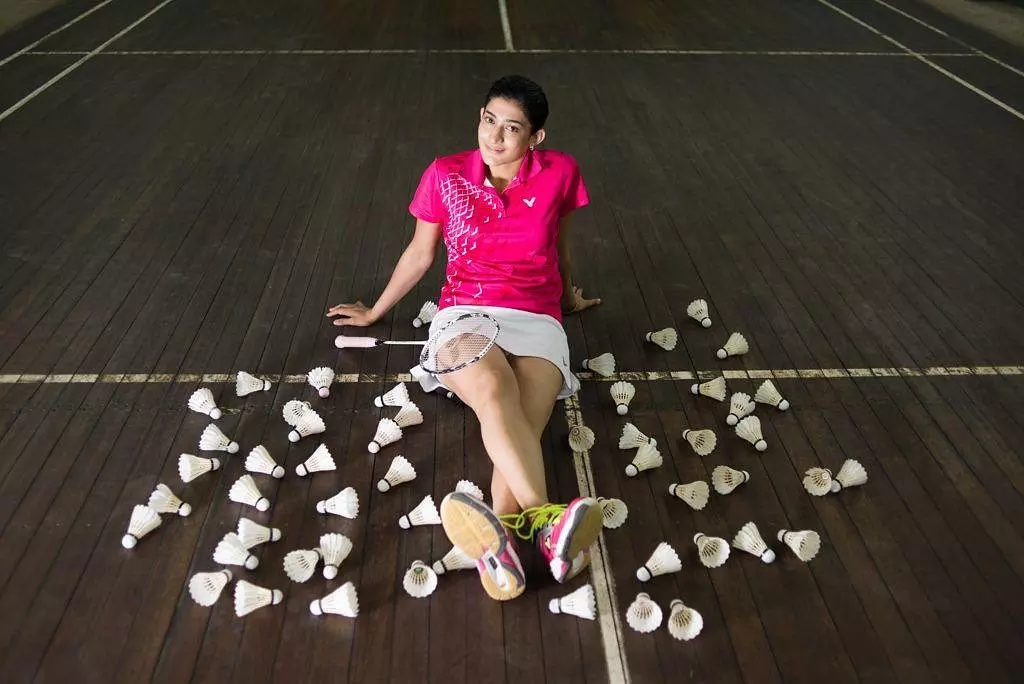
Ashwini Ponnappa, who has achieved many firsts for Indian badminton, is drawing new energy from her 20-year-old partner Tanisha Crasto. But the 33-year-old says her biggest challenge is to stay motivated.
Ashwini Ponnappa poses for a photo among shuttles at a badminton court. (Photo credit: Ashwini Ponnappa/Instagram)
Ashwini Ponnappa is unbothered about her age. An average female shuttler retires at 28, but Ashwini, even at 33, does not see any reason for slowing down. She does not let the thought of retirement sneak into her mind either. Having recently taken up the fresh challenge of playing two intense and physically demanding disciplines – women’s and mixed doubles – instead of one, Ashwini says she ‘finds solace’ in distributing her priorities. “It is not easy to play two events, but it is something that I want to do at this point, I kind of find solace in playing two events rather than one,” Ashwini told The Bridge.
Ashwini broke her long-standing and rather futile partnership with N. Sikki Reddy last year, following her highly successful one with Jwala Gutta which ended in 2016. She tried her hands at pottery and commentary before embarking on a fresh challenge by pairing up with Tanisha Crasto, 13 years younger than her. To put the matter into perspective, when Ashiwni had won her first title – the national sub-junior girls’ doubles gold in 2004 – Tanisha had been in her nappies.
A partner in the mould of a mentor
Ashwin admitted that the trickiest thing for her now is to stay motivated. But Tanisha’s exuberant presence is not allowing her to lag behind. “As you get older, things get tricker. When you are young, you have time on your side, enthusiasm. For me, the challenge right now is to look after my body and keep my mind fresh. And to keep going, keep pushing and keep having that belief and hope that ‘yes, you are going to get that result, again’,” Ashwini said. “It’s tricky, especially when it comes to getting to the stadium and training every single day. The glimmer of hope is that I always believe something good is going to come my way. And starting over with a young partner is a motivating,” she stated.
Being a senior player, Ashwini is more than just a partner in this new partnership. “I love the energy and enthusiasm that she (Tanisha) brings in to the court. Partnering with her is quite fun, because she always wants to do well. And she is very gritty on court. Our age gap does not matter on court. Of course, since I have played for such a long time, I tend to be more like a mentor,” she said. But Ashwini ruled out having any seniority complex. “But having said that, when you are on board, you cannot have a seniority complex. At the end of the day, you are in a partnership irrespective of how big the age gap is,” added the shuttler.
Even though the Ashwini-Tanisha partnership is at a nascent stage now, the combination has started clicking. They claimed their first International Challenge title in Nantes, France, in June. They were also part of India’s mixed team silver medal-winning squad at the 2022 Commonwealth Games. Ranked 56th in the world, Ashwini-Tanisha is the second-choice women’s doubles pair for India after Treesa Jolly-Gayatri Gopichand. The pair will next be seen in action at the Asian Games in Hangzhou in September. However, Ashwini is no longer in the reckoning for the Olympics or BWF World Championships, as she has slipped out of the top 32. “We just started playing in January. Unfortunately, we have not played too many tournaments. But I am very happy with the fact that we won the Nantes International Challenge. We are just getting started, we have a long way to go,” Ashwini asserted.
Juggling between challenges Her women’s doubles career is already legendary, but Ashwini’s transition to mixed doubles has always been challenging. “Switching to mixed doubles has always been a challenge. It is easier to have a woman on your side and also one at the back of the court. I have been a women’s doubles specialist in my career so far. I have always been known as a player who is predominantly at the back of the court rather than front,” explained Ashwini. “The most obvious difference is that in mixed doubles, you always find the girl at the net,” she said.
But, Ashwini, like always, is not willing to give up. “I think I have adapted over the years, which also requires me to move into the net. It’s not natural for me, but I have learnt to make the transition to the back of the court,” she said about the challenge of playing mixed doubles. This challenge is precisely the reason her partnership with B. Sumeeth Reddy has not taken off yet. In the mixed-gender event, they are ranked 64th and are yet to taste success. This is the latest of Ashwini’s many attempts to make her mixed doubles career fly. She had previously paired up with Satwiksairaj Rankireddy, to whom she attributed the speed and power of her smash. But that partnership was severed soon as Satwik specialised in men’s doubles and gave up on mixed doubles.
As she is ranked outside the top rung, Ashwini is no longer a sure shot on the World Tour; she features regularly in the qualifiers. This makes her newest journey more strenuous, as she has had to juggle between smaller tournaments for ranking points, where she often plays too many matches in a day. “If I am playing the bigger tournaments, it is not much of an issue because there is enough time. But if I am playing the smaller tournaments, which we have to since we do not really have a good ranking, there are times when you could end up playing three to four matches in a day,” said Ashwini.
Pride of Indian women’s doubles
Ashwini has been a trailblazer in Indian women’s doubles along with Jwala. The duo achieved many firsts for Indian doubles, by winning Commonwealth Games gold and BWF World Championships bronze. In fact, for 11 years, Ashwini and Jwala were India’s only doubles pair to win a medal at the Worlds before Satwiksairaj Rankireddy and Chirag Shetty – pioneers in men’s doubles – matched their feat in 2022 in Tokyo.
strip
“We were the first to win the bronze medal at the World Championships. And we were the first ones to win a bronze medal overall in 28 years. It was a very special moment for us. The best part for me was that we enjoyed the entire tournament. The icing on the cake was the bronze medal,” Ashwini said.
Ashwini welcomes changes in women’s doubles
Though she finds herself out of favour in the Indian badminton contingent in top-notch events, the seasoned star is delighted with the changes in Indian women’s doubles, which has emerged from an earlier archaic philosophy to become an attractive discipline for youngsters.
“When I started, I did not want to play doubles. I was more interested in women’s singles. I was asked to choose it. But over the years, I have proved myself as a women’s doubles specialist,” said Ashwini.
She welcomes the recent trend where more players are taking up the discipline and sponsors are supporting their bids. India now has two women’s doubles pairings in the top 50. There are five more in the top 100, including Ashwini-Tanisha at 56.
“It has evolved quite a bit in the last decade, especially the last few years. Especially after the Covid-19 pandemic. Youngsters are being pushed towards doubles and sponsors are supporting them. In the past, only one or two pairs were sent and not a lot of pairs went on their own. This has changed drastically,” observed Ashwini.
However, Ashwini finds the latest BWF World Tour hectic, where shuttlers are forced to compete for ranking and Olympic qualification points round the year.
“It gets really overwhelming at times. It is hard to find the right gap for a break. It would be nice if we have a streamlined year, where we would also get an off season. But I would say the sport is growing the way it should grow. There’s always good and bad, it depends on how you look at it,” opined Ashwini.
source: http://www.thebridge.in / The Bridge / Home> Badminton / by Sudipta Biswas / August 27th, 2023
‘It’s having the right people around—that is crucial. To stop a negative mindset and have the team encouraging and moving you forward, that helps one grow,’ says Rohan Bopanna.
Rohan Bopanna
Twenty years in the making, the legacy of tennis champion Rohan Bopanna has been strong and sublime. The oldest player on the masters’ circuit at 43, the lone Indian winning matches, tennis is ingrained in his soul. Now, the champion turns his aggressive play, ball plucking, and serve-oriented game to the 2023 US Open doubles draw with Australian Matthew Ebden, all the while also embracing his first love coffee – as Coffee Board of India’s coffee ambassador. But, more on that later.
At a time when the rigours of age force one to hang their boots, Coorg and Bangalore boy Rohan Bopanna perseveres. Playing his best tennis yet, 2023 saw him win an ATP master’s title, reach a major final and semi-final, making it back onto the doubles ranked No. 8. This resilience, perseverance, discipline and insatiable urge to compete has been his lode star. From a “not-scholarship worthy teen” who paid for coaching and board in Pune, the years have only transformed his game and resolve into the Indian tennis juggernaut he is today. Aware of the constant battle with age, Rohan’s 2023 Davis Cup appearance will be his last, international tennis continues though.
“I am retiring from Davis Cup, not general tennis. Having played Davis Cup for 20-plus years, it is the right time to make the call. It is based in India, and I see a few younger players upping their ranking. Thus, I was aware that I will be replaced by another Indian, unlike on the tour where if I retire, it is not guaranteed that the spot will go to an Indian,” explains Rohan, adding, “Playing my last match in India will be special. So proud and happy about my 20-year journey at the Davis Cup,” adds the player currently in the US.
Brushing aside his age, he feels, “Age is truly a number. The mind limits us, it defines if you can or can’t push the limit. If you manage the demands on the body, anything is possible. The right time for recovery, sleep, food, strength and mobility is key.” There are no off days for the grand slammer – an hour of mobility, exercise bands, strength work for his legs, agility and Iyengar yoga before practice. The gym for a cool down, he adds, “Doing squats is extremely painful for me as I don’t have cartilage. I focus on small muscles. Cooling down and stretching, and an ice bath is key. Investing and traveling with a physio helps me take care of my body as maintaining muscle is important.”
Loving simple home cooked fare, he admits being partial to rice, and no yeast. Not a stickler, if the urge strikes, in Rome, a pizza slice is welcome, even a rare dessert, and in Coorg his mom’s Pandi curry. Fruits, eggs, cereal for breakfast, his favourite filter coffee, salmon or chicken with white rice and vegetables for a meal, the most essential is, “Proper sleep – seven to eight hours, recovery is sacrosanct. Having a personal physio at Wimbledon helped me reach the doubles semi-finals after playing back to back matches on four consecutive days,” adds Bopanna.
Oh partner my partner
Bopanna and Matthew Ebden have been clinching tough matches on the doubles circuit since January 2023. A player who achieved a doubles career-high No. 3 in 2013, and earned 400th doubles win of his career in 2021, has over the relentless tournament-hopping, and match-playing found many partners – Imran Qureshi, Matwe Middelkoop, etc, and now Ebden. It’s about focusing on the relationship and evolving. “Camaraderie has to develop off the court too, which aids in tight matches. You need to trust each other, understand the need for space, when to take charge or change tactics. Ebden brings a calmness on court, and we both don’t get flustered,” mulls Rohan.
A Coorg at heart
Spending his formative years (till 14) at the family coffee estate Raja Prabha Estate at Madhapur (named after Raja his uncle, and Prabha his dad), one can easily picture a little Rohan running amok amid greenery, climbing and swinging from trees – even today, the outdoorsy persona thrives. “Being a part of coffee picking, harvesting, packaging – the estate has given me amazing memories. Tennis, I picked up much later, at 10. Till then, I was a naughty brat!” he smiles.
That tennis requires deep pockets, it’s Rohan’s parents’ unwavering support that has seen his fortunes rise. “When you are paying for so many tickets, it’s not easy – my coach, physio, wife and daughter. The hardest part is that from a young age one has to pay all the expenses. Even today, I pay for my coach, physio, travel, and unfortunately not many people know this, they think the federation helps,” he says.
Attributing his father for pushing his limits, and his mother for ensuring he was focused, today he realises the crucial role they played. “Not once did they say, ‘ok, tennis is going nowhere, let’s stop it.’ They encouraged me, gave me a chance to learn and excel. They wanted me to represent India one day. From 2002, now playing for 20 years has been a blessing,” he adds.
“Dad learnt and taught himself tennis in Coorg, he got eight members together, built a tennis court – formed a club, and they taught each other, even the wives! Appreciating this journey from basics – even today the club has no gym – my dad had built two poles with a rope to help strengthen my grip. Those days, often, there was no electricity, I would study under a candlelight, that was normal,” chuckles Rohan.
Gifted a bicycle in Pune, for four years, the grand slam winner would pedal 14-15 km every day, then at 19, he got a 1999 Hero Honda Splendour, which is there even today!
Many tennis players visited the estate for his wedding to Supriya, and loved it. “Mahesh, Sania and Rishi have come there – and yes, they played tennis on that basic court where I started my journey,” he says.
Dad’s biggest fan is Tridha
Rohan thrives on competition. But tennis can be a lonely endeavour. Respite with family helps, and Rohan is grateful his daughter can witness him play. “Our daughter Tridha is four. She watches me play – which is an amazing feeling. I am happy she can witness my live tennis instead of saying, ‘Oh, my dad used to play.’ It makes a world of difference. Having Supriya and her around is a blessing. She might not understand the game but is thrilled to watch me practice, picks up balls, she even brings a racket for fun – When I lose a match, she has now learnt to muster the courage, to say ‘bad luck’,” says the doting father.
The inner circle plays a significant role in an athlete’s journey, and his robust support system includes coach Scott Davidoff who has worked with players like Mahesh Bhupathi and Sania Mirza. Bringing a new energy to Rohan’s steadfast game, he adds, “Scott has been travelling with me for over 12 years. We are able to push and play at a higher level. He brings stability. When overwhelmed, Scott understands my struggles, is succinct, and helps manage the mind. It could be a suggestion on slowing down my first serves if I am not accurate, or using a kick serve – his perspective comes from years of experience.”
Brewing the coffee narrative
His love affair with coffee has come full circle as coffee ambassador for the Coffee Board of India. A rite of passage with the ubiquitous seed, the World Coffee Conference to be held in Bangalore from September 25-28, and Rohan is embracing this role whole heartedly. “The Coffee Board CEO recognised that I was doing my bit for Indian coffee. I’d love to showcase Indian coffee, its rich culture – which many are unaware about. To bring India onto the world map. Indian coffee is uniquely grown under shade, compared to others grown in direct sunlight,” pipes the guy always carries his coffee filter and roast on tour.
On awakening, a ritual steeped in love, the welcome brew and aroma is a camaraderie that is special. “My coffee love came way before tennis,” chuckles Rohan who is touring with gifts of his own artisan coffee blend. Many tennis players love coffee, thus the Rohan Bopanna blend in a tie up with Maverick and Farmer is quite the rage. “The beans are from my estate, roasted, and packaged – a medium roast 100 percent Arabica blend,” says the filter coffee aficionado who feels a medium roast enhances flavour, and is fascinated by the innumerable brewing methods.
Indian tennis needs structure
Indian tennis has been mercurial. While doubles has seen successes, the dearth of singles, Rohan feels, is because India currently does not have a structure to help its growth. “We need tournaments and opportunities for players based on rankings, more futures and challengers. Foresight too – each state tennis association should hold at least one of each per year. We have many junior tournaments, but after that, it’s zero – KSLTA, and MSLTA are trying to host tournaments which is great. If the other 15-20 states did that too, Indian tennis will get a full calendar. And Indian tennis will grow,” stresses Bopanna citing the example of US-based Ben Shelton (19) who is wowing fans and is in the top 100. “We don’t have that opportunity, we need to create it first before even asking where the players are,” he affirms.
Perseverance above all
From a dismal 2020 where he went five months without a win, a stellar 2022, and 2023, “It’s mental strength to constantly manage situations no matter what, that is important.” A calmer Bopanna now understands the reality of effort, how to stop the mind rambles. “It’s having the right people around – that is crucial. To stop a negative mindset, and have the team encouraging and moving you forward, that helps one grow.”
The writer is a senior journalist. Views expressed in the above piece are personal and solely that of the author. They do not necessarily reflect Firstpost’s views.
source: http://www.firstpost.com / First Post / Home> Opinion / by Suruchi Kapur-Gomes / August 27th, 2023
A new war memorial will be unveiled soon in South Kodagu, in the memory of all the martyrs, and to offer a tribute to the soldiers.
Soldiers are responsible for the protection of the country. They work selflessly for the betterment of the country and ensure that peace and harmony is maintained. Hence, to remember the struggle of martyrs and their sacrifices, a new war memorial has been set up at the main junction of T Shettigeri village, in South Kodagu and will be unveiled on August 28.
he major highlight of this memorial is that it has been set up by the funds donated by the No 33 Ex-Servicemen Association of T Shettigeri. This association consists of 450 retired soldiers. Installing a new war memorial was a dream of the association. This association has also contributed a lot to the society including extension of financial assistance to the needy and also providing aid during the time of natural disasters.
This war memorial is made up of marbles that cost around Rs 5 lac and the cost of construction is largely donated by the wife of K Bopaiah, a former havaldar, said president of Association, K A Vishwanath.
source: http://www.daijiworld.com / Daijiworld.com / Home> Karnataka / by Daijiworld Media Network – Madikeri (SJM) / August 25th, 2023
The Rainforest Challenge India is among the top five toughest motor spots in the world and the rally was held from July 22 to July 29.
Chethan Chengappa teamed up as a co-driver with rallyist Anand V Manjooran and finished second overall. (Photo|Special arrangement)
Madikeri :
A spirited rallyist from Kodagu has finished second overall in the Rainforest Challenge (RFC) India rally held at South Goa recently. Chethan Chengappa, who joined in as a co-driver alongside a Kerala rallyist, came second overall despite complexities.
The Rainforest Challenge India is among the top five toughest motor spots in the world and the rally was held from July 22 to July 29. The RFC recorded 21 participants from across the country.
Chethan Chengappa teamed up as a co-driver with rallyist Anand V Manjooran and finished second overall and second in category, despite the various breakdowns of the vehicle they were driving. The duo were supported by JK Tyres Motor Sports and Vamcy Merla Sports Foundation (VMSF).
The highlight of their win was when Chetan took over the wheels and drove in reverse gear for nearly 3.5 km.
“The RFC has 26 stages and the terrain is really tough. In the twilight zone, the main gearbox of our jeep broke down. At this time, I took over the wheel and drove 3.5 km in reverse gear to finish the stage,” recalled Chethan.
He added that the rally was extremely tough due to incessant rainfall in Goa this year. “In one of the stages where we had to cross a river, our jeep got stuck. I took over the wheels and we finished second overall,” he explained. Chethan has been an active rallyist and he has participated in the RFC India six times. He has won five times in the rally – thrice as overall champion and finished second overall two times.
source: http://www.newindianexpress.com / The New Indian Express / Home> States> Karnataka / by Express News Service / July 31st, 2023
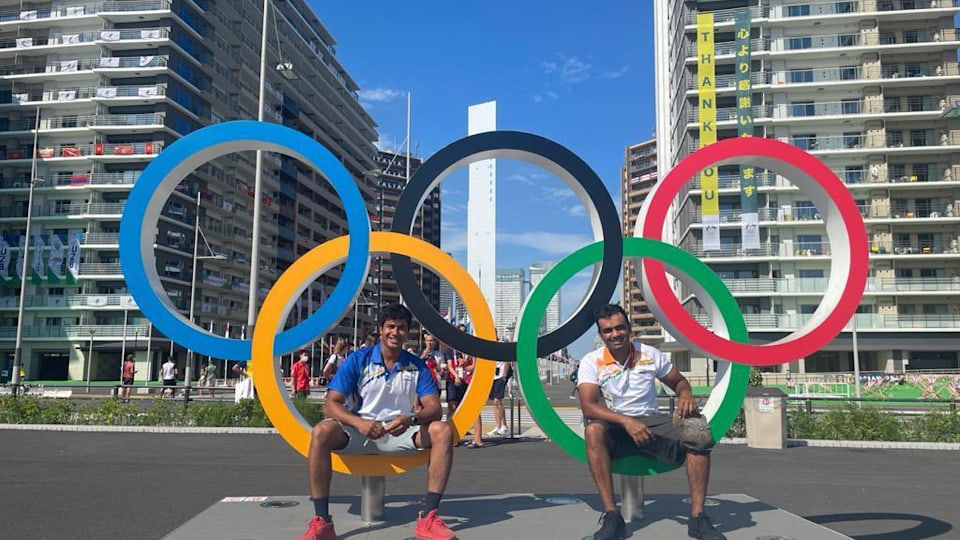
KC Ganapathy will pair up with Varun Thakkar to represent India in the men’s 49er event at Tokyo 2020.
Indian sailing star KC Ganapathy not only made his country proud but also put his community — Kodava — on the sailing map of the world by making a cut in the 49er event (with crew member Varun Thakkar) for Tokyo 2020 at the Mussanah Open Championship earlier this year.
For the uninitiated, the Kodavas are a tribe from the Kodagu region of Karnataka in India, who speak the Kodava language. And the 26-year-old will be the first from his community to represent India at the Olympics.
His journey to the pinnacle of the sporting event has been challenging as after losing his father, Deepak Chengappa, it was his mother Reshma Chengappa, who ran the furniture business for his family in Chennai.
However, his achievement is also fulfilling for his grandmother Padma Prathap, a resident of Kolthodu village near Hatur in South Kodagu, as she has seen Ganapathy overcome all the odds.
“He won the Under-12 National Championship and has come a long way. I pray for his success every moment,” she told the starofmysore.com.
Incidentally, his journey is also inspiring for his Indian sailing contingent teammates, who have seen his never-say-die spirit at close quarters.
It happened so in 2020, that after being reduced to visual training for a major part of 2020 in Chennai, Ganapathy and his crew member Thakkar decided to train in South India in Rameswaram. However, the plan turned out into a disaster, as a bike accident almost reduced his chances of competing any further.
Ganapathy suffered a hairline fracture on the foot along with a soft tissue damage. But he was able to pull off the recovery in no-time, thanks to the doctors and training process he was asked to follow. His teammate Vishnu Sarvanan, a laser radial class sailor, has had a lot of respect for him ever since.
“When I got into sailing for the first time, I kind of looked up to him,” Vishnu told the New Indian Express.
Moreover, Ganapathy also worked on putting up weight to balance his boat (along with his partner), which needs a minimum of 160 kilograms on board. And from quitting school to pursue sailing on a full-time basis, Ganapathy has come a long way in pursuit of making his dreams count
When will KC Ganapathy’s campaign at Tokyo 2020 begin?
Varun Thakkar and KC Ganapathy will begin their campaign at Tokyo 2020 on July 27, Tuesday, in the men’s 49er Race 1.
source: http://www.olympics.com / Olympics.com / by Samrat Chakraborty / July 26th, 2023
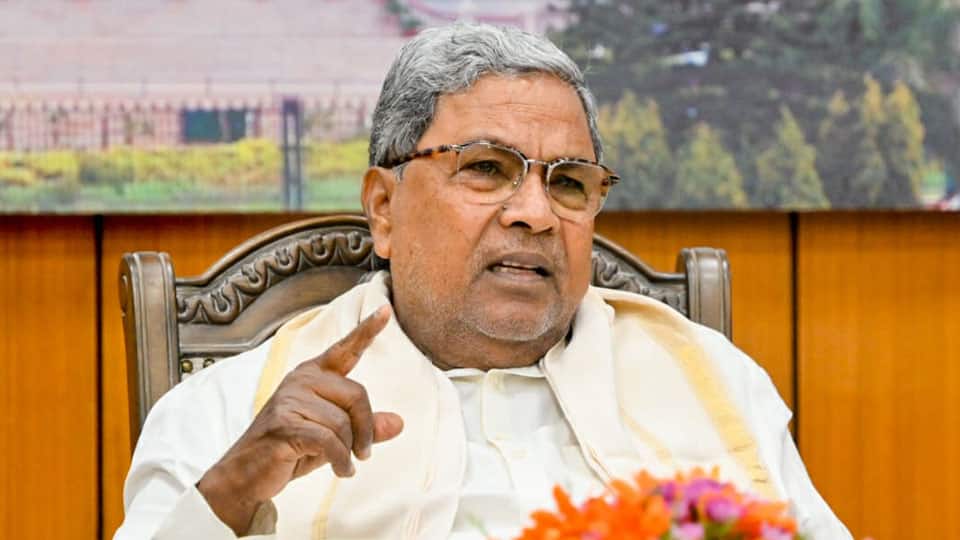
Fulfilling a long-pending demand of Kodavas, the Karnataka Cabinet, which met here on Thursday, agreed to mention as ‘Kodava/Kodavaru’ in the Caste Certificate, instead of ‘Kodagaru,’ who are currently listed in the 3a Category.
Announcing this after the Cabinet meeting here yesterday, Law and Parliamentary Affairs Minister H.K. Patil said the State Government has accepted the recommendations made by the Karnataka Backward Classes Commission to use the words ‘Kodava’, ‘Kodavaru’, instead of ‘Kodagaru’ in the list of Backward Classes and issue a notification in this regard.
The Commission, after a thorough study, in 2005 and 2010, had recommended the Government to use ‘Kodava’ and ‘Kodavaru’ in Kannada and ‘Codava’, ‘Codavaru’ in English, instead of ‘Kodagaru’ in the 3a Category list.
The Karnataka High Court, on Dec.16, 2021, had directed the Government to use the name ‘Kodava’, Kodavaru’ as suggested by the Backward Classes Commission. Justice Krishna S. Dixit had passed the order while allowing a petition filed by Codava National Council (CNC).
The Court then had also cautioned the Government of imposing a heavy cost in the next level of legal battle if it does not comply with the order within an outer limit of three months.
CNC’s effort pays off
The Cabinet decision on Thursday is a victory of sorts for CNC and its President N.U. Nachappa, who had fought over the issue for over a decade.
With the change of Government in the State, Nachappa and other CNC members had met Chief Minister Siddharamaiah recently under the leadership of Virajpet MLA and Advocate A.S. Ponnanna and reiterated the demand for mentioning ‘Kodavaru’ in the Caste Certificate. Nachappa had argued that in the past, it was mentioned as ‘Kodagaru’ in the Caste Certificate, which had an impact on the cultural and social values of the Kodavas.
He further maintained that the CNC had appealed to the Karnataka Backward Classes Commission Secretary to bring in changes in the Caste Certificate issued under Category 3a.
Now, CM Siddharamaiah, responding to the plea, brought the issue before the Cabinet yesterday, which approved using the term ‘Kodava’, ‘Kodavaru’ in the Caste Certificate instead of ‘Kodagaru.’
The Cabinet decision has also called the bluff of former BJP MLAs of Kodagu, who had turned away from their responsibility regarding the issue for years. When confronted over the issue, the former MLAs in the past had constantly argued that the matter does not come under the purview of the State Government and it is the Centre which has to do it.
source: http://www.starofmysore.com / Star of Mysore / Home> News> Top Stories / July 28th, 2023
Helps Forest Officers effectively plan operationsand drive pachyderms back into jungle.
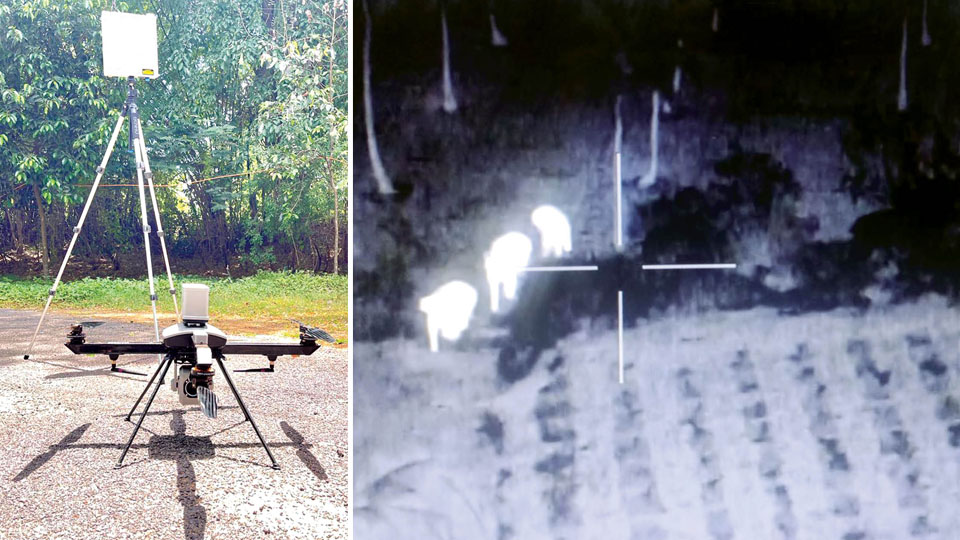
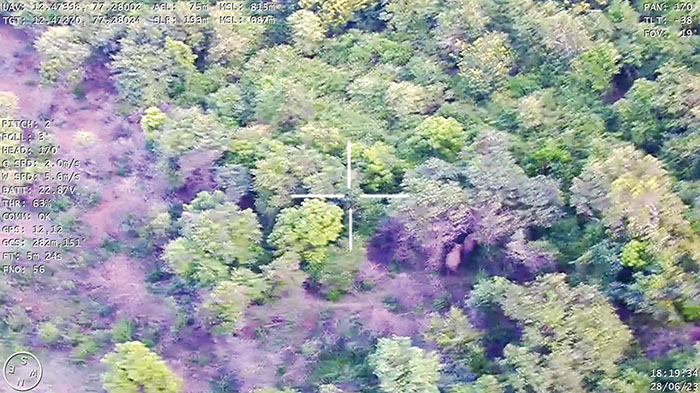
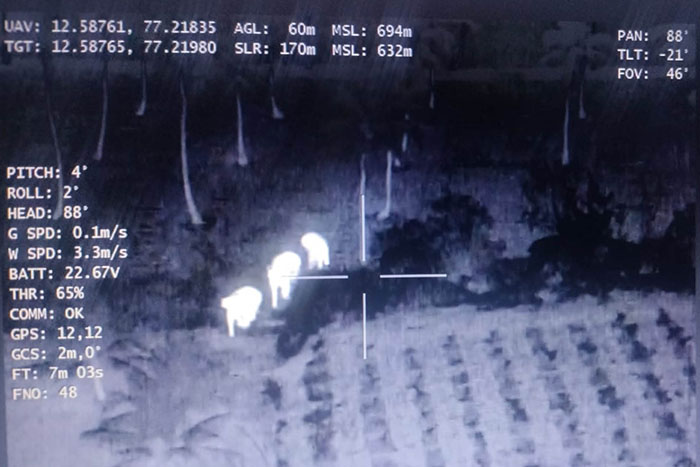
Amid the rise in the human-elephant conflict in some forested pockets of Kodagu along the Nagarahole Tiger Reserve, the Forest Department has deployed a hi-tech thermal drone to keep track of daytime and nocturnal movements of wild elephants inside forest ranges and human habitats.
The drone technology was first used in Nagarahole to control forest fires and now, there are three such drones there. However, a need was felt to acquire a thermal drone due to the increasing human-elephant conflict.
Sources said while managing the human-elephant conflict, the safety of elephants and also humans has been a major concern for the Forest Department and the wildlife activists as deaths of animals are being frequently reported from various parts of the district as they come into contact with live electricity wires.
Due to the need, one thermal drone was brought to Nagarahole in January this year at a cost of Rs. 25 lakh. Monitoring the movement of the elephants has always been a challenge for the Department amid several limitations.
“Now we have been using a thermal drone and it detects live objects through their body temperature and those get flashed on the computer screen. It gives us a proper count of a herd and the number of calves,” Nagarahole Tiger Reserve Director Harshakumar Chikkanaragund told Star of Mysore.
The drone can also be used to drive the elephant herd away from a potential danger area as its location can be pinpointed. The drones are not only helping the staff determine the herd composition and drive them in a desirable direction but also prevent casualties.
Heat signatures of living species
Unlike drones with normal cameras that rely on light signals to capture images, thermal drone cameras pick up heat signatures of living species in motion. This makes thermal drones ideal for deployment after sunset, complementing the use of normal drones during daylight hours.
“By accurately detecting herd movements, determining their composition and tracking elephant directions, objective decisions can be made for deploying elephant squads. Thermal drone cameras have become an invaluable asset for night-time operations. They enhance situational awareness, ensuring efficient management of wild elephant movements and mitigating potential conflicts,” Harshakumar added.
According to Deputy Range Forest Officer (DRFO) Yogeshwari Desai, who has been trained to use the thermal drone, the machine has a 2-km range and can fly 400 metres above the surface. It has a powerful thermal sensor and night vision ‘positive image’ technology cameras. It is convenient to use and the exact location can be ascertained. If one has to do physical combing even for a 2-km range, a lot of manpower and equipment is needed,” she explained.
Easy navigation inside woods
The camera on the drone operates based on the location information obtained via GPS, enabling easy navigation of the elephants’ whereabouts. Additionally, the drones produce minimal noise, allowing the staff to monitor animals such as elephants, tigers and other wildlife without causing any disturbance
During the night, the thermal drones conduct operations using radar, ensuring that local residents are not inconvenienced. Once the specific location of the elephants is identified, the information is sent to the Task Force and the teams proceed to drive the elephants back into the forest.
It also becomes easy to spot the origin of forest fire and extinguishers can be rushed to the place, she said. The drone has a backup of 40 minutes and after that, the battery must be charged. The drone has three batteries.
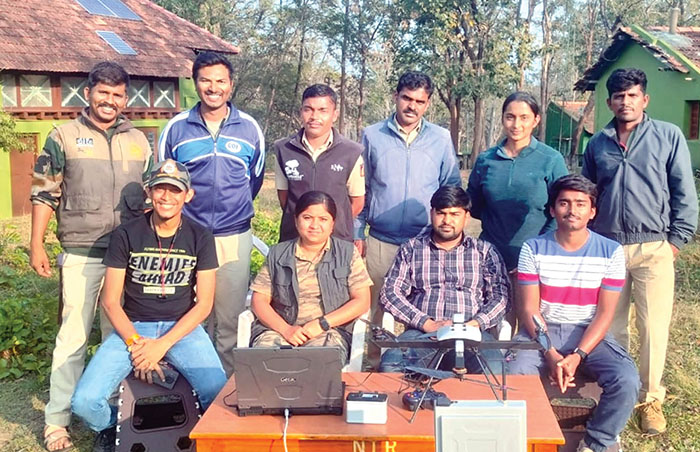
The team that has been trained to operate thermal drone at Nagarahole.
Trained team
Before the drone was deployed, a New Delhi-based team trained eight operators at Nagarahole. They are DRFO Jyothi Kumar and Forest Guard Sunil Nellebidu (Antharasanthe), DRFO B.B. Mahesh Kumar (D.B. Kuppe), DRFO Chethan Kumar Kolur (Nagarahole), DRFO Yogeshwari Desai (Anechowkur), DRFOs K.K. Arpitha and H.N. Madhuprasad (Hunsur) and Forest Guard Basavaraju (Veeranahosahalli).
The operators were trained for six days at Dammanakatte, Veeranahosahalli and Moorkal ranges that abut human habitats. The Nagarahole Director further said that they will seek aid from wildlife-related organisations, NGOs and firms to sponsor more such thermal drones for effective management of conflict zones.
source: http://www.starofmysore.com / Star of Mysore / Home> Feature Articles, Top Stories /July 18th, 2023
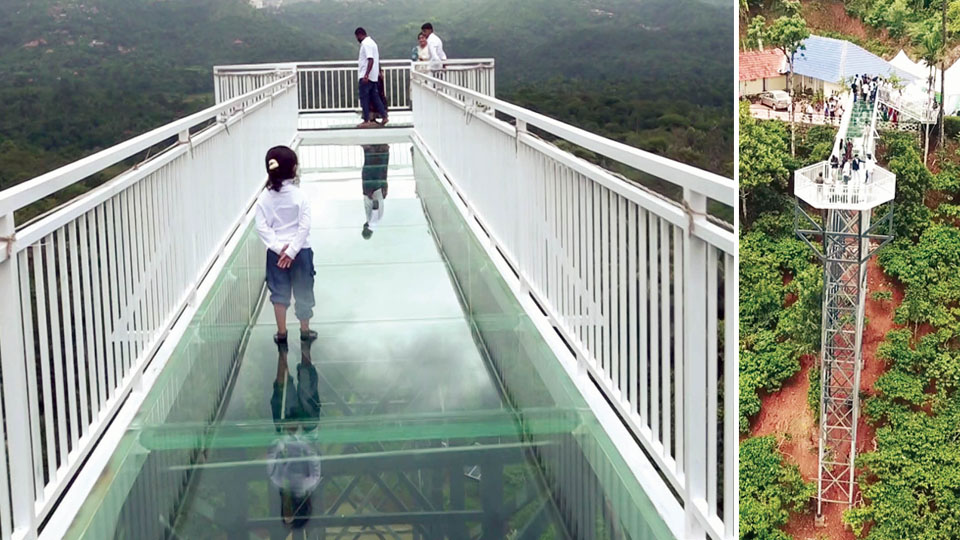
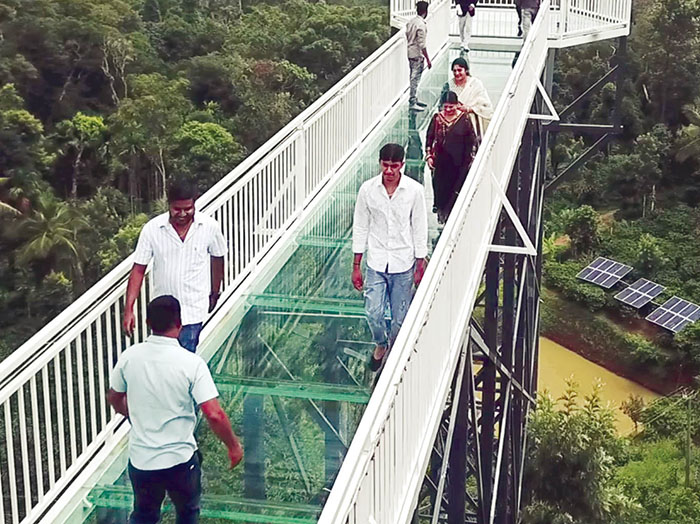
Among the multiple famed tourist attractions in the hill station of Kodagu — a captivating destination for travellers from far and wide throughout the year — is a new must-visit place, a brand-new glass skywalk bridge.
It is made of tempered glass panels or flooring that provide visitors with a thrilling experience of walking above ground level, often offering panoramic views of the surrounding landscape
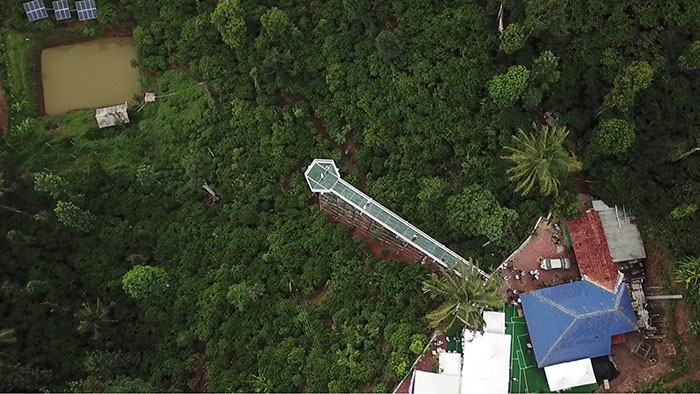
The glass skywalk bridge in the district is the second such attraction in South India, the first one being at Wayanad in Kerala at 900 Kandi Eco Park. This remarkable Glass Skywalk Bridge of Kodagu is nestled amidst the forests and hills of the Western Ghats, attracting tourists like a magnet.
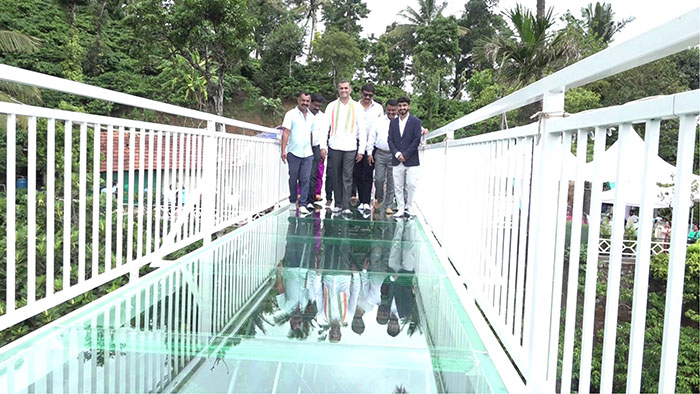
The bridge, standing approximately 78 feet tall, with a length of about 32 metres and a width of 2 metres, has been attracting tourists to the ‘Pappy’s Bridge of Coorg’ at Udoth Motte near Madikeri on the Madikeri-Bhagamandala Road. This bridge, with a capacity to support around 5 tonnes, can accommodate up to 40 to 50 individuals at once, providing them with an opportunity to immerse themselves in the beauty of nature.
Through its stunning natural beauty, the tourism sector in Kodagu has successfully garnered global attention and the newly added glass skywalk bridge further enhances this tourism initiative.
Situated amidst the lush green hills, the bridge offers a breathtaking view. Standing and gazing from the bridge not only evokes a sense of fear but also provides an exhilarating experience. The surrounding hills seem to reach out and beckon, their peaks adorned with greenery.
Looking down from the top feels as if the sky is within reach and stepping on the glass, while enjoying the beauty of nature, brings joy to the visitors. While the natural beauty of Kodagu with its umpteen viewpoints has enchanted the tourists, the bridge, amidst the greenery of the hills stands this remarkable creation, skilfully erected by engineers.
Walking on the transparent glass surface, amidst the verdant nature, offers a thrilling experience that takes it to the next level. The facility, allowing tourists to indulge in the beauty of nature, was recently inaugurated by Virajpet MLA A.S. Ponnanna who also walked along the bridge.
He appreciated the significant contribution of the local community to this tourism initiative and noted that the facility holds significance as a unique attraction in the region, surpassing even the famous glass bridge in Wayanad.
He said that the facility will contribute to the Kodagu district’s development as a nature-friendly tourist destination, without causing any harm to the environment. He also mentioned that the implementation of this unique project will lead to an increase in the number of tourists visiting the district.
Fake image
Yet again an image claiming that cracks had developed on the glass bridge went viral and the video generated panic among tourists. Later it was found to be stable and the photo was confirmed to be fake.
source: http://www.starofmysore.com / Star of Mysore / Home> Feature Articles, Top Stories / July 17th, 2023
WELCOME. If you like what you see "SUBSCRIBE via EMAIL" to receive FREE regular UPDATES.
Read More »