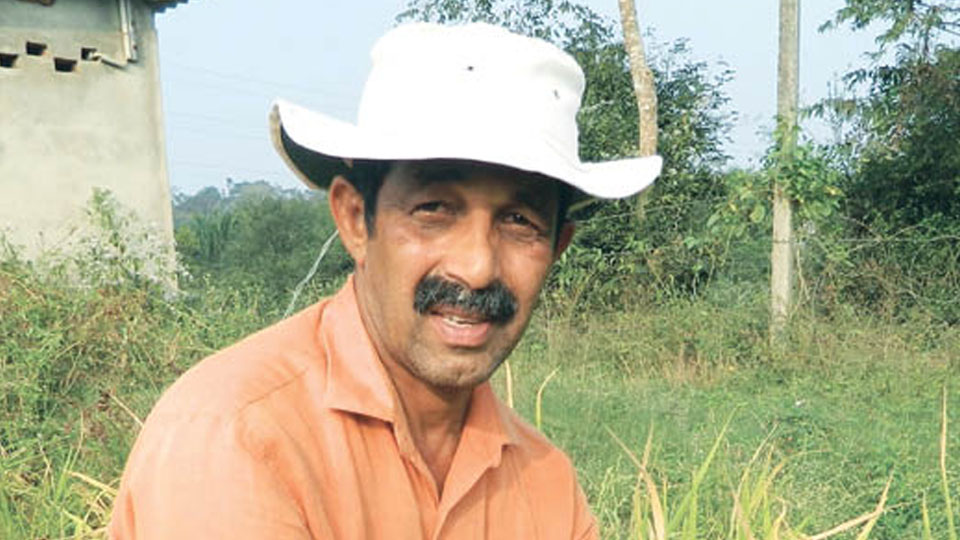
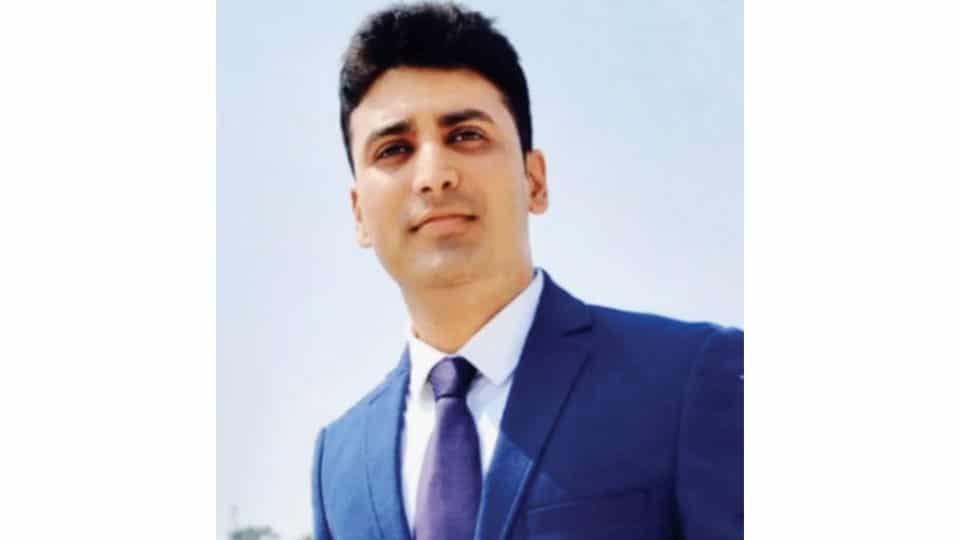
Progressive farmer and Rajyotsava awardee Somengada Ganesh Thimmaiah shares his thoughts
Madikeri:
Kodagu’s progressive farmer Somengada Ganesh Thimmaiah of Nallur village near Ponnampet in the southern part of the district has won the Rajyotsava Award for agriculture.
Though coffee and pepper are the prominent commercial crops in Kodagu, Ganesh Thimmaiah has been growing both agricultural and horticultural crops in integrated farming methods and has scripted success.
He is actively involved in innovative agricultural practices since the last 30 years and had earlier served the Indian Army. After retirement from services, he took up agriculture in his 15-acre land and has grown more than 60 varieties of paddy.
To gain additional income, he has a poultry farm and is also involved in apiculture and pisciculture. Apart from the regular crops of coffee, pepper, ginger, mango, orange and jackfruit, Thimmaiah has cultivated rambutan fruit.
In the integrated method in agriculture, he grows areca, coffee and paddy as main crops and a variety of vegetables and fruits and sub-crops. Thimmaiah has also been growing the ‘Beth’ plants required for honey bees and has implemented a mechanised system in agriculture.
At a time when more and more youths are showing interest in jobs and businesses, Ganesh Thimmaiah has earned name and fame as model farmer and has bagged many awards in the past. He won the National-level Babu Jagjivan Ram Krishi Samman Award. The Indian Council of Agricultural Research (ICAR), New Delhi, conferred the prestigious award on Thimmaiah on the occasion of its 92nd Foundation Day in 2020.
In April this year, he gave comprehensive training in agriculture to the batch of IAS officers at Lal Bahadur Shastri National Academy of Administration, Mussoorie.
“I am honoured to be conferred with the prestigious Rajyotsava Award and this gives me an opportunity to innovate further. I have been involved in agriculture for three decades and there is a need of attracting more and more youths to agriculture as it is profitable if innovative,” he said.
source: http://www.starofmysore.com / Star of Mysore / Home> News / October 31st, 2022
In 2018 Kodagu was struck by a rain disaster never heard of or seen before causing landslides, devastating floods and destroying houses and properties of the people, specially in North Kodagu area of Madikeri and Somwarpet Taluks.
Thousands of people were homeless and had to take shelter in schools and public buildings turned into Gruel Centres (Ganji Kendras), where free food was provided. It was a heart-rending sight of hapless, suffering people.
The Government and many NGOs and social organisations rushed to help the victims of the disaster. Among them was also the Bharatiya Vidya Bhavan (BVB), Madikeri Kendra. September 2018 was the month, BVB launched its Bhavan’s Project Coorg to contribute its mite to help the victims of the great natural disaster. This month BVB is completing four years of its service to a section of the victims which is being continued successfully even now and will continue.
For the Bhavan’s Project Coorg initiative, BVB chose one village known as Kalur village which was badly hit with landslides resulting in loss of houses and cultivated lands — coffee estates and paddy fields. It was the worst disaster in the history of Kodagu.
Naturally, several families were in deep shock and limbo as their source of livelihood was completely destroyed. The future looked bleak. How long could they continue in the rehabilitation (relief) camp?
At such a dismal situation, BVB extended its helping hand to the women of Kalur village by taking them under the protective wings of Bhavan’s Project Coorg. It was an initiative to provide both psychological and financial stability to them.
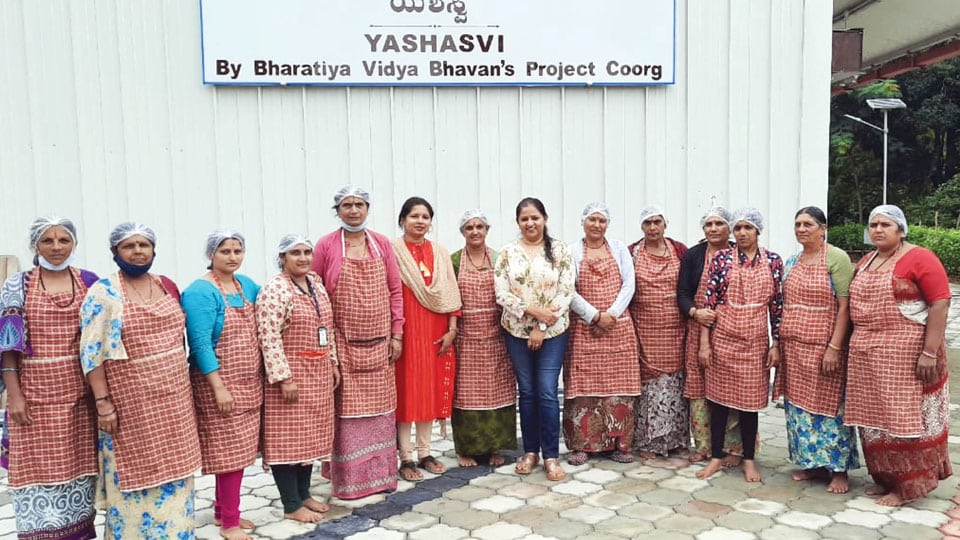
To begin with, BVB started skill development programmes by imparting training in food processing and tailoring to the agricultural women of Kalur village under a programme known as Yashasvi. BVB took 65 women of the village to train them in food processing and tailoring.
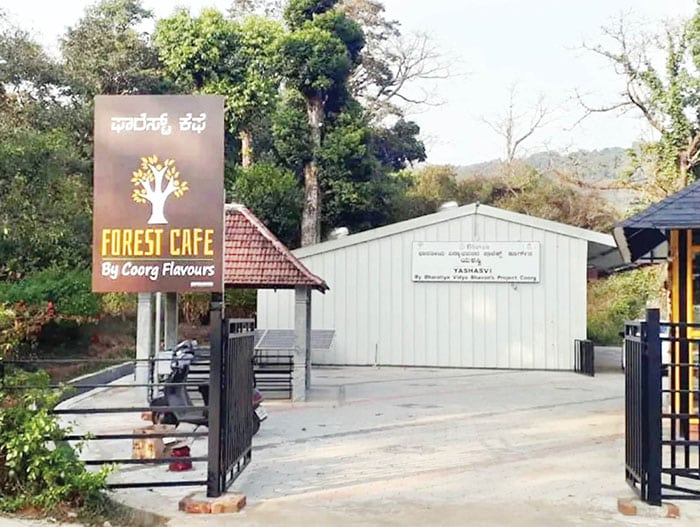
After training, they were provided work on a regular basis and they began to produce a line of packaged high quality masalas, apparently with a Coorg flavour, under the brand name, “Coorg Flavours.”
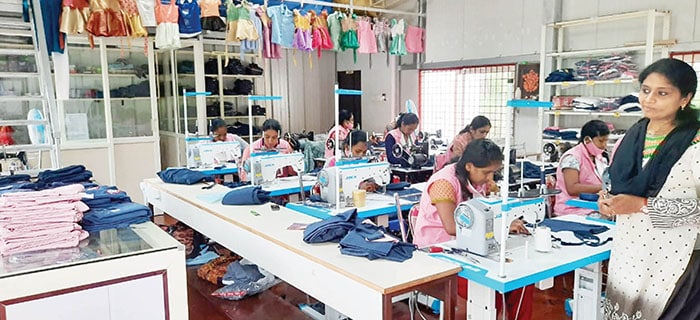
Simultaneously, Tailoring Unit was set up with sewing machines and required facilities, which now undertakes to produce school and NCC uniforms, uniforms required for Government Departments and private organisations. Every woman working here earns sufficient income because of BVB’s initiative.
Today, Food Processing Unit makes different products like home-made chocolates, masalas etc. BVB’s Project Coorg has two stores, which helps sustaining this project, at Madikeri, capital of Kodagu district. Thus BVB made self-reliance possible for hapless women.
Support from people is needed to make this initiative grow and sustain.
For more information, contact BVB Madikeri Hon. Secretary Balaji Kashyap on Mob: 98458-31683.
source: http://www.starofmysore.com / Star of Mysore / Home> News / By K.B. Ganapathy,Chairman, BVB Mysuru / September 15th, 2022
Traditional clothes, jewels and accessories set the Kodavas apart.
Madikeri :
Rituals and culture narrate the history and ancestral beliefs of a community. Traditional attire binds a community and signifies their identity, while also promoting its culture. One such is the Kodava community, nestled in the picturesque district of Kodagu, and boasts of a unique culture and even more unique attire.
Anyone who has attended a Kodava wedding will be familiar with the traditional dress worn by Kodava men. A half-sleeved knee-length black wraparound coat, a silk sash girding the waist and headgear make up the attire, known as ‘Kuppya Chele’.
“In the Kodava language, ‘Kuip’ translates to heat, and ‘ya’ means absent. In simple words, the attire that protects one from heat is the ‘Kuppya’,” analysed Bacharaniyanda Appanna, a Kodava historian. To hold the ‘Kuppya’ in place, a cloth belt called the ‘chele’ is used. The ‘Kuppya Chele’ is accessorised with traditional weapons.
Kodavas are a native Dravidian race that settled amid the thick forests of the ‘Malayadri Sahyadri’ range and speak the original Dravidian language of Kodava. Ancestors wore ‘Kuppya’ made of indigenous plant fibre called ‘Bolakka Balli’.
“When clothes started coming in from Kerala through the barter system, the ‘Kuppya’ or knee-length coat was stitched in white cloth. However, when the British came to Kodagu in 1834, the priests of the Church had issues with this attire. Since the white ‘kuppya’ resembled the habit of Christian priests, the British passed an order to change the colour of the Kodava attire,” explained Apanna.
It is said that the elders voiced their resentment against the British for meddling with their culture. However, a mutual understanding was arrived at. “During this rift, serge fabric came to India from England. Black serge was imported in large quantities, and became more convenient as it rarely appeared dirty. The ‘kuppya’ was soon stitched in black serge, but to ensure the survival of ancestral culture, white ‘kuppya’ is mandated on special occasions. The bridegroom, temple head or priest, village head or ‘thakka mukyasta’ are mandated to wear white ‘kuppya’. Even a dead body is dressed in white ‘kuppya’,” explained Appanna.
The ‘chele’ also witnessed a touch of modernisation, and the 25-ft long strong multipurpose cloth has been replaced with fancy brightly-coloured silk cloth. “During war times, the ‘chele’ was used to tie enemies and for other purposes,” said Appanna.
A married youngster wears the Kodava saree adorned with ‘pathak’
The comfort sari The women of the community also wear unique attire, and a mythological story is intertwined around it. The Kodava women wear a sari that is pleated at the back and the ‘pallu’ or loose end is wrapped around the front. “According to mythology, seer Agasthya and Cauvery had a rift, and Cauvery left Talacauvery discreetly. She showed up after ten days at Bhagamandala, and then left towards Balamuri, where villagers stopped her and requested her to stay. However, she flowed with great force, which caused the saris worn by the women to turn backwards. She was then calmed and promised to show herself every year during the Cauvery Sankramana celebrations,” narrated Appanna.
This sari also has scientific symbolism. Since Kodava women participated in agricultural activities, the back-pleat saris were more comfortable, and women could even climb trees easily. These saris hold great significance for the community and are paired with headgear called the ‘vasthra’. “Both Kodava men and women wear the head cloth. Our ancestors believed that the sun’s rays should never fall behind the neck and they covered it with ‘vasthra’. However, the headgear has been modernised to suit current trends and has intricate artwork, especially those worn by women,” he explained.
Traditional jewels The traditional knife called the ‘peecha katthi’, which was used in self-defence during ancestral times, forms part of the men’s attire and symbolises the tribal and warrior culture of the community. The ‘peecha kathi’ or dagger, and ‘odi kathi’ or traditional sword, are accessories for men, while a variety of traditional jewels add a touch of cultural flavour to the women’s saris.
“‘Peecha kathi’ was fixed to the attire using the ‘chele’. Earlier, these daggers had handles of wood. Now, they are carved in silver and gold and shine brightly on the traditional attire,” Appanna said.
The women have seven types of jewels. “At Talacauvery, the seven seers or ‘sapta rishis’ meditated. One could also find seven ponds at the centre, which are now covered. As a sign of blessings from the seers, the Kodava tradition mentions seven types of adornments from head to toe. However, only a few jewels have stood the test of time,” he explained.
Among the jewels, ‘Pathak’ holds great significance for married women. “When a girl goes to her husband’s house, her parents pack ten essential items – mostly traditional brass items – to be sent with her. These items are given to help her lead an independent life in her husband’s house, and must not be brought back to the girl’s house unless the couple is separated. To protect these items, a jewel consisting of ‘Naga’ (snake) god’s incarnation is tied by the mother of the bride during the wedding ceremony, called the ‘Pathak’,” explained Appanna. This jewel holds symbolic significance and is similar to a ‘mangal sutra’, while other traditional jewels include the ‘joe maale’ and ‘kokke thaati’.
Primarily nature worshippers, the culture, traditions and rituals of Kodavas are unique and tribal in nature. While the size of the community has shrunk in the past, steps are now in place to revive the community’s rich culture.
source: http://www.newindianexpress.com / The New Indian Express / Home> States> Karnataka / by Prajna GR, Express News Service / October 30th, 2022
An advocate by profession, he guides candidates appearing for competitive exams
Mysore/Mysuru:
Mundanda Rajesh Ponnappa has cleared IAS by securing 222nd rank in UPSC exams, the results of which were announced on May 30.
Rajesh Ponnappa is the son of Jaya Poovaiah and Sudha (Thamane – Sadera). Hailing from Nelaji in Kodagu, they are now settled in Bengaluru. Sudha is an advocate while Poovaiah is a coffee planter. His younger sister Dhanyata is a journalist.
Ponnappa did his Schooling and Pre-University course at Army Public School, Bengaluru. He then completed B.E. in Mechanical Engineering from Visvesvaraya Technological University topping the Varsity.
He joined Karnataka State Law University again to top the University. He continued studying by completing Post Graduate Diploma course at National Law School of India University in Bengaluru. Presently, he is an advocate by profession in Bengaluru.
Ponnappa appeared for UPSC exams under the guidance of Dr. Arjun Bopanna of Namma KPSC Academy / Bangalore IAS Academy to clear with 222nd rank. He has also competed in Equestrian Sports at National-level. Under the guidance of his mentor and aunt Periyanda late Baby, wife of Appaji, Ponnappa has written and published three books on law. He writes articles for newspapers on how to prepare for competitive exams and guides candidates aspiring to appear for competitive exams.
source: http://www.starofmysore.com / Star of Mysore / Home> News / June 01st, 2022
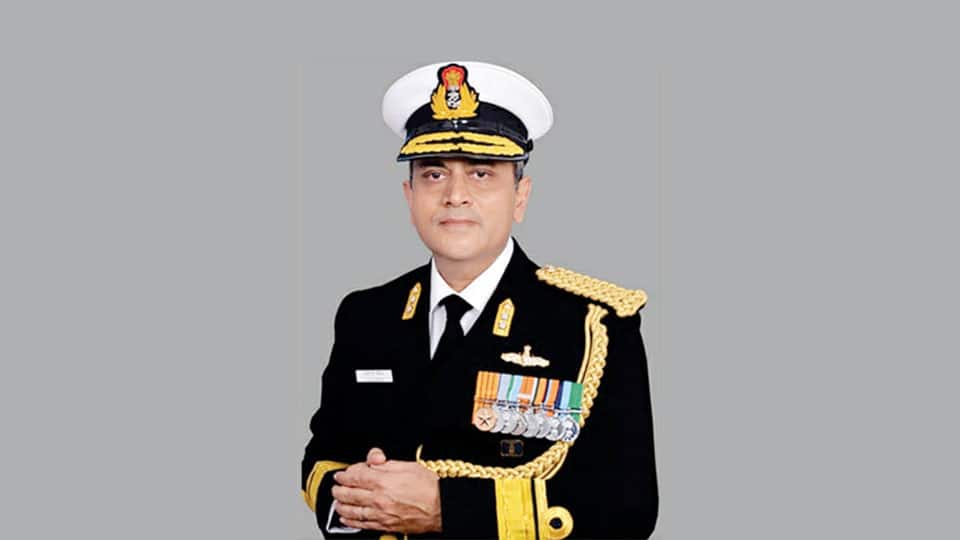
Rear Admiral Ichettira B. Uthaiah took over as the Admiral Superintendent, Naval Dockyard, Visakha-patnam from Rear Admiral N.M. Sreekumar Nair, on May 31 in Visakhapatnam.
Rear Admiral is a naval commissioned officer rank above that of a Commodore and Captain and below that of a Vice Admiral. On handing over the helm at Naval Dockyard, Visakhapatnam, Rear Admiral Sreekumar Nair would take over as Director General Naval Project at Visakhapatnam, on promotion as Vice-Admiral.
Uthaiah was commissioned into the Indian Navy in November 1987. He holds a B.Tech degree in Marine Engineering, an M.Tech degree in Mathematical Modelling and Computer Simulation and an M.Phil degree in Strategic Studies.
In his 33 years of service, the Rear Admiral has served the Indian Navy in various capacities, with appointments at the Warship Design Directorate, Training Academies, Naval Dockyard and at the Command and Naval Headquarters.
His key staff appointments cover areas of Warship Design, Building and Acqui-sition; Warship Operation, Maintenance and Repair, Officer Training and Project Management of a mega Marine and Civil Infrastructure Project. His recent operational and staff appointments include General Manager (Refit) at Naval Dockyard, Visakhapatnam, and Principal Director (Ship Production).
On being elevated to the rank of Rear Admiral, the officer was appointed as Additional Director General (Technical) at Headquarters, Project Seabird. The mega project involves the creation of a futuristic Naval Base at Karwar, with four self-contained townships, a Naval Air station and a 400-bed tertiary care hospital.
An alumnus of the Naval War College, he was awarded the Vishist Seva Medal (VSM) for distinguished service at Naval Dockyard and was instrumental in concluding major warship construction contracts with Russian and Indian Shipyards as Principal Director.
The equivalent ranks of Rear Admiral in the Indian military are Major General (Army) and Air Vice Marshal (Air Force). Uthaiah is the son of Ichettira M. Belliappa (Bollu) and Lalitha (Cheppudira). Belliappa was serving as an officer at the Housing Board in Chennai. After retirement, he came to Kodagu and settled in Makkandur.
Uthaiah is married to Ramya, daughter of Maneyapanda Ravi. The couple has two children. While their daughter is pursuing her legal studies, their son is an architect. Uthaiah’s brother I.B. Viju Bopanna is working as a Global Drive Officer with Coca-Cola in the US.
source: http://www.starofmysore.com / Star of Mysore / Home> News / June 02nd, 2022
Vice Admiral adds new Navy attractions to Gen. K.S. Thimayya Museum at Madikeri
Modules of INS Shivalik, Sindhughosh Class submarine and AK230 Navy gun mount
Madikeri:
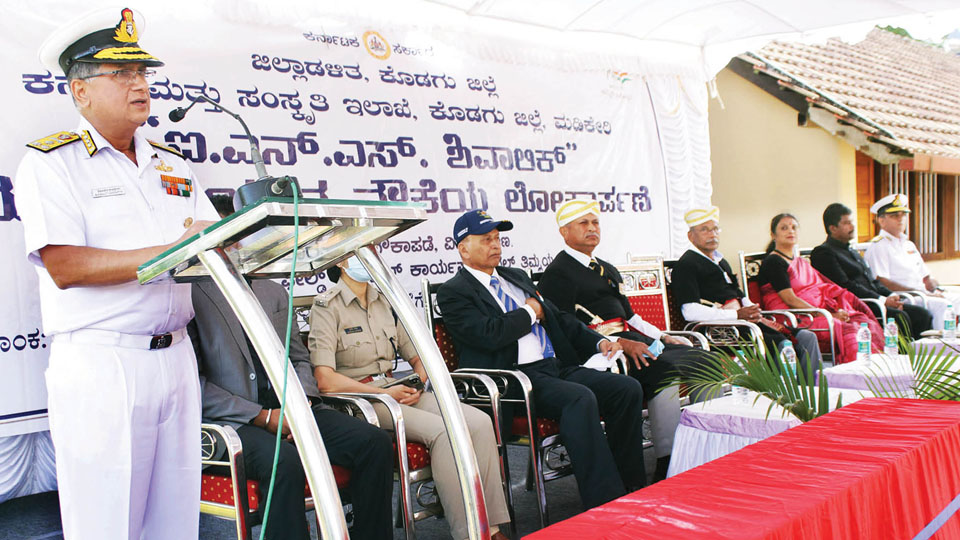
The INS Shivalik (F47) ship module was declared open for public viewing at ‘Sunny Side,’ General Kodandera S. Thimayya’s house in Madikeri that has been converted into a Museum and a War Memorial.
The 24-feet model, along with a Russian-made AK230 Navy gun mount (anti-aircraft gun) and a module of Sindhughosh Class submarine had arrived at the museum two weeks ago and they were dedicated by Vice Admiral Biswajit Dasgupta, Flag Officer Commanding-in-Chief, Eastern Naval Command yesterday. He was accompanied by his wife Roopa Dasgupta.
The modules were brought to Madikeri from Visakhapatnam Naval Base. INS Shivalik is designed to escape detection by normal radars and surveillance equipment and is one of the formidable stealth frigates in naval prowess. Apart from India, only the US, Russia, UK, France, Sweden, Japan, Italy and China have the capability to build stealth warships of this size and class.
Impressed by the museum and also the culture of Armed Forces in Kodagu, Vice Admiral Biswajit Dasgupta said that the district has emerged as an inspiration to thousands of youth to join the Defence Forces. He said that it was an honour for him to inaugurate critical exhibits at the museum.
On the INS Shivalik, he said that the frigate was built in India and is one among the many warships built by India. “Shivalik was built at Mazagaon Dock. India has four public sector Defence shipyards — Mazagaon Dock Shipbuilders Limited (Mumbai), Garden Reach Shipbuilders and Engineers Limited (Kolkata), Goa Shipyard Limited (Goa) and Hindustan Shipyard Limited (Visakhapatnam). The Cochin Shipyard is also capable of making warships and INS Virat was built there,” he said.
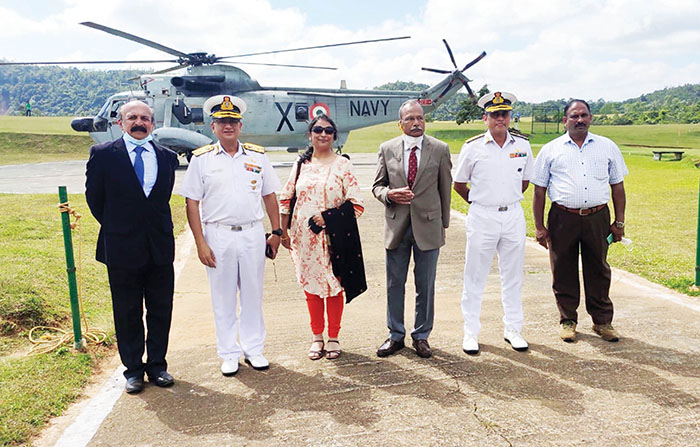
Field Marshal Cariappa and General Thimayya Forum Convener Major (Retd.) Biddanda Nanda Nanjappa (extreme left), Vice Admiral Biswajit Dasgupta, Flag Officer Commanding-in-Chief, Eastern Naval Command and his wife Roopa Dasgupta, Forum President retired Colonel Kandrathanda C. Subbaiah, Rear Admiral Iychettira B. Uthaiah and Madikeri Tahsildar Mahesh at the helipad in Madikeri when the guests arrived
‘Aatma Nirbhar’ Bharat
“The first indigenous warship was built by the Indian Navy in the 1960s where the concept of ‘Aatma Nirbhar’ Bharat was diligently followed. In the future, the Navy has plans to build 41 warships in the Indian Shipyards and 39 will be fully indigenous. Moreover these are the most advanced machines that have a formidable fire power that can shatter any other powerful ships of any country,” he said.
Giving a patient ear to the office-bearers of the Field Marshal Cariappa and General Thimayya Forum that played a pivotal role in converting the rickety house of the celebrated General that once housed the RTO office into a swanky museum, Vice Admiral Biswajit Dasgupta said that the dedication of the Forum, the respect shown by the people of Kodagu to the Armed Forces and also the dedication towards preserving heritage were commendable and inspirational.
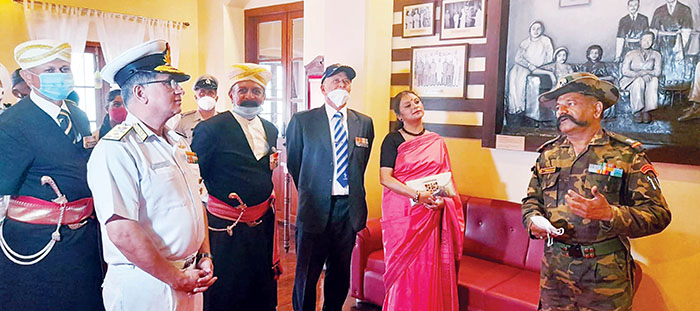
Picture shows the dignitaries inside the ‘Sunny Side’ Museum.
AK230 Navy gun mount
On the AK230 Navy gun mount, he said that it has been designed to engage air and surface targets, such as anti-ship missiles, aircraft, helicopters, other types of air strike weapons, as well as small-size surface ships. It can fire 2,000 bullets from its barrel in one minute. The Navy still uses such guns and also the advanced ones, he added.
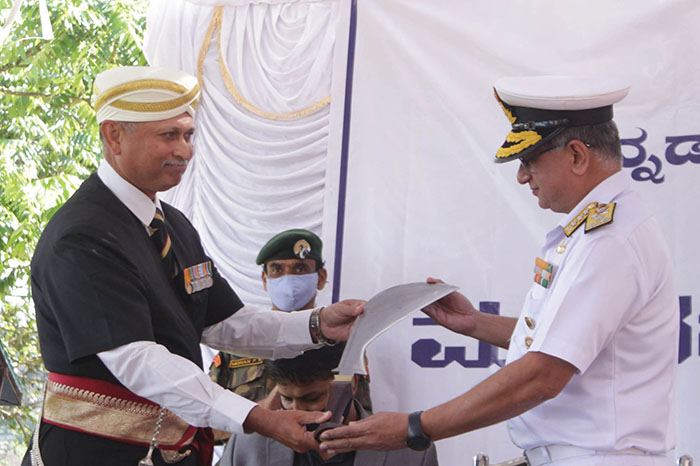
He appreciated Rear Admiral Iychettira B. Uthaiah for his efforts in bringing in the Navy equipment to the museum. The module of the Sindhughosh Class submarine was unfurled by Rear Admiral Uthaiah who handed it over to Major General (Retd.) Kuppanda Nanjappa of the Forum.
CDS late Gen. Bipin Rawat remembered
Forum President retired Colonel Kandrathanda C. Subbaiah narrated the story of establishing the museum and recalled the contribution of late Chief of Defence Staff Gen. Bipin Rawat, late Lieutenant General Biddanda C. Nanda and former Army Chief General Dalbir Singh Suhag. A minute’s silence was observed in honour of Bipin Rawat, his wife and other officers and soldiers who were killed in the recent chopper crash at Coonoor.
Kodagu Deputy Commissioner Dr. B.C. Satish presented a ‘thook bolcha’ (traditional Kodava lamp) to Vice Admiral Biswajit Dasgupta and his wife while Lieutenant General Pattacheruvanda Thimmaiah presented ‘Odikathi’ (traditional sword of Kodavas) to Vice Admiral Biswajit Dasgupta and also to Rear Admiral Uthaiah.
Before dedicating the Navy war machine modules, the dignitaries paid respects to the Amar Jawan War Memorial. They later went around the museum and were impressed by the collection
Forum Convener Major (Retd.) Biddanda Nanda Nanjappa, officer from Visakhapatnam Naval Base Nishanth B. Badoria, Kannada and Culture Department Director Darshana, SP Kshama Mishra, Sainik School Principal Col. G. Kannan, Vice-Principal Lt. Col. Seemanth Tripati, Squadron Leader R.K. Dey, students of the school and a large number of uniformed retired soldiers were present on the occasion.
source: http://www.starofmysore.com / Star of Mysore / Home> News / December 14th, 2021
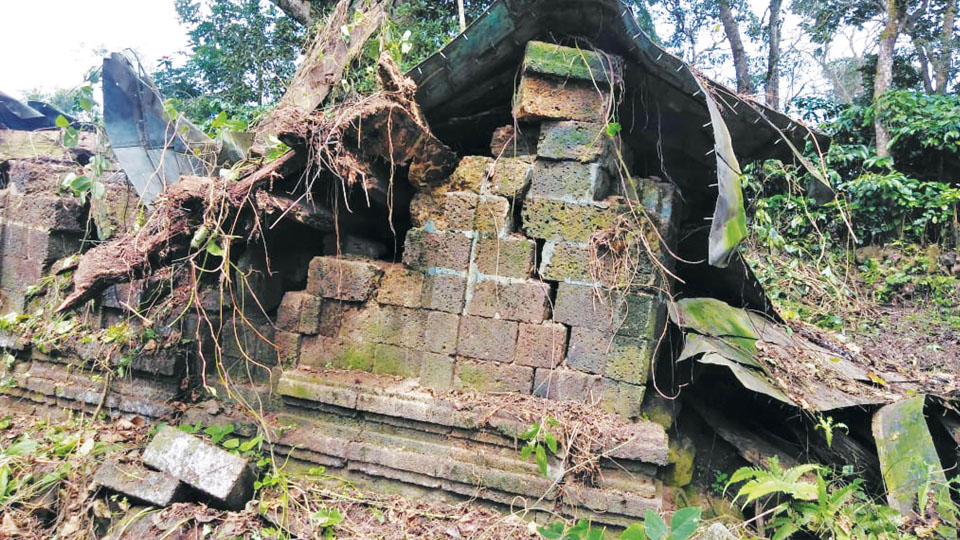
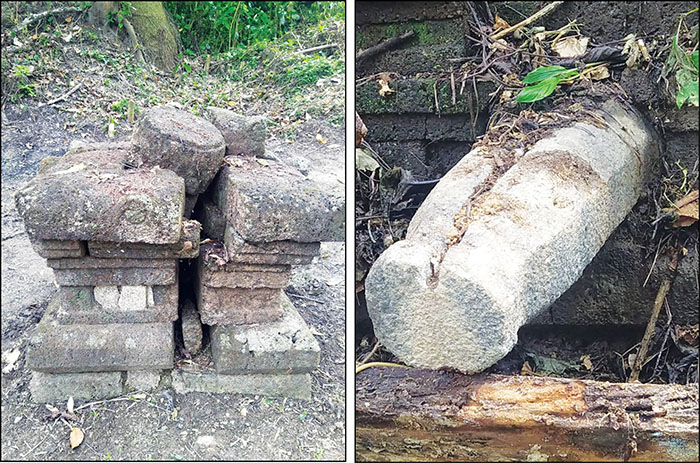
An ancient Shiva Temple, said to be about 700 years old, has been discovered at Bollumadu village in Virajpet taluk. The temple, found at a spot behind the Post Office on Kadanga Paraane is in a highly dilapidated state and is on the verge of total collapse.
The temple, said to be built using red stones, first came to be known to the villagers through Tantris in 2008. Subsequently, the villagers had cleaned up the spot by cutting down the trees around the temple. But as the temple was not accessible by road, no renovation works could be taken up and the temple remained in its dilapidated state.
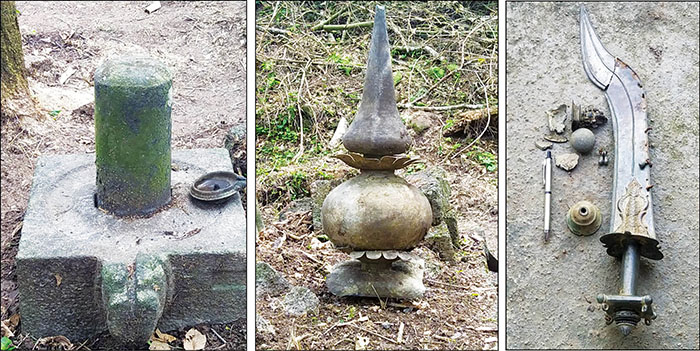
However, the temple exploration resumed two days ago with villagers again cleaning the vicinity by cutting down the bushes and other plants. During the exploration, a Shivalinga stone sculpture was found in the well of the temple premises. Also, the almighty’s Ayudha (weapon) ‘Kadtale’ and small Ganapathi idols have been discovered. This apart, the stone sculptured images of Tripata, Kumuda, Jagatti, Kanta, Pattika and Devakoshta Sopanas were found at the temple foundation. After the discovery of the ancient temple, Bollumada villagers contacted Nayakanda Prakash, who is staying at Mysuru, seeking his help for tracing the history of the ancient temple. Prakash is a former official of Archaeological Survey of India and had also served as a site supervisor at Ram Janmabhumi in Ayodhya, UP.
Prakash, who visited the spot, opined that the temple dedicated to Lord Shiva may be 600 to 700 years old and it may also be a contemporary of the times of the ancient Bhagamandala Temple.
Prakash, who collected some documents regarding the site, observed that an excavation was necessary to trace the complete history of the temple, according to Bollumadu Gram Panchayat President Matanda Arun.
Pointing out that the spot where the temple has been discovered is said to be a Pysari land, Matanda Arun said that a few families are residing in the vicinity of the newly discovered temple. Though the temple was discovered earlier, it could not be reached as there was no access and as such no one bothered to go there. Now a huge tree has fallen on the temple’s ‘Garbhagudi’ (Sanctum Sanctorum), destroying it.
Now, a villager has come forward to part with his land to make way for accessing the temple, Arun said adding that the Kodagu District Administration will be appealed to take up excavation of this centuries old temple.
source: http://www.starofmysore.com / Star of Mysore / Home> News / October 23rd, 2022
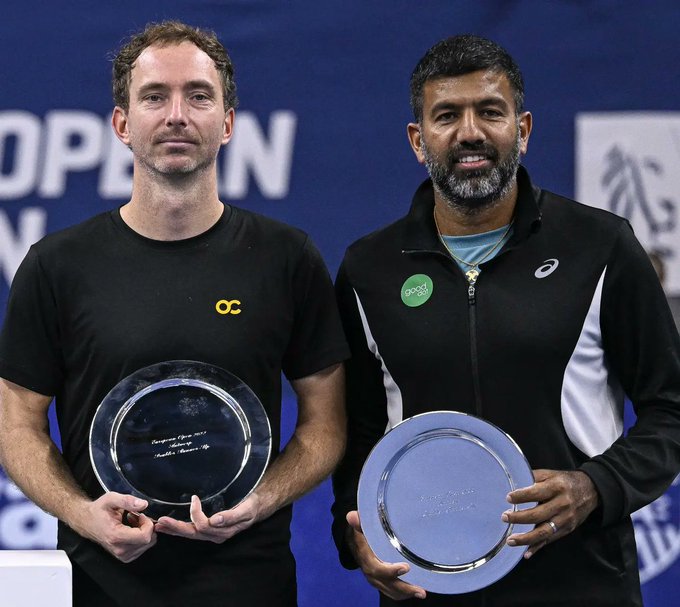
The second-seeded men’s doubles pair of Rohan Bopanna and Matwe Middelkoop finished as the runners-up at the European Open.
Rohan Bopanna(right) and Matwe Middelkoop / @Twitter
The second-seeded men’s doubles pair of Rohan Bopanna and Matwe Middelkoop, on Sunday, finished as the runners-up at the ATP 250 European Open. The Indo-Dutch pair went down 6-3, 3-6, 5-10 to the all Dutch pair of Tallon Grieskspoor and Botic van de Zandschulp in the a hard-fought final.
Bopanna and Middelkoop started well as they broke right in the second game of the first set. The Indo-Dutch pair then cruised to win the first set 6-3, but Grieskspoor and Zandschulp were too hot to handle for the remainder of the contests.
During the duration of the match, Bopanna and Middelkoop hit nine aces and converted 3 out of their 4 break points. They had earlier reached the final with a hard fought 7-6 (8-6), 2-6, 10-7 win over Sander Arends and David Pel in the semifinal.
Rohan Bopanna and Matwe Middelkoop had combined to lift the men’s doubles title at Tel Aviv Open earlier this month.
source: http://www.thebridge.in / The Bridge / Home> Tennis / by The Bridge Desk / October 24th, 2022
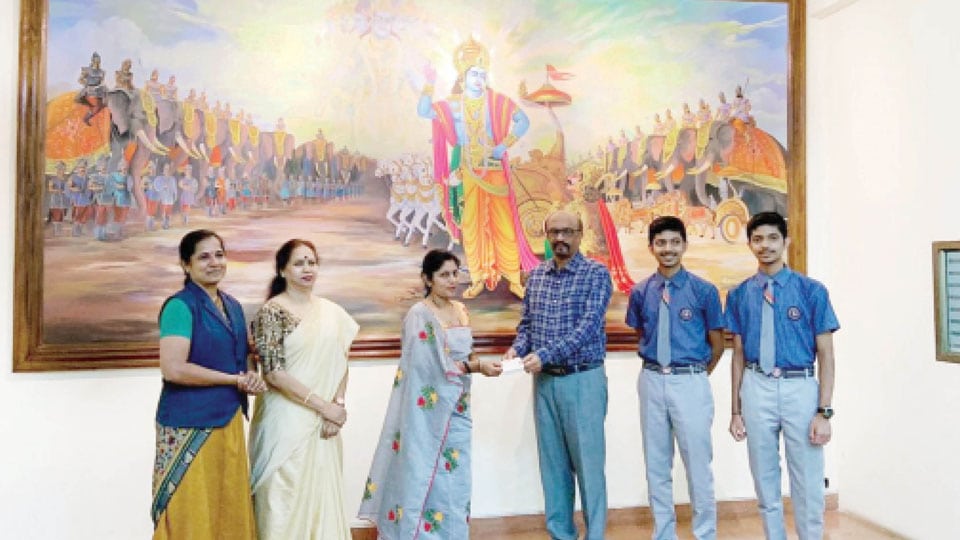
. Picture shows the students’ mother Jayanthi Poovaiah (daughter of Bottolanda Ponnanna of Hinkal, Mysuru) receiving the cheque from BVB Hon. Secretary P.S. Ganapathy as BVB School Principal Vijaya Narasimham and Class teacher Shashikala look on
Twin brothers K.P. Subbaiah and K.P. Somaiah of Bharatiya Vidya Bhavan (BVB) School in Vijayanagar, Mysuru, who have secured 624/625 and 615/625 marks respectively in the recently held SSLC examinations, were given Rs. 50,000 by the BVB Mysore Kendra to help them pursue further education.
Picture shows the students’ mother Jayanthi Poovaiah (daughter of Bottolanda Ponnanna of Hinkal, Mysuru) receiving the cheque from BVB Hon. Secretary P.S. Ganapathy as BVB School Principal Vijaya Narasimham and Class teacher Shashikala look on.
BVB School has been achieving 100% results in SSLC every year and this year also, out of 148 students, 120 cleared the exam in distinction and 28 in first class.
source: http://www.starofmysore.com / Star of Mysore / Home> Photo News / June 01st, 2022
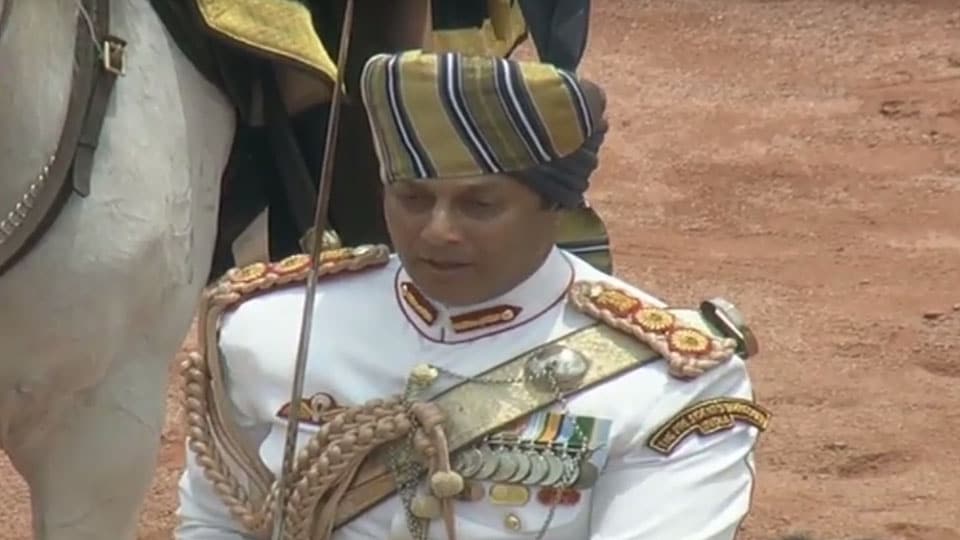
It was a proud moment for Colonel Bommanda Dhiraj Chengappa from Kodagu as he led a contingent of 46 horse-mounted Bodyguards and presented the National Salute to President Ram Nath Kovind.
The President’s Bodyguards also escorted Kovind to the Parliament House for the swearing-in.
Later, both President Kovind and ex-President Pranab Mukherjee were given an Inter Services Guard of Honour separately.
On conclusion of the Guard of Honour, The President’s Bodyguards escorted Mukherjee from the forecourt to the Iron Gate of the Rastrapathi Bhavan.
source: http://www.starofmysore.com / Star of Mysore / Home> News / July 25th, 2017
WELCOME. If you like what you see "SUBSCRIBE via EMAIL" to receive FREE regular UPDATES.
Read More »