Category Archives: Amazing Feats

Obituary: Sanjay Ponnapa, pioneer of Wellington’s coffee culture


Sanjay Ponnapa at the opening of the first Fuel Espresso takeaway cart, on The Terrace, Wellington, in 1996.

Sanjay Ponnapa: businessman; b January 10, 1964; d November 26, 2021

Sanjay Ponnapa, who has died aged 56 in Hong Kong, was one of the founders of Wellington’s coffee industry, going on to build a highly successful coffee empire in Wellington and Asia.

He was born in Tamil Nadu, near to his family’s homeland of Kodagu. The Kodagu (formerly known as Coorg) is a small, sparsely populated region nestled in the rich coffee-growing hills of the Western Ghats​, about halfway down India’s western side.

His family were coffee farmers and soldiers; his uncles included Field Marshal Kodendera Madappa Cariappa, the first Indian commander-in-chief of the Indian Army, and General Kodendera Subayya Thimayya.
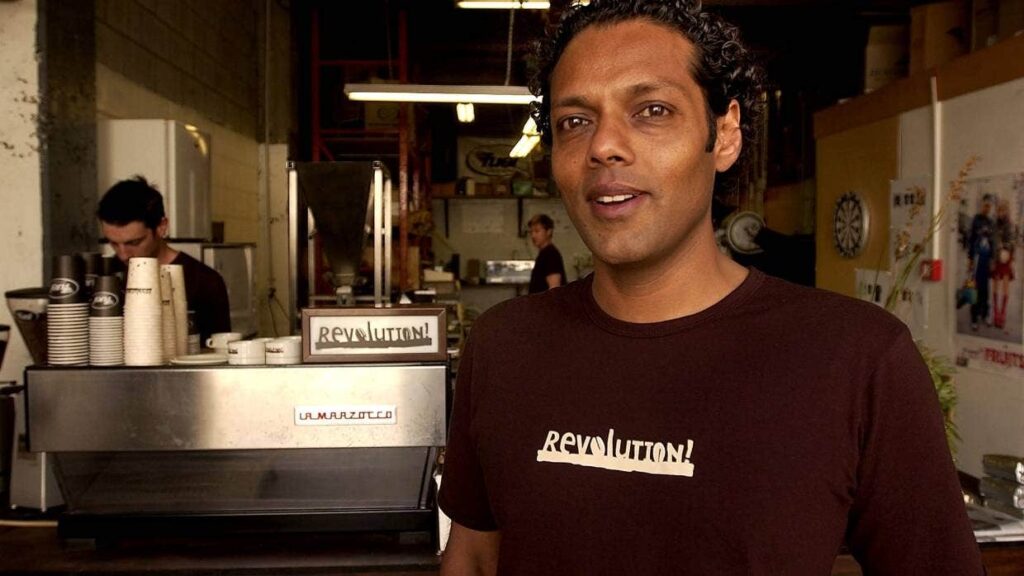
Sanjay Ponnapa in 2004, at the launch of Fuel Espresso’s Revolution brand. He roasted and created his own coffee blends, including specialty arabica beans from his family’s plantations in Coorg, western India.

Coming from India to the gastronomically bleak New Zealand of the 1960s must have been a shock, but Ponu’s brother sent over bags of Coorg coffee, which Leela would roast in the family kitchen.

Sanjay went to school at Viard College in Porirua and then St Patrick’s College (Silverstream). He grew up into a tall, strongly built, strikingly good-looking man, with a love of fine clothes, whiskey and late 50s jazz. He attended Victoria University and the University of Canterbury, but left without a degree.

He worked in the fashion industry, then travelled to New York, supporting himself by cocktail bartending. Those playboy years were not wasted, as seeds were being planted that were to bear fruit later; attention to detail, a love of quality and customer service. One seed in particular was to grow into a plant that would build an empire.

Around 1995 he returned to Wellington and took a job with a young business called Coffee Supreme. It was the first years of what was to become the city’s cafe boom. Supreme founder Chris Dillon remembers Ponnapa as “very entrepreneurial”.

“He was always picking your brains. We had a lot of conversations about what he wanted to do next, and the potential he could see for takeaway carts, like he had seen in the US.”
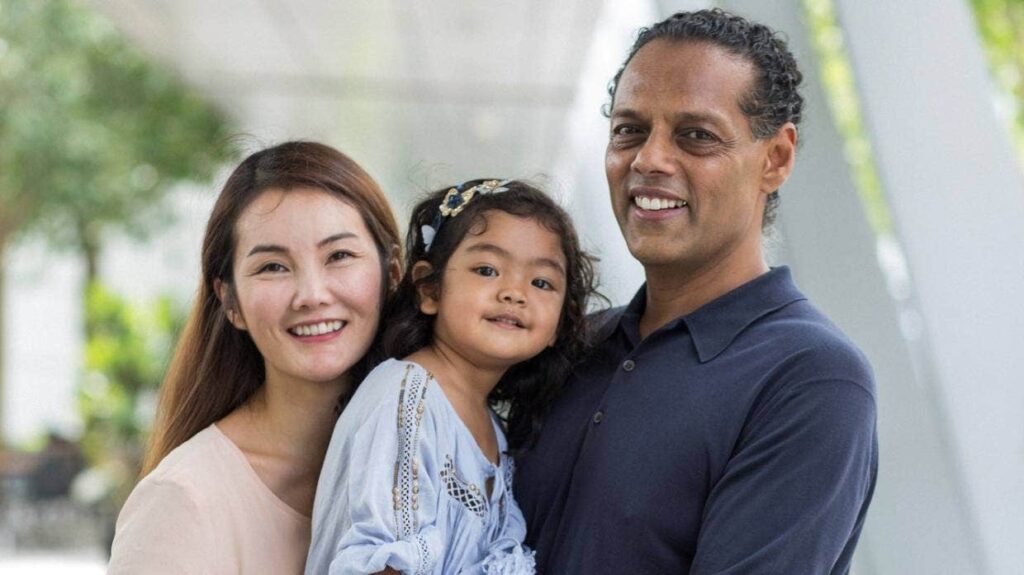
Yeonhee and Sanjay Ponnapa with daughter Leela in 2015. Fuel now has seven sites in Hong Kong and two in Shanghai, in addition to three in Wellington.

Ponnapa wanted to do something different. He still wasn’t sure how. Then, in 1996, things came together. He designed and built his first coffee cart.

Anyone who was in Wellington then will remember it: based on the 1950s design icon, the Airstream Caravan, in silver, black and red, with the sounds of Miles Davis and Sonny Rollins wafting through aromas of the finest arabica coffee served in branded cups. It was an instant hit with Wellingtonians. Fuel Espresso Ltd was born.

“He wanted to elevate takeaway,” says Dillon. “Many thought it was second-best. He wanted to show it could be beautiful. He paid a lot of attention to branding, to how staff deported themselves, to make sure it would be a very coherent presentation. I’m pretty sure staff didn’t get to play fast and loose with the music playlist.”

That year Ponnapa also met his first wife, Alexandra Tylee. They were married the same year. For the first five years, they worked side by side developing Fuel.

The first cart, on The Terrace, showed them that the concept worked; the next challenge was getting more sites. Ponnapa persuaded sceptical bureaucrats to allow coffee carts at the hospital and airport.

“It hadn’t been done. We had to convince them it was a good thing to do,” Tylee says. “Back then lots of people hadn’t had proper espresso coffee. He was really charming, determined and tenacious, and didn’t give up.”

Fuel soon expanded to seven carts and sites around Wellington. Unhappy with the wholesale imported beans most cafes used, they travelled to Trieste, Italy, and created their own blend with coffee maestro Vincenzo Sandalji. They then set up their own roastery in Holland St.

“We practised the roasting for about a year before he was happy with it. He wanted to get it right. He was a perfectionist,” says Tylee.

Ponnapa was very proud of his blend, a closely guarded mix of Italian and specialty arabica beans from his family plantations in Coorg. He believed passionately that good coffee, like good wine, needed close attention to blending and even ageing. He decided to age his coffee, contrary to what he called the “global industry’s obsession with the ‘fresh is best’ dogma”.

Tylee says his talent as a leader helped the business grow. “Everyone at Fuel was really like a family. He loved being able to integrate his passion for his music, and his family. He had a vision and saw it through.”

Unfortunately, family life was not so smooth. The couple’s son Zeus was born in late 1999. He died only a few months later, from Sudden Infant Death Syndrome, and his parents eventually parted ways.

By 2005, Fuel Espresso was well-established in the Wellington coffee scene, and Ponnapa was looking for the next step. He saw it in Hong Kong. He had a vision for a chain of high-end cafes nestled amongst the Guccis, the Versaces and other luxury shops of Hong Kong’s plazas.

Over the next decade he built it. Fuel now has seven sites in Hong Kong and two in Shanghai, in addition to three in Wellington. It has been stunningly successful; a tribute to the boy from Porirua who exported the taste and aroma of his secret blend to Asia.

Hong Kong became his home; he met his second wife, Yeonhee Kim, who worked in the financial sector. They married in 2012. Their daughter, Leela, was born the next year.

On Friday, November 26, Ponnapa mentioned to his wife that he was feeling unwell. He attended a staff dinner that evening, but left early. While entering an escalator, he is believed to have suffered a medical event that caused him to fall. He died at the scene.

Dillon says Ponnapa made a significant contribution to the development of Wellington’s cafe culture. “Fuel was the first high-end New Zealand takeaway coffee chain. He would say the only one. No-one had made good-quality takeaway coffee with that level of attention to detail and quality and presentation.”

Tylee says it’s hard to believe he’s gone. “He was so full of life, he had so many interests and so much he wanted to do.

“He was really warm, and a caring person.”

Chris Brown, of Sputnik PR, worked closely with Ponnapa to build his brand, but says his business achievements were ultimately not what gave him most satisfaction.

“He was very excited about celebrating their [his and Yeonhee’s] 10th anniversary. After all he’d been through, he thought his little family was his greatest success.”

Sources: Mythi Ponnapa, Chris Brown, Chris Dillon, Alexandra Tylee

source: http://www.stuff.co.nz / Stuff / Home> Life & Style> Food & Drink / by Patrick Piercy / December 11th, 2021
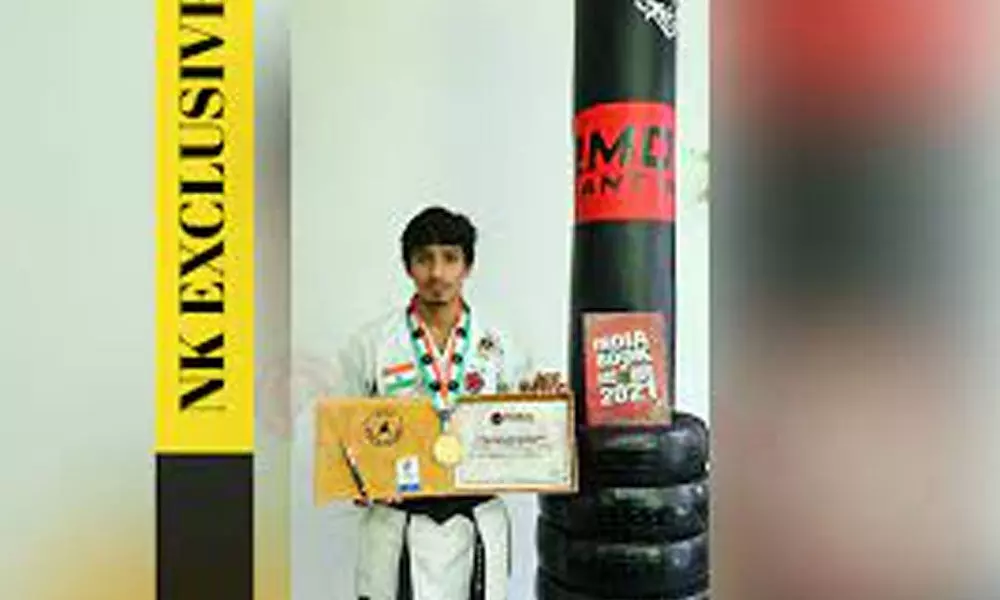
Kodagu martial artist finds place in India Book of Records

HIGHLIGHTS

A lad from Virajpet taluk succeeded in gaining entry into India Book of Records by performing tough karate feats.

Kodagu martial artist finds place in India Book of Records

Madikeri:

A lad from Virajpet taluk succeeded in gaining entry into India Book of Records by performing tough karate feats.

K Rahul, 20, delivered 262 punches and kicks in 60 seconds to gain entry into the history book.

Rahul, a student of Uechiryo Karate school in Virajpet, strove many years to gain entry into the record book. The India Book of Records has issued an identity card, certificate and medal to Rahul.

Rahul was trained by karate expert H R Shivappa.

He also won hundreds of medals in district and State level competitions. Last month he won a gold medal in international online karate championship competition organised by World Union of Martial Arts Federation, World Karate Alliance in September 2021.

Rahul now aims to gain entry into Asia Book of Records.

He said karate is not merely a martial art for self defense, but offers a lot to sportspersons to achieve.

Kodagu, the smallest district in the State, has contributed hundreds of sports talents to the country. Many talented sportspersons have proved their mettle in international and national level sports competitions.

source: http://www.thehansindia.com / The Hans India / Home> News> State> Karnataka / by Hans News Service / December 06th, 2021

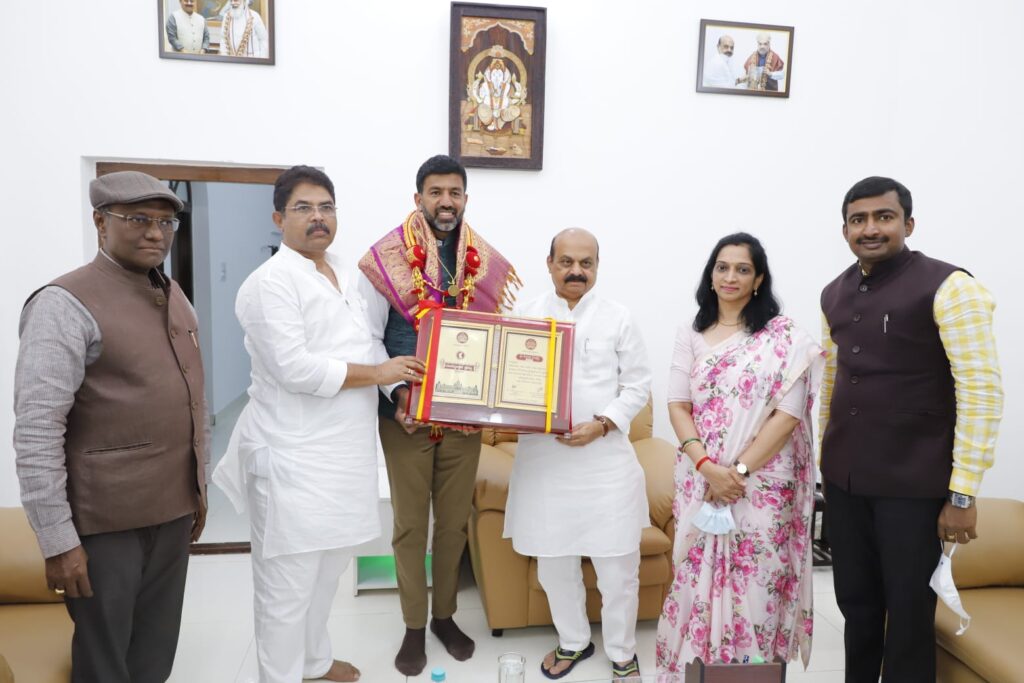
Rohan Bopanna honoured with Rajyaotsava award by Karnataka government

The Indian tennis star Rohan Bopanna was honoured with the Rajyaotsava award by the Karnataka state government on Tuesday.

Rohan Bopanna being conferred with the Rajyaotsava award (Source: rohanbopanna/Twitter)

The Indian tennis star Rohan Bopanna was honoured with the Rajyaotsava award by the Karnataka state government on Tuesday. The 41-year-old took to his Twitter account to express his gratitude for the same.

“It’s an honour to receive the Rajyaotsava award, one of the highest civilian awards and for the state to recognise my achievements and contributions to Indian tennis,” Bopanna tweeted.

The Rajyotsava award is the second-highest civilian honour conferred by the Karnataka state government annually. It is awarded across 24 categories and includes a gold medal and cash prize worth INR. 1 lakh.

source: http://www.thebridge.in / The Bridge / Home> Tennis / by The Bridge Desk / December 01st, 2021

NCC Fetes Two Next Of Kins Of 1971 War Martyrs

‘Vijay Shrankla Aur Sankritiyon Ka Maha Sangram’ celebrated

Mysuru/Mysore: 

Marking 75 years of Independence as also 50 years of India’s victory over Pakistan in the 1971 war leading to the creation of Bangladesh, the National Cadet Corps (NCC) is celebrating the occasion as ‘Vijay Shrankla Aur Sankritiyon Ka Maha Sangram’ across the country from Nov. 28 to Dec. 19 this year.

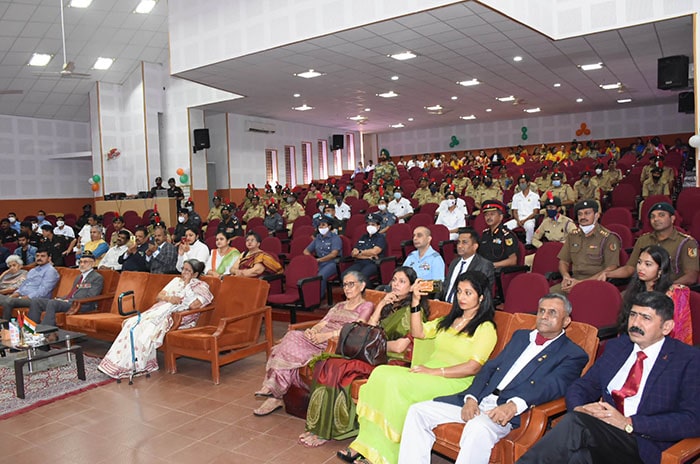
As part of the celebrations, the Mysuru NCC Group felicitated the Next of Kins (NoKs) of the two martyrs — Flying Officer K.P. Muralidharan of 20 Air Squadron and Risaldar B.M. Kaveriappa of the 66 Armoured Regiment — at a programme held at Cauvery auditorium in Karnataka State Open University (KSOU) premises on Hunsur Road here this morning.

The NoKs who were felicitated are Lalita Krishna Kumar, sister of Flying Officer K.P. Muralidharan and B.M. Machaiah, son of Risaldar B.M. Kaveriappa.

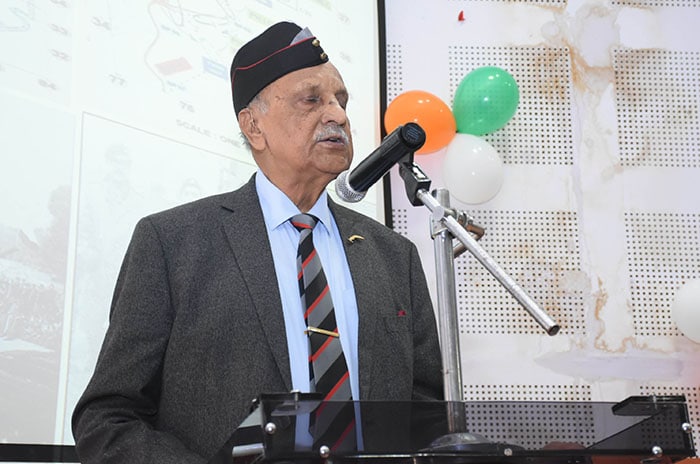
Maj. Gen. (Retd.) C.K. Karumbaya, SM, was the chief guest. Maj. Gen. (Retd.) S.G. Vombatkere, VSM was the guest of honour.

As part of the celebrations, 75 NoKs of martyrs of 1971 war will be felicitated at 75 locations across the country.

Defence Officers, Junior Commissioned Officers and Other Ranks posted locally at Mysuru including NCC Group Commander Col. R.R. Menon, NCC cadets and Associate NCC Officers, Air Veteran Mandetira N. Subramani, President, VeKare Ex-servicemen Trust, Mysuru were present on the occasion.

About Flying Officer K.P. Muralidharan: Flying Officer Kotteiezath Puthiyavettil Muralidharan hailed from Nilambur Kovilakom in Mallapuram district of Kerala. Born on Oct. 6, 1945, he was commissioned into the India Air Force on Oct. 29, 1966 at the age of 21. During the 1971 Indo-Pak War, Muralidharan was serving with 20 Sqn. known as ‘Lightnings’ and was based at Air Force Station in Pathankot. He took off in his Hunter (A-462) for a mission from Pathankot and was involved in a dog fight with enemy aircraft. He was last seen flying north of Peshawar in combat with a PAF Sabre and was shot down by the enemy Sabre. His aircraft crashed inside the enemy territory.

Risaldar B.M. Kaveriappa:

Born on Feb. 4, 1931 at Kadangamarur in Virajpet of Kodagu district, Kaveriappa joined the 66 Armoured Regiment in September 1969 and was appointed as a Troop Leader which he served till the last day of his life.

Kaveriappa was in command of 1 Troop Bravo Squadron. While moving to reinforce 3 Troop, his tank was hit by an enemy RCL Gun and he along with his crew were killed.  

source: http://www.starofmysore.com / Star of Mysore / Home> News / November 30th, 2021

Farmer From Kodagu Has Won An Award For Preserving Local Pepper Crop

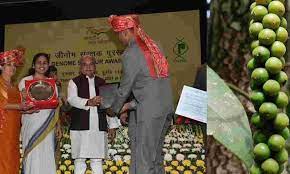
Left, N Poonacha receiving the award at the ceremony in New Delhi. Right, Snapshot of the indigenous ‘Adi Pepper’ spikes.

HIGHLIGHTS

  • Napanda Poonacha of Kodagu district, a progressive farmer, who hopes to be recognized as a pro-nature farmer
  • He was recently granted the Plant Genome Saviour Farmer Reward (2019-20) for his efforts to save indigenous ‘Adi Pepper’ crop

Napanda Poonacha of Kodagu district, a progressive farmer, who hopes to be recognized as a pro-nature farmer and has set examples for the other farmers to come forward to encourage them. He is working hard to establish commercial crops that have minimal or no negative impact on biodiversity, and he was recently granted the Plant Genome Saviour Farmer Reward (2019-20) for his efforts to save indigenous ‘Adi Pepper’ crops.

The Union Agriculture Ministry’s Protection of Plant Varieties and Farmers’ Rights Authority bestowed the honour on Poonacha, who received it from union agriculture minister Narendra Singh Tomar at an event in New Delhi on November 11.

He is the owner of Adi Pepper Demo Farm and Research Center in Garvale, where he is actively engaged in discovering natural crops in the district that have the capacity to become commercial crops while inflicting minimal environmental impact.

Napanda Poonacha expressed his happines for recieving the award. He said that farmers who recognise, conserve, and cultivate crops that are beneficial to biodiversity have been given this honour. Furthermore, He received the prize for his research, conservation, and promotion of the ‘Adi Pepper,’ an indigenous kind of pepper mainly grown across the natural habitat of Garvale village borders in Kodagu, India.

He further explained that Adi Pepper crops can be discovered all around the Garvale region in their natural habitat. They undertook the responsibility at the research centre to obtain this species of pepper registered under PPFRI, and in 2015, this high-quality pepper was recognised as a farmer’s variety pepper. This is the only pepper species that has passed biochemical testing, and it is regarded the best of the seven pepper species growing in Kodagu.

Since that particular form of pepper was once known as forest pepper and was mainly used for domestic reasons by the people, it has recently reached a brand value of Rs 3500 per kilo, generating more than six times the earnings of the other black pepper species sold in the district.

source: http://www.thehansindia.com / The Hans India / Home> News> State> Karnataka / by Susmita Modak / by Hans News Service / November 19th, 2021

CFTRI Scientist Develops New Beverage From Coffee Leaves

Mysore/Mysuru:

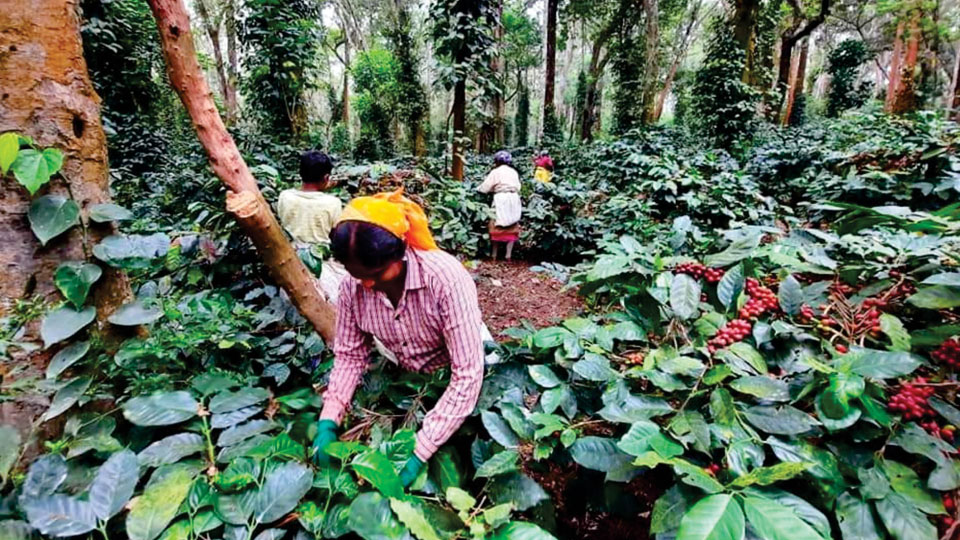
Here is a chance for coffee growers to get additional cash from their plants throughout the year apart from income from the sale of beans. Mysuru-based Central Food Technological Research Institute (CFTRI) has developed a technology to prepare a value-added product from coffee leaves that packs in health benefits too.

Coffee is only harvested for a few months every year, depending on the country’s harvest season. This can leave a number of producers and workers without work (and income) for a significant portion of the year.

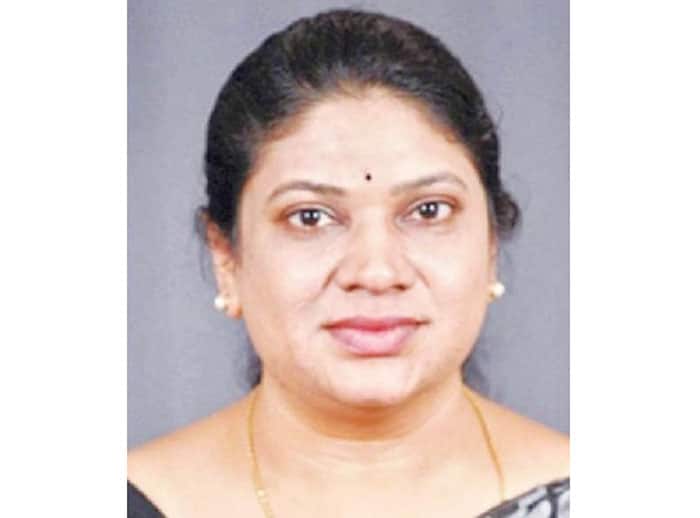
Pushpa S. Murthy

However, some producers have decided to diversify the crops that they grow and sell. As coffee leaves are constantly being produced, growers can harvest them in the off-season if there is demand, according to Pushpa S. Murthy, Principal Scientist (Spice and Flavour Science Department) of CFTRI.

This technology follows a CFTRI project on the development of value-added products from coffee leaves taken up in 2019. The project was funded by the Union Ministry of Food Processing Industries.

If farmers can use the leaves which can be harvested during the off-season or during pruning, without interfering with coffee bean growth, it will have a great impact on the social elevation of coffee farmers, she said.

Around 70 percent of the coffee industry is unemployed or underemployed during nine months of the year due to the nature of the growth cycle of the coffee beans. The project aimed to provide a year-round sustainable process for the coffee farmers.

With CFTRI technology, the brew can be prepared with water, allowed for a few minutes to steep, filtered and consumed. The institute has initiated the transfer of this technology to the coffee industry, and a few industry participants have already extended their consent, she said.

The leaf brew does not really taste like coffee, according to Murthy. “The brew is subtle with less caffeine compared to coffee or tea,” she said. On the nutritional value of the beverage, she said coffee leaves are rich in phenolic acids with potential health benefits. A coffee leaf contains around 17 percent more antioxidants than green tea. The beverage should be consumed plain.

The beverage accords health-promoting polyphenols like chlorogenic acid and mangiferin which help in reducing blood glucose levels, inflammation and blood pressure, she said.

 Leaf drink ‘kuti’ and ‘kahwa daun’ popular in Sumatra, Ethiopia

Coffee leaf tea has been consumed in Sumatra, Ethiopia, Jamaica, Java and Sudan for centuries. From the 16th century to the 19th century, Ethiopian farmers set aside their harvested coffee for trade or consumption in special ceremonies. As a day-to-day drink, the Harari people in Ethiopia instead enjoyed ‘kuti’.

‘Kuti’ tea was made by boiling coffee leaves in hot water, sometimes with a pinch of salt or some sugar. It was generally boiled for at least 30 minutes, as it was believed that the longer the leaves were boiled for, the sweeter the resulting brew would be.

Coffee leaf tea bears some similarities to green tea, but it is more earthy and sweeter. It is lower in caffeine than green tea, and thanks to its high levels of antioxidants, it has historically been believed that it cures or relieves cold symptoms.

In the 19th century, Dutch colonists transported coffee plants to designated farming regions in Indonesia. Workers on the coffee plantations were forbidden from consuming the coffee they harvested, so they drank something called “kahwa daun” instead.

‘Kahwa daun’ was made by drying coffee leaves in the sun to reduce their bitterness. The leaves were then smoked and roasted for a few hours. Finally, they would be steeped in boiling water, and then served in a coconut shell.

source: http://www.starofmysore.com / Star of Mysore / Home> Top Stories / November 14th, 2021

Website on preserving Kodava culture launched

A new website featuring the unique culture of Kodavas, documenting the customs and traditions of the community, has been launched. The website www.kodavas.in has been put together by journalist and author B.T. Bopanna.

“My main intention is to document the customs and traditions of Kodavas, a microscopic minority community, which is slowly losing its moorings in Kodagu. Most of the younger Kodavas, who have been brought up in cities like Bengaluru and Mysuru, are unaware of the essence of Kodava culture. I felt a website was the best medium to increase awareness of the culture and help preserve it”, Mr. Bopanna said in a statement.

Mr. Bopanna, who has also pieced together five websites including his first www.coorgtourism way back in 2005, said the new website will “come in handy for someone wanting to know about the rituals involved in ceremonies connected with birth, wedding, death etc”.

In order to ensure that the content in the website was authentic, Mr. Bopanna said he took the help of Boverianda Chinnappa and Nanjamma Chinnappa, who had researched and written about Kodava culture.

“Much of the content in the website has been taken from the book Pattole Palame, compiled in 1924 by Nadikerianda Chinnappa, where the Kodava language folksongs, proverbs and riddles are transcribed in Kannada script and Kodava customs and traditions are described in Kannada language. The Pattole Palame was translated into English by Boverianda Chinnappa and Nanjamma. I have also borrowed content from their book ‘Ainmanes of Kodagu’”, Mr. Bopanna said.

The topics covered in the website including the origin of Kodavas, their customs, related to birth, wedding, death and their festivals, the religion of Kodavas, Kodava language, Jamma land tenure, their passion for the game of hockey, guns in Kodava culture, their ‘ainmanes’ etc. Mr .Bopanna said the website also contains video clips related to some of the topics on Kodava culture.

The site has been designed by Bhakti Saraswat-Devaiah, he added in the statement.

source: http://www.thehindu.com / The Hindu / Home> News> States> Karnataka / by Special Correspondent / Mysuru – November 12th, 2021

President Presents Padma Awards – 2021: Sudharma Editor Jayalakshmi, Hockey Champ Dr. M.P. Ganesh And 117 Others Receive Highest Civilian Honours

New Delhi:

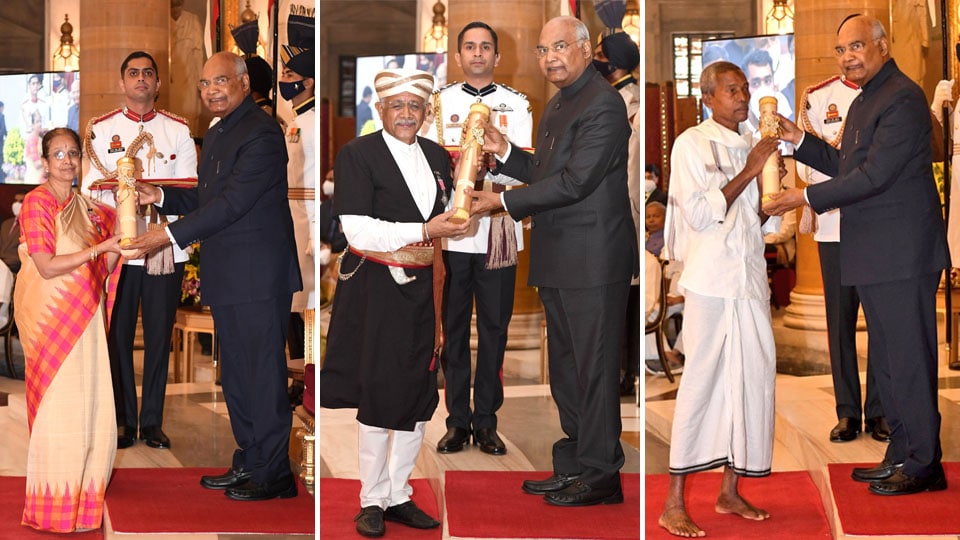
Vidushi K.S. Jayalakshmi, Editor of the world’s only Sanskrit daily newspaper published in Mysuru, Hockey player Dr. M.P. Ganesh of Kodagu and Harekala Hajabba, an orange vendor from Mangaluru who built a primary school with his earnings, were among 119 persons who received Padma Awards from President Ram Nath Kovind at Rashtrapati Bhavan yesterday.

Padma Awards are one of the highest civilian honours of India announced annually. The Awards are given in three categories: Padma Vibhushan (for exceptional and distinguished service), Padma Bhushan (distinguished service of higher order) and Padma Shri (distinguished service).

A total of 119 Padma Awards comprising 7 Padma Vibhushan, 10 Padma Bhushan and 102 Padma Shri Awards were presented. 29 of the awardees are women, 16 posthumous awardees and 1 transgender awardee.

Padma Vibhushan

Late playback singer S.P. Balasubramaniam (Posthumous) in the field of Art and Dr. Belle Monappa Hegde for Medicine, Former External Affairs Minister Sushma Swaraj (Posthumous) are among seven persons, who were presented with the Awards.

Padma Bhushan

Chandrashekhar Kambara for Literature and Education, Tarun Gogoi (Posthumous) for Public Affairs, Ram Vilas Paswan (Posthumous) for Public Affairs and Keshubhai Patel (Posthumous) for Public Affairs among 10 others.

Padma Shri

Vidushi K.S. Jayalakshmi for Literature and Education (Journalism), Hockey Olympian Dr. M.B. Ganesh for Sports, Matha B. Manjamma Jogati for Arts,  Harekala Hajabba for Education, Vijay Sankeshwar for Trade and Industry, Rangaswamy Lakshminarayana Kashyap for Literature and Education and actress Kangana Ranaut are among 119 persons who were conferred with the Award.

Awardees’ Profile

Vidushi K.S. Jayalakshmi, wife of late K.V. Sampath Kumar, took over as the Editor of ‘Sudharma,’ the world’s only Sanskrit daily newspaper published in Mysuru. The paper was started in 1070 by Varadaraja Iyengar and following his demise in 1990, the newspaper was taken over by his son K.V. Sampath Kumar and his (Sampath Kumar) wife Jayalakshmi. Jayalakshmi took over the reins after the demise of Sampath Kumar in June this year.

Mollera Poovaiah Ganesh, aged 73, a resident of Suntikoppa in Kodagu, was the captain of the Indian hockey team and won the Arjuna award in 1973.

Ganesh began his sports career with football and later switched over to hockey after he joined the Army. He represented the Services (defence services) in the National Hockey Championship from 1965 to 1973. He found a place in the Indian team in 1970. Ganesh played for India at 1972 Munich Olympics, finishing third. He was one of the coaches of the Indian team that won a gold medal at the 1980 Olympic Games in Moscow.

He twice represented India in Asian Games (Bangkok-1970 and Tehran-1974). Both the times India returned home with a Silver medal. He was in the Indian team that won Bronze at the first World Cup at Barcelona in 1971 and captained the team that won Silver at the next World Cup in Amsterdam. He also played for World XI in 1972 and Asian XI from 1970 to 1974. Ganesh last played for India in 1974 after his career was cut short by a knee injury. At present, he is serving as the CEO of SAI National Hockey Academy in New Delhi.

Harekala Hajabba, 66-year-old orange vendor, received this award for bringing a revolution in rural education by constructing a school in Harekala-Newpadpu village in Mangaluru. The school currently has 175 underprivileged students from the village. Hajabba, who sells oranges at Mangaluru bus depot since 1977, has never been to school.

source: http://www.starofmysore.com / Star of Mysore / Home> News> Top Stories / November 09th, 2021

Honesty Glitters More Than Gold: Petrol Pump Staff Finds Suitcase With Jewels

A petrol pump attendant returned a suitcase that contained gold jewels worth more than Rs. 5 lakh to Rs. 6 lakh (a conservative estimate) to the actual owners. The suitcase was left on the main road by two women who had alighted a bus from Bengaluru in Kushalnagar.

On the night of Thursday (Nov. 4) at 10, a bus stopped in front of the TATA Petrol Pump in Kushalnagar amidst rain. Two women got down from the bus with bags and a black suitcase. They were waiting on the road while a car stopped in front of them. In a tearing hurry to get inside the car to escape rain, the women forgot the suitcase on the road. The car left the place moments later.

As it was closing time, H.V. Somashekar came out of his petrol pump office to close the gates after a long day. The black suitcase lying on the road amidst a drizzle caught his eye. He looked around only to see the area deserted. He did not open the suitcase; instead stood near it and called the Kushalnagar Police Station.

Dy.SP Shailendra and Circle Inspector Mahesh asked ASI Manjunath and two others to go to the spot and retrieve the suitcase, taking all precautions. They did not have any idea of what the suitcase contained and brought the same to the Police Station.

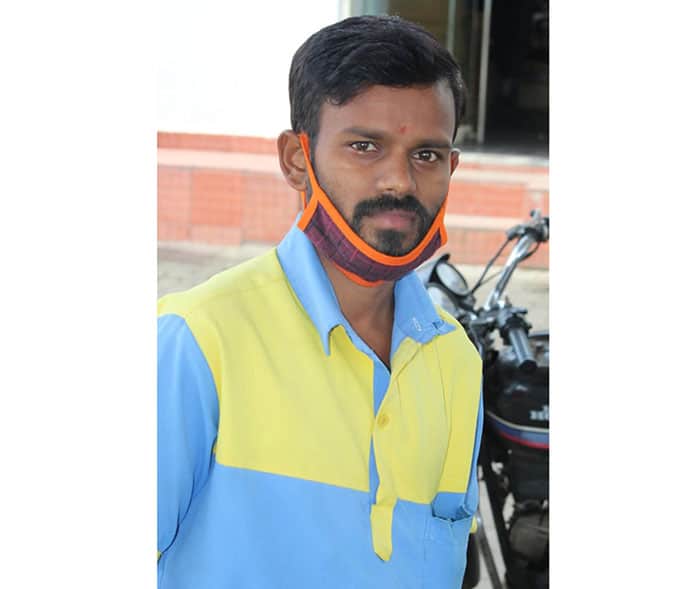
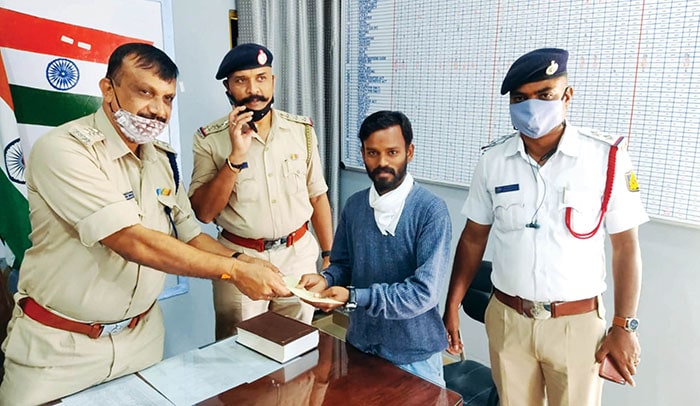
Petrol pump staff H V Somashekar

As they opened the box, they could not believe their eyes. It contained gold ornaments, all brand new. Not sure of the value of the gold, they also recovered cash worth Rs. 5,000 and two costly watches. There were some new clothes in it and the Police found a slip with a phone number.

When the Police called that number and told the woman on the other side who answered the call that they were calling from Kushalnagar Police Station, the woman immediately cut the call hearing the word ‘Police’ and switched off the mobile. The Police kept on trying but the mobile was not switched on.

However, at around midnight when the Police dialled the number, the same woman picked up the call. The Police told her about the suitcase found in front of the petrol pump. The woman till then had not realised that her black suitcase was missing and only after the call it dawned on her that she had forgotten the suitcase on the road that night. 

The woman, who identified herself as Nafisa from Bengaluru, had given her daughter in marriage to a family at Kumboor near Suntikoppa and the mother and daughter had come from Bengaluru to attend a relative’s wedding in Kushalnagar. Though they wanted to come to the Police Station at midnight, the Police refused as there were procedures to be completed. They were asked to come the next morning. Accordingly, they came to the Police Station, checked the box and found all the ornaments and other valuables intact.

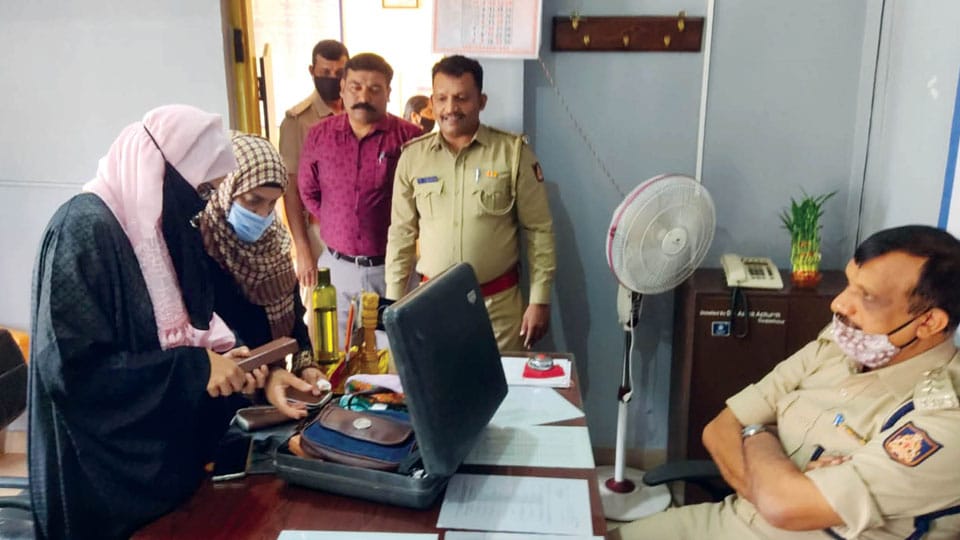
Picture shows petrol pump staff H.V. Somashekar receiving the cash reward from Dy. SP Shailendra as Inspectors Mahesh and Traffic SI Chandrashekhar look on.

The mother and daughter profusely thanked the petrol pump employee Somashekar for returning the suitcase with jewels and also thanked the Police.

Somashekar told the Police that he believed in hard work and was a God-fearing man without having a desire to grab somebody else’s cash and gold. The mother-daughter duo and the Police gave Somashekar a cash award for his honesty.

source: http://www.starofmysore.com / Star of Mysore / Home> Feature Articles / November 06th, 2021

Udupi: From mountain to ocean – Adventurous journey of five young girls from Karnataka

Udupi :

Five young girls of Karnataka, who are participating in the historical journey of ‘Mountain to Ocean’ as part of the Platinum Jubilee celebration of India’s independence, reached Karwar after scaling Antamhoi mountain peak (5245 meters) and cycling for 3000 km all the way from Ladakh.

Now the girls are kayaking 300 km in the sea from Karwar in the coastal area of the state. They reached Malpe sea beach on Friday, October 29.

In-charge deputy commissioner and CEO of zilla panchayat Dr Naveen Bhat welcomed the team of girls on behalf of the district administration on the beach of Malpe. He said, “Young girls, In addition to involving themselves in adventurous sports, should make resolutions to achieve landmarks at national, international and Olympic Games. The adventurous qualities of these young girls should be model to all young girls and women of this state.

“The achievements of these youths, who have put up with all the difficulties they faced during their adventurous tour should not be limited to only our state or country but should be role models to the young generation of the world.

“Already a spot has been identified at Padukere in the district for training on adventurous sport. General Timmaiah adventure academy will also start a branch here. Youth of the district should reap the benefits of this center.”

Sharing their experience of this adventure, the young girls said, “We scaled the peak of mountain carrying bags weighing 25 kg. We did our own cooking throughout our journey and did not depend on anyone. In addition, we erected tents ourselves. We have scaled the peak before the specified time. We did not mind the health issues during the journey but reached our goal. We have seen the issues faced by women and girls in various parts of our country. We have the intention of conducting awareness programmes for women in order for them to venture out of the house and become adventurous. Parents and our trainers have given us whole hearted support.”

Aishwarya V and Dhanalaxmi, residents of Shivamogga, Asha, resident of Bengaluru, Pushpa, resident of Madikeri and Bindu from Mysuru are in the team of girls in this adventurous journey.

Clifford Lobo, assistant director of Udupi tourism department and Shabbir, director of adventurous journey were present. Dr Roshan Kumar Shetty, assistant director of department of youth empowerment and sports welcomed the gathering and rendered vote of thanks.

Mountain to Sea (Shikaradinda Sagara) is a 60 day-long campaign which professes that the adventure and courage of women will portray progress of men. This programme, which is being organized with the cooperation of Indian Mountaineering foundation and General Timmaiah national adventure academy, was flagged off on August 16 and is going to end at Mangaluru after the Kayak journey in sea.

source: http://www.daijiworld.com / DaijiWorld.com / Home> Top Stories / by Daijiworld Media Network – Udupi (MS) / October 29th, 2021