Sanjana Kattera, a corona warrior who was part of the Oxford COVID-19 vaccine trial team, is ‘Coorg Person of the Year, 2020’, according to a release.
Kodagu-born Dr. Sanjana was involved in treating COVID-affected children. A paediatrician, she was part of the vaccine trial team at the Liverpool School of Tropical Medicine in the United Kingdom. The release said Dr. Sanjana served patients selflessly by risking her life, especially when PPE suits were in short supply initially.
Dr. Sanjana was selected ‘Coorg Person of the Year’ in a poll conducted by www.coorgtourisminfo.com, Kodagu’s first news portal, promoted by senior journalist P.T. Bopanna.
She worked with phase I/II of the trial with the age group 18-55 years by initially screening and recruiting patients as part of the eligibility criteria.
Dr. Sanjana, daughter of Suresh Kattera and Smitha Suresh, did her schooling in the United World College South East Asia (UWCSEA) in Singapore.
She studied medicine at the University of Edinburgh in the U.K. After completing her medicine, she specialised in paediatrics in a hospital in the U.K, and is currently training in NHS, Liverpool. She will be completing her Membership of the Royal College of Paediatrics and Child Health (MRCPCH) early next year.
The corona warrior had a tough competition for the ‘Coorg Person of the Year’ title from M.A. Ganapathy, IPS, director-general of the Bureau of Civil Aviation Security (BCAS), the release added.
source: http://www.thehindu.com / The Hindu / Home> News> States> Karnataka / by Special Correspondent / Mysuru – December 21st, 2020
Coronavirus infection has created so much scare among the people that initially even the doctors were wary of treating these patients. Many doctors and nurses who treated such patients have lost their lives.
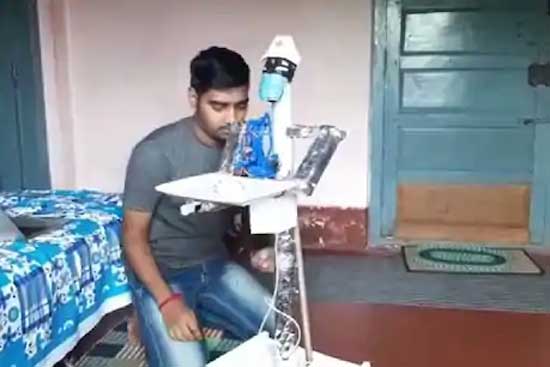
Observing these things, an engineering student from Virajpet here has invented a robot to solve the problem. Manikantha from Hubballi, is the son of Amaresh, working in the court at Ponnampet in the district. Amaresh has been living in Virajpet since the last 15 years. Manikantha is a fifth semester student of electronics engineering department at the engineering college at Mandya.
IEEE India Council had invited students to send in their plans about projects relating to COVID treatment. The council which observed the report sent by Manikantha, asked him to prepare the project and paid Rs 12,000 as expenses. Manikantha by using C programming, created this robot.
This robot can be controlled with the help of a mobile phone. It can go near the COVID patients and dispense medicines and tablets. It can give instructions to patients, and check the heartbeat and body temperature. It also greets the patients. When returning, it scans its entire body and protects itself. IJWMT too has got a research article authored by the student and published. It also issued him a citation.
Manikantha’s parents are happy. He happens to be the first to invent a medical robot for the treatment of COVID patients.
source: http://www.daijiworld.com / Daijiworld.com / Home> Top Stories / by Daijiworld Media Network, Madikeri (SP) / December 12th, 2020
Joshna’s contemporary Dipika Pallikal has competed in 297 PSA Tour matches. England’s Alison Waters (487) and Camille Serme (France, 439) have topped the list in the women’s category.
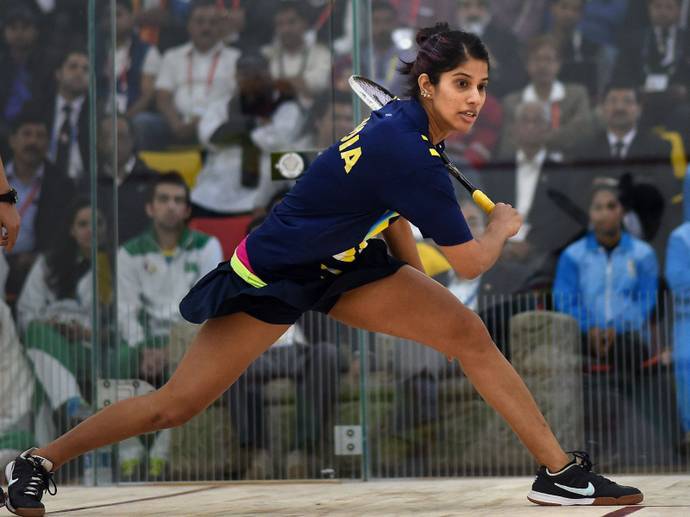
Joshna Chinappa achieved the unique feat in the CIB-Black Ball Squash Open in Cairo (Egypt). – RITU RAJ KONWAR (FILE PHOTO)
India squashplayer Joshna Chinappabecame the first Indian female player and second (male and female) to play 400 PSA Tour squash matches.
The 34-year-old achieved the unique feat in the CIB-Black Ball Squash Open in Cairo (Egypt).
The Indian, seeded 10, defeated Julianne Courtice of England 10-12, 11-6, 11-9, 12-10 in the women’s first round.
Only Saurav Ghosal (444) has played more than Joshna.
Joshna’s contemporary Dipika Pallikal has competed in 297 PSA Tour matches. England’s Alison Waters (487) and Camille Serme (France, 439) have topped the list in the women’s category.
source: http://www.sportstar.thehindu.com / SportStar / Home> Squash / by Team SportStar / Chennai – December 09th, 2020
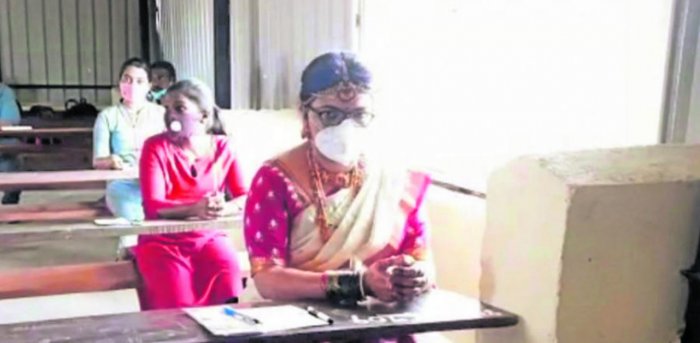
A bride came directly from the marriage hall to the Junior College in Madikeri to write a competitive examination, after completing her wedding rituals, on Sunday.
Swathi, a resident of Ashokapura, is the bride. The competitive examination for the selection of DCC Bank staff had coincided with the date of her marriage with Suresh from Madhuramma Pattana in Suntikoppa.
The marriage was held at Ambedkar Bhavan in Madikeri. The auspicious timing was fixed so that it did not clash with the timing of the examination.
Swathi and Suresh entered into wedlock between 6.30 am and 9 am on Sunday and Swathi later came to the exam hall in the Junior College in Madikeri directly, in her wedding attire.
Swathi Suresh said that she had been preparing for the competitive exam from the past several months.
The marriage rituals were performed in short, so that she did not lag behind the schedule of the exam.
Swathi expressed her confidence in clearing the exam.
source: http://www.deccanherald.com / Deccan Herald / Home> State> Mangaluru / by DHNS, Madikeri / November 22nd, 2020
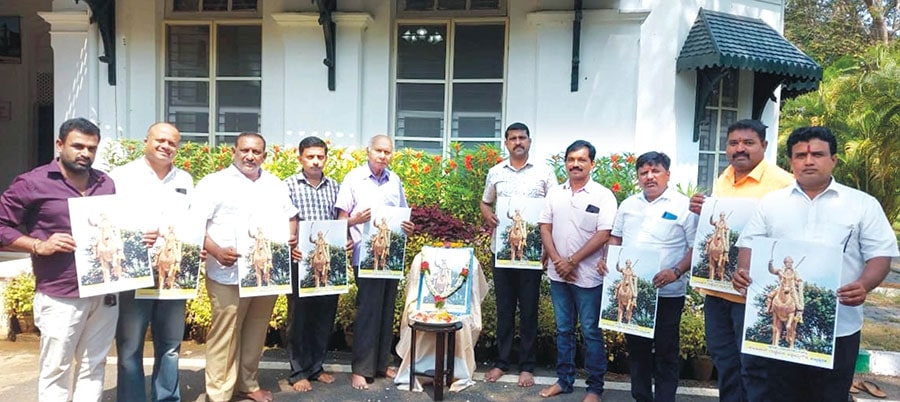
Nammuru Nammoru Samaja Seva Trust, Mysuru, observed Martyred Freedom Fighter SubedarGuddemane Appaiah Gowda Memorial Day at an event held at Jaladarshini Guest House recently.
Veteran writer Dr. C.P. Krishnakumar (CPK) inaugurated the programme by showering petals on the portrait of Appaiah Gowda.
Speaking on the occasion, CPK said that the year 1857 is a very significant year in the history of freedom struggle. Pointing out that the 1857 Sepoy Mutiny was the first major battle in the fight for the country’s independence from the Britishers, he said that we have read about great freedom warriors such as Mangal Pandey and Tatya Tope who laid down their lives.
Noting that the first independence revolution took place in 1837, 20 years before the sepoy mutiny of 1857, the veteran writer said that many great freedom fighters such as Tipu Sultan, Rani Chennamma, Sangolli Rayanna, Parampara of Kodagu, Kalyanaswamy, Guddemane Appaiah Gowda, Kedambadi Ramegowda and Kudiya brothers had laid down their lives much earlier fighting the Britishers.
Recalling that the people of Kodagu revolted when the Britishers divided the then Coorg State into Kasaragod, Puttur and Sullia and brought them under Madras Province, he said that warriors from Kodagu such as Nanjaiah, Kedambadi Ramegowda and Guddemane Appaiah Gowda are an inspiration for generations to come.
Noting that Appaiah Gowda led the ‘Katukai battle’ (Amara Sullia Dange) against the British in 1837, Dr. CPK said that he was one of the greatest heroes Kodagu has produced. Stating that Appaiah Gowda was a symbol of patriotism, self-respect and pride of Kodagu, he said that Appaiah Gowda, who was hanged by the British in front of Madikeri Fort in 1837 for leading protests against colonial power, did not want outsiders to have a say in the affairs of Kodagu.
He urged the Government to set up an Authority for sensitising the public on the sacrifices made by Appaiah Gowda and all other great freedom fighters of the times and on the significance of Amara Sullia Dange (Sullia rebellion).
Trust President Satish Gowda, Vice-President Kumar Gowda, Gen. Secretary A. Ravi, Dist. Vokkaliga Assn. Vice-President Gururaj, Director Ravi, Dentist Lokesh and others were present.
source: http://www.starofmysore.com / Star of Mysore / Home> News / November 03rd, 2020
The doors of diplomacy were not welcoming of women for a good part of the 20th century.
Until 1946, the UK did not allow women into its foreign service. The foreign and commonwealth office was apprehensive about British prestige being endangered abroad as it felt that a foreign government would perceive it as an insult to conduct diplomacy with a woman diplomat.
Some believed : “A clever woman would not be liked, an attractive woman would not be taken seriously.”
Both the UK and the US had rules which stipulated that a female diplomat should resign from service after her marriage.
The situation in India was not too different in the 20th century and this is the story of C.B. Muthamma, the first woman to join the Indian Foreign Service (IFS). She encountered sexism right from the initial interview conducted by the Union Public Service Commission (UPSC) and had to fight for her promotions and seniority even after putting in years of service.
Muthamma excelled in the UPSC examinations conducted in 1948. During her interview, she was in for a rude shock when the chairman of the UPSC tried to dissuade her from joining the IFS. Muthamma alleged that he later admitted that he had used his authority to ensure that she was awarded low marks in the viva voce. Soon after being inducted into the IFS, she was asked to sign an undertaking that she would resign when she gets married.
In 1979, she petitioned the Supreme Court after she was denied ambassadorship and promotion to grade I of the IFS despite an unblemished record. More importantly, the court’s attention was drawn to two misogynistic service rules of the IFS.
Rule 8(2) of the Indian Foreign Service (Conduct and Discipline) Rules, 1961 stipulated that a woman member of the service had to obtain permission from the government before marrying and the government could ask her to resign if it was satisfied that her “family and domestic commitments” would affect her performance. Rule 18(4) of the Indian Foreign Service (Recruitment, Cadre, Seniority and Promotion) Rules, 1961 stipulated that no married woman had a right to be a member of the IFS.
During the course of the hearing, the government informed the court that it had repealed Rule 18(4). However, the solicitor general defended Rule 8(2) by contending that the rule intended to prevent married women from leaking confidential information and thereby endanger security. This contention exposed how misogynistic the government was. The rule rested on an absurd premise that a married man was unlikely to leak confidential information while a married woman could not be trusted! Also, the rule presumed that it was only a woman who could have “family and domestic commitments” after marriage which could affect her performance.
As the case progressed, the government perhaps felt that the court was not inclined to accept its justification of the rule and hence assured the court that the rule was all set to be deleted and the same would be announced in the official gazette.
Interestingly, after Muthamma challenged the denial of promotion, the government suddenly retracted its assessment that she was not meritorious enough to be appointed as an ambassador. Before the court pronounced its verdict, she was appointed as the ambassador to The Hague and the government even assured the court that her seniority, which was affected by the late promotion, would be restored.
As the government addressed/promised to address, the issues raised in the petition while the case was pending, the court did not have to issue directions to the government. However, Justice Krishna Iyer, who authored the judgment, pointed out that Rule 8(2) and Rule 18(4) were unconstitutional as they violated the principles of equality and non discrimination enshrined in Articles 14, 15 and 16 of the Constitution. He began the judgement with the following line :
“This writ petition by Miss Muthamma, a senior member of the Indian Foreign Service, bespeaks a story which makes one wonder whether Articles 14 and 16 belong to myth or reality”.
He observed that “masculine hubris” haunted the Ministry of External Affairs and described the rules as misogynous and a hangover of a culture of masculinity which suppressed women. The judgment urged the government to remove “stains of gender discrimination” from all the service rules without waiting for “ad hoc inspirations” from petitions filed in the court.
Muthamma’s story suggests that calling out misogyny in the language of rights and constitutional values can act as a powerful nudge. By publicising the discrimination, she effectively abashed the foreign service and forced it to introspect. Also, her efforts enabled the Supreme Court to condemn misogyny in service rules and this judgement has served as a guiding precedent for courts while deciding cases of gender discrimination.
Rahul Machaiah is a post graduate student of law at Azim Premji University, Bangalore.
Featured image credit: Wikipedia (Editing: LiveWire)
source: http://www.livewire.thewire.in / Live Wire / Home> Gender & Sexuality / by Rahul Machaiah / October 14th, 2020
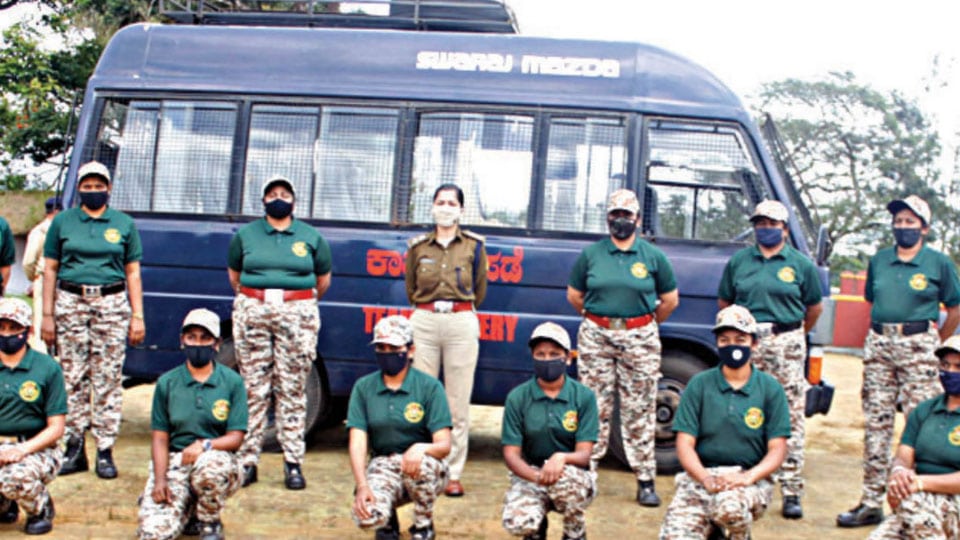
‘Cauvery Pade’ (Cauvery Force), an all-women Police team to tackle crimes against women and children in Kodagu district, was launched by Kodagu SP Kshama Mishra here on Thursday last.
Speaking on the occasion, Kshama Mishra said that the team will have two Assistant Sub-Inspectors (ASIs) and 16 other Police personnel.
“The Force will act against atrocities and crimes against children, girls and women. The Force will make regular rounds around schools and colleges, accommodations where there are more number of women and other women-dominated places and will act against anyone found behaving in an obscene or indecent way and harassing or stalking women,” she said.
Continuing, the SP said that ‘Cauvery Pade’ has been formed on the lines of ‘Abbakka Pade’ in Udupi, ‘Obavva Pade’ in Chitradurga and ‘Chamundi Pade’ in Mysuru. The patrol team will make rounds from 8 am to 6 pm in the limits of all prominent Police Stations of the district, focussing on schools and colleges for ensuring the safety of girl students.
The members of the public can call 100 in case of trouble or distress, she said and added that the mobile numbers of all the eighteen personnel attached to this women Police team, will be announced soon as the higher authorities issue them.
source: http://www.starofmysore.com / Star of Mysore / Home> News / October 06th, 2020
A befitting tribute to Indo-Pak War Hero on his 55th death anniversary
Madikeri:
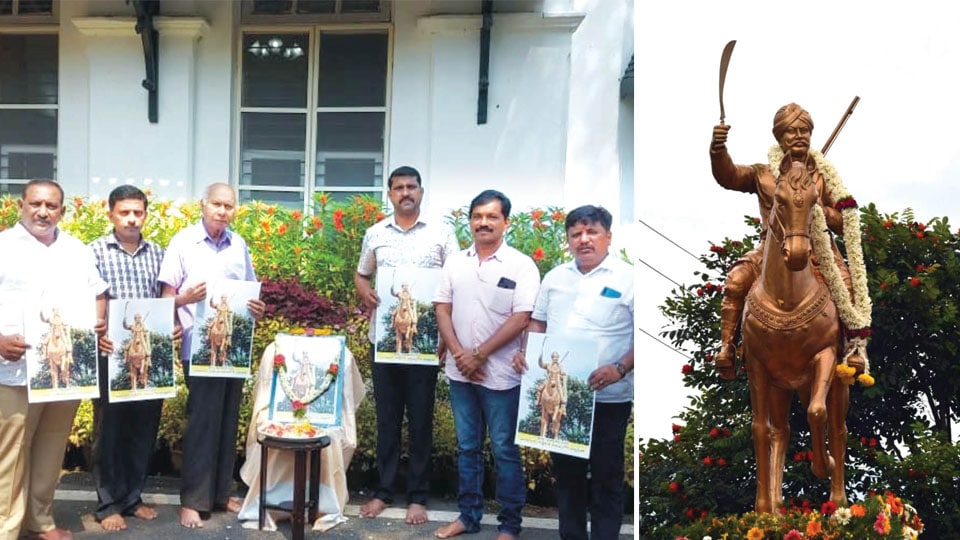
The statue of Squadron Leader Ajjamada Bopayya Devayya will be unveiled at Madikeri in Kodagu District on Sept. 7.
The 6-feet-9-inch bronze statue installed at the Old Private Bus Stand Circle will be unveiled on the day Devayya was martyred. Incidentally, the Circle has also been named after him.
Sqn. Ldr. A.B. Devayya is the only Indian Air Force (IAF) Officer to be posthumously awarded the Maha Vir Chakra (MVC). During the 1965 India-Pakistan War, Devayya (called ‘Wings of Fire’) was part of a strike mission (on the Pakistani airbase Sargodha).
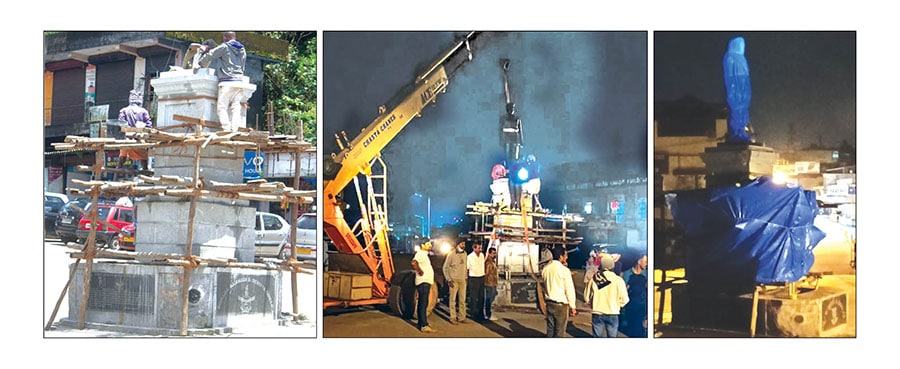
Works on installing the statue of Squadron Leader A.B. Devayya at Madikeri in Kodagu district is almost complete.
Works on installing the statue of Squadron Leader A.B. Devayya at Madikeri in Kodagu district is almost complete.
The work on the statue basement is almost complete and a giant crane was used to shift and mount the statue on the pedestal.
The bronze statue weighs 600 kg and Rs. 20 lakh has been spent on getting the statue carved at Kengeri near Bengaluru.
The statue installation work was spearheaded by Ajjamada family members, Squadron Leader Ajjamada Devayya Memorial Trust, Field Marshal K.M. Cariappa and General Thimayya Forum, Kodava Makkada Koota.
Wartime job
Sqn. Ldr. A.B. Devayya was born to Ajjamada Bopayya and Neelamma couple on Dec. 24, 1932 at Manchalli village near Kutta in South Kodagu. He joined the Indian Air Force as a pilot on Dec. 26, 1954. Devayya was married to Keethiyanda Sundari.
When the Indo-Pak war broke out in 1965, Devayya was an instructor at the Air Force Flying College. He was posted to No.1 ‘Tigers’ Squadron’ and flew the Mystere fighter bomber. During the war, Devayya shot down a US-made PAF (Pakistan Air Force) F-104 Starfighter while flying an inferior Mystere of French make. The dogfight between the Mystere and the Starfighter was recorded by British author John Fricker in his book ‘Battle for Pakistan’ published in 1979.
Action in the skies
John Fricker wrote, “On Sept. 7, 1965, Mystere pilot Squadron Leader A.B. Devayya showed commendable courage by staying in the fight, and despite being mortally wounded, he eventually scored several cannon strikes against the Starfighter, causing it to be abandoned. This was the first and only Starfighter to be lost through enemy action in the 1965 war.”
Devayya was part of an air strike mission on the PAF base at Sargodha, with the objective being to neutralise its air assets. He engaged in a dogfight with the Starfighter flown by Pakistani Flight Lieutenant Amjad Hussain at an altitude of 7,000 ft. The PAF fighter was faster and more modern, but Hussain made the mistake of reducing his speed in an attempt to out-turn Devayya.
Hussain failed to clear his tail during the dog-fight and suffered several cannon strikes. He was forced to eject since the Mystere had a limited range for action and did not have enough fuel reserves to return to India.
Posthumous award
The Mystere aircraft was destroyed and it was assumed that Devayya died on Pakistani soil. The IAF was not aware of what had happened to Devayya, first recording him missing and later declaring him dead. It was revealed much later by Pakistan that Devayya’s body was found almost intact by villagers not very far from Sargodha and buried.
For this feat in the 1965 conflict, 23 years later, in 1988 he was posthumously awarded the Maha Vir Chakra (MVC). He is the only Air Force Officer to have been awarded the MVC posthumously so far.
Two heroes from Kodagu receive ‘Maha Vir Chakra’
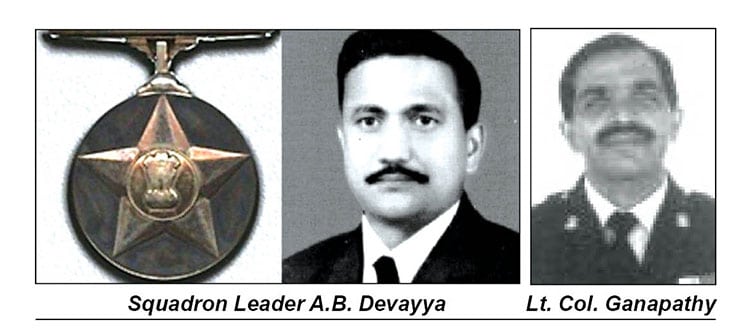
Two Defence personnel from Kodagu have so far received the honour of Maha Vir Chakra, next only to the supreme Defence award Param Vir Chakra. While Squadron Leader A.B. Devayya received the honour in 1988, the other officer is Major Puttichanda Somaiah Ganapathy (later promoted as Lieutenant Colonel) who is now leading a retired life in Bengaluru.
Major Ganapathy was awarded Maha Vir Chakra for his combat role in 1987 Operation Pawan in Sri Lanka (launched by Indian Peace Keeping Force) against the LTTE. His unit, located at Annakottai, was surrounded and repeatedly attacked by militants on Oct. 16, 1987. His Company had occupied this location to provide a firm base for the 41 Infantry Brigade to launch an offensive.
LTTE militants repeatedly attacked the position with very heavy fire, resulting in heavy casualties, and his unit required immediate replenishment of ammunition. Throughout the day, Major Ganapathy fought gallantly and kept the militants at bay.
When all efforts to drop ammunition by helicopter failed due to heavy fire, Major Ganapathy kept fighting, moving from trench to trench till 6 am on Oct. 17, 1987 when he was finally supplied with ammunition by a patrol. He displayed extreme devotion and held his position against heavy odds.
source: http://www.starofmysore.com / Star of Mysore / Home> News / by Prasad Sampigekatte / August 31st, 2020
Air Marshal Nanda Cariappa pays rich tributes to martyred soldiers
Madikeri:
“Kargil Vijay Diwas is a symbol of India’s pride and valour. I bow to the soldiers who, with their indomitable courage, drove the enemy from the inaccessible hills of Kargil and waved the Tricolour there again. The country is proud of the heroes of India, who are dedicated to protecting the motherland. We remember the courage and determination of our Armed Forces, who protected our nation in 1999 and continued protecting us and their sacrifices will continue to inspire generations,” said Air Marshal Kodandera Nanda Cariappa.
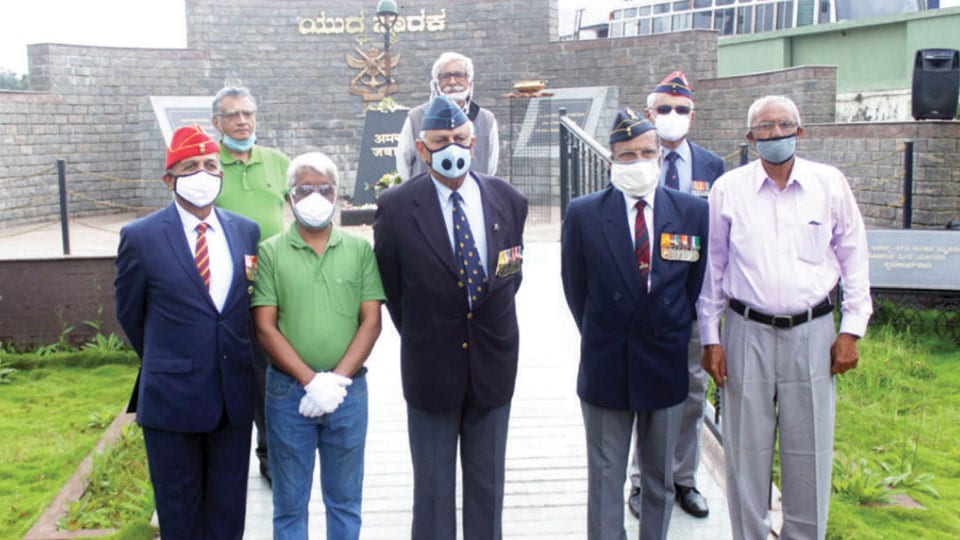
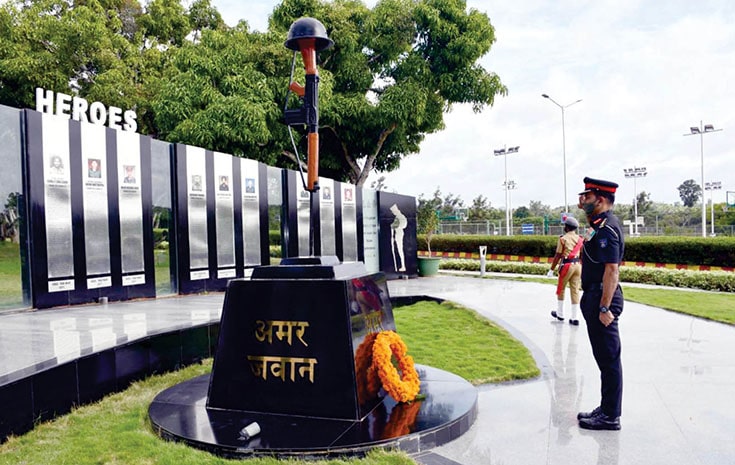
He was speaking at Sunny Side War Memorial — the house of General K.S. Thimmayya — at Madikeri yesterday on the occasion of Kargil Vijay Diwas. The event was organised amidst COVID pandemic by Field Marshal K.M. Cariappa and General Thimmayya Forum. “It is a special and a sacred milestone in the history of Indian Armed Forces,” he said after laying a wreath at Amar Jawan Memorial at Sunny Side.
Field Marshal K.M. Cariappa and General Thimmayya Forum President Col. (retd.) Kandrathanda Subbaiah, Lieutenant Colonel (retd.) Chengappa, Major (retd.) Biddanda Nanda Nanjappa and others paid rich tributes. Ajjinanda Thamoo Poovaiah of Kodagu Ekikarana Ranga, Kokkalera Cariappa, entrepreneur Arun, Sukumar of Hindu Vedike and others were present.
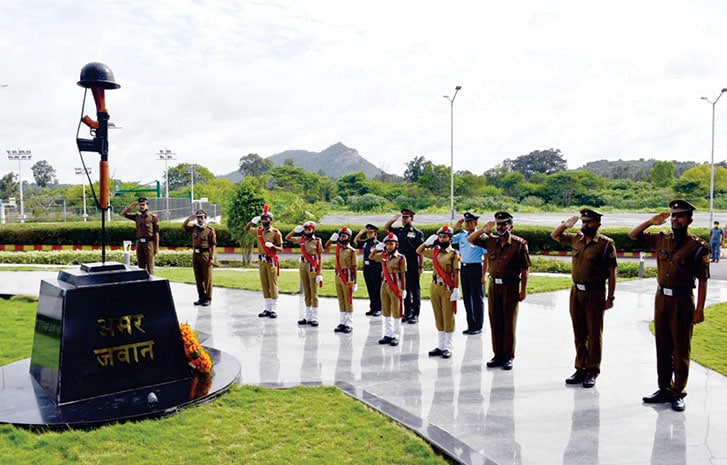
Kodagu Sainik School Principal Col. G. Kannan paying homage to war heroes at the War Memorial.
Sainik School pays tribute
The supreme sacrifice by the brave Indian soldiers was remembered by the Kodagu Sainik School fraternity by paying homage to war heroes at the War Memorial. Principal Col. G Kannan laid the wreath. Lt. Col Seema Tripathi, Vice-Principal and Sqn. Ldr. R.K. Dey, Administrative Officer also remembered the sacrifices.
Associate NCC Officers of the School also paid floral tributes at the Memorial. The Principal addressed the cadets and shared a video to the cadets about the event and told them that the School, under Ministry of Defence and with the support from Government of Karnataka, is committed to prepare them to be future leaders not only in defence forces but in all walks of life.
Owing to the COVID pandemic, the programme and competitions were held online. Cdt. Amogh and his team of other cadets performed a role play titled “Yeh Dil Mange More!” a tribute to Capt. Vikram Batra, Param Vir Chakra awardee, through video conference. Online quiz, poster-making contests were held and e-certificates were also awarded to the winning cadets.
source: http://www.starofmysore.com / Star of Mysore / Home> News / July 27th, 2020
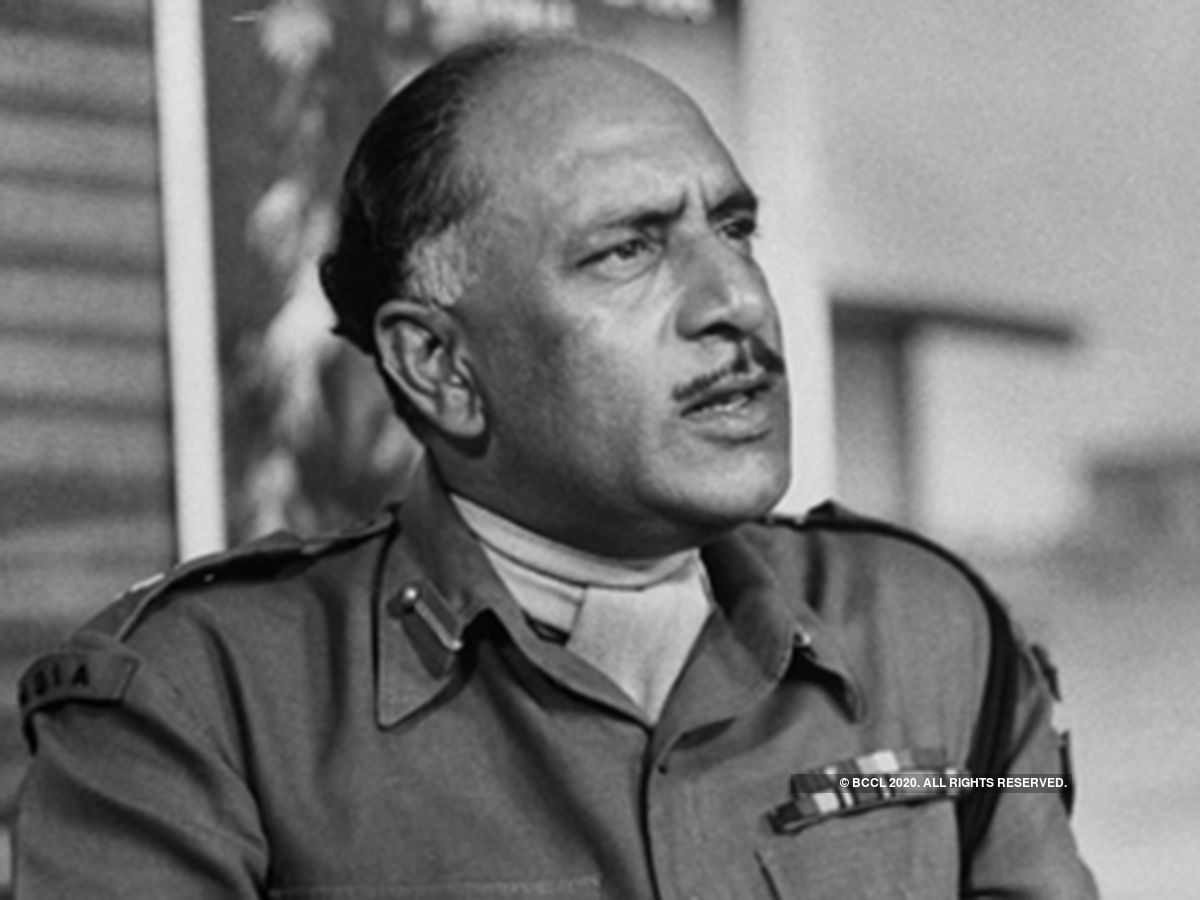
In Nov 1948, Thimayya moved Stuart tanks in utmost secrecy by dismantling their turrets and used them in direct firing role that led to the capture of Zoji-la which had evaded capture on previous instances. It was because Zoji-la was in our hands that liberation of Kargil was possible in 1999.
General KS Thimayya
There were three elements to India’s largely unknown role in the Korean War 1950-1953. This is the second in a continuing series on that conflict. For the earlier story on the 60th Para, click here (https://bit.ly/2DW0PHS)
India became a member of the United Nations when the organization was founded on October 24th, 1945. Established to ensure world peace—among other goals— after a ruinous World War, the UN has had a mixed track record. One of its successes, however, was the bringing of the Korean War to a close. India played a unique role in bringing the conflict to a speedy conclusion by advocating against a policy being debated at the UN which could have led to the war’s prolongation or escalation. That war was also the first commitment to a UN assignment by an independent India and the Indian Army. This contribution and the men who made it a success are still celebrated as heroes for their commitment and courage.
The Korean War began on 25th June 1950 and would rage for three long years between the Western alliance—led by the USA under a UN resolution called the UN Command—and a Socialist alliance of North Korea and China (known as the Korean People’s Army (KPA) and the Chinese People’s Volunteers (CPV)) supported by the Soviet Union. The two sides reached a military stalemate by the middle of 1953 and had agreed on the terms of a ceasefire. In truth, the war would have come to an end in 1952 if the peace talks held at Panmunjom on October 25, 1951 could have reached a decision on the question of prisoner swaps. This was a contentious topic, and one where India finally found the solution—a solution accepted nearly unanimously by the UN, allowing for the signing of the Korean Armistice Agreement on July 27, 1953. India’s efforts to find a compromise failed more often than not, increasing tensions between India and the United States, and even South Korea. The US had reasons to suspect Indian neutrality as we were among the first countries to recognize China diplomatically, even advocating for their seat at the UN in 1950.
A major issue that defied agreement was how to deal with a large number of Korean and Chinese prisoners—about two hundred thousand of them—held by the UN Command. Many prisoners refused to return to their original countries. There were also a few similar UN prisoners, mostly Americans, held by the Korean People’s Army (KPA) and the Chinese People’s Volunteers (CPV))
The Armistice agreement stipulated that a Neutral Nations Repatriation Commission (the NNRC) would be established with two countries from each bloc, and headed by India—underscoring our nation’s reputation as a neutral country. Thus the NNRC had Czechoslovakia and Poland from the Eastern Bloc, and Sweden and Switzerland from the West. India was also tasked with providing a brigade of soldiers to provide security for the prisoner exchange.
The NNRC decided the fate of the remaining 20,000 POWs —and their repatriation—also called the Big Switch. It followed Operation Little Switch in April-May of 1952, which saw the exchange of wounded and sick soldiers held by both sides. The solution included handing over these prisoners to the NNRC headed by India. A full Indian contingent of nearly 6000 called Custodian Force of India (CFI) were to take over physical custody of these prisoners; this was our nation’s initiation into peacemaking and conflict resolution.
Led by General Thimayya as Chairman, and Ambassador B.N. Chakravarty, IFS, as the Alternate Chairman, the Neutral Nations Repatriation Commission (NNRC) was a task that many did not think Indians would be able to handle or deliver, because of its layered complexities and intrigue.
The Indian government had made sure to send their best medical unit 6oth Para Field Ambulance earlier ( https://bit.ly/2CrHWfn) and now, in sending General KS Thimayya—later to be the COAS— they displayed the same intent.
The force behind the NNRC
Kodandera Subayya Thimayya was one of three brothers born to a rich coffee planter of Cheppudira clan in Madikeri in the district of Kodagu. He joined Bishop Cotton School in Bangalore before enrolling at the Prince of Wales Royal Indian Military College (RIMC) in Dehradun; he was one of six Indian cadets later chosen to attend the Royal Military Academy at Sandhurst along with Gen PN Thapar who would later succeed him as the Chief in 1961 and be made a scapegoat for failures in 1962. Gen Thimayya’s brothers too joined the Army and his elder brother Ponnappa later joined the INA inspired by Subhas Chandra Bose and his younger brother died in the first war in Kashmir.
Thimayya graduated from Sandhurst in 1926 and received a commission into the British Indian Army, going on to become the first Indian to command an Infantry brigade: the 268th Indian Infantry Brigade—part of the post-World War II British Commonwealth Occupation Force in Japan. He received the British Distinguished Service Order for his service for the British military during World War II.
General Thimayya was also chosen to lead the counter offensive in Kashmir and headed the Jammu Kashmir force from April 1948 . The J&K force was split as Srinagar and Jammu Division, Gen Thimayya headed the Srinagar Div in May 1948 . Immediately he set about recapturing territories lost to the marauders with his daring and dynamic brigade commanders – Brig LP Sen of 161 brigade in Uri Sector, Brig Atal of Para Brigade tasked to recapture Zojila and Harbaksh Singh in command of 163 in Handwara – Kupwara . They were on a recapturing spree when Nehru decided to unilaterally declare suspension of operations as the case was referred to the UN much to the protestations of the army brass. Fortunately Pakistan didn’t comply with the UN resolution allowing the re – commencement of operations. This window of opportunity saw the consolidation of Ladakh with the capture of Zojila Dras and Kargil. Leh a weakly held garrison was saved by the sheer audacity and courage of Thimayya and Air Cmde Mehar Singh who landed in a Dakota together for the first time in Leh paving the way for beefing up troops that saved Leh from enemy hands . In another audacious move for capture of Zojila tanks of 7 Cavalry was used in a direct firing role which completely destroyed the enemy morale leading to its capture . Thus Ladakh was saved in the nick of time by November 1948 before winter set in . Seeing the change in pace and tempo of operations Pakistan quickly agreed to the terms of the UN resolution calling for a ceasefire before it lost all other territories held by them. The rest is history but what stood out is the sheer character and audacity which made him a national hero for saving Kashmir .
Another anecdote that revolves around him is the detention of a senior politician’s son after he and some goons passed lewd remarks and even tried to molest the wife of an Army officer of 5 JAT in Amritsar in 1959 . With the personal involvement of none less than that of the CM Of Punjab the ripples of this action went up to Parliament. General Thimayya was summoned for an explanation and his response that silenced the opposition was “If we cannot defend the honour of our women, how can you expect us to defend the honour of our country?”
His ability to project India’s honor was on full display during his handling of the NNRC in Korea.
The NNRC through CFI was responsible for gathering non-repatriated prisoners into camps; that included nearly 170,000 prisoners held by UN forces who didn’t want to return to either China or North Korea.
In the face of Chinese demands for the forceful repatriation of their soldiers, the UN and the CFI worked hard to explain to each prisoner their rights and privileges; they could then choose to go home or remain with the side that captured them.
This called for compassion, fairness, and neutrality on the part of the Indian Custodian Force, who rendered yeoman service during the entire span of their mission from September 1953 to March 1954. On several occasions, intricate situations were resolved only because of the patience and tact of General KS Thimayya and Major General SPP Thorat. They proved their mettle, earning well-deserved praise for their command and for India.
It was an unenviable task; in the end only less than 100 who wished not be repatriated to either country came back to India once the NNRC and CFO concluded their operations. A few Koreans chose to resettle in India, while others were repatriated to Brazil.
General Thimayya is not only an Indian military hero he is also a hero of the Korean War . It has been 66 years since the end of the Korean war but even till day he is remembered by Koreans with gratitude and affection. He was awarded a Padma Bhushan in 1954 for his service in Korea.
General Thimayya went on to become the COAS from 1957-1961. After his retirement the UN again requested for his service in 1964 to command UN troops operating on Cyprus in keeping with his reputation of impartiality displayed in Korea . He would however die of a massive heart attack on December 18, 1965 at the age of 59.
————–
Col ( Dr) Divakaran Padma Kumar Pillay, Shaurya Chakra, PhD is a Research Fellow, with the Manohar Parrikar Institute for Defence Studies and Analyses. His twitter id is @dpkpillay12.
—————
source: http://www.economictimes.indiatimes.com / The Economic Times / Home> National> Business News> News> Defence / by ET Contributor – Col.(Dr)Divakaran Padma Kumar Pillay / July 21st, 2020
WELCOME. If you like what you see "SUBSCRIBE via EMAIL" to receive FREE regular UPDATES.
Read More »