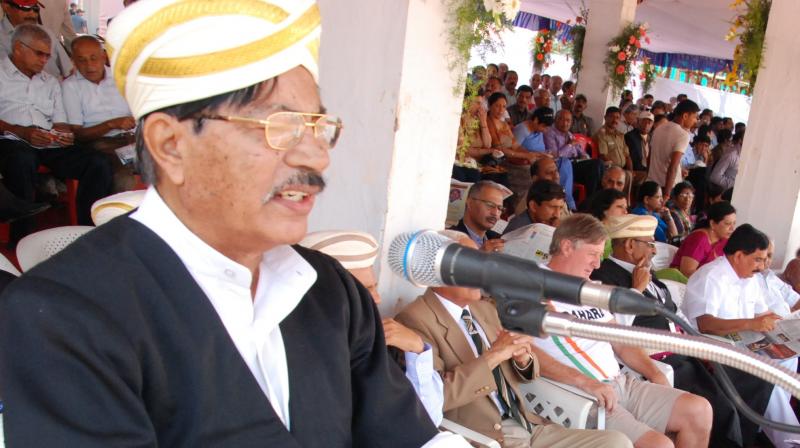
Madikeri Akashavani in its ‘Krishi Ranga’ programme on July 15 at 6.55 pm, will feature ‘Pondman’ Kamegowda, who recently hit the headlines after PM Narendra Modi made a reference to him in his monthly ‘Mann Ki Baat’ programme on All India Radio (AIR) last month.
source: http://www.starofmysore.com / Star of Mysore / Home> In Briefs / July 14th, 2020
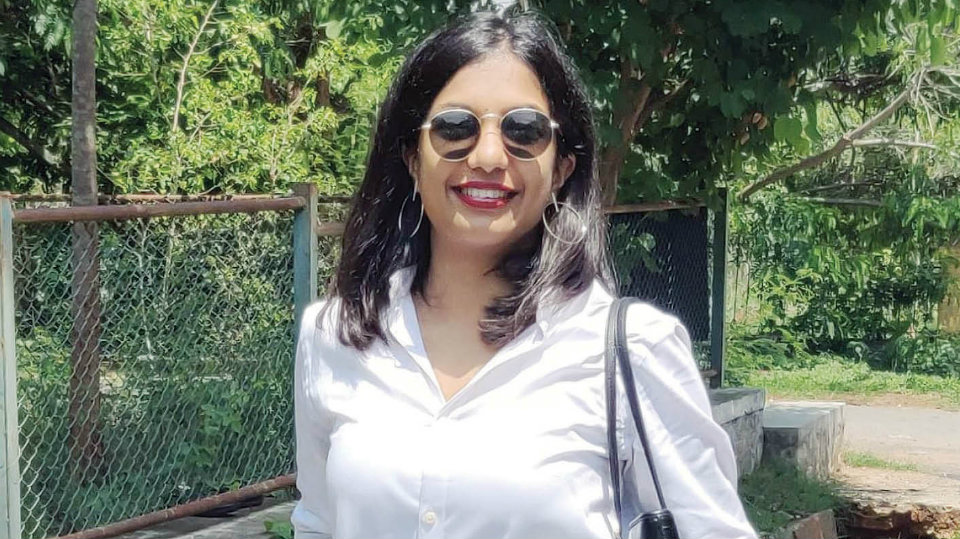
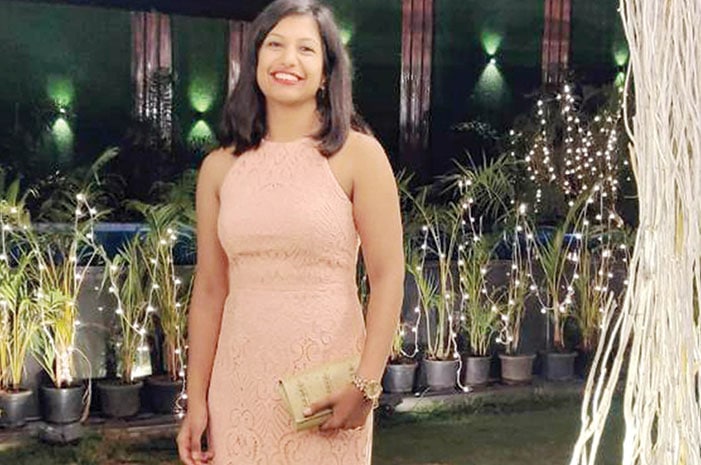
Everyone has some or the other ambition or dream to achieve when they are in college but very few of them live their dreams or choose the career they wished. Mysuru-based Coluvanda Punya Nanjappa has achieved her childhood dream or call it passion to be a fighter jet pilot.
She has been selected for the training and once she completes it, she will be a fighter pilot, a rare distinction for a woman who has her roots in Kodagu, a land of defence personnel. Though the district has achieved the fame of producing a Field Marshal, a General and innumerable Lieutenant Generals, Brigadiers and Majors in the Indian Army and their equal ranks in the Navy and the Air Force, it is for the first time a woman fighter pilot is emerging from the tiny district.
In fact, she will be the only second woman from Karnataka to be a fighter jet pilot after Meghana Shanbough from Chikkamagalur and is the lone woman in her ongoing training course where there are 40 future fighter pilots.
Last year, Punya became the only women cadet from Karnataka to be selected for the flying branch training at the Indian Air Force Academy. The training for cadets who are selected for the flying branch is divided into three stages. Punya has already completed the Stage-1 of her training at the Academy in Dundigal in Telangana and has been selected to join the fighter stream where she will undergo Stage-II training at Hakimpet, again in Telangana.
The training stages are vivid and is a combination of adventure, skill and deft manoeuvring. They will be trained to engage in air-to-air combat, air-to-ground combat and sometimes electronic warfare while in the cockpit of a fighter aircraft. Fighter pilots undergo specialised training in aerial warfare and dogfighting (close range aerial combat).
After Stage-II, Punya will be commissioned as an officer to undergo Stage-III training. She is likely to be commissioned as an officer in the next passing out parade in December. Punya has always wanted to join the fighter pilot stream and her childhood dream has been realised. A resident of Vijayanagar in city, Punya was selected as a Trainee Pilot of IAF Flying Branch last year.
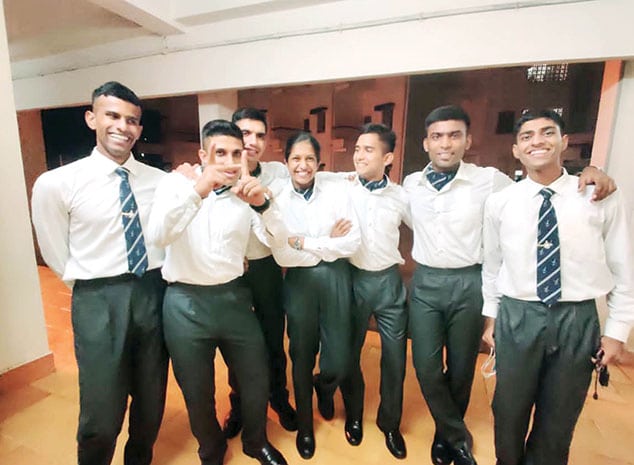
Punya with her batch-mates at the Training Academy in Telangana.
She is the daughter of Anuradha Nanjappa (a teacher at St. Joseph’s Central School) and late Coluvanda P. Bala Nanjappa (he was serving as the Manager of Prabha Theatre), native of Chambebellur in Virajpet taluk of Kodagu district.
Punya completed her schooling at St. Joseph’s Central School in Vijayanagar, pursued her PUC at Vijaya Vittala PU College in Saraswathipuram and Engineering at NIE, Mysuru. Punya then took up Air Force Common Admission Test (AFCAT) — an officer recruitment gateway in three branches of Air Force — Flying Branch (Short Service Commission only), Technical branch (Permanent and Short Service Commission) and Ground Duty Branch (Permanent and Short Service Commission).
source: http://www.starofmysore.com / Star of Mysore / Home> News / July 03rd, 2020
Reeth Abraham is one of India’s most well known athletes participating in the hurdles, long jump and heptathlon events, with a career that began in 1976. She has won various medals at several international competitions including at the Asian level. Her achievement stands out particularly since she won a medal at the Asian level less than a year after she became a mother.
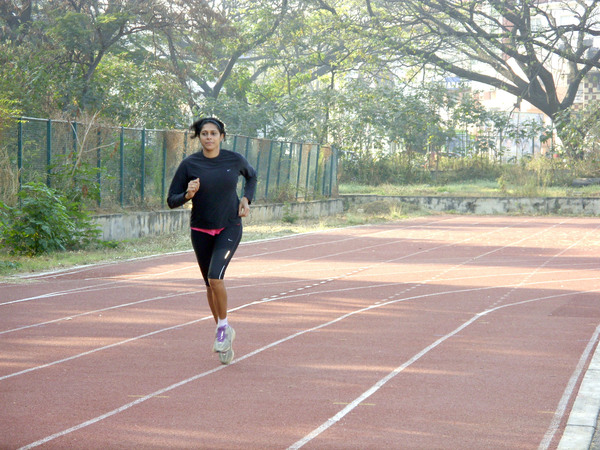
Reeth, at one of her practice sessions at Kanteerava Stadium / Pic: Deepthi M S
Although she retired from competitive athletics in 1992, this 49-year-old has continued training over the years and is now active as a Masters athlete. In 2011, she won 2 medals for India at the World Masters Athletics meet at Sacramento, USA in the triple jump and long jump events. Among various awards and recognitions she has received over the years, she has been a recipient of the Arjuna Award in 1997. She is one of the founding members of Clean Sports India. Reeth lives in Koramangala.
Citizen Matters caught up with her for a brief chat at the Kanteerava Stadium, just after she had finished her day’s training.
Reeth, enough is known about your career as an athlete but only last year, your achievements at the World level as a Masters athlete caught our attention. How does one even qualify?
Clean Sports India is an organisation founded to rid Indian sport of its twin malaises, lack of sports persons in administration and drug usage. Clean Sports India aims to get former sportspersons into managing the various sports bodies in India including the Olympic Sports Federations, Associations and other Clubs in India, as opposed to administrators who have occupied positions of influence in various bodies without the sport itself making much progress. Its other objective is to ensure clean competition by keeping drugs away from both practice and competition.
This was my sixth appearance at the World Masters meet. One has to first qualify at the State Masters meet, for which you can just turn up and then the National meet, which you get to if you are successful at the state meet. If one is good enough and successful at the national meet, you get to represent India at the global level. The Karnataka state meet was held in Mandya recently. The World meet is in Brazil next year. The World Masters meet is held every two years. One needs to be over 35 years to be eligible as a Masters athlete.
How did you manage to train and keep in shape while raising two kids (Reeth is the proud mother of a daughter and a son)? Do you go to a gym regularly? What is your current training schedule like?
(Smiles) I don’t know how I managed. It just happened. I would sometimes leave my kids under the care of someone while I trained. It wasn’t easy but somehow I managed.
I train at the stadium 3 days a week and train in a gym on 3 days a week. I also swim occasionally for relaxation.
In addition to your involvement with the Nike Run Club, do you coach any athletes?
No I don’t have any trainees. There is not much time left on hand between my job and my own training outside my work hours.
You were recruited by a bank years ago. How has the situation changed for athletes on the sponsorship front?
I was amongst the first batch of athletes recruited by Corporation Bank. This was followed by various other banks later, which recruited various sportspersons. Some banks even had cricketers in their ranks. It is still very difficult for most athletes to eke out a living without sponsorship. That is one reason most athletes these days give up after a certain level since they don’t have the patience to put in years of hard work, which may or may not result in success. And even when one is successful, the recognition one gets may not mean much monetarily. Even as a Masters athlete, I have managed to get a sponsor for my travel to the World Masters meet but I am not sure how other athletes manage.
One of the things I have noticed at the Kanteerava stadium is the significant number of talented girls who are training as athletes, which is not quite reflective of the trend of India’s senior athletes. Where do they disappear as they grow older?
Reeth is one of the coaches at the Nike Run Club (NRC), an initiative from Nike to introduce ordinary people into running. Reeth helps the NRC attendees warm up through a routine of various exercises and then go for a run, before cooling down and helps various runners get introduced to the sport and get better at it, every Saturday at the Kanteerava stadium.
The problem is that as these kids grow older they have several options before them which are sometimes more rewarding. And as I said earlier, not all of them are willing to invest the effort and work hard for 10-12 years before tasting success at higher levels of athletics, especially when their hard work elsewhere can lead to success in other areas. And athletics after a certain point is extremely competitive. So I can see the perspective of the kids if they choose to focus elsewhere.
If you could change something in Indian athletics today, what would it be?
Make it enjoyable for young athletes to participate and compete. Once one reaches a certain level of competition, it is very challenging for an athlete to handle the pressure to perform and win medals. In my time, there was no one to help us on such matters.
What are your opinions on sports facilities in Bangalore?
In Bangalore, it is gradually improving. There are more people who are taking sports seriously.
You are a resident of Koramangal, what do you think of the sports facilities there?
Speaking of sports facilities in Koramangala, it is zero. I see no changes at all, the Koramangala indoor stadium for that matter, is used only for exhibition and nothing else.
Any message for aspiring masters athletes?
Unless you have been an active athlete earlier, events with throws (shot put, discus) and jumps (long jump, triple jump) are out, since they require special training and may result in injuries, if one doesn’t train carefully. Perhaps long distance running is an event a beginner can aspire to compete in.
source: http://www.bengaluru.citizenmatters.in / Citizen Matters / Home> Current / by Dharmendra D. / February 28th, 2012
Field Marshal KM Cariappa (Photo Credits: indianarmy.nic.in)
It is the 27th death anniversary of Field Marshal KM Cariappa on May 15 this year. He was the first Indian Commander-in-Chief of the Indian Army in Independent India. KM Cariappa is widely regarded as one of the most-decorated Indian Army officers of all times. There’s a lot to know when it comes to his life and achievements of his illustrious military career. If you are looking for interesting facts about Lt Gen KM Cariappa, his life, career, etc., then you have to come to the right place. We, at LatestLY, bring you some of the lesser-known facts about General Cariappa as we observe his 27th death anniversary.
1. KM Cariappa was born in a family of farmers, on January 28, in 1899, in Coorg. Not many people know that his childhood pet name was ‘Chimma’.
2. During his college days around 1917, he came to know about the Indian Army’s recruitment exercise. KM Cariappa was one of the 42 applicants out of 70 who were selected. The rest, they say, is history.
3. In 1925, KM Cariappa was sent on a world tour, where he came across a lot of foreign cultures, soldiers, and public. He was nicknamed ‘Kipper’ by a wife of a British officer who couldn’t pronounce his name.
4. In 1942, when he was promoted as the acting lieutenant colonel and the commanding officer of 7th Rajput Machine Gun Battalion, KM Cariappa became the first Indian to do so, in the Indian Army.
5. In the same year, i.e. 1945, he was promoted to the post of Brigadier. This made KM Cariappa the first Indian officer to fully attain this rank.
6. Not many people know that KM Cariappa was the officer-in-charge of the division of Army and its assets during the time of India’s independence in 1947.
7. During the First Indo-Pakistani War 1947-48, when the Indian Army HQ had strictly instructed to not conduct any operation in the Kashmir Valley, KM Cariappa didn’t obey the orders and instead launched offensive strikes in the region. The result of it was that India was able to assert its control over Ladakh and nearby regions.
8. In 1949, when Indian Army had to appoint the first Indian Commander-in-Chief (C-in-C), there were two other contenders, i.e., Shringanesh and Nathu Singh, along with KM Cariappa, who was in contention too. However, it was KM Cariappa who eventually took over as the first Indian C-in-C of independent Indian Army.
9. It is a little-known fact that the phrase ‘Jai Hind’, which was the slogan of Subash Chandra Bose-led Indian National Army (INA), was adopted by KM Cariappa, and has since then been the formal phrase to greet each other in the armed forces.
10. KM Cariappa retired from the post of Commander-in-Chief in 1953, after serving the position for 4 years.
11. Not many people know that he has also served as the Indian High Commissioner to Australia, New Zealand, after his retirement, until 1956.
12. KM Cariappa was also honoured with the Legion of Merit by American President Harry S Truman – one of the rare feats.
13. After being persuaded a lot by his friends and family members, KM Cariappa also tried his luck in politics. In 1957 Lok Sabha Elections, he contested unsuccessfully from North-east Bombay seat, against Krishna Menon.
14. In 1986, the government conferred the rank of Field Marshal on KM Cariappa as a mark of honour and recognition of his illustrious career spanning over three decades. He, along with Field Marshal Sam Manekshaw, are the only people who have been accorded this honour, till date.
15. As per a legend, when his son, KC Cariappa was captured as a prisoner-of-war (POW) in the Indo-Pakistani War 1965, KM Cariappa was contacted by Pakistani General Ayub Khan informing him about his son’s safety, and even offered his release. However, KM Cariappa proudly replied, “He is my son no longer. He is the child of this country, a soldier fighting for his motherland like a true patriot. My many thanks for your kind gesture, but I request you to release all or release none. Give him no special treatment.”
KM Cariappa breathed his last on May 15, 1993. After suffering from arthritis and heart problems, he died in his sleep at Bangalore Command Hospital. As India observes the 27th death anniversary of the decorated soldier of the Indian Army, we at LatestLY, thank KM Cariappa enough for his selfless services, and wish his soul rests in peace!
source: http://www.latestly.com / LatestLY / Home> Lifestyle> Festivals and Events / May 17th, 2020
Pandanda Kuttappa was conferred with the Karnataka Rajyotsava Award in 2015
Pandanda Kuttappa, the brainchild of the popular Kodava Hockey Festival, passed away at his residence here on Thursday. He was 85 and is survived by two daughters and a son.
Kuttappa, a former first-division hockey referee, conducted the inaugural tournament in 1997 with the help of his brother Pandanda Kashi Ponnappa. Through the tournament, Kuttappa aimed to bring all the Kodavas together under one roof and preserve the rich hockey culture of the district.
Held annually during April-May, the festival has grown to become the most popular event of the Kodavas. Since the first edition, which saw 60 teams competing, the meet has got only bigger. In 2017, with 323 teams participating, the festival entered entered the Limca Book of Records.
After its initial editions, the meet became a platform to unearth young talent as well. To groom the gifted players recognised in the Festival, Kuttappa, a retired State Bank of India manager, established the Kodava Hockey Academy.
“It’s sad day for hockey lovers,” said AB Subbaiah, the former India hockey goalkeeper, on Kuttappa’s demise “He has done a lot to the Festival. When he started this, he didn’t think it would become as famous as it is today. Full credit to his hard work,” said the former Olympian and coach, who is now the secretary general of Hockey Karnataka.
Subbaiah said with Kuttappa’s passing, the tournament will not be the same. “Kuttappa had only hockey in mind. Now with others to deal with, organising the event will not be free of challenges,” he said.
The Festival was a starting point of careers of India internationals Pradhan Somanna, Nikkin Thimmaiah and SK Uthappa. “We in Kodagu are fascinated by hockey. When I represented the country I thanked him (Kuttappa) for helping me achieve my dream,” said Nikkin.
“In all my interactions with him, he always told me that he wanted young players from Kodagu to go on and play for India. I owe my career to the Festival,” he added.
Last year, the tournament was cancelled due to the floods that ravaged Kodagu. The coronavirus outbreak forced the organisers to call off the meet this year. The Kulletira Cup was the last meet held under Kuttappa’s supervision in 2018.
Fondly known as ‘Kuttani’, he was conferred with the Karnataka Rajyotsava Award in 2015.
source: http://www.deccanherald.com / Deccan Herald / Home> Sports> Other Sports / by Vivek MV / DHNS, Bengaluru / May 07th, 2020
Pandanda Kuttappa, legendary co-founder of Kodava Hockey Festival, is mourned by hockey lovers everywhere. Pandanda Kuttappa
Coorg:
The world of hockey on Friday mourned an amazing man who promoted the game in Coorg by tapping into ethnic pride and kept it alive in the face of inroads made by packaged cricket.
Pandanda Kuttappa, a legendary figure in Coorg and co-founder of the famous Kodava Hockey Festival, died of old age-related problems on Thursday. He is survived by his wife, two daughters and a son, and remembered by countless thousands who love hockey. He was 85.
Along with his brother Pandanda Kashi Ponnappa, Kuttappa designed the Kodava Hockey Festival as a family hockey tournament exclusively for Kodava families. When it started in 1997—with finances arranged by the brothers themselves–few thought it would be anything more than a vanity event for a few years before everybody packed up and went home. They were wrong. The tournament tapped into the Kodava identity and gave it an intensity money-funded tournaments cannot match – be it the derby frenzies of football in England or the Oxford v Cambridge boat race. The Kodava Hockey Festival not only struck a chord in the coffee plantations of Coorg, it made the region a nursery for the game, producing an entire sequence of star players who graced the Indian national team.
Paying rich tributes to Kuttappa, Hockey India on Friday recalled his contribution to the sport and his crucial role in popularising the game in the south and making Coorg the breeding ground for hockey in the country.
“We are truly saddened by the demise of Pandananda Kuttappa. We share his family’s grief and pray for his soul. Kuttappa’s contribution to hockey especially in the Kodava region will be remembered for generations,” HI president Mohd Mushtaque Ahmad said in a statement.
The Family Hockey Tournament not only sees intense competition but also draws thousands to the hockey pitch. Interestingly, it has no gender bar for the participating teams. Women could play in the same team as men.
On an average, 250 families send teams to the tournament which is usually played during April-May every year.
Despite there being no age or gender bar for participating in the matches, the tournament is highly competitive, involving high-caliber hockey. Some strict rules apply: such as that all members of a team must belong to the same clan and participate in full hockey attire. It is for a woman to decide whether she wants to represent her father’s family or husband’s.
source: http://www.deccanchronicle.com / Deccan Chronicle / Home> Sports, In Other News / by D C Web Desk / May 08th, 2020
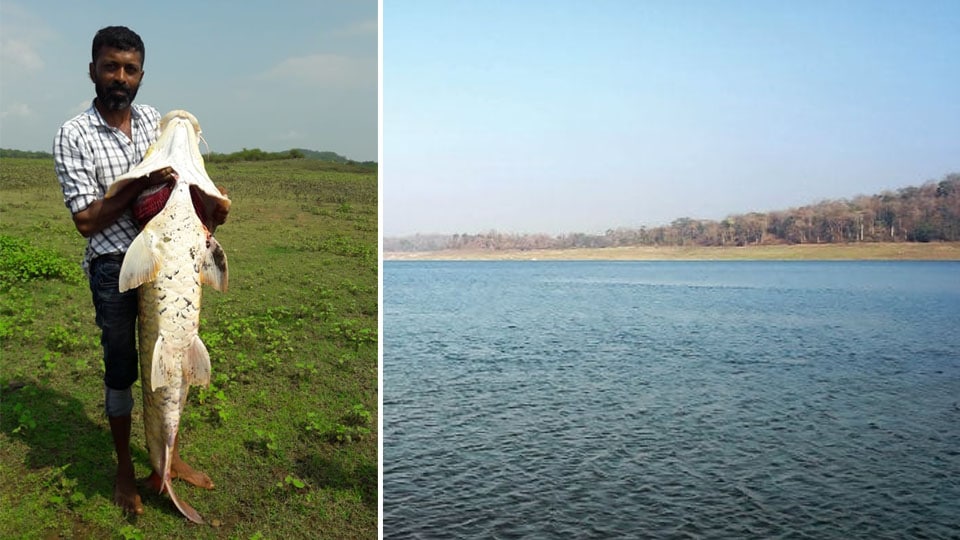
A group of youths who were fishing at Harangi backwaters in Kodagu District this morning were in for a pleasant surprise as they caught a giant fish that weighed 38 kgs. The fish was caught with the traditional method of fishing rod and angler.
The fish, Catla variety, was caught at Nakoor village along the Harangi backwaters by Preveesh, who then uploaded the same on his Facebook page. He said that though he was hoping for a good catch he did not expect this big a catch. Earlier too he had caught giant Catlas but this particular fish was his biggest catch. Today’s fish was sold at the local market.
Due to lockdown and lack of activities, there is a lot of fishing going on in the Harangi backwaters where youths come in many groups to fish. Typically, the fishing activity starts early in the morning and ends at around 11 pm. Local villagers from Nakoor, Shirangala, Suntikoppa, Hosathota, Kusboor and Madapura come to the backwaters to fish on the 5.6 km Harangi River stretch from the Harangi Dam to Koodige Bridge.
Traditional fishing is being held from many years in the backwaters of Harangi, which spreads over 1,886 hectares in area. Lakhs of fingerlings are released into the reservoir every year.
Some innovative villagers have even dug up irrigation ponds in the backwaters to supply water in summer to their fields. When the water storage is high at the Harangi Reservoir, these irrigation ponds get filled and submerge and when the water at the dam recedes, these ponds are full of water and fish.
Varieties of fish, including Mahseer, Catla and Rohu are released to Harangi every year and along with these, fingerlings procured from Kabini and Bhadra reservoirs are being provided to farmers at subsidised costs. Many families in this belt depend on fishing for their livelihood.
source: http://www.starofmysore.com / Star of Mysore / Home> News . April 29th, 2020
Quantum Physics deals with the behaviour of subatomic particles and is arguably the most complex branch of Theoretical Physics. I do not profess to understand this highly abstract subject but know that classical laws of Physics fail at quantum levels.
It boggles the mind when told that a subatomic particle exists simultaneously at two different spots. One location could be on your table and the other on the surface of Jupiter!
English Physicist Paul Dirac theoretically proved way back in 1930s that fundamental particles known as fermions should have a counterpart somewhere in the universe with an opposite charge – known as anti-particle.
Complicated. Difficult to fathom. I fail to comprehend. Based on this theory it is theoretically possible to have ‘teleportation’ that are portrayed in science fiction movies and books.
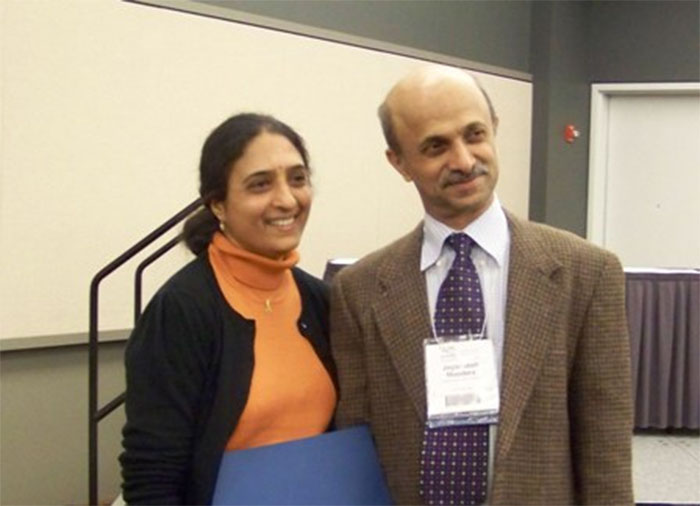
Coorg-born Physicist Dr. Jagadeesh S. Moodera has been a scientist at Massachusetts Institute of Technology (MIT) since 1981. He has several path-breaking research papers to his credit. My wife and I had the good fortune of a guided tour of his laboratory at MIT during our visit to Boston to attend the Kodava Convention-2019, in September last year.
Dr. Jagadeesh explained the intricacies of the experiments that he and his team were involved in. It was fascinating to see a huge setup with myriad tubes, probes, cables and instruments in order to create a 100% vacuum in a space of about 2 cubic centimetres.
Part of the experiment was conducted in this small space which was absolutely contamination free. There was another setup equally complicated where a space was created for the experiment which was free of any kind of vibration – not even that created by the traffic in the streets distance away, or footsteps of students in the nearby corridors. In addition, this space is cooled to -273 degree centigrade (that’s as close as one could get to -273.15 degree centigrade which is absolute zero). The experiments were conducted under these ideal conditions and usually between 10 pm and 6 am when chances of vibration were the least.
The experiment Dr. Jagadeesh and his colleagues have been working on since 2012 was to discover what Italian Theoretical Physicist Eltore Majorana, extending on Paul Dirac’s theory, had postulated in 1937 that there should be some subatomic particles that are indistinguishable from their anti-particle.
Scientists have been looking for these particles named Majorana fermions. Many theories have emerged over the years. Theoretical Physicists at MIT and elsewhere predicted that Majorana fermions may exist on solids such as gold under certain conditions. Dr. Jagadeesh and his team were on a mission to discover the existence of the elusive Majorana fermion.
The experiment, extremely complicated, needed many long hours in the laboratory. Dr. Jagadeesh explained how the delicate research was carried out at nano-particle level and observed through Scanning Tunneling Microscope (STM). STM is capable of ‘feeling’ the presence of atoms and molecules. 3mm x 3mm was the size of the surface on which the experiment was carried out, consisting of nano-wires of gold, grown on superconducting material: Vanadium.
MIT News dated 10th April 2020 has announced the successful sighting of the mysterious Majorana fermion by Dr. Jagadeesh Moodera and team. This is a major breakthrough. In Dr. Jagadeesh’s words ‘We have shown they are there, and stable, and easily scalable.’ Please visit webpage: http://news.mit.edu/2020/first-majorana-fermion-metal-quantum-computing-0410
The finding that Majorana fermions are scalable and could be made into qubits (individual computational units) is spectacular. These qubits could be used to build the most powerful and error free quantum computers. This will be a step closer to the phenomenon known as Singularity, which predicts that by the year 2042 AD there will be computers that will have computing power of all the human brains put together!
Once Singularity is achieved, humans need not invent anything further. Solutions to the most complex problems will be arrived at within seconds. If we had these computers today, a remedy for the current Covid-19 would have been found in a jiffy!
Dr. Jagadeesh’s wife Dr. Geetha Berera is a senior lecturer in MIT and we had an opportunity to visit her laboratory as well. The couple are totally dedicated to academics and research. Every year they visit Coorg and conduct a Quiz programme for school students. They are in the process of starting a school in Coorg under their organisation – CREATE Gurukula Trust – focusing on encouraging young minds in research activities. Meritorious students at Coorg Institute of Technology (CIT) are recipients of annual scholarships and awards instituted by Dr. Jagadeesh and Dr. Geetha. Dr. Jagadeesh and Dr. Geetha are eminent role models for young Kodavas to emulate.
source: http://www.starofmysore.com / Star of Mysore / Home> Feature Articles / by C.P. Belliappa / May 04th, 2020
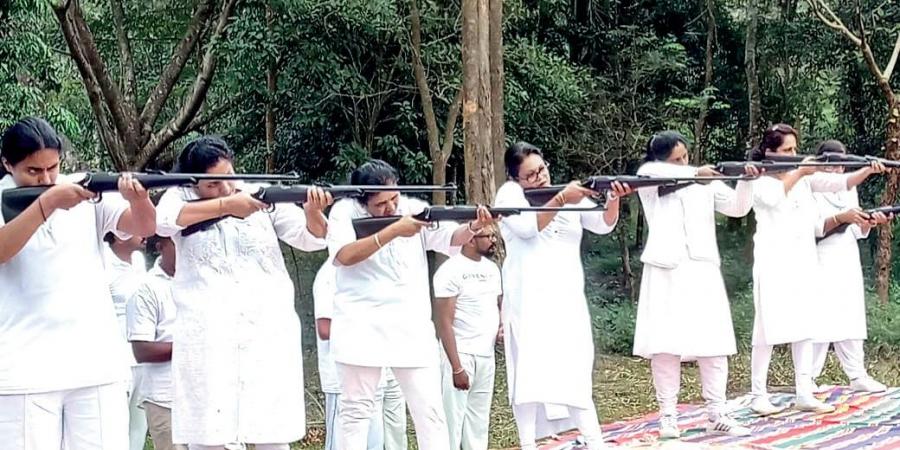
The participants of the training programme were given certification from the police and winners in the shooting event were presented prizes. Women take part in a gun training event in Gonikoppal. (Photo | EPS)
Madikeri :
Every morning for the past five days, a handful of women from South Kodagu had set aside their usual kitchenware in favour of licenced firearms with the aim of becoming expert shooters.
In a land where owning a gun is part of the tradition, taking a break from their daily routine to learn the use of firearms is a small price to pay. It also gives women good self-defence capabilities.
The women who underwent the training needed no coaxing. Proudly dressed in all whites and wearing sneakers, they used to rush to the Cauvery College Grounds in Gonikoppal where they learned to load guns, aim and fire at targets.
The shooting training was organised by the Gonikoppal police and over 60 residents from across South Kodagu took part in the programme. Among the trainees were eight women who have become amateur shooters after the training.
“Gun is worshipped in Kodava culture and it is a cliché to say that shooting is in the blood of Kodavas. However, the men are usually trained in this skill and it is only recently that girls are being trained in this tradition. Nevertheless, when opportunity knocks on the door, you don’t deny it,” said Bharati Bopanna, a resident of Ponnampet, who attended the training programme and won the third place in the shooting competition.
When Bharati heard that the police are training residents in shooting, she registered herself for the programme. “Women, especially married ones, are not used to much physical exercise. And the training programme stressed on physical fitness.
Apart from that, during traditional festivals, women are given loaded guns to perform ritualistic shooting. While I had tried my hands on shooting, I never really knew to load the rifle. After this training, I need not depend on anyone to load a gun.”
The participants of the training programme were given certification from the police and winners in the shooting event were presented prizes.
source: http://www.newindianexpress.com / The New Indian Express / Home> States> Karnataka / by Express News Services / December 30th, 2020
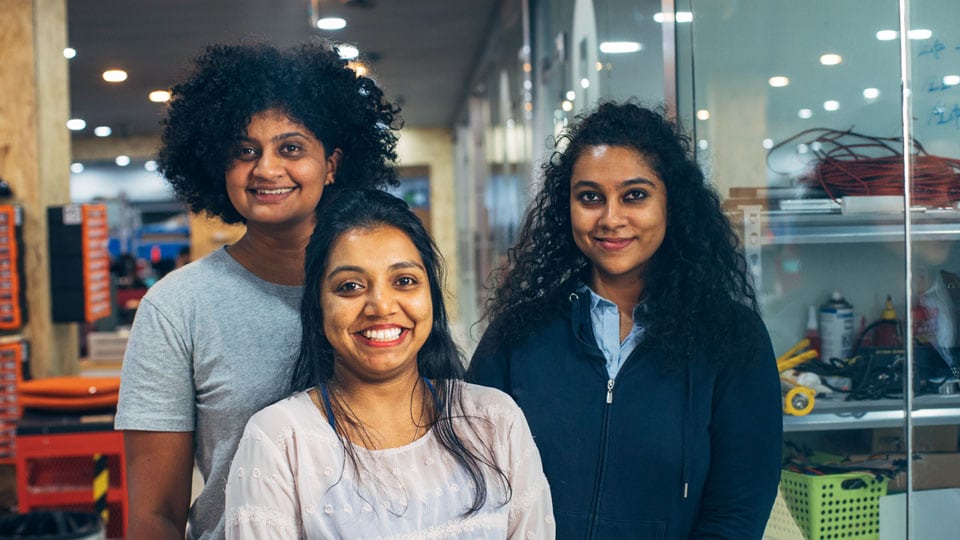
(from left) Sanchi Poovaya, Ranjana Nair and Aardra Kannan Ambili)
Mysore/Mysuru:
Unique among many medical solutions offered to combat COVID-19 is the new breathing monitor for Coronavirus patients developed by a Bengaluru-based start-up RayIoT and it is a matter of pride that a Kodagu-born and Mysuru-educated innovator is behind the device.
She is Ammanichanda Sanchi Poovaya, a young but experienced engineer, innovator and entrepreneur. She co-founded healthcare start-up RayIoT Solutions Inc. and is the Chief Operating Officer of the start-up that has already made a mark in innovative healthcare products.
Her start-up creates innovative healthcare and baby-tech products using Artificial Intelligence (AI) and Internet-of-Things (IoT) technologies. Very recently, Sanchi Poovaya and her other two co-founders Aardra Kannan Ambili (Chief Technology Officer) and Ranjana Nair (Co-founder and CEO) built a remote respiration monitoring system for COVID-19 patients that allows doctors to remotely monitor less critical patients while seriously ill ones get more attention.
Connected workflow sends alerts to the doctor in case of any abnormal variations in the patient’s vitals. With the high effectiveness of using respiration rate as a predictive vital, early detection especially among at-risk caregivers is a possibility.
“It is a non-contact, Wi-Fi enabled, affordable respiration rate monitor for Coronavirus patients that can run as mini ICU units. In its current form, RayIoT will work as a mini ICU monitoring unit. The algorithms of Artificial Intelligence will allow doctors and other health professionals to track the respiration rate of multiple patients through an app from anywhere in the world,” Sanchi Poovaya said.
In a pandemic like COVID-19 where doctors are falling ill with excessive patient inflow, and the management of quarantined patients have become difficult, the device wirelessly tracks patient’s respiration rate, heart rate, blood pressure and temperature.
Since all the devices can be connected to one central database, using RayIoT, healthcare professionals can monitor more than one lakh patients at a time continuously. By just tracking respiration rate, they will be able to intelligently categorise quarantined patients into mild, severe, and critical cases, she said.
“The idea of a remote respiration monitoring system came to us when a celebrity, who was converting his 14-room sprawling bungalow into a quarantine facility, reached out to us. His problem was remote access to doctors, nurses and medical equipment to fully equip his quarantine facility.”
The team had to come up with a low-cost solution that could monitor the vitals of hundreds of patients at any given point of time and connect to doctors through video when the patients are moving into a severe or critical stage. “The solution also helped Government Task Forces who are monitoring huge swathes of population by providing them a single source of truth with our quarantine database,” Sanchi reveals.
RayIoT has been created by same team that is behind Raybaby (the world’s first non-contact sleep and breathing monitor for babies. This product has won many awards and was mentioned in CNN as one of the must have home gadgets.
Ammanichanda Sanchi Poovaya completed her schooling at Good Shepherd, Ammathi in Kodagu, and JSS Public School, Mysuru. She completed her Mechanical Engineering at the National Institute of Engineering (NIE), Mysuru and MS in Mechanical Engineering from Cornell University, New York.
Sanchi Poovaya is the daughter of Ammanichanda Sunil Poovaya (ex-Merchant Navy) and Shiela Poovaya (Pattada, Betoli). They live in Hosur, Bengaluru.
source: http://www.starofmysore.com / Star of Mysore / Home> Covid News / April 26th, 2020
WELCOME. If you like what you see "SUBSCRIBE via EMAIL" to receive FREE regular UPDATES.
Read More »