Category Archives: Amazing Feats

She sips, swirls and spits: Meet Asia’s only woman coffee taster

What would life be without spicy food, ice-creams, perfumes, fragrant flowers, late-night parties and alcohol? Ask Sunalini Menon, who swears by this regimen.

No, she’s not a health freak or someone prone to allergies. She’s been practising abstinence for the sake of her passion, which is also her profession.

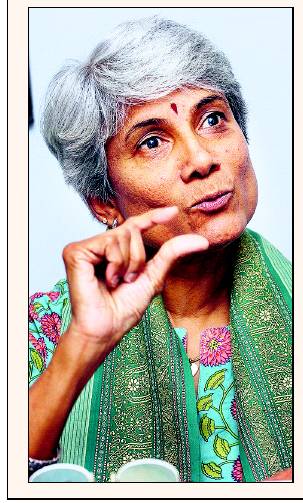
Asia’s first and only woman professional in the field of coffee cupping (tasting), Sunalini has experienced the aroma of several thousands of coffee types and spent a considerable time in the fields. “I love ice-creams and soft drinks but they affect my taste buds. My profession requires them to be extremely sensitive. So, I steer clear of cold food items or beverages,” she said. The chief executive of Coffeelab, one of India’s largest coffee exporters, Sunalini spoke to TOI on the ocassion of Coffee Santhe, a three-day carnival hosted by Karnataka Chitrakala Parishath.

Restraint and discipline are core attributes of a good coffee cupper. “It is essential to preserve the palate, the instrument vital for coffee tasting. We’re advised to avoid spicy food. Alcohol and smoking are a strict no no. Late nights and poor health can be a hindrance to the job,” she explained.

Coffee cuppers have to perform regular tongue exercises not only to keep their taste buds active but also to pick up foreign flavours. “Cupping with experts from other parts of the world helps calibrate one’s potential and understand the coffee produce of other countries. One also needs to perceive through the eyes, nose and palate of other cuppers,” she said.
SunaliniMenonKF26sept2015

Habituated to taking a sip and playfully swirling the liquid in her mouth before spitting, Sunalini said her job doesn’t allow her to swallow the coffee, however aromatic and delicious it be. “Coffee can have the distinct enzymatic flavours of apples, apricots, peaches and berries; sugar-browning flavours of chocolate, caramel, honey or those of spices like clove and pepper. It is an inborn acuity of taste, knowledge, experience, memory and good communication skills which help the cupper differentiate one flavour from another,” she said.

Sunalini, who entered the male bastion decades ago, said her journey hasn’t been easy. “I wasn’t lucky enough to be handheld when learning the tricks of the trade. I had to learn on my own, especially the chemistry of the coffee bean. It took a long time for me to be accepted into the fold, but once there, you are in,” she said.

Cupping as a Career

There are certifications for coffee tasters issued by the Specialty Coffee Association of America (SCAA) and Specialty Coffee Association of Europe (SCAE). The SCAA issues two types of certificates. One is called the Licensed ‘Q’ grader and the other, the Licensed ‘R’ grader. The ‘Q’ grader licence is a certificate for proficiency in evaluating arabica coffees and the ‘R’ grader for proficiency in evaluating robusta coffees,” said Sunalini.

She admitted that coffee tasting as a career could have some limitations.

“To overcome them, one needs to perhaps complement tasting with other jobs such growing, roasting or marketing coffee,” she said.Coffee tasting is more of a passion; it may not help you financially, especially in the first 10 or 12 years. Credibility comes only through knowledge and experience,” Sunalini signed off.

source: http://www.timesofindia.indiatimes.com / The Times of India / News Home> City> Bengaluru / by Sreemoyee Chatterjee, TNN / September 26th, 2015
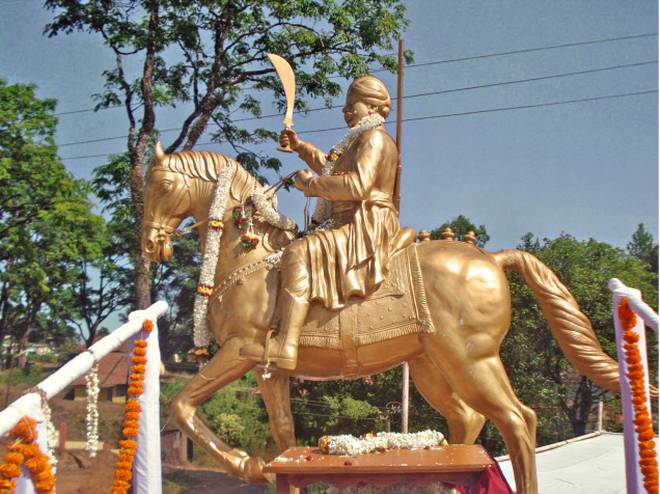
A memorial in honour of Appaiah Gowda

The bronze statue of freedom fighter Guddemane Appaiah Gowda, which was unveiled in Madikeri on Monday.

He was hanged by the British in Madikeri on October 31, 1837

Chief Minister D.V. Sadananda Gowda said on Monday that his government would take steps to initiate the process of development in Kodagu, a land known for its warriors, freedom fighters and natural landscape.

He was addressing a gathering at the Gandhi Maidan here after unveiling a bronze statue of Guddemane Appaiah Gowda at Field Marshal K.M. Cariappa Circle.

Appaiah Gowda was a freedom fighter, who was hanged by the British on charges of sedition on the fort premises here on October 31, 1837.

Mr. Sadananda Gowda’s wife Dotty hailed from Guddemane family. She was also present.

The Chief Minister said that he had taken nearly six months to visit Kodagu as he was being pressured by Madikeri MLA M.P. Appachu Ranjan and Speaker of the Legislative Assembly K.G. Bopaiah to take steps to solve the vexed Jamma Bane issue in Kodagu before the visit.

Responding to the demands made by Mr. Ranjan and M.C. Nanaiah, MLC, Mr. Gowda said that he would take steps to include a proposal to set up a medical college in Kodagu in the next budget.

A sum of Rs. 322 crore had been spent on various development projects such as roads, bridges, and buildings in Kodagu in the past few years. A sum of Rs. 115 crore would be sanctioned to the district in 2011-12, he said.

On considering Mr. Ranjan for inclusion in the next Cabinet expansion, Mr. Gowda said how could he deny it when he himself was the Chief Minister and he was versed with the requirements of Kodagu. All 122 MLAs from the BJP were capable of becoming Ministers, but it was not possible owing to restrictions.

Mr. Gowda, who conducted a progress review meeting involving officers of various departments at the Sudarshan Guesthouse, took exception to the tardy progress in the execution of projects under the Mahatma Gandhi National Rural Employment Guarantee Act (MGNREGA) in Kodagu. He instructed the officials to speed up work on the projects.

Of the 3,850 projects planned under the scheme in Kodagu, only 508 had been completed, according to officials.

Expressing dissatisfaction over the implementation of drinking water projects in the district, Mr. Gowda directed the officials to complete them in a month.

Of the 235 projects, only 22 had been completed in the current year, the officials stated.

Of the Rs. 8.5 crore earmarked for drinking water schemes in Kodagu in the current year, only Rs. 3.75 crore had been spent. Mr. Gowda announced that he would take the issue of lack of progress in the execution of projects in six departments seriously.

Mr. Gowda and Air Marshal K.C. Cariappa (retd.), son of Field Marshal K.M. Cariappa, paid respects to Field Marshal Cariappa’s statue.

source: http://www.thehindu.com / The Hindu / Home> National> Karnataka / by Jeevan Chinnappa / Madikeri – January 03rd, 2012 (updated July 25th, 2016)

Let Kodagu’s Rain Soaked Greens Refresh You

Bengaluru :

With rains drenching the hilly, wooded landscape of the Kodavas, it is time to visit the Kodagu district in Karnataka, the birthplace of the mighty Cauvery.

Originating at Talacauvery, the Cauvery gently flows from the Western Ghats and in the process, traces a long journey of 800 kilometers in the South-Eastern direction and empties in the Bay of Bengal. With monsoon gaining vigour once again, the coffee land especially during the months of July and August, is at its best. It is a sublime experience to visit Madikeri and surrounding areas that are home to many a waterfall.

As these are located in dense jungles, one has to trek and walk a few kilometers to take a peek at silver cascades in both the Brahmagiri and Pushpagiri hill ranges. Both these hill ranges are home to many waterfalls but the Mallali Falls near Somwarpete and Irupu near Virajpete, attract many tourists before, during and after the monsoons.

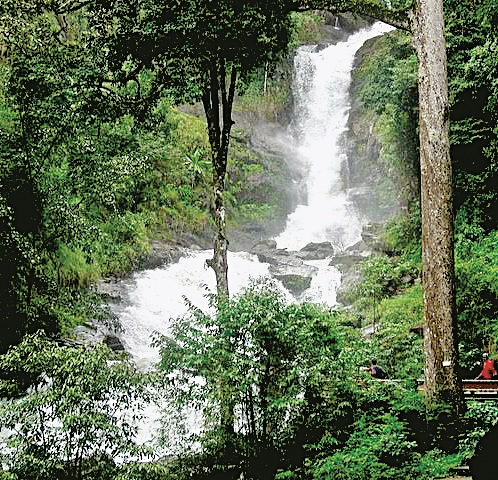
A fresh water cascade, the Irupu comes to life during the heavy downpour that is so common in these hilly ranges. This (also called the Lakshman Tirtha Falls) is situated on the highway to Nagarhole and just 20 kilometers away from the National Park. One has to walk at least half a mile to reach this place which is in the midst of a forest and far away from the cacophony of urban life.

WaterfallsKF30jul2015

Enjoying the sounds of the serene hill ranges and the gushing foamy waters, one can relax and forget all about urban stress. The roaring sound of the falls can be heard from a distance as one walks on the rocky twisting pathway with the chirping birds and the lush forests for company.
The pristine scenery resonates with the chirping of birds one has never heard before. The falls criss-crossing the hills and the forests tumble down from a height of just 150-200 feet while the spray of the gushing waters during monsoons is so intense that one can get easily wet. However, it is not safe to venture into the waters as the currents are strong. If you planned a visit before the monsoons, you can stand literally below the falls and get a soothing shower.

But do not miss visiting during the monsoons as Irupa falls from a cliff in all its mesmerising glory. If you are interested in visiting the nearby temple, you can take a peek as legends associate it with the visit of Ram and Lakshman when they were searching for Sita.

There are good spots to relax and enjoy, clean, wholesome vegetarian food but make it a point to place your orders in advance if you are visiting this place in a group. If you are carrying food and drinks, do not litter the place with plastic debris as it is a fragile ecology and home to many birds and animals.

Just two to three hours drive from Madikeri, one has to take the Virajpete route to reach this breathtaking place where the waterfall plunges from the Brahmagiri peaks in all its beauty and finally joins the Lakshman Teertha River. Since it is a very popular tourist spot, the place is easily accessible via tarred roads, concrete steps, viewing seats and affordable lodging and boarding facilities in and around the densely wooded ranges.

source: http://www.newindianexpress.com / The New Indian Express / Home> Cities> Bengaluru / by Meera Bharadwaj / July 30th, 2015

More on General K.S. Thimayya

MORE ON GENERAL K.S. THIMAYYA

Sir,

A few readers have written about General K.S. Thimayya in these columns with reference to your Abracadabra dated May 28. May I add further to some already written.

In 1957, Gen. Thimayya became COAS (Chief of Army Staff) superseding two of his seniors. V.K. Krishna Menon was the Defence Minister, had made a name in UN and other international forums, with high calibre and intelligence. Thimayya’s tiff with Menon was not personal. Whenever Menon visited Army units and interacted with Jawans (soldiers), he used to ask pointed questions on their grouse against any of their officers. It is something not liked by the senior officers who were accompanying the Defence Minister.

It was a question of discipline in the Army. Gen. Thimayya sent his resignation letter to Prime Minister; the rumour was that the other Chiefs were to follow if the resignation was accepted. Prime Minister Nehru tactfully handled the situation; General withdrew the resignation.

Gen. Thimayya wanted to write a book about his experiences in war fronts but the Government did not permit as he was in the service. Thimayya happened to meet one American writer Humpry Evans, who stayed with the General for sometime, made notes and got it published in US. The book “Thimayya of India” having a glossy wrapper on the cover with an impressive photograph of the General reviewing a Guard of Honour presented to him at West Point ( US Academy to train Defence officers).

Though he retired in 1961, his services were requisitioned directly by UN, to head a Peace Keeping Force at Cyprus — a small Island in Mediterranean, off the coast of Turkey and Greek, which had won Independence under Archbishop Makarios from Britain. However, it had to face a civil war between Greek Cypriot and Turkish Cypriot (mostly Muslims). Gen. Thimayya as head of the Peace Keeping Force did very well in separating the warring factions and brought peace.

Gen. Thimayya died in Nicosia (Cyprus) in Dec.1965. His body was brought to Bangalore; his wife and only daughter were there. Last rites were performed and the body was buried with all military honours and 17 gun salute. The Government of Cyprus honoured him by issuing a commemorative stamp and naming a street after him.

Gen. Thimayya was an alumnus of the Bishop Cotton Boys School, Bangalore. The alumni of the school celebrate “Gen. Thimayya Day” every year by arranging lectures by senior Army Officers and other dignitaries.

— Capt. (Retd.) A.K.Char / V.V.Mohalla, 28.6.2015

source: http://www.starofmysore.com / Star of Mysore / Home> Voice of the Reader / Sunday – July 05th, 2015

Madikeri Farmer Eyes Record With 41-ft Cane

Madikeri :

B Hoovaiah is a happy man. A stalk of sugarcane grown by Hoovaiah in Madikeri is all set to enter the Guinness Records as the tallest in the world. The earlier record, set in 2001, was held by Venkatesh Gowda of Kolar.

Hoovaiah, a BSNL tower operator in Convent Junction in Madikeri, has been protecting the cane for three years now. All the required inspections have been completed by expert committees and a team from Guinness is expected to arrive shortly, before an official announcement can be made.

Hoovaiah told Express that an expert team inspected the stalk and measured it at 41.1 feet.

He then formally approached the Guinness authorities, asking them to consider it for a world record.

Later, he received an acknowledgement from Guinness records in-charge, Era Norroy.

Hoovaiah, who served in the Indian Army for 26 years, lives at Bettathoor in Madikeri taluk and has served as a tower operator for 11 years.

He expressed happiness that the cane had been grown organically.

source: http://www.newindianexpress.com / The New Indian Express / home> States> Karnataka / by B C Dinesh / July 10th, 2014

BCIL launches Global Rainforest Research initiative in Coorg, Karnataka

BCIL has signed up with the Centre for Rainforest Ecology [CRE] for a collaborative platform that will be created at Zed Acres in the lush Kopatti valley of Coorg, a 20-minute drive from Madikeri.
zedacres-coorgKF29Jan2014
This rainforest patch of BCIL is over 70 acres with 4 mountains, and two perennial, roaring streams that form part of the campus. The rich flora and fauna at Zed Acres marks the rare tertiary stage succession rainforest that Zed Acres is. The Company had acquired this land in 1997 only because of its receiving 24 feet of annual rainfall, or over 7200 mm.

The CRE, headed by Gowrishankar, a core environmentalist, is a rare organisation dedicated entirely to training experts on high-end ecology and rainforest programme at the Post Masters levels for specialized professionals in biology, taxonomy, herpetology, ornithology and other upper reaches of scientific research. Says BCIL’s Dinesh, who created the collaboration, “As an environmentalist myself, I have worked with the Whitaker farm and Romulus Whitaker and his son for many years. Gowrishankar is a fine researcher who will know how to guide the highest values on such biodiversity research at Zed Acres.”

Dinesh envisages the further populating of Zed Acres with a very responsible, and eco-conscious, tourism initiative that will host extremely discerning nature-lovers at the tastefully designed set of chalets that Zed Acres will launch early next year. Plans are afoot for completion of the facilities that will offer a truly out-of-the-world, deep-ecology experience of this rainforest patch.

source: http://www.zed.in / ZED / Home> ZED Updates

Tributes paid to war hero Devayya

Virajpet MLA K.G. Bopaiah and others offering floral tributes to the portrait of Ajjamada Devayya at the Circle named after him in Madikeri on Saturday.

Rich tributes were paid to late Squadron Leader Ajjamada B. Devayya, a Kodava hero who showed exemplary courage to shoot down a Pakistani Supersonic F104 aircraft in the 1965 war under adverse conditions, at the Circle named after him at the private bus stand in Madikeri on Saturday. Sq. Ldr. Devayya carried out the attack on this day in 1965 to lay down his life for the nation.

Garland

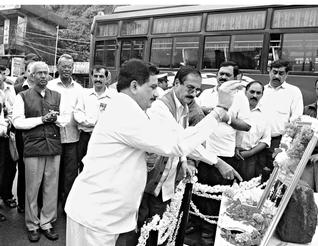
Virajpet MLA K.G. Bopaiah, Ajjamada family members, officials, and guests garlanded the portrait of Devayya in the morning to remember the heroics of the war veteran with Mr. Bopaiah promising to find a suitable location to set up a statue in the city in honour of Devayya for upholding military traditions of Kodagu.

Sq. Ldr. Devayya was born on 24 Dec 1932. He was the only one among the members of the strike force who sacrificed his life for the nation after carrying out the task of attacking the Sargodha airfield in Pakistan on September 7, 1965.

This was revealed in a book written by English journalist John Fricker, after he was party to the description of an episode by the then Flight Lieutenant, Amjad Hussain, of Pakistan.

The private bus-stand circle in Madikeri was named after the war hero on September 7, 2009.

Sq. Ldr. Devayya was conferred with the Maha Vir Chakra for his illustrious service to the nation posthumously which was received by his wife Sundari from the President of India.

Delay

Though the State government sanctioned Rs. 5 lakh for setting up a statue of Devayya, the project was being delayed over a court order, he said. Efforts were on to talk to Bal Bhavan authorities to secure land to set up the statue of Devayya, he said. Deputy Commissioner Anurag Tewari, Ajjamada family members Karumbaiah, Katti Mandaiah, ex-servicemen, officials of Department of Sainik and Resettlement Board, Madikeri, were present.

source: http://www.thehindu.com / The Hindu / Home> National> Karnataka / by Special Correspondent / Madikeri – September 08th, 2013

1st Soliga KAS does his tribe proud

Bangalore :

Ravi Ramaiah is on cusp of setting a record by becoming the first KAS officer from the Soliga tribes. But to his misfortune, this 28-year-old, selected to be a Class I officer in 2011, is yet to receive his appointment order. The reason: the recruitment process has been kept in abeyance because 25 of the 362 successful candidates were found to have indulged in malpractices.

But Ravi, who hails from a hamlet near Nagarahole in Mysore district, has not given up hope. Working as a police constable in Mysore’s Jayalakshmipuram police station, Ravi began dreaming of becoming a bureaucrat after his primary school teacher Suresh and lecturer Rudrappa felt he could achieve more.

“They encouraged me to take the KSPC exams. I cleared both exams and the interview in my first attempt. I used to study at least eight hours a day,” Ravi said. He scored 956 marks out of 1,800 in the Mains exam and 150 out of 200 in the interview.

“The imbroglio over appointments has ruined my dreams,” Ravi says.

Coming out with flying colours in the face of adversity is not new to Ravi. “I did my primary education at a government school in Beeranahalli, walking alone 3 km from and to my house in the jungle. These lonely treks made me decide to be a self-made man. Jungle made me a brave and bold man,” he says.

Ravi’s father, Ramaiah, studied till class III, while mother Jayamma never went to school. “He is a born naturalist. He can smell the air and predict rain two days in advance,” Ravi says of his father. His eldest brother is an SSLC dropout, while the second brother completed his II PUC.

Ravi’s teacher Suresh took him to Hunsur and got him admitted to a government high school.

source: http://www.articles.timesofindia.indiatimes.com / The Times of India / Home> City> Bangalore> Government School / by Rajiv Kalkod, TNN / November 28th, 2013

On eve of Arjuna award ceremony, Joshna Chinappa wants boost for squash

Joshna Chinappa will receive the Arjuna award today, a recognition that has come after a long wait for the Chennai squash player.

The 25-year-old became the first Indian girl to win the prestigious British Junior under-19 title in 2003 and followed it up with a gold at the South Asian Federation Games gold in 2004.

Joshna Chinappa
Joshna Chinappa

Chinappa, currently ranked 27 in the world, spoke to MiD DAY on what the Arjuna award means to her and other aspects of the sport.

Excerpts:

What does the Arjuna award mean to you?
It means a lot to me. This is one of my biggest achievements. I have been recognised by the government and the feeling is special.

With you and Deepika Pallikal being the only two faces in Indian squash, what will it take for more of your kind to emerge?
Hopefully, there will be more kids taking up squash after us and pursuing it as a career. But for that, there has to be better structure to develop squash and reach out to all sections of people in different parts of the country. There is a need for good coaches, facilities, conducting tournaments all over the country and helping kids financially to play international as well as national tournaments.

How has the progress of you and Deepika changed the popularity of the sport in the past few years?
I think more people are aware of squash because of what Saurav Ghosal, Deepika Pallikal, Siddharth Suchde, Harinder Sandhu and myself have been doing on the international circuit. There have been some international events that have helped in bringing more recognition to the sport. Squash has grown a lot in Chennai, but needs to develop more in other parts of the country.

What needs to be done to give the sport a boost? It is restricted to cities and has not entered rural areas…
Squash is still a club-level sport in many cities and not everyone can afford a membership to play. We need to develop courts that are easily accessible at the grassroots level. Courts have to be built with the help of the central and state governments along with the federation. Also, a program to develop squash in particular areas. Hopefully, with a good plan, corporates will come on board to support squash and then we can see more kids
taking up the sport.

Since squash has been short-listed now for the Olympics, how difficult will it be for the federation to convince the International Olympic Committee for the final spot?
Squash being short-listed is amazing and hopefully, we can make it to the Olympics as it deserves to. But we are competing with wrestling which has a better chance of getting back in. I’m just hoping for the best.

source: http://www.mid-day.com / Mid Day / Home> Sports / by Sundari Iyer / Mumbai – August 31st, 2013

Permission to sell Kodagu’s Jamma lands could lead to ecological disaster

The tiny hill district of Kodagu (Coorg) in Karnataka is facing an ecological disaster with the President of India giving his assent to a controversial legislation which allows the disposal and sale of Jamma lands in Kodagu located in the fragile Western Ghats. It is feared that the resultant denudation of the forests in the region could trigger an environmental damage with unpredictable consequences.

The repercussions of the legislation — The Karnataka Land Revenue (Third Amendment), Act, 2011, which received Presidential assent early this year after the bill was referred to the President by the Karnataka governor last year, will not only be severe on the Western Ghats region, considered as one of world’s bio-diversity hotspots, but will also take its toll on the customary laws, traditions and culture of the indigenous communities.

Jamma land tenure is unique to Kodagu district and it is estimated that the extent of ‘Jamma Baane’ land in Kodagu is around 2.55 lakh acres in possession of the local people — Kodavas, Amma-Kodavas, Heggades, Airis, Koyavas, Moplas and Gaudas. Jamma lands consist of wetland for growing paddy and the accompanying Baane land, initially used for cattle grazing and held free of assessment, now converted into coffee estates.

According to Sir J B Lyall, a British expert on tenures in Coorg who traced the origin of Jamma, it was originally a military tenure held on payment of half the assessment in consideration of military service. Jamma was granted under ‘sanads’ largely by the Coorg Rajas (1600 AD to 1834 AD) and to a smaller extent by the British till 1895 to the local inhabitants.

Hitherto, there was a ban on the sale of Jamma lands as the cultivator was only a ‘deemed owner’. The new legislation will confer the title of ‘occupant owner’ and allows the sale of land. The legislation, it is feared, will legitimise large scale denudation of trees and the formation of human settlements on Jamma Bane lands as there will be heavy influx of population from the neighbouring states. The presence of increased human habitation will have its impact on the adjoining forest land, its flora and fauna.

For generations, the life of the local communities, centered around the cultivation of the Jamma lands, the principal tenure in Kodagu. The Jamma lands could not be alienated as there was no provision for transferring the title of the property. The ownership was jointly held by the clan and it was managed by the head of the clan (Pattedara).

The issue went before the Karnataka high court and a full bench of the court held in its judgement delivered in October, 1993 that Jamma Baane landholders had limited privileges for cattle grazing, supply of firewood and timber for the domestic and agriculture purposes, but had no right to exploit the trees for commercial purposes, unless the holder had paid full timber value to the government. The court also held that the land-owner had no right to the sub-soil.

Customs and traditions

Once the ban on the sale of Jamma lands is lifted, the indigenous communities will be removed from their traditional Jamma holdings which formed the basis of their customs and traditions. The ‘ain-mane’ or the ancestral houses of the clans, was the focal point of all festivities and religious usages. It is feared that once the Jamma lands are sold to outsiders, the new land owners could lay claim to the ‘ain-manes,’ considered sacred to the local communities. This could lead to social tensions and law and order problem.

The biggest threat will come from the real estate mafia who were eyeing the Jamma lands all these years. With tourism boom in Kodagu, the local communities will be under pressure to sell their lands as the state will not have any control over them. It is learnt that already Jamma lands are being sold in anticipation of the new law taking effect.

The amendment to the Jamma tenure was effected during the previous BJP regime. The amendment was politically motivated and passed in haste without much debate in the Legislative Assembly, reportedly at the instance of the then Speaker K G Bopaiah who wanted to take political advantage. One of the reasons for Bopaiah’s re-election from the Virajpet constituency was on account of the political mileage he gained by getting the amendment passed.

The new amendment will create more problems than it hopes to solve. Those who drafted the amendment bill have failed to recognise the fact that apart from Jamma Baane lands, there are other types of Baanes — ‘Hithlu’ and ‘Sagu Baane’ lands.
Advocate K Sarojini Muthanna, who is knowledgeable on Jamma tenure matters, has suggested that the government should carry out further amendments to the Karnataka Land Revenue Act, 1964, devoting a separate chapter for the Jamma lands of Kodagu. The main support for the amendment has come from Akhila Kodava Samaja, representing a small section of the Kodavas. The president of the Samaja, Mathanda C Monnappa, opined that the amendment removed ‘irritants’ by way of government circulars which gave the impression that the land belonged to the government.

A large section of people, however, feel that in the interest of preserving the culture of Kodagu, and maintaining the ecological balance in the Western Ghats, the Siddaramaiah government should not give effect to the amendment to the Jamma land tenure.

source: http://www.deccanherald.com / Deccan Herald / Home> Panorama / by P T Bopanna / July 24th, 2013