Kodandera Madappa Cariappa is a man known for many firsts, but he is best remembered as the legend who made the Indian Army truly Indian. Perhaps this is why people feel the time has come to honour the late Field Marshal with the ‘Bharat Ratna.’
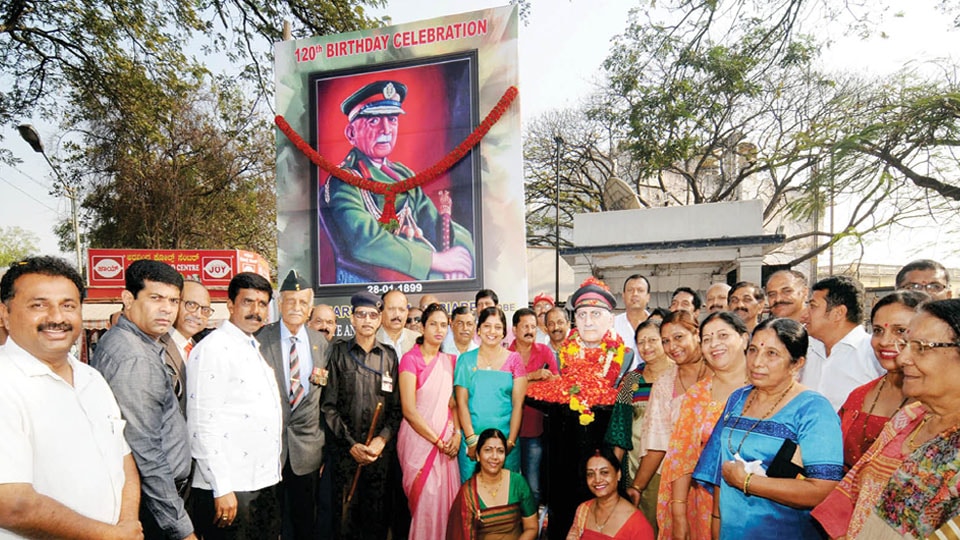
This morning too, the demand for ‘Bharat Ratna’ was raised by Mysureans on the occasion of 120th birth anniversary celebrations of Field Marshal K.M. Cariappa. The event was marked by showering of flower petals on the bust and garlanding of a huge portrait of the late Commander-in-Chief of the Armed Forces at Field Marshal K.M. Cariappa Circle (Hotel Metropole Circle) on JLB Road.
Speaking on the occasion, former Mayor M.J. Ravikumar said that when he was the Mayor a few years ago, he took measures for installation of Cariappa’s bust at the Circle following a demand from Kodava Samaja.
Stating that both Field Marshal K.M. Cariappa and Siddaganga Seer late Dr. Sri Shivakumara Swamiji very much deserved ‘Bharat Ratna,’ he said that the Union Government must consider this demand of the people.
Former Vice-President of Mysuru Kodava Samaja Cultural and Sports Club N.M. Thimmaiah said that he had written to the MCC and the Government demanding the installation of a life-size statue of the great warrior at the Circle in city. Recalling the achievements of Cariappa as Army Chief, he said Cariappa deserved ‘Bharat Ratna’ for his courage, bravery and valour.
Maj. Gen. C.K. Karumbaya (retd.), Corporators Prameela and M.U. Subbaiah, former Mayor H.N. Srikantaiah, Kodava Samaja Vice-President Prof. K.C. Belliappa, Secretary M.M Ponnappa, Cultural and Sports Club President M.P. Nanaiah and others were present.
source: http://www.starofmysore.com / Star of Mysore / Home> News / January 28th, 2019
In Coorg, regional cuisines bear the imprint of a long-gone era.
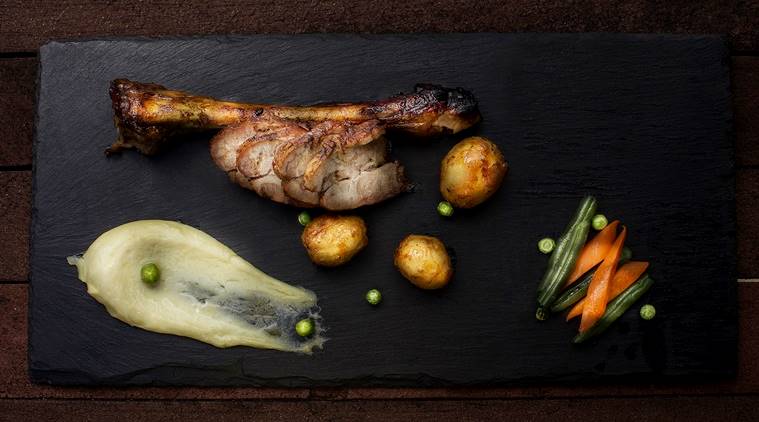
A whiff of the raj: Roast lamb.
I’m not a fan of Anglo-Indian cooking (nor of the omnipresent curry powder that got dunked into its gloopy, bland sauces). Yet, the diverse ways in which English tastes combined with regional ingredients and cooking styles across India during the Raj continue to fascinate me.
On a recent visit to Coorg, I found myself wondering what it must have been like for the British sahibs and memsahibs as they found themselves amidst the seclusion of its forested hills. Watching the mists drift across the plantations of Siddapur in south Coorg, Karnataka, I tried to imagine how these foreigners recreated a taste of British cities and shires in this isolated station, where estates were often 20 to 30 miles apart.
Gazatteer of Coorg, first published in 1870, notes that following the opening of Mercara Estate in 1854 by one Mr Fowler, the first European planter, dozens of extensive estates sprang up in Coorg within a short time. “Here seemed to have been discovered the Eldorado of honest industry in a delightful climate and home-like country,” it notes.
Yet “home-like country” it wasn’t. As the British initiated the planting of coffee in a big way in Coorg, Hassan and Chikmagalur, they were confronted by brutal heat, unfamiliar customs, frightening wild animals, blood-sucking leeches and a lengthy monsoon that could stretch up to six months.
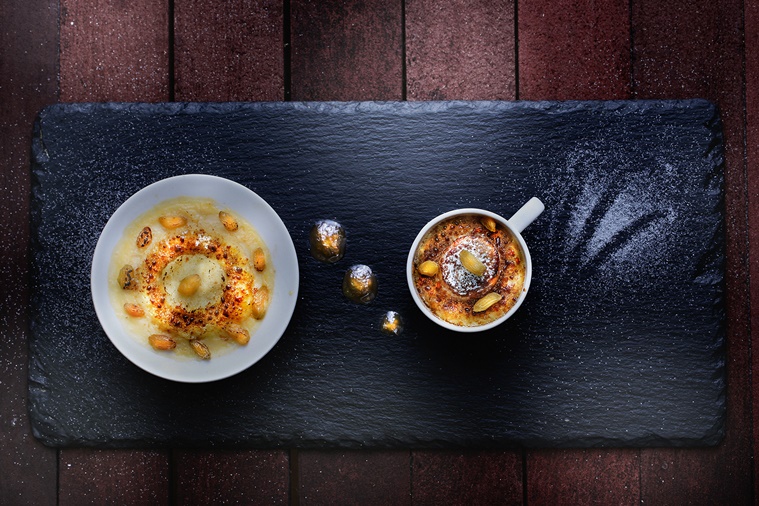
Bread pudding at the Evolve Back Chikkana Halli Estate in Siddapur.
But the interplay between diverse people, larders and culinary traditions led to the development of a distinct culture on the plantations. A lively snapshot of the time appears in Cathleen Ballantyne’s account of plantation life, Plenty Salaams, first published in 1954. Ballantyne arrived in Coorg during the 1880s for a visit and stayed with her husband George, a planter, for 50 years.
Describing the thrum of daily life, Ballantyne writes, “On a coffee estate, the day began early. At 6.30, one was wakened by the clanging of the estate bell, which summoned coolies to muster-roll before starting their day’s work…Then at 7, out on the verandah, chhota hazri — a substantial meal of porridge, eggs and bacon, coffee and fruit. For the dorai (the master), there came the morning round of the estate. For the wife, the walk, or ride, before engaging in the usual household routine, such as the ordering of meals, the weighing out of all the commodities required for the day, and, by using a lactometer, finding out that the milk had not been watered…”
Celebrations served to break the monotony and hardship of plantation life, and Ballantyne’s droll account is replete with instances of tomfoolery and merry-making during parties and picnics. My favourite is a description of a slapstick food fight at a picnic on the banks of Cauvery, where “rolls, potatoes, curry puffs and other eatables were flung about with great dexterity.” The beloved foods of the foreigners came out during these outings. Ballantyne mentions “lobster salad, chicken in aspic, cold saddle of mutton, curry puffs (pastry enclosing curried mince), an assortment of cold sweets”. Milk punch and whiskey flowed, heightening the attractions of these riotous, unending rounds of feasting.
Evolve Back Chikkana Halli Estate in Siddapur, my perch during this visit, has devoted some time to researching this slice of life. Over a meal of pepper water, mutton-ball curry, delicate coconut rice, and pan-roasted roast chicken, chef Naveen Alvares talked about the months of research that led to the planter’s menu currently served at their restaurant Peppercorn. Disappointed with their initial recces of Anglo-Indian restaurants in Bengaluru, Alvares and his team took the help of late Ranee Vijaya Kuttaiah, the author of the highly regarded Cuisine from Coorg, to master colonial-era planters’ dishes. The roast chicken, for instance, is a simple recipe that requires chicken to be marinated with salt, pepper and vinegar, caramelised with a little sugar and then cooked in its own juices in the pan.
No Anglo-Indians remain in Coorg today. In the absence of first-hand testimonies and experiences, reminiscence and nostalgia play a vital role in forming a clearer picture of life in those times. Vivian Rodrigues, whose family has owned coffee and pepper plantations in Pollibetta in Coorg and Saklespur in Hassan district for over a century, painted a vivid picture of the clubs that sprung up during the 19th century as places for the planters and their wives to relax and socialise. “The bar was the most important fixture in the club and the choicest single malts and gin were stocked. The cuisine was obviously British. Local cooks became butlers and were rechristened with British names that were easy to pronounce. We had an Anthony from Ooty who used to be Arokiaswamy!” he recounts.
Bridget White-Kumar, author of several books on Anglo-Indian cooking, says, “The British and Europeans in Coorg ate largely what they ate back home. Yet, over time, some regional influences came into their cuisine and they began eating rice with a curry made with minimal spices.” Various blends of curry powder were concocted, including Bolst’s hot curry powder, which became an instant rage.
Though locals never quite took to curry powder, they inherited an abiding love for baking from the British, and recipes of cakes dating back to the colonial times continue to be religiously followed in homes, clubs and bakeries. “It’s typical in Coorg to come home to a freshly baked cake in the evening,” says Muthu Bopanna, the owner of coffee plantations and a heritage homestay in Madikeri.
Roasts and barbecues are just as beloved. Vancouver-based blogger Shalini Nagappa cherishes her childhood memory of a Christmas spent feasting on roast turkey at her uncle’s farm near Kushalnagar. “What a moment of high excitement it was! And while it was not the exaggeratedly plump, meltingly tender, cartoon bird of my dreams, my uncle’s penchant for adding ‘more butter’, a la Julia Child made it divine,” she writes in her blog, A Cookery Year in Coorg.
After India gained independence in 1947, British planters sold their estates to Kodavas and other south Indians. The food served on these estates today tends to be a mix of traditional Kodava, Mangalorean, Bunt, Lingayat and Chettiar cuisine — depending on the ownership — and their personal eclectic influences.
Former journalist David Housego, writing about the cooking of the Raj, observed that in contrast to the Portuguese, who left a strong culinary footprint on the cuisine of former colonies like Goa, the British largely ignored the rich regional cuisines of India. As a result, no truly great hybrid dishes came out of this East-West encounter. This is evident in Coorg, where the local cuisine remains largely unaffected by British influence. Yet, one still gets a whiff of the time when the intermingling of British, Irish, European and Indian culinary accents created a unique Anglo-Indian aroma across the coffee estates, planters’ clubs and dak bungalows of Coorg.
This article appeared in print withe headline ‘Curry Puff Days’
source: http://www.indianexpress.com / The Indian Express / Home> Eye / by Sona Bahadur / January 20th, 2019
‘South Coorg of Roads’ team will organise an awareness rally ‘The Republic Ride’, a bike rally from Southern Kodagu to Northern Kodagu, on January 26.
The rally will cover 187-km area. The rally will be flagged-off near the General Thimmaiah and Field Marshal Cariappa statues at Kaveri College premises in Gonikoppa at 7 am. 20 bikes will take part in the rally.
The rally will progress through Piriyapattana, Kushalnagar, Somvarpet, Mallalli falls, Madikeri fort, Ammatti, Ontiyangadi and will culminate at Gonikoppa in the evening, stated a press release.
source: http://www.deccanherald.com / Deccan Herald / Home> State> Mangaluru / by Ashwani Kumar N K R / DH News Service, Madikeri / January 17th, 2019
The 3rd Edition of Mane Mane Kavigoshti – 2019 spearheaded by Akashavani-DD artiste and District Kannada Sahitya Sammelana-2017 President Monnanda Shobha Subbaiah will be held on Jan.20 at Ashoka Bhavan in Madikeri.
Interested may register their names by sending WhatsApp message to Mob: 94483-66715 or 94818-83194, according to a press release.
source: http://www.starofmysore.com / Star of Mysore / Home> In Briefs / January 17th, 2019
Gulshan Devaiah said that it kind of resonated well with me almost, like I felt like why didn’t I discover this earlier.
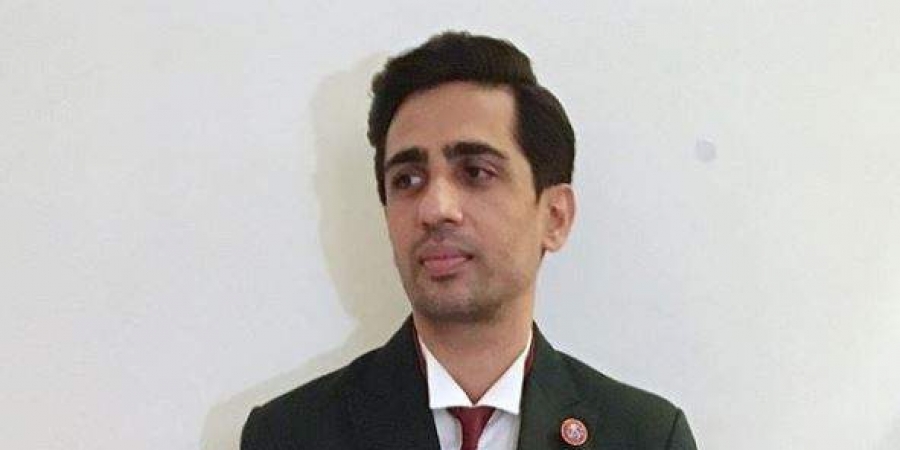
Bollywood actor Gulshan Devaiah (Photo | Gulshan Devaiah Instagram)
Mumbai :
Actor Gulshan Devaiah took up boxing and mixed martial arts (MMA) in real life after training for the film “Mard Ko Dard Nahi Hota”. He says he took it up because had begun to enjoy it a lot while training for the movie,
“There is a certain philosophy in fighting in the different martial arts and I think I started connecting with that and particularly what I enjoyed most of all the routines we did was boxing and after we finished filming and it was my wife said you should cornice doing MMA and that we both should do it together. I figured that’s a great idea because I has begun to enjoy it a lot while training,” Gulshan said in a statement.
He added that it “kind of resonated well with me almost, like I felt like why didn’t I discover this earlier”.
“Mard Ko Dard Nahi Hota” is directed by Vasan Bala and produced under the RSVP banner.
Gulshan plays a martial art expert in the movie, which is slated to release on March 15.
source: http://www.newindianexpress.com / The New Indian Express /’ Home> Entertainment> Hindi / by IANS / January 24th, 2019
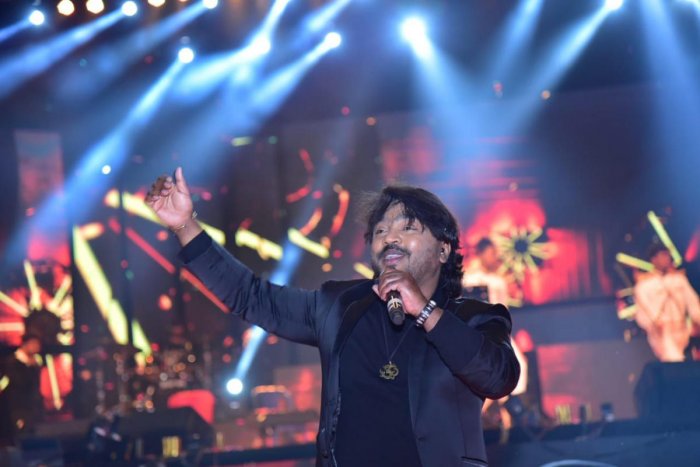
Music director Arjun Janya entertains the audience as apart of the Kodagu Pravasi Utsav 2019 at Gandhi Maidan in Madikeri.
The sizzling performances by top artistes from the film industry left the crowds spellbound during the cultural programmes organised on the concluding day of Kodagu Pravasi Utsav at Gandhi Maidan in Madikeri on Sunday night.
Music director Arjun Janya and troupe made the audience dance to the beat of popular numbers.
The musical extravaganza which began at 7 pm, went on till 10.30 pm. The venue was totally packed and many witnessed the programme by sitting on the hill situated on the right side of Gandhi Maidan.
Anuradha Bhat, Indu Nagaraj, Sanchit Hegde and Vyasaraj sang super-hit songs while Renuka Swamy created an artwork on the spot.
Plays and dances were organised by Karnataka Arebhashe Sahitya Academy.
source: http://www.deccanherald.com / Deccan Herald / Home> State> Mangaluru / by Adithya KA / DH News Service / Madikeri / January 14th, 2019
Lodges, resorts and homestays in the district saw 85 per cent occupancy on all three days.
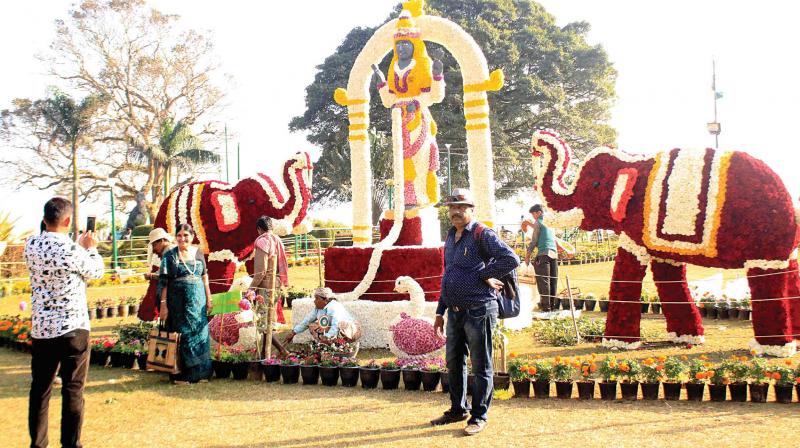
People at a flower show organised as part of Kodagu Pravasi Festival at Raja’s Seat in Madikeri. (KPN)
Madikeri:
The three-day Kodagu Pravasi Utsav, which ended here on Sunday, attracted a large number of people.
The event was held to revive tourism in Kodagu, the picturesque district which was devastated by floods and landslides in last August.
Lodges, resorts and homestays in the district saw 85 per cent occupancy on all three days. The Department of Tourism and the district administration organised the event for the first time to give flip to tourism.
“This event will go a long way in motivating the people who depend on tourism in Kodagu after the big tragedy in August last,” Kodagu district resorts, hotels and restaurants’ association head Nagendra Prasad said.
“Kodagu Pravasi Utsav should become an annual event henceforth,” P.K. Somaiah, a planter from Murnad near Madikeri, said.
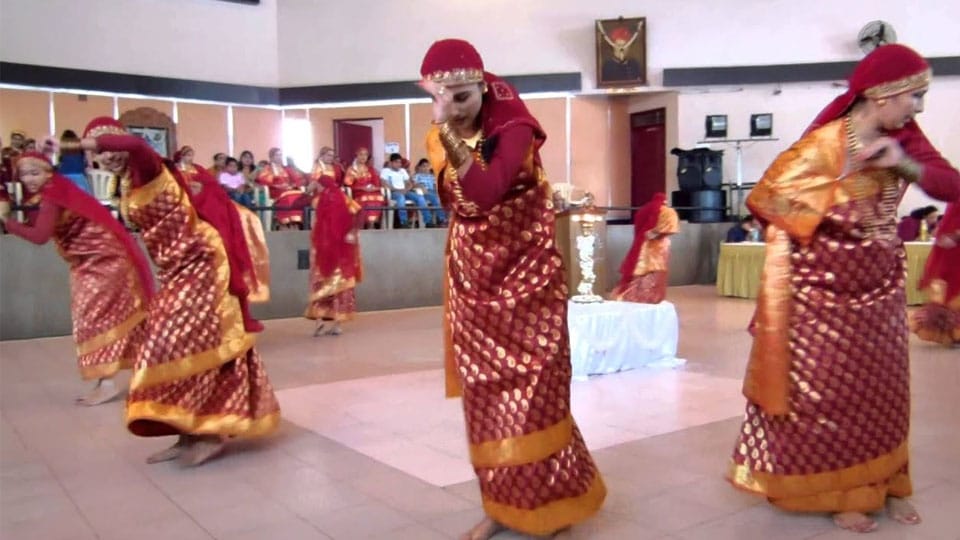
The day-long open street festival on the stretch between MM Circle and Raja Seat in Madikeri on Sunday attracted at least 30,000 people. The event, which began with yoga and zumba, had colourful cultural programmes. Folk artistes performed Chinese lion dance and “maragaalu kunitha”. The event also featured a magic show, live demonstration of pottery making and portrait painting. The venue had shops selling desi clothes, handicrafts and handlooms exhibitions, besides food stalls.
The three-day flower show hosted by the Horticulture Department at the Raja Seat had 15,000 species of plants.
source: http://www.deccanchronicle.com / Deccan Chronicle / Home> Nation> Current Affairs / by Shilpa P, Deccan Chronicle / January 14th, 2019
Shree Kaveri Kodagu Mahila Sangha has organised various cultural competitions like Dance, Drawing, Singing, Kodava Paat and Pick-and-Speak at Kodagu Sahakara Sangha in Jayalakshmipuram here on Jan.20 from 10.30 am.
Chendrimada Sushila Subramani will be the chief guest.
Moovera Bollamma Kuttappa, President, Shree Kaveri Kodagu Mahila Sangha, will be preside.
Sangha members and their children interested in taking part in the contests may contact Bollamma Kuttappa on Mob: 99012-39798 or Nirmala Subramani on Mob: 94487-53767 or Shanthi Kuttappa on Mob: 94498-29143, according to a press release.
source: http://www.starofmysore.com / Star of Mysore / Home> News / January 14th, 2019
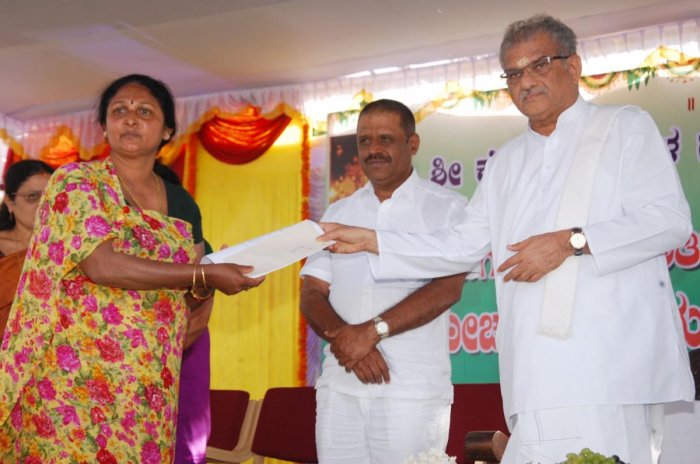
Dharmasthala Dharmadhikari D Veerendra Heggade hands over a cheque to a victim of natural calamity, as a part of the assistance programme under SKDRDP, in Madikeri on Thursday.
Dharmasthala Dharmadhikari D Veerendra Heggade launched a programme to assist flood victims through Sri Kshetra Dharmasthala Rural Development Project (SKDRDP) in Madikeri on Thursday.
He handed over cheques to those affected by the recent floods and natural calamities to assist the flood victims in rebuilding their lives.
Heggade urged the government to construct houses for the needy and to rebuild the infrastructure in Madikeri which was destroyed by flash floods and landslides.
“Loans up to Rs 450 crore have been released to Kodagu through IDBI bank. Monthly interest on the loans during the months when flood victims were rendered homeless and jobless was paid by the SKDRDP. There is a need to waive the interest during this period and bank officials should think and act in this regard,” stressed Heggade.
He said SKDRDP will encourage flood-affected women to become self-employed by providing training in the making of handicraft items and processed food among other measures.
SKDRDP executive director L H Manjunath said that every homeless and landless family will receive financial assistance of a maximum of Rs 65,000. The amount will be transferred to the bank accounts of 2,106 families within a week. A total amount of Rs 8 crore had been set aside. An amount of Rs 2 crore was also contributed to the Chief Minister’s Relief Fund, he added.
Veerendra Heggade visited the six flood-affected villages and listened to the woes of residents.
source: http://www.deccanherald.com / Deccan Herald / Home> State> Mangaluru / by Adithya K A / DH News Service, Madikeri / January 10th, 2019
The Codava National Council (CNC) has welcomed the state government’s move to restart the study on Kodava genealogy.
Speaking to reporters on Sunday, CNC President N U Nachappa said, “The study on genealogy is essential to preserve Kodava community. The study was halted in the past and has now been revived.”
The CNC had been demanding Kodava genealogy study for the last several years.
“The study should be completed at the earliest. In the past, the state government had entrusted the responsibility of the study to Karnataka State Tribal Research Institute, Mysuru, and the government had released Rs 11 lakh for the purpose.
However, owing to the conspiracy of a few, the study was stopped abruptly. Now, the study on genealogy has been revived once again,” added Nachappa.
source: http://www.deccanherald.com / Deccan Herald / Home> States> Mysuru / by Adithya K A / DH News Service, Madikeri / January 06th, 2019
WELCOME. If you like what you see "SUBSCRIBE via EMAIL" to receive FREE regular UPDATES.
Read More »